Questions · Page 1 of 2

[2 Mark Question Answer]

🎯

Test yourself on this topic

50 questions · timed · auto-graded

Question 12 Marks
What is the (a) force of gravity and (b) weight of a block of mass 10.5 kg ? Take $g =10 ms^{-2}$.
Answer
Mass, $m = 10.5 kg$
$G = 10 m/s^2$​​​​​​​
(a) Force, $F = mg$
$F = (10.5) (10) = 105 N$
(b) Weight, $w = mg$
$w = (10.5) (10) = 105 N$
View full question & answer
Question 22 Marks
What is the importance of law of gravitation ?
Answer
The gravitational force of attraction is significant to explain the motion of heavenly bodies, e.g. motion of planets around the Sun, motion of the Moon around the Earth etc.
View full question & answer
Question 32 Marks
A man weighs $600 N$ on the Earth. What would be his approximate weight on the Moon? Give a reason for your answer?
Answer
Man's weight on Earth $= 600 N$
Man's weight on the Moon $= (1/6)$ man's weight on Earth;
Because the acceleration due to gravity on the Moon is $1/6^{th}$​​​​​​​ that of Earth and w = mg.
Therefore, man's weight on Moon $= (600/6) = 100 N.$
View full question & answer
Question 42 Marks
The weight of a body on Earth is $98 N$ , where acceleration due to gravity is $9.8 m s ^{-2}$. What will be its $(a)$ mass and $(b)$ weight on the Moon, where acceleration due to gravity is $1.6 m s ^{-2} ?$
Answer
Weight of the body on Earth $=98 N$.
Acceleration due to gravity on Earth $=9.8 m / s ^2$.
Let ' $m$ ' be the mass of the body on Earth.
$m  =W / g$
$m  =(98 / 9.8)=10 kg$
Thus, the mass of the body is 10 kg , which always remains constant.
(a) Mass on moon = mass on Earth $=10 kg$
(b) Let weight on moon is $W ^{\prime}$.
$W ^{\prime}=$ mass $\times$ acceleration due to gravity on the Moon.
[Given, acceleration due to gravity on the Moon $=1.6 m / s ^2$ ]
$W' = 10 \times 1.6 =16 N.$
View full question & answer
Question 52 Marks
The weight of a body is 2.0 N . What is the mass of the body? $\left( g =10 m s ^{-2}\right)$
Answer
Weight, $W = 2.0 N$
$g = 9.8 m/s^2$​​​​​​​
Let 'm' be the mass of the body.
$W = mg$
Or,$ m = W/g = (2/9.8) kg = 0.2 kg.$
View full question & answer
Question 62 Marks
State the magnitude and direction of the force of gravity acting on the body of mass $5 \ kg$. Take $g = 9.8 m s^{-2}.$
Answer
Mass $= 5 kg.$
$g = 9.8 m/s^2.$
Let $F$ be the force of gravity,
$F = mg.$
$F = (5) (9.8) = 49 N.$
Force of gravity always acts downwards.
View full question & answer
Question 72 Marks
Calculate the weight of a body of mass $10 kg$ in (a) kgf and (b) newton. Take $g = 9.8 m s^{-2}.$
Answer
Mass = 10 kg
(i) Weight (in kgf) = 10 x 1 kgf = 10 kgf
$[1 kgf = 9.8 N]$
(ii) Weight (in newton) $= 10 x 9.8 = 98 N.$
View full question & answer
Question 82 Marks
Write an expression for the gravitational force of attraction between two bodies of masses $m_1$ and $m_2$​​​​​​​ separated by a distance r.
Answer
$F \propto \frac{ Gm _1 m _2}{ d ^2}$ Here G is a constant of proportionality called the universal gravitational constant.
View full question & answer
Question 92 Marks
Write the approximate weight of a body of mass $5 \ kg$. What assumption have you made?
Answer
Given: mass $= 5 kg$
Assumption made is value of acceleration due to gravity is $10 ms^{-2}$​​​​​​​
Weight $= mg$
$W = 5 \times 10$
$W = 50 N$
View full question & answer
Question 102 Marks

The value of g at the centre of Earth is zero. What will be the weight of a body of mass m kg at the centre of the Earth?

Answer
W = mg
At the centre of Earth, g = 0.
Therefore, W = 0.
View full question & answer
Question 112 Marks
A pebble is dropped freely in a well from its top. It takes 20 s for the pebble to reach the water surface in the well. Taking $g =10$ $m s ^{-2}$ and speed of sound $=330 m s ^{-1}$. Find : The depth of water surface
Answer
Time $t =20 s$
$g = 10 m/s^2$​​​​​​​
Let $'D$' be the depth of the well.
Using the second equation of motion,
$D = ut + (1/2) gt^2$
$D = 0 + (1/2)(10)(20)^2$
$D = 2000 m$
View full question & answer
Question 122 Marks

Distinguish between mass and weight.

Answer
Mass is a scalar quantity, but weight is a vector quantity. Mass is the measure of the quantity of matter contained in a body, but weight is the measure of force with which the Earth attracts the body. Mass of a body is always constant but weight varies from place to place.
View full question & answer
Question 132 Marks
Define the terms mass and weight.
Answer
Mass: The mass of a body is the quantity of matter it contains. Weight: The weight of a body is the force with which the Earth attracts it.
View full question & answer
Question 142 Marks
ball is thrown vertically upwards with an initial velocity of $49 m s ^{-1}$. Calculate: The time taken by it before it reaches the ground again. (Take $\left.g =9.8 m s ^{-2}\right)$.
Answer
Initial velocity, u = $49 m / s$
$
g =9.8 m / s ^2
$
Total time of flight is given by $t =2 u / g$
Or, $t =2(49) / 9.8$
Or, $t=10 s$
View full question & answer
Question 152 Marks
A body falls from the top of a building and reaches the ground $2.5 s$ later. How high is the building? (Take $g = 9.8 m s^{-2})$
Answer
Given time $t =2.5, g =9.8 m / s ^2$
Height, $H=(1 / 2) gt ^2$
Or, $H=(1 / 2)(9.8)(2.5)^2$
Or, $H =30.6 m$
View full question & answer
Question 162 Marks

A body is thrown vertically upwards with an initial velocity u. Write the expression for the maximum height attained by the body.

Answer
A body is thrown vertically upwards with an initial velocity $u$. Write the expression for the maximum height attained by the body.
$
v^2=u^2-2 g h
$
We - get,
$
h_{\max }=\frac{u^2}{2 g}
$
View full question & answer
Question 172 Marks

A body falls freely under gravity from rest and reaches the ground in time t. Write the expression for the height fallen by the body.

Answer
Initial velocity, $u =0$.
Time taken $= t$.
Acceleration due to gravity $= g$.
Let ' $h$ ' be the height fallen.
$
\begin{aligned}
& h = ut +\frac{1}{2} g t ^2 \\
& h =\frac{1}{2} g t ^2
\end{aligned}
$
View full question & answer
Question 182 Marks
What will be the velocity of the stone on reaching the ground? (Take $g=10 m s^{-2})$
Answer
Let ' $v$ ' be the velocity on reaching the ground.
Using the third equation of motion,
$
v^2-u^2=2 g H
$
or, $v^2-0=2(10)(80)$
or, $v^2=1600$
or, $v=40 m / s$
View full question & answer
Question 192 Marks
How long will a stone take to fall to the ground from the top of a building 80 m high
Answer
Height, $s=80 m$
$
g =10 m / s ^2
$
Using the second equation of motion,
$
S=u t+(1 / 2) g t^2
$
Or, $80=0+(1 / 2)(10)(t)^2$
Or, $( t )^2=16$
Or, $t=4 s$
View full question & answer
Question 202 Marks
A pebble is thrown vertically upwards with a speed of $20 m s ^{-1}$. How high will it be after 2 s ? (Take $\left.g =10 m s ^{-2}\right)$
Answer
Initial velocity, $u=20 m / s$
Time, $t =2 s$
$
g =10 m / s ^2
$
Maximum height reached in $2 s , H =(1 / 2) gt ^2$
Or, $H =(1 / 2)(10)(2)^2$
Or, $H =20 m$
View full question & answer
Question 212 Marks
An body is dropped from the top of a tower. It acquires a velocity $20 m s ^{-1}$ on reaching the ground. Calculate the height of the tower. (Take $g =10 m s ^{-2}$ )
Answer
Initial velocity $u =0$ Final velocity $=20 m / s g =10 m / s ^2$ Let ' $h$ ' be the height of the tower. Using the third equation of motion, $v ^2- u ^2=2 gs$ or, $(20)^2-0=2(10) h$ or, $h =20 m$
View full question & answer
Question 222 Marks
A ball is thrown vertically upwards. It goes to a height $20 m$ and then returns to the ground. Taking acceleration due to gravity g to be $10 ms^{-2}$, find:
the initial velocity of the ball
Answer
Given, maximum height reached, $s=20 m$ Acceleration due to gravity, $g=10 m / s ^2$ Let ' $u$ ' be the initial velocity.
At the highest point, velocity $=0$
Using the third equation of motion,
$v^2-u^2=2 g s$
or, $0-u^2=2(10)(20) m / s$
or, $u^2=-(400) m / s$ [Negative sign indicates that the motion is against gravity]
or, $u=20 m / s$
View full question & answer
Question 232 Marks
What force, in newton, your muscles need to apply to hold a mass of 5 kg in your hand? State the assumption.
Answer
Mass, $m=5 kg$
Force, $F = mg$
$
F =(5)(9.8)=49 N
$
Assumption: Value of acceleration due to gravity is $9.8 m / s ^2$
View full question & answer
Question 242 Marks
Write an expression for the force due to gravity on a body of mass m and explain the meaning of symbols used in it.
Answer
The force due to gravity on a body of mass m kept on the surface of Earth (mass=M and radius=R) is equal to the force of attraction between the Earth and that body. $F =\frac{ GMm }{ R ^2}$
View full question & answer
Question 252 Marks

To move a boat ahead in water, the boatman has to push the water backwards by his oar. Explain this statement.

Answer
To move a boat, the boatman pushes (action) the water backwards with his oar. In this response, the water exerts an equal and opposite force (reaction) in the forward direction on the boat due to which the boat moves ahead.
View full question & answer
Question 262 Marks
State Newton's third law of motion.
Answer
According to Newton's third law of motion, to every action there is always an equal and opposite reaction. The action and reaction act simultaneously on two different bodies.
View full question & answer
Question 272 Marks

Comment on the statement 'the sum of action and reaction on a body is zero'.

Answer
The given statement is wrong. Reason: According to Newton's third law of motion, the action and reaction act simultaneously on different bodies. Hence they do not cancel each other.
View full question & answer
Question 282 Marks
A light ball falling on ground, after striking the ground rises upwards. Explain the reason.
Answer
When a falling ball strikes the ground, it exerts a force on the ground. The ground exerts a force back at the ball in the opposite direction. This is the reason the ball rises upwards.
View full question & answer
Question 292 Marks
A force causes an acceleration of $10 m s ^{-2}$ in a body of mass $500 g$ . What acceleration will be caused by the same force in a body of mass $5 \ kg$ ?
Answer
Let the force be $F$.
Force $F$ causes an acceleration, $a =10 m / s ^2$ in a body of mass, $m =500 g$ or $0.5 kg$
Thus, $F = ma$
Or, $F=(0.5)(10)=5 N$
Let $a^{\prime}$ be the acceleration which force $F(=5 N )$ cause on a body of mass, $m ^{\prime}=5 kg$.
Then, $a ^{\prime}= F / m ^{\prime}$.
Or, $a ^{\prime \prime}=(5 / 5) ms ^{-2}$.
Or, $a ^{\prime}=1 ms ^{-2}$.
View full question & answer
Question 302 Marks
Write the mathematical form of Newton's second law of motion. State the conditions if any.
Answer
Mathematical expression of Newton's second law of motion is as shown below: Force = Mass × Acceleration Above relation holds for the following conditions: (i) When the velocity of the body is much smaller than the velocity of light. (ii) When the mass remains constant.
View full question & answer
Question 312 Marks
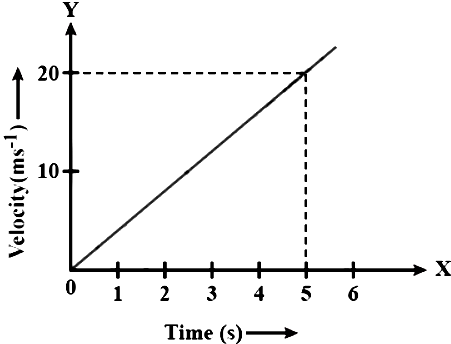
Figure shows the velocity-time graph of a particle of mass 100 g moving in a straight line. Calculate the force acting on the particle.
(Hint : Acceleration = Slope of the v-t graph)
Answer
Given mass, $m =100 g =0.1 kg$.
Slope of a velocity-time graph gives the value of acceleration.
$
\text { Acceleration }=\text { Slope }=\frac{20}{5}=4 m / s ^2 .
$
Force $=$ Mass $\times$ Acceleration.
Force $=0.1 \times 4=0.4 N$.
View full question & answer
Question 322 Marks
How does Newton's second law of motion differ from the first law of motion?
Answer
Newton's first law of motion gives the qualitative definition of force. It explains the force as the cause of acceleration only qualitatively but Newton's second law of motion gives the quantitative value of force. It states force as the product of mass and acceleration. Thus, it relates force to the measurable quantities such as acceleration and mass.
View full question & answer
Question 332 Marks
State the Newton's second law of motion. What information do you get from it?
Answer
According to Newton's second law of motion, the rate of change of momentum is directly proportional to the force applied on it and the change of momentum takes place in the direction in which the force is applied. It gives the quantitative value of force, i.e. it relates the force to the measurable quantities such as acceleration and mass.
View full question & answer
Question 342 Marks
A force acts for 10 s on a stationary body of mass 100 kg, after which the force ceases to act. The body moves through a distance of 100 m in the next 5 s. Calculate : The magnitude of the force
Answer
Mass, $m=100 kg$
Distance moved, $s =100 m$
Initial velocity, $u =0$
Force, $F = ma$
Or, $F =(100)$ (2) N.
Or, $F=200 N$.
View full question & answer
Question 352 Marks
A force acts for 10 s on a stationary body of mass 100 kg, after which the force ceases to act. The body moves through a distance of 100 m in the next 5 s. Calculate : The acceleration produced by the force
Answer
Mass, $m=100 kg$
Distance moved, $s =100 m$
Initial velocity, $u =0$
From Newton's third equation of motion,
$
v ^2- u ^2=2 as \text {. }
$
Or, $a=\left(v^2-u^2\right) / 2 s$.
Or, $a=\left[\left(20^2-0^2\right) / 2(100)\right] ms ^{-2}$.
Or, $a =2 ms ^{-2}$.
View full question & answer
Question 362 Marks
A force acts for $10 s$ on a stationary body of mass $100 kg$, after which the force ceases to act. The body moves through a distance of 100 m in the next $5 s$. Calculate : The velocity acquired by the body
Answer
Mass, $m = 100 kg$
Distance moved, $s = 100 m$
Initial velocity, $u = 0$
Because the body moves through a distance of $100 m$ in $5 s,$
Velocity of the body = Distance moved / time taken
Velocity $= (100/5) = 20 m/s^{-1}$​​​​​​​
View full question & answer
Question 372 Marks
Calculate the magnitude of force which when applied on a body of mass $0.5 kg$ produces an acceleration of $5 m s^{-2}.$
Answer
Mass, $m = 0.5 kg.$
Acceleration, $a = 5 ms^{-2}$​​​​​​​
Force, F = ma   [ From Newton's second law]
Or, $F = (0.5) (5) N = 2.5 N.$
View full question & answer
Question 382 Marks

A force of 10 N acts on a body of mass 5 kg. Find the acceleration produced.

Answer
Force, $F=10 N$
Mass, $m=5 kg$
Acceleration, $a = F / m$ [ From Newton's second law]
Or, $a=(10 / 5) ms ^{-2}$
Or, $a =2 ms ^{-2}$
View full question & answer
Question 392 Marks

A force of 15 N acts on a body of mass 2 kg. Calculate the acceleration produced.

Answer
Force, $F=15 N$
Mass, $m =2 kg$
Acceleration, $a= F / m$ [ From Newton's second law]
Or, $a=(15 / 2) ms ^{-2}$
Or, $a =7.5 ms ^{-2}$
View full question & answer
Question 402 Marks
The linear momentum of a ball of mass $50 \ g$ is $0.5 kg m s ^{-1}$. Find its velocity.
Answer
Linear momentum $=0.5 kg m / s$
Mass, $m =50 g =0.05 kg$
 Velocity = Linear momentum / mass 
$=0.5 / 0.05 m / s$
$=10 m / s ^{-1}$
View full question & answer
Question 412 Marks
A body of mass $5 \ kg$ is moving with velocity $2 m s^{-1}.$ Calculate its linear momentum.
Answer
Mass of the body, $m=5 kg$
Velocity, $v =2 m / s$
Linear momentum $=m v=(5)(2) kg m / s$
$=10 kg m / s ^{-1}$
View full question & answer
Question 422 Marks
Use Newton's second law of motion to explain the following instance :
An athlete prefers to land on sand instead of hard floor while taking a high jump .
Answer
When an athlete lands from a height on a hard floor, his feet comes to rest instantaneously, so a very large force is exerted by the floor on his feet, but if he lands on sand, his feet push the sand for some distance; therefore, the time duration in which his feet comes to rest increases. As a result, the force exerted on his feet decreases and he is saved from getting hurt.
View full question & answer
Question 432 Marks
Use Newton's second law of motion to explain the following instance :

A cricketer pulls his hands back while catching a fast moving cricket ball .

Answer
We pull our hands back while catching a fast moving cricket ball, because by doing so, we increase the time of catch, i.e. increase the time to bring about a given change in momentum, and hence, the rate of change of momentum decreases. Thus, a small force is exerted on our hands by the ball.
View full question & answer
Question 442 Marks
Why does a glass vessel break when it falls on a hard floor, but it does not break when it falls on a carpet?
Answer
When a glass vessel falls from a height on a hard floor, it comes to rest almost instantaneously, i.e. in a very short time, so the floor exerts a large force on the vessel and it breaks. However, if it falls on a carpet, then the time duration, in which the vessel comes to rest, increases, so the carpet exerts less force on the vessel and it does not break.
View full question & answer
Question 452 Marks
Name the $S.I$. and $C.G.S$. units of force. How are they related?
Answer
The S.I. unit of force is newton and the C.G.S. unit of force is dyne. $1 N=10^5$ dyne.
View full question & answer
Question 462 Marks
What is the C.G.S. unit of force? How is it defined?
Answer
The C.G.S. unit of force is dyne.
One dyne is the force which acts on a body of mass 1 gramme and produces an acceleration of $1 cms ^{-2}$, i.e. 1 dyne $=1 g \times 1 cms ^{-2}$.
View full question & answer
Question 472 Marks
Name the S.I. unit of force and define it .
Answer
The S.I. unit of force is newton.
One newton is the force which acts on a body of mass $1 kg$ and produces an acceleration of $1 m / s ^2$, i.e. $1 N =1 kg \times 1 m / s ^2$.
View full question & answer
Question 502 Marks
How can Newton's first law of motion be obtained from the second law of motion?
Answer
From Newton's second law of motion, F = ma. If F = 0, then a = 0. This means that if no force is applied on the body, its acceleration will be zero. If the body is at rest, then it will remain in the state of rest and if it is moving, then it will remain moving in the same direction with the same speed. Thus, a body not acted upon by an external force, does not change its state of rest or motion. This is the statement of Newton's first law of motion.
View full question & answer
[2 Mark Question Answer] - PHYSICS STD 9 Questions - Vidyadip