Question 15 Marks
How does the time period (T) of a simple pendulum depend on its length (l)? Draw a graph showing the variation of $T^2$ with l. How will you use this graph to determine the value of g (acceleration due to gravity)?
Answer
View full question & answer→The time period of a simple pendulum is directly proportional to the square root of its effective length.
$T \propto \sqrt{l}$
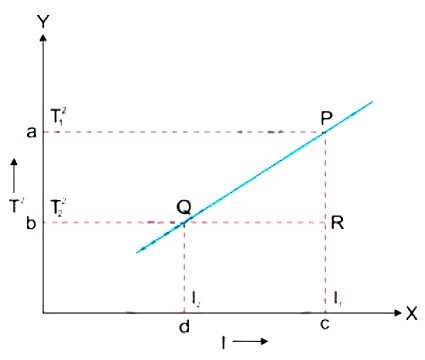
From this graph, the value of acceleration due to gravity ( $g$ ) can be calculated as follows.
The slope of the straight line can be found by taking two points $P$ and $Q$ on the straight line and drawing normals from these points on the $X$ - and $Y$-axis, respectively. Then, the value of T2 is to be noted at $a$ and $b$, the value of $I$ at $c$ and $d$. Then,
$\text { Slope }=\frac{ PR }{ QR }=\frac{ ab }{ cd }=\frac{T_1^2-T_2^2}{l_1-l_2}$
This slope is found to be constant at a place and is equal to $\frac{4 \pi^2}{ g }$, where $g$ is the acceleration due to gravity at that place. Thus, $g$ can be determined at a place from these measurements using the following relation:
$g =\frac{4 \pi^2}{\text { Slope of } T^2 Vs l \text { graph }}$
$T \propto \sqrt{l}$
From this graph, the value of acceleration due to gravity ( $g$ ) can be calculated as follows.
The slope of the straight line can be found by taking two points $P$ and $Q$ on the straight line and drawing normals from these points on the $X$ - and $Y$-axis, respectively. Then, the value of T2 is to be noted at $a$ and $b$, the value of $I$ at $c$ and $d$. Then,
$\text { Slope }=\frac{ PR }{ QR }=\frac{ ab }{ cd }=\frac{T_1^2-T_2^2}{l_1-l_2}$
This slope is found to be constant at a place and is equal to $\frac{4 \pi^2}{ g }$, where $g$ is the acceleration due to gravity at that place. Thus, $g$ can be determined at a place from these measurements using the following relation:
$g =\frac{4 \pi^2}{\text { Slope of } T^2 Vs l \text { graph }}$