Questions

[1 Mark Question Answer]

🎯

Test yourself on this topic

33 questions · timed · auto-graded

Question 11 Mark
Figure given below shows a velocity-time graph for a car starting from rest. The graph has three parts $AB, BC$ and $CD.$
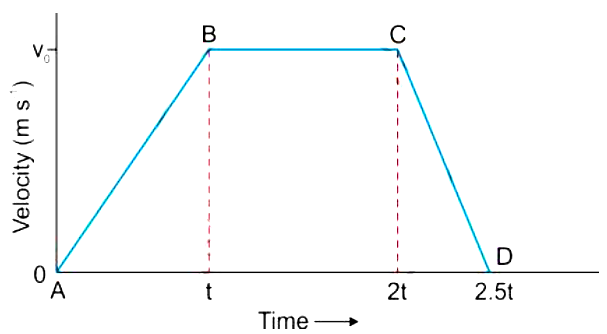
State how is the distance travelled in any part determined from this graph .
Answer
Distance travelled in any part of the graph can be determined by finding the area enclosed by the graph in that part with the time axis.
View full question & answer
Question 21 Mark
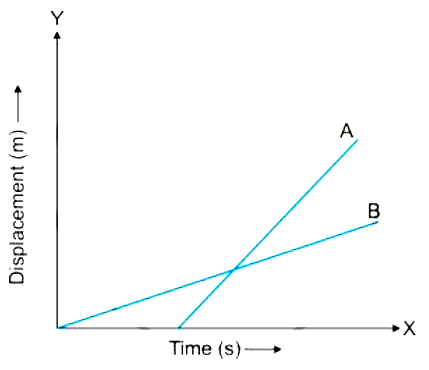
Figure shows the displacement-time graph of two vehicles $A$ and $B$ moving along a straight road. Which vehicle is moving faster? Give reason.
Answer
Vehicle A is moving with a faster speed because the slope of line $A$ is more than the slope of line $B.$
View full question & answer
Question 31 Mark
What can you say about the nature of motion of a body if its displacement-time graph is A curve.
Answer
It depicts that the body is moving with variable velocity.
View full question & answer
Question 41 Mark
What can you say about the nature of motion of a body if its displacement-time graph is A straight line inclined to the time axis with an obtuse angle?
Answer
It depicts that the body is moving towards the starting point with uniform velocity.
View full question & answer
Question 51 Mark
What can you say about the nature of motion of a body if its displacement-time graph is A straight line inclined to the time axis with an acute angle?
Answer
It depicts that the body is moving away from the starting point with uniform velocity.
View full question & answer
Question 61 Mark
What can you say about the nature of motion of a body if its displacement-time graph is A straight line parallel to the time axis?
Answer
There is no motion, the body is at rest.
View full question & answer
Question 71 Mark
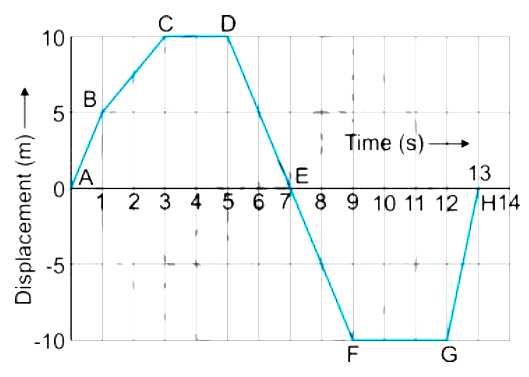
From the displacement-time graph of a cyclist given below in the Figure, find The time after which he reaches the starting point .
Answer
At $7\ s$ and $13\ s,$ the cyclist reaches his starting point.
View full question & answer
Question 81 Mark
State how the velocity-time graph can be used to find The displacement of the body in a given time.
Answer
The displacement of a body in a given time is given by the area enclosed between the velocity$-$time graph and $X-$axis $($with proper signs$).$
View full question & answer
Question 91 Mark
State how the velocity-time graph can be used to find The distance travelled by the body in a given time
Answer
The total distance travelled by a body in a given time is given by the area enclosed between the velocity-time graph and $X-$axis $($without any sign$).$
View full question & answer
Question 101 Mark
State how the velocity-time graph can be used to find
The acceleration of a body
Answer
The slope of the velocity-time graph gives the value of acceleration.
View full question & answer
Question 111 Mark
What does the slope of a displacement-time graph represent?
Answer
Slope of a displacement-time graph represents velocity.
View full question & answer
Question 121 Mark
For the motion with uniform velocity , how is the distance travelled related to the time ?
Answer
For the motion with uniform velocity, distance is directly proportional to time.
View full question & answer
Question 131 Mark
How is the distance related with time for motion under uniform acceleration such as the motion of a freely falling body?
Answer
For motion under uniform acceleration, such as the motion of a freely falling body, distance is directly proportion to the square of the time.
View full question & answer
Question 141 Mark
The velocity-time graph for a uniformly retarded body is a straight line inclined to the time axis with an obtuse angle. How is retardation calculated from the velocity-time graph?
Answer
retardation is calculated by finding the negative slope.
View full question & answer
Question 151 Mark
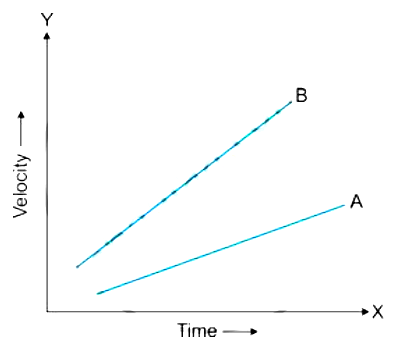
Figure shows the velocity-time graphs for two cars $A$ and $B$ moving in the same direction. Which car has greater acceleration? Give reasons to your answer.
Answer
Car $B$ has greater acceleration because the slope of line $B$ is more than the slope of line $A.$
View full question & answer
Question 161 Mark
What does the slope of velocity-time graph represent?
Answer
The slope of the velocity-time graph represents acceleration of the body.
View full question & answer
Question 171 Mark
When is the magnitude of displacement equal to the distance?
Answer
The magnitude of displacement is equal to distance if the motion of the body is one-dimensional.
View full question & answer
Question 181 Mark
A car moving on a straight path covers a distance of $1\ km$ due east in $100\ s.$ What is the speed of the car$?$
Answer
Speed of the car $=$ Distance/time taken
$=\frac{1 km }{100 s }=\frac{1000 m }{100 s }=10 m / s$
View full question & answer
Question 191 Mark
What do you mean by motion in one direction?
Answer
When a body moves along a straight line path, its motion is said to be one-dimensional motion.
View full question & answer
Question 201 Mark
Arrange the following speeds in increasing order. $10\ m s^{-1}, 1\ km \min^{-1}$ and $18\ km\ h^{-1}.$
Answer
$18\ km\ h^{-1} < 10\ m s^{-1} < 1\ km \min^{-1}$
View full question & answer
Question 211 Mark
When is a body said to be in motion?
Answer
A body is said to be in motion if it changes its position with respect to its immediate surroundings.
View full question & answer
Question 221 Mark
When is a body said to be at rest?
Answer
A body is said to be at rest if it does not change its position with respect to its immediate surroundings.
View full question & answer
Question 231 Mark
If a stone and a pencil are dropped simultaneously in vacuum from the top of a tower, then which of the two will reach the ground first? Give reason.
Answer
In vacuum, both will reach the ground simultaneously because acceleration due to gravity is same $(=g)$ on both objects.
View full question & answer
Question 241 Mark
'The value of $g$ remains the same at all places on the Earth's surface'. Is this statement true? Give reason for your answer.
Answer
No. The value of $'g'$ varies from place to place. It is maximum at poles and minimum at the Equator on the surface of the Earth.
View full question & answer
Question 251 Mark
Give one example of the following motion :
Uniform retardation
Answer
Example of uniform retardation: If a car moving with a velocity $'v'$ is brought to rest by applying brakes, then such a motion is an example of uniform retardation.
View full question & answer
Question 261 Mark
Give one example of following motion :
Variable acceleration
Answer
Example of variable acceleration: The motion of a vehicle on a crowded road is with variable acceleration.
View full question & answer
Question 271 Mark
Give one example of following motion :
Variable velocity
Answer
Example of variable velocity: A ball dropped from some height is an example of variable velocity.
View full question & answer
Question 281 Mark
Give one example of following motion : Uniform velocity
Answer
Example of uniform velocity : A body, once started, moves on a frictionless surface with uniform velocity.
View full question & answer
Question 291 Mark
Which of the quantity-velocity or acceleration-determines the direction of motion?
Answer
Velocity determines the direction of motion.
View full question & answer
Question 301 Mark
Distinguish between uniform velocity and variable velocity.
Answer
If a body travels equal distances in equal intervals of time along a particular direction, then the body is said to be moving with a uniform velocity. However, if a body travels unequal distances in a particular direction in equal intervals of time or it moves equal distances in equal intervals of time but its direction of motion does not remain same, then the velocity of the body is said to be variable $($or non-uniform$).$
View full question & answer
Question 311 Mark
When is instantaneous speed the same as the average speed?
Answer
Instantaneous velocity is equal to average velocity if the body is in uniform motion.
View full question & answer
Question 321 Mark
Which of the quantity-speed or velocity-gives the direction of motion of a body?
Answer
Velocity gives the direction of motion of the body.
View full question & answer
Question 331 Mark
Define speed. What is its $S.I.$ unit?
Answer
The speed of a body is the rate of change of distance with time. Its $SI$ unit is metre/second $(m/s).$
View full question & answer