Questions

[2 Mark Question Answer]

🎯

Test yourself on this topic

35 questions · timed · auto-graded

Question 12 Marks
A body starts to slide over a horizontal surface with an initial velocity of $0.5 ms^{-1}$. Due to friction, its velocity decreases at the rate of $0.05 ms^{-2}$. How much time will it take for the body to stop?
Answer
Initial velocity of body $u =0.5 ms^{-1}$.
Final velocity of the body $v =0 ms^{-1}$ as body comes to rest finally.
Retardation of body $=0.05 ms^{-2}$.
We know that $v = u + at$.
$0=0.5-0.05 t$
$T=0.5 / 0.05=10 sec .$
View full question & answer
Question 22 Marks
 A car moving with a uniform acceleration of $10 m / s ^2$ on a straight road changes its speed from $10 m / s$ to $30 m / s$. Find the time lapsed for the change of speed.
Answer
Acceleration of the car $=10 ms^{-2}$.
Initial velocity $u =10 m / s$.
Final velocity $v =30 m / s$.
We $v=u+a t$.
$T = (v- u)/a$
$T = (30 - 10 )/10 = 2 sec.$
Time taken by car is $2$ sec.
View full question & answer
Question 32 Marks
A body moves along a straight road with a speed of $20 m / s$ and has a uniform acceleration of $5 m / s ^2$. What will be its speed after $2$ s ?
Answer
Initial velocity $u = 20$ m/s.
Acceleration $= 5 m/s^2.$
$T = 2 s.$
We know $v= u + at.$
$v= 20 + 5X2= 30$ m/s.
View full question & answer
Question 42 Marks
A car is moving with a speed of $50$ km/h. One second later, its speed is $55$ km/h. What is its acceleration?
Answer
Initial speed of car $u=50 km / h$.
Final speed of car v $=55 km / h$.
Time taken by car to attain this speed is $=1 sec .=1 / 3600 hr$.
Acceleration of the car is $=(55-50) \times 3600=18000 kmh ^{-2}$.
View full question & answer
Question 52 Marks
A car accelerates uniformly from a velocity of $18$ km/h to $36$ km/h in $15$ min. What is its acceleration?
Answer
Initial velocity of car $u = 18$ km/hr.
Final velocity of car $v= 36$ km/hr.
Time taken by body $= 15 min. = 1/4 hr$
Acceleration of car $a = ( v- u )/t = (36 - 18 ) X 4 = 72 kmh^{-2}.$
View full question & answer
Question 82 Marks
What can you say about the motion of a body if:
Its time-velocity graph is a straight line
Answer
In velocity-time graph a straight line shows body is moving with uniform constant velocity if it is parallel to x axis and shows body is moving constant acceleration of it is inclined to x axis.
View full question & answer
Question 92 Marks
What can you say about the motion of a body if:
Its time-displacement graph is a straight line.
Answer
In displacement-time graph a straight line shows body is at rest if it is parallel to time axis and shows a body is moving with uniform velocity if it is inclined to x axis.
View full question & answer
Question 102 Marks
Which is greater?
(i) 36 km/hr
(ii) 8.5 m/s
Answer
36 km/ hr can be converted into m/ s to compare with 8.5m/ s.
36 km/ hr = {36 x 1000) / 3600 = 10 m/ s which is greater than
8.5 m/ s So 36 km/ hr is greater than 8.5 m/ s.
View full question & answer
Question 112 Marks
Convert 20 m/s into km/hr.
Answer
20m/s can be converted into km/hr as
20 m/s = $\frac{20 \times 3600}{1000}$ = 72 km/hr.
View full question & answer
Question 122 Marks
Which is greater?
(i) 60 km/hr
(ii) 15 m/s
Answer
60 km/hr can be converted into m/s to compare with 15m/s.
60 km/hr = (60 X 1000)/3600 = 16.66 m/s. so speed 60 km/hr is greater.
View full question & answer
Question 132 Marks
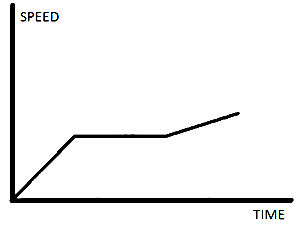
Draw the following graph:
Speed versus time for a non-uniform acceleration.
Answer

speed time graph for a non uniform acceleration.
View full question & answer
Question 142 Marks
Draw the following graph:
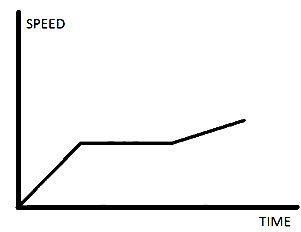
Speed versus time for a stepped motion
Answer

Speed time graph for a stepped motion
View full question & answer
Question 152 Marks
What can you conclude if the speed-time graph of a body is a curve moving upwards starting from the origin?
Answer
If speed time graph is moving upward then the body is accelerating and if it is starting from origin then it means the body has initial velocity =0.
View full question & answer
Question 162 Marks
A car travels at a uniform speed of 42 km/h. In 10 minutes, how much distance would it cover?
Answer
As we distance = speed X time.
Speed = 42 km/hr.
Time = 10 m = 1/6 hr.
Distance = 42 X 1/6 =7 km.
View full question & answer
Question 172 Marks
How will you use a speed-time graph to find whether the acceleration of the body is uniform or not?
Answer
A straight line curve on speed time graph indicates that acceleration of the body is uniform and a zigzag or curved line indicates that acceleration of a body is not uniform.
View full question & answer
Question 182 Marks
Give two examples of uniform circular motion from your daily life.
Answer
(i) Motion of blades of an electric fan.
(ii) Motion of moon around earth.
View full question & answer
Question 192 Marks
Distinguish between uniformly and non-uniformly accelerated motions.
Answer
A uniformly accelerated motion is one in which speed is constantly increasing or decreasing with time while a non uniform motion is one in which speed is not constantly changing with time.
View full question & answer
Question 202 Marks
Write down the three equations of motion.
Answer
First equation of motion is $v = u + at.$
Second equation of motion is $s= ut + 1/2a t^2.$
Third eqution of motion is $v^2 - u^2 =2as.$
View full question & answer
Question 212 Marks
What is meant by a constant velocity? Is it same as uniform velocity?
Answer
When the velocity of a moving body doesn't change with time then the velocity of the body is said to be constant or uniform.Yes uniform velocity and constant velocity are one and the same thing.
View full question & answer
Question 222 Marks
How does speed differ from velocity?
Answer
Speed is a scalar quantity whereas velocity is a vector quantity. So speed doesn't have its direction and velocity has a particular direction.
View full question & answer
Question 232 Marks
A body goes from P to Q with a uniform speed of u and immediately returns back to P at a uniform speed of v. what is the average velocity for the whole journey?
Answer
As body goes from P to Q and then return back to P so the displacement of the body would be zero and hence average velocity would also be zero.
View full question & answer
Question 242 Marks
A book is lying in an almirah. Is it at rest or in motion?
Answer
If a book is lying in almirah then it is at rest.
View full question & answer
Question 252 Marks
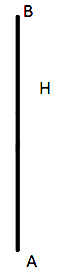
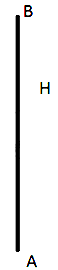
An object is thrown vertically upwards. It rises upto a height H and then returns to its initial position. Calculate
The displacement of the object.
Answer

Total displacement =0 as starting and ending points are coinciding.
View full question & answer
Question 262 Marks
An object is thrown vertically upwards. It rises upto a height H and then returns to its initial position. Calculate
The total distance traveled by the object
Answer

Total dist ance travelled = dist ance from A to B +distance from B to A
So total distance = H +H = 2H.
View full question & answer
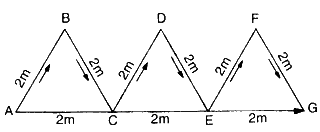
Question 272 Marks
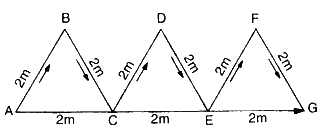
Calculate the distance and displacement in the following case:
Answer

Distance is 2+2+2+2+2+2=12m while displacement is 2+2+2=6m.
View full question & answer
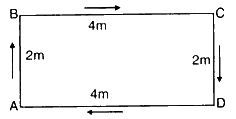
Question 282 Marks
Calculate the distance and displacement in the following case:
Answer

Distance is 2+4+2+4=12m while displacement is 0m.
View full question & answer
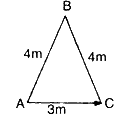
Question 292 Marks
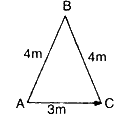
Calculate the distance and displacement in the following case:
Answer

Distance is 4+4=8 m while displacement is 3m.
View full question & answer
Question 302 Marks
Write two differences between distance and displacement.
Answer
(i) Distance is a scalar quantity whereas displacement is a vector quantity.
(ii) Distance is always positive but displacement can be negative,zero or positive.
View full question & answer
Question 312 Marks
Show the difference between distance and displacement with the help of a diagram.
Answer

In this case Distance travelled = half of the parameter of circle.
So distacne travelled is = πr
Displacement = diameter of circle.
So displacement is 2r
View full question & answer
Question 322 Marks
What do you mean by the distance traveled by a body?
Answer
The actual length of the path covered by a moving object irrespective of its direction of motion is called the distance travelled by the object.
View full question & answer
Question 342 Marks
Represent the location of an object described as at $15 m, 45^{\circ}$ west of north, on a graph paper.
View full question & answer
Question 352 Marks
You are at rest as well as in motion. Justify the statement giving your point of view.
Answer
Yes we are at rest as well as motion because we are at rest with respect to a observer which is itself at rest and we are in motion with respect to a observer which is in motion.
View full question & answer
[2 Mark Question Answer] - PHYSICS STD 9 Questions - Vidyadip