Questions

[5 Mark Question Answer]

🎯

Test yourself on this topic

15 questions · timed · auto-graded

Question 15 Marks

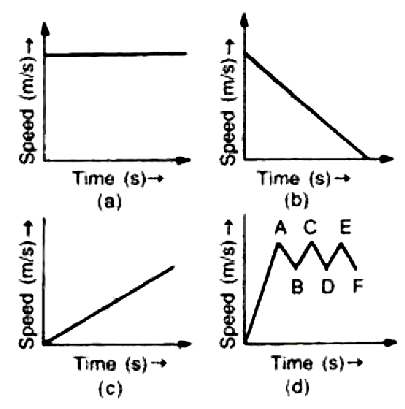
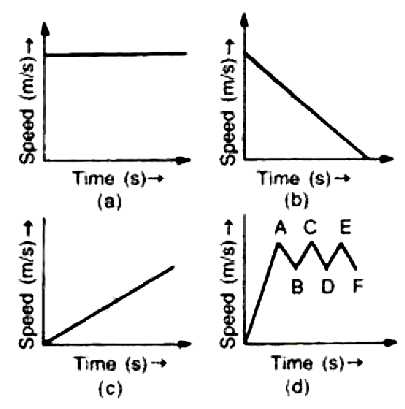
(i) In speed time graph uniform motion is given by a straight line parallel to x axis so figure (a) denotes the uniform motion.
(ii) In speed time graph motion with increasing speed is shown by straight line with positive slope so figure (c) denotes the motion with speed increasing.
(iii) In speed time graph motion with decreasing speed is shown by straight line with negative slope so figure (b) denotes the motion with speed decreasing.
(iv) In speed time graph motion with oscillating speed is shown by zigzag line so figure {d) denotes the motion with speed oscillating.
Answer
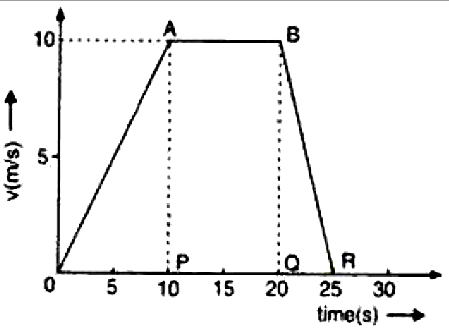
As we know that acceleration is given by the slope of the velocity-time graph so we have to calculate the slope of the graph of each stage of motion,
Acceleration during $O$ to $P=(10-0) /(10-0)=1 ms^{-2}$
Acceleration during $P$ to $Q=(10-10) /(20-10)=0 ms^{-2}$
Acceleration during $Q$ to $R=(0-10) /(25-20)=-2 ms^{-2}$
View full question & answer
Question 25 Marks
A 50 m long train passes over a bridge at a speed of 30 km/h. If it takes 36 seconds to cross the bridge, calculate the length of the bridge.
Answer
Speed of train = 30 km/hr.
Speed in m/s = ( 30 X1000 )/3600 = 50/6 m/s.
Length of train = 50 m.
Let the length of the bridge be s metre.
The train has to cover a total distance of 50 +s to cross that bridge.
Time taken by train to cover this distance = 36 sec.
So as time taken = total distance /total time taken.
36 = ( 50 +s ) X 6/ 50.
1800 = 300 + 6s
6s = 1500.
S = 1500/6 = 250m
Length of bridge is 250 m.
View full question & answer
Question 35 Marks
A train travels the first 30km of its journey at 30km/h. Find the speed it should travel the next 90km to have an average speed of 60km/h.
Answer
The train travels the first 30 km at speed of 30 km/hr.
Time taken by train to cover this distance is = distance/speed = 30/30 = 1 hr.
Let the speed of the train to cover the next 90 km is v.
Then time taken by train to cover this 90 km is 90/v.
Total time becomes T = 1 +90/v = ( v + 90)/v.
Total distance= 120 km.
Average speed = 60 km/h (given)
However average is given by = total distance /total time.
So (120 x v)/(v +90) = 60
120 v = 60v +5400
60v = 5400
v= 5400/60 =90 km/hr.
so train has to cover those 90 km at a speed of 90 km/hr.
View full question & answer
Question 45 Marks
A body moves along a straight track. Half of the distance it covers with a velocity of $40 ms^{-1}$ and the remaining half with a velocity of $60 ms^{-1}$. What is the average velocity for the whole journey?
Answer
Let total distance be S .
Body covers distance $S / 2$ with speed $40 ms^{-1}$ then the time taken by him to cover this distance would be $T _1= S / 2 \times 40$.
Again body covers the rest of the distance $S / 2$ with speed $60 ms^{-1}$ then the time taken by him to cover this distance would be $T_2=S / 2 \times 60$.
So total time taken by the body to cover the distance $S$ is $T=T_1+T_2$.
Total time $T=S / 2(1 / 40+1 / 60)=s(40+60) / 2 \times 40 \times 60=s / 48$.
And average speed $= S / T =48 ms^{-1}$.
So average speed is $48 ms^{-1}$.
View full question & answer
Question 55 Marks
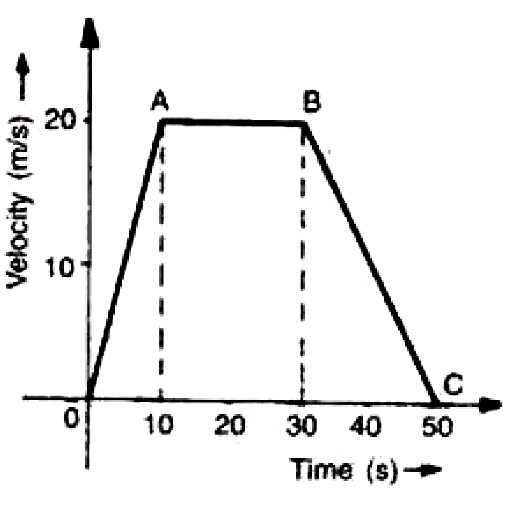
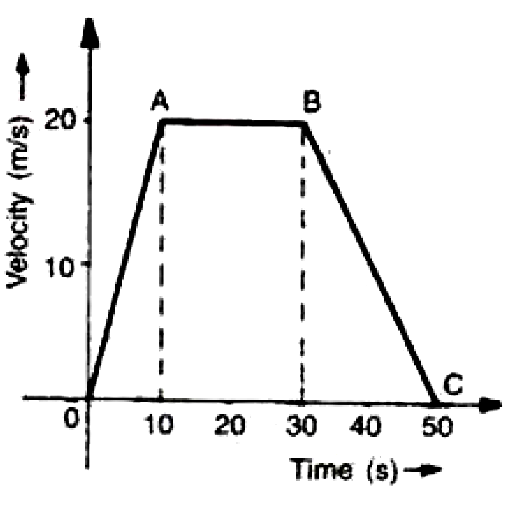
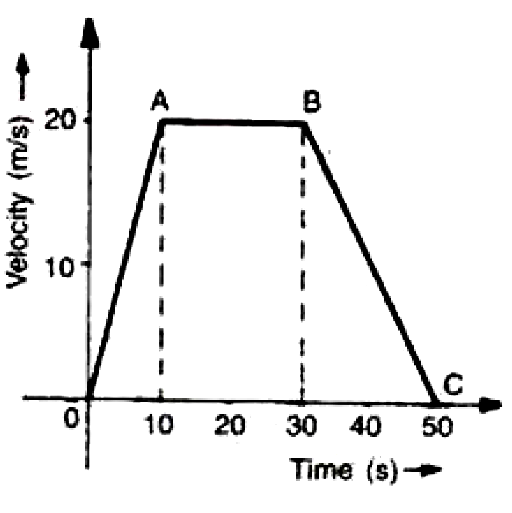
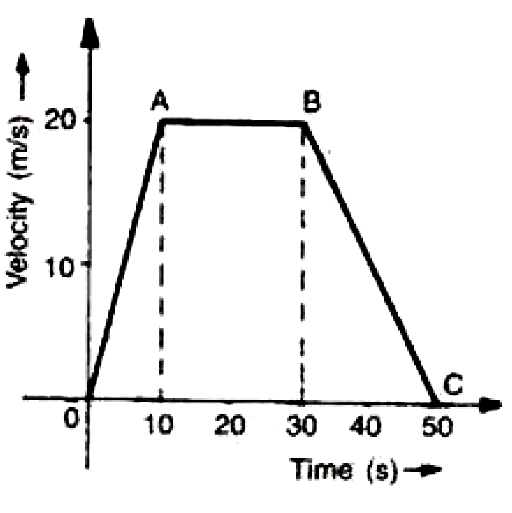
The graph shows how the velocity of a scooter varies with time in 50 s.
Work out: Deceleration
Answer

Scooter is decelerating in the region 8 to $C$.
$
a =( v - u ) / t =(0-20) / 20=-1 m ^{-2} \
$
View full question & answer
Question 65 Marks
The graph shows how the velocity of a scooter varies with time in 50 s.
Work out: The distance traveled in 10 s, 20 s, and 50 s.
Answer

The distance travelled in $10 sec$ is $S 1=\frac{1}{2} \times 20 \times 10=100 m$
Distance travelled in $10 s$ to $30 s$ is $s _2=20 \times(30-10)=20 \times 20=400 m$ Distance travelled in $30 s$ to 50 is $S_3=\frac{1}{2} \times 20 \times(50-30)=200 m$.
Total distance covered by scooter is $=100 m+400 m+200 m=700 m$.
View full question & answer
Question 75 Marks
The graph shows how the velocity of a scooter varies with time in 50 s.
Work out: Acceleration.
Answer

Scooter is accelerating in the region O to A and acceleration is given by
$a = (v - u)/t = (20 - 0)/10 = 2 m^{-2}.$
View full question & answer
Question 85 Marks
The graph shows how the velocity of a scooter varies with time in 50 s. Interpret the graph.
Answer

From 0 to 10 sec. i.e O to A motion is accelerating one. From 10 s to 30 sec. scooter is moving with uniform velocity, from 30 s to 50 sec scooter is retarding fromB to c.
View full question & answer
Question 95 Marks
On a 120 km track, a train travels the first 40 km at a uniform speed of 30 km/h. How fast must the train travel the next 80 km, so as to average 60 km/h for the entire trip.
Answer
Train travels first 40 km at speed of 30 km/hr.
Time taken by train to cover this distance is = distance/speed = 40/30 = 4/3 hr.
Let speed of train to cover next 80 km is v .
Then time taken by train to cover these 80 km is 80/v.
Total time becomes T = 4/3 +80/v = ( 4v + 240)/3v.
Total distance= 120 km.
Average speed = 60 km/h (given)
However average is given by = total distance /total time.
So (120 X 3 X v)/(4v +240) = 60
360 v = 240v +14400
120v = 14400
v= 14400/120 =120 km/hr.
so train has to cover those 80 km at a speed of 120 km/hr.
View full question & answer
Question 105 Marks
Derive the equation
$V^2-u^2 = 2as$
Answer

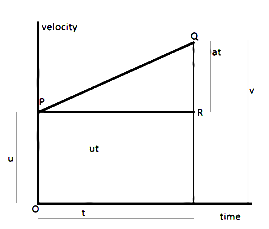
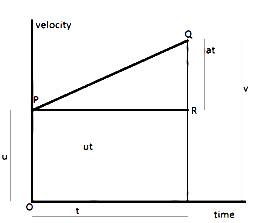
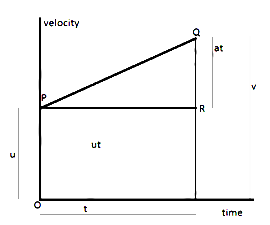
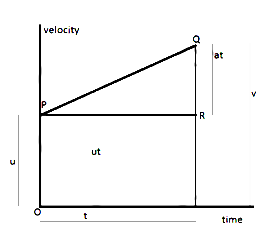
In figure we know
$S=$ area of trapezium OSQP
Area of trapezium OSQP $=\frac{1}{2}$ \{sum of parallel sides) $x$ perpendicular distance between them.
$ S=\frac{1}{2}(O P+S Q) \times P R .$
$P R=Q R / a=(Q S-R S) / a$
$P R=(v-u) / a=t $
So $P R=t$.
Substituting these values in expression of area of trapezium we get $S=Y$. $\{u+v) \times t S={ }^{\prime} 1 / 2(u+v) \times(u$
$ -v) / a .$
$2 a S=v^2-u^2$
$v^2-u^2=2 a s . $
View full question & answer
Question 115 Marks
Derive the equation
$S=u t+\frac{1}{2} a^2$
Using a speed- time graph
Answer

The area enclosed under a velocity time curve gives the distance covered by a moving body. So total distance $S$ covered by a uniformly accelerating body is given by area of trapezium OSQP.
$S=\text { area of trapezium OSQP. }$
AREA of rectangle OSRP + area of triangle PRQ.
$ S=O P \times O S+\frac{1}{2} P R \times Q R$
$S=u \times t+\frac{1}{2} \times t \times \text { at }$
$S=u t+\frac{1}{2} at ^2 $
This is known as second equation of motion.
View full question & answer
Question 125 Marks
Derive th e equation of motion.
$
S=u t+\frac{1}{2} at ^2
$
Where the symbols have their usual meanings
Answer

In figure we know
S = area of trapezium OSQP
Area of trapezium OSQP = 1/2 (sum of parallel sides) x perpendicular distance between them.
S = 1/2 (OP + SQ) x PR.
PR= QR/a= (QS-RS) / a
PR= (v - u)/a = t
So PR= t .
Substituting these values in expression of area of trapezium we get
S= 1/2 (u + v) xt
S = 1/2 (u +v) x (u - v)/a.
2aS = v2 - u2
v2 - u2 = 2 as.
This is known as third equation of motion.
View full question & answer
Question 135 Marks
Derive the equations
$(i) v= u+a$t and
$(ii) v^2-u^2= 2as$, where the symbols have their usual meanings.
Answer

This is graph plotted between velocity and time.
(i) The initial velocity of the body is u at t=O. The velocity of the body increases at a uniform rate and this increase in velocity up to time t is depicted by a straight line PQ. The slope of line PQ gives acceleration a.
$a= QR/ PR.$
$PR= OS =t$
$SR= OP =u$
$QR= a x PR.$
$= a x t .$
The point Q corresponds to the final velocity v after time t .
v = QR+ RS and generally we write v = u + at .
This is first equation of motion.
(ii) The area enclosed under a velocity time curve gives the distance covered by a moving body. So total distance S covered by a uniformly accelerating body is given by area of trapezium OSQP.
S = area of trapezium OSQP.
AREA of rectangle OSRP + area of triangle PRQ.
$S = OP x OS + 1/2 PR xQR.$
$S= u x t + 1/2 x t x at .$
$S= ut + 1/2 at^2$​​​​​​​
This is known as second equation of motion.
View full question & answer
Question 145 Marks
Given on th e side are a few speed - time graphs for various objects moving along a stra ight line. Refer below figure. (a), (b), (c) and (d).

Which of these graphs represent
(a) Uni form motion
(b) Motion with speed increasing
(c) Motion with speed decreasing and
(d) Motion with speed oscillating.?
Answer

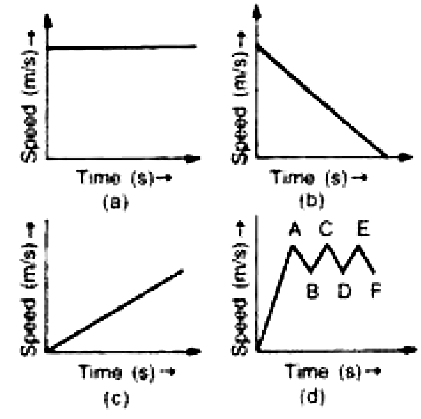
(i) In speed time graph uniform motion is given by a straight line parallel to x axis so figure (a) denotes the uniform motion.
(ii) In speed time graph motion with increasing speed is shown by straight line with positive slope so figure (c) denotes the motion with speed increasing.
(iii) In speed time graph motion with decreasing speed is shown by straight line with negative slope so figure {b) denotes the motion with speed decreasing.
(iv) In speed time graph motion with oscillating speed is shown by zigzag line so figure {d) denotes the motion with speed oscillating.
View full question & answer
Question 155 Marks
A boy covers half of his journey with a uniform speed of u and the other half with a uniform speed of v. What is the average speed for the whole journey?
Answer
Let total distance be S .
Boy covers distance $S / 2$ with speed $u$ then time taken by him to cover this distance would be $T _1= S / 2 u$.
Again boy covers rest of the distance $S / 2$ with speed $v$ then time taken by him to cover this distance would be $T_2= S / 2 v$.
So total time taken by boy to cover the distance $S$ is $T=T_1+T_2$.
Total time $T=S / 2(1 / u+1 / v)=s(u+v) / 2 u v$.
And average speed $= S / T =2 uv /( u + v )$.
View full question & answer
[5 Mark Question Answer] - PHYSICS STD 9 Questions - Vidyadip