Questions · Page 1 of 5

4 Marks Questions

🎯

Test yourself on this topic

50 questions · timed · auto-graded

Question 14 Marks
Write a pair of linear equations which has the unique solution $x = -1, y = 3$. How many such pairs can you write?
Answer
Condition for the pair of system to have unique solution
$\frac{\text{a}_1}{\text{a}_2}\neq\frac{\text{b}_1}{\text{b}_2}$
Let the equations are,
$a_1x + b_1y + c_1 = 0$
and $a_2x + b_2y + c_2 = 0$
Since, x = -1 and y = 3 is the unique solution of these two equations, then
$a_1(-1) + b_1(3) + c_1 = 0$
$\Rightarrow -a_1 + 3b_1 + c_1 = 0$
and $a_2(-1) + b_2(3) + c2 = 0$
$\Rightarrow -a_2 + 3b_2 + c_2 = 0$
So, the different valume of $a_1, a_2, b_1, b_2, c_1​​​​​​​$​​​​​​​ and $c_2​​​​​​​$​​​​​​​ satisfy the eqs. (i) and (ii).
Hence, infinitely many pairs of linear equations are possible.
View full question & answer
Question 24 Marks
Solve the following systems of equations:
$\frac{\text{xy}}{\text{x}+\text{y}}=\frac{6}{5}$
$\frac{\text{xy}}{\text{y}-\text{x}}=6$ where $\text{x}+\text{y}\neq0,\text{y}-\text{x}\neq0.$
Answer
The given system of equation is
$\frac{\text{xy}}{\text{x}+\text{y}}=\frac{6}{5}$
$\Rightarrow5\text{xy}=6(\text{x}+\text{y})$
$\Rightarrow5\text{xy}=6\text{x}+6\text{y}\ ......(\text{i})$
And, $\frac{\text{xy}}{\text{y}-\text{x}}=6$
$\Rightarrow\text{xy}=6(\text{y}-\text{x})$
$\Rightarrow\text{xy}=6\text{y}-6\text{x}\ .....(\text{ii})$
Adding equation (i) and equation (ii) we get
$6\text{xy}=6\text{y}+6\text{y}$
$\Rightarrow6\text{xy}=12\text{y}$
$\Rightarrow\text{x}=\frac{12\text{y}}{6\text{y}}=2$
Putting x = 2 in equation (i) we get
$5\times2\times\text{y}=6\times2+6\text{y}$
$\Rightarrow10\text{y}=12+6\text{y}$
$\Rightarrow10\text{y}-6\text{y}=12$
$\Rightarrow4\text{y}=12$
$\Rightarrow\text{y}=\frac{12}{4}=3$
Hence solution of the given system of equations is x = 2, y = 3.
View full question & answer
Question 34 Marks
In the following system of equation determine whether the system has a unique solution, no solution or infinitely many solutions. In case there is a unique solution, find it:
$x - 2y = 8$
$5x - 10y = 10$
Answer
Given
$x - 2y = 8$
$5x - 10y = 10$
To find: To determine whether the system has a uniqfue solution, no solution or infinitely many solutions
We know that the system of equations,
$a_1x + b_1y + c_1 = 0$
$a_2x + b_2y + c_2 = 0$
For unique solution
$\frac{\text{a}_1}{\text{a}_2}\neq\frac{\text{b}_1}{\text{b}_2}$
For no solution
$\frac{\text{a}_1}{\text{a}_2}=\frac{\text{b}_1}{\text{b}_2}\neq\frac{\text{c}_1}{\text{c}_2}$
For infinitely many solution
$\frac{\text{a}_1}{\text{a}_2}=\frac{\text{b}_1}{\text{b}_2}=\frac{\text{c}_1}{\text{c}_2}$
Here,
$\frac{1}{5}=\frac{-2}{-10}=\frac{8}{10}$
$\frac{1}{5}=\frac{1}{5}\neq\frac{4}{5}$
Since, $\frac{\text{a}_1}{\text{a}_2}=\frac{\text{b}_1}{\text{b}_2}=\frac{\text{c}_1}{\text{c}_2}$ which means $\frac{1}{5}=\frac{1}{5}\neq\frac{4}{5}$ hence the system of equation has no solution.
Hence the system of equation has no solution.
View full question & answer
Question 44 Marks
Find the value of k for which each of the following system of equations have infinitely many solutions:
$2x + 3y = k$
$(k - 1)x + (k + 2)y = 3k$
Answer
The given system of equations may be written as
$2x + 3y - k = 0$
$(k - 1)x + (k + 2)y - 3k = 0$
The system of equations is of the form
$a_1x + b_1y + c_1 = 0$
$a_2x + b_2y + c_2 = 0$
Where, $a_1 = 2, b_1 = 3, c_1 = -k$
and, $a_2 = k - 1, b_2 = k + 2, c_2 = -3k$
For infinitely many solutions, we must have
$\frac{\text{a}_1}{\text{a}_2}=\frac{\text{b}_1}{\text{b}_2}=\frac{\text{c}_1}{\text{c}_2}$
$\Rightarrow\frac{2}{\text{k}-1}=\frac{3}{\text{k}+2}=\frac{-\text{k}}{-3\text{k}}$
$\Rightarrow\frac{2}{\text{k}-1}=\frac{3}{\text{k}+2}$ and $\frac{3}{\text{k}+2}=\frac{-\text{k}}{-3\text{k}}$
$\Rightarrow 2(k + 2) = 3(k - 1)$ and $3 \times 3k = k(k + 2)$
$\Rightarrow 2k + 4 = 3k - 3$ and $9 = k + 2$
$\Rightarrow 4 + 3 = 3k - 2k$ and $9 - 2 = k$
$\Rightarrow 7 = k$ and $7 = k$
$\Rightarrow k = 7$ and $k = 7$
$\Rightarrow k = 7$ satisfies both the conditions
Hence, the given system of equations will have infinitely many solutions, if $k = 7$
View full question & answer
Question 54 Marks
Find the values of a and b for which the following system of equations has infinitely many solutions:
$2x + 3y = 7$ 
$(a - 1)x + (a + 2)y = 3a$
Answer
The given system of equations is $2x + 3y - 7 = 0 (a - 1)x + (a + 2)y - 3a = 0$
It is of the form $a_1x + b_1y + c_1 = 0 a_2x + b_2y + c_2 = 0$
Where, $a_1 = 2, b_1 = 3, c_1 = -7$ And,
$a_2 = (a - 1), b_2 = (a + 2)$ and
$c_2 = -3a$
The given system of equations will be have infinite number of solution, if
$\frac{\text{a}_1}{\text{a}_2}=\frac{\text{b}_1}{\text{b}_2}=\frac{\text{c}_1}{\text{c}_2}$ $\Rightarrow\frac{2}{\text{a}-1}=\frac{3}{\text{a}+2}=\frac{-7}{-3\text{a}}$ $\Rightarrow\frac{2}{\text{a}-1}=\frac{3}{\text{a}+2}=\frac{7}{3\text{a}}$$\Rightarrow\frac{2}{\text{a}-1}=\frac{3}{\text{a}+2}$ and $\frac{3}{\text{a}+2}=\frac{7}{3\text{a}}$
$\Rightarrow 2(a + 2) = 3(a - 1)$ and $3 \times 3a = 7(a + 2)$
$\Rightarrow 2a + 4 = 3a - 3$ and $9a = 7a + 14 \Rightarrow 4 + 3 = 3a - 2a$ and $9a - 7a = 14$
$\Rightarrow 7 = a$ and $2a = 14$
$\Rightarrow a = 7$ and $a = 7$
$\Rightarrow a = 7$ Hence, the given system of equations will have infinitely many solutions, if $a = 7$
View full question & answer
Question 64 Marks
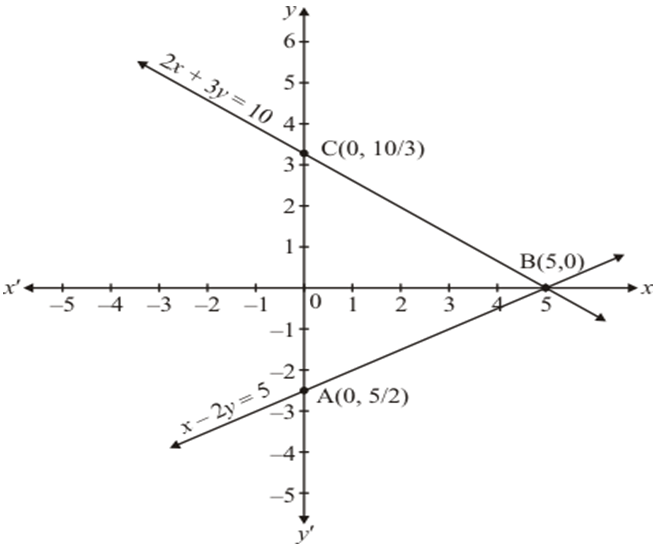
Solve the following systems of equations graphically:
x - 2y = 5
2x + 3y = 10
Answer
The given equations are:
x - 2y = 5 ......(i)
2x + 3y = 10 .....(ii)
Puting x = 0 in equation (i), we get,
⇒ 0 - 2y = 5
$\Rightarrow\text{y}=\frac{-5}{2}$
$\Rightarrow\text{x}=0,\ \text{y}=\frac{-5}{2}$
Puting y = 0 in equation (i), we get,
⇒ x + 2 × 0 = 5
⇒ x = 5
⇒ x = 5, y = 0
Use the following table to draw the graph.
x
0
5
y
$\frac{-5}{2}$
0
Draw the graph by plotting the two points $\text{A}\Big(0,\frac{-5}{2}\Big)$ and B(5, 0) from table.

Graph the equation (ii),
⇒ 2x + 3y = 10 ......(ii)
Putting x = 0 in equation (ii), we get,
⇒ 2 × 0 + 3y = 10
$\Rightarrow\text{y}=\frac{10}{3}$
$\Rightarrow\text{x}=0,\ \text{y}=\frac{10}{3}$
Putting y = 0 in equation (ii), we get,
⇒ 2x + 3 × 0 = 10
⇒ x = 5
x = 5, y = 0
use the following table to draw the graph.
x
0
5
y
$\frac{10}{3}$
0
Draw the graph by plotting the two points $\text{C}\Big(0,\frac{10}{3}\Big)$ and B(5, 0) from table.
The two lines intersects at points B(5, 0).
Hence x = 5, y = 0 is the solution.
View full question & answer
Question 74 Marks
Solve the following system of equations by the method of cross-multiplication:$\text{x}\Big(\text{a}-\text{b}+\frac{\text{ab}}{\text{a}-\text{b}}\Big)=\text{y}\Big(\text{a}-\text{b}-\frac{\text{ab}}{\text{a}+\text{b}}\Big)$
$\text{x}+\text{y}=2\text{a}^2$
Answer
The given equations are,
$\text{x}\Big(\text{a}-\text{b}+\frac{\text{ab}}{\text{a}-\text{b}}\Big)-\text{y}\Big(\text{a}-\text{b}-\frac{\text{ab}}{\text{a}+\text{b}}\Big)=0\ .....(\text{i})$
$\text{x}+\text{y}=2\text{a}^2\ .....(\text{ii})$
By cross-multiplication we get,
$\Rightarrow\frac{\text{x}}{-\Big(\text{a}+\text{b}-\frac{\text{ab}}{\text{a}+\text{b}}\Big)\big(-2\text{a}^2\big)-0}=\frac{\text{y}}{0-\Big(\text{a}-\text{b}+\frac{\text{ab}}{\text{a}-\text{b}}\Big)\big(-2\text{a}^2\big)}\\=\frac{1}{\Big(\text{a}-\text{b}+\frac{\text{ab}}{\text{a}-\text{b}}\Big)+\Big(\text{a}+\text{b}-\frac{\text{ab}}{\text{a}+\text{b}}\Big)}$
$\Rightarrow\frac{\text{x}}{\bigg\{\frac{(\text{a}+\text{b})^2-\text{ab}}{(\text{a}+\text{b})}\bigg\}2\text{a}^2}=\frac{\text{y}}{\bigg\{\frac{(\text{a}-\text{b})^2+\text{ab}}{\text{a}-\text{b}}\bigg\}2\text{a}^2}\\=\frac{1}{\frac{\big\{(\text{a}-\text{b})^2+\text{ab}\big\}}{(\text{a}-\text{b})}+\frac{\big\{(\text{a}+\text{b}^2)-\text{ab}\big\}}{(\text{a}+\text{b})}}$
$\Rightarrow\frac{\text{x}}{\frac{(\text{a}^2+\text{b}^2+2\text{ab}-\text{ab})2\text{a}^2}{(\text{a}+\text{b})}}=\frac{\text{y}}{\frac{(\text{a}^2+\text{b}^2-2\text{ab}+\text{ab})2\text{a}^2}{(\text{a}-\text{b})}}\\=\frac{1}{\frac{(\text{a}^2+\text{b}^2-2\text{ab}+\text{ab})}{(\text{a}-\text{b})}+\frac{(\text{a}^2+\text{b}^2+2\text{ab}-\text{ab})}{(\text{a}+\text{b})}}$
$\Rightarrow\frac{\text{x}}{\frac{(\text{a}^2+\text{b}^2+\text{ab})2\text{a}^2}{(\text{a}+\text{b})}}=\frac{\text{y}}{\frac{(\text{a}^2+\text{b}^2-\text{ab})2\text{a}^2}{(\text{a}-\text{b})}}\\=\frac{1}{\frac{(\text{a}^2+\text{b}^2-\text{ab})}{(\text{a}-\text{b})}+\frac{(\text{a}^2+\text{b}^2+\text{ab})}{(\text{a}+\text{b})}}$
$\Rightarrow \frac{\text{x}}{\frac{(\text{a}-\text{b})(\text{a}^2+\text{b}^2+\text{ab})2\text{a}^2}{(\text{a}+\text{b})(\text{a}-\text{b})}}=\frac{\text{y}}{\frac{(\text{a}-\text{b})(\text{a}^2-\text{ab}+\text{b}^2)2\text{a}^2}{(\text{a}-\text{b})(\text{a}+\text{b})}}\\=\frac{(\text{a}-\text{b})(\text{a}+\text{b})}{\text{a}^3+\text{ab}^2-\text{a}^2\text{b}+\text{a}^2\text{b}+\text{b}^3-\text{ab}^2+\text{a}^2+\text{ab}^2+\text{a}^2\text{b}-\text{a}^2\text{b}-\text{b}^3-\text{ab}^2}$
$ \frac{\text{x}}{\frac{(\text{a}^3-\text{b}^3)2\text{a}^2}{\text{a}^2-\text{b}^2}}=\frac{\text{y}}{\frac{(\text{a}^3+\text{b}^3)2\text{a}^2}{\text{a}^2-\text{b}^2}}=\frac{\text{a}^2-\text{b}^2}{2\text{a}^3}$
$\text{x}=\frac{(\text{a}^2-\text{b}^2)}{2\text{a}^3}\times\frac{(\text{a}^3-\text{b}^3)2\text{a}^2}{(\text{a}^2-\text{b}^2)}$
$ \text{x}=\frac{\text{a}^3-\text{b}^3}{\text{a}}$
$\text{y}=\frac{\text{a}^2-\text{b}^2}{2\text{a}^3}\times\frac{(\text{a}^3+\text{b}^3)2\text{a}^2}{(\text{a}^2-\text{b}^2)}$
$\text{y}=\frac{\text{a}^3+\text{b}^3}{\text{a}}$
Thus, $\text{x}=\frac{\text{a}^3-\text{b}^3}{\text{a}}$ and $\text{y}=\frac{\text{a}^3+\text{b}^3}{\text{a}}$
View full question & answer
Question 84 Marks
Solve the following systems of equations:
x - y + z = 4,
x + y + z = 2,
2x + y - 3z = 0.
Answer
We have,
x - y + z = 4 ........(i)
x + y + z = 2 .......(ii)
2x + y - 3z = 0 .........(iii)
From equation (i) we get
z = 4 - x + y
⇒ z = -x + y + 4
Substituting z = -x + y + 4 in equation (ii) we get
x + y + (-x + y + 4) = 2
⇒ x + y - x + y + 4 = 2
⇒ 2y + 4 = 2
⇒ 2y = 2 - 4 = -2
⇒ 2y = -2
$\Rightarrow\text{y}=\frac{-2}{2}=-1$
Substituting the value of z in equation (iii) we get
2x + y - 3(-x + y + 4) = 0
⇒ 2x + y + 3x - 3y - 12 = 0
⇒ 5x - 2y - 12 = 0
⇒ 5x - 2y = 12 .......(iv)
Putting y = -1 in equation (iv) we get
5x - 2 × (-1) = 12
⇒ 5x + 2 = 12
⇒ 5x = 12 - 2 = 10
$\Rightarrow\text{x}=\frac{10}{5}=2$
Puuting x = 2 and y = -1 in z = -x + y + 4 we get
z = -2 + (-1) + 4
= -2 - 1 + 4
= -3 + 4
= 1
Hence solution of the giving system of equation is x = 2, y = -1, z = 1.
View full question & answer
Question 94 Marks
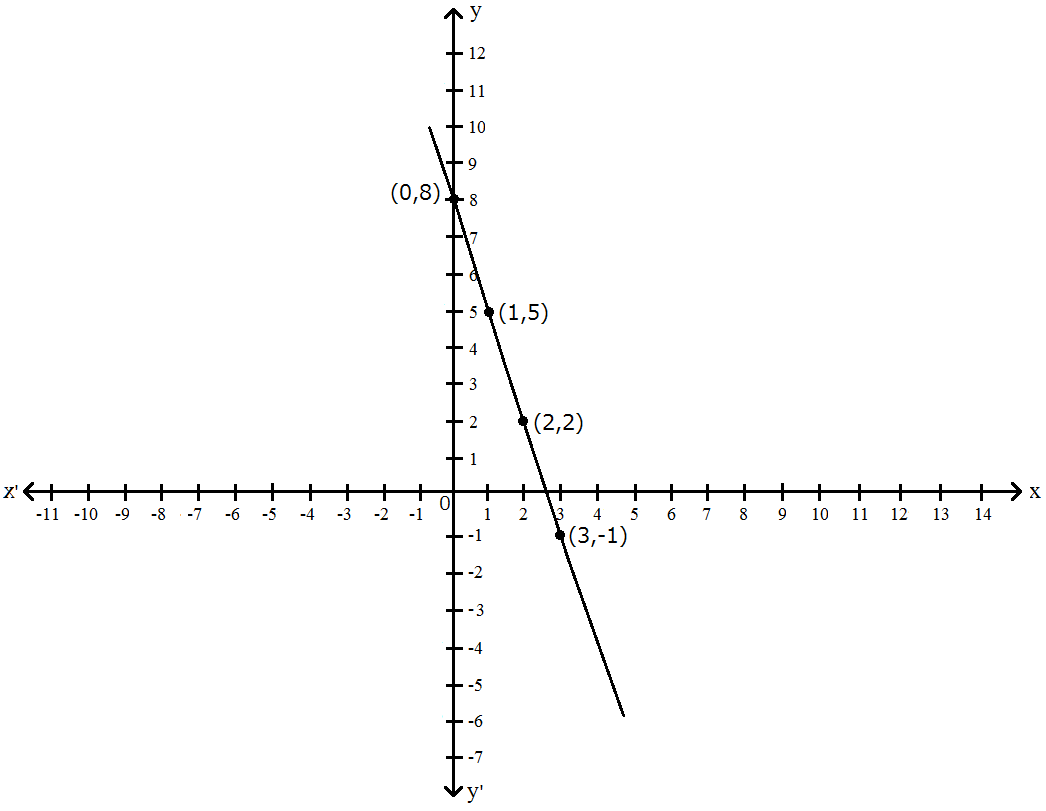
Solve graphically that the following system of equation has infinitely many solutions:
3x + y = 8
6x + 2y = 16
Answer
The given equations are,
3x + y = 8 .......(i)
6x + 2y = 16 ........(ii)
From (i), y = 8 - 3x .......(iii)
Putting x = 0 in (iii), we get y = 8
Putting x = 1 in (iii), we get y = 5
Putting x = 2 in (iii), we get y = 2
x
0
1
2
y
8
5
2
From (ii), $\text{y}=\frac{16-6\text{x}}{2}\ .....(\text{iv})$
Putting x = 1 in (iv), we get y = 5
Putting x = 2 in (iv), we get y = 2
Putting x = 3 in (iv), we get y = -1
x
1
2
3
y
5
2
-1

When we polt these points on graph paper we observe that all then points on a line so the given system of equations has infinitaly many solutions.
View full question & answer
Question 104 Marks
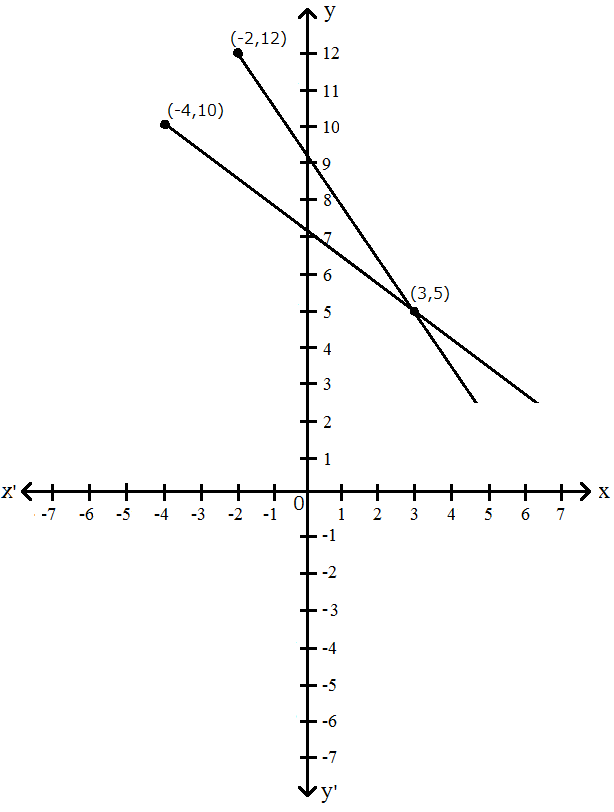
Form the pair of linear equations in the following problems, and find their solution graphically:
5 pencils and 7 pens together cost Rs. 50, whereas 7 pencils and 5 pens together cost Rs. 46. Find the cost of one pencil and a pen.
Answer
Let the number of pencils and pens be x and y respectively.
According to questions.
5x + 7y = 50 .......(i)
7x + 5y = 46 ........(ii)
From (i), $\text{y}=\frac{50-5\text{x}}{7}\ ......(\text{iii})$
Putting x = 3 in (iii), we get y = 5
Putting x = -4 in (iii), we get y = 10
x
3
-4
y
5
10

From (ii), $\text{y}=\frac{46-7\text{x}}{5}\ ......(\text{iv})$
Putting x = 3 in (iv), we get y = 5
Putting x = -2 in (iv), we get y = 12
x
3
-2
y
5
12
Thus, from graph cost of pencil = Rs. 3 and cost of pen= Rs. 5.
View full question & answer
Question 114 Marks
The area of a rectangle remains the same if the length is increased by $7$ meters and the breadth is decreased by $3$ meters. The area remains unaffected if the length is decreased by $7$ meters and breadth in increased by $5$ meters. Find the dimensions of the rectangle.
Answer
Let the length and breadth of the rectangle be $xm$ and $ym$ respectively. Then,
Area $= xym^2$
If length is increased by $7\ m$ and the breadth is decreased by $3\ m$, the area rem ains same
$\therefore$ $xy = (x + 7)(y - 3)$
$\Rightarrow xy = xy - 3x + 7y - 21$
$\Rightarrow 3x - 7y = -21 ......(i)$
When length is decreased by 7m and breasth is increased by 5m, then area rem ains unaffected
$\therefore$ $xy = (x - 7)(y + 5)$
$\Rightarrow xy = xy + 5x - 7y - 35$
$\Rightarrow 35 = 5x - 7y$
$\Rightarrow 5x - 7y = 35 .....(ii)$
Subtracting equation (i) from (ii), we get
$5x - 3x = 35 - (-21)$
$\Rightarrow 2x = 35 + 21$
$\Rightarrow\text{x}=\frac{56}{2}=28$
Putting $x = 28$ inj equation (ii) we get
$5 \times 28 - 7y = 35$
$\Rightarrow 140 - 7y = 35$
$\Rightarrow -7y = 35 - 140$
$\Rightarrow -7y = -105$
$\Rightarrow\text{y}=\frac{105}{7}=15$
Hence, length and breadth of the rectangle are $28\ m$ and $15\ m$ respectively.
View full question & answer
Question 124 Marks
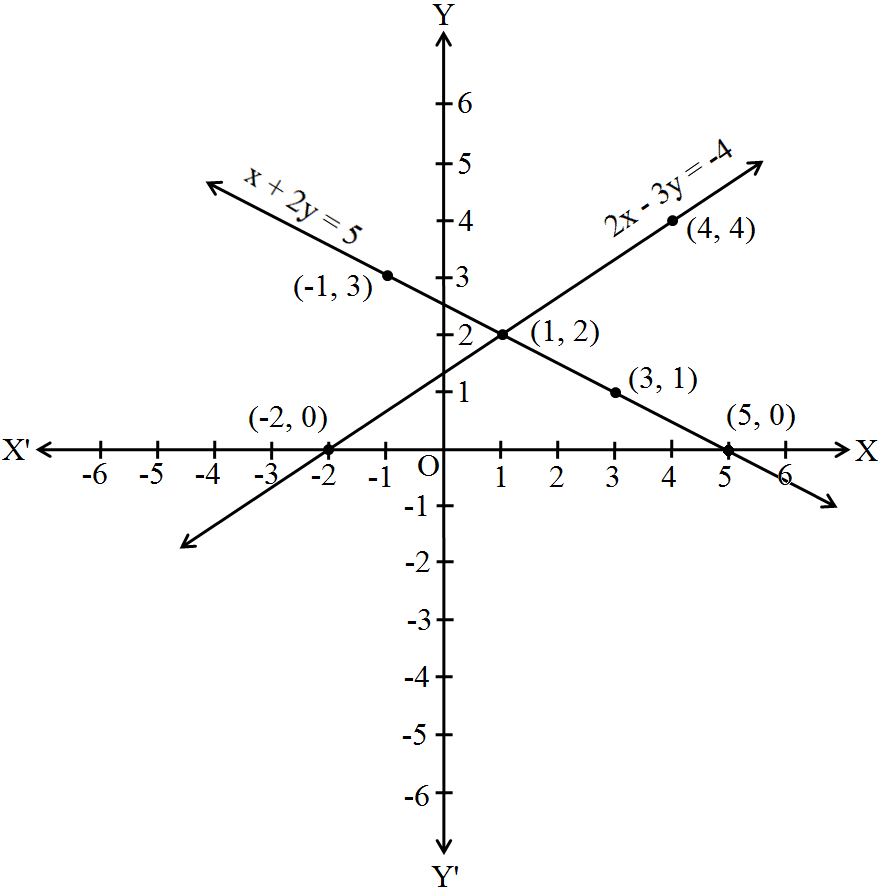
Solve graphically each of the following systems of linear equations. Also, find the coordinates of the points where the lines meet the axis of x in each system.
x + 2y = 5,
2x - 3y = -4.
Answer
x + 2y = 5 ......(i) 2x - 3y = -4 ......(ii) x + 2y = 8 .....(i) ⇒ x = 5 - 2y Substituting some different values of x, we get corresponding values of y as shown below.
x
3
1
-1
y
1
2
3
Now plot the points on the graph and join them similarly in equation 2x - 3y = 4 ⇒ 2x = 3y - 4 $\text{x}=\frac{3\text{y}-4}{2}$
x
-2
1
4
y
0
2
4
polt these points and join them we see that these two lines intersect each other at (1, 2) x = 1, y = 2. and these two lines also meet x-axis at (1, 0) and (2, 0) respectively as shown in the,
View full question & answer
Question 134 Marks
A and B each has some money. If A gives Rs. 30 to B, then B will have twice the money left with A. But, if B gives Rs. 10 to A, then A will have thrice as much as is left with B. How much money does each have?
Answer
Let the money with A be Rs. x and the money with B be Rs. y
It is given that if A give Rs. 30 to B. Then B will have twice the money left with A. Then According to the question we have
⇒ y + 30 = 2(x - 30)
⇒ y + 30 = 2x - 60
⇒ y - 2x = -60 - 30
⇒ -2x + y + 90 = 0 .....(i)
It is also given that if B gives Rs. 10 to A then a will have thric as much as is left with B
⇒ x + 10 = 3(y - 10)
⇒ x + 10 = 3y - 30
⇒ x - 3y + 10 + 30 = 0
⇒ x - 3y + 40 = 0 .......(ii)
Multiplying eq. (ii) by 2 and we get
⇒ 2x - 6y + 80 = 0 .....(iii)
Now, adding eq (i) and (iii) and we get
⇒ -2x + y + 90 + 2x - 6y + 80 = 0
⇒ -5y + 170 = 0
⇒ -5y = -170
$\Rightarrow\text{y}=\frac{170}{5}$
⇒ y = 34
Now, Putting the value os y in eq. (i)
⇒ -2x + y + 90 = 0
⇒ -2x + 34 + 90 = 0
⇒ -2x + 124 = 0
⇒ -2x = -124
$\Rightarrow\text{x}=\frac{124}{2}$
⇒ x = 62
Hence, the money with A be Rs. 62 and money with B be Rs. 34
View full question & answer
Question 144 Marks
One says, "Give me a hundred, friend! I shall then become twice as rich as you." The other replies, "If you give me ten, I shall be six times as rich as you."Tell me what is the amount of their respective capital?
Answer
Let the money with the first person and second person be Rs. x and Rs. y respectively.
According to the question,
x + 100 = 2(y - 100)
x + 100 = 2y - 200
x - 2y = -300 .....(i)
6(x - 10) = (y + 10)
6x - 60 = y + 10
6x - y = 70 ......(ii)
Multiplying equation (ii) by 2 we obtain
12x - 2y = 140 ......(iii)
Subtracting equation (i) from equation (iii) we obtain
11x = 140 + 300
11x = 440
x = 40
Putting the value of x in equation (i) we obtain
40 - 2y = -300
40 + 300 = 2y
2y = 340
y = 170
Thus, the two friends had Rs. 40 and Rs. 170 with them.
View full question & answer
Question 154 Marks
In a rectangle, if the length is increased by 3 meters and breadth is decreased by 4 meters, the area of the rectangle is reduced by 67 square meters. If length is reduced by 1 meter and breadth is increased by 4 meters, the area is increased by 89 Sq. meters. Find the dimensions of the rectangle.
Answer
Let the length and breadth of the rectangle be x and y units respectively.
Then, area of rectangle = xy square units
If the length is increased by 3 meters and breath is reduced each by 4 square meters the area is reduced by 67 square units
$\therefore$ xy - 67 = (x + 3)(y - 4)
xy - 67 = xy + 3y - 4x - 12
4x - 3y - 67 + 12 = 0
4x - 3y - 55 = 0 ......(i)
Then the length is reduced by 1 meter and breadth is increased by 4 meter then the area is increased by 89 square units
xy + 89 = (x - 1)(y + 4)
xy + 89 = xy + 4x - y - 4
4x - y - 4 - 89 = 0
4x - y - 93 = 0 ......(ii)
Thus we get the following system of linear equation
4x - 3y - 55 = 0
4x - y - 93 = 0
By using cross multiplication we have
$\Rightarrow\frac{\text{x}}{(-3\times-93)-(-1\times-55)}=\frac{\text{-y}}{(4\times-93)-(4\times-55)}\\=\frac{1}{(4\times-1)-(4\times-3)}$
$\Rightarrow\frac{\text{x}}{279-55}=\frac{\text{-y}}{-372+220}=\frac{1}{-4+12}$
$\Rightarrow\frac{\text{x}}{224}=\frac{-\text{y}}{-152}=\frac{1}{8}$
$\text{x}=\frac{224}{8}$
$\text{x}=28$
and,
$\text{y}=\frac{152}{8}$
$\text{y}=19$
Hence the length of rectangle is 28 meter, The breath of rectangle is 19 meter.
View full question & answer
Question 164 Marks
Solve the following system of equations by the method of cross-multiplication:
$\text{ax}+\text{by}=\frac{\text{a}+\text{b}}{2}$
$3\text{x}+5\text{y}=4$
Answer
Given,
$\text{ax}+\text{by}=\frac{\text{a}+\text{b}}{2}$
$3\text{x}+5\text{y}=4$
To find: The solution of the systems of equation by the method of cross-multiplication:
Here we have the pair of simultaneous equation,
$\text{ax}+\text{by}-\frac{\text{a}+\text{b}}{2}=0$
$3\text{x}+5\text{y}-4=0$
By cross multiplication method we get,
$\Rightarrow\frac{\text{x}}{(-4\text{b})-\Big(-\frac{5(\text{a}+\text{b})}{2}\Big)}=\frac{-\text{y}}{(-4\text{a})-\Big(-\frac{3(\text{a}+\text{b})}{2}\Big)}\\=\frac{1}{5\text{a}-3\text{b}}$
$\Rightarrow\frac{\text{x}}{(-4\text{b})+\frac{5(\text{a}+\text{b})}{2}}=\frac{-\text{y}}{(-4\text{a})+\frac{3(\text{a}+\text{b})}{2}}=\frac{1}{5\text{a}-3\text{b}}$
$\Rightarrow\frac{\text{x}}{(-4\text{b})+\frac{5(\text{a}+\text{b})}{2}}=\frac{1}{5\text{a}-3\text{b}}$
$\Rightarrow\text{x}(5\text{a}-3\text{b})=-4\text{b}+\frac{5(\text{a}+\text{b})}{2}$
$\Rightarrow\text{x}(5\text{a}-3\text{b})=\frac{5\text{a}-3\text{b}}{2}$
$\Rightarrow\text{x}=\frac{1}{2}$
And, $\frac{-\text{y}}{(-4\text{a})+\frac{3(\text{a}+\text{b})}{2}}=\frac{1}{5\text{a}-3\text{b}}$
$\Rightarrow\frac{-\text{y}}{\frac{-8\text{a}+3\text{a}+3\text{b}}{2}}=\frac{1}{5\text{a}-3\text{b}}$
$\Rightarrow\frac{-\text{y}}{\frac{-5\text{a}+3\text{b}}{2}}=\frac{1}{5\text{a}-3\text{b}}$
$ \Rightarrow\text{y}(5\text{a}-3\text{b})=\frac{5\text{a}-3\text{b}}{2}$
$\Rightarrow\text{y}=\frac{1}{2}$
Hence we get the value of $\text{x}=\frac{1}{2}$ and $\text{y}=\frac{1}{2}$
View full question & answer
Question 174 Marks
Solve the following systems of equations:
$\frac{2}{\text{x}}+\frac{3}{\text{y}}=\frac{9}{\text{xy}},$
$\frac{4}{\text{x}}+\frac{9}{\text{y}}=\frac{21}{\text{xy}},\text{x}\neq0,\text{y}\neq0.$
Answer
The system og given equation is
$\frac{2}{\text{x}}+\frac{3}{\text{y}}=\frac{9}{\text{xy}}\ .......(\text{i})$
$\frac{4}{\text{x}}+\frac{9}{\text{y}}=\frac{21}{\text{xy}},\text{where}\text{ x}\neq0,\text{y}\neq0\ .......(\text{ii}) $
Multiplying equation (i) and equation (ii) by xy we get
$2\text{y}+3\text{x}=9\ .....(\text{iii})$
$4\text{y}+9\text{x}=21\ ......(\text{iv})$
From (iii) we get
$3\text{x}=9-2\text{y}$
$\Rightarrow\text{x}=\frac{9-2\text{y}}{3}$
Substituting $\text{x}=\frac{9-2\text{y}}{3}$ in equation (iv) we get
$4\text{x}+9\Big(\frac{9-2\text{y}}{3}\Big)=21$
$\Rightarrow4\text{y}+3(9-2\text{y})=21$
$\Rightarrow4\text{y}+27-6\text{y}=21$
$\Rightarrow-2\text{y}=21-27$
$\Rightarrow-2\text{y}=-6$
$\Rightarrow\text{y}=\frac{-6}{-2}=3$
Putting y = 3 in $\text{x}=\frac{9-2\text{y}}{3},$ we get
$\text{x}=\frac{9-2\times3}{3}$
$=\frac{9-6}{3}$
$=\frac{3}{3}=1$
Hence, solution of the system of equation x = 1, y = 3.
View full question & answer
Question 184 Marks
Places A and B are 100km apart on a highway. One car starts from A and another from B at the same time. If the cars travel in the same direction at different speeds, they meet in 5 hours. If they travel towards each other, they meet in 1 hour. What are the speeds of two cars.
Answer

Let x km/hr and y km/hr be the speed of cars A and B respectively.
When they move in same direction, they meet in 5 hours.
Suppose they meet at C. Then,
Distance cover by A = AC
Distance cover by B = BC
Distance = Speed × time
Distance cover by A = 5x km
Distance cover by B = 5y km
Clearly, AC - BC = AB
5x - 5y = 100
x - y = 20 ....(i)
When they move towards each other they meet in one hours.
Distance cover by A = AD = x km
Distance cover by B = BD = y km
Cleary, AD + BD = AB
⇒ x + y = 100 ....(ii)
Adding (i) and (ii) we get
⇒ 2x = 120
⇒ x = 60km/hr
Putting x = 60 in (ii) we get
⇒ 60 + y = 100
⇒ y = 40 km/hr
Thus, speed of A = 60km/hr. and Speed of B = 40 km/hr.
View full question & answer
Question 194 Marks
5 pens and 6 pencils together cost Rs. 9 and 3 pens and 2 pencils cost Rs. 5. Find the cost of 1 pen and 1 pencil.
Answer
Let the coist of a pen be Rs. x and that of a pencil be Rs. y. Then,
5x + 6y = 9 .....(i)
and 3x + 2y = 5 .....(ii)
Multiplying equations (i) by 2 and equation (ii) by 6, we get
10x + 12y = 18 .....(ii)
18x + 12y = 30.......(iv)
Subtracting equation (iii) by equation (iv) we get
18x - 10x + 12y - 12y = 30 - 18
⇒ 8x = 12
$\Rightarrow\text{x}=\frac{12}{8}=\frac{3}{2}=1.5$
Substituting x = 1.5 in equation (i) we get
5 × 1.5 + 6y = 9
⇒ 7.5 + 6y = 9
⇒ 6y = 9 - 7.5
⇒ 6y = 1.5
$\Rightarrow\text{y}=\frac{1.5}{6}=\frac{1}{4}=0.25$
Hence, cost of one pen = Rs. 1.50 and cost of one pencil = Rs.0.25
View full question & answer
Question 204 Marks
Solve the following system of equations by the method of cross-multiplication:
$mx - ny = m^2 + n^2$
$x + y = 2m$
Answer
Given,
$mx - ny = m^2 + n^2$
$x + y = 2m$
To find: The solution of the systems of equation by the method of cross-multiplication:
Here we have the pair of simultaneous equation
$mx - ny - (m^2 + n^2 ) = 0$
$x + y - 2m = 0$
By cross multiplication method we get,
$\Rightarrow\frac{\text{x}}{(-2\text{m})(-\text{n})-[-(\text{m}^2+\text{n}^2)]}=\frac{-\text{y}}{(-2\text{m})(\text{m})-[-(\text{m}^2+\text{n}^2)]}\\=\frac{1}{\text{m + n}}$
$\Rightarrow\frac{\text{x}}{(\text{m}+\text{n})^2}=\frac{-\text{y}}{(-2\text{m}^2)+(\text{m}^2+\text{n}^2)}=\frac{1}{\text{m + n}}$
$\Rightarrow \frac{\text{x}}{(\text{m}+\text{n})^2}=\frac{1}{\text{m + n}}$
$\Rightarrow\text{x}=\text{m + n}$
Now for y,
$\Rightarrow\frac{-\text{y}}{(-2\text{m}^2)+(\text{m}^2+\text{n}^2)}=\frac{1}{\text{m + n}}$
$\Rightarrow \frac{\text{y}}{(\text{m}^2-\text{n}^2)}=\frac{1}{\text{m + n}}$
$\Rightarrow\frac{\text{y}}{(\text{m}-\text{n})(\text{m}+\text{n})}=\frac{1}{\text{m + n}}$
Hence we get the value of $x = m + n$ and $y = m - n$.
View full question & answer
Question 214 Marks
Solve the following systems of equations:
x + y = 5xy,
3x + 2y = 13xy, $\text{x}\neq0,\text{y}\neq0.$
Answer
The given system of equation is
x + y= 5xy ......(i)
3x + 2y = 13xy .......(ii)
Multiplying equation (i) by 2 and equation (ii) by 1, we get
2x + 2y = 10xy .......(iii)
3x + 2y = 13xy .........(iv)
Subtracting equation (iii) from equation (iv) we get
3x - 2x = 13xy - 10xy
⇒ x = 3xy
$\Rightarrow\frac{\text{x}}{3\text{x}}=\text{y}$
$\Rightarrow\text{y}=\frac{1}{3}$
Putting $\text{y}=\frac{1}{3}$ in equation (i) we get
$\text{x}+\frac{1}{3}=5\text{x}\times\text{x}\times\frac{1}{3}$
$\text{x}+\frac{1}{3}=\frac{5\text{x}}{3}$
$\Rightarrow\frac{1}{3}=\frac{5\text{x}}{3}-\text{x}$
$\Rightarrow\frac{1}{3}=\frac{5\text{x}-3\text{x}}{3}$
$\Rightarrow1=2\text{x}$
$\Rightarrow2\text{x}=1$
$\Rightarrow\text{x}=\frac{1}{2}$
Hence, solution of the given system of equation is $\text{x}=\frac{1}{2},\text{y}=\frac{1}{3}.$
View full question & answer
Question 224 Marks
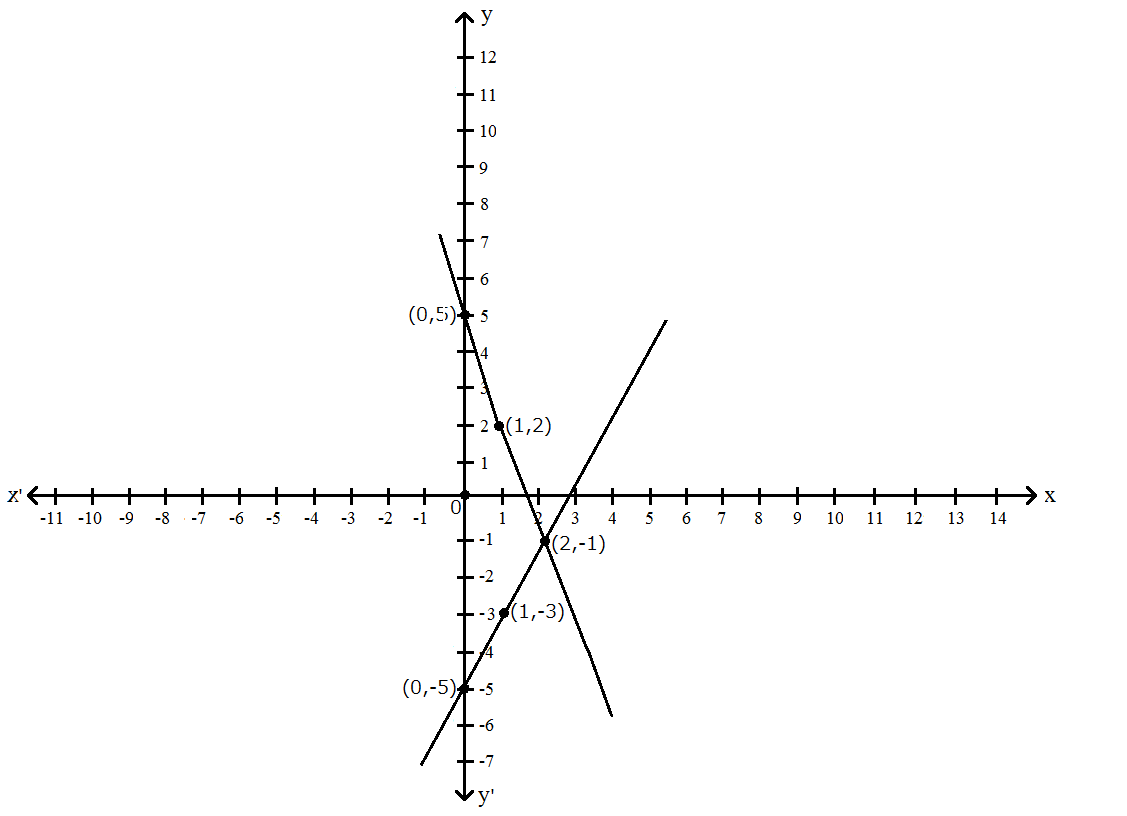
Solve graphically the following system of linear equation. Also find the coordinates of the points where the lines meet axis of y.
3x + y - 5 = 0,
2x - y - 5 = 0.
Answer
The given equations are
3x + y - 5 = 0 ........(i)
2x - y - 5 = 0 ...........(ii)
From (i), y = 5 - 3x ........(iii)
Putting x = 0 in (iii), we get y = 5
Putting x = 1 in (iii), we get y = 2
Putting x = 2 in (iii), we get y = -1
x
0
1
2
y
5
2
-1
From (ii), y = 2x - 5 ......(iv)
Putting x = 0 in (iv), we get y = -5
Putting x = 1 in (iv), we get y = -3
Putting x = 2 in (iv), we get y = -1
x
0
1
2
y
-5
-3
-1

When we solve yhese equations x = 2 and y = -1 this is the point where these lines intersect each other. (0, 5) and (0, -5) are the points where lines meeet axis of y.
View full question & answer
Question 234 Marks
In the following system of equation determine whether the system has a unique solution, no solution or infinitely many solutions. In case there is a unique solution, find it:
$x - 3y = 3$
$3x - 9y = 2$
Answer
The given system of equations may be written as,
$x - 3y - 3 = 0$
$3x - 9y - 2 = 0$
The given system of equations is of the form,
$a_1x + b_1y + c_1 = 0$
$a_2x + b_2y + c_2 = 0$
Where, $a_1 = 1, b_1 = -3, c_1 = -3$
And $a_2 = 3, b_2= -9, c_2 = -2$
We have,
$\frac{\text{a}_1}{\text{a}_2}=\frac{1}{3}$
$\frac{\text{b}_1}{\text{b}_2}=\frac{-3}{-9}=\frac{1}{3}$
And $\frac{\text{c}_1}{\text{c}_2}=\frac{-3}{-2}=\frac{3}{2}$
Clearly, $\frac{\text{a}_1}{\text{a}_2}=\frac{\text{b}_1}{\text{b}_2}\neq\frac{\text{c}_1}{\text{c}_2}$
So, the given system of equation has no solutions.
View full question & answer
Question 244 Marks
Solve the following systems of equations:
3x - 7y + 10 = 0,
y - 2x - 3 = 0.
Answer
The given equations are
3x - 7y + 10 = 0 ......(i)
y - 2x - 3 = 0 ......(ii)
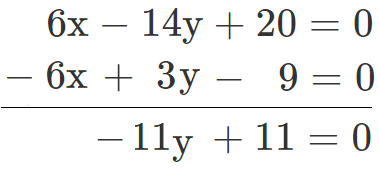
Multiply equation (i) by 2 and equation (ii) by (3), and add both equations we get.

⇒ y = 1
Put the value of y in equation (i) we get,
3x - 7 × 1 + 10 = 0
⇒ 3x = -3
⇒ x = -1
Hence the value of x = -1 and y = 1.
View full question & answer
Question 254 Marks
One says. "give me hundred, friend! I shall then become twice as rich as you" The other replies, "If you give me ten, I shall be six times as rich as you". Tell me what is the amount of their respective capital?
Answer
Let the money with first person be Rs. x and the money with the recond person be Rs. y. Then
⇒ (x + 100) = 2(y - 100)
⇒ (y + 10) = 6(x - 10)
It is given trhat if first person given Rs. 100 to second person then second person will become twice as rich as first person.
Then, according to the question.
⇒ (x + 100) = 2(y - 100)
⇒ x + 100 = 2y - 200
⇒ x - 2y + 100 + 200 = 0
⇒ x - 2y + 300 = 0 .....(i)
It is also given that if first person gives Rs. 100 to second person then the second person will become twice as rich as first person.
Then according to the question, we have
⇒ (y + 10) = 6(x - 10)
⇒ y + 10 = 6x - 60
⇒ 6x - y - 60 - 10
⇒ 6x - y - 70 = 0 .....(ii)
Now, multiplying eq. (ii) by 2 and we get
⇒ 12x - 2y - 140 = 0 .....(iii)
By subtracting eq. (iii) from eq. (i) and we get
⇒ x - 2y + 300 - (12x - 2y - 140)
⇒ x - 2y + 300 - 12x + 2y + 140 = 0
⇒ -11x + 440 = 0
⇒ 11x = 440
$\Rightarrow\text{x}=\frac{440}{11}$
⇒ x = 40
Now, Putting x = 40 in eq. (ii) and we get
6 × 40 - y - 70 = 0
⇒ 240 - y - 70 = 0
⇒ -y + 170 = 0
⇒ -y = -170
⇒ y = 170
Hence, first person's capital will be Rs. 40 recond person's capital will be Rs. 170
View full question & answer
Question 264 Marks
A boat goes 24km upstream and 28km downstream in 6 hrs. It goes 30km upstream and 21km downstream in $6\frac{1}{2}$ hrs. Find the speed of the boat in still water and also speed of the stream.
Answer
Let the speed of stream and boat in still water be y km/ hr and x km/ hr respectively.
Speed upstream = (x - y) km/ hr
Speed upstream = (x + y) km/ hr
Times taken to cover 24 km. upstream $=\frac{24}{\text{x}-\text{y}}(\text{hour})$
Times taken to cover 28 km downstream $=\frac{28}{\text{x}+\text{y}}(\text{hour})$
Total journey of 6 hours $=\frac{24}{\text{x}-\text{y}}+\frac{28}{\text{x}+\text{y}}$
$\Rightarrow6=\frac{24}{(\text{x}-\text{y})}+\frac{28}{(\text{x}+\text{y})}\ .....(\text{i})$
When total journey of $6\frac{1}{2}$ hours $=\frac{30}{(\text{x}-\text{y})}+\frac{21}{(\text{x}+\text{y})}$
$\Rightarrow\frac{13}{2}=\frac{30}{(\text{x}-\text{y})}+\frac{21}{(\text{x}+\text{y})}\ ....(\text{ii})$
Let $\frac{1}{\text{x}-\text{y}}=\text{u}$ and $\frac{1}{\text{x}+\text{y}}=\text{v}$
multiplying (iii) by 5 and (iv) by 2, we get
$\Rightarrow60\text{u}+70\text{v}=15\ ....(\text{v})$
$$$\Rightarrow60\text{u}+42\text{v}=13\ ....(\text{vi})$
Subtracting (vi) from (v) we get
$\Rightarrow28\text{v}=15-13$
$\Rightarrow28\text{v}=2$
$\Rightarrow\text{v}=\frac{1}{14}$
Putting $\text{v}=\frac{1}{14}$ in (v) we get
$\Rightarrow60\text{u}+70\times\frac{1}{14}=15$
$\Rightarrow60\text{u}+5=15$
$\Rightarrow60\text{u}=10$
$\Rightarrow\text{u}=\frac{1}{6}$
$\because\frac{1}{\text{x}-\text{y}}=\text{u}$
$\Rightarrow\frac{1}{\text{x}-\text{y}}=\frac{1}{6}$
$\text{x}-\text{y}=6\ ....(\text{vii})$
and $\frac{1}{\text{x}+\text{y}}=\text{v}$
$\Rightarrow\frac{1}{\text{x}+\text{y}}=\frac{1}{14}$
$\Rightarrow\text{x}+\text{y}=14\ .....(\text{viii})$
Adding (vii) and (viii) we get
$\Rightarrow2\text{x}=20$
$\Rightarrow\text{x}=10$
Putting x = 10 in (viii) we get
$\Rightarrow10+\text{y}=14$
$\Rightarrow\text{y}=4$
Thus, speed of stream = 4km/ hr.
And, speed of boat in still water = 10km/ hr.
View full question & answer
Question 274 Marks
Solve the following system of equations by the method of cross-multiplication:
$a^2x + b^2y = c^2$
$b^2x + a^2 y = d^2$
Answer
Given,
$a^2x + b^2y = c^2$
$b^2x + a^2 y = d^2$
To find: The solution of the systems of equation by the method of cross-multiplication:
Here we have the pair of simultaneous equation,
$a^2x + b^2y - c^2 = 0$
$b^2x + a^2y - d^2 = 0$
By cross multiplication method we get,
$\Rightarrow\frac{\text{x}}{(-\text{d}^2\text{b}^2)-(-\text{c}^2\text{a}^2)}=\frac{-\text{y}}{(-\text{d}^2\text{a}^2)-(-\text{c}^2\text{b}^2)}\\=\frac{1}{\text{a}^4-\text{b}^4}$
$\Rightarrow\frac{\text{x}}{(\text{c}^2\text{a}^2-\text{d}^2\text{b}^2)}=\frac{\text{y}}{(\text{d}^2\text{a}^2-\text{c}^2\text{b}^2)}=\frac{1}{\text{a}^4-\text{b}^4}$
Consider the following for x
$\Rightarrow \frac{\text{x}}{(\text{c}^2\text{a}^2-\text{d}^2\text{b}^2)}=\frac{1}{\text{a}^4-\text{b}^4}$
$\Rightarrow\text{x}=\frac{\text{a}^2\text{c}^2-\text{d}^2\text{b}^2}{\text{a}^4-\text{b}^2}$
Now consider the following for y
$\Rightarrow \frac{\text{y}}{(\text{d}^2\text{a}^2-\text{c}^2\text{b}^2)}=\frac{1}{\text{a}^4-\text{b}^4}$
$\Rightarrow \text{y}=\frac{\text{a}^2\text{d}^2-\text{b}^2\text{c}^2}{\text{a}^4-\text{b}^4}$
Hence, we get the value of $ \text{x}=\frac{\text{a}^2\text{c}^2-\text{b}^2\text{d}^2}{\text{a}^4-\text{b}^4}$ and $\text{y}=\frac{\text{a}^2\text{d}^2-\text{b}^2\text{c}^2}{\text{a}^4-\text{b}^4}$
View full question & answer
Question 284 Marks
7 audio cassettes and 3 video cassettes cost Rs. 1110, while 5 audio cassettes and 4 video cassettes cost Rs. 1350. Find the cost of an audio cassette and a video cassette.
Answer
Let x and y be the cost of audio and video cassettes respectively.
cost of 7 audio and 3 video cassette Rs. 1110
7x + 3y = 1110 .....(i)
Cost of 5 audion and 4 video cassettes Rs. 1350
5x + 4y = 1350 ......(ii)
Multiplying (i) by 4 and (ii) by 3, we get
28x + 12y = 4440 .....(iii)
15x + 12y = 4050 ........(iv)
Subtracting (iv) from (iii) we get
⇒ 13x = 390
$\Rightarrow\text{x}=\frac{390}{13}=30$
Putting x = 30 in (i) we get
⇒ 7 × 30 + 3y = 1110
⇒ 3y = 1110 - 210
$\Rightarrow\text{y}=\frac{900}{3}=300$
Thus cost of cassette = Rs. 30 and cost of video cassette = Rs. 300
View full question & answer
Question 294 Marks
Solve the following systems of equations:
23x - 29y = 98,
29x - 23y = 110.
Answer
The given equations are
23x - 29y = 98 .......(i)
29x - 23y = 110 .......(ii)
Adding (i) and (ii) we get
⇒ 52x - 52y = 208
⇒ x - y = 4 .......(iii)
Subtracting (i) from (ii) we get
⇒ 6x + 6y = 12
⇒ x + y = 2 ........(iv)
Adding (iii) and (iv) we get
⇒ 2x = 6
⇒ x = 3
Putting x = 3 in (iv) we get
⇒ 3 + y = 2
⇒ y = -1
Thus, x = 3 and y = -1.
View full question & answer
Question 304 Marks
Solve the following systems of equations:
11x + 15y + 23 = 0,
7x - 2y - 20 = 0.
Answer
The given equations are
11x + 15y + 23 = 0 ......(i)
7x - 2y - 20 = 0 .......(ii)
From (i), we get
$\text{y}=\frac{-23-11\text{x}}{15}\ .....(\text{iii})$
Putting the values of y from (iii) to (ii), we get
$\Rightarrow\text{7}\text{x}-2\Big(\frac{-23-11\text{x}}{15}\Big)-20=0$
$\Rightarrow105\text{x}+46+22\text{x}-300=0$
$\Rightarrow127\text{x}-254=0$
$\Rightarrow\text{x}=\frac{254}{127}$
$\Rightarrow\text{x}=2$
Putting x = 2 in (iii), we get
$\Rightarrow\text{y}=\frac{-23-11\times2}{15}$
$\Rightarrow\frac{-45}{15}$
$\Rightarrow\text{y}=-3$
Thus, x = 2 and y = -3.
View full question & answer
Question 314 Marks
Solve the following system of equations by the method of cross-multiplication:
$x + ay = b,$
$ax - by = c.$
Answer
The given system of equations by be written as
$x + ay - b = 0$
$ax - by - c = 0$
Here $a_1 = 1, b_1 = a, c_1 = -b$
$a_2= a, b_2 = -b$ and $c_2 = -c$
$\Rightarrow\ \frac{\text{x}}{\text{a}\times(-\text{c})-(-\text{b})\times(-\text{b})}=\frac{-\text{y}}{1\times(-\text{c})-(-\text{b})\times\text{a}}\\=\frac{1}{1\times(-\text{b})-\text{a}\times\text{a}}$
$\Rightarrow\ \frac{\text{x}}{-\text{a}\text{c}-\text{b}^2}=\frac{-\text{y}}{-\text{c}+\text{ab}}=\frac{1}{-\text{b}-\text{a}^2}$
Now, $\frac{\text{x}}{-\text{ac}-\text{b}^2}=\frac{1}{-\text{b}-\text{a}^2}$
$\Rightarrow\ \text{x}=\frac{-\text{ac}-\text{b}^2}{-\text{b}-\text{a}^2}$
$\Rightarrow\ \text{x}=\frac{-(\text{b}^2+\text{ac})}{-(\text{a}^2+\text{b})}$
and $\frac{-\text{y}}{-\text{c}+\text{ab}}=\frac{1}{-\text{b}-\text{a}^2}$
$\Rightarrow\ -\text{y}\frac{\text{ab}-\text{c}}{-(\text{a}^2+\text{b})}$
$\Rightarrow\ \text{y}=\frac{\text{ab}-\text{c}}{\text{a}^2+\text{b}}$
Hence, $\text{x}=\frac{\text{ac}+\text{b}^2}{\text{a}^2+\text{b}},\text{y}=\frac{\text{ab}-\text{c}}{\text{a}^2+\text{b}}$ is the solution of the given system the equations.
View full question & answer
Question 324 Marks
The present age of a father is three years more than three times the age of the son. Three years hence father's age will be 10 years more than twice the age of the son. Determine their present ages.
Answer
Let the present age of father be x years and the present age of his son be y years.
The present age of father is three years more than three times the age of the son. Thus, we have
x = 3y + 3
⇒ x - 3y - 3 = 0
After 3 years, father's age will be (x + 3) years and son’s age will be (y + 3) years.
Thus using the given information, we have
x + 3 = 2(y + 3) + 10
⇒ x + 3 = 2y + 6 + 10
⇒ x - 2y - 13 = 0
Here x and y are unknowns. We have to solve the above equations for x and y.
By using cross-multiplication, we have
$\Rightarrow\frac{\text{x}}{(-3)\times(-13)-(-2)\times(-3)}=\frac{-\text{y}}{1\times(-13)-1\times(-3)}\\=\frac{1}{1\times(-2)-1\times(-3)}$
$\Rightarrow\frac{\text{x}}{39-6}=\frac{-\text{y}}{-13+3}=\frac{1}{-2+3}$
$\Rightarrow\frac{\text{x}}{33}=\frac{-\text{y}}{-10}=\frac{1}{1}$
$\Rightarrow\frac{\text{x}}{33}=\frac{\text{y}}{10}=1$
$\Rightarrow\text{x}=33,\ \text{y}=10$
Hence, the present age of father is 33 years and the present age of son is 10 years.
View full question & answer
Question 334 Marks
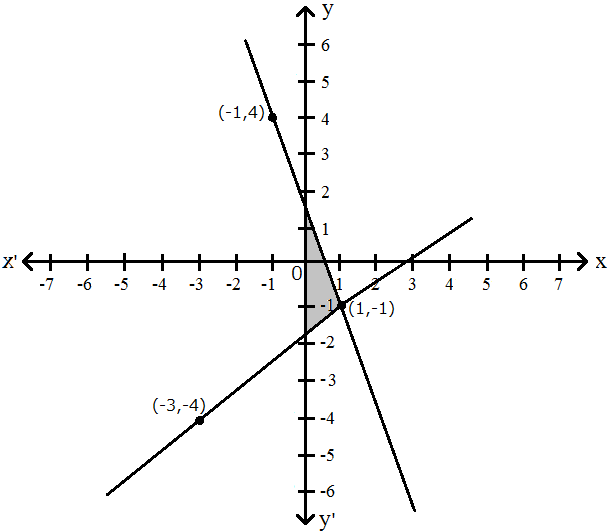
Solve the following system of equations graphically:
Shade the region between the lines and the y-axis.
3x - 4y = 7,
5x + 2y = 3.
Answer
The given equations are,
3x - 4y = 7 ......(i)
5x + 2y = 3 ........(ii)
From (i), $\text{y}=\frac{3\text{x}-7}{4}\ .....(\text{iii})$
Putting x = -3 in equations (iii), we get y = -4
Putting x = 1 in equations (ii), we get y = -1
x
-3
1
y
-4
-1

From (ii), $\text{y}=\frac{3-5\text{x}}{2}\ ......(\text{iv})$
Putting x = 1 in equations (ii), we get y = -1
Putting x = -1 in equations (ii), we get y = 4
x
1
-1
y
-1
4
Clearly, from the graph that these two lines intersect each other at point (1, -1) so solution of these equation x = 1 and y = -1.
View full question & answer
Question 344 Marks
Solve the following systems of equations graphically:
2x + 3y = 4
x - y + 3 = 0
Answer
The given equations are,
2x + 3y = 4 ......(i)
x - y + 3 = 0 ........(ii)
Putting x = 0 in equation (i), we get,
⇒ 2 × 0 + 3y = 4
$\Rightarrow\text{y}=\frac{4}{3}$
$\Rightarrow\text{x}=0,\ \text{y}=\frac{4}{3}$
Putting y = 0 in equation (i), we get,
⇒ 2x + 3 × 0 = 4
⇒ x = 2
⇒ x = 2, y = 0
Use the following table to draw the graph.
X
0
2
Y
$\frac{4}{3}$
0
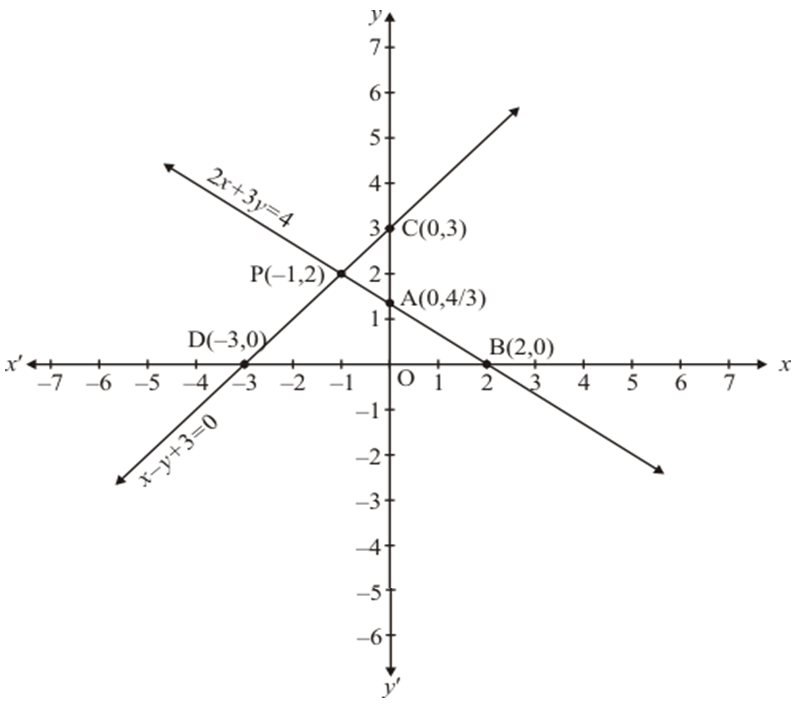
Draw the graph by plotting the two points $\text{A}\Big(0, \frac{4}{3}\Big)$ and B(2, 0) from table.

Graph of the equation,
⇒ x - y = -3 ........(ii)
Putting x = 0 in equation (ii), we get,
⇒ 0 - y = -3
⇒ y = 3
⇒ x = 0, y = 3
Putting y = 0 in equation (ii), we get,
⇒ x - 0 = -3
⇒ x = -3
⇒ x = -3, y = 0
Use the following table to draw the graph.
x
0
-3
y
3
0
Draw the graph by plotting the two points C(0, 3) and D(-3, 0) from table.
The two lines intersect at points P(-1, 2).
Hence, x = -1 and y = 2 is the solution.
View full question & answer
Question 354 Marks
Solve the following systems of equations:
$\text{x}+\text{y}=2\text{xy},$
$\frac{\text{x}-\text{y}}{\text{xy}}=6,\text{x}\neq0,\text{y}\neq0.$
Answer
The system of the given equation is
$\text{x}+\text{y}=2\text{xy}\ ......(\text{i})$
And, $\frac{\text{x}-\text{y}}{\text{xy}}=6$
$\text{x}-\text{y}=6{\text{xy}}\ ......(\text{ii})$
Adding equation (i) and equation (ii) we get
$2{\text{x}}=2{\text{xy}}+6{\text{xy}}$
$\Rightarrow2{\text{x}}=8{\text{xy}}$
$\Rightarrow\frac{2{\text{x}}}{8{\text{x}}}={\text{y}}$
$\Rightarrow{\text{y}}=\frac{1}{4}$
Putting ${\text{y}}=\frac{1}{4}$ in equation (i) we get
${\text{x}}+\frac{1}{4}=2{\text{x}}\times\frac{1}{4}$
$\Rightarrow{\text{x}}+\frac{1}{4}=\frac{\text{x}}{2}$
$\Rightarrow{\text{x}}-\frac{\text{x}}{2}=\frac{-1}{4}$
$\Rightarrow\frac{2\text{x}-\text{x}}{2}=\frac{-1}{4}$
$\Rightarrow{\text{x}}=\frac{-2}{4}=\frac{-1}{2}$
Hence, solution of the given system of equation is ${\text{x}}=\frac{-1}{2},\text{y}=\frac{1}{4}.$
View full question & answer
Question 364 Marks
If $x + 1$ is a factor of $2x^3 + ax^2 + 2bx + 1$, then find the values of a and b given that $2a - 3b = 4$.
Answer
Given that $(x + 1)$ is a factor of $f(x) = 2(x)^3 + ax^2 + 2bx + 1$, then $f(-1) = 0$
[if $(\text{x}+\alpha)$ is a factor of $f(x) = ax^2 + bx + c$, then $f(-) = 0$]
$\Rightarrow 2(-1)^3 + a(-1)^2 + 2b(-1) + 1 = 0$
$\Rightarrow -2 + a - 2b + 1 =0$
$\Rightarrow a - 2b - 1 = 0 .....(i)$
Also, $2a - 3b = 4$
$\Rightarrow 3b = 2a - 4$
$\Rightarrow\text{b}=\Big(\frac{2\text{a}-4}{3}\Big)$
Now, put the value of b in eq. (i) qe get
$\text{a}-2\Big(\frac{2\text{a}-4}{3}\Big)-1=0$
$\Rightarrow 3a - 2(2a - 4) - 3 = 0$
$\Rightarrow 3a - 4a + 8 - 3 = 0$
$\Rightarrow -a + 5 = 0$
$\Rightarrow a = 5$
Now put the value of a in eq (i) we get
$5 - 2b - 1 = 0$
$\Rightarrow 2b = 4$
$\Rightarrow b = 2$
Hence the required value of a and b are $5$ and $2$ respectively.
View full question & answer
Question 374 Marks
The sum of two numbers is $1000$ and the difference between their squares is $256000$. Find the numbers.
Answer
Let the numbers are x and y. One of them must be greater than or equal to the other. Let us assume that x is greater than or equal to y.
The sum of the two numbers is 1000. Thus, we have x + y = 1000
The difference between the squares of the two numbers is 256000. Thus, we have
$x^2 - y^2 = 256000$
$\Rightarrow (x + y)(x - y) = 256000$
$\Rightarrow 1000(x - y) = 256000$
$\Rightarrow\text{x}-\text{y}=\frac{256000}{1000}$
$\Rightarrow x - y = 256$
So, we have two equations
$x + y = 1000$
$x - y = 256$
Here x and y are unknowns. We have to solve the above equations for x and y.
Adding the two equations, we have
$(x + y) + (x - y) = 1000 + 256$
$\Rightarrow x + y + x - y = 1256$
$\Rightarrow 2x = 1256$
$\Rightarrow\text{x}=\frac{1256}{2}$
$\Rightarrow x = 628$
Substituting the value of x in the first equation, we have
$628 + y = 1000$
$\Rightarrow y = 1000 - 628$
$\Rightarrow y = 372$
Hence, the numbers are $628$ and $372$.
View full question & answer
Question 384 Marks
A train covered a certain distance at a uniform speed. If the train could have been 10km/hr. faster, it would have taken 2 hours less than the scheduled time. And, if the train were slower by 10km/hr. it would have taken 3 hours more than the scheduled time. Find the distance covered by the train.
Answer
Let the actual speed of the train be x km/hr. and the actual time taken by y hours. Then,
Distance = Speed × Time
Distance covered = (xy) km .....(i)
If the speed is increased by 10km/ hr. then time of journey is reduced by 2 hours When speed is (x + 10) km/hr. time of journey is (y - 2) hours
Distance coverd = (x + 10) (y - 2)
xy = (x + 10) (y - 2)
xy = xy + 10y - 2x - 20
-2x + 10y - 20 = 0
-2x + 3y - 12 = 0 ......(ii)
When the speed is reduced by 10km/hr, then the time of journey is increased by 3 hours when sped is (x - 10) km/hr. times of journey is (y + 3) hours
$\therefore$ Distance covered = (x - 10) (y + 3)
xy = (x - 10) (y + 3)
xy = xy - 10y + 3x - 30
0 = -10y + 3x - 30
3x - 10y - 30 = 0 ......(iii)
Thus we obtain the following system of equations:
-x + 5y - 10 = 0
3x - 10y - 30 = 0
By using cross-multiplication we have
$\Rightarrow\frac{\text{x}}{5\text{x}-30-(-10)\times-10}=\frac{-\text{y}}{(-1\times-30)-(3\text{x}-10)}\\=\frac{1}{(-1\times-10)-(3\times5)}$
$\Rightarrow\frac{\text{x}}{-150-100}=\frac{-\text{y}}{30+30}=\frac{1}{10-15}$
$\Rightarrow\frac{\text{x}}{-250}=\frac{-\text{y}}{60}=\frac{1}{-5}$
$\Rightarrow\text{x}=\frac{-250}{-5}$
$\Rightarrow\text{x}=50$
$\Rightarrow\text{y}=\frac{-60}{-5}$
$\Rightarrow\text{y}=12$
Putting the value os x and y in equation (i) we get
Distance = xy km
= 50 × 12
= 600km
Hence, the length of the journey is 600km.
View full question & answer
Question 394 Marks
A sailor goes 8km downstream in 40 minutes and returns in 1 hours. Determine the speed of the sailor in still water and the speed of the current.
Answer
Let the speed of the sailor in still water be x km/hr and the spped of the current be y km/hr.
Then,
Speed downstream = (x + y) km/hr
Speed in return journey = (x - y) km/hr
Now, Time taken cover 8km downstream $=\frac{8}{\text{x}+\text{y}}\text{hrs.}$
But, Time taken to cover 8km downstream is 40 minutes
$\Rightarrow\frac{8}{\text{x}+\text{y}}=\frac{40}{60}$
$\Rightarrow\frac{8}{\text{x}+\text{y}}=\frac{2}{3}$
$\Rightarrow\frac{8\times3}{2}=\text{x}+\text{y}$
$\Rightarrow4\times3=\text{x}+\text{y}$
$\Rightarrow\text{x}+\text{y}=12\ ....(\text{i})$
and, Times taken in return journey $=\frac{8}{\text{x}-\text{y}}\text{km/hr}$
But Time taken in return journey is 1 hour
$=\frac{8}{\text{x}-\text{y}}=1$
$\Rightarrow\text{x}-\text{y}=8\ .....(\text{ii})$
Adding equation (i) and equation (ii) we get
$2\text{x} = 12 + 8$
$\Rightarrow2\text{x} = 20$
$\Rightarrow\text{x}=\frac{20}{2}=10$
Putting x = 10 in equation (i) we get
$10+\text{y}=12$
$\Rightarrow\text{y}=12-10$
$\Rightarrow\text{y}=2$
Hence, speed of the sailor in still water = 10km/hr
Speed of the current = 2km/hr.
View full question & answer
Question 404 Marks
Determine the values of a and b so that the following system of linear equations have infinitely many solutions:
$(2a - 1)x + 3y - 5 = 0$
$3x + (b - 1)y - 2 = 0$
Answer
The given system of equations may be written as
$(2a - 1)x + 3y - 5 = 0$
$3x + (b - 1)y - 2 = 0$
It is of the form
$a_1x + b_1y + c_1 = 0$
$a_2x + b_2y + c_2 = 0$
Where, $a_1 = 2a - 1, b_1 = 3, c_1 = -5$
And $a_2 = 3, b_2 = b - 1, c_2 = -2$
The given system of equations will have infinite number of solutions, if
$\frac{\text{a}_1}{\text{a}_2}=\frac{\text{b}_1}{\text{b}_2}=\frac{\text{c}_1}{\text{c}_2}$
$\Rightarrow\frac{2\text{a}-1}{3}=\frac{3}{\text{b}-1}=\frac{-5}{-2}$
$\Rightarrow\frac{2\text{a}-1}{3}=\frac{-5}{-2}$ and $\frac{3}{\text{b}-1}=\frac{-5}{-2}$
$\Rightarrow2(2\text{a}-1)=5\times3$ and $3\times2=5(\text{b}-1)$
$\Rightarrow4\text{a}-2=15$ and $6 = 5\text{b}-5$
$\Rightarrow4\text{a}=15+2$ and $6+5=5\text{b}$
$\Rightarrow\text{a}=\frac{17}{4}$ and $\text{b}=\frac{11}{5}$
Hence the given system of equations will have infinitely many solutions, if $\text{a}=\frac{17}{4}$ and $\text{b}=\frac{11}{5}$
View full question & answer
Question 414 Marks
Ramesh travels 760km to his home partly by train and partly by car. He takes 8 hours if he travels 160km. by train and the rest by car. He takes 12 minutes more if the travels 240km by train and the rest by car. Find the speed of the train and car respectively.
Answer
Let speed of train and car be x km/ hr. and y km/ hr.
According to question
$\frac{160}{\text{x}}+\frac{600}{\text{y}}=8\ ....(\text{i})$
$\frac{240}{\text{x}}+\frac{520}{\text{y}}=8+\frac{12}{60}$
$\frac{240}{\text{x}}+\frac{520}{\text{y}}=\frac{41}{5}\ .....(\text{ii})$
Let $\frac{1}{\text{x}}=\text{u}$ and $\frac{1}{\text{y}}=\text{v}$
$\Rightarrow160\text{u}+600\text{v}=8$
$\Rightarrow20\text{u}+75\text{v}=1\ .....(\text{iii})$
$\Rightarrow240+520=\frac{41}{5}\ .....(\text{iv})$
Multiplying (3) by 12 we get
$\Rightarrow240\text{u}+900\text{v}=12\ .....(\text{v})$
subtracting (iv) from (v) we get
$\Rightarrow380\text{v}=\frac{19}{5}$
$\Rightarrow\text{v}=\frac{1}{100}$
Putting $\frac{1}{100}$ in (v) we get
$\Rightarrow240\text{u}+900\times\frac{1}{100}=12$
$\Rightarrow240\text{u}+9=12$
$\Rightarrow240\text{u}=3$
$\Rightarrow\text{u}=\frac{3}{240}=\frac{1}{80}$
$\because\frac{1}{\text{x}}=\text{u}$
$\Rightarrow\text{x}=\frac{1}{\text{u}}=80\text{km/ hr.}$
and, $\frac{1}{\text{y}}=\text{v}$
$\Rightarrow\text{y}=\frac{1}{\text{v}}=100\text{km/ hr.}$
Thus, speed of train = 80km/ hr.
and, speed of car = 100km/ hr.
View full question & answer
Question 424 Marks
Draw the graphs of the following equations:
2x - 3y + 6 = 0
2x + 3y - 18 = 0
y - 2 = 0
Find the vertices of the triangle so obtained. Also, find the area of the triangle.
Answer
The given system of equations is
2x - 3y + 6 = 0
2x + 3y - 18 = 0
y - 2 = 0
Now, 2x - 3y + 6 = 0
⇒ 2x = 3y - 6
$\Rightarrow\text{x}=\frac{3\text{y}-6}{2}$
When y = 0, we have
$\text{x}=\frac{3\times0-6}{2}=-3$
When y = 2, we have
$\text{x}=\frac{3\times2-6}{2}=0$
Thus, we have the following table
x
-3
0
y
0
2
We have,
2x + 3y - 18 = 0
⇒ 2x = 18 - 3y
$\Rightarrow\text{x}=\frac{18-3\text{y}}{2}$
When y = 2, we have
$\Rightarrow\text{x}=\frac{18-3\times2}{2}=6$
When y = 6, we have
$\text{x}=\frac{18-3\times6}{2}=0$
Thus, we have the following table.
x
6
0
y
2
6
We have,
y - 2 = 0
⇒ y = -2
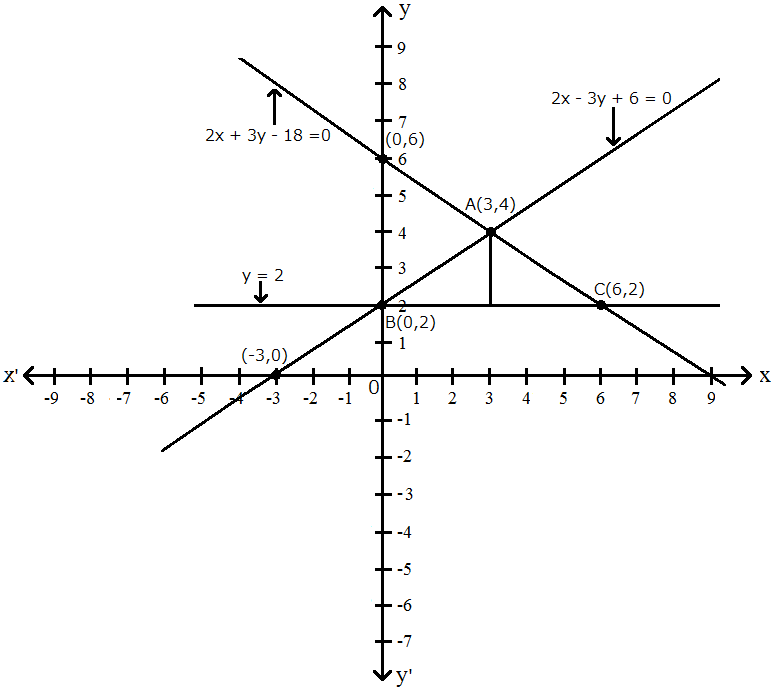
Graph of the given system of equations.

From the graph of the three equations, we find that the three lines taken in pairs intersect each other at points A(3, 4), B(0, 2) and C(6, 2).
Hence, the vertices of the required triangle are (3, 4), (0, 2) and (6, 2).
From graph, we have
AD = 4 - 2 = 2
BC = 6 - 0 = 6
Area of $\triangle\text{ABC}=\frac{1}{2}\text{(Base} \times \text{Height)}$
$=\frac{1}{2}\times\text{BC}\times\text{AD}$
$=\frac{1}{2}\times6\times2$
$=6\text{ sq.units.}$
$\therefore$ Area of $\triangle\text{ABC}=6\text{sq.units}.$
View full question & answer
Question 434 Marks
Solve graphically the following system of linear equation. Also find the coordinates of the points where the lines meet axis of y.
2x + y - 11 = 0,
x - y - 1 = 0.
Answer
The given equations are
2x + y - 11 = 0 ........(i)
x - y - 1 = 0 ...........(ii)
From (i), y = 11 - 2x .......(iii)
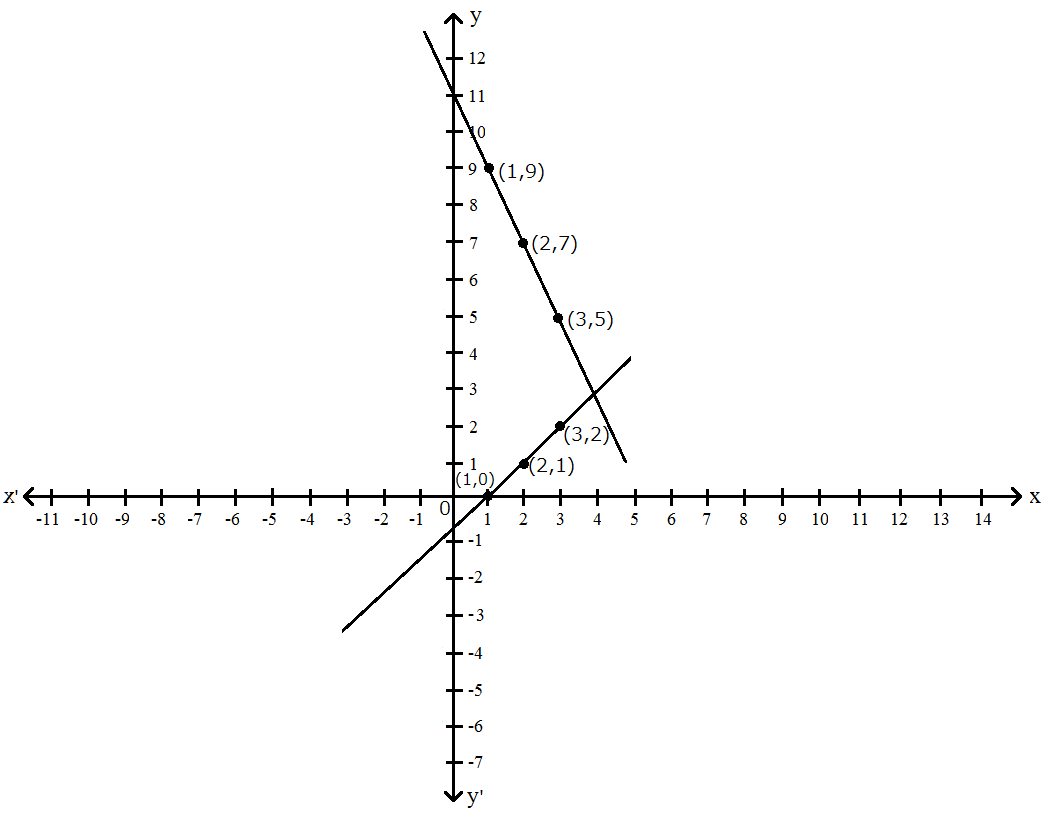
Putting x = 1 in (iii), we get y = 9
Putting x = 2 in (iii), we get y = 7
Putting x = 3 in (iii), we get y = 5
x
1
2
3
y
9
7
5
From (ii), x - y - 1 = 0 .......(iv)
y = x - 1
Putting x = 1 in (iv), we get y = 0
Putting x = 2 in (iv), we get y = 1
Putting x = 3 in (iv), we get y = 2
x
1
2
3
y
0
1
2

When we solv4e these equations x = 4 and y = 3, this is the point where these lines intersect each other. (0, -1) abd (0, 11) are the points where the lines mut axis of y.
View full question & answer
Question 444 Marks
2 women and 5 men can together finish a piece of embroidery in 4 days, while 3 women and 6 men can finish it in 3 days. Find the time taken by 1 woman alone to finish the embroidery, and that taken by 1 man alone.
Answer
Let one women alone can finish the work in x days and one men can finish the work in y days. then,
One women one days's work $=\frac{1}{\text{x}}$
One man one day's work $=\frac{1}{\text{y}}$
2 women's one day's work $=\frac{2}{\text{x}}$
5 man's one day's work $=\frac{5}{\text{y}}$
Since, 2 women and 5 men can finish the work in 4 works
$\Rightarrow 4\Big(\frac{2}{\text{x}}+\frac{5}{\text{y}}\Big)=1$
$\Rightarrow\frac{8}{\text{x}}+\frac{20}{\text{y}}=1.....(\text{i})$
3 women and 6 men can finish the work in 3 days.
$\Rightarrow 3\Big(\frac{3}{\text{x}}+\frac{6}{\text{y}}\Big)=1$
$\Rightarrow\frac{9}{\text{x}}+\frac{18}{\text{y}}=1.....(\text{iii})$
Putting $\frac{1}{\text{x}}=\text{u}$ and $\frac{1}{\text{y}}=\text{v}$ in eq. (i) and eq. (ii) and we get
By using cross multiplication we have
$\Rightarrow \frac{\text{u}}{20\times(-1)-(18)\times(-1)}=\frac{\text{-v}}{8\times(-1)-9\times(-1)}\\=\frac{1}{(8\times18)-(9\times20)}$
$\Rightarrow\frac{\text{u}}{-20+18}=\frac{\text{-v}}{-8+9}=\frac{1}{144-180}$
$\Rightarrow \frac{\text{u}}{-2}=\frac{\text{-v}}{1}=\frac{1}{-36}$
$\Rightarrow \frac{\text{u}}{-2}=\frac{1}{-36}$
$\Rightarrow \text{u}=\frac{-2}{-36}=\frac{1}{18}$
$\Rightarrow \frac{\text{-v}}{1}=\frac{1}{-36}$
$\Rightarrow \text{v}=\frac{1}{36}$
$\Rightarrow \frac{1}{\text{x}}=\frac{1}{18}$
$\Rightarrow\text{x}=18$
$\Rightarrow \text{v}=\frac{1}{36}$
$\Rightarrow\text{y}=36$
Hence, the time taken by 1 women alone to finish the embroidery is 36 days. The time taken by 1 man alone to finish the embroidery is 18 days.
View full question & answer
Question 454 Marks
Form the pair of linear equations in the following problems, and find their solution graphically:
10 students of class X took part in Mathematics quiz. If the number of girls is 4 more than the number of boys, find the number of boys and girls who took part in the quiz.
Answer
Let the number of girls and boys in the class be x and y respectively.
According to the given conditions, we have,
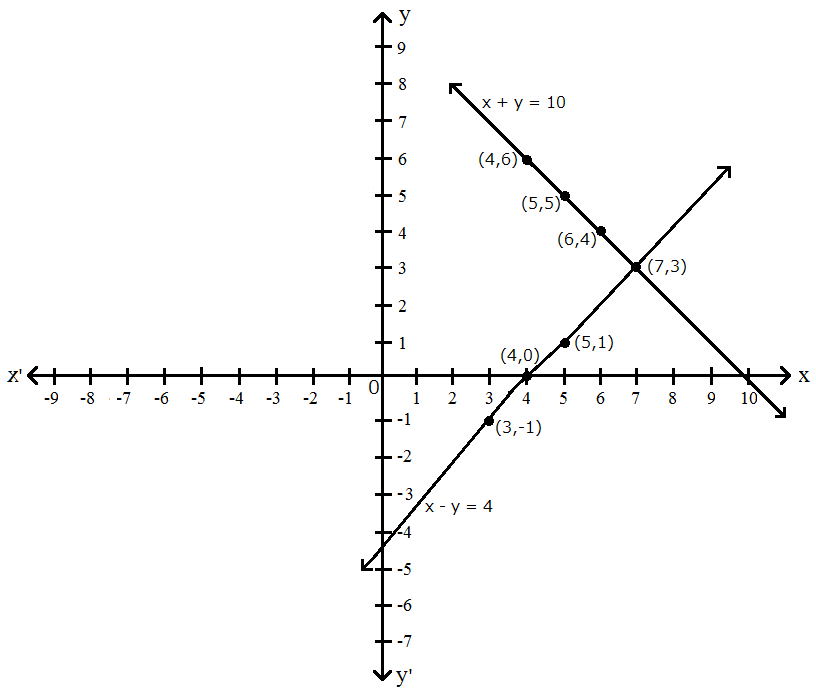
x + y = 10
x - y = 4
x + y = 10
⇒ x = 10 - y
Three solutions of this equations can be written in a table as follows,
x
4
5
6
y
6
5
4
x - y = 4
⇒ x = 4 + y
Three solutions of this equation can be written in a table as follows.
x
5
4
3
y
1
0
-1
The graphical representation is as follows.

From the graph, it can be observes that the two lines intersect each other at the point (7, 3). So. x = 7 and y = 3. Thus the number of girls and boys in the class are 7 and 3 respectively.
View full question & answer
Question 464 Marks
Solve the following systems of equations:
$\frac{6}{\text{x}+\text{y}}=\frac{7}{\text{x}-\text{y}}+3$
$\frac{1}{2(\text{x}+\text{y})}=\frac{1}{3(\text{x}-\text{y})}$ where $\text{x}+\text{y}\neq0$ and $\text{x}-\text{y}\neq0.$
Answer
Let $\frac{1}{\text{x}+\text{y}}=\text{u}$ and $\frac{1}{\text{x}-\text{y}}=\text{v}$
$6\text{u}-7\text{v}-3=0\ .....(\text{i})$
$\frac{\text{u}}{2}=\frac{\text{v}}{3}$
$3\text{u}=2\text{v}$
$3\text{u}-2\text{v}=0$
Maltiplying by 2
$6\text{u}-4\text{v}=0\ ...(\text{iii})$
Now substracting (iii) from (i) we get
$-7\text{v}+4\text{v}=3$
$\text{v}=-1$
Putting v = -1 in equation (iii)
$6\text{u}+4=0$
$\text{u}=\frac{-2}{3}$
$\because\frac{1}{\text{x}+\text{y}}=\frac{-2}{3}$
$2\text{x}+2\text{y}=-3\ ...(\text{iv})$
and $\frac{1}{\text{x}-\text{y}}=-1$
$\text{x}-\text{y}=-1\ ...(\text{v})$
Multiplying (v) by 2 and adding with (iv)
$2\text{x}+2\text{y}=-3\\\underline{2\text{x}-2\text{y}=-2}\\4\text{x}\ \ \ \ \ \ \ \ \ =-5$
$\text{x}=\frac{-5}{4}$
and $\text{y}=\frac{-5}{4}+1$
$\text{y}=\frac{-1}{4}$
View full question & answer
Question 474 Marks
Two years ago, a father was five times as old as his son. Two year later, his age will be 8 more than three times the age of the son. Find the present ages of father and son.
Answer
Let the present age of father be x years and the present age of his son be y years.
After 2 years, father’s age will be (x + 2) years and the age of son will be (y + 2) years.
Thus using the given information, we have
x + 2 = 3(y + 2) + 8
⇒ x + 2 = 3y + 6 + 8
⇒ x - 3y - 12 = 0
Before 2 years, the age of father was (x - 2) years and the age of son was (y - 2) years.
Thus using the given information, we have
(x - 2) = 5(y - 2)
⇒ x - 2 = 5y - 10
⇒ x - 5y + 8 = 0
So, we have two equations
x - 3y - 12 = 0
x - 5y + 8 = 0
Here x and y are unknowns. We have to solve the above equations for x and y.
By using cross-multiplication, we have
$\Rightarrow\frac{\text{x}}{(-3)\times8-(-5)\times(-12)}=\frac{-\text{y}}{1\times8-1\times(-12)}\\=\frac{1}{1\times(-5)-1\times(-3)}$
$\Rightarrow\frac{\text{x}}{-24-60}=\frac{-\text{y}}{8+12}=\frac{1}{-5+3}$
$\Rightarrow\frac{\text{x}}{-84}=\frac{-\text{y}}{20}=\frac{1}{-2}$
$\Rightarrow\frac{\text{x}}{84}=\frac{\text{y}}{20}=\frac{1}{2}$
$\Rightarrow\text{x}=\frac{84}{2},\ \text{y}=\frac{20}{2}$
$\Rightarrow\text{x}=42,\ \text{y}=10$
Hence the present age of father is 42 years and the present age of son is 10 years.
View full question & answer
Question 484 Marks
Solve the following systems of equations:
$\frac{\text{x}}{3}+\frac{\text{y}}{4}=11,$
$\frac{5\text{x}}{6}-\frac{\text{y}}{3}=-7.$
Answer
The given system of equation is
$\frac{\text{x}}{3}+\frac{\text{y}}{4}=11\ .......(\text{i})$
$\frac{5\text{x}}{6}-\frac{\text{y}}{3}=-7\ .......(\text{ii})$
From (i), we get
$\frac{4\text{x}+3\text{y}}{12}=11$
$\Rightarrow4\text{x}+3\text{y}=132\ ......(\text{iii})$
From (ii), we get
$\frac{5\text{x}-2\text{y}}{6}=-7$
$\Rightarrow5\text{x}-2\text{y}=-42\ ......(\text{iv})$
Let us eliminate y from the given equations. The co-efficients of y in the equations (iii) and (iv) are 3 and 2 respectively. The L.C.M of 3 and 2 is 6. so, we make the co-efficient of y equal to 6 in the two equations.
Multiplying (iii) by 2 and (iv) by 3, we get
8x + 6y = 264 .......(v)
15x - 6y = -126 .......(vi)
Adding (v) and (vi), we get
8x + 15x = 264 - 126
⇒ 23x = 138
$\Rightarrow\text{x}=\frac{138}{23}=6$
substituting x = 6 in (iii), we get
4 × 6 + 3y = 132
⇒ 3y = 132 - 24
⇒ 3y = 108
$\Rightarrow\text{y}=\frac{108}{3}=36$
Hence, the solution of the given system of equations is x = 6, y = 36.
View full question & answer
Question 494 Marks
Determine, graphically, the vertices of the triangles formed by the lines y = x, 3y = x, x + y = 8.
Answer
Given linear equations are y = x ......(i) 3y = x .....(ii) and x + y = 8 ......(iii) For equation y = x, If x = 1, then y = 1 If x = 0, then y = 0 If x = 2, then y = 2 Table for line y = x,
x
0
1
2
y
0
1
2
Points
O
A
B
For equation x = 3y If x = 0, then y = 0, if x = 3, then y = 1 and if x = 6, then y = 2 Table for line x = 3y,
x
0
3
6
y
0
1
2
Points
O
C
D
For equation, If x = 0, then y = 8 if x = 8, then y = 0 and if x = 4, then y = 4 Table for line x + y = 8,
x
0
4
8
y
8
4
0
Points
P
Q
R
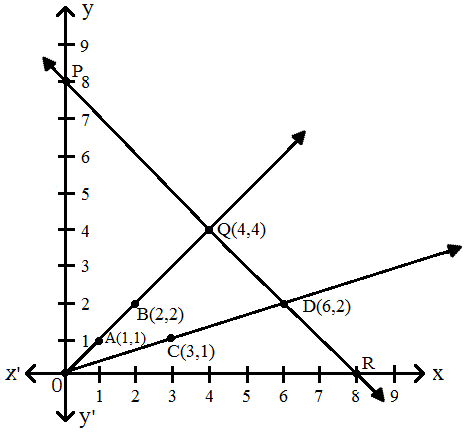
Plotting the points A(1, 1) and B(2,2), we get the straight line AB. Plotting the points C(3, 1) and D(6, 2), we get the straight line CD. Plotting the points P(0, 8), Q(4, 4) and R(8, 0), we get the straight line PQR. We see that lines AB and CD intersecting the line PR on Q and D, respectively. So, ∆OQD is formed by these lines. Hence, the vertices of the ∆OQD formed by the given lines are O(0, 0), Q(4, 4) and D(6, 2).
View full question & answer
Question 504 Marks
A motor boat can travel 30km upstream and 28km downstream in 7 hours. It can travel 21km upstream and return in 5 hours. Find the speed of the boat in still water and the speed of the stream.
Answer
Let the speed of the motorboat in still water and the speed of the stream are u km/ h and v km/ h, respectively.
Then, a motorboat speed in downstream = (u + v) km/ hr and a motorboat speed in upstream = (u - v) km/ hr. Motorboat has taken time to travel 30 km upstream,
$\text{t}_1=\frac{30}{\text{u}-\text{v}}\text{h}.$
and motorboat has taken time to travel 28km downstream,
$\text{t}_2=\frac{28}{\text{u}+\text{v}}\text{h.}$
By first condition, a motorboat can travel 30km upstream and 28km downstream in 7 h.
i. e., $\text{t}_1+\text{t}_2=7\text{h.}$
$\Rightarrow\frac{30}{\text{u}-\text{v}}+\frac{28}{\text{u}+\text{v}}=7\ ....(\text{i})$
Now, motorboat has taken time to travel 21km upstream and return
i. e., $\text{t}_3=\frac{21}{\text{u}-\text{v}}$ [for upstream]
and $\text{t}_4=\frac{21}{\text{u}+\text{v}}$ [for downstream]
By second condition, $\text{t}_4+\text{t}_3=5\text{h.}$
$\Rightarrow\frac{21}{\text{u}+\text{v}}+\frac{21}{\text{u}-\text{v}}=5\ .....(\text{ii})$
Let $\text{x}=\frac{1}{\text{u}+\text{v}}$ and $\text{y}=\frac{1}{\text{u}-\text{v}}$
eqs. (i) and (ii) becomes
$30\text{x}+28\text{y}=7\ ....(\text{iii})$
and $21\text{x}+21\text{y}=5$
$\Rightarrow\text{x}+\text{y}=\frac{5}{21}\ .....(\text{iv})$
Now, multiplying in eq. (iv) by 28 and then subtracting from eq. (iii) we get
$\ \ \ \ \ 30\text{x}+28\text{y}=\ \ \ 7\ \ \ \ \ \ \ \\\ \ \ \ \ 28\text{x}+28\text{y}=\frac{140}{21}\\\underline{ \ \ -\ \ \ \ -\ \ \ \ \ \ \ \ -\ \ \ \ \ \ \ \ \ }\\\ \ \ \ \ \ 2\text{x}\ \ \ \ \ \ \ \ \ \ \ \ =7-\frac{20}{3}$
$=\frac{21-20}{3}$
$\Rightarrow2\text{x}=\frac{1}{3}$
$\Rightarrow\text{x}=\frac{1}{6}$
On putting the value of x in eq. (iv) we get
$\frac{1}{6}+\text{y}=\frac{5}{21}$
$\Rightarrow\text{y}=\frac{5}{21}-\frac{1}{6}$
$=\frac{10-7}{42}=\frac{3}{42}$
$\Rightarrow\text{y}=\frac{1}{14}$
$\therefore\text{x}=\frac{1}{\text{u}+\text{v}}=\frac{1}{6}$
$\Rightarrow\text{u}+\text{v}=6\ .....(\text{v})$
and $\text{y}=\frac{1}{\text{u}-\text{v}}=\frac{1}{14}$
$\Rightarrow\text{u}-\text{v}=14\ .....(\text{vi})$
Now, adding eqs. (v) and (vi) we get
⇒ 2u = 20
⇒ u = 10
On Putting the value of u in eq. (v) we get
10 + v = 6
⇒ v = -4
Hence, the speed of the motorboat in still water is 10km/ hr. and the speed of the stream 4km/ h.
View full question & answer
4 Marks Questions - Maths STD 10 Questions - Vidyadip