Questions

4 Marks Questions

🎯

Test yourself on this topic

32 questions · timed · auto-graded

Question 14 Marks
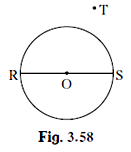
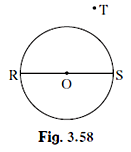
In figure 3.58, seg RS is a diameter of the circle with centre O. Point T lies in the exterior of the circle. Prove that ∠ RTS is an acute angle.
Answer
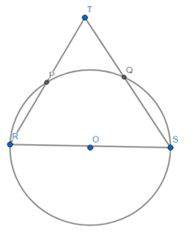
Given RS is the diameter
⇒ ∠ ROS = 180°
m(arc RS) = 180°
Now, ∠ RTS is an external angle.
$\angle R T S=\frac{1}{2}[m(\operatorname{arcRS})-m(\operatorname{arcPQ})]$
$\Rightarrow \angle R T S=\frac{1}{2}\left[180^{\circ}-m(\operatorname{arcPQ})\right]$
$\Rightarrow \angle R T S=90^{\circ}-\frac{1}{2} m(\operatorname{arcPQ})$
Hence, ∠ RTS is an acute angle.
View full question & answer
Question 24 Marks
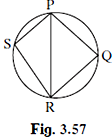
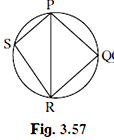
In figure 3.57, $\square PQRS$ is cyclic. side PQ ≅ side RQ. ∠ PSR = 110°, Find-

(1) measure of ∠ PQR
(2) m(arc PQR)
(3) m(arc QR)
(4) measure of ∠ PRQ
Answer
Given PQRS is a cyclic quadrilateral.
∵Opposite angles of a cyclic quadrilateral are supplementary
⇒∠ PSR + ∠ PQR = 180°
⇒∠ PQR = 180° - 110°
⇒∠ PQR = 70°
(2)2 × ∠ PQR = m(arc PR){The measure of an inscribed angle is half the measure of the arc intercepted by it.}
m(arc PR) = 140°
⇒m(arc PQR) = 360° -140° = 220° {Using Measure of a major arc = 360°- measure of its corresponding minor arc}
(3)side PQ ≅ side RQ
∴m(arc PQ) = m(arc RQ){Corresponding arcs of congruent chords of a circle (or congruent circles) are congruent}
⇒m(arc PQR) = m(arc PQ) + m(arc RQ)
⇒m(arc PQR) = 2 × m(arc PQ)
⇒m(arc PQ) = 110°
(4)In ∆ PQR,
∠ PQR + ∠ QRP + ∠ RPQ = 180°{Angle sum property}
⇒∠ PRQ + ∠ RPQ = 180° - ∠ PQR
⇒ 2∠ PRQ = 180° - 70° {∵side PQ ≅ side RQ}
⇒∠ PRQ = 55°
View full question & answer
Question 34 Marks
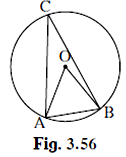
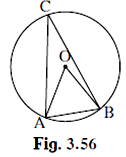
In figure 3.56, in a circle with centre O, length of chord AB is equal to the radius of the circle. Find measure of each of the following.

(1) ∠ AOB (2) ∠ ACB
(3) arc AB (4) arc ACB.
Answer
In ∆AOB,
AB = OA = OB = radius of circle
⇒ ∆AOB is an equilateral triangle
∠ AOB + ∠ ABO + ∠ BAO = 180° {Angle sum property}
⇒ 3∠ AOB = 180° {All the angles are equal}
∠ AOB = 60°
(2)∠ AOB = 2 × ∠ ACB {The measure of an inscribed angle is half the measure of the arc intercepted by it.}
⇒∠ ACB = 30°
(3)∠ AOB = 60°
⇒arc(AB) = 60° {The measure of a minor arc is the measure of its central angle.}
(4) Using Measure of a major arc = 360°- measure of its corresponding minor arc
⇒arc(ACB) = 360° - arc(AB)
⇒arc(ACB) = 360° - 60° = 300°
View full question & answer
Question 44 Marks
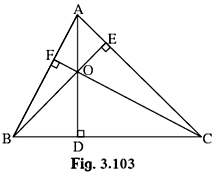
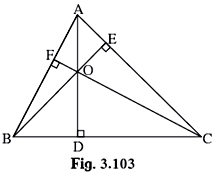
In figure 3.103, seg AD $\perp$ side BC, seg BE $\perp$  side AC, seg CF $\perp$ side AB. Point O is the orthocentre. Prove that , point O is the incentre of∆ DEF.
Answer

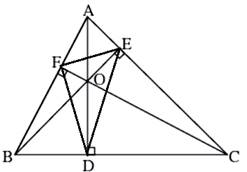
Join D to E , D to F and E to F.
In ΔABE,
⇒ ∠ ABE + ∠BAE + ∠BEA = 180° (Sum of all angles of a triangle)
⇒ ∠ABE + ∠ BAE + 90 = 180
⇒ ∠ABE + ∠ BAE = 90
⇒ ∠ABO + ∠ BAC = 90
⇒ ∠ABO = 90 - ∠ BAC ………………….(1)
In quadrilateral BFOD, we have
We have ∠F = 90 , ∠D = 90
⇒ ∠B + ∠F + ∠O + ∠D = 360°
⇒ ∠B + ∠O + 180 = 360
⇒ ∠B + ∠O = 180
Therefore, BFOD is a cyclic quadrilateral.
∠FBO = ∠FDO (angle by the same arc)
⇒ ∠ABO = ∠FDO
From (1),
⇒ ∠ FDO = 90 - ∠BAC ………………….(2)
In ΔAFC,
⇒ ∠ CAF + ∠FCA + ∠AFC = 180° (Sum of all angles of a triangle)
⇒ ∠CAF + ∠ FCA + 90 = 180
⇒ ∠CAF + ∠ FCA = 90
⇒ ∠BAC + ∠ OCE = 90
⇒ ∠OCE = 90 - ∠ BAC ………………….(3)
In quadrilateral CEOD, we have
We have ∠E = 90 , ∠D = 90
⇒ ∠C + ∠E + ∠O + ∠D = 360°
⇒ ∠C + ∠O + 180 = 360
⇒ ∠C + ∠O = 180
Therefore, CEOD is a cyclic quadrilateral.
∠ODE = ∠OCE (angle by the same arc)
From (3),
⇒ ∠ ODE = 90 - ∠BAC …………(4)
From (2) and (4) we conclude,
∠FDO = ∠ODE
OD bisects ∠D.
Similarly, we can prove that OE bisects ∠E and OF bisects ∠F.
Hence O is the incenter of ΔDEF.
View full question & answer
Question 54 Marks
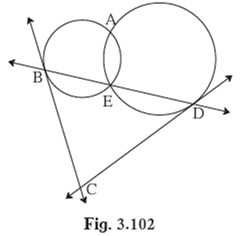
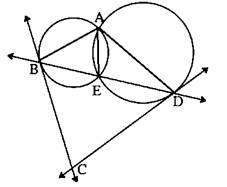
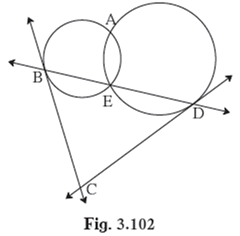
In figure 3.102, two circles intersect each other at points A and E. Their common secant through E intersects the circles at points B and D. The tangents of the circles at points Band D intersect each other at point C.
Prove that $\square$ABCD is cyclic.
Answer
We join A to B and A to D and A to E

As BC is a tangent at B, we have
∠ CBD = ∠BAE ………….(1)
As CD is a tangent at D, we have
∠ CDB = ∠DAE ………….(2)
In ΔBCD, we have
⇒ ∠CBD + ∠CDB + ∠ BCD = 180° (Sum of all angles of a triangle)
⇒ ∠BAE + ∠DAE + ∠BCD = 180° (From (1) and (2))
⇒ ∠BAD + ∠BCD = 180° (∠BAE + ∠DAE = ∠BAD)
In quadrilateral ABCD,
We have ∠A + ∠C = 180° (Proved above)
⇒ ∠A + ∠B + ∠C + ∠D = 360°
⇒ ∠B + ∠D + 180 = 360
⇒ ∠B + ∠D = 180
Therefore, opposite angles of the quadrilateral sum to 180. Hence ABCD is a cyclic quadrilateral.
View full question & answer
Question 64 Marks
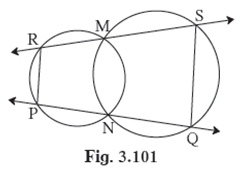
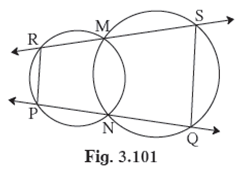
In figure 3.101, two circles intersect at points M and N. Secants drawn through M and N intersect the circles at points R, S and P, Q respectively.
Prove that :seg SQ || seg RP.
Answer

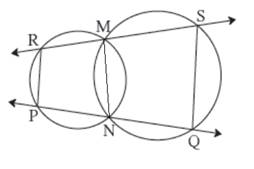
We join MN.
As PRMN is a cyclic quadrilateral,
∠R + ∠PNM = 180° …………………..(1) (opposite angles of a cyclic quadrilateral)
Also, QSMN is a cyclic quadrilateral,
∠S + ∠ QNM = 180° ……………………(2) (opposite angles of a cyclic quadrilateral)
Adding (1) and (2)
∠ R + ∠S + ∠ PNM + ∠QNM = 360°
⇒ ∠ R + ∠S + 180 = 360 (PQ is a straight line)
⇒ ∠ R + ∠S = 180°
Similarly we have,
As PRMN is a cyclic quadrilateral,
∠P + ∠RMN = 180° …………………..(3) (opposite angles of a cyclic quadrilateral)
Also, QSMN is a cyclic quadrilateral,
∠Q + ∠ SMN = 180° ……………………(4) (opposite angles of a cyclic quadrilateral)
Adding (3) and (4)
∠ P + ∠Q + ∠ RMN + ∠SMN = 360°
⇒ ∠ P + ∠Q + 180 = 360 (RS is a straight line)
⇒ ∠ P + ∠Q = 180°
Therefore, PR ∥ SQ.
View full question & answer
Question 74 Marks
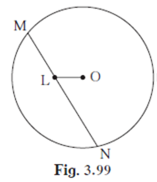
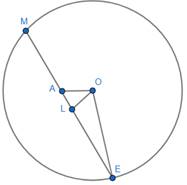
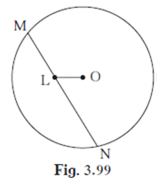
In figure 3.99, seg MN is a chord of a circle with centre O. MN = 25,L is a point on chord MN such that ML = 9 and d(O,L) = 5.
Find the radius of the circle.
Answer
The figure is shown below:

Draw perpendicular on MN from the center O .
Mark the point as A . Join O to N .
As we know that perpendicular on a chord bisects the chord
$\mathrm{AM}=\mathrm{MN} / 2$
$\Rightarrow \mathrm{AM}=25 / 2=12.5$
Given that $L M=9$
$\Rightarrow \mathrm{LM}+\mathrm{LA}=\mathrm{AM}$
$\Rightarrow 9+\mathrm{LA}=12.5$
$\Rightarrow \mathrm{LA}=3.5$
$\text { In } \triangle \mathrm{OAL}$
$\Rightarrow \mathrm{OL}^2=\mathrm{OA}^2+\mathrm{AL}^2$
$\Rightarrow 5^2=\mathrm{OA}^2+(3.5)^2$
$\Rightarrow \mathrm{OA}^2=25-12.25$
$\Rightarrow \mathrm{OA}^2=12.75$
In $\triangle O A N$,
$\Rightarrow \mathrm{ON}^2=\mathrm{OA}^2+\mathrm{AN}^2$
$\Rightarrow \mathrm{ON}^2=12.75+(12.5)^2$
$\Rightarrow \mathrm{ON}^2=12.75+156.25$
$\Rightarrow \mathrm{ON}^2=169$
$\Rightarrow \mathrm{ON}=13$
Therefore, the radius of the circle is 13 .
View full question & answer
Question 84 Marks
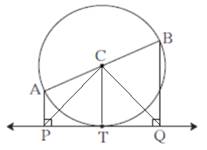
Prove that any three points on a circle cannot be collinear.
Answer
To Prove: seg CP ≅seg CQ
Construction: Join CP, CQ and CT
Figure:

Since PQ is a tangent to the circle, ∠CTP = ∠CTQ = 90
Since ∠APT = ∠CTP = 90
AP || CT.
Similarly,
CT || BQ.
So, we can say that,
AP || CT || BQ
AB is a line cutting all three parallel lines.
AC = CB (Radius of the circle, and AB is diameter, C is center)
Since C is center point of line AB cutting parallel lines.
We can say these parallel lines are equal distance.
Therefore, PT = TQ.
Now in ΔCTP and ΔCTQ,
CT is a common side, PT = TQ and ∠CTP = ∠CTQ = 90
CP = CQ. (Pythagoras theorem or congruent triangle theorem)
Hence, Proved.
View full question & answer
Question 94 Marks
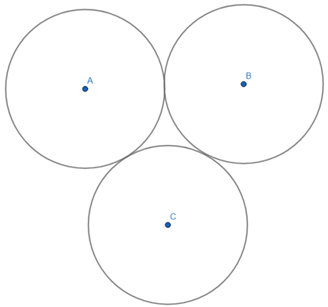
Draw circles with centres A, B and C each of radius 3 cm, such that each circle touches the other two circles.
Answer

Draw a circle with radius 3 and centred at A. Similarly draw other two circles with centre B and C and same radius touching each other externally.
View full question & answer
Question 104 Marks
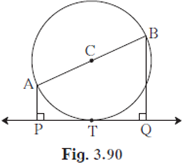
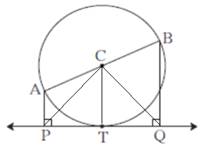
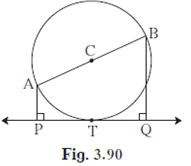
In figure 3.90, seg AB is a diameter of a circle with centre C. Line PQ is a tangent, which touches the circle at point T. seg AP $\perp$ line PQ and seg BQ $\perp$ line PQ. Prove that, seg CP ≅seg CQ.
Answer
To Prove: seg CP ≅seg CQ
Construction: Join CP, CQ and CT
Figure:

Since PQ is a tangent to the circle, ∠CTP = ∠CTQ = 90
Since ∠APT = ∠CTP = 90
AP || CT.
Similarly,
CT || BQ.
So, we can say that,
AP || CT || BQ
AB is a line cutting all three parallel lines.
AC = CB (Radius of the circle, and AB is diameter, C is center)
Since C is center point of line AB cutting parallel lines.
We can say these parallel lines are equal distance.
Therefore, PT = TQ.
Now in ΔCTP and ΔCTQ,
CT is a common side, PT = TQ and ∠CTP = ∠CTQ = 90
CP = CQ. (Pythagoras theorem or congruent triangle theorem)
Hence, Proved.
View full question & answer
Question 114 Marks
prove the following : If an angle has its vertex on the circle, its one side touches the circle and the other intersects the circle in one more point, then the measure of the angle is half the measure of its intercepted arc.
Answer
Theorem
If an angle has its vertex on the circle, its one side touches the circle and the other intersects the circle in one more point, then the measure of the angle is half the measure of its intercepted arc.
Image
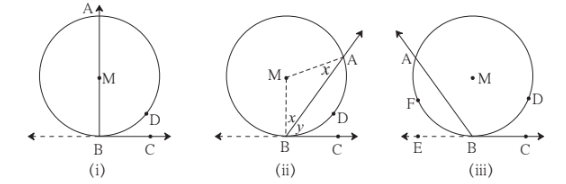
Given: Let $\angle A B C$ be an angle, where vertex $B$ lies on a circle with centre $M$.
Its side $B C$ touches the circle at $B$ and side BA intersects the circle at A. Arc ADB is intercepted by $\angle A B C$.
To prove: $\angle \mathrm{ABC}=1 / 2 \mathrm{~m}(\operatorname{arc} \mathrm{ADB})$
Proof: Consider three cases.
(1) In the above figure (i), the centre $M$ lies on the arm $B A$ of $\angle A B C$,
$\angle \mathrm{ABC}=\angle \mathrm{MBC}=90^{\circ}$ tangent theorem (I)
arc $\mathrm{ADB}$ is a semicircle.
$\therefore \mathrm{m}(\operatorname{arc} \mathrm{ADB})=180^{\circ} \ldots .$. definition of measure of arc (II)
From (I) and (II)
$\angle \mathrm{ABC}=1 / 2 \mathrm{~m}(\operatorname{arc} \mathrm{ADB})$
(2) In the above figure (ii) centre $M$ lies in the exterior of $\angle A B C$,
Draw radii $M A$ and $M B$.
Now, $\angle \mathrm{MBA}=\angle \mathrm{MAB}$.... isosceles triangle theorem
$\angle \mathrm{MBC}=90^{\circ}$. . tangent theorem..... (I)
let $\angle M B A=\angle M A B=x$ and $\angle A B C=y$.
$ \angle \mathrm{AMB}=180-(\mathrm{x}+\mathrm{x})=180-2 \mathrm{x}$
$\angle \mathrm{MBC}=\angle \mathrm{MBA}+\angle \mathrm{ABC}=\mathrm{x}+\mathrm{y}$
$\therefore \mathrm{x}+\mathrm{y}=90^{\circ} \therefore 2 \mathrm{x}+2 \mathrm{y}=180^{\circ}$
$\text { In } \triangle \mathrm{AMB}, 2 \mathrm{x}+\angle \mathrm{AMB}=180^{\circ}$
$\therefore 2 \mathrm{x}+2 \mathrm{y}=2 \mathrm{x}+\angle \mathrm{AMB}$
$\therefore 2 \mathrm{y}=\angle \mathrm{AMB}$
$\therefore \mathrm{y}=\angle \mathrm{ABC}=1$
$2 \angle \mathrm{AMB}=1$
$2 \mathrm{~m}(\operatorname{arc} \text { ADB) } $
View full question & answer
Question 124 Marks
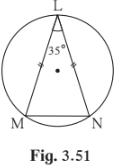
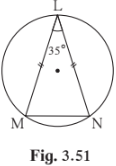
In figure 3.51 , chord $\mathrm{LM} \cong$ chord $\mathrm{LN}$ $\angle \mathrm{L}=35^{\circ}$ find
(i) $m(\operatorname{arc} \mathrm{MN})$
(ii) $m(\operatorname{arc} \mathrm{LN})$Image
Answer
(i) $\angle \mathrm{L}=\frac{1}{2} m(\operatorname{arc} \mathrm{MN})$ inscribed angle theorem.
$\therefore 35=\frac{1}{2} m(\operatorname{arc~MN})$
$\therefore 2 \times 35=m(\operatorname{arc~MN})=70^{\circ}$
(ii)
$ m\text {(arc MLN })  =360^{\circ}-m(\operatorname{arc} \text { MN }) \text {...... definition of measure of arc}$
$=360^{\circ}-70^{\circ}=290^{\circ} $
Now, chord $L M \cong$ chord LN
$\therefore \operatorname{arc} L M \cong \operatorname{arc} L N$
but $m(\operatorname{arcLM})+m(\operatorname{arcLN})=m(\operatorname{arc~MLN})=290^{\circ} \ldots .$. arc addition property
$m(\operatorname{arcLM})=m(\operatorname{arc~LN})=\frac{290^{\circ}}{2}=145^{\circ}$
or, (ii) chord $\mathrm{LM} \cong$ chord $\mathrm{LN}$
$ \therefore \angle \mathrm{M}=\angle \mathrm{N} \ldots . . . \text { isosceles trinangle theorem. }$
$\therefore 2 \angle \mathrm{M}=180^{\circ}-35^{\circ}=145^{\circ}$
$\therefore \angle \mathrm{M}=\frac{145^{\circ}}{2}$
$ \text { Now, } m(\operatorname{arc} L N)  =2 \times \angle \mathrm{M}$
$=2 \times \frac{145^{\circ}}{2}=145^{\circ} $
View full question & answer
Question 134 Marks
Prove the following : The measure of an inscribed angle is half of the measure of the arc intercepted by it.
View full question & answer
Question 144 Marks
Point O is the centre of a circle. Line a and line b are parallel tangents to the circle at P and Q. Prove that segment PQ is a diameter of the circle.
View full question & answer
Question 164 Marks
If two consecutive angles of cyclic quadrilateral are congruent, then prove that one pair of opposite sides is congruent and other is parallel.
Answer
SELF
View full question & answer
Question 254 Marks
Draw circles with centres A, B and C each of radius 3 cm, such that each circle touches the other two circles.
View full question & answer
Question 274 Marks
prove the following : If an angle has its vertex on the circle, its one side touches the circle and the other intersects the circle in one more point, then the measure of the angle is half the measure of its intercepted arc.
View full question & answer
Question 284 Marks
In figure 3.51 , chord $\mathrm{LM} \cong$ chord $\mathrm{LN}$ $\angle \mathrm{L}=35^{\circ}$ find
(i) $m(\operatorname{arc} \mathrm{MN})$
(ii) $m(\operatorname{arc} \mathrm{LN})$

Image

View full question & answer
Question 294 Marks
Prove the following : The measure of an inscribed angle is half of the measure of the arc intercepted by it.
View full question & answer
Question 304 Marks
Point O is the centre of a circle. Line a and line b are parallel tangents to the circle at P and Q. Prove that segment PQ is a diameter of the circle.
View full question & answer
Question 324 Marks
If two consecutive angles of cyclic quadrilateral are congruent, then prove that one pair of opposite sides is congruent and other is parallel.
View full question & answer
4 Marks Questions - Maths STD 10 Questions - Vidyadip