Question 14 Marks
Verify that $2$ is a zero of the polynomial $x^3 + 4x^2 - 3x - 18$.
AnswerLet $p(x) = x^3 + 4x^2 - 3x - 18$
Now, $p(2) = 2^3 + 4 \times 2^2 - 3 \times 2 - 18 = 0$
$\therefore$ $2$ is a zero of p(x).
View full question & answer→Question 24 Marks
If 1 and -2 are two zeros of the polynomial $(x^3 - 4x^2 - 7x + 10),$ find its third zero.
AnswerLet $f(x) = x^3- 4x^2- 7x + 10$ Since 1 and -2 are the zeros of f(x),
it follows that each one of (x - 1) and (x + 2) is a factor of f(x). Consequently,
$(x - 1)(x + 2) = (x^2 + x - 2)$ is a factor of $f(x).$
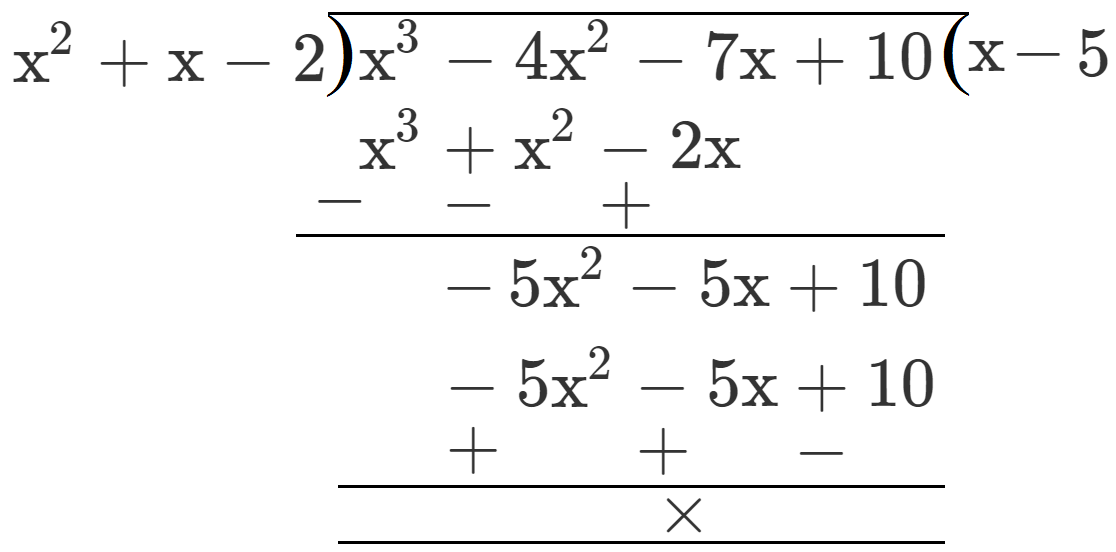
On dividing $f(x)$ by $(x^2 + x - 2)$, we get:
$\therefore f(x) = 0$
$\Rightarrow (x^2 + x - 2)(x - 5) = 0 $
$\Rightarrow (x - 1)(x + 2)(x - 5) = 0 $
$\Rightarrow x = 1$ or $x = -2$ or $x = 5$
Hence, the third zero is 5 View full question & answer→Question 34 Marks
Show that $(x + 2)$ is a factor of $f(x) = x^3 + 4x^2 + x - 6.$
AnswerGiven: $f(x) = x^3 + 4x^2 + x - 6$
Now, $f(-2) = (-2)^3 + 4(-2)^2 + (-2) - 6$
$= -8 + 16 - 2 - 6$
$= 0$
$\therefore$ $(x + 2)$ is a factor of $f(x) = x^3 + 4x^2 + x - 6.$
View full question & answer→Question 44 Marks
Find the zeros of the following quadratic polynomial and verify the relationship between the zeros and the coefficients:
$3x^2 - x - 4$
AnswerWe have,
$ f(x) = 3x^2 - x - 4$
$ = 3x2 - 4x + 3x - 4 $
$= x(3x - 4) + 1(3x - 4) $
$= (3x - 4)(x + 1)$
$\therefore$ $f(x) = 0 \Rightarrow (3x - 4)(x + 1) = 0$
$ \Rightarrow 3x - 4 = 0$ or $x + 1 = 0$ $\Rightarrow\text{x}=\frac{4}{3}$ or $x = -1$ So the zeros of f(x) are $\frac{4}3{}$ and $-1$
Sum of zeros $=\frac{4}{3}+(-1)$
$=\frac{1}{3}=\frac{-(\text{Coefficient of x})}{(\text{Coefficient of }\text{x}^2)}$
Product of zeros $=\frac{4}{3}\times(-1)$
$=\frac{-4}{3}=\frac{\text{Constant term}}{\text{Coefficient of }\text{x}^2}$
View full question & answer→Question 54 Marks
Find all the zeros of $(2x^4 - 3x^3 - 5x^2 + 9x - 3)$, if it is given that two of its zeros are $\sqrt3$ and $-\sqrt3.$
AnswerLet $f(x) = 2x^4 - 3x^3 - 5x^2 + 9x - 3$ Since $\sqrt3$ and $-\sqrt3$ are the zeros of f(x),
it follows that each one of $\big(\text{x}-\sqrt3\big)$ and $(\text{x}+\sqrt3)$ is a factor of f(x).
Consequently, $\big(\text{x}-\sqrt3\big)\big(\text{x}+\sqrt3\big)=(\text{x}^2-3)$ is a factor of f(x).
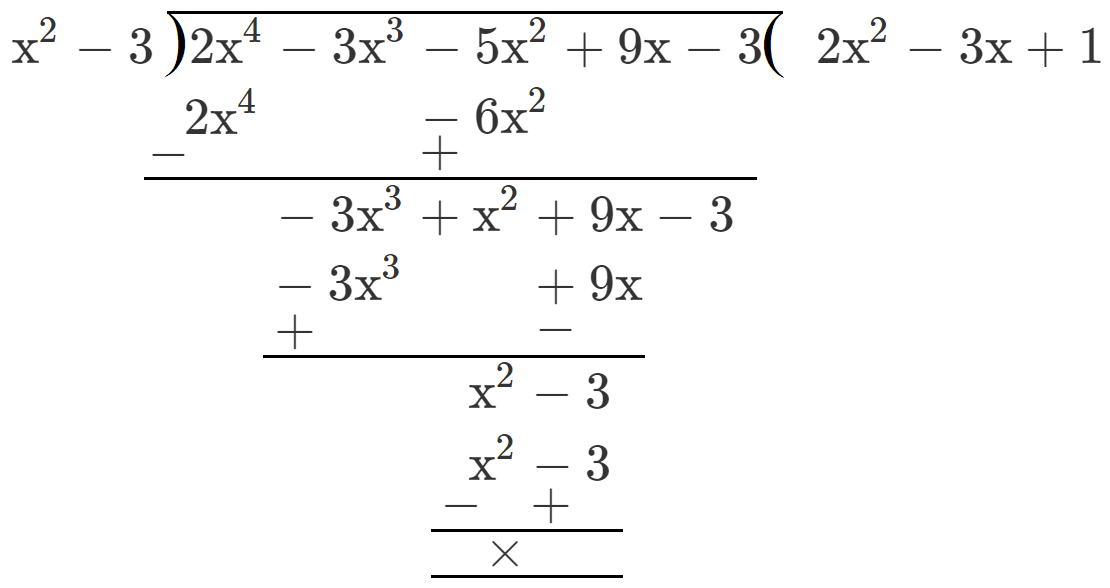
On dividing $f(x)$ by $(x^2 - 3)$, we get:
$\therefore$ $f(x) = 0 $
$\Rightarrow 2x^4 - 3x^3 - 5x^2 + 9x - 3 = 0 $
$\Rightarrow (x^2 - 3)(2x^2 - 3x + 1) = 0 $
$\Rightarrow (x^2 - 3)(2x^2 - 2x - x + 1) = 0$
$\Rightarrow\big(\text{x}-\sqrt3\big)\big(\text{x}+\sqrt3\big)(\text{2x}+1)(\text{x}-1)=0$
$\Rightarrow\text{x}=\sqrt3$ or $\text{x}=-\sqrt3$ or $\text{x}=\frac{1}{2}$ or $x = 1$ View full question & answer→Question 64 Marks
Verify that $5, -2$ and $\frac{1}3{}$ are the zeros of the cubic polynomial $p(x) = 3x^3 - 10x^2 - 27x + 10$ and verify the relation between its zeros and coefficients.
Answer$p(x) = (3x^3 - 10x^2 - 27x + 10) $
$p(5) = (3 \times 5^3- 10 \times 5^2 - 27 \times 5 + 10) $
$= (375 - 250 - 135 + 10) = 0 $
$p(-2) = [3 \times (-2^3) - 10 \times (-2^2) - 27 \times (-2) + 10] $
$= (-24 - 40 + 54 + 10) = 0$
$\text{p}\Big(\frac{1}{3}\Big)=\Big\{3\times\Big(\frac{1}{3}\Big)^3-10\times\Big(\frac{1}3{}\Big)^2-27\times\frac{1}{3}+10\Big\}$
$=\Big(3\times\frac{1}{27}-10\times\frac{1}{9}-9+10\Big)$
$=\Big(\frac{1}{9}-\frac{10}{9}+1\Big)=\Big(\frac{1-10+9}{9}\Big)$
$=\Big(\frac{0}{9}\Big)=0$
$\therefore$ $5, -2$ and $\frac{1}{3}$ are the zeroes of $p(x)$, Let $\alpha=5,\ \beta=-2$ and $\gamma=\frac{1}{3}.$
Then we have: $(\alpha+\beta+\gamma)=\Big(5-2+\frac{1}{3}\Big)$
$=\Big(\frac{10}{3}\Big)=\frac{-(\text{Coefficient of }\text{x}^2)}{(\text{Coefficient of }\text{x}^3)}$
$(\alpha\beta+\beta\gamma+\gamma\alpha)=\Big(-10-\frac{2}{3}+\frac{5}{3}\Big)$
$=\frac{-27}{3}=\frac{\text{Coefficient of x}}{\text{Coefficient of }\text{x}^3}$
$\alpha\beta\gamma=\Big\{5\times(-2)\times\frac{1}{3}\Big\}$
$=\frac{-10}{3}=\frac{-\text{(Constant term)}}{(\text{coefficient of }\text{x}^3)}$
View full question & answer→Question 74 Marks
Very-Short-Answer Question:
The sum of the zero and the product of zero of a quadratic polynomial are $\frac{-1}{2}$ and −3 respectively, write the polynomial.
AnswerLet $\alpha$ and $\beta$ be the zeros of the required quadratic polynomial.
Then, we have
$\alpha+\beta=-\frac{1}{2}$ and $\alpha\beta=-3$
Now, a qudratic polynomial whose zeros are $\alpha$ and $\beta$ is given by
$\text{p}(\text{x})=\text{x}^2-(\alpha+\beta)\text{x}+\alpha\beta$
$\therefore$ Required quadratic polynomial,
$\text{p}(\text{x})=\text{x}^2-\Big(-\frac{1}{2}\Big)\text{x}+(-3)$
$=\text{x}^2+\frac{1}{2}\text{x}-3$
View full question & answer→Question 84 Marks
Find the quadratic polynomial whose zeros are 2 and -6. Verify the relation between the coeficients and the zeros of the polynomial.
AnswerLet $\alpha =2$ and $\beta=-6$
Sum of the zeros $=(\alpha+\beta)$
$=2+(-6) =- 4$
Product of the zeros $=\alpha\beta$
$=2\times(-6) =- 12$
$\therefore$ Required polynomial $=\text{x}^2-(\alpha+\beta)\text{x}+\alpha\beta$
$=\text{x}^2-(-4)\text{x}-12$
$=\text{x}^2+\text{4x}-12$
Sum of the zeros = -4
$=\frac{-4}{1}=\frac{-(\text{Coefficient of x})}{(\text{Coefficient of }\text{x}^2)}$
Product of the zeros = -12
$=\frac{-12}{1}=\frac{\text{Constant term}}{\text{Coefficient of }\text{x}^2}$
View full question & answer→Question 94 Marks
Find the zeros of the following quadratic polynomial and verify the relationship between the zeros and the coefficients:
$2x^2 - 11x + 15x$
AnswerWe have,
$f(x) = 2x^2 - 11x + 15x$
$= 2x^2 - 6x - 5x + 15$
$= 2x(x - 3) - 5(x - 3)$
$= (x - 3)(2x - 5)$
$\therefore$ $f(x) = 0$
$\Rightarrow (x - 3)(2x - 5) = 0$
$\Rightarrow x - 3 = 0$ or $2x - 5 = 0$
$\Rightarrow x = 3$ or $\text{x}=\frac{5}{2}$
So, the zeros of f(x) are 3 and $\frac{5}{2}$
Sum of zeros $3+\frac{5}{2}=\frac{11}{2}$
$=-\frac{(-11)}{2} =\frac{-(\text{Cofficient of x})}{(\text{Coefficient of }\text{x}^2)}$
Product of zeros $=3\times\frac{5}{2}$
$=\frac{15}{2}=\frac{\text{Constant term}}{\text{Coefficient of }\text{x}^2}$
View full question & answer→Question 104 Marks
Find a cubic polynomial whose zeroes are $2, -3$ and $4$
AnswerIf the zeroes of the cubic polynomial are a, b and c then the cubic polynomial can be found as:
$x^3- (a + b + c)x^2 + (ab + bc + ca)x - abc ...(1)$
Let $a = 2, b = -3$ and $c = 4$
Substituting the values in (1), we get
$x^3 - (2 - 3 + 4)x^2 + (-6 - 12 + 8)x - (-24)$
$\Rightarrow x^3 - 3x^2 - 10x + 24$
View full question & answer→Question 114 Marks
If $2$ and $-2$ are two zeros of the polynomial $(x^4 + x^3 - 34x^2 - 4x + 120)$, find all the zeros of given polynomial.
AnswerLet $f(x) = x^4 + x^3 - 34x^2 - 4x + 120$ Since $2$ and $-2$ are the zeros of $f(x)$, it follows that each one of $(x - 2)$ and $(x + 2)$ is a factor of $f(x)$.
Consequently, $(x - 2)(x + 2) = (x^2 - 4)$ is a factor of $f(x).$
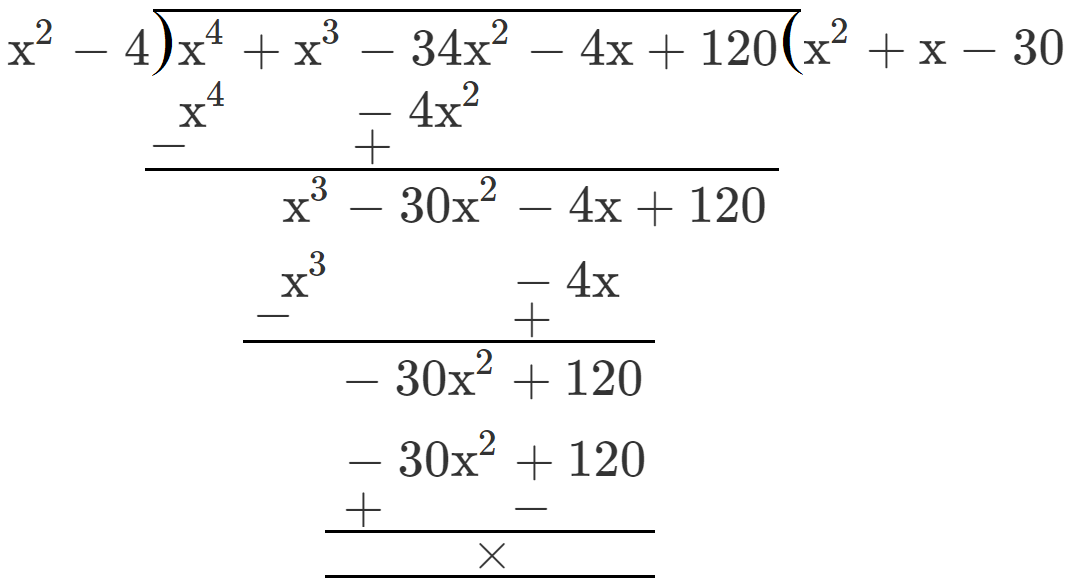
On dividing $f(x)$ by $(x^2 - 4)$, we get:
$\therefore$ f(x) = 0
$\Rightarrow (x^2 + x - 30)(x^2 - 4) = 0$
$ \Rightarrow (x^2 + 6x - 5x - 30)(x - 2)(x + 2) = 0 $
$\Rightarrow [x(x + 6) - 5(x + 6)](x - 2)(x + 2) = 0 $
$\Rightarrow (x - 5)(x + 6)(x - 2)(x + 2) = 0$
$\Rightarrow x = 5$ or x $= -6$ or $x = 2$ or $x = -2$
Hence, all the zeros are $2, -2, 5$ and $-6$ View full question & answer→Question 124 Marks
One zero of the polynomial $3x^3 + 16x^2 + 15x - 18$ is $\frac{2}{3}.$ Find the other zeros of the polynomial.
Answer$p(x) = 3x^3 + 16x^2 + 15x - 18$
Since $\frac{2}{3}$ is a zero of $p(x)$, so $\Big(\text{x}-\frac{2}{3}\Big)$ is a factor of $f(x)$.
$\Rightarrow (3x - 2)$ is also its factor On dividing $p(x)$ by $(3x - 2),$
we get
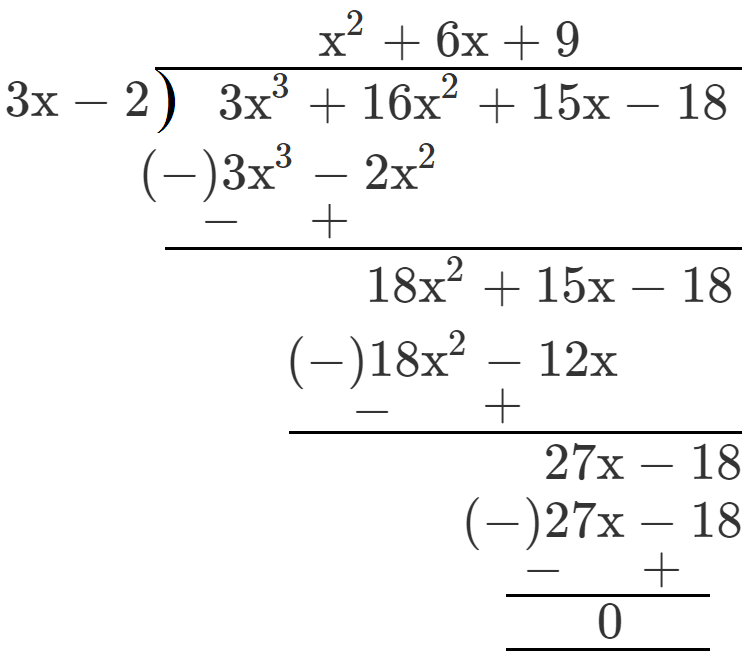
$\therefore$ $f(x) = (x^2 + 6x + 9)(3x - 2) $
$= (x2 + 3x + 3x + 9)(3x - 2) $
$= [x(x + 3) + 3(x + 3)](3x - 2)$
$ = (x + 3)(x + 3)(3x - 2) = 0$
$\therefore$ $f(x) = 0 (x + 3)(x + 3)(3x + 2)$
$= 0 x = -3$ or $x = -3$ or $\text{x}=\frac{2}{3}$
Thus, the other two zeros are $-3, -3$ View full question & answer→Question 134 Marks
It is given that $-1$ is one of the zeros of the polynomial $x^3 + 2x^2 - 11x - 12$. Find all the given zeros of the given polynomial.
AnswerLet $f(x) = x^3+ 2x^2- 11x - 12$
Since $-1$ is a zero of$ f(x), (x + 1)$ is a factor of $f(x)$.
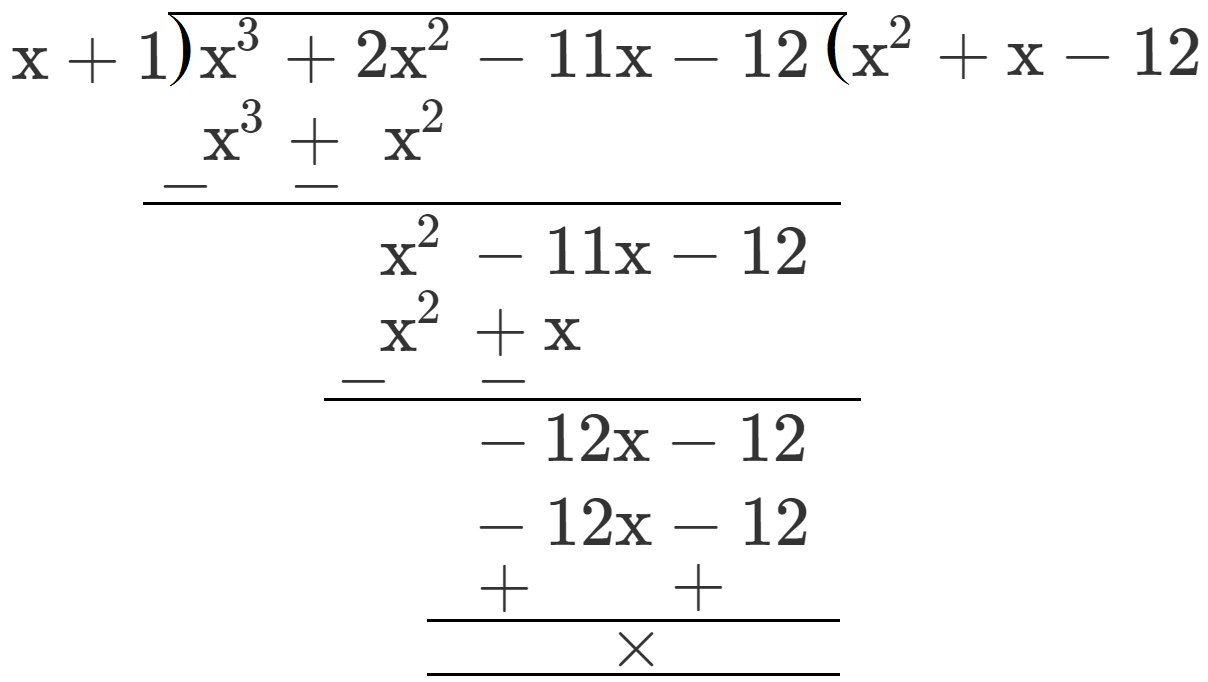
On dividing $f(x)$ by $(x + 1)$, we get:
$f(x) = x^3+ 2x^2- 11x - 12$
$= (x + 1)(x^2 + x - 12)$
$= (x + 1){x^2 + 4x - 3x - 12}$
$= (x + 1){x(x + 4) - 3(x + 4)}$
$= (x + 1)(x - 3)(x + 4)$
$\therefore$ $f(x) = 0$
$\Rightarrow (x + 1)(x - 3)(x + 4) = 0$
$\Rightarrow (x + 1) = 0$ or $(x - 3) = 0 or (x + 4) = 0$
$\Rightarrow x = -1$ or $x = 3$ or $x = -4$
Thus, all the zeros are $-1, 3$ and $-4$ View full question & answer→Question 144 Marks
Very-Short-Answer Question:
If $(a - b), a$ and $(a + b)$ are zeros of the polynomial $2x^3 - 6x^2 + 5x - 7$, write the value of $a$.
AnswerGiven polynomial is $p(x) = 2x^3 - 6x^2 + 5x - 7$
Let $\alpha=(\text{a}-\text{b}),\ \beta=\text{a}$ and $\gamma(\text{a}+\text{b})$
Now, $\alpha+\beta+\gamma =-\frac{(-6)}{2}=3$
$\Rightarrow (a - b) + a + (a + b) = 3$
$\Rightarrow 3a = 3$
$\Rightarrow a = 1$
View full question & answer→Question 154 Marks
If the zeroes of the polynomial $x^3- 3x^2 + x + 1$ are $(a - b), a$ and $(a + b)$, find the values of a and b.
AnswerThe given polynomial $= x^3- 3x^2 + x + 1$ and its roots are $(a - b)$, $a$ and $(a + b)$.
Comparing the given polynomial with $Ax^3 + Bx^2 + Cx + D$, we have:
$A = 1, B = -3, C = 1$ and $D = 1$
Now, $(\text{a}-\text{b})+\text{a}+(\text{a}+\text{b})=\frac{-\text{B}}{\text{A}}$
$\Rightarrow\text{3a}=-\frac{-3}{1}$
$\Rightarrow\text{a}=1$
Also, $(\text{a}-\text{b})\times\text{a}\times(\text{a}+\text{b})=\frac{-\text{D}}{\text{A}}$
$\Rightarrow\text{a}(\text{a}^2-\text{b}^2)=\frac{-1}{1}$
$\Rightarrow1(1^2-\text{b}^2)=-1$
$\Rightarrow1-\text{b}^2=-1$
$\Rightarrow\text{b}^2=2$
$\Rightarrow\text{b}=\pm\sqrt2$
$\therefore\text{a}=1$ and $\text{b}=\pm\sqrt2$
View full question & answer→Question 164 Marks
Find the zeros of the following quadratic polynomial and verify the relationship between the zeros and the coefficients:
$8x^2 - 4$
AnswerWe have,$\text{f}(\text{x})=\text{8x}^2-4$
$=4(\text{2x}-1)^2$
$=4\big[\big(\sqrt2\text{x}\big)^2-1^2\big]$ $\big[\therefore\text{a}^2-\text{b}^2=(\text{a}-\text{b})(\text{a}+\text{b})\big]$
$=4\big(\sqrt2\text{x}-1\big)\big(\sqrt2\text{x}+1\big)$
$\therefore\text{f}(\text{x})=0$
$\Rightarrow\big(\sqrt2\text{x}-1\big)\big(\sqrt2\text{x}+1\big)=0$
$\therefore\sqrt2\text{x}-1=0$ or $\sqrt2\text{x}+1=0$
$\therefore\text{x}=\frac{1}{\sqrt2}$ or $\text{x}=-\frac{1}{\sqrt2}$
So the zeros of f(x) are $\frac{1}{\sqrt2}$ and $-\frac{1}{\sqrt2}$
Sum of zeros $=\Big(\frac{1}{\sqrt2}\Big)+\Big(-\frac{1}{\sqrt2}\Big)=0$
$=\frac{0}{8}=-\frac{\text{Coefficient of x}}{\text{Coefficient of }\text{x}^2}$
Product of zeros $=\Big(\frac{1}{\sqrt2}\Big)\times\Big(-\frac{1}{\sqrt2}\Big)=-\frac{1}{2}$
$=\frac{-4}{8}=\frac{\text{Constant term}}{\text{Coefficient of }\text{x}^2}$
View full question & answer→Question 174 Marks
If $\alpha,\ \beta,\ \gamma$ are the zeroes of the polynomial $p(x) = 6x^3 + 3x^2- 5x + 1$, find the value of $\Big(\frac{1}{\alpha}+\frac{1}{\beta}+\frac{1}{\gamma}\Big).$
AnswerGiven: $p(x) = 6x^3 + 3x^2- 5x + 1$
$= 6x^2 - (-3)x^2 + (-5)x - (-1)$
Comparing the polynomial with $\text{x}^3-\text{x}^2(\alpha+\beta+\gamma)+\text{x}(\alpha\beta+\beta\gamma+\gamma\alpha)-\alpha\beta\gamma,$ we get:
$\alpha\beta+\beta\gamma+\gamma\alpha=-5$
and $\alpha\beta\gamma=-1$
$\therefore\Big(\frac{1}{\alpha}+\frac{1}{\beta}+\frac{1}{\gamma}\Big)$
$=\Big(\frac{\beta\gamma+\alpha\gamma+\alpha\beta}{\alpha\beta\gamma}\Big)$
$=\Big(\frac{-5}{-1}\Big)$
$=5$
View full question & answer→Question 184 Marks
Find the zeros of the following quadratic polynomial and verify the relationship between the zeros and the coefficients:
$4x^2 - 4x + 1$
AnswerWe have,
$f(x) = 4x^2 - 4x + 1$
$= 4x^2 - 2x - 2x + 1$
$= 2x(2x - 1) - 1(2x - 1)$
$= (2x - 1)(2x - 1)$
$\therefore$ $f(x) = 0$
$\Rightarrow (2x - 1)(2x - 1) = 0$
$\Rightarrow (2x - 1)^2 = 0$
$\Rightarrow 2x - 1 = 0$
$\Rightarrow\text{x}=\frac{1}{2}$
So, the zeros of $f(x)$ are $\frac{1}{2}$ and $\frac{1}{2}$
Sum of zeros $\frac{1}{2}+\frac{1}{2}=1$
$=\frac{1}{1}=\frac{1\times4}{1\times4}$
$=\frac{4}{4} =\frac{-(\text{Cofficient of x})}{(\text{Coefficient of }\text{x}^2)}$
Product of zeros $=\frac{1}{2}\times\frac{1}{2}$
$=\frac{1}{4}=\frac{\text{Constant term}}{\text{Coefficient of }\text{x}^2}$
View full question & answer→Question 194 Marks
If $\text{x}=\frac{2}{3}$ and $x = -3$ are the roots of the quadratic equation $ax^2 + 7x + b = 0$ then find the values of $a$ and $b$.
AnswerSince $\frac{2}{3}$ and $-3$ are zeros of $ax^2 + 7x + b$, we have
Sum of roots $=\frac{2}{3}+(-3)$
$=\frac{2-9}{3}=\frac{-7}{3}$
$\Rightarrow\frac{-7}{\text{a}}=\frac{-7}{3}$
$\Rightarrow\text{a}=3$
Product of roots $=\frac{2}{3}\times(-3)=-2$
$\Rightarrow\frac{\text{b}}{\text{a}}=-2$
$\Rightarrow\frac{\text{b}}{3}=-2$
$\Rightarrow\text{b}=-6$
View full question & answer→Question 204 Marks
By actual division, show that $x^2- 3$ is a factor of $2x^4+ 3x^3- 2x^2- 9x - 12$
AnswerLet $f(x) = 2x^4+ 3x^3- 2x^2- 9x - 12$ and $g(x) = x^2- 3$
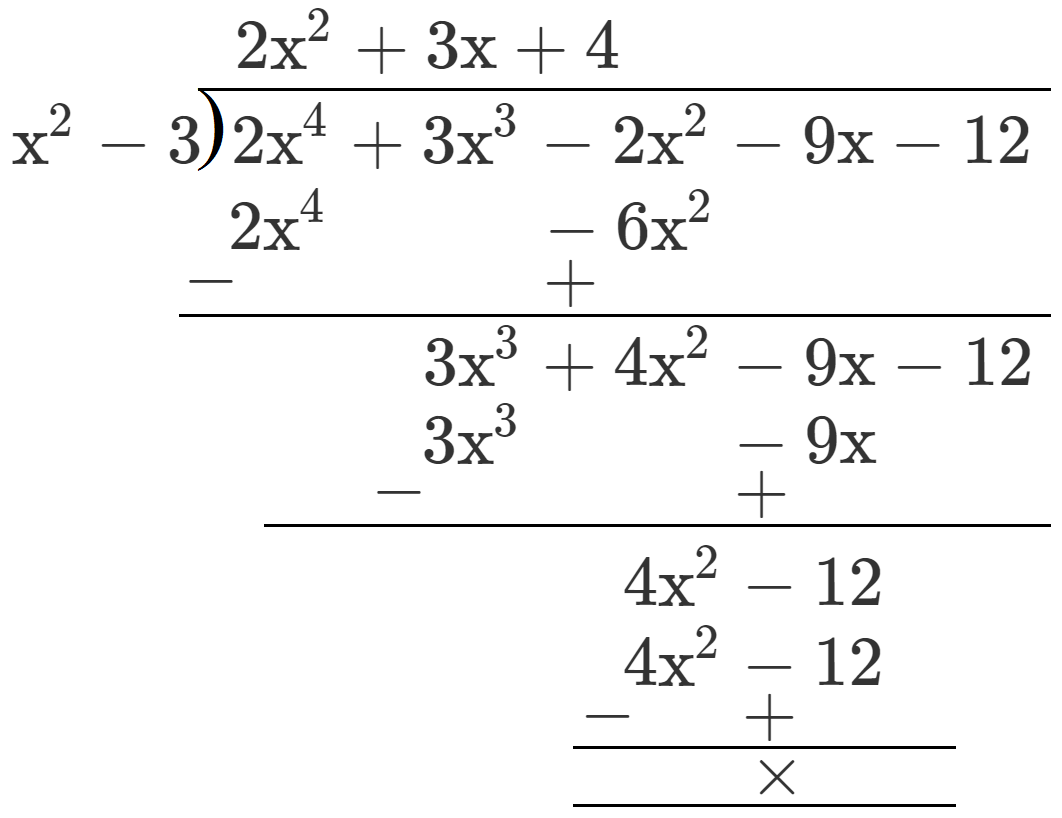
Quotient $q(x)=2x^2+ 3x + 4$
Remainder $r(x) = 0$
Since, the remainder is $0$.
Hence,$x^2- 3$ is a factor of $2x^4+ 3x^3- 2x^2- 9x - 12$ View full question & answer→Question 214 Marks
Find a cubic polynomial with the sum, sum of the product of its zeros taken two at a time and the product of its zeros are $5, -2$ and $-24$ respectively.
AnswerWe know the sum, sum of the product of the zeros taken two at a time and the product of the zeros of a cubic polynomial then the cubic polynomial can be found as:
$x^3$ - (Sum of the zeros)$x^2$ + (sum of the product of the zeros taking two at a time)$x$ - Product of zeros
Therefore, the required polynomial is:
$x^3- 5x^2- 2x + 24$
View full question & answer→Question 224 Marks
Find the quotient and the remainder when:
$f(x) = x^3 - 3x^2 + 5x - 3$ is divided by $g(x) = x^2 - 2$
Answer
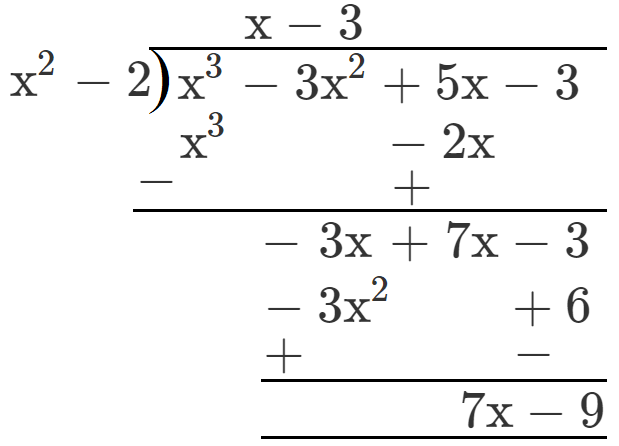
Quotient $q(x) = x - 3$
Remainder $r(x) = 7x - 9$ View full question & answer→Question 234 Marks
Find the quadratic polynomial, sum of whose zeros is $8$ and their product is $12$. Hence, find the zeros of the polynomial.
AnswerLet $\alpha,\beta$ be the zeros of required quadratic polynomial $f(x)$.
Now, $\alpha+\beta=8$ and $\alpha\beta=12$
$\text{f}(\text{x})=\text{x}^2-(\alpha+\beta)\text{x}+\alpha\beta$
$=\text{x}^2-\text{8x}+12$
$\therefore$ required polynomial is $x^2 - 8x + 12$
Also $f(x) = x^2 - 8x + 12$
$= x^2- 6x - 2x = 12$
$= x(x - 6) - 2(x - 6)$
$\therefore$ $f(x) = 0$
$(x - 6)(x - 2) = 0$
$\therefore$$ x - 6 = 0$ or #x - 2 = 0$
$i.e. x = 6$ or $x = 2$
$\therefore$ Zeros of polynomial are $6$ and $2$
View full question & answer→Question 244 Marks
Verify division algorithm for the polynomials $f(x) = 8 + 20x + x^2 - 6x^3$ and $g(x) = 2 + 5x - 3x^2$
AnswerWe can write $f(x)$ as $-6x^3 + x^2 + 20x + 8$ and
$g(x)$ as $-3x^2 + 5x + 2$
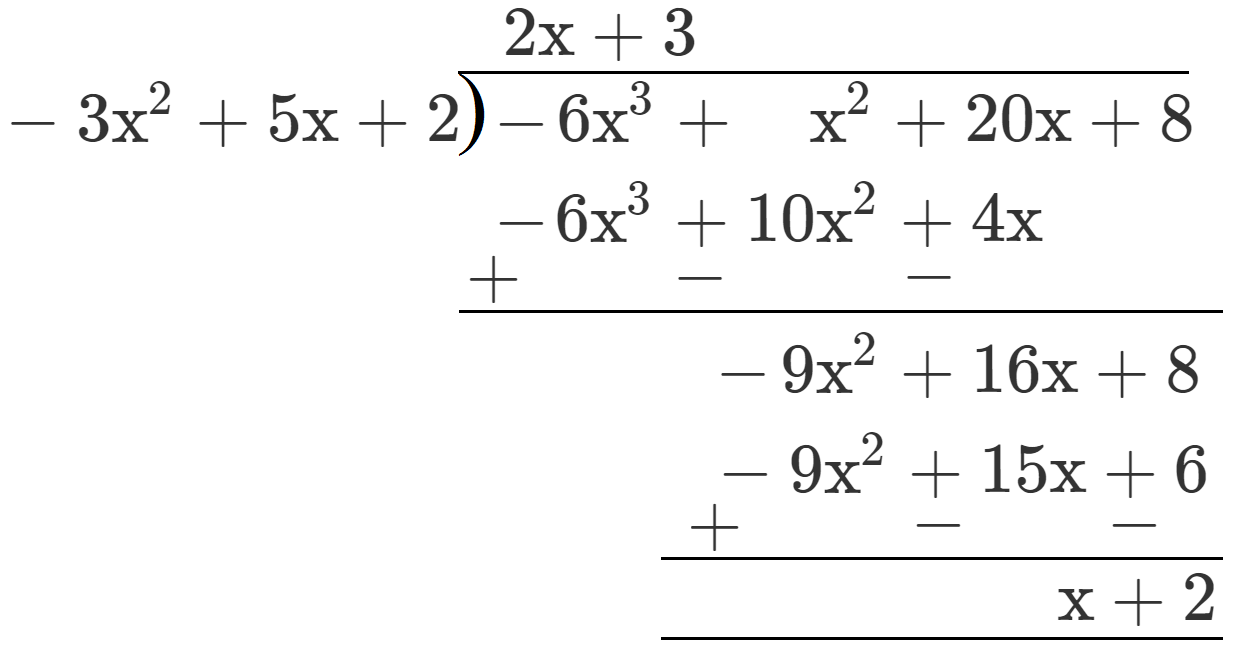
Quotient $= 2x + 3$
Remainder$ = x + 2$ By using division rule,
we have Divided = Quotient $\times$ Divisor + Remainder
$\therefore$ $-6x^3 + x^2 + 20x + 8 = (-3x^2 + 5x + 2)(2x + 3) + x + 2 $
$\Rightarrow -6x^3 + x^2 + 20x + 8 = -6x^3 + 10x^2 + 4x - 9x^2 + 15x + 6 + x + 2$
$ \Rightarrow -6x^3 + x^2 + 20x + 8 = -6x^3 + x^2 + 20x + 8$ View full question & answer→Question 254 Marks
Find the zeros of the following quadratic polynomial and verify the relationship between the zeros and the coefficients:
$5y^2 + 10y$
AnswerWe have, $f(x) = 5y^2 + 10y =5y(y + 2)$
$\therefore$ $f(x) = 0 \Rightarrow 5y(y + 2) = 0 $
$\Rightarrow 5y = 0$ or $y + 2 = 0$
$ \Rightarrow y = 0$ or $y = -2$
So the zeros of $f(x)$ are $0$ and$ -2$
Sum of zeros $= 0 + (-2) = -2$
$=\frac{-2}{1}=\frac{-2\times5}{1\times5}$
$=\frac{-10}{5}=-\frac{\text{Coefficient of y}}{\text{Coefficient of }\text{y}^2}$
Product of zeros $= 0 × (-2) = 0$
$=\frac{0}{1}=\frac{0\times5}{1\times5}$
$=\frac{0}{5}=\frac{\text{Constant term}}{\text{Coefficient of }\text{y}^2}$
View full question & answer→Question 264 Marks
Find the quotient and the remainder when:
$f(x) = x^4 - 5x + 6$ is divided by $g(x) = 2 - x^2$
AnswerWe can write
$f(x)$ as $x^4+ 0x^3 + 0x^2 - 5x + 6$ and $g(x) as -x^2 + 2$
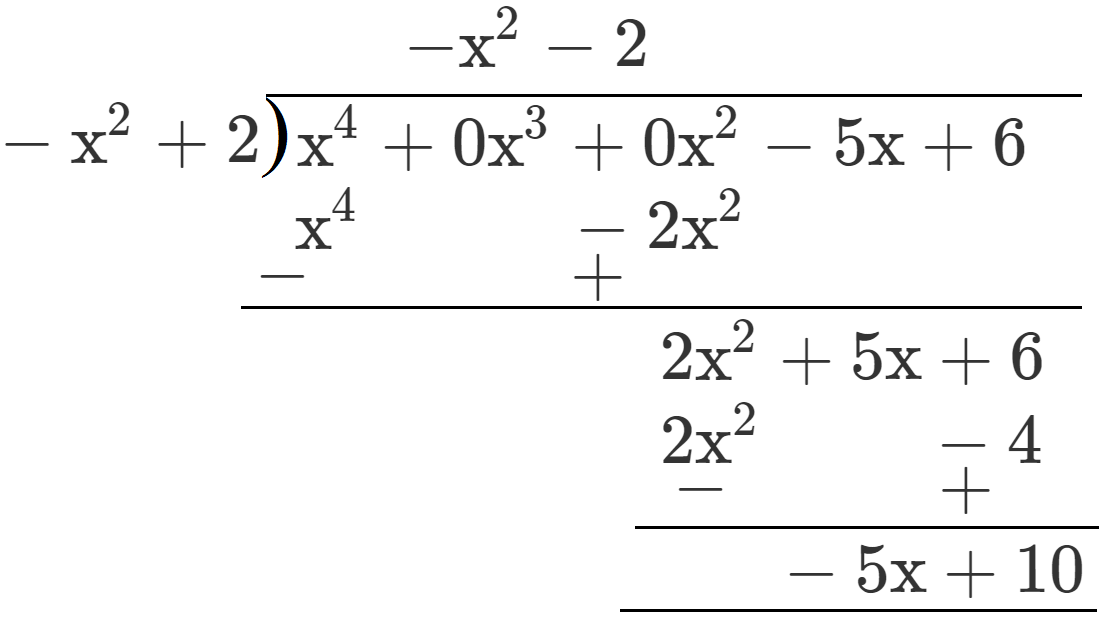
Quotient $q(x) = -x^2 - 2$
Remainder $r(x) = -5x + 10$ View full question & answer→Question 274 Marks
Find the quadratic polynomial, the sum of whose zeroes is $-5$ and their product is $6$.
AnswerGiven:
Sum of the zeroes $= -5$
Product of the zeroes $= 6$
$\therefore$ Required polynomial = $x^2$ - (sum of the zeroes)x + product of the zeros
$= x^2- (-5)x + 6$
$= x^2 + 5x + 6$
View full question & answer→Question 284 Marks
Show that the polynomial $f(x) = x^4 + 4x^2 + 6$ has no zeroes.
AnswerLet $t = x^2$
So, $f(t) = t^4 + 4t^2 + 6$
Now, to find the zeros, we will equate $f(t) = 0$
$\Rightarrow t^4 + 4t^2 + 6 = 0$
Now, $\text{t}=\frac{-4\pm\sqrt{16-24}}{2}$
$=\frac{-4\pm\sqrt{-8}}{2}$
$=2\pm\sqrt{-2}$
i.e., $\text{x}^2=-2\pm\sqrt{-2}$
$\Rightarrow\text{x}=\sqrt{-2\pm\sqrt{-2}},$ which is not a real number.
The zeros of a polynomial should be real number s.
$\therefore$ The given f(x) has no zeros.
View full question & answer→Question 294 Marks
Verity that $3, -2, 1$ are the zeros of the cubic polynomial $p(x) = x^3 - 2x^2 - 5x + 6$ and verify the relation between its zeros and coefficients.
AnswerThe given polynomial is $p(x) = (x^3 - 2x^2 - 5x + 6)$
$p(3) = (3^3- 2 \times 3^2 - 5 \times 3 + 6)$
$= (27 - 18 - 15 + 6) = 0$
$p(-2) = [(-2^3) - 2 \times (-2^2) - 5 \times (-2) + 6]$
$= (-8 - 8 + 10 + 6) = 0$
$p(1) = (1^3 - 2 \times 1^2 - 5 \times 1 + 6) = (1 - 2 - 5 + 6) = 0$
$3, -2$ and $1$ are the zeroes of $p(x)$,
Let $\alpha=3,\ \beta=-2$ and $\gamma=1.$ Then we have:
$(\alpha+\beta+\gamma)=(3-2+1)$
$=2=\frac{-(\text{Coefficient of }\text{x}^2)}{(\text{Coefficient of }\text{x}^3)}$
$(\alpha\beta+\beta\gamma+\gamma\alpha)=(-6-2+3)$
$=\frac{-5}{1}=\frac{\text{Coefficient of x}}{\text{Coefficient of }\text{x}^3}$
$\alpha\beta\gamma=\Big\{3\times(-2)\times1\Big\}$
$=\frac{-6}{1}=\frac{-\text{(Constant term)}}{(\text{coefficient of }\text{x}^3)}$
View full question & answer→Question 304 Marks
Short-Answer Question:
If $\alpha$ and $\beta$ are the zeroes of a polynomial $f(x) = 6x^2 + x - 2$, find the value of $\Big(\frac{\alpha}{\beta}+\frac{\beta}{\alpha}\Big).$
AnswerSince $\alpha$ and $\beta$ are the zeros of $6x^2 + x - 2$, we have
$\alpha+\beta=-\frac{1}{6}$
$\alpha\beta=\frac{-2}{6}=\frac{-1}{3}$
$\therefore\frac{\alpha}{\beta}+\frac{\beta}{\alpha}=\frac{\alpha^2+\beta^2}{\alpha\beta}$
$=\frac{(\alpha+\beta)^2-2\alpha\beta}{\alpha\beta}$
$=\frac{\Big(-\frac{1}{6}\Big)^2-2\Big(-\frac{1}{3}\Big)}{\Big(-\frac{1}{3}\Big)}$
$=-\frac{\frac{1}{36}+\frac{2}{3}}{\frac{1}{3}}$
$=-\frac{\frac{25}{36}}{\frac{1}{3}}$
$=-\frac{25}{36}\times\frac{3}{1}$
$=-\frac{25}{12}$
View full question & answer→Question 314 Marks
Short-Answer Question:
If $\alpha$ and $\beta$ are the zeroes of a polynomial $f(x) = x^2 - 5x + k$, such that $\alpha-\beta=1$ find the value of k.
AnswerLet are the zeros of $x^2 - 5x + k.$
Then, we have
$\alpha+\beta=-\frac{(-5)}{1}=5$
$\alpha\beta=\frac{\text{k}}1{}=\text{k}$
Given, $\alpha-\beta=1$
Now, $(\alpha+\beta)^2=(\alpha-\beta)^2+4\alpha\beta$
$\Rightarrow(5)^2=(1)^2+4\times\text{k}$
$\Rightarrow25=1+\text{4k}$
$\Rightarrow\text{4k}=24$
$\Rightarrow\text{k}=\frac{24}{4}$
$\Rightarrow\text{k}=6$
View full question & answer→Question 324 Marks
If $(x + a)$ is a factor of the polynomial $2x^2 + 2ax + 5x + 10$, find the value of of a.
AnswerLet $f(x) = 2x^2 + 2ax + 5x + 10$
Since (x + a) is a factor of f(x), we have
$f(-a) = 0$
$\Rightarrow 2(-a)^2 + 2a(-a) + 5(-a) + 10 = 0$
$\Rightarrow 2a^2 - 2a^2 - 5a + 10 = 0$
$\Rightarrow 5a = 10$
$\Rightarrow a = 2$
View full question & answer→