Questions

5 Marks Question

🎯

Test yourself on this topic

6 questions · timed · auto-graded

Question 15 Marks
Find the length of each side of a rhombus whose diagonals are 24cm and 10cm long.
Answer
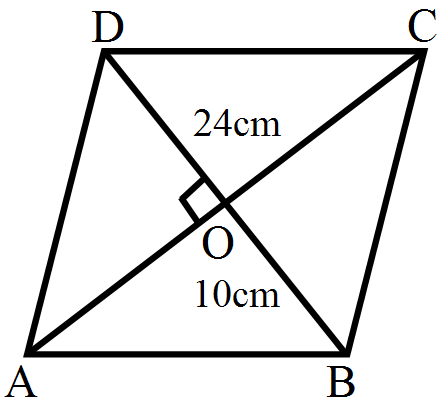
In an rhombus, the diagonals are perpendicular bisectors of each other, and side are equal to eachother.
So, $\text{AO}=\frac{1}{2}\text{AC}=12\text{cm}$
$\text{OD}=\frac{1}{2}\text{BD}=5\text{cm}$
In right-angled $\triangle\text{AOD},$
$\text{AD}^2=\text{AO}^2+\text{OD}^2$
$\Rightarrow\text{AD}^2=\text{12}^2+\text{5}^2$
$\Rightarrow\text{AD}^2=\text{144}+\text{25}$
$\Rightarrow\text{AD}^2=\text{169}$
$\Rightarrow\text{AD}=\text{13}\text{cm}$
So, the length of the each side of the rhombus is 13cm.
View full question & answer
Question 25 Marks
State the SSS-criterion for similarity of trianglrs.
Answer
If the corresponding sides of two triangles are proportional then their corresponding angles are equal, and hence the two triangles are similar.
View full question & answer
Question 35 Marks
If $\triangle\text{ABC}\sim\triangle\text{DEF}$ such that 2AB = DE and BC = 6cm, find EF.
Answer
Given $\triangle\text{ABC}\sim\triangle\text{DEF}$ and 2AB = DE and BC = 6cm
$\Rightarrow\frac{\text{AB}}{\text{DE}}=\frac{\text{BC}}{\text{EF}}$
$\Rightarrow\frac{1}{2}=\frac{6}{\text{EF}}$
$\Rightarrow\text{EF}=3\text{cm}$
View full question & answer
Question 45 Marks
For the following statments state whether true (T) or false(F):
In a $\triangle\text{ABC},\text{AB}=6\text{cm},\angle\text{A}=45^\circ$ and $\text{AC}=8\text{cm}$ and in a $\triangle\text{DEF},\text{DF}=9\text{cm},\angle\text{D}=45^\circ$and $\text{DE}=12\text{cm},$ then $\triangle\text{ABC}\sim\triangle\text{DEF}.$
Answer
False.
Solution:
Given that,
$\angle\text{A}=45^\circ,\text{AB}=6\text{cm}$ and $\text{AC}=8\text{cm}$
$\angle\text{D}=45^\circ,\text{DF}=9\text{cm}$ and $\text{DE}=12\text{cm}$
Consider, $\triangle\text{ABC}$ and $\triangle\text{DFE},$
$\angle\text{A}=\angle\text{D}=45^\circ$
$\frac{\text{AB}}{\text{DE}}=\frac{6}{12}=\frac{1}{2}$
$\frac{\text{AC}}{\text{DF}}=\frac{8}{9}$
$\Rightarrow\frac{\text{AB}}{\text{DF}}\not=\frac{\text{AC}}{\text{DF}}$
Thus, the triangles are not similar.
View full question & answer
Question 55 Marks
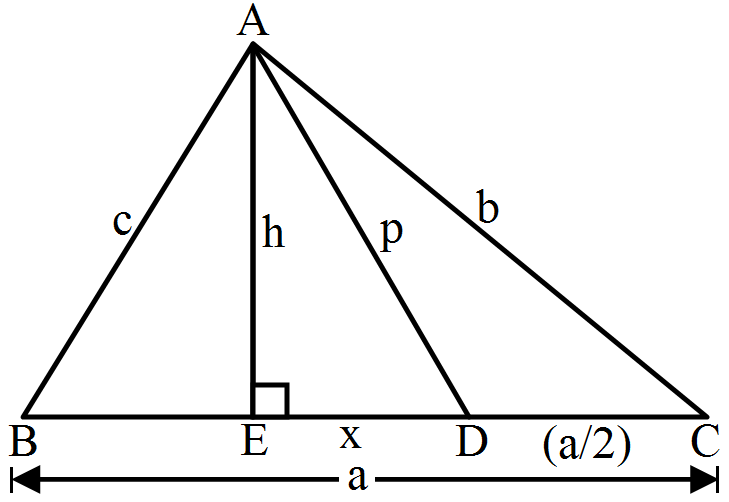
In the given figure, D is the midpoint of side BC and $\text{AE}\perp\text{BC}.$ If BC = a, AC = b, AB = c, ED = x, AD = p and AE = h, prove that.

$\text{b}^2=\text{p}^2+\text{ax}+\frac{\text{a}^2}{4}$
Answer
Given: D is the midpoint of side $\text{BC},\text{AE}\perp\text{BC},\text{BC}=\text{a},\text{AC}=\text{b},\text{AB}=\text{c},\text{ED}=\text{x},\text{AD}=\text{p}$ and $\text{AE}=\text{h}$
In $\triangle\text{AEC},\angle\text{AEC}=90^\circ$
$\text{AD}^2=\text{AE}^2+\text{ED}^2$ (by pythagoras theorem)
$\Rightarrow\text{p}^2=\text{h}^2+\text{x}^2$
In $\triangle\text{AEC},\angle\text{AEC}=90^\circ$
$\text{AC}^2=\text{AE}^2+\text{EC}^2$ (by pythagoras theorem)
$\text{b}^2=\text{h}^2+\Big(\text{x}+\frac{\text{a}}{\text{2}}\Big)^2=\big(\text{h}^2+\text{x}^2\big)+\text{ax}+\frac{\text{a}^2}{4}$
$\therefore\text{b}^2=\text{p}^2+\text{ax}+\frac{\text{a}^2}{4}\dots(1)$
View full question & answer
Question 65 Marks
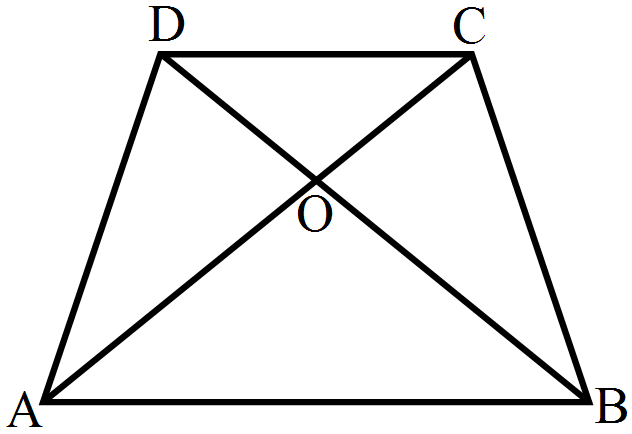
In a trapezium ABCD, it is given that AB || CD and AB = 2CD. Its diagonals AC and BD intersect at the point O such that $\text{ar}(\triangle\text{AOB})=84\text{cm}^2.$ Find $\text{ar}(\triangle\text{COD}).$
Answer

The diagonals of a trapezium divide each other proportionally.
$\angle\text{CDO}=\angle\text{OBA}$ ...(alternate angles)
$\angle\text{COD}=\angle\text{AOB}$ ...(vertically opposite angles)
$\Rightarrow\triangle\text{COD}=\triangle\text{AOB}$ ...(AA criterion for similarity)
$\Rightarrow\frac{\text{ar}(\triangle\text{COD})}{\text{ar}(\triangle\text{AOB})}=\frac{\text{CD}^2}{\text{AB}^2}$
$\Rightarrow\frac{\text{ar}(\triangle\text{COD})}{84}=\frac{1^2}{2^2}$
$\Rightarrow\text{ar}(\triangle\text{COD})=21\text{cm}^2$
View full question & answer