Question types

P-1 Heat question types

18 questions across 6 question groups — pick any mix to generate a Science paper with step-by-step answer keys.

18
Questions
6
Question groups
5
Question types
Sample Questions

P-1 Heat questions

One sample from each question group in this chapter. Select any group above to see the full set with answer keys.

Q 1M.C.Q1 Mark
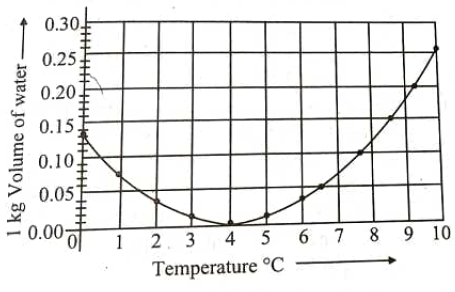
Water expands on reducing its temperature below __________ ${ }^{\circ} C$.
  • A
    $0$
  • $4$
  • C
    $12$
  • D
    $5$

Answer: B.

View full solution
Q 3M.C.Q1 Mark
The vapour content in the air is measured using a physical quantity called _____________.
  • Absolute humidity
  • B
    Relative humidity
  • C
    Dew point
  • D
    Humidity

Answer: A.

View full solution
Read the following paragraph and answer the questions based on it:
If heat is exchanged between a hot and cold object, the temperature of the cold object goes on increasing due to gain of energy and the temperature of the hot object goes on decreasing due to loss of energy.
The change in temperature continues till the temperatures of both the objects attain the same value. In this process, the cold object gains heat energy and the hot object loses heat energy. If the system of both the objects is isolated from the environment by keeping it inside a heat resistant box, then no energy can flow from inside the box or come into the box.

i. Heat is transferred from where to where?
ii. Which principle do we learn about from this process?
iii. How will you state the principle briefly?
View full solution
A copper sphere of 100 g mass is heated to raise its temperature to $100^{\circ} C$ and is released in water of mass 195 g and temperature $20^{\circ} C$ in a copper calorimeter. If the mass of calorimeter is 50 g , what will be the maximum temperature of water?
(Given: specific heat of copper $=0.1 cal / g ^{\circ} C$ )
View full solution
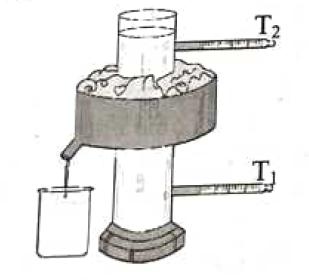
Observe the given diagram and answer the following questions:

Image

i. What is the name of the given apparatus?
ii. Which phenomenon is studied with the help of this apparatus?
iii. What are the final temperatures in thermometers $T _1$ and $T _2$ ?
iv. At what temperature the density of water is maximum?
v. Give one example of the above phenomenon in nature.
View full solution

Generate a P-1 Heat paper free

Pick question groups from the list above, set marks and difficulty, and export a branded PDF with step-by-step answer keys. First 3 chapters free — no signup.

Download App