……… is used in balloons and in scuba diving.
- ✓Helium
- BOxygen
- CNitrogen
- DOzone
Answer: A.
View full solution →485 questions across 14 question groups — pick any mix to generate a Science paper with step-by-step answer keys.
M.C.Q
22 Q→02Answer the following questions:[1 M]
102 Q→03Give scientific reasons: [2 M]
10 Q→04Answer the following questions: [2 M]
69 Q→05Answer the following questions: [3 M]
53 Q→06Answer the following questions: [5 M]
26 Q→07Write True or False
39 Q→08Name the Following
16 Q→09Do As Directed.
91 Q→10Write notes.
1 Q→11Fill in the blanks.
34 Q→12Find An Odd One Out
10 Q→13Distinguish Between :
7 Q→14Match the following.
5 Q→One sample from each question group in this chapter. Select any group above to see the full set with answer keys.
Answer: A.
View full solution →Answer: C.
View full solution →Answer: C.
View full solution →Answer: B.
View full solution →Answer: D.
View full solution →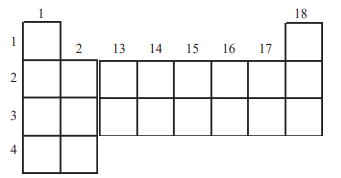
| Column 1 | Column 2 | Column 3 |
| i. Triad | a. Lightest and negatively charged particle in all the atoms | 1. Mendeleev |
| ii. Octave | b. Concentrated mass and positive charge | 2. Thomson |
| iii. Atomic number | c. Average of the first and the third atomic mass | 3. Newlands |
| iv. Period | d. Properties of the eighth element similar to the first | 4. Rutherford |
| v. Nucleus | e. Positive charge on the nucleus | 5. Dobereiner |
| vi. Electron | f. Sequential change in molecular formulae | 6. Moseley |
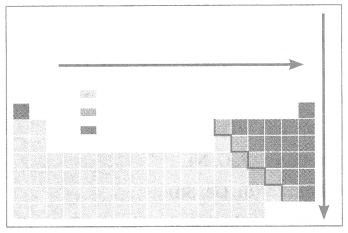
(a) Which points are considered for the modern periodic table?
(b) How are blocks indicated?
(c) Which elements are present near the zig-zag line?
(d) Draw the electronic configuration of the second-row elements of first group in the periodic table.
(e) In a periodic table while going from left to right atomic radius decreases. Explain. (Practice Activity Sheet – 1)
| Column A | Column B |
| (i) Alkali metals | (a) Group 2 |
| (ii) Alkaline earth metals | (b) Group 1 |
| (iii) Halogens | (c) Group 18 |
| (iv) Noble gases | (d) Group 17 |
| Column A | Column B |
| (i) Atomic size in a period from (left to right) | (a) Atomic mass |
| (ii) Atomic size in a group from (top to bottom) | (b) Increases |
| (iii) Modern Periodic Law | (c) Atomic Number |
| (iv) Mendeleev’s Periodic Law | (d) Decreases |
| Column A | Column B |
| (i) Sodium | (a) Non-metal |
| (ii) Sulphur | (b) Lanthanide |
| (iii) Manganese | (c) Metal |
| (iv) Cerium | (d) Transition metal |
| Column A | Column B | Column C |
| (i) Triad | (a) Positive change on the nuleus | (1) Mendeleev |
| (ii) Octave | (b) Sequential change in molecular formulae | (2) Dobereiner |
| (iii) Atomic number | (c) Average of the first and the third atomic mass | (3) Newlands |
| (iv) Period | (d) Properties of the eighth element similar to the first | (4) Mosely |
Pick question groups from the list above, set marks and difficulty, and export a branded PDF with step-by-step answer keys. First 3 chapters free — no signup.