Questions · Page 1 of 2

3 Marks Question

🎯

Test yourself on this topic

50 questions · timed · auto-graded

Question 13 Marks
A washing tub in the shape of a frustum of a cone has height 21 cm. The radii of the circular top and bottom are 20 cm and 15 cm respectively. What is the capacity of the tub? $\left(\pi=\frac{22}{7}\right)$
Answer
Height of frustum, $h=21 cm$
Two radii of frustum are, $r_1=20 cm$ and $r_2=15 cm$
As we know,
Volume of frustum of cone, $V=\frac{1}{3} \times \pi h \times\left(r_1^2+r_2^2+r_1 r_2\right)$
$\Rightarrow V=\frac{1}{3} \times \frac{22}{7} \times 21 \times\left(20^2+15^2+20 \times 15\right)$
$\Rightarrow V=\frac{1}{3} \times \frac{22}{7} \times 21 \times 925$
$\Rightarrow V=20350 cm^3$
$\Rightarrow V=20.35 \text { litres }$
$\therefore$ Capacity of bucket is 20.35 litres
View full question & answer
Question 23 Marks
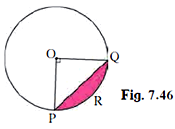
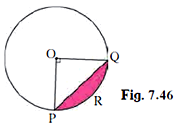
In the figure 7.46 , if $O$ is the centre of the circle, $P Q$ is a chord. $\angle POQ =90^{\circ}$, area of shaded region is $114 cm^2$, find the radius of the circle. $(\pi=3.14)$
Answer
Area Of shaded region, $A_R=114$ sq.cm
Area of sector (O-PRQ),AS = one-fourth of area of circle $\Rightarrow A s=\frac{1}{4} \pi r^2$
Area ( $\triangle POQ ), A_T=\frac{1}{2} \times r^2$
Area of Shaded Region, $A_R=A_S-A_T$
$\Rightarrow A_R=\frac{1}{2} r^2\left(\frac{\pi}{2}-1\right)$
$\Rightarrow 114=\frac{1}{2} \times r^2 \times\left(\frac{3.14}{2}-1\right)$
$\Rightarrow r=\sqrt{\frac{114 \times 2}{0.57}}$
$\Rightarrow r =20 cm$
$\therefore$ Radius of the circle is 20 cm
View full question & answer
Question 33 Marks
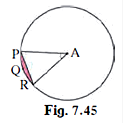
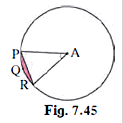
In the figure 7.45, if A is the centre of the circle. ∠ PAR = 30°, AP = 7.5, find the area of the segment PQR. (π = 3.14)
Answer
Radius of circle, $r=7.5 \mathrm{~cm}$
$\angle \mathrm{PAR}=\theta=30^{\circ}$
Area(A - PQR), $A_s$:
Area of sector, $A_S=\frac{\theta}{360} \times \pi r^2$
$\Rightarrow A_S=\frac{30}{360} \times 3.14 \times(7.5)^2$
$\Rightarrow A_S=14.71 \mathrm{sq} . \mathrm{cm}$
Also,
$\text { Area }(\triangle A P R), A_T=\frac{1}{2} \times r^2 \times \sin (\theta)$
$\Rightarrow A_T=\frac{1}{2} \times(7.5)^2 \times \sin \left(30^{\circ}\right)$
$\Rightarrow A_T=\frac{1}{2} \times(7.5)^2 \times \frac{1}{2}$
$\Rightarrow A_T=14.06 \mathrm{sq.} \mathrm{cm}$
Area of segment $P Q R, A_R=A_S-A_T$
$\Rightarrow A_R=14.71-14.06=0.6562 \mathrm{sq} . \mathrm{cm}$
$\therefore$ Area of shaded region is 0.6562 sq.cm
View full question & answer
Question 43 Marks
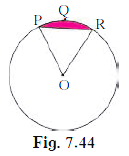
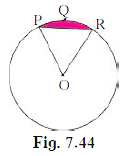
In the figure 7.44, O is the centre of the circle. M (arc PQR) = 60° OP = 10 cm.
Find the area of the shaded region. (π = 3.14, √3 = 1.73)
Answer
Since the angle subtended at centre is $60^{\circ}$
And by the property, if two sides of a triangle are equal then their corresponding angles are also equal.
$\Rightarrow \angle \mathrm{ORP}=\angle \mathrm{OPR}$
As the sum of all internal angles of a triangle is equal to $180^{\circ}$
$\Rightarrow \angle O R P=\angle O P R=60^{\circ}$
$\Rightarrow \triangle O P R$ is an equilateral triangle.
Area of equilateral triangle, $A_T=\frac{\sqrt{3}}{4}(O P)^2$
$\Rightarrow A_T=\frac{\sqrt{3}}{4} \times 10^2$
$\Rightarrow A_T=43.25 \mathrm{sq} . \mathrm{cm}$
Area Of Sector (O-PQR), As is given as:
Area of sector, $A_S=\frac{\theta}{360} \times \pi r^2$
$\Rightarrow A_S=\frac{60}{360} \times 3.14 \times 10^2$
$\Rightarrow A_s=52.33 \mathrm{sq} . \mathrm{cm}$
Area of shaded region, $A_R=A_S-A_T$
$\Rightarrow A_R=52.33-43.25$
$\Rightarrow A_R=9.08 \mathrm{sq} . \mathrm{cm}$
$\therefore$ Area of shaded region is 9.08 sq.cm
View full question & answer
Question 53 Marks
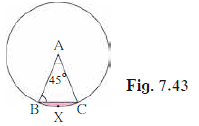
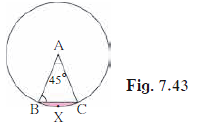
In figure 7.43, A is the centre of the circle. ∠ ABC = 45° and AC = 7√2 cm. Find the area of segment BXC.
Answer
From the property, we know that, If two sides of a triangle are equal then their corresponding angles are also equal.
So, as AB = AC,
⇒ ∠ ABC = ∠ ACB = 45°
As the sum of angles of a triangle is equal to 180°
⇒∠ ABC + ∠ ACB + ∠ BAC = 180°
⇒45° + 45° + ∠ BAC = 180°
⇒90° + ∠ BAC = 180°
⇒ ∠ BAC = 90°
Area of $\triangle A B C, A_T=\frac{1}{2} \times A B \times A C$
$\Rightarrow A_T=\frac{1}{2} \times(7 \sqrt{2})^2$
$\Rightarrow A_T=49 sq . cm$
Area of the sector $=$ one-fourth of a circle
$A_S=\frac{1}{4} \times \pi \times A C^2$
$A_S=\frac{1}{4} \times \frac{22}{7} \times(7 \sqrt{2})^2$
$\Rightarrow A_S=77 sq . cm$
Area of the shaded region, $A_R=A_S-A_T$
$\Rightarrow A_R=77-49$
$\Rightarrow A_R=28 sq . cm$
$\therefore$ The area of the shaded region is $28 sq . cm$.
View full question & answer
Question 63 Marks
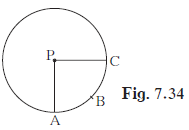
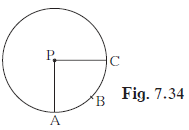
In figure 7.34, if A(P-ABC) = $154 \mathrm{~cm}^2$ radius of the circle is 14cm, find
(1) ∠ APC.
(2) l (arc ABC).
Answer
As we know that,
Area of sector, $A=\frac{\theta}{360} \times \pi r^2$
(1) Let the $\angle APC$ be $\theta$
Radius of circle, $r=14 cm$
Area of sector, $A=154 cm^2$
$\Rightarrow \theta=\frac{A \times 360}{\pi r^2}$
$\Rightarrow \theta=\frac{154 \times 360 \times 7}{22 \times 14^2}$
$\Rightarrow \theta=90^{\circ}$
(2) Since the angle formed is $90^{\circ}$, which is one-fourth of the perimeter of circle
$\Rightarrow l (\operatorname{arc} A B C)=\frac{1}{4} \times 2 \pi r$
$\Rightarrow l =\frac{22 \times 14}{2 \times 7}$
$\Rightarrow l =22 cm$
View full question & answer
Question 73 Marks
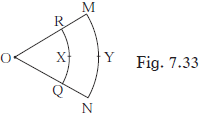
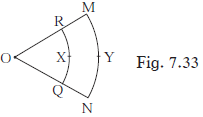
In figure 7.33 O is the centre of the sector.∠ ROQ = ∠ MON = 60°. OR = 7 cm, and OM = 21 cm. Find the lengths of arc RXQ and arc MYN.
$\left(\pi=\frac{22}{7}\right)$
Answer
Let the ∠ ROQ= ∠ MON = θ = 60°
As we know that,
Length of arc $=\frac{\theta}{360} \times 2 \pi r$
$\Rightarrow \text { Length }( RXQ )=\frac{60}{360} \times 2 \pi \times OR$
$\Rightarrow \text { Length }( RXQ )=\frac{1}{6} \times 2 \times \frac{22}{7} \times 7$
$\Rightarrow \text { Length }( RXQ )=7.6 cm$
$\text { Similarly } \Rightarrow \text { Length }( MYN )=\frac{60}{360} \times 2 \pi \times 0 M$
$\Rightarrow \text { Length }( MYN )=\frac{1}{6} \times 2 \times \frac{22}{7} \times 21$
⇒ Length (MYN) = 22 cm
View full question & answer
Question 83 Marks
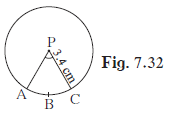
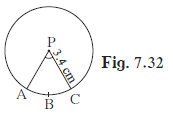
In figure 7.32, radius of circle is 3.4 cm and perimeter of sector P-ABC is 12.8 cm. Find A (P-ABC).
Answer
Radius of circle, r = 3.4 cm
Perimeter of sector, P = 12.8
⇒ P = length of arc + 2× radius
⇒ Length of arc, l = P – 2×r
⇒ l = 12.8 – 2(3.4)
⇒ l = 6 cm
Let the ∠ APC be θ
As we know that,
$\text { Length of arc }=\frac{\theta}{360} \times 2 \pi r $
$\Rightarrow 1=\frac{\theta}{360} \times 2 \pi r $
$\Rightarrow \theta=\frac{360 \times l}{2 \pi r}$
Also,
Area of sector, $A=\frac{\theta}{360} \times \pi r^2$
On Substituting the value of theta from above equation,
$\Rightarrow A=\frac{360 \times 1}{360 \times 2 \pi r} \times \pi \times r^2 $
$\Rightarrow A=\frac{1 \times r}{2} $
$\Rightarrow A=\frac{6 \times 3.4}{2} $
$\Rightarrow A=10.2\  sq . cm$
View full question & answer
Question 93 Marks
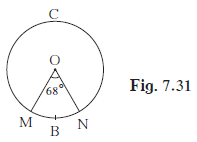
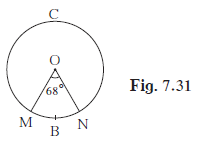
In the figure 7.31, radius of the circle is 7 cm and m(arc MBN) = 60°,find

(1) Area of circle
(2) A(O – MBN)
(3) A(O - MCN)
Answer
Radius of circle, $r=7 \mathrm{~cm}$
Area of circle, $A_C=\pi r^2$
$\Rightarrow A_C=\frac{22}{7} \times 7^2$
$\Rightarrow A_C=154 \text { sq. } \mathrm{cm}$
$\therefore$ area of circle is $154 \mathrm{sq} . \mathrm{cm}$
(2) Angle subtended by the arc $=60^{\circ}$
As we know,
$\text { Area of sector }=\frac{\theta}{360} \times \pi r^2$
$\Rightarrow \text { Area }(0-M B N)=\frac{60}{360} \times \text { Area of circle }$
$\Rightarrow \text { Area }(0-M B N)=\frac{1}{6} \times A_C$
$\Rightarrow \mathrm{A}(\mathrm{O}-\mathrm{MBN})=25.7 \mathrm{sq} . \mathrm{cm}$
(3) $\mathrm{A}(\mathrm{O}-\mathrm{MCN})=$ Area of circle $-\mathrm{A}(\mathrm{O}-\mathrm{MBN}$ )
$\Rightarrow \operatorname{Area}(O-M C N)=A C-25.7$
$\Rightarrow \operatorname{Area}(O-M C N)=154-25.7$
$\therefore$ Area of major sector is $128.3 \mathrm{sq} . \mathrm{cm}$
View full question & answer
Question 103 Marks
Area of a sector of a circle of radius 15 cm is $30 cm^2$. Find the length of the arc of the sector.
Answer
Radius of circle, $r=15 cm$
$\text { Area of sector }=\frac{\theta}{360} \times \pi r^2$
$\Rightarrow 30=\frac{\theta}{360} \times 3.14 \times r^2 $
$\Rightarrow \theta=\frac{360 \times 30}{3.14 \times 15^2}$
Also,
$\text { Length of } \operatorname{arc}=\frac{\theta}{360} \times 2 \pi r$
On substituting the values, we get,
$\text { Length of arc }=\frac{30}{3.14 \times 15^2} \times 2 \pi r $
$\Rightarrow \text { Length of arc }=4 cm$
View full question & answer
Question 113 Marks
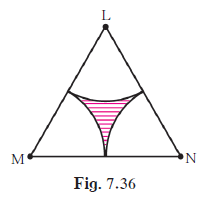
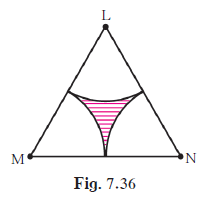
>∆ LMN is an equilateral triangle. LM = 14 cm. As shown in figure, three sectors are drawn with vertices as centre and radius7 cm. Find,


(1) A (Δ LMN)
(2) Area of any one of the sectors
(3) Total area of all three sectors
(4) Area of shaded region
Answer
(1) Side of triangle $=\mathrm{LM}=\mathrm{a}=14 \mathrm{~cm}$
Since $\triangle \mathrm{LMN}$ is an equilateral triangle, so the area of the triangle is given by:
Area of triangle, $A_T=\frac{\sqrt{3}}{4} a^2$
$\Rightarrow A_T=\frac{\sqrt{3}}{4} \times 14^2$
$\Rightarrow A_T=84.87 \mathrm{sq} . \mathrm{cm}$
(2) Angle subtended by the corner $=\theta=60^{\circ}$
As we know,
Area of sector, $A_S=\frac{\theta}{360} \times \pi r^2$
Here $r=\frac{a}{z^{\prime}}$
$\Rightarrow A_S=\frac{60}{360} \times \frac{22}{7} \times\left(\frac{a}{2}\right)^2$
$\Rightarrow A_S=25.67 \mathrm{sq} . \mathrm{cm}$
(3) Total area of all sector, $A_{T S}=3 \times A_S$
$\Rightarrow A_{T S}=3 \times 25.67$
$\Rightarrow A_{T S}=77.01 \mathrm{sq} \cdot \mathrm{cm}$
(4) Area of shaded region, $A_R=$ Area of triangle - Area of all three sectors
$\Rightarrow A_S=A_T-A_{T S}$
$\Rightarrow A_S=84.87-77.01$
$\Rightarrow A_S=7.86 \mathrm{sq} . \mathrm{cm}$
$\therefore$ area of shaded region is $7.86 \mathrm{sq} . \mathrm{cm}$
View full question & answer
Question 123 Marks
>Radius of a sector of a circle is 7 cm. If measure of arc of the sector is –
(I) $30^{\circ}$
(II) $210^{\circ}$
(lll) three right angles
Find the area of sector in each case.
Answer
Radius of circle, $r=7 cm$
(I) Angle subtended by arc, $\theta=30^{\circ}$
As we know,
Area of sector, $A=\frac{\theta}{360} \times \pi r^2$
$A_I=\frac{30}{360} \times \frac{22}{7} \times 7^2$
$\Rightarrow A_I=12.83 sq . cm$
(II) Angle subtended by arc, $\theta=210^{\circ}$
Similarly,
Area of sector, $A_{I I}=\frac{\theta}{360} \times \pi r^2$
$A_{I I}=\frac{210}{360} \times \frac{22}{7} \times 7^2$
$\Rightarrow A _{\|}=89.83 sq . cm$
(III) Angle subtended by arc, $\theta=(3 \times 90)^{\circ}=270^{\circ}$
Similarly,
Area of sector, $A_{I I I}=\frac{\theta}{360} \times \pi r^2$
$A_{I I I}=\frac{270}{360} \times \frac{22}{7} \times 7^2$
$\Rightarrow A_{I I I}=115.5 sq . cm$
View full question & answer
Question 133 Marks
The radii of ends of a frustum are 14 cm and 6 cm respectively and its height is 6 cm. Find its
i) Curved surface area
ii) Total surface area
iii) Volume
Answer
The two radii of frustum are, $r_1=14 cm$ and $r_2=6 cm$
Height of frustum, $H=6 cm$
Slant height of frustum, $l=\sqrt{H^2+\left(r_1-r_2\right)^2}$
$\Rightarrow l=\sqrt{6^2+(14-6)^2}$
$\Rightarrow l=\sqrt{36+64}$
$\Rightarrow l=10$
As we know that,
Curved surface area, $A_C=\pi l\left(r_1+r_2\right)$
$\Rightarrow A_C=(3.14) \times 10 \times(14+6)$
$\Rightarrow A_C=(3.14) \times 200$
$\Rightarrow A_C=628 sq . cm$
$\therefore$ the curved surface area of frustum is 628 sq. cm
(ii) Total surface area, $A _T=$ Curved surface area + area of the two circular regions
$A_T=A_C+\pi r_1^2+\pi r_2^2$
On substituting the above values, we get,
$\Rightarrow A_T=628+(3.14) \times\left(14^2+6^2\right)$
$\Rightarrow A_T=628+(3.14) \times(196+36)$
$\Rightarrow A_T=628+728.48$
$\Rightarrow A_T=1356.48 sq . cm$
$\therefore$ the total surface area of frustum is $1356.48 cm^2$
(iii) As we know,
The Volume of frustum, $V=\frac{1}{3} \pi H\left(r_1^2+r_2^2+r_1 r_2\right)$
On substituting the values, we get,
$V =\frac{1}{3} \times 3.14 \times 6 \times\left(14^2+6^2+14 \times 6\right)$
$V =\frac{1}{3} \times 3.14 \times 6 \times(196+36+84)$
$V =\frac{1}{3} \times 3.14 \times 6 \times 316$
$V=1984.48 cm^3$
$\therefore \text { Volume of the frustum is } 1984.48 cm^3$
View full question & answer
Question 143 Marks
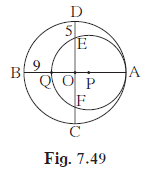
In the figure 7.49, two circles with centre O and P are touching internally at point A. If BQ = 9, DE = 5, complete the following activity to find the radii of the circles.
Answer
SOLUTION Let the radius of the bigger circle be $R$ and that of smaller circle be $r$.
$O A, O B, O C$ and $O D$ are the radii of the bigger circle
$\therefore O A=O B=O C=O D=R$
$P Q=P A=r$
$O Q=O B-B Q=R-9$
$O E=O D-D E=R-5$
As the chords QA and EF of the circle with centre $P$ intersect in the interior of the circle, so by the property of internal division of two chords of a circle,
$O Q \times O A=O E \times O F$
$(R-9) \times R=(R-5) \times(R-5) \ldots \ldots \ldots(\because O E=O F)$
$R^2-9 R=R^2-10 R+25$
$R=25$
$A Q=2 r=A B-B Q$
$2 r=50-9=41$
$r = \frac{41}{2} = 20.5$
View full question & answer
Question 153 Marks
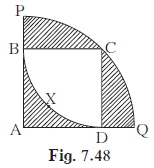
In the figure 7.48, square ABCD is inscribed in the sector A- PCQ. The radius of sector C - BXD is 20 cm. Complete the following activity to find the area of shaded region.
Answer
$\Rightarrow 400-\frac{\theta}{360} \times \pi r ^2 $
$\Rightarrow 400-\frac{90}{360} \times 3.14 \times 400 $
$\Rightarrow 400-314 $
$\Rightarrow 76\  sq . cm$
Radius of bigger sector $=$ Length of diagonal of square $A B C D$
$\Rightarrow 20 \sqrt{2}$
Area of the shaded regions outside the square $=$ Area of sector $A-P C Q-$ Area of square $A B C D=A(A-P C Q)-$
$\text { A(ABCD) } $
$\Rightarrow \frac{\theta}{360} \times \pi \times r ^2-400 $
$\Rightarrow \frac{90}{360} \times 3.14 \times(20 \sqrt{2})^2-400 $
$\Rightarrow 628-400 $
$\Rightarrow 228\  sq . cm$
$\therefore$ total area of the shaded region $=86+228=314\ sq.cm.$
View full question & answer
Question 163 Marks
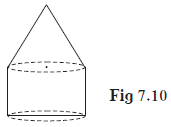
A cylinder and a cone have equal bases. The height of the cylinder is 3 cm and the area of its base is $100 cm^2$.The cone is placed upon the cylinder. Volume of the solid figure so formed is $500 cm^3$. Find the total height of the figure.
Answer
Let the radius of base be $r$.
Let the height of cone $= H$
Height of cylinder, $h=3 cm$
Area of base, $A=100 sq . cm$
As we know the area of circle is $\pi r^2$
$\Rightarrow \pi r^2=10$
Volume of complete solid figure, $V =$ Volume of cone + volume of cylinder
$\Rightarrow V=\frac{1}{3} \pi r^2 H+\pi r^2 h$
$\Rightarrow V=\pi r^2\left(h+\frac{H}{3}\right)$
It is given that volume of solid figure, $V =500$ cubic cm
On substituting the value of $V$ and $\pi r^2$ from eq (1), we get,
$\Rightarrow 500=100\left(3+\frac{H}{3}\right)$
$\Rightarrow H =6 cm$
Total height of figure $= h + H =3+6=9 cm$
$\therefore$ total height is 9 cm
View full question & answer
Question 173 Marks
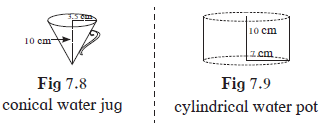
Observe the measures of pots in figure 7.8 and 7.9. How many jugs of water can the cylindrical pot hold?
Answer
Height of water jug, $H _{ J }=10 cm$
Radius of water jug, $R _{ J }=3.5 cm$
Volume of conical jug, $V_J=\frac{1}{3} \pi\left(R_j\right)^2 H_J$
Let the number of jugs be $n$.
Height of cylindrical pot, $H _{ p }=10 cm$
Radius of pot, $R _{ p }=7 cm$
Volume of pot $=\pi\left(R_p\right)^2 H_p$
Since the water is transferred from pot to ' $n$ ' number of jugs,
$\Rightarrow \text { Volume of pot }= n \times \text { Volume of jug }$
$\Rightarrow \pi\left(R_p\right)^2 H_p=n \times \frac{1}{3} \pi\left(R_j\right)^2 H_J$
On substituting the given values,
$\Rightarrow n=3 \times\left(\frac{R_p}{R_J}\right)^2 \times \frac{H_p}{H_J}$
$\Rightarrow n =3 \times 2^2 \times 1$
$\Rightarrow n =12 cm$
$\therefore$ The cylindrical pot can hold 12 jugs of water.
View full question & answer
Question 183 Marks
The area of a sector of a circle of 6 cm radius is 15π sq.cm. Find the measure of the arc and length of the arc corresponding to the sector.
Answer
Let the measure of arc be θ
Area of sector = 15π
Radius, r = 6 cm
As we know,
Area of sector, $A_S=\frac{\theta}{360} \times \pi r^2$
$15 \pi=\frac{\theta}{360} \times \pi \times 6^2$
$\Rightarrow \theta=150^{\circ}$
Also,
Length of arc, $1=\frac{\theta}{360} \times 2 \pi r$
Length of arc, $l=\frac{150}{360} \times 2 \times \pi \times 6$
⇒ l = 5π
∴ The length of the arc is equal to 5π.
View full question & answer
Question 193 Marks
The dimensions of a cuboid are 44 cm, 21 cm, 12 cm. It is melted and a cone of height 24 cm is made. Find the radius of its base.
Answer
Since the volume of cuboid = length× breadth× height
⇒ Volume of cuboid = Product of the given three dimensions
⇒ Volume of cuboid = 44× 21× 12
Height of cone, H = 24 cm
Let Radius of cone be r
Volume of cone $=\frac{1}{3} \pi r ^2 H$
As the cone is melted to form a cone,
⇒ Volume of cone = volume of cuboid
$\Rightarrow \frac{1}{3} \times \frac{22}{7} \times 24 \times r ^2=44 \times 21 \times 12$
$r^2=\frac{44 \times 21 \times 12 \times 7 \times 3}{22 \times 24}$
$r^2=21 \times 7 \times 3$
$r^2=21 \times 21$
$\Rightarrow r=21 cm$
∴ The radius of the cone is 21 cm
View full question & answer
Question 203 Marks
The radius of a metallic sphere is 9 cm. It was melted to make a wire of diameter 4 mm. Find the length of the wire.
Answer
Radius of sphere, R = 9 cm
Volume of sphere, $V=\frac{4}{3} \pi R ^3$
Let the length of wire be H
Radius Of wire, r = 2 mm = 0.2 cm
Volume of wire , $v=\pi r^2 H$
As sphere is melted to make a wire,
⇒ V = v
$\frac{4}{3} \pi R^3=\pi r^2 H$
$\Rightarrow H=\frac{4}{3} \times \frac{R^3}{r^2}$
$\Rightarrow H=\frac{4}{3} \times \frac{9^3}{0.2^2}$
⇒ H = 24300 cm
⇒ H = 243 m
∴ The length of the wire formed is 243 m
View full question & answer
Question 213 Marks
The diameter and length of a roller is 120 cm and 84 cm respectively. To level the ground, 200 rotations of the roller are required. Find the expenditure to level the ground at the rate of Rs. 10 per sq. m
Answer
Diameter of roller = 120 cm
⇒ Radius, r = 60 cm
Length Of Roller, h = 84 cm
Curved Surface area of Roller, $A_R=2 \pi r h$
$A_R=2 \times \frac{22}{7} \times 60 \times 84$
$\Rightarrow A_R=31680 \text { sq. } \cdot cm$
Total area of ground, $A_G=200 \times A_R$
$\Rightarrow A_G=6336000 cm^2$
$A s 1 m^2=10^4 cm^2$
$\Rightarrow A_G=633.6 sq \cdot m$
Rate to level the ground $=$ Rs. 10 per sq.m
Total Expenditure $=\left(\right.$ Total area of ground, $\left.A_G\right) \times$ Rate
$\Rightarrow$ Total Expenditure $=633.6 \times 10$
$\Rightarrow$ Total expenditure $=$ Rs. 6336
$\therefore$ Total expenditure to level the road will be Rs. 6336
View full question & answer
Question 223 Marks
Find the volume of a cone if the radius of its base is 1.5 cm and its perpendicular height is 5 cm.
Answer
Radius of base of cone, r = 1.5cm
Perpendicular height of cone, H = 5cm
As we know that,
Volume of the cone, $V =\frac{1}{3} \pi r ^2 H$
On substituting the given values,
$\Rightarrow V=\frac{1}{3} \times \frac{22}{7} \times(1.5)^2 \times 5$
$=\frac{1}{3} \times \frac{22}{7} \times 2.25 \times 5$
$=\frac{247.5}{21}$
$\Rightarrow V=11.79 cm^3\\
$\therefore$ Volume of the cone is $11.79 cm^3$
View full question & answer
Question 233 Marks
Some plastic balls of radius 1 cm were melted and cast into a tube. The thickness, length and outer radius of the tube were 2 cm, 90 cm and 30 cm respectively. How many balls were melted to make the tube?
Answer
Volume of 1 plastic ball $= V _{ B }$
Radius of ball, $r_B=1 cm$
$V_B=\frac{4}{3} \times \pi r_B^3$
$V_B=\frac{4}{3} \times \pi$
Length of tube, $h =90 cm$
Outer radius of tube, $r _{ O }=30 cm$
Thickness of tube $=2 cm$
Inner radius, $r _1=30-2=28 cm$
Volume of tube, $V _{ T }=$ Volume of Outer cylinder - Volume of inner cylinder
$V_T=\pi h\left(r_O^2-r_I^2\right)$
$\Rightarrow V_{ T }=90 \pi\left(30^2-28^2\right)$
$\Rightarrow V _{ T }=90 \times 116 \times \pi$
Let ' $n$ ' be the number of balls melted.
$\Rightarrow V _{ T }= n \times V _{ B }$
$\Rightarrow 90 \times 116 \times \pi=n \times \frac{4}{3} \times \pi$
$\Rightarrow n =7830 \text { balls }$
$\therefore 7830$ balls were melted to make the tube.
View full question & answer
Question 243 Marks
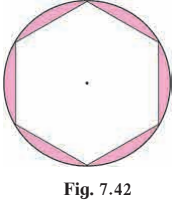
A regular hexagon is inscribed in a circle of radius $14 \mathrm{~cm}$. Find the area of the region between the circle and the hexagon. $\quad\left(\pi=\frac{22}{7}, \sqrt{3}=1.732\right)$
Answer
side of the hexagon $=14 \mathrm{~cm}$
$ \mathrm{A}(\text { hexagon })=6 \times \frac{\sqrt{3}}{4} \times(\text { side })^2$
$=6 \times \frac{\sqrt{3}}{4} \times 14^2$
$=509.208 \mathrm{~cm}^2$
$\mathrm{~A}(\text { circle })=\pi \mathrm{r}^2$
$=\frac{22}{7} \times 14 \times 14$
$=616 \mathrm{~cm}^2$
The area of the region between the circle and the hexagon
$ =\mathrm{A}(\text { circle })-\mathrm{A}(\text { hexagon })$
$=616-509.208$
$=106.792 \mathrm{~cm}^2 $
Image
View full question & answer
Question 253 Marks
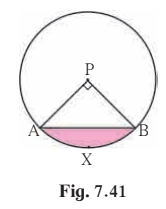
The radius of a circle with centre P is 10 cm. If chord AB of the circle substends a right angle at P, find areas of the minor segment and the major segment. (π = 3.14)
Answer
$r=10 \mathrm{~cm}, \theta=90, \pi=3.14$
$
\begin{aligned}
\mathrm{A}(\mathrm{P}-\mathrm{AXB}) & =\frac{\theta}{360} \times \pi \mathrm{r}^2 \\
& =\frac{90}{360} \times 3.14 \times 10^2 \\
& =\frac{1}{4} \times 314 \\
& =78.5 \mathrm{~cm}^2 \\
\mathrm{~A}(\Delta \mathrm{APB}) & =\frac{1}{2} \text { base } \times \text { height } \\
& =\frac{1}{2} \times 10 \times 10 \\
& =50 \mathrm{~cm}^2
\end{aligned}
$
$
\begin{aligned}
\mathrm{A}(\text { minor segment }) & =\mathrm{A}(\mathrm{P}-\mathrm{AXB})-\mathrm{A}(\triangle \mathrm{PAB}) \\
& =78.5-50 \\
& =28.5 \mathrm{~cm}^2
\end{aligned}
$
$
\begin{aligned}
\mathrm{A}(\text { major segment }) & =\mathrm{A}(\text { circle })-\mathrm{A}(\text { minor segment }) \\
& =3.14 \times 10^2-28.5 \\
& =314-28.5 \\
& =285.5 \mathrm{~cm}^2
\end{aligned}
$
Image
View full question & answer
Question 263 Marks
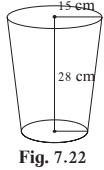
A bucket is frustum shaped. Its height is $28 \mathrm{~cm}$. Radii of circular faces are $12 \mathrm{~cm}$ and $15 \mathrm{~cm}$. Find the capacity of the bucket. $\left(\pi=\frac{22}{7}\right.$ )
Answer
$r_1=15 \mathrm{~cm}, r_2=12 \mathrm{~cm}, \mathrm{~h}=28 \mathrm{~cm}$
Capacity of the bucket $=$ Volume of frustum
$ =\frac{1}{3} \pi h\left(r_1^2+r_2^2+r_1 \times r_2\right)$
$=\frac{1}{3} \times \frac{22}{7} \times 28\left(15^2 \times 12^2+15 \times 12\right)$
$=\frac{22 \times 4}{3} \times(225+144+180)$
$=\frac{22 \times 4}{3} \times 549$
$=88 \times 183$
$=16104 \mathrm{~cm}^3=16.104 \text { litre } $
$\therefore$ capacity of the bucket is 16.104 litre.
Image
View full question & answer
Question 273 Marks
How many solid cylinders of radius $10 \mathrm{~cm}$ and height $6 \mathrm{~cm}$ can be made by melting a solid sphere of radius $30 \mathrm{~cm}$ ?
Answer
Radius of a sphcre, $\mathrm{r}=30 \mathrm{~cm}$
Radius of the cylinder, $\mathrm{R}=10 \mathrm{~cm}$
Height of the cylinder, $\mathrm{H}=6 \mathrm{~cm}$
Let the number of cylinders be $n$.
Volume of the sphere $=\mathrm{n} \times$ volume of a cylinder
$
\begin{aligned}
\therefore \mathrm{n} & =\frac{\text { Volume of the sphere }}{\text { Volume of a cylinder }} \\
& ==\frac{\frac{4}{3} \pi(r)^3}{\pi(R)^2 H} \\
& ==\frac{\frac{4}{3} \times(30)^3}{10^2 \times 6}==\frac{\frac{4}{3} \times 30 \times 30 \times 30}{10 \times 10 \times 6}=60
\end{aligned}
$
$\therefore 60$ cylinders can be made.
View full question & answer
Question 283 Marks
The radius and height of a cylindrical water reservoir is $2.8 \mathrm{~m}$ and $3.5 \mathrm{~m}$ respectively. How much maximum water can the tank hold? A person needs 70 litre of water per day. For how many persons is the water sufficient for a day $?\left(\pi=\frac{22}{7}\right)$
Answer
$(\mathrm{r})=2.8 \mathrm{~m}$,
( h) $=3.5 \mathrm{~m}, \pi=\frac{22}{7}$
Capacity of the water reservoir $=$ Volume of the cylindrical reservoir
$ =\pi \mathrm{r}^2 \mathrm{~h}$
$=\frac{22}{7} \times 2.8 \times 2.8 \times 3.5$
$=86.24 \mathrm{~m}^3$
$=86.24 \times 1000 \quad\left(\because 1 \mathrm{~m}^3=1000 \text { litre }\right)$
$=86240.00 \text { litre. } $
$\therefore$ the rescrvoir can hold 86240 litre of water.
The daily requirement of water of a person is 70 litre.
$\therefore$ water in the tank is sufficient for $\frac{86240}{70}=1232$ persons.
View full question & answer
Question 293 Marks
Area of segment PRQ is 114 sq cm. Chord PQ subtends centre angle $\angle $POQ measuring 90°. Find the radius of the circle. $(\pi=3.14)$
Answer
20 cm
View full question & answer
Question 303 Marks
Find the area of minor segment of a circle of radius 6 cm when its chord subtends an angle of 60° at its centre. $(\sqrt{3}=1.73)$
Answer
$3.29 cm^2$
View full question & answer
Question 313 Marks
Find the length of the arc of the circle of diametr $8.4 \ cm$ with area of the sector $18.48 \ cm^2$​​​​​​​. Also find measure of the arc.
Answer
$8.8 \ cm, 120^\circ $
View full question & answer
Question 333 Marks
The radius of the circle is 3.5 cm and the area of sector is 3.85 sq cm. Find the measure of the arc of the circle.
Answer
36°
View full question & answer
Question 343 Marks
In a clock, the minute hand is of length 14 cm. Find the area covered by the minute hand in 5 minutes.
Answer
$51.33 cm^2$
View full question & answer
Question 353 Marks
If the area of a sector is $\frac{1}{12}$th of the area of the circle, then what is the measure of the corresponding central angle.
Answer
30°
View full question & answer
Question 363 Marks
A sector of a circle with radius 10 cm has central angle 72°. Find the area of the sector $(\pi=3.14)$
Answer
$62.8 cm^2$
View full question & answer
Question 373 Marks
The base radii of two right circular cones of the same height are in the ratio 2 : 3. Find ratio of their volumes.
Answer
$4: 9$
View full question & answer
Question 383 Marks
A beam 4 m long, 50 m wide and 20 m deep is made of wood, which weighs 25 kg per $m ^3$. Find the weight of the beam.
Answer
10 kg
View full question & answer
Question 393 Marks
A solid cube with edge 'l' was divided exactly into two equal halves. Find the ratio of the total surface area of the given cube and that of the cuboid formed.
Answer
$3: 2$
View full question & answer
Question 403 Marks
A washing tub in the shape of a frustum of a cone has height 21 cm. The radii of the circular top and bottom are 20 cm and 15 cm respectively. What is the capacity of the tub?$\left(\pi=\frac{22}{7}\right)$
View full question & answer
3 Marks Question - Maths STD 10 Questions - Vidyadip