MCQ 11 Mark
A number when divided by $143$ leaves $31$ as remainder. What will be the remainder when the same number is divided by $13?$
AnswerLet the number be $n.$
When the number is divided by $143,$ leaves $31$ as remainder.
$\Rightarrow$ The given number is of the form, $143x + 31$
$\Rightarrow n = 143x + 31,$ where $x$ is the quotient
$\Rightarrow n = 13(11x) + 13(2) + 5$
$\Rightarrow n = 13(11x + 2) + 5$
So, here the remainder will be $5$ when divided by $13$
View full question & answer→MCQ 21 Mark
$\text{HCF}$ of $(2^3 \times 3^2 \times 5), (2^2 \times 3^3 \times 5^2)$ and $(2^4 \times ^3\times 5^3 \times 7)$ is:
Answer$(2^3 \times 3^2 \times 5), (2^2 \times 3^3 \times 5^2)$ and $(2^4 \times ^3\times 5^3 \times 7)$
$\text{HCF} = 2^2 \times 3 \times 5 = 60$
View full question & answer→MCQ 31 Mark
$2.13113111311113......$ is:
AnswerAn irrational number is a number that is non$-$terminating and non-repeating.
$2.13113111311113...$ is neither terminating nor repeating, and hence is an irrational number.
View full question & answer→MCQ 41 Mark
$\pi$ is:
AnswerAn irrational number is a number that is non$-$terminating and non$-$repeating.
$\pi=3.1415926\dots$
Which is neither terminating nor repeating, and hence is an irrational number.
View full question & answer→MCQ 51 Mark
a and b are two positive integers such that the least prime factor of a is $3$ and the least prime factor of $b$ is $5.$ Then, the least prime factor of $(a + b)$ is:
AnswerSince $3$ is the least prime factor of $a$, and $5$ is the least prime factor of $b,$
so, $2$ cannot be a factor of either.
$\therefore a$ and $b$ are both odd.
We know that, sum of two odd numbers is alwayas even.
So, $a + b$ is even.
$\Rightarrow$ The least prime factor of $(a + b)$ is $2$
View full question & answer→MCQ 61 Mark
What is the largest number that divides $70$ and $125,$ leaving remainders $5$ and $8$ respectively?
Answer$70$ and $125$ are divided by the largest number leaving remainders $5$ and $8$ respectively.
$70 - 5 = 65$
$125 - 8 = 117$
So, $65$ and $117$ are exactly divisible by the required number.
Thus, the required number is the $\text{HCF}$ of $65$ and $117$
$\text{HCF}(65, 117) = 13$
View full question & answer→MCQ 71 Mark
Which of the following has terminating decimal expansion?
- A
$\frac{32}{91}$
- ✓
$\frac{19}{80}$
- C
$\frac{23}{45}$
- D
$\frac{25}{42}$
AnswerCorrect option: B. $\frac{19}{80}$
A number is a terminating decimal, if the denominator is of the form $2^m \times 5^n$, where m and n are non-negative integers.
$\frac{32}{91}=\frac{32}{7\times13}$
$\frac{19}{80}=\frac{19}{2^4\times5}$
$\frac{23}{45}=\frac{23}{3^2\times5}$
$\frac{25}{42}=\frac{25}{2\times3\times7}$
Clearly, option $(b)$ is a terminating decimal, since its denominator is of the form $2^m \times 5^n$
View full question & answer→MCQ 81 Mark
$\frac{1}{\sqrt{2}}$ is:
AnswerAn irrational number is a number that is non$-$terminating and non$-$repeating.
$\frac{1}{\sqrt{2}}=\frac{1\times\sqrt{2}}{\sqrt{2}\times\sqrt{2}} ...($Rationalising the denominator$)$
$=\frac{\sqrt{2}}{2}$
$=\frac{1}2{}\times\sqrt{2}$
Now, $\frac{1}2{}$ is rational but $\sqrt2$ is irrational.
Product of a rational number and an irrational number is irrational.
Hence, $\frac{1}{\sqrt2}$ is an irrational number.
View full question & answer→MCQ 91 Mark
Which of the following rational numbers is expressible as a terminating decimal?
- A
$\frac{124}{165}$
- B
$\frac{131}{30}$
- ✓
$\frac{2027}{625}$
- D
$\frac{1625}{462}$
AnswerCorrect option: C. $\frac{2027}{625}$
A number is a terminating decimal, if the denominator is of the form $2^m \times 5^n$, where m and n are non$-$negative integers.
$\frac{124}{165}=\frac{124}{3\times5\times11}$
$\frac{131}{30}=\frac{131}{2\times3\times5}$
$\frac{2027}{625}=\frac{2027}{5^4}=\frac{2027}{2^0\times5^4}$
$\frac{1625}{462}=\frac{1625}{2\times3\times7\times11}$
Clearly, option $(c)$ is a terminating decimal, since its denominator is of the form $2^m \times 5^n.$
View full question & answer→MCQ 101 Mark
$2.\overline{35}$ is:
Answer$2.\overline{35}=2.35353535\dots$
Which is repeating decimal number, and hence is a rational number.
View full question & answer→MCQ 111 Mark
The number $3.24636363...$ is:
Answer$3.24636363...$
Which is repeating decimal number, and hence is a rational number.
View full question & answer→MCQ 121 Mark
The decimal expansion of the rational number $\frac{37}{2^2\times5}$ will terminate after:
AnswerThe prime factorisation of the denominator is $2^2 \times 5$
Since $2 > 1$,
The decimal expansion will terminate after $2$ decimal places.
View full question & answer→MCQ 131 Mark
$\sqrt2$ is:
AnswerAn irrational number is a number that is non$-$terminating and non$-$repeating.
$\sqrt2=1.4142135\dots$ which is neither terminating nor repeating, and hence is an irrational number.
View full question & answer→MCQ 141 Mark
$0.\overline{68}+0.\overline{73}=?$
- A
$1.\overline{41}$
- ✓
$1.\overline{42}$
- C
$0.\overline{141}$
- D
AnswerCorrect option: B. $1.\overline{42}$
Consider, $\text{x}=0.\overline{68}$
$\Rightarrow\text{x}=0.6868\dots\dots(\text{i})$
Multiply by $100$
$\Rightarrow\text{100x}=68.68\dots\dots(\text{ii})$
Subtracting $(i)$ from $(ii),$ we get
$\text{99x}=68$
$\Rightarrow\text{x}=\frac{68}{99}\dots(\text{A})$
Consider, $\text{x}=0.\overline{73}$
$\Rightarrow x = 0.7373......(iii)$
Multiply by $100$
$\Rightarrow 100x = 73.73......(iv)$
Subtracting $(iii)$ from $(iv),$ we get
$\text{99x}=73$
$\Rightarrow\text{x}=\frac{73}{99}\dots(\text{B})$
Adding $(A)$ and $(B),$ gives us
$\frac{68}{99}+\frac{73}{99}=\frac{141}{99}=1.42424\dots$
$\Rightarrow0.\overline{68}+0.\overline{73}=1.42424\dots$
$=1.\overline{42}$
View full question & answer→MCQ 151 Mark
The decimal representation of $\frac{71}{150}$ is:
AnswerCorrect option: B. A non$-$terminating, repeating decimal.
A number is a terminating decimal, if the denominator is of the form $2^m \times 5^n$, where $m$ and $n$ are non$-$negative integers.
The prime factorisation of the denominator is $2 \times 3 \times 50^2$
So, the denominator will be non$-$terminating.
Since $\frac{71}{150}$ is a rational number, it will surely be repeating.
View full question & answer→MCQ 161 Mark
What is the largest number that divides each one of $1152$ and $1664$ exactly?
AnswerThe largest number that divides each one of $1152$ and $1664$ exactly will be the $\text{HCF}$ of the numbers.
Using Euclid's Division Algorithm,
$1664 = 1152 \times 1 + 512$
$1152 = 512 \times 2 + 128$
$512 = 128 \times 4 + 0$
So, $\text{HCF}(1152, 1664) = 128$
Hence, the largest number is $128$
View full question & answer→MCQ 171 Mark
$\pi$ is:
AnswerAn irrational number is a number that is non$-$terminating and non$-$repeating.
$\pi=3.1415926\dots$
Which is neither terminating nor repeating, and hence is an irrational number.
View full question & answer→MCQ 181 Mark
What is the least number that divisible by all the natural numbers from $1$ to $10 ($both inclusive$)?$
- A
$100$
- B
$1260$
- ✓
$2520$
- D
$5040$
AnswerCorrect option: C. $2520$
To find the least number divisible by all the natural numbers is the $\text{LCM}$ of the numbers from $1$ to $10$
Find the prime factorization of each of the numbers to find the $\text{LCM}$.
$1, 2, 3, 5, 7, 4 = 2^2, 6 = 2 \times 3, 8 = 2^3, 9 = 3^2, 10 = 2 \times 5$
$\text{LCM} = 2^3 \times 3^2 \times 5 \times 7 = 2520$
View full question & answer→MCQ 191 Mark
Which of the following is a pair of co$-$primes?
- A
$(14, 35)$
- ✓
$(18, 25)$
- C
$(31, 93)$
- D
$(32, 62)$
AnswerCorrect option: B. $(18, 25)$
Two numbers are said to be co$-$prime
If the $\text{HCF}$ between them is $1$
$14 = 2 \times 7$
$35 = 5 \times 7$
$\text{HCF}(14, 35) = 7$
$18 = 2 \times 3 \times 3$
$25 = 5 \times 5$
$\text{HCF}(18, 25) = 1$
$31 = 1 \times 31$
$93 = 3 \times 31$
$\text{HCF}(31, 93) = 31$
$32 = 2 \times 2 \times 2 \times 2 \times 2$
$62 = 2 \times 31$
$\text{HCF}(32, 62) = 2$
Since the $\text{HCF}(18, 25)$ is $1, 18$ and $25$ is the pair of co$-$primes.
View full question & answer→MCQ 201 Mark
Euclid's division lemma sates that for any positive integers $a$ and $b$, there exist unique integers $q$ and $r$ such that $a = bq + r,$ where $r$ must satisfy:
- A
$1<\text{r}<\text{b}$
- B
$0<\text{r}\le\text{b}$
- ✓
$0\le\text{r}<\text{b}$
- D
$0<\text{r}<\text{b}$
AnswerCorrect option: C. $0\le\text{r}<\text{b}$
Euclid's division lemma states that,
For any positive integers $a$ and $b$, there exist unique integers $q$ and $r$ such that
$\text{a}=\text{bq}+\text{r},$ where $0\le\text{r}<\text{b}$
View full question & answer→MCQ 211 Mark
The number $1.732$ is:
AnswerSince the number is a terminating decimal number, it is a rational number.
View full question & answer→MCQ 221 Mark
The $\text{HCF}$ of two numbers is $27$ and their $\text{LCM}$ is $162.$ If one of the numbers is $54,$ what is the other number?
AnswerLet the two $n$ umbers be $a$ and $b.$
$\text{HCF} \times \text{LCM} = ab$
$\Rightarrow 27 \times 162 = 54 \times b$
$\Rightarrow b = 81$
View full question & answer→MCQ 231 Mark
What is the largest number that divides $245$ and $1029,$ leaving remainder $5$ in each case?
Answer$245$ and $1029$ are divided by the largest number leaving remainders $5$ in each case.
$245 - 5 = 240$
$1029 - 5 = 1024$
So, $240$ and $1024$ are exactly divisible by the required number.
Thus, the required number is the $\text{HCF}$ of $240$ and $1024$
$\text{HCF}(240, 1024) = 16$
View full question & answer→MCQ 241 Mark
On dividing a positive integer $n$ by $9$, we get $7$ as remainder. What will be the remainder if $(3n - 1)$ is divided by $9?$
AnswerOn dividing $n$ by $9$ the remainder is $7$
$\Rightarrow n = 9q + 7,$ where $q$ is the quotient
$\Rightarrow 3n = 3(9q + 7)$
$\Rightarrow 3n = 27q + 21$
$\Rightarrow 3n - 1 = 27q + 21 - 1$
$\Rightarrow 3n - 1 = 27q + 20$
$\Rightarrow 3n - 1 = 27q + 18 + 2$
$\Rightarrow 3n - 1 = 9(3q + 2) + 2$
So, the remainder will be $2$
View full question & answer→MCQ 251 Mark
Which of the following is an irrational number?
- A
$\frac{22}{7}$
- B
$3.1416$
- C
$3.\overline{1416}$
- ✓
$3.141141114...$
AnswerCorrect option: D. $3.141141114...$
An irrational number is a number that is non$-$terminating and non$-$repeating.
Option $(a)$ is a rational number, while option $(c)$ is a repeating decimal number,
and so are rational numbers. Option $(d)$ is an irrational number.
View full question & answer→MCQ 261 Mark
The simplest form of $\frac{1095}{1168}$ is:
- A
$\frac{17}{26}$
- B
$\frac{25}{26}$
- C
$\frac{13}{16}$
- ✓
$\frac{15}{16}$
AnswerCorrect option: D. $\frac{15}{16}$
$\frac{1095}{1168}=\frac{5\times3\times73}{2\times2\times2\times2\times73}$
$=\frac{5\times3}{2\times2\times2\times2}$
$=\frac{15}{16}$
View full question & answer→MCQ 271 Mark
The product of two numbers is $1600$ and their $\text{HCF}$ is $5$. The $\text{LCM}$ of the numbers is:
- A
$8000$
- B
$1600$
- ✓
$320$
- D
$1605$
AnswerLet the two $n$ umbers be $a$ and $b.$
$\text{HCF} \times \text{LCM} = ab$
$\Rightarrow 5 \times \text{LCM} = 1600$
$\Rightarrow \text{LCM} = 320$
View full question & answer→MCQ 281 Mark
$\text{LCM}$ of $(2^3 \times 3 \times 5)$ and $(2^4 \times 5 \times 7)$ is:
- A
$40$
- B
$560$
- C
$1120$
- ✓
$1680$
AnswerCorrect option: D. $1680$
$(2^3 \times 3 \times 5)$ and $(2^4 \times 5 \times 7)$
$\text{LCM} = 2^4 \times 3 \times 5 \times 7 = 1680$
View full question & answer→MCQ 291 Mark
The decimal expansion of the number $\frac{14753}{1250}$ will terminate after:
AnswerThe prime factorisation of the denominator is $2 \times 5^2$
Since $4 > 1,$
The decimal expansion will terminate after $4$ decimal places.
View full question & answer→MCQ 301 Mark
$\big(2+\sqrt{2}\big)$ is:
AnswerAn irrational number is a number that is non$-$terminating and non$-$repeating.
Now, $2$ is a rational number and $\sqrt2$ is an irrational number.
Sum of a rational number and an irrational number is irrational.
Hence, $\big(2+\sqrt{2}\big)$ is an irrational number.
View full question & answer→MCQ 311 Mark
If $a = (2^2 \times 3^3 \times 5^4)$ and $b = (2^3 \times 3^2 \times 5)$, then $\text{HCF(a, b)} = ?$
Answer$a = 2^2 \times 3^3 \times 5^4$
$b = 2^3 \times 3^2 \times 5$
$\text{HCF(a, b)}= 2^2 \times 3^2 \times 5 = 180$
View full question & answer→MCQ 321 Mark
If n is a natural number, then $9^{2n} - 4^{2n}$ is always divisible by:
- A
$5$
- B
$3$
- ✓
both $5$ and $13$
- D
AnswerCorrect option: C. both $5$ and $13$
$n$ is natural number, and $9^{2 n}-4^{2 n}$ is the form of $a^{2 n}-b^{2 n}$ is or $\left(a^n\right)^2-\left(b^n\right)^2$ which is divisibel by $(a+b)$ and $(a-b)$ or $9+4$ and $9-4$ or $13$ and $5$ both.
View full question & answer→MCQ 331 Mark
The exponent of $2$ in the prime factorisation of $144$, is:
Answer$\begin{array}{c|c}2 &144\\\hline 2 & 72\\\hline 2 & 36\\\hline2 & 18\\\hline3 & 9\\\hline3 & 3 \\\hline&1 \end{array}$
$144 = 2^4 \times 3^2$
$\therefore$ Exponant of $2$ is $4$
View full question & answer→MCQ 341 Mark
The decimal expansion of the rational number $\frac{14587}{1250}$ will terminate after:
AnswerDecimal expansion of $\frac{14587}{1250}$ is terminate after $4$ decimal place.
$\Bigg\{\because\frac{14587}{1250}=\frac{14587\times8}{1250\times8}=\frac{14587\times8}{10000}\Bigg\}$
View full question & answer→MCQ 351 Mark
For some integer $q,$ every odd integer is of the form:
- A
$q$
- B
$q + 1$
- C
$2q$
- ✓
$2q + 1$
AnswerCorrect option: D. $2q + 1$
We know that, all numbers that are not the multiple of $2$ are odd numbers.
Odd integers are $..., -3, -1, 1, 3, 5,...$
So, odd numbers can be written as $2m + 1,$ where $m$ is an integer.
$m$ can be $..., -2, -1, 0, 1, 2,...$
$\therefore 2m + 1$ can be$ ..., -3, -1, 1, 3,...$
Hence, the correct answer is option $D.$
View full question & answer→MCQ 361 Mark
The smallest rational number by which $\frac{1}{3}$ should be multiplied so that its decimal expansion terminates after one place of decimal, is:
- ✓
$\frac{3}{10}$
- B
$\frac{1}{10}$
- C
$3$
- D
$\frac{3}{100}$
AnswerCorrect option: A. $\frac{3}{10}$
The smallest rational number which should be multiplied by $\frac{1}{3}$ to get a terminating.
$\text{decimals }=\frac{3}{10}$
$\because\ \frac{1}{3}\times\frac{3}{10}=\frac{1}{10}=0.1$
View full question & answer→MCQ 371 Mark
If $n = 2^3 \times 3^4 \times 5^4 \times 7$, then the number of consecutive zeroes in $n,$ where $n$ is a natural number, is:
AnswerSince, it is given that
$n = 2^3 \times 3^4 \times 5^4 \times 7$
$= 2^3 \times 5^4 \times 3^4 \times 7$
$= 2^3 \times 5^3 \times 5 \times 3^4 \times 7$
$= (2 \times 5)^3 \times 5 \times 3^4 \times 7$
$= 5 \times 3^4 \times 7 \times (10)^3$
So, this means the given number $n$ will end with $3$ consecutive zeroes.
View full question & answer→MCQ 381 Mark
The number of decimal places after which the decimal expansion of the rational number $\frac{23}{2^2\times5}$ will terminate, is:
AnswerDecimal expansion of $\frac{23}{2^2\times5}=\frac{23}{20}$
$=\frac{23\times5}{20\times5}=\frac{115}{100}=1.15$
$\therefore$ Number of decimal places $= 2$
View full question & answer→MCQ 391 Mark
For some integer $m,$ every even integer is of the form:
- A
$m$
- B
$m + 1$
- ✓
$2m$
- D
$2m + 1$
AnswerWe know that, even integers are $2, 4, 6, …$
So, it can be written in the form of $2m$ Where, $m =$ Integer $= Z$
$[$Since, integer is represented by $Z]$
or $m = …, -1, 0, 1, 2, 3, …$
$2m = …, -2, 0, 2, 4, 6, …$
View full question & answer→MCQ 401 Mark
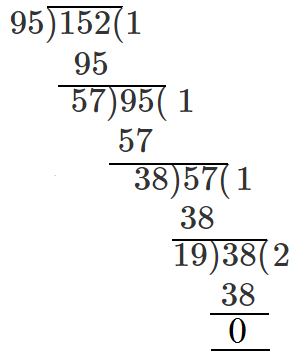
The $\text{HCF}$ of $95$ and $152,$ is:
Answer$\text{HCF}$ of $95$ and $152 = 19$
View full question & answer→MCQ 411 Mark
If $p$ and $q$ are co$-$prime numbers, then $p^2$ and $q^2$ are:
- ✓
Co$-$prime.
- B
Not co$-$prime.
- C
- D
AnswerCorrect option: A. Co$-$prime.
We know that the co$-$prime numbers have no factor in common, or, their $\text{HCF}$ is $1$.
Thus, $p^2$ and $q^2$ have the same factors with twice of the exponents of $p$ and $q$ respectively, which again will not have any common factor.
Thus we can conclude that $p^2$ and $q^2$ are co$-$prime numbers.
Hence, the correct choice is $(a).$
View full question & answer→MCQ 421 Mark
If the $\text{LCM}$ of $a$ and $18$ is $36$ and the $\text{HCF}$ of $a$ and $18$ is $2$, then $a =$
Answer$\text{LCM} (a, 18) = 36$
$\text{HCF} (a, 18) = 2$
We know that the product of numbers is equal to the product of their $\text{HCF}$ and $\text{LCM.}$
Therefore,
$18a = 2(36)$
$\text{a}=\frac{2(36)}{18}$
$a = 4$
Hence the correct choice is $(c).$
View full question & answer→MCQ 431 Mark
If two positive integers $a$ and $b$ are expressible in the form $a = pq^2$ and $b = p^2q; p, q$ being prime numbers, then $\text{HCF (a, b)}$ is:
- ✓
$pq$
- B
$p^3q^3$
- C
$p^3q^2$
- D
$p^2q^2$
Answer$a = pq^2$ and $b = p^3q$ where $a$ and $b$ are positive integers and $p, q$ are prime numbers, then $\text{HCF} = pq.$
View full question & answer→MCQ 441 Mark
If $\text{HCF} (26, 169) = 13,$ then $\text{LCM} (26, 169) =$
- A
$26.$
- B
$52.$
- ✓
$338.$
- D
$13.$
AnswerCorrect option: C. $338.$
$\text{HCF} (26, 169) = 13$
$\text{LCM} (26, 169) =\frac{26\times169}{13}=338$
View full question & answer→MCQ 451 Mark
Euclid’s division lemma states that for two positive integers $a$ and $b,$ there exist unique integers $q$ and $r$ such that $a = bq + r,$ where $r$ must satisfy:
- A
$1 < r < b$
- B
$0 < r ≤ b$
- ✓
$0 ≤ r < b$
- D
$0 < r < b$
AnswerCorrect option: C. $0 ≤ r < b$
According to Euclid’s Division lemma, for a positive pair of integers there exists unique integers $q$ and $r,$ such that,
$a = bq + r,$ where $0 ≤ r < b$
View full question & answer→MCQ 461 Mark
The remainder when the square of any prime number greater than $3$ is divided by $6$, is:
Answer$\because$ The given prime number is greater than $3$
Let the prime number be $=6\text{k}\pm1$
When $k$ is a natural number
$\therefore\ (6\text{k}\pm1)^2=36\text{k}^2\pm12\text{k}+1$
$=6\text{k}(6\text{k}\pm2)+1$
$\therefore$ Remainder $= 1$
View full question & answer→MCQ 471 Mark
The largest number which divides $70$ and $125,$ leaving remainders $5$ and $8,$ respectively, is:
AnswerSince, $5$ and $8$ are the remainders of $70$ and $125,$ respectively.
Thus, after subtracting these remainders from the numbers, we have the numbers $65 = (70 - 5), 117 = (125 - 8),$
which is divisible by the required number.
Now, required number $= \text{HCF}$ of $65, 117$
$[$For the largest number$]$
For this, $117 = 65 \times 1 + 52 [$ Dividend $=$ divisor $\times$ quotient $+$ remainder$]$
$\Rightarrow 65 = 52 \times 1 + 13$
$\Rightarrow 52 = 13 \times 4 + 0$
$\text{HCF} = 13$
Hence, $13$ is the largest number which divides $70$ and $125,$ leaving remainders $5$ and $8.$
View full question & answer→MCQ 481 Mark
If $3$ is the least prime factor of number $a$ and $7$ is the least prime factor of number $b$, then the least prime factor of $a + b,$ is:
Answer$3$ is the least prime factor of a $7$ is the least prime factor of $b,$ then sum of a $a$ and $b$ will be divisible by $2,
2$ is the least prime factor of $a + b.$
View full question & answer→MCQ 491 Mark
If two positive integers $a$ and $b$ are written as $a = x^3y^2$ and $b = xy^3; x, y$ are prime numbers, then $\text{HCF(a, b)}$ is:
- A
$xy$
- ✓
$xy^2$
- C
$x^3y^3$
- D
$x^2y^2$
AnswerCorrect option: B. $xy^2$
It is given that,
$\text{a}=\text{x}^3\text{y}^2=\text{x}\times\text{x}\times\text{x}\times\text{y}\times\text{y}$
$\text{b}=\text{xy}^3=\text{x}\times\text{y}\times\text{y}\times\text{y}$
$\text{HCF(a, b)}=\text{HCF}(\text{x}^3\text{y}^2,\text{xy}^3)=\text{x}\times\text{y}\times\text{y}=\text{xy}^2$
Hence, the correct answer is option $B.$
View full question & answer→MCQ 501 Mark
Which of the following rational numbers have terminating decimal?
QUESTION Which of the following rational numbers have terminating decimal?
$i. \frac{16}{225}$
$ii. \frac{5}{18}$
$iii. \frac{2}{21}$
$iv. \frac{7}{250}$
- A
$(i)$ and $(ii)$
- B
$(ii)$ and $(iii)$
- C
$(i)$ and $(iii)$
- ✓
$(i)$ and $(iv)$
AnswerCorrect option: D. $(i)$ and $(iv)$
We know that a rational number has terminating decimal if the prime factors of its denominator are in the form $2^m \times 5^n \frac{16}{225}$ and $\frac{7}{250}$ has terminating decimals.
View full question & answer→