Question 14 Marks
The $\frac{3}{4}\text{th}$ part of a conical vessel of internal radius 5cm and height 24cm is full of water. The water is emptied into a cylindrical vessel with internal radius 10cm. Find the height of water in cylindrical vessel.
AnswerLet height of water in cylindrical vessel = h cm
Volume of water (in cylinder) $=\Big(\frac{3}{4}\Big)$ Volume of water (in cone)
$\therefore$ Volume of cylinder $=\pi\text{r}^2\text{h}$ & Volume of cone $=\Big(\frac{1}{3}\Big)\pi\text{r}^2\text{h}$
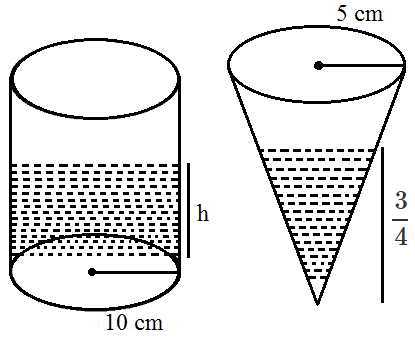
$\Rightarrow\pi(10)^2\text{h}=\frac{3}{4}\Big[\frac{1}{3}\pi(5)^224\Big]$
$\Rightarrow100\text{h}=\frac{1}{4}\times25\times24$
$\Rightarrow\text{h}=\frac{25\times24}{4\times100}=1.5\text{cm}$
Hence, height of water in cylindrical vessel (h) = 1.5cm. View full question & answer→Question 24 Marks
An icecream cone full of icecream having radius $5\ cm$ and height $10\ cm$ as shown’in the figure. Calculate the volume of icecream, provided that its $\frac{1}{6}$ parts is left unfilled with icecream.
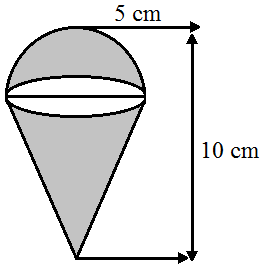
AnswerGiven, ice-cream cone is the combination of a hemisphere and a cone.
Also, radius of hemisphere $= 5\ cm$
$\therefore$ Volume of hemisphere $=\frac{2}{3}\pi\text{r}^3$
$=\frac{2}{3}\times\frac{22}{7}\times(5)^3$
$=\frac{5500}{21}=261.90\text{cm}^3$
Now, radius of the cone $= 5\ cm$
and height of the cone $= 10 - 5 = 5\ cm$
$\therefore$ Volume of the cone $=\frac{1}{3}\pi\text{r}^2\text{h}$
$=\frac{1}{3}\times\frac{22}{7}\times(5)^2\times5$
$=\frac{2750}{21}=130.95\text{cm}^3$
Now, total volume of ice- cream cone
$= 261.90 + 130.95 = 392.85\ cm^2$
Since, $\frac{1}{6}$ part is left unfilled with ice cream.
Required volume of ice cream
$=392.85-392.85\times\frac{1}{6}=392.85-65.475$
$=327.4\text{cm}^3$
View full question & answer→Question 34 Marks
The internal and external diameters of a hollow hemispherical vessel are $21\ cm$ and $25.2\ cm$ respectively. The cost of painting $1\ cm^2$ of the surface is $10$ paise. Find the total cost to paint the vessel all over.
AnswerOuter diameter of the hemispherical vessel $= 25.2\ cm$
and inner diameter $= 21\ cm$
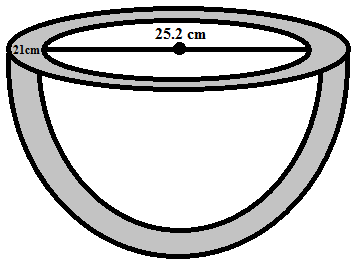
$\therefore$ outer radius (R) $=\frac{25.2}{2}=12.6\text{cm}$
And inner radius (r) $=\frac{21}{2}=10.5\text{cm}$
Total surface area = Outer surface area + Inner surface area + Area of the base ring.
$= 2\pi\text{R}^2+2\pi\text{r}^2+\pi\Big\{\text{R}^2-\text{r}^2\Big\}$
$= 2\pi\text{R}^2+2\pi\text{r}^2+\pi\text{R}^2-\pi\text{r}^2$
$= 3\pi\text{R}^2+\pi\text{r}^2$
$=3\times\frac{22}{7}(12.6)^2+\frac{22}{7}(10.5)^2\text{cm}^2$
$=\frac{66}{7}\times158.76+\frac{22}{7}\times110.25\text{cm}^2$
$= 1496.88 + 346.50\ cm^2 = 1843.38\ cm^2$
Rate of polishing the surface $= ₹ 0.10\ per\ cm^2$
Total cost = 1843.38 $\times\frac{10}{100}$ $= ₹ 184.338 = ₹ 184.34$ View full question & answer→Question 44 Marks
In the given figure, from the top of a solid cone of height $12\ cm$ and base radius $6\ cm$, a cone of height $4\ cm$ is removed by a plane parallel to the base. Find the total surface area of the remaining solid.$\Big(\text{use}\ \pi=\frac{22}{7}\text{and}\sqrt{5}=2.236\Big).$
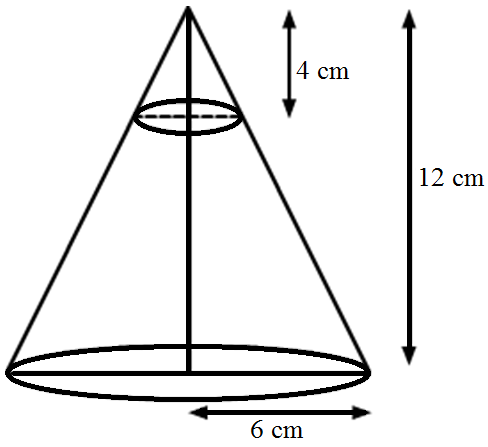
AnswerTotal height of cone $= 12\ cm$
Radius of its base $= 6\ cm$
A cone of height $4\ cm$ is cut out
Height of the so formed frustum $= 12 – 4 = 8\ cm$
Let r be the radius of the cone cut out
Then, $\frac{\text{r}}{6}=\frac{4}{12}=\text{r}=\frac{6\times4}{12}=2\text{cm}$
Let l is the slant height of whole cone
$\therefore\text{l}=\sqrt{\text{r}^2+\text{h}^2}=\sqrt{6^2+12^2}=\sqrt{36+144\text{cm}}\\=\sqrt{180}\text{cm}=\sqrt{36\times5}=6\sqrt{5}\text{cm}$
and slant height of the remaining portion i.e., of frustum $=6\sqrt{5}-\frac{6\sqrt{5}}{3}$
$=6\sqrt{5}-2\sqrt{5}=4\sqrt{5}\text{cm}$
Now surface area of remaining portion $=\pi(\text{r}_1+\text{r}_2)\times\text{l}_1$
$=\frac{22}{7}(6+2)\times4\sqrt{5}\text{cm}^2$
$=\frac{22}{7}\times8\times4\sqrt{5}\text{cm}^2$
$=\frac{704\sqrt{5}}{7}\text{cm}^2=\frac{704}{7}(2.236)=224.88\text{cm}^2$
and area of base and top $=\pi(6^2+2^2)$
$=\frac{22}{7}(36+4)\text{cm}^2$
$=40\times\frac{22}{7}=\frac{880}{7}\text{cm}^2=125.71\text{cm}^2$
$\therefore$ Total surfce area $= 224.88 + 125.71 = 350.59\ cm^2$
View full question & answer→Question 54 Marks
A vessel is a hollow cylinder fitted with a hemispherical bottom of the same base. The depth of the cylinder is $\frac{14}{3}\text{m}$ and the diameter of hemisphere is $3.5m$. Calculate the volume and the internal surface area of the solid.
AnswerGiven radius of hemisphere $( r )=\frac{3.5}{2}=1.75 m$
Height of cylinder $( h ) \frac{14}{3} m$
Volume of cylinder $=\pi r ^2 h$
$=\pi(1.75)^2\left(\frac{14}{3}\right) cm^3 \ldots$
Volume of Hemisphere $=\frac{2}{3} \pi r ^3$
$=\frac{2}{3} \times \pi(1.75)^3 cm^3 \ldots(2)$
Volume of vessel $=(1)+(2)$
$V=V_1+V_2$
$V=\pi r^2 h+\frac{2}{3} \pi r^3$
$V=\pi(1.75)^2\left(\frac{14}{3}\right)+\frac{2}{3} \pi(1.75)^2$
$V=56 m^3$
$\therefore$ Volume of vessel $(v)=56 m^3$
Internal surface area of solid (s) $=2 \pi rh +2 \pi r ^2$
$S=$ Surface area of cylinder + Surface area of hemisphere
$S=2 \pi(1.75)\left(\frac{14}{3}\right)+2 \pi(1.75)^2$
$S=70.51 m^2$
$\therefore$ Internal surface area of solid $( s )=70.51 m^2$^
View full question & answer→Question 64 Marks
A solid right circular cone of height 120cm and radius 60cm is placed in a right circular cylinder full of water of height 180cm such that it touches the bottom. Find the volume of water left in the cylinder, if the radius of the cylinder is equal to the radius of the cone.
Answer
- Whenever we placed a solid right circular cone in a right circular cylinder with full of water, then volume of a solid right circular cone is equal to the volume of water failed from the cylinder.
- Total volume of water in a cylinder is equal to the volume of the cylinder.
- Volume of water left in the cylinder = Volume of the right circular cylinder – Volume of a right circular cone.
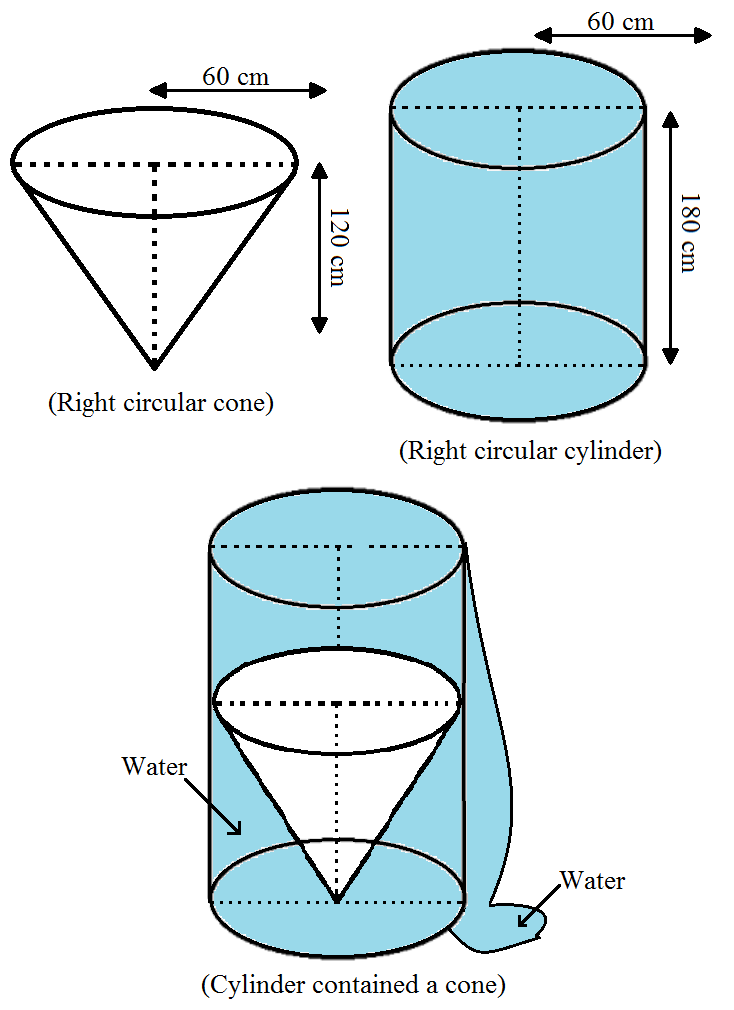
Now, given that
Height of a right circular cone = 120cm
Radius of a right circular cone = 60cm
$\therefore$ Volume of a right circular cone $=\Big(\frac{1}{3}\Big)\pi\text{r}^2\times\text{h}$
$=\Big(\frac{1}{3}\Big)\times\Big(\frac{22}{7}\Big)\times60\times60\times120$
$=\Big(\frac{22}{7}\Big)\times20\times60\times120$
$=144000\pi\text{cm}^3$
$\therefore$ Volume of a right circular cone = Volume of water failed from the cylinder = 1440007cm3 [from point (i)]
Given that, height of a right circular cylinder = 180cm
and radius of a right circular cylinder = Radius of a right circular cone = 60cm View full question & answer→Question 74 Marks
A solid toy is in the form of a hemisphere surmounted by a right circular cone. Height of the cone is 2cm and the diameter of the base is 4cm. If a right circular cylinder circumscribes the toy, find how much more space it will cover.
AnswerGiven radius of cone, cylinder and hemisphere (r) $=\frac{4}{2}=2\text{cm}$
Height of cone (l) = 2cm
Height of cylinder (h) = 4cm
Volume of cylinder $=\pi\text{r}^2\text{h}=\pi(2)^2(4)\text{cm}^3...(1)$
Volume of cone $=\frac{1}{3}\pi\text{r}^2\text{l}$
$=\frac{1}{3}\pi(2)^2\times2$
$=\frac{\pi}{3}(4)\times2\text{cm}^3...(2)$
Volume of hemisphere $=\frac{2}{3}\pi\text{r}^3$
$=\frac{2}{3}\times\pi(2)^3$
$=\frac{2}{3}\times\pi(8)\text{cm}^3...(3)$
So remaining volume of cylinder when toy is inserted to it $=\pi\text{r}^2\text{h}-\Big(\frac{1}{3}\pi\text{r}^2\text{l}+\frac{2}{3}\pi\text{r}^3\Big)$
$=(1)-((2)+(3))$
$=\pi(2)^2(4)-\Big(\frac{\pi}{3}\times8+\frac{2}{3}\times\pi\times8\Big)$
$=16\pi-\frac{2}{3}\pi(4+8)=16\pi-8\pi=8\pi\text{cm}^3$
$\therefore$ so remaining volume of cylinder when toy is inserted to it $=8\pi\text{cm}^3$
View full question & answer→Question 84 Marks
A spherical ball of radius $3\ cm$ is melted and recast into three spherical balls. The radii of the two of the balls are $1.5\ cm$ and $2\ cm$ respectively. Determine the diameter of the third ball.
AnswerRadius of larger ball $(R) = 3\ cm.$
$\therefore\text{volume}=\frac{4}{3}\pi(\text{R})^3$
$=\frac{4}{3}\pi(\text{3})^3=36\pi\text{cm}^3$
Radius of smaller ball $(r_1) = 1.5cm$ = $\frac{3}{2}\text{cm}$
$\therefore\text{volume}=\frac{4}{3}\pi(\text{r}{_1})^3=\frac{4}{3}\pi\Big(\frac{3}{2}\Big)^3$
$=\frac{9{\pi}}{2}\text{cm}^3$ and radius of secound ball $(r_2) = 2cm$
$\therefore\text{volume}=\frac{4}{3}\pi(\text{r}{_2})^3=\frac{4}{3}\pi\times(2)^3$
$=\frac{32}{3}\pi\text{cm}^3$
$\therefore$ volume of the third ball,
$=36\pi-\Big(\frac{9}{2}\pi+\frac{32}{3}\pi\Big)$
$=36\pi-\Big(\frac{27+64}{6}\pi\Big)$
$=\frac{216\pi-91\pi}{6}=\frac{125}{6}\pi$
View full question & answer→Question 94 Marks
A toy is in the form of a cone surmounted on a hemisphere. The diameter of the base and the height of the cone are 6cm and 4cm, respectively. Determine the surface area of the toy. $(\text{use}\ \pi=3.14)$
AnswerGiven height of cone (h) = 4cm
Diameter of cone (d ) = 6cm
$\therefore$ Radius (r) $=\frac{6}{2}=3\text{cm}$
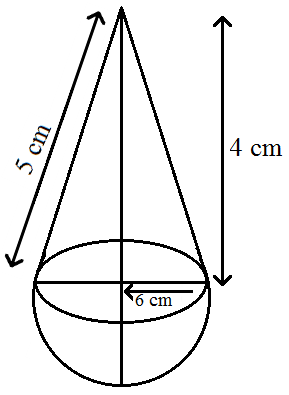
Let 'l' be slant height of cone
$\text{l}=\sqrt{\text{r}^2+\text{h}^2}$
$=\sqrt{3^2+4^2}=5\text{cm}$
$\text{l}=5\text{cm}$
$\therefore$ slant height of cone (l) = 5cm View full question & answer→Question 104 Marks
A circus tent has cylindrical shape surmounted by a conical roof. The radius of the cylindrical base is $20m$. The heights of the cylindrical and conical portions are $4.2m$ and $2.1m$ respectively. Find the volume of the tent.
AnswerGiven that:
Radius of the cylindrical base $r = 20m$
Height of the cylindrical portion $h_1 = 4.2m$
Height of the conical portion $h_2 = 2.1m$
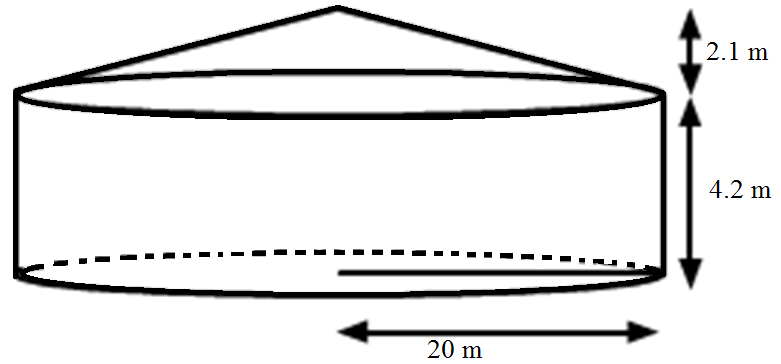
The volume of the cylinder is given by the following formula
$\text{V}_1=\pi\text{r}^2\text{h}_1$
$=\frac{22}{7}\times20^2\times4.2$
$=5280\text{m}^3$
The volume of the conical portion is
$\text{V}_1=\frac{1}{3}\pi\text{r}^2\text{h}_2$
$=\frac{1}{3}\times\frac{22}{7}\times20^2\times2.1$
$=880\text{m}^3$
Therefore, the total volume of the circus tent is
$V = V_1 + V_2$
$= 5280 + 880$
$= 6160m^3$
Hence, the volume of the circus tent is $V = 6160m^3$ View full question & answer→Question 114 Marks
Find the number of metallic circular discs with 1.5cm base diameter and of height 0.2cm to be melted to form a right circular cylinder of height 10cm and diameter
4.5cm.
AnswerGiven that, lots of metallic circular disc to be melted to form a right circular cylinder. Here, a circular disc work as a circular cylinder.
Base diameter of metallic circular disc = 1.5cm
$\therefore$ Radius of metallic circular disc $=\frac{1.5}{2}\text{cm}[\because\text{diameter}=2\times\text{radius}]$
and height of metallic circular disc i.e., = 0.2cm
$\therefore$ Volume of a circular disc $=\pi\times(\text{Radius})^2\times\text{Hieght}.$
$=\pi\times\Big(\frac{1.5}{2}\Big)^2\times0.2$
$=\frac{\pi}{4}\times1.5\times1.5\times0.2$
Now, hieght of a right circular cylinder (h) = 10cm
and diameter of a right circular cylinder = 4.5cm
⇒ Radius of a right circular cylinder (r) $=\frac{4.5}{2}\text{cm}$
$\therefore$ Volume of a right circular cylinder $=\pi\text{r}^2\text{h}$
$\pi\Big(\frac{4.5}{2}\Big)^2\times10=\frac{\pi}{4}\times4.5\times4.5\times10$
$\therefore$ Number of metallic circular disc.
$=\frac{\text{volume of right circular cylinder}}{\text{volume of metallic circular disc}}$
$=\frac{\frac{\pi}{4}\times4.5\times4.5\times10}{\frac{\pi}{4}\times1.5\times1.5\times0.2}$
$=\frac{3\times3\times10}{0.2}=\frac{900}{2}=450$
Hence, the required number of metallic circular disc is 450.
View full question & answer→Question 124 Marks
A toy is in the shape of a right circular cylinder with a hemisphere on one end and a cone on the other. The radius and height of the cylindrical part are $5\ cm$ and $13\ cm$ respectively. The radii of the hemispherical and conical parts are the same as that of the cylindrical part. Find the surface area of the toy if the total height of the toy is 30cm.
AnswerRadius of the base of the cylindrical part $(r) = 5\ cm$
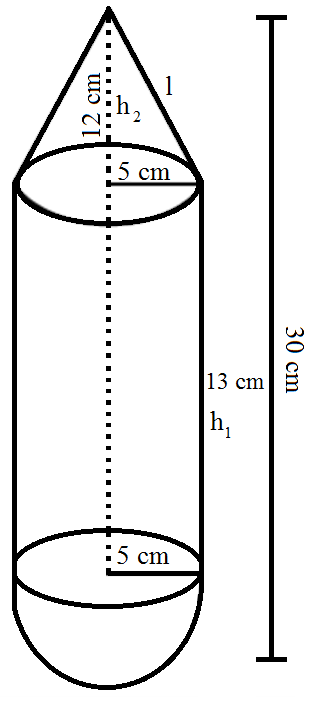
Height of cylindrical part $(h_1) = 13\ cm$
Height of the conical part $(h_2) = 30 – (13 + 5) = 30- 18 = 12\ cm$
$\therefore$ Slant height (l) $=\sqrt{\text{r}^2+\text{h}^2_2}$
$=\sqrt{(5)^2+(12)^2}=\sqrt{25+144}$
$=\sqrt{169}=13\text{cm}$
Radius of heispherical part $(r) = 5\ cm$
Total surface area of the toy = curved surface area of conical part + curved surface area of cylindrical part + curved surface area of hemisphere
$=\pi\text{rl}+2\pi\text{rh}_1+2\pi\text{r}^2$
$=\pi\text{r}(\text{l}+2\text{h}_1+2\text{r})$
$=\frac{22}{7}\times5[13+2\times13+2\times5]\text{cm}^2$
$=\frac{110}{7}[13+26+10]=\frac{110}{7}\times49$
$=770\text{cm}^2$ View full question & answer→Question 134 Marks
A hemispherical bowl of internal radius $9\ cm$ is full of liquid. The liquid is to be filled into cylindrical shaped small bottles each of diameter $3\ cm$ and height $4\ cm$. How many bottles are necessary to empty the bowl?
AnswerRadius of hemisphere bowl $(r_1) = 9cm$
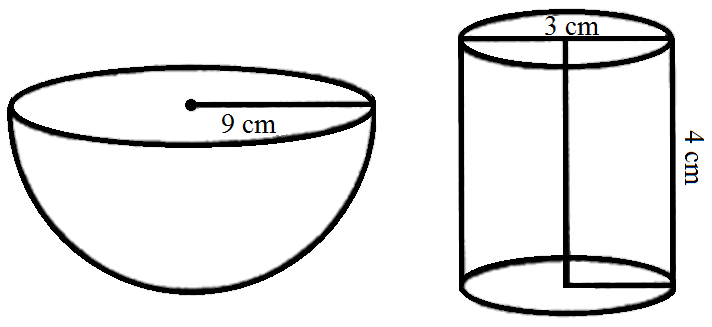
$\therefore$ Volume of liquids filled in it
$=\frac{2}{3}\pi\text{r}^3=\frac{2}{3}\pi(9)^3\text{cm}^3=486\pi\text{cm}^3$
Diameter of cylindrical bottle $= 3\ cm$
$\therefore$ Radius $(r_2)$ $=\frac{3}{2}\text{cm}$
and height $(h) = 4\ cm$
$\therefore$ Volume of one bottle $=\pi\text{r}^2\text{h}=\pi\Big(\frac{3}{2}\Big)^2\times4$
$=\frac{9}{4}\pi\times4=9\pi\text{cm}^3$
$\therefore$ Number of bottles requird to fill the liquid of the bowl $=\frac{486\pi}{9\pi}=54$ View full question & answer→Question 144 Marks
A bucket is in the form of a frustum of a cone of height 30cm with radii of its lower and upper ends as $10\ cm$ and $20\ cm$ respectively. Find the capacity and surface area of the bucket. Also, find the cost of milk which can completely fill the container, at the rate of $₹ 25$ per litre. $(\text{use}\ \pi=3.14)$
AnswerHeight of the bucket, $h = 30\ cm$
Radii $r_1=10\ cm$ and $r_2 = 20\ cm$
Capacity of the bucket,
$\text{V}=\frac{1}{3}\pi\text{h}\big(\text{r}^2_1+\text{r}_1\text{r}_2+\text{r}^2_2\big)$
$=\frac{1}{3}\pi\times30\big(10^2+10\times20+20^2\big)$
$=21980\text{cm}^3$
$=21.980\ \text{liters}$
$ \text{l}=\sqrt{\text{h}^2+(\text{r}-\text{r}_1)^2}$
$ \text{l}=\sqrt{30^2+(20-10)^2}=10\sqrt{10}$
Surface area of the bucket
$ \text{S}= \text{CSA}+\text{area or the base}$
$ \text{S}=\pi(\text{r}_1+\text{r}_2)\text{l}+\pi \text{r}^2_1$
$ \text{S}=\pi(10+20)10\sqrt{10}+\pi(10)^2$
$\text{S}=2978.86+314=3292.86\text{cm}^2$
Cost of milk which can completely fill the container at $Rs. 25/ litre$
$= 21.980 \times 25$
$= Rs. 549.50$
View full question & answer→Question 154 Marks
A building is in the form of a cylinder surmounted by a hemispherical dome. The base diameter of the dome is equal to $\Big(\frac{2}{3}\Big)$ of the total height of the building. Find the height of the building, if it contains $67\Big(\frac{1}{21}\Big)\text{m}^3$of air.
Answer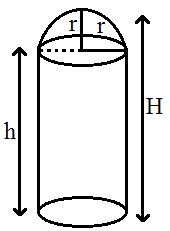
Let the radius of the dome be r.
Diameter be d.
Let the height of the building be H.
Given d $=\frac{2}{3}\text{H}$
$\Rightarrow2\text{r}=\frac{2}{3}\text{H}$
$\Rightarrow\text{r}=\frac{\text{H}}{3}$
$\Rightarrow3\text{r}=\text{H}$
Also, h + r = H
⇒ 3r = h + r
⇒ 2r = h
$\Rightarrow\text{r}=\frac{\text{h}}{2}$
Volume of air = Volume of air in the cylinder + Volume of air int he hemispherical dome
$\Rightarrow\pi\text{r}^2\text{h}+\frac{2}{3}\pi\text{r}^3=67\frac{1}{21}$
$\Rightarrow\pi\Big(\frac{\text{h}}{2}\Big)^2\text{h}+\frac{2}{3}\pi\Big(\frac{\text{h}}{2}\Big)^3=\frac{1408}{21}$
$\Rightarrow\text{h}^3=\frac{11264}{176}=64$
$\Rightarrow\text{h}=4\text{m}$
Hence, the radius will be r $=\frac{\text{h}}{2}=\frac{4}{2}=2\text{m}$
Height of the building, H $=3\text{r}=3\times2=6\text{m}$ View full question & answer→Question 164 Marks
In the middle of a rectangular field measuring $30\ m \times 20\ m$, a well of $7\ m$ diameter and $10\ m$ depth is dug. The earth so removed is evenly spread over the remaining part of the field. Find the height through which the level of the field is raised.
AnswerDiameter of well $= 7\ m$
$\therefore$ Radius (r) $=\Big(\frac{7}{2}\Big)\text{m}$
$\therefore$ Depth $(h) = 10\ m$
Volume of cylindrical $=\pi\text{r}^2\text{h}$
$=\frac{22}{7}\times\frac{7}{2}\times\frac{7}{2}\times10=385\text{m}^3$
Area of the mouth of well $=\pi\text{r}^2=\frac{22}{7}\times\frac{7}{2}$
$\times\frac{7}{2}=\frac{77}{2}\text{m}^2$
Length of field $(l) = 30\ m$
and width $(b) = 20\ m$
$\therefore$ Total area of the field $= l \times b = 30 \times 20$
$= 600m^2$
Area if the field excluding well $=600-\frac{77}{2}$
$= 600 - 38.5 = 561.5m^2$
Let h bethe height of earth spread over the ramaining part of the field
$561.5 \times h = 385$
$\text{h}=\frac{385}{561.5}\text{m}=\frac{385\times100\times10}{5610}\text{cm}$
$=\frac{3500}{51}=68.6\text{cm}$
View full question & answer→Question 174 Marks
Two cylindrical vessels are filled with oil. Their radii are $15\ cm, 12\ cm$ and heights $20\ cm$, $16\ cm$ respectively. Find the radius of a cylindrical vessel $21\ cm$ in height, which will just contain the oil of the two given vessels.
AnswerRadius of first cylinder $(r_1) = 15cm$
and radius of second cylinder $(r_2) = 12cm$
Height of the first cylinder $(h_1) = 20cm$
and height of second cylinder $(h_2) = 16cm$
Volume of both of cylinders
$=\pi\text{r}_1^2\text{h}_1+\pi\text{r}_2^2\text{h}_2$
$=\pi[\text{r}_1^2\text{h}_1+\text{r}_2^2\text{h}_2]=\pi[15^2\times20+12^2\times16]\text{cm}^3$
$=\pi\ [225\times20+144\times16]$
$=\pi\ [4500+2304]\text{cm}^3$
$=\pi\ [6804]\text{cm}^3$
$\therefore$ Volume of the required cylinder $=\pi\ (6804)\text{cm}^3$
Let Radius be = r
and height h = 21cm
$\therefore$ volume $=\pi\text{r}^2\text{h}$
$6804\pi=\pi\text{r}_1^2\times21$
$\Rightarrow\text{r}^2=\frac{6804\pi}{21\pi}=324=(18)^2\Rightarrow\text{r}=18$
$\therefore$ Radius of the required cylinder $= 18cm$
View full question & answer→Question 184 Marks
A cylindrical tube of radius $12\ cm$ contains water to a depth of $20\ cm.$ A spherical ball dropped into the tub and the level of the water is raised by $6.75\ cm$. Find the radius of the ball.
AnswerGiven that radius of a cylindrical tube $(r) = 12\ cm$
Level of water raised in tube $(h) = 6.75\ cm$
Volume of cylinder $\pi\text{r}^2\text{h}$
$=\pi(12)^2\times6.75\text{cm}^3$
$=\frac{22}{7}(12)^2\ 6.25\text{cm}^3\ ...(1)$
let 'r' be radius of a spherical ball
Volume of sphere $=\frac{4}{3}\pi\text{r}^3\ ...(2)$
To find radius of spherical balls
Equating(1) and (2)
$\pi\times(12)^2\times6.75=\frac{4}{3}\pi\text{r}^3$
$\text{r}^3=\frac{\pi\times(12)^2\times6.75}{\frac{4}{3}\times\pi}$
$r^3= 729$
$r^3= 9^3$
$r = 9\ cm$
$\therefore$ Radius f spherical ball $(r) = 9\ cm$
View full question & answer→Question 194 Marks
Two cones with same base radius $8\ cm$ and height $15\ cm$ are joined together along their bases. Find the surface area of the shape formed.
AnswerIf two cones with same base and height are joined together along their bases, then the shape so formed is look like as figure shown.
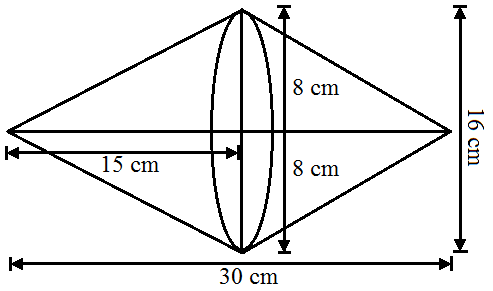
Given that, radius of cone, $r = 8\ cm$ and height o cone, $h = 15\ cm$
So, surface area of the shape so formed
= curved area of first cone $\times$ Curved surface area of secound cone
= $2$ surface area of cone
$=2\times\pi\text{rl}=2\times\pi\times\text{r}\times\sqrt{\text{r}^2+\text{h}^2}$
$=2\times\frac{22}{7}\times8\times\sqrt{(8)^2+(15)^2}$
$=\frac{2\times22\times8\times\sqrt{64+225}}{7}$
$=\frac{44\times8\times\sqrt{289}}{7}=\frac{44\times8\times17}{7}$
$=\frac{5984}{7}=854.85\text{cm}^2$
$=855\text{cm}^2$
Hence, the surface areaq of the shape so formed is $855cm^2$. View full question & answer→Question 204 Marks
A conical hole is drilled in a circular cylinder of height 12cm and base radius 5cm. The height and the base radius of the cone are also the same. Find the whole surface and volume of the remaining cylinder.
Answer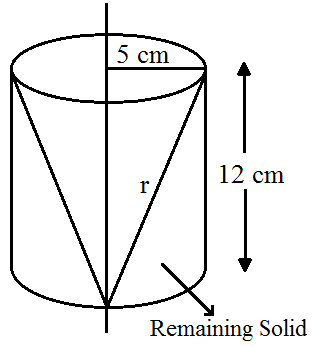
Given base radius of cylinder (r) = 5cm
Height of cylindet (h) = 12cm
Let 'l' be slant height of cone
$\text{l}=\sqrt{\text{r}^2+\text{h}^2}$
$=\sqrt{5^2+12^2}$
$\text{l}=13\text{cm}$
$\therefore$ Height and base radius of cone and cylinder are same
Total surface area of remaining part (s) $=2\pi\text{rh}+\pi\text{r}^2+\pi\text{rl}$
$=2\times\pi\times5\times12+\pi\times5^2+\pi\times5\times13$
T.S.A $=210\pi\text{cm}^2$
Volume of remaining part = Volume of cylinder - Volume of Cone
$\Rightarrow\text{V}=\pi\text{r}^2\text{h}-\frac{1}{3}\pi\text{r}^2\text{h}$
$\Rightarrow\text{V}=\pi(5)^2(12)-\frac{1}{3}\pi(5)^2(12)$
$\Rightarrow\text{V}=200\pi\text{cm}^3$
$\therefore$ Volume of remaining part (v) $=200\pi\text{cm}^3$ View full question & answer→Question 214 Marks
A path 2m wide surrounds a circular pond of diameter 40m. How many cubic metres of gravel are required to grave the path to a depth of 20cm?
AnswerDiameter of circular pond = 40m
Radius of pond (r) = 20m
Thickness = 2m
Depth = 20cm = 0.2m
Since it is viewed as a hollow cylinder
Thickness (t) = R - r
2 = R - r
2 = R - 20
R = 22m
$\therefore\text{Volume of hollow cylinder}=\pi(\text{R}^2-\text{r}^2)$
$=\pi(22^2-20^2)\text{h}$
$=\pi(22^2-20^2)\times0.2$
$=\pi(84)\times0.2$
View full question & answer→Question 224 Marks
A rocket is in the form of a circular cylinder closed at the lower end with a cone of the same radius attached to the top. The cylinder is of radius $2.5\ m$ and height $21\ m$ and the cone has the slant height 8m. Calculate the total surface area and the volume of the rocket.
AnswerGiven:
Radius of the cylinder $r =2.5 m$, height of the cylinder, $h =21 m$ slant height of the cone $I =8 m$.
.We have to find total surface area and volume of the rocket
Let us assume that the area of the cone is $S_1$.
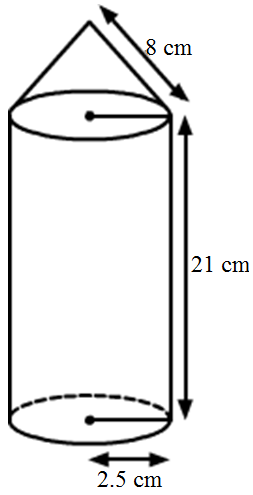
$S_1=\pi rl$
$=3.14 \times 2.5 \times 8$
$=62.8 m^2$
The area of the cylinder $S_2$ is given by
$S_2=2 \pi rh+\pi r^2$
$=3.14 \times 2.5(2 \times 21+2.5)$
$=349.33 m^2$
Total area $S$ is
$S=S_1+S_2$
$=62.8+349.33$
$=412.13 m^2$
Now, we are going to find the volume of the rocket V .
$\text { Volume of the cone is given by }$
$V_1=\frac{1}{3} \pi r^2 h$
$=\frac{1}{3} \times 3.14 \times 2.5^2 \sqrt{8^2-2.5^2}$
$=49.71 m^3$ View full question & answer→Question 234 Marks
When the triangle is revolved about the side BC, then the base-radius, height and slant height of the produced cone becomes AB, BC and AC respectively. Therefore, the volume of the produced cone is
AnswerDiameter of base of conical tent $= 14m$
Radius (r) $=\Big(\frac{14}{3}\Big)=7\text{cm}$
Height $(h) = 24\ m$
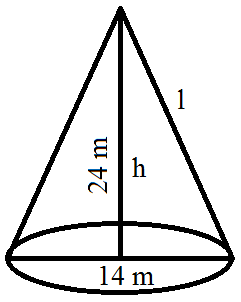
$\therefore$ slant height (l) $=\sqrt{\text{r}^2+\text{h}^2}=\sqrt{7^2+24^2}$
$=\sqrt{49+576}=\sqrt{625}=25\text{m}$
$\therefore$ Surface area $=\pi\text{rl}=\frac{22}{7}\times7\times25\text{m}^2$
$= 550m^2$
Width of cloth used $= 5m$
$\therefore$ Length of cloth used $=\frac{550}{5}=110\text{m}$
Rate of cloth $= ₹ 25$ per metre
$\therefore$ Total cost $= ₹ 110 \times 25 = ₹ 2750$ View full question & answer→Question 244 Marks
If a cone of radius $10\ cm$ is divided into two parts by drawing a plane through the mid-point of its axis, parallel to its base. Compare the volumes of the two parts.
AnswerRadius of the cone $(r_1) = 10\ cm$
Cone is divided into $2$ parts Such that $PQ || AB$
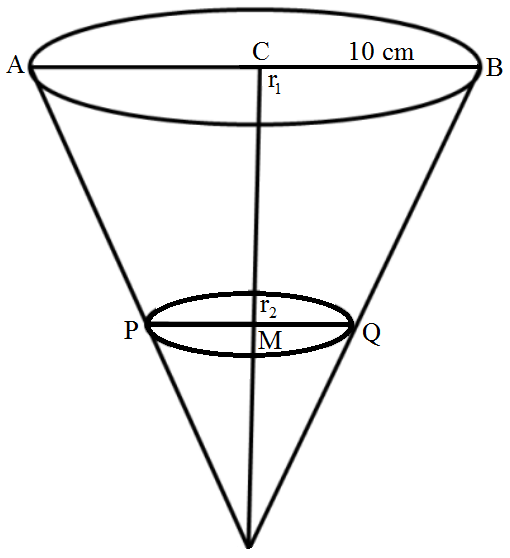
$\because$ Radius of the smaller cone
$(\text{r}_2)=\frac{10}{2}=5\text{cm}$
Let h be height of bigger cone
Then height of the smaller cone $=\frac{\text{h}}{2}$
$\therefore$ Volume of the cone $=\frac{1}{3}\pi\text{r}_1^2\text{h}=\frac{1}{3}\pi(10)^2\text{h}$
$=\frac{100}{3}\pi\text{h}...(1)$
And volume of smaller cone $=\frac{1}{3}\pi(5)^2\frac{\text{h}}{2}$
$=\frac{25}{6}\pi\text{h}...(2)$
Volume of the frustum so formed $=\frac{100}{3}\pi\text{h}$
$=\frac{25}{6}\pi\text{h}$
$=\frac{200-25}{6}\pi\text{h}$
$=\frac{175}{6}\pi\text{h}$
Now ratio of the volume of the smaller cone and frustum $=\frac{25}{6}\pi\text{h}:\frac{175}{6}\pi\text{h}$
$=1:7$ View full question & answer→Question 254 Marks
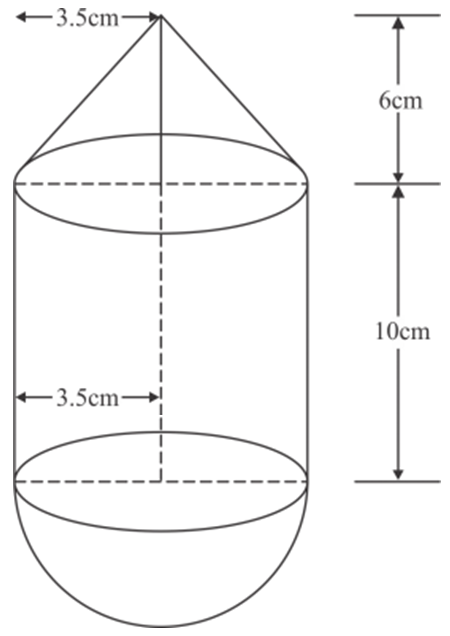
A solid is in the form of a right circular cylinder, with a hemisphere at one end and a cone at the other end. The radius of the common base is 3.5cm and the heights of the cylindrical and conical portions are 10cm. and 6cm, respectively. Find the total surface area of the solid. $\Big(\text{use}\ \pi=\frac{22}{7}\Big)$
AnswerWe have the following diagram
For cone, we have
r = 3.5cm
h = 6cm
$\text{l}=\sqrt{\text{r}^2+\text{h}^2}$
$=\sqrt{3.5^2+6^2}$
$=6.95\text{cm}$
Curved surface area of the cone is given as
$\text{S}_1=\pi\text{rl}$
$=\frac{22}{7}\times3.5\times6.946$
$=76.408\text{cm}^2$
For cylindrical part, we have
r = 3.5cm
h = 10cm
Curved surface area of the cylinder is
$\text{S}_2=2\pi\text{rh}$
$=2\times\frac{22}{7}\times3.5\times10$
$=220\text{cm}^2$
The surface area of the hemisphere is
$\text{S}_3=2\pi\text{r}^2$
$=2\times\frac{22}{7}\times3.5^2$
$77\text{cm}^2$
Total surface area of the solid is given by
$S = S_1 + S_2 + S_3$
$= 76.408 + 220 + 77$
$= 373.408cm^2$
Hence the total surface area of the solid is $S = 373.408cm^2$ View full question & answer→Question 264 Marks
Water flows at the rate of 10m/ minutes through a cylindrical pipe 5mm in diameter. How long would it take to fill a conical vessel whose diameter at the base is 40cm and depth 24cm?
AnswerGiven, speed of water flow = $10 m min^{-1} = 1000 cm/min$
$\therefore$ Radius of the pipe $=\frac{5}{10\times2}=0.25\text{cm}$
$\therefore$ Area of the face of pipe $=\pi\text{r}^2=\frac{22}{7}\times(0.25)^2=0.1964\text{cm}^2$ Also, given diameter of the conical vessel = 40cm
$\therefore$ Volume of conical vessel $=\frac{1}{3}\pi\text{r}^2\text{h}$
$=\frac{1}{3}\times\frac{22}{7}\times(20)^2\times24$ $=\frac{11200}{21}=10057.14\text{cm}^3$
$\therefore$ Required time $=\frac{\text{Volume of the conical vessel}}{\text{Area of the face of pipe}\times\text{speed of water}}$ $=\frac{10057.14}{0.1964\times10\times100}$ $=51.20\ \text{min}=51\text{min}\frac{20}{100}\times60\text{s}$$= 51\ \text{min}\ 12\text{s}$
View full question & answer→Question 274 Marks
A pen stand made of wood is in the shape of a cuboid with four conical depressions and a cubical depression to hold the pens and pins, respectively. The dimension of the cuboid are 10cm × 5cm × 4cm. The radius of each of the conical depression is 0.5cm and the depth is 2.1cm. The edge of the cubical depression is 3cm. Find the volume of the wood in the entire stand.
AnswerGiven that, length of cuboid pen stand (l) = 10cm
Breadth of cuboid pen stand (b) = 5cm
and height of cuboid pen stand (h) = 4cm
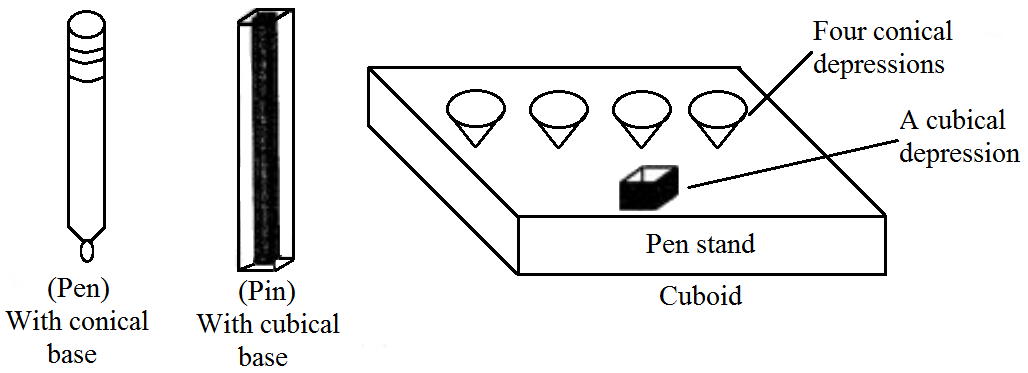
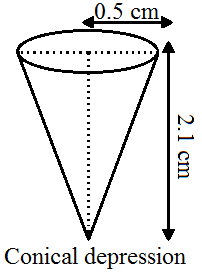
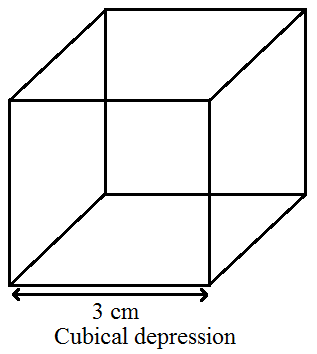
$\therefore$ Volume of cuboid pend stand $= l \times b \times h= 10 \times 5 \times 4 = 200cm^3$
Also, radius of conical depression $(r) = 0.5cm$
and height (depth) of a conical depression $(h_1) = 2.1cm$
$\therefore$ Volume of a conical depression $=\pi\text{rh}_1$
$=\frac{1}{3}\times\frac{22}{7}\times0.5\times0.5\times2.1$
$=\frac{22\times5\times5}{1000}=\frac{22}{40}=\frac{11}{20}=0.55\text{cm}^3$
Also, given Edge of cubical depression $(a) = 3cm$
$\therefore$ Volume of cubical depression $= (a)^3 = (3)^3= 27cm^3$
So, volume of 4 conical depressions
= 4 × Volume of a conical depression
$=4\times\frac{11}{20}=\frac{11}{5}\text{cm}^3$
Hence, the volume of wood in the entire pen stand = volume of cuboid pen stand - volume of 4 conical depressions - Volume of a cubical depressions
$=200-\frac{11}{5}27=200-\frac{146}{5}$
$=200-29.2=170.8\text{cm}^3$
So, the required Volume of the wood in the entire stand is $170.8\ cm^3.$ View full question & answer→Question 284 Marks
The diameters of internal and external surfaces of a hollow spherical shell are 10cm and 6cm respectively. If it is melted and recast into a solid cylinder of length of 2cm, find the diameter of the cylinder.
AnswerDiameter of external surface of a sphere = 10cmand internal diameter = 6cm
$\therefore$ External radius (R) $\frac{10}{2}=5\text{cm}$
and internal radius (r) $=\frac{6}{2}=3\text{cm}$
$\therefore$ Volume of the metal used $=\frac{4}{3}\pi[\text{R}^3-\text{r}^3]$
$=\frac{4}{3}\pi[5^3-3^3]=\frac{4}{3}\pi(125-27)\text{cm}^3$
$=\frac{4}{3}\pi\times98=\frac{392\pi}{3}\text{cm}^3$
$\therefore$ Volume of solid cylinder so formed $=\frac{392}{3}\pi\text{cm}^3$
length (hieght) of cylinder (h) $=2\frac{2}{3}\text{cm}$
$=\frac{8}{3}\text{cm}$
Let r be its radius, then
$\pi\text{r}^2\text{h}=\frac{392}{3}\pi\Rightarrow\pi\text{r}^2\times\frac{8}{3}=\frac{392}{3}\pi$
$\Rightarrow\text{r}^2=\frac{392}{3}\times\frac{3}{8}=49$
$\therefore\text{r}=\sqrt{49}=7$
$\therefore\text{Diameter}=2\text{r}=2\times7=14\text{cm}$
View full question & answer→Question 294 Marks
A solid is composed of a cylinder with hemispherical ends. If the length of the whole solid is 108cm and the diameter of the cylinder is 36cm, find the cost of polishing the surface at the rate of 7 paise per $cm^2.$
AnswerTotal height of the solid = 108cm
Each diameter of base of hemispherical part = 36cm
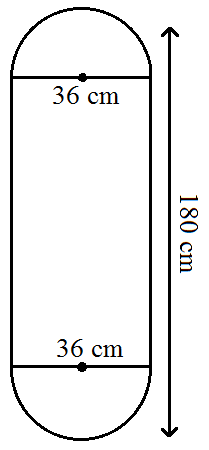
$\therefore$ Radius (r) $=\frac{36}{2}=18\text{cm}$
height of cylindrical part (h)
$= 108 - 2 × 18cm$
$= 180 - 36 = 72cm$
Now total surface area of the solid = surface area of two hemispherical parts + curved surface area of cylindrical part
$=2\times2\pi\text{r}^2+2\pi\text{rh}=4\pi\text{r}^2+2\pi\text{rh}$
$=2\pi\text{r}(2\text{r}+\text{h})$
$= 2 \times 3.1416 \times 18 [2 \times 18 + 72]cm^2$
$= 36 \times 3.1416 [36 + 72]cm^2$
$= 36 \times 3.1416 \times 108cm^2$
$= 36 \times 3.1416cm = 12214.5480cm^2$
Cost $1\ cm^2$ for polishing the surface = 7paise
$\therefore$ Total cost = Rs. 12214.5408 × $\frac{7}{100}$
= Rs. 855.017856 = Rs. 855.02 View full question & answer→Question 304 Marks
A solid toy is in the form of a hemisphere surmounted by a right circular cone. The height of cone is 4cm and the diameter of the base is 8cm. Determine the volume of the toy. If a cube circumscribes the toy, then find the difference of the volumes of cube and the toy. Also, find the total surface area of the toy.
AnswerLet r be the radius of the hemisphere and the cone and h be the height of the cone.
Volume of the toy=Volume of the hemisphere + Volume of the cone
$=\frac{2}{3}\pi\text{r}^3+\frac{1}{3}\pi\text{r}^2\text{h}$
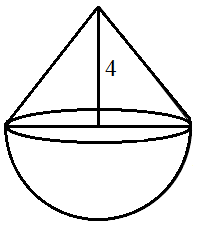
$=\Big(\frac{2}{3}\times\frac{22}{7}\times4^3+\frac{1}{3}\times\frac{22}{7}\times4^2\times4\Big)\text{cm}^3$
$=\Big(\frac{1408}{7}\Big)\text{cm}^3$
A cube circumsrcibes the given solid. Therefore, edge of the cube should be 8cm. Volume of the cube = 83cm3 = 512cm3 Difference in the volume of the cube and
The toy $=\Big(512-\frac{1408}{7}\Big)\text{cm}^3=310.86\text{cm}^3$
Total surface area of the toy = curved surface area of cone + curved surface area of hemisphere
$=\pi\text{rl}+2\pi\text{r}^2,\text{where}\ \text{l}=\sqrt{\text{h}^2+\text{r}^2}$
$=\pi\text{r}(\text{l}+2\text{r})$
$=\frac{22}{7}\times4\times\Big(\sqrt{4^2+4^2}+2\times4\Big)$
$=\frac{22}{7}\times4\times\Big(4\sqrt{2}+8\Big)$
$=\frac{22}{7}\times4\times(13.65)$
$=171.68\text{cm}^2$ View full question & answer→Question 314 Marks
A solid wooden toy is in the form of a hemisphere surmounted by a Cone of same radius. The radius of hemisphere is $3.5\ cm$ and the total wood used in the making of toy is $166\Big(\frac{5}{6}\Big)\text{cm}^3.$ Find the height of the toy. Also, find the cost of painting the hemispherical part of the toy at the rate of $₹10\ per\ cm^2$.
Answer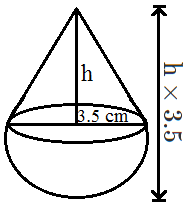
Volume of toy $=166\frac{5}{6}\text{cm}^3=\frac{1001}{6}\text{cm}^3$
Radius of the hemisphere $= 3.5\ cm$
Let h be the height of cone
then volume of wood used
$=\frac{1}{3}\pi\text{r}^2\text{h}+\frac{2}{3}\pi\text{r}^3$
$=\frac{1}{3}\times\frac{22}{7}\times(3.5)^2\times\text{h}+\frac{2}{3}\times\frac{22}{7}\times(3.5)^3$
$=\frac{22}{21}(3.5)^2[\text{h}+2\times3.5]$
$=\frac{22}{21}\times\frac{1225}{100}(\text{h}+7)=\frac{1001}{6}$
$\text{h}+7=\frac{1001}{6}\times\frac{21\times100}{22\times1225}=13\text{cm}$
$\therefore\text{h}=13-7=6\text{cm}$
and total height of the toy $= 6 + 3.5 = 9.5\ cm$
Surface area of hemisphere part $=2\pi\text{r}^2$
$=2\times\frac{22}{7}\times3.5\times3.5\text{cm}^2$
$=\frac{2\times22}{7}\times\frac{7}{2}\times\frac{7}2{}\text{cm}^2=77\text{cm}^2$
rate of painting the surface are = ₹ $10cm^2$
Total cost $= ₹ 77 \times ₹ 10 = ₹ 770$ View full question & answer→Question 324 Marks
What length of a solid cylinder 2cm in diameter must be taken to recast into a hollow cylinder of length 16cm, external diameter 20 cm and thickness 2.5mm?
AnswerWe are given a solid cylinder of, diameter = 2cmWe have to recast it into a hollow cylinder of length = 16cm
External Diameter = 20cm and thickness = 2.5mm=0.25cm
We have to find the height of the solid cylinder that can be used to get a hollow cylinder of the desired dimensions.
Volume of a solid cylinder $=\pi\text{r}^2\text{h}$
So,
The volume of the given solid cylinder $=\pi(1)^2\text{h}\ ...\text({a})$
Here, height h has to be found.
Volume of a hollow cylinder $=\pi\text{h}(\text{R}^2-\text{r}^2)$
Where R is the external radius and r is the internal radius.
External radius is given. Thickness of the hollow cylinder is also given. So, we can find the internal radius of the hollow cylinder.
⇒ Thickness = R−r
⇒ 0.25 = 10 - r
⇒ r = 9.75cm
So, the volume of the hollow cylinder $=\pi\times16\times(100-95.0.625)\ ...(\text{b})$
From (a) and (b) we get,
$\pi(1)^2\text{h}=\pi\times16\times(100-95.0625)$
$\pi\text{h}=\pi\times16\times(100-95.0625)$
$\text{h}=16\times(4.9375)$
$\text{h}=79\text{cm}$
Hence, the required height of the solid cylinder is h = 79cm
View full question & answer→Question 334 Marks
A frustum of a right circular cone has a diameter of base $20\ cm,$ of top $12\ cm$, and height $3\ cm$. Find the area of its whole surface and volume.
AnswerThe radii of the bottom and top circles are $r_1 = 10\ cm$ and $r_2 = 6\ cm$ respectively. The height of the frustum cone is $h= 3\ cm$.
Therefore, the volume of the bucket is
$\text{V}=\frac{1}{3}\pi \big(\text{r}^2_1+\text{r}_1\text{r}_2+\text{r}^2_2\big)\times\text{h}$
$=\frac{1}{3}\pi \big(10^2+10\times6+6^2\big)\times3$
$=\frac{1}{3}\times\frac{22}{7}\times196\times3$
$=616\text{cm}^3$
Hence volume $= 616cm^3$
The slant height of the bucket is
$\text{l}=\sqrt{(\text{r}_1-\text{r}_2)^2+\text{h}^2}$
$=\sqrt{(10-6)^2+3^2}$
$=\sqrt{25}$
$= 5\text{cm}$
The total surface area of the frustum cone is
$=\pi (\text{r}_1+\text{r}_2)\times\text{l}+\pi\text{r}^2_1+\times\pi\text{r}^2_2$
$=\frac{22}{7}\times(10+6)\times5+\frac{22}{7}\times10^2+\frac{22}{7}\times6^2$
$=\frac{4752}{7}$Square cm
$= 678.85$ Square cm
Hence, Total surface area $= 678.85$
View full question & answer→Question 344 Marks
A tent consists of a frustum of a cone capped by a cone. If the radii of the ends of the frustum be $13m$ and $7m$, the height of the frustum be $8m$ and the slant height of the conical cap be $12m$, find the canvas required for the tent.$\Big(\text{use}\ \pi=\frac{22}{7}\Big)$
AnswerRadius of the bottom of the tent $(r_1) = 13m$
and radius of the top $(r_2) = 7m$
Height of frustum portion $(h_1) = 8m$
Slant height of the conical cap $(l_2) = 12m$
Let $l_1$ be the slant height of the frustum portion, then
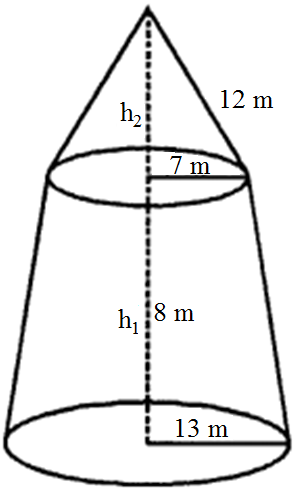
$\text{l}_1=\sqrt{(\text{h})^2+(\text{r}_1-\text{r}_2)^2}$
$=\sqrt{(8)^2+(13-7)^2}=\sqrt{(8)^2+(6)^2}$
$=\sqrt{(8)^2+(13-7)^2}=\sqrt{(8)^2+(6)^2}$
Now surface area of the whole tent
$=\pi(\text{r}_1+\text{r}_2)\text{l}_1+\pi\text{r}_2\text{l}_2 $
$=\pi \big[(13+7)\times10\big]+\pi (7)(12)$
$=\pi \big[20\times10\big]+\pi (84)$
$=200\pi+84\pi=287\pi\text{m}^2$
$=284\times\frac{22}{7}=\frac{6284}{7}=892.57\text{m}^2$ View full question & answer→Question 354 Marks
A right angled triangle with sides 3cm and 4cm is revolved around its hypotenuse. Find the volume of the double cone thus generated.
AnswerIn right angled $\triangle\text{ABC}$ ,$ \angle\text{B}=90°$
AB = 3cm and BC = 4cm
$\therefore$ Diagonal CA $=\sqrt{\text{AB}^2+\text{BC}^2}$ (pythagoras theorem)
$=\sqrt{(3)^2+(4)^2}=\sqrt{9+16}=\sqrt{25}=5\text{cm}$
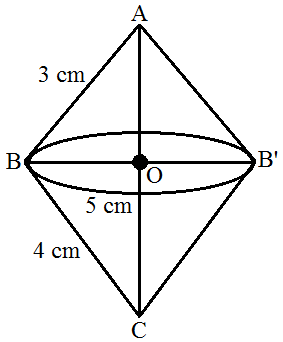
We get double cones as shown in the figure BB' is joined which bisects by AC ar O at right angles
In $\triangle\text{ABC},\angle\text{B}=90^\circ$
$\therefore$ area $(\triangle\text{ABC})=\frac{3\times4}{2}=6\text{cm}^2$
and area $(\triangle\text{ABC})=\frac{1}{2}\text{AC}\times\text{BO}$
$\Rightarrow6=\frac{1}{2}\times5\times\text{BO}$
$\Rightarrow\text{BO}=\frac{6\times2}{5}=\frac{12}{5}=2.4\text{cm}$
$\therefore$ Radius of cone along AO is BO which iscm and Also along CO is BO which is 2.4cm Now volumes of two cones so formes
$=\frac{1}{3}\pi\text{r}^2\times\text{AO}+\frac{1}{3}\pi\text{r}^2\times\text{CO}$
$=\frac{1}{3}\pi\text{r}^2(\text{AO}+\text{CO})=\frac{1}{3}\pi\text{r}^2\times\text{AC}$
$=\frac{1}{3}\times\frac{22}{7}\times(2.4)^2\times5\text{cm}^3$
$=\frac{22}{21}\times5.76\times5\times\text{cm}^3=\frac{110\times1.92}{7}\text{cm}^2$
$=\frac{211.20}{7}\text{cm}^3$
$=\frac{211.20}{7}\text{cm}^3$
$=\frac{21120}{7\times100}=\frac{1056}{35}\text{cm}^3$
$=30\frac{6}{35}\text{cm}^3$ View full question & answer→Question 364 Marks
The volume of a hemi-sphere is $2425cm^3$. Find its curved surface area. $\Big(\text{use}\ \pi=\frac{22}{7}\Big)$
AnswerGiven that volume of a hemisphere $=2424\frac{1}{2}\text{cm}^3$
Volume of a hemisphere $=\frac{2}{3}\pi\text{r}^3$
$\Rightarrow\frac{2}{3}\pi\text{r}^3=2425\frac{1}{2}$
$\Rightarrow\frac{2}{3}\pi\text{r}^3=\frac{4851}{2}$
$\Rightarrow\text{r}^3=\frac{4851\times3}{2\times2\times\pi}$
$\Rightarrow\text{r}^3=\frac{4851\times3}{4\pi}$
$\text{r}^3=157.625$
$\text{r}=10.50\text{cm}$
$\therefore$ Radius of hemisphere $= 10.5\ cm$
Curved surface area of hemisphere $=2\pi\text{r}^2$
$=2\pi(10.5)^2$
$= 692.72$
$\Rightarrow 693cm^2$
$\therefore$ curved surface area of hemisphere $= 693\ cm^2$
View full question & answer→Question 374 Marks
A cylindrical road roller made of iron is 1m long, Its internal diameter is 54cm and the thickness of the iron sheet used in making the roller is 9cm. Find the mass of the roller, if $1\ cm^3$ of iron has 7.8gm mass. $(\text{use}\ \pi=3.14)$
Answer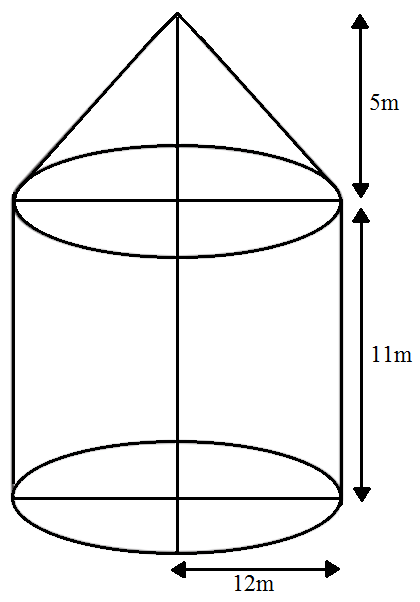
Given internal radius of cylinder road roller $(r_1) =\frac{54}{2}=27\text{cm}$
Given thickness of road roller $\Big(\frac{1}{\text{b}}\Big)=9\text{cm}$
Let order radii of cylinderical road roller be R.
$⇒ t = R - r$
$⇒ 9 = R - 27$
$⇒ R = 9 + 27 = 36cm$
$⇒ R = 36cm$
Given height of cylindrical road roller $(h) = 1m$
$h = 100cm$
Volume of iron $=\pi\text{h}(\text{R}^2-\text{r}^2)$
$\pi(36^2-27^2)\times100$
$=1780.38\text{cm}^3$
Volume of iron $= 1780.38\ cm^3$
Mass of $1\ cm^3$ of iron $= 7.8\ gm$
Mass of $1780.38\ cm^3$ of iron $= 1780.38 \times 7.8$
$= 1388696.4gm$
$= 1388.7kg$
$\therefore$ Mass of roller $(m) = 1388.7kg$ View full question & answer→Question 384 Marks
$2.2$ cubic dm of brass is to be drawn into a cylindrical wire $0.25cm$ in diameter. Find the length of the wire.
AnswerGiven that $2 × 2dm^3$ of grass is to be drawn into a cylindrical wire $0.25cm$ in diameter.
Given diameter of cylindrical wire $= 0.25cm$
$\text{Radius of wire}(\text{r})=\frac{\text{d}}{2}=\frac{0.25}{2}=0.125\text{cm}$
$=0.125\times10^{-2}\text{m}$
we have to find length of wire?
Volume of brass of $2.2dm^3$ is equal to volume of cylindrical wire.
$\frac{22}{7}(0.125\times10^{-2})\text{h}=2.2\times10^{-3}$
$\Rightarrow\text{h}=\frac{2.2\times10^{^3}\times7}{2(0.125\times10^{-2})^2}$
$\therefore$ Length of cylindrical wire $= 448m$
View full question & answer→Question 394 Marks
A well with inner radius $4m$ is dug $14m$ deep. Earth taken out of it has been spread evenly all around a width of $3m$ it to form an embankment. Find the height of the embankment.
AnswerGiven that inner radius of a well (a) $=4 m$
Depth of a well $( h )=14 m$
Volume of a cylinder $=\pi r ^2 h$
$V_1=\pi(4)^2 \times 14 m^3 \ldots(1)$
Given well is spread evenly to form an embankment
Width of an embankment $=3 m$
Outer radii of a well $(R)=4+3=7 m$
Volume of hollow cylinder $=\pi\left( R ^2- r ^2\right) \times hm ^3$
$V_2=\pi\left(7^2-4^2\right) \times h m^3$
Equating (1) and (2)
$V_1=V_2$
$\Rightarrow \pi(4)^2 \times 14=\pi(49-16) \times h$
$\Rightarrow h=\frac{\pi(4)^2 \times 14}{\pi(33)}$
$h=6.78 m$
View full question & answer→Question 404 Marks
The radii of the circular bases of a frustum of a right circular cone are $12\ cm$ and $3\ cm$ and the height is $12\ cm.$ Find the total surface area and the volume of the frustum.
AnswerThe height of the frustum cone is $h = 12\ cm$. The radii of the bottom and top circles are $r_1 = 12\ cm$ and $r_2 = 3cm$ respectively.
The slant height of the frustum cone is
$\text{l}=\sqrt{\big(\text{r}_1-\text{r}_2\big)^2+\text{h}^2}$
$=\sqrt{\big(12-3\big)^2+12^2}$
$=\sqrt{225}$
$=15\text{cm}$
The total surface area of the frustum cone is
$=\pi\big(\text{r}_1+\text{r}_2\big)\times\text{l}+\pi\text{r}^2_2+\pi\text{r}^2_2$
$ =\pi\times\big(12+3\big)\times15+\pi\times12^2+\pi\times3^2$
$ =\pi\times225\times26+144\pi\times9\pi$
$=378\pi\text{cm}^2$
Hence, Tolal surface area $ =378\pi\ \text{cm}^2$
The volume of the frustum cone is
$\text{V} =\frac{1}{3}\pi \big(\text{r}^2_1+\text{r}_1\text{r}_2+\text{r}^2_2\big)\times\text{h}$
$ =\frac{1}{3}\pi \big({12}^2+12\times3+3^2\big)\times12$
$ =\frac{1}{3}\pi\times189\times12$
$=756\pi\text{cm}^3$
Hence, Volume of frustum $=756\pi \ \text{cm}^3$
View full question & answer→Question 414 Marks
A tent of height $77\ dm$ is in the form of a right circular cylinder of diameter $36\ m$ and height $44\ dm$ surmounted by a right circular cone. Find the cost of the canvas at $Rs.\ 3.50$ per m$^2$ $\Big(\text{use}\ \pi=\frac{22}{7}\Big)$
AnswerTotal height of the tent $= 77\ dm$
Height of cylindrical part $(h_1) = 44\ dm$
$= 4.4\ m$
Height of conical part $(h_2) = 7.7 – 4.4 = 3.3\ m$
Diameter of the base of the tent $= 36\ m$
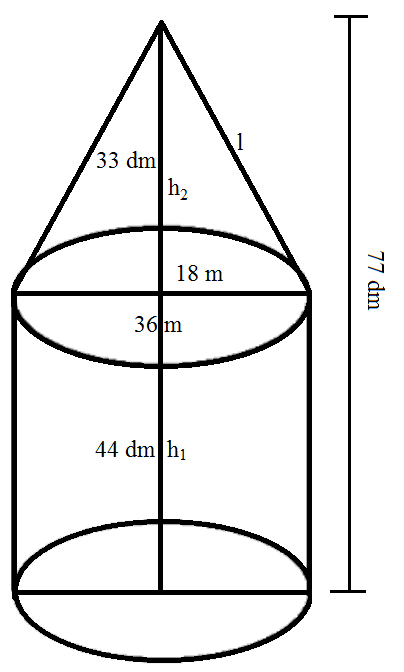
$\therefore$ Radius (r) $=\frac{36}{2}=18\text{m}$
Slant height on the conical part (l)
$=\sqrt{\text{r}^2+\text{h}^2_2}$
$=\sqrt{(18)^2+(3.3)^2}=\sqrt{324+10.89}$
$=\sqrt{334.89}=18.3\text{m}$
Now surface area of the tent = curved surface area of the cylindrical part and curved surface are of the conical part
$=2\pi\text{r}\text{h}_1=\pi\text{r}\text{l}$
$=2\times\frac{22}{7}\times18\times4.4+\frac{22}{7}\times18\times18.3\text{m}^2$
$=\frac{22}{7}\times18[2\times4.4+18.3]$
$=\frac{396}{7}(8.8+18.3)\text{m}^2$
$=\frac{396}{7}\times27.1\text{m}^2=1533.085\text{m}^2$
Rate of canvas $= Rs.\ 3.50$ per m$^2$
$\therefore$ Total cost $= Rs. 1533.085 \times 3.50$
$= Rs. 5365.7975 = Rs. 5365.80.$ View full question & answer→Question 424 Marks
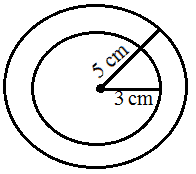
The diameters of the internal and external surfaces of a hollow spherical shell are 6cm and 10cm respectively. If it is melted and recast into a solid cylinder of diameter 14cm. find the height of the cylinder.
AnswerOuter diameter of hollow spherical shell = 10cm
and inner diameter = 6cm
Outer radius (R) $=\frac{10}{2}$ = 5cm 6
and inner radius (r) $=\frac{6}{2}$ = 3cm
$\therefore\text{volume of metal used}=\frac{4}{3}\pi(\text{R}^3-\text{r}^3$
$=\frac{4}{3}\pi[5^3-3^3]$
$=\frac{4}{3}\pi[125-27]=\frac{4}{3}\pi\times98\text{cm}^3$
Now volume of solid cylinder $=\frac{4}{3}\pi\times98\text{cm}^3$
Diameter = 14cm
$\therefore\text{radius}(\text{r}_1)=\frac{14}{2}=7\text{cm}$
let h beits height then $\pi\text{r}^2_1\text{h}=\frac{4}{3}\pi\times98$
$\Rightarrow\pi{7}^2\text{h}=\frac{4}{3}\pi\times98$
$\Rightarrow49\pi\text{h}=\frac{98\times4}{3}\pi$
$\Rightarrow\text{h}=\frac{98\times4\pi}{3\times49\times\pi}=\frac{8}{3}$
$\therefore$ Hieght of solid cylinder $=\frac{8}{3}\text{cm}$ View full question & answer→Question 434 Marks
A heap of rice in the form of a cone of diameter $9m$ and height $3.5m$. Find the volume of rice. How much canvas cloth is required to cover the heap?
AnswerThe heap of rice is in the form of a cone. Diameter, $d = 9m$ radius, $\text{r}=\frac{9}{2}\text{m}$$\text{height},=3.5\text{m}$
Volume, $\text{V}=\frac{1}{3}\pi\text{r}^2\text{h}$ $\frac{1}{3}\pi\Big(\frac{9}{2}\Big)^2\times3.5$
$=74.25\text{m}^3$
Thus, volume of rice $= 74.25m^3$ The canvas cloth required to cover the heap will be the curved surface area of the cone. $\text{l}=\sqrt{\text{h}^2+\text{r}^2}$ $\text{l}=\sqrt{3.5^2+\Big(\frac{9}{2}\Big)^2}$ $\text{l}=\sqrt{12.25+20.25}$$\text{l}=5.7\text{m}$
$\text{CSA}=\pi\text{rl}$ $=\pi\times\Big(\frac{9}{2}\Big)\times5.7$$=80.62\text{m}^2$
Hence, the canvas cloth required to cover the heap will be $80.62m^2$
View full question & answer→Question 444 Marks
A right circular cylinder and aright circular cone have equal bases and equal heights. If their curved surfaces are in the ratio 8 : 5, determine the ratio of the radius of the base to the height of either of them.
AnswerLet r and h be the radius and height of a cylinder and a cone respectively
$\therefore$ Slant height of cone $=\sqrt{\text{r}^2+\text{h}^2}$
Now curved surface area of cylinder $=2\pi\text{rh}$
and cureved surface area of cone $=\pi\text{rl}$
$=\pi\text{r}\sqrt{\text{r}^2+\text{h}^2}$
$\because$ their ratio is 8 : 5
$\therefore\frac{2\pi\text{rh}}{\pi\text{r}\sqrt{r^2+\text{h}^2}}=\frac{8}{5}\Rightarrow\frac{2\text{h}}{\sqrt{r^2+\text{h}^2}}=\frac{8}{5}$
$\Rightarrow\frac{4\text{h}^2}{\text{r}^2+\text{h}^2}=\frac{64}{25}$ (squaring both side)
$\Rightarrow\frac{\text{h}^2}{\text{r}^2+\text{h}^2}=\frac{16}{25}$ (Dividing by 4)
$\Rightarrow25\text{h}^2=16\text{r}^2+16\text{h}^2$
$\Rightarrow25\text{h}^2-16\text{h}^2=16\text{r}^2\Rightarrow9\text{h}^2=16\text{r}^2$
$\Rightarrow\frac{\text{r}^2}{\text{h}^2}=\frac{9}{16}\Rightarrow\Big(\frac{\text{r}}{\text{h}}\Big)^2=\Big(\frac{3}{4}\Big)^2$
$\therefore\frac{\text{r}}{\text{h}}=\frac{3}{4}\Rightarrow\text{r}:\text{h}=3:4$
$\therefore$ Ratio of r and h = 3 : 4
View full question & answer→Question 454 Marks
A right circular cylinder and a right circular cone have equal bases and equal heights. If their curved surfaces are in the ratio 8 : 5, determine the ratio of the radius of the base to the height of either of them.
AnswerLet r and h be the radius and height of a circular cylinder and also of a cone, then curved
surface area of the cylinder $=2\pi\text{rh}$
and curved surface area of cone
$=\pi\text{rl}=\pi\text{r}\sqrt{\text{h}^2+\text{r}^2}$
but they are in the ratio 8 : 5
$\frac{2\pi\text{rh}}{\pi\text{r}\sqrt{\text{h}^2+\text{r}^2}}=\frac{8}{5}\Rightarrow\frac{2\text{h}}{\sqrt{\text{h}^2+\text{r}^2}}=\frac{8}{5}$
$\frac{4\text{h}^2}{\text{h}^2+\text{r}^2}=\frac{64}{25}$ (squaring on both sides)
$\frac{\text{h}_2}{\text{h}^2+\text{r}^2}=\frac{16}{25}$
$\Rightarrow25\text{h}^2=16\text{h}^2+16\text{r}^2$
$\Rightarrow25\text{h}^2-16\text{h}^2=16\text{r}^2$
$\Rightarrow9\text{h}^2=16\text{r}^2$
$\Rightarrow\frac{\text{r}^2}{\text{h}^2}=\frac{9}{16}=\Big(\frac{3}{4}\Big)^2$
$\Rightarrow\frac{\text{r}}{\text{h}}=\frac{3}{4}$
$\therefore$ Ratio of r and h = 3 : 4
Hence ratio of radius and height = 3 : 4.
View full question & answer→Question 464 Marks
A cylindrical bucket, $32\ cm$ high and $18\ cm$ of radius of the base, is filled with sand. This bucket is emptied on the ground and a conical heap of sand is formed. If the height of the conical heap is $24\ cm$, find the radius and slant height of the heap.
AnswerGiven that Height of cylinder bucket $(h) = 32\ cm$
Radius $(r) = 18\ cm$
Volume of cylinder $=\pi\text{r}^2\text{h}$
$=\frac{22}{7}(18)^2\times32\text{cm}^2\ ...(1)$
Given height of conical heap $= 24\ cm$
Let radius of conical heap be $r_1$
Slant height of conical heap be $l_1$
$\Rightarrow\text{l}^2_1=\text{r}^2_1+\text{h}^2_1$
$\Rightarrow\text{r}^2_1=\text{l}^2_1+\text{h}^2_1$
$\Rightarrow\text{r}^2_1=\text{l}^2_1-(24)^2\ ...(2)$
Volume of cone $=\frac{1}{3}\pi\text{r}^2\text{h}$
So its volume $=\frac{1}{3}\pi\text{r}^2_1\text{h}_1$
$=\frac{1}{3}\times\frac{22}{7}\times\text{r}^2_1\times24$
$=\frac{22}{7}\times\text{r}^2_1\times8\text{cm}^3\ ...(3)$
So equating (1) and (3)
$(1) = (3)$
$\Rightarrow\frac{22}{7}(18)^2\times32=\frac{22}{7}\times\text{r}^2_1\times8$
$\Rightarrow\frac{(18)^2\times32}{8}=\text{r}^2_1$
$\Rightarrow\text{r}^2_1=1296$
$\Rightarrow\text{r}_1=36\text{cm}$
Radius of conical heap is $36\ cm$
substituting $r_1$ in $(2)$
$\Rightarrow\text{r}^2_1=\text{l}^2_1-(24)^2$
$\Rightarrow1296=\text{l}^2_1-576$
$\Rightarrow1296+576=\text{l}^2_1$
$\Rightarrow1872=\text{l}^2_1$
$\Rightarrow\text{l}_1=43.26\text{cm}$
$\therefore$ Slant height of conical heap $= 43.26\ cm$.
View full question & answer→Question 474 Marks
A well of diameter 2m is dug 14m deep. The earth taken out of it is spread evenly all around it to form an embankment of height 40cm. Find the width of the embankment.
AnswerDiameter of well = 2m
$\therefore\text{Radius(r)}=\frac{2}{2}=1\text{m}$
$\text{Depth(h)}=14\text{m}$
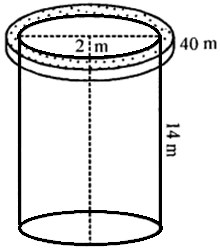
$\therefore$ Volume of earth dug out $=\pi\text{r}^2\text{h}$
$\frac{22}{7}\times1\times1\times14=44\text{m}^3$
Now height of embankment = 40cm
$=\frac{40}{100}=\frac{2}{5}\text{m}$
Let width of embankment = x m
$\therefore$ outer radius (R) = (1+ x) m
$\therefore$ Volume of earth used in embankment
$=\pi(\text{R}^2-\text{r}^2)\times\text{h}$
$\therefore\pi\text{h}(\text{R}^2-\text{r}^2)=44$
$\Rightarrow\frac{22}{7}\times\frac{2}{5}[(1+\text{x})^2-(1)^2]=44$
$\Rightarrow1+\text{x}^2+2\text{x}=1=44\times\frac{7\times5}{22\times2}=35$
$\Rightarrow\text{x}^2+2\text{x}-35=0\Rightarrow\text{x}^2+7\text{x}=5\text{x}-35=0$
$\Rightarrow\text{x}(\text{x}+7)-5(\text{x}+7)=0\Rightarrow(\text{x}+7)(\text{x}-5)=0$
Either x + 7 = 0, then x = -7 which is not possible being negative or x - 5 = 0, then x = 5
$\therefore$ Width of embankment = 5m. View full question & answer→Question 484 Marks
A toy is in the form of a hemisphere surmounted by a right circular cone of the same base radius as that of the hemisphere. If the radius of the base of the cone is 21cm and its volume is $\frac{2}{3}$ of the volume of hemisphere, calculate the height of the cone and the surface area of the toy.
AnswerLet the height of the conical part be h.
Radius of the cone = Radius of the hemisphere = r = 21cm
The toy can be diagrammatically represented as
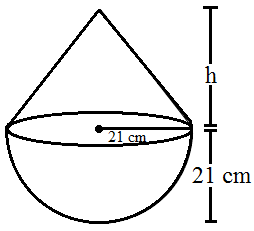
Volume of the cone $=\frac{1}{3}\pi\text{r}^2\text{h}$
Volume of the hemisphere $=\frac{2}{3}\pi\text{r}^3$
According to given information:
Volume of the cone $=\frac{2}{3}.$ Volume of the hemisphere
$\therefore\frac{1}{3}\pi\text{r}^2\text{h}=\frac{2}{3}\times\frac{2}{3}\pi\text{r}^3$
$\Rightarrow\text{h}=\frac{\frac{2}{3}\times\frac{2}{3}\pi\text{r}^3}{\frac{1}{3}\pi\text{r}^2}$
$\Rightarrow\text{h}=\frac{4}{3}\text{r}$
$\therefore\text{h}=\frac{4}{3}\times21\text{cm}=28\text{cm}$
Thus, surface area of the toy = Curved surface area of cone + Curved surface area of hemisphere
$=\pi\text{rl}+2\pi\text{r}^2$
$=\pi\text{r}\sqrt{\text{h}^2+\text{r}^2}+2\pi\text{r}^2$
$=\pi\text{r}(\sqrt{\text{h}^2+\text{r}^2}+2\text{r}$
$=\frac{22}{7}\times21\text{cm}(\sqrt{(28\text{cm})^2+(21\text{cm})^2}+2\times21\text{cm})$
$=66(\sqrt{784+441}+42)\text{cm}^2$
$=66(\sqrt{1225}+42)\text{cm}^2$
$=66(35+42)\text{cm}^2$
$=66\times77\text{cm}^2$
$=5082\text{cm}^2$ View full question & answer→Question 494 Marks
The difference between the outer and inner curved surface areas of a hollow right circular cylinder $14\ cm$ long is $88\ cm^2$. If the volume of metal used in making the cylinder is $176\ cm^3$, find the outer and inner diameters of the cylinder. $\Big(\text{use}\ \pi=\frac{22}{7}\Big)$
AnswerThe height of the hollow cylinder is $14\ cm$.
Let the inner and outer radii of the hollow cylinder are r cm and R cm respectively.
The difference between the outer and inner surface area of the hollow cylinder is
$=2\pi\text{R}\times14-2\pi\text{r}\times14$
$=28\pi(\text{R}-\text{r})\text{cm}^2$ By the given condition, this difference is $88$ square cm.
Hence, we have $=28\pi\Big(\text{R}-\text{r}\Big)=88$
$\Rightarrow\text{R}-\text{r}=\frac{44\times7}{14\times22}$
$\Rightarrow\text{R}-\text{r}=\frac{44\times7}{14\times22}$
$\Rightarrow\text{R}-\text{r}=1$ The volume of the metal used in making the cylinder is
$\text{V}_1=\pi\{(\text{R})^2-(\text{r})^2\}\times14\text{cm}^3$ By the given condition, the volume of the metal is $176$ cubic cm.
Hence, we have $\pi\{(\text{R})^2-(\text{r}^2)\}\times14=176$
$\Rightarrow\text{R}^2-\text{r}^2=\frac{176\times7}{14\times22}$
$\Rightarrow\text{R}^2-\text{r}^2=4$
$\Rightarrow(\text{R}-\text{r})(\text{R}+\text{r})=4$
$\Rightarrow1\times(\text{R}+\text{r})= 4$
$\Rightarrow\text{R}+\text{r}=4$
Hence, we have two equations with unknowns $R$ and $r R - r = 1 R + r = 4$ Adding the two equations,
we have $(R - r) + (R + r) = 1 + 4 \Rightarrow 2R = 5 \Rightarrow R = 2.5$
Then from the second equation, we have $r = 4 - 2.5 = 1.5$
Therefore, the outer and inner diameters of the hollow cylinder are 5cm and $3\ cm$ respectively.
View full question & answer→Question 504 Marks
The radius of the base of a right circular cone of semi-vertical angle α is r. Show that its volume is $\pi\text{r}^2 \cot\ \text{a}$ and curved surface area is $\pi\text{r}^2\text{cosec a}.$
AnswerRadius of circular cone = r and semi vertical angle = α Let AO = h and slant height AC = l In $\triangle\text{AOC},\text{AO}\bot\text{BC}$ 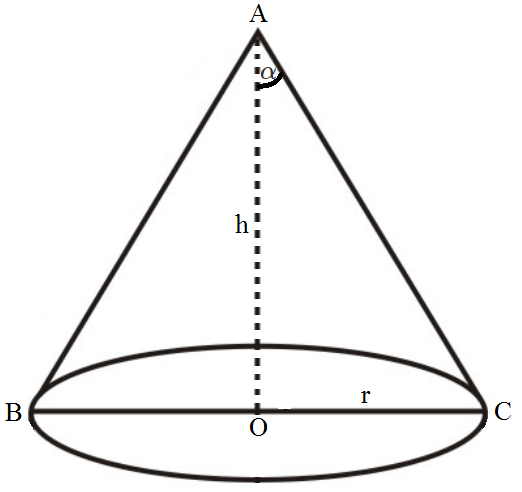
$\cot\text{a}=\frac{\text{AO}}{\text{OC}}$ $\Rightarrow\cot\text{a}=\frac{\text{h}}{\text{r}}\Rightarrow\text{h}=\text{r}\cot\text{a}$ Now volume $=\frac{1}{3}\pi\text{r}^2\text{h}=\frac{1}{3}\pi\text{r}^2\times\text{r}\cot\text{a}$ $=\frac{1}{3}\pi\text{r}^3\times\text{r}\cot\text{a}$ Now $\sin\text{a}=\frac{\text{OC}}{\text{AC}}\Rightarrow\sin\text{a}=\frac{\text{r}}{\text{l}}$ $\Rightarrow\text{l}=\frac{\text{r}}{\sin\text{a}}=\text{r}\ \text{cosec}\ \text{a}$ Curved surface area $=\pi\text{rl}=\pi\text{r}\times\text{r}\ \text{cosec}\ \text{a}$$=\pi\text{r}^2\ \text{cosec}\ \text{a}$ View full question & answer→