Questions

Write short notes

🎯

Test yourself on this topic

12 questions · timed · auto-graded

Question 13 Marks
Write a note on types of non-genetic RNA.
Answer
There are three types of cellular RNAs:
1. messenger RNA (mRNA),
2. ribosomal RNA (rRNA),
3. transfer RNA (tRNA). ‘

1. Messenger RNA (mRNA):
a. It is a linear polynucleotide.
b. It accounts 3% of cellular RNA.
c. Its molecular weight is several million.
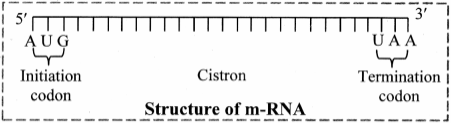
d. mRNA molecule carrying information to form a complete polypeptide chain is called cistron.
e. Size of mRNA is related to the size of message it contains.
f. Synthesis of mRNA begins at 5’ end of DNA strand and terminates at 3’ end.

Role of messenger RNA:
It carries genetic information from DNA to ribosomes, which are the sites of protein synthesis.

2. Ribosomal RNA (rRNA):
a. rRNA was discovered by Kurland in 1960.
b. It forms 50-60% part of ribosomes.
c. It accounts 80-90% of the cellular RNA.
d. It is synthesized in nucleus.
e. It gets coiled at various places due to intrachain complementary base pairing.
Role of ribosomal RNA: It provides proper binding site for m-RNA during protein synthesis.

3. Transfer RNA (tRNA):
a. These molecules are much smaller consisting of 70-80 nucleotides.
b. Due to presence of complementary base pairing at various places, it is shaped like clover-leaf.
c. Each tRNA can pick up particular amino acid.
d. Following four parts can be recognized on tRNA
1. DHU arm (Dihydroxyuracil loop/ amino acid recognition site
2. Amino acid binding site
3. Anticodon loop / codon recognition site
4. Ribosome recognition site.
e. In the anticodon loop of tRNA, three unpaired nucleotides are present called as anticodon which pair with codon present on mRNA.
f. The specific amino acids are attached at the 3’ end in acceptor stem of clover leaf of tRNA.
Role of transfer RNA: It helps in elongation of polypeptide chain during the process called translation.
View full question & answer
Question 23 Marks
Write a short note on m-RNA.
Answer
Messenger RNA (mRNA):
a. It is a linear polynucleotide.
b. It accounts 3% of cellular RNA.
c. Its molecular weight is several million. , d. mRNA molecule carrying information to form a complete polypeptide chain is called cistron.
e. Size of mRNA is related to the size of message it contains.
f. Synthesis of mRNA begins at 5’ end of DNA strand and terminates at 3’ end.

Role of messenger RNA:
It carries genetic information from DNA to ribosomes, which are the sites of protein synthesis.Image
View full question & answer
Question 33 Marks
Write a note on derived lipids.
Answer
Derived Lipids:
a. They are composed of fused hydrocarbon rings (steroid nucleus) and a long hydrocarbon side chain.
b. One of the most common sterols is cholesterol.
Biological significance:
a. It is widely distributed in all cells of the animal body, but particularly in nervous tissue.
b. Cholesterol exists either free or as cholesterol ester.
c. Adrenocorticoids, sex hormones (progesterone, testosterone) and vitamin D are synthesized from cholesterol.
d. Cholesterol is not found in plants.
e. Sterols exist as phytosterols in plants.
f. Yam Plant (Dioscorea) produces a steroid compound called diosgenin. It is used in the manufacture of antifertility pills, i.e. birth control pills.
View full question & answer
Question 43 Marks
Write a note on simple lipids.
Answer
Lipids are classified into three main types:
Simple lipids:
$a.$ These are esters of fatty acids with various alcohols. Fats and waxes are simple lipids.
$b.$ Fats are esters of fatty acids with glycerol $(CH_2OH-CHOH-CH_2OH).$
$c.$ Triglycerides are three molecules of fatty acids and one molecule of glycerol.
$d.$ Unsaturated fats are liquid at room temperature and are called oils. Unsaturated fatty acids are hydrogenated to produce fats e.g. Vanaspati ghee.
View full question & answer
Question 53 Marks
Write a note on monosaccharides.
Answer
Monosaccharides:
a. Monosaccharides are the simplest sugars having crystalline structure, sweet taste and soluble in water.
b. They cannot be further hydrolyzed into smaller molecules.
c. They are the building blocks or monomers of complex carbohydrates.
d. They have the general molecular formula (CH20)n, where n can be 3, 4, 5, 6 and 7.
e. They can be classified as triose, tetrose, pentose, etc.
f. Monosaccharides containing the aldehyde (-CHO) group are classified as aldoses e.g. glucose, xylose, and those with a ketone(-C=0) group are classified as ketoses. E.g. ribulose, fructose.
View full question & answer
Question 63 Marks
Write a short note on secondary metabolites.
Answer
  1. Secondary metabolites are small organic molecules produced by organisms that are not essential for their growth, development and reproduction.
  2. Several types of bacteria, fungi and plants produce secondary metabolites.
  3. Secondary metabolites can be classified on the basis of chemical structure (e.g. SMs containing rings, sugar), composition (with or without nitrogen), their solubility in various solvents, or the pathway by which they are synthesized (e.g. phenylpropanoid produces tannins).
  4. A simple way of classifying secondary metabolites includes three main groups such as:
    • Terpenes: Made from mevalonic acid that is composed mainly of carbon and hydrogen
    • Phenolics: Made from simple sugars containing benzene rings, hydrogen and oxygen.
    • Nitrogen-containing compounds: Extremely diverse class may also contain sulphur.
View full question & answer
Question 73 Marks
Write a note on properties of protein.
Answer
Properties of proteins are as follows:
  1. Proteins are extremely reactive and highly specific in behaviour.
  2. Proteins are amphoteric in nature i.e. they act as both acids and bases.
  3. The behaviour of proteins is strongly influenced by pH.
  4. Like amino acids, proteins are dipolar ions at the isoelectric point i.e. the sum of the positive charges is equal to the sum of the negative charges and the net charge is zero.
  5. The ionic groups of a protein are contributed by the side chains of the polyfunctional amino acids.
  6. A protein consists of more basic amino acids such as lysine and arginine exist as a cation at the physiological pH of 7.4. Such proteins are called basic proteins.
  7. Histones of nucleoproteins are basic proteins.
  8. A protein rich in acidic amino acids exists as an anion at the physiological pH. Such proteins are called acidic proteins.
  9. Most of the blood proteins are acidic proteins.
View full question & answer
Question 83 Marks
Why plant fats are liquid at room temperature while animal fats are solid?
Answer
  1. Plant fats are unsaturated fatty acids, whereas animal fats are saturated fatty acids.
  2. Fats having unsaturated fatty acids are liquid at room temperature.
  3. Saturated fatty acids are solid at room temperature. Hence, plant fats are liquid at room temperature, while animal fats are solid.
View full question & answer
Question 93 Marks
Write a short note on : Cellulose.
Answer
a. It is a polymer made from P-glucosc molecules and the polymer molecules are ‘straight’.
b. Cellulose serves to form the cell walls in plant cells.
c. These are much tougher than cell membranes.
d. This toughness is due to the arrangement of glucose units in the polymer chain and the hydrogen-bonding between neighbouring chains.
View full question & answer
Question 103 Marks
Write a short note on : Glycogen
Answer
a. It is amylopectin with very short distances between the branching side-chains.
b. Glycogen is stored in animal body particularly in liver and muscles from where it is hydrolyzed as per need to produce glucose.
View full question & answer
Question 113 Marks
Write a short note on : Starch
Answer
a. Starch is a stored food in the plants.
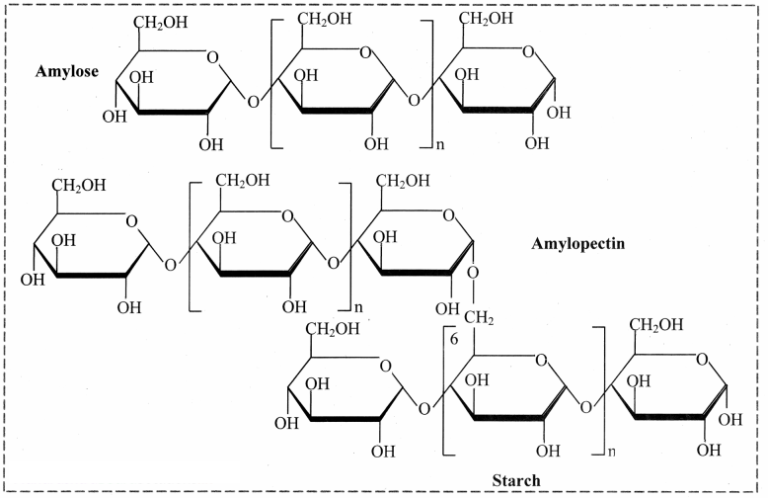
b. Starch contains two types of glucose polymer: amylose and amylopectin.
c. Both are made from a-glucose.
d. Amylose is an unbranched polymer of a-glucose.
e. The molecules coil into a helical structure.
f. It foims a colloidal suspension in hot water.
g. Amylopectin is a branched polymer of a-glucose.
h. It is completely insoluble in water.Image
View full question & answer
Question 123 Marks
How are disaccharides absorbed through the cell membrane?
Answer
1. Disaccharides are soluble in water but they are too big to pass through the cell membrane by diffusion.
2. They are broken down in the small intestine during digestion.
3. Thus, formed monosaccharides then pas into the blood and through cell membranes into the cells.
$C _{12} H _{22} O _{11}+ H _2 O \xrightarrow[]{\text { hydrolysis }} C _6 H _{12} O _6+ C _6 H _{12} O _6$
View full question & answer