MCQ 11 Mark
The parametric equations of the circle $x^2+y^2+m x+m y=0$ are
AnswerCorrect option: A. $x=\frac{-m}{2}+\frac{m}{\sqrt{2}} \cos \theta_i y=\frac{-m}{2}+\frac{m}{\sqrt{2}} \sin \theta$
$x=\frac{-m}{2}+\frac{m}{\sqrt{2}} \cos \theta_i y=\frac{-m}{2}+\frac{m}{\sqrt{2}} \sin \theta$
View full question & answer→MCQ 21 Mark
A pair of tangents are drawn to a unit circle with centre at the origin and these tangents intersect at A enclosing an angle of 60. The area enclosed by these tangents and the arc of the circle is
- A
$\frac{2}{\sqrt{3}}-\frac{\pi}{6}$
- ✓
$\sqrt{3}-\frac{\pi}{3}$
- C
$\frac{\pi}{3}-\frac{\sqrt{3}}{6}$
- D
$\sqrt{3}\left(1-\frac{\pi}{6}\right)$
AnswerCorrect option: B. $\sqrt{3}-\frac{\pi}{3}$
$\sqrt{3}-\frac{\pi}{3}$ 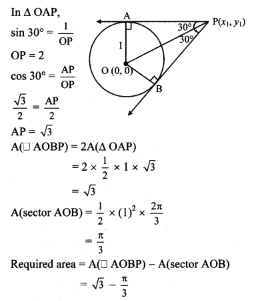
View full question & answer→MCQ 31 Mark
The equation of a circle with origin as centre and passing through the vertices of an equilateral triangle whose median is of length 3a is
- A
$x^2+y^2=9 a^2$
- B
$x^2+y^2=16 a^2$
- ✓
$x^2+y^2=4 a^2$
- D
$x^2+y^2=a^2$
AnswerCorrect option: C. $x^2+y^2=4 a^2$
$x^2+y^2=4 a^2$ Since the triangle is equilateral.
The centroid of the triangle is same as the circumcentre
and radius of the circumcircle $=\frac{2}{3}$ (median) $=\frac{2}{3}(3 a)=2 a$
Hence, the equation of the circumcircle whose centre is at $(0,0)$ and radius $2 \mathrm{a}$ is $\mathrm{x}^2+\mathrm{y}^2=$4a^2
View full question & answer→MCQ 41 Mark
If a circle passes through the points (0, 0), (a, 0), and (0, b), then find the co-ordinates of its centre.
- A
$\left(\frac{-a}{2}, \frac{-b}{2}\right)$
- B
$\left(\frac{a}{2}, \frac{-b}{2}\right)$
- C
$\left(\frac{-a}{2}, \frac{b}{2}\right)$
- ✓
$\left(\frac{a}{2}, \frac{b}{2}\right)$
AnswerCorrect option: D. $\left(\frac{a}{2}, \frac{b}{2}\right)$
$\left(\frac{a}{2}, \frac{b}{2}\right)$
View full question & answer→MCQ 51 Mark
The area of the circle having centre at (1, 2) and passing through (4, 6) is
MCQ 61 Mark
If the lines 3x – 4y + 4 = 0 and 6x – 8y – 7 = 0 are tangents to a circle, then find the radius of the circle.
- ✓
$\frac{3}{4}$
- B
$\frac{4}{3}$
- C
$\frac{1}{4}$
- D
$\frac{7}{4}$
AnswerCorrect option: A. $\frac{3}{4}$
$\frac{3}{4}$ Tangents are parallel to each other.
The perpendicular distance between tangents = diameter
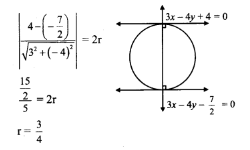
View full question & answer→MCQ 71 Mark
The equation(s) of the tangent(s) to the circle $x^2+y^2=4$ which are parallel to $x+2 y+3=$ 0 are
View full question & answer→MCQ 81 Mark
Find the equation of the circle which passes through the points (2, 3) and (4, 5), and the center lies on the straight line y – 4x + 3 = 0.
- ✓
$x^2+y^2-4 x-10 y+25=0$
- B
$x^2+y^2-4 x-10 y-25=0$
- C
$x^2+y^2-4 x+10 y-25=0$
- D
$x^2+y^2+4 x-10 y+25=0$
AnswerCorrect option: A. $x^2+y^2-4 x-10 y+25=0$
$x^2+y^2-4 x-10 y+25=0$
View full question & answer→MCQ 91 Mark
If the lines 2x – 3y = 5 and 3x – 4y = 7 are the diameters of a circle of area 154 sq. units, then find the equation of the circle.
- A
$x^2+y^2-2 x+2 y=40$
- B
$x^2+y^2-2 x-2 y=47$
- ✓
$x^2+y^2-2 x+2 y=47$
- D
$x^2+y^2-2 x-2 y=40$
AnswerCorrect option: C. $x^2+y^2-2 x+2 y=47$
$x^2+y^2-2 x+2 y=47$ Centre of circle = Point of intersection of diameters.
Solving 2x – 3y = 5 and 3x – 4y = 7, we get
x = 1, y = -1
Centre of the circle C(h, k) = C(1, -1)
∴ Area = 154
$\begin{aligned} & \pi r^2=154 \\ & \frac{22}{7} \times r^2=154 \\ & r^2=154 \times \frac{22}{7}=49 \\ & \therefore r=7\end{aligned}$
equation of the circle is
$\begin{aligned} & (x-1)^2+(y+1)^2=72 \\ & x^2+y^2-2 x+2 y=47\end{aligned}$
View full question & answer→MCQ 101 Mark
Equation of a circle which passes through (3, 6) and touches the axes is
- A
$x^2+y^2+6 x+6 y+3=0$
- B
$x^2+y^2-6 x-6 y-9=0$
- ✓
$x^2+y^2-6 x-6 y+9=0$
- D
$x^2+y^2-6 x+6 y-3=0$
AnswerCorrect option: C. $x^2+y^2-6 x-6 y+9=0$
$x^2+y^2-6 x-6 y+9=0$
View full question & answer→MCQ 112 Marks
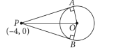
Two tangents to the circle $x^2+y^2=4$ at the points $A$ and $B$ meet at the point $P(-4,0)$. Then the area of the quadrilateral $P A O B, O$ being the origin, is
- A
$2 \sqrt{3}$ sq. units
- B
$8 \sqrt{3} sq$. units
- ✓
$4 \sqrt{3} sq$. units
- D
$6 \sqrt{3} sq$. units
AnswerCorrect option: C. $4 \sqrt{3} sq$. units
(c) : The centre of the circle is $(0,0)$ and radius is 2 units and coordinates of $P$ are $(-4,0)$.
$\therefore O P=4$ units
Also $O A=O B=2$ units [radius of circle]
$
\therefore \quad O A^2+A P^2=O P^2
$
[By Pythagoras theorem]
$\Rightarrow 2^2+A P^2=(4)^2 \Rightarrow A P^2=12 \Rightarrow A P=2 \sqrt{3}$
Similarly, $B P=2 \sqrt{3}$
Area of $P A O B=$ Area of $\triangle O A P+$ Area of $\triangle O B P$
$=\frac{1}{2} \times 2 \sqrt{3} \times 2+\frac{1}{2} \times 2 \sqrt{3} \times 2=4 \sqrt{3}$ sq. units
View full question & answer→MCQ 122 Marks
The centre of the circle whose radius is 3 units and touching internally the circle $x^2+y^2-4 x-6 y-12=$ 0 at the point $(-1,-1)$ is
- ✓
$\left(\frac{4}{5}, \frac{7}{5}\right)$
- B
$\left(\frac{4}{5}, \frac{-7}{5}\right)$
- C
$\left(\frac{-4}{5}, \frac{-7}{5}\right)$
- D
$\left(\frac{-4}{5}, \frac{7}{5}\right)$
AnswerCorrect option: A. $\left(\frac{4}{5}, \frac{7}{5}\right)$
(a) : Given equation of circle is
$x^2+y^2-4 x-6 y-12=0$
i.e., $(x-2)^2+(y-3)^2=5^2$.....(i)
So the given circle has centre $B(2,3)$ and radius 5 units.
Let $A(h, k)$ be the centre of circle having radius 3 units and touches the circle (i) at $P(-1,-1)$
In the given diagram, we have $B P=5$ and $A P=3$
$\therefore \quad A B=B P-A P=5-3=2$
$\therefore \quad A(h, k)$ divides $B P$ in the ratio $3: 2$ internally
$
\therefore h=\frac{3 \times 2+2 \times(-1)}{3+2}=\frac{4}{5} ; k=\frac{3 \times 3+2 \times(-1)}{3+2}=\frac{7}{5}
$
$\therefore \quad$ Required centre of circle is $\left(\frac{4}{5}, \frac{7}{5}\right)$.
![]() https://pg-data.sgp1.digitaloceanspaces.com/chapter_wise/16527/D5.png" alt="Image" width="110" height="">
https://pg-data.sgp1.digitaloceanspaces.com/chapter_wise/16527/D5.png" alt="Image" width="110" height=""> View full question & answer→MCQ 132 Marks
If the line $x-2 y=m(m \in Z )$ intersects the circle $x^2+y^2=2 x+4 y$ at two distinct points, then the number of possible values of $m$ are
Answer(b) : Equation of circle is $x^2+y^2=2 x+4 y$, can be written as $(x-1)^2+(y-2)^2=5$
$\therefore \quad$ Centre of circle is $(1,2)$ and radius is $\sqrt{5}$.
Distance of $(1,2)$ from line $x-2 y-m=0$
$=\left|\frac{1-4-m}{\sqrt{1^2+2^2}}\right|<\sqrt{5} \quad$ (as line intersect the circle)
$
\Rightarrow|-3-m|<5 \Rightarrow|-(m+3)|<5 \Rightarrow m+3<5
$
$
m=-7,-6,-5,-4,-3,-2,-1,0,1 \text {. }
$
$\therefore \quad$ Number of possible values of $m$ is 9 .
View full question & answer→MCQ 142 Marks
The equation of the circle whose centre lies on the line $x-4 y=1$ and which passes through the points $(3,7)$ and $(5,5)$ is
- ✓
$x^2+y^2+6 x+2 y-90=0$
- B
$x^2+y^2+6 x-2 y+90=0$
- C
$x^2+y^2+6 x+2 y+90=0$
- D
$x^2+y^2-6 x+2 y-90=0$
AnswerCorrect option: A. $x^2+y^2+6 x+2 y-90=0$
(a) : Consider the line first, we have $x-4 y=1$
$\Rightarrow x=1+4 y$
$\therefore \quad$ Any point on the line is of the form $(4 a+1, a)$, which included the centre of circle also. This point is equidistant from any point on the circumference of the circle.
$
\begin{array}{r}
\therefore \quad(4 a+1-3)^2+(a-7)^2=(4 a+1-5)^2+(a-5)^2 \\
\Rightarrow \quad 16 a^2-16 a+4+a^2-14 a+49=16 a^2-32 a+16 \\
+a^2-10 a+25
\end{array}
$
$
\begin{aligned}
& \Rightarrow \quad-12 a=12 \Rightarrow a=-1 \\
& \therefore \text { Centre of circle }=(-4+1,-1)=(-3,-1)
\end{aligned}
$
Now, radius $(r)=\sqrt{(-3-3)^2+(-1-7)^2}=\sqrt{100}=10$
$\therefore \quad$ Equation of circle is $(x+3)^2+(y+1)^2=10^2$
i.e., $x^2+y^2+6 x+2 y-90=0$
View full question & answer→MCQ 152 Marks
The parametric equation of the circle $x^2+y^2-6 x-$ $2 y+9=0$ are
- ✓
$x=3+\cos \theta, y=1+\sin \theta$
- B
$x=1+\cos \theta, y=3+\sin \theta$
- C
$x=\cos \theta, y=\sin \theta$
- D
$x=3+\sin \theta, y=1+\cos \theta$
AnswerCorrect option: A. $x=3+\cos \theta, y=1+\sin \theta$
(a) : If $\left(x_1, y_1\right)$ is centre of circle and $r$ is radius then parametric equation of circle can be written as
$
x=x_1+r \cos \theta, \quad y=y_1+r \sin \theta
$
Given equation of circle is
$
x^2+y^2-6 x-2 y+9=0 \Rightarrow(x-3)^2+(y-1)^2=1
$
$\therefore \quad$ Centre of circle is $(3,1)$ and radius of circle is 1 .
Equation in parametric form is $x=3+\cos \theta, \quad y=1+\sin \theta$
View full question & answer→MCQ 162 Marks
The equation of tangents to the circle $x^2+y^2=4$ which are parallel to $x+2 y+3=0$ are
- A
$x-2 y= \pm 2 \sqrt{5}$
- B
$x-2 y= \pm 2$
- C
$x+2 y= \pm 2 \sqrt{3}$
- ✓
$x+2 y= \pm 2 \sqrt{5}$
AnswerCorrect option: D. $x+2 y= \pm 2 \sqrt{5}$
(d) : Given, equation of the circle is $x^2+y^2=4$ and equation of the line is $x+2 y+3=0$
Slope of the line $=-1 / 2$
Since, the required tangents are parallel to the given line.
$\therefore \quad$ Slope of tangents $(m)=-\frac{1}{2}$
We know that the equation of the tangents to the circle $x^2+y^2=a^2$ with slope $m$ are $y=m x \pm \sqrt{a^2\left(1+m^2\right)}$
$\therefore \quad$ The required equation of tangents are
$
\begin{aligned}
y & =-\frac{1}{2} x \pm \sqrt{(2)^2\left(1+\left(\frac{-1}{2}\right)^2\right)} \\
\Rightarrow y & =-\frac{1}{2} x \pm \sqrt{5} \Rightarrow 2 y+x= \pm 2 \sqrt{5}
\end{aligned}
$
View full question & answer→MCQ 172 Marks
Find the equation of a circle of radius 5 units whose centre lies on $x$-axis and passes through the point $(2,4)$.
- A
$x^2+y^2-12 x-11=0$
- B
$x^2+y^2-4 x-21=0$
- ✓
$x^2+y^2+2 x-24=0$
- D
$x^2+y^2+12 x-11=0$
AnswerCorrect option: C. $x^2+y^2+2 x-24=0$
(c) : Let the coordinates of the centre of the required circle be $C(a, 0)$. Since it passes through $P(2,4)$.
$\therefore C P=$ radius $\Rightarrow C P=5$
$\Rightarrow \sqrt{(a-2)^2+(0-4)^2}=5$
$\Rightarrow(a-2)^2+16=25 \Rightarrow a-2= \pm 3 \Rightarrow a=5$ or $a=-1$
Thus, the coordinates of the centre are $(5,0)$ or $(-1,0)$. Hence, the equations of the required circle are
$
(x-5)^2+(y-0)^2=5^2 \text { and }(x+1)^2+(y-0)^2=5^2
$
$\Rightarrow x^2+y^2-10 x=0$ and $x^2+y^2+2 x-24=0$
View full question & answer→MCQ 182 Marks
The intercept on the line $y=x$ by the circle $x^2+y^2-2 x=0$ is $A B$. The equation of the circle with $A B$ as a diameter is
- A
$x^2+y^2+x+y=0$
- ✓
$x^2+y^2-x-y=0$
- C
$x^2+y^2-3 x+y=0$
- D
$x^2+y^2+3 x-y=0$
AnswerCorrect option: B. $x^2+y^2-x-y=0$
(b) : Points of intersection of the line $y=x$ and circle $x^2+y^2-2 x=0$ are given by $x^2+x^2-2 x=0 \Rightarrow 2 x^2-2 x=0$ $\Rightarrow 2 x(x-1)=0 \Rightarrow x=0$ or $x=1$
When $x=0, y=0$, When $x=1, y=1$
$\therefore \quad$ Points $A$ and $B$ are $(0,0)$ and $(1,1)$
Now, the equation of a circle whose diameter is $A B$ is given by $(x-0)(x-1)+(y-0)(y-1)=0$
$
\Rightarrow x^2-x+y^2-y=0 \Rightarrow x^2+y^2-x-y=0
$
View full question & answer→MCQ 192 Marks
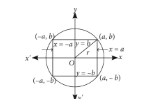
The sides of a rectangle are given by $x= \pm a$ and $y= \pm b$. The equation of the circle passing through the vertices of the rectangle is
AnswerCorrect option: B. $x^2+y^2=a^2+b^2$
(b) : Centre of the required circle $=(0,0)$.
Radius $(r)=\sqrt{(a-0)^2+(b-0)^2}$
$=\sqrt{a^2+b^2}$
$\therefore$ Equation of circle is $(x-0)^2+(y-0)^2=\left(\sqrt{a^2+b^2}\right)^2 \Rightarrow x^2+y^2=a^2+b^2$
View full question & answer→MCQ 202 Marks
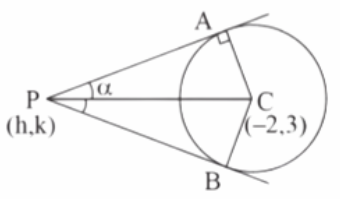
The angle between a pair of tangents drawn from a point P to the circle $x^2+y^2+4 x-6 y+9 \sin ^2 \alpha+13 \cos ^2 \alpha=0$ is $2 \alpha$.The equation of the locus of the point P is
- A
$x^2+y^2+4 x-6 y+4=0$
- B
$x^2+y^2+4 x-6 y-9=0$
- C
$x^2+y^2+4 x-6 y-4=0$
- D
$x^2+y^2+4 x-6 y+9=0$
View full question & answer→MCQ 212 Marks
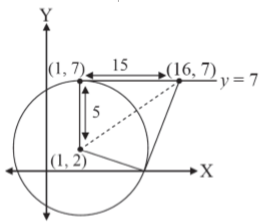
Two tangents PQ and PR drawn to the circle $x^2+y^2-2 x-4 y-20=0$ from point P(16, 7). If the centre of the circle is C, then the area of quadrilateral PQCR will be
Answer(C)
Required area $=\frac{1}{2}(5 \times 15) \times 2=75$
View full question & answer→MCQ 222 Marks
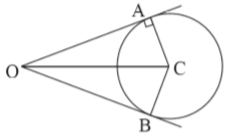
If OA and OB are the tangents from the origin to the circle $x^2+y^2+2 g x+2 f y+c=0$ and C is the centre of the circle, the area of the quadrilateral OACB is
- A
$\frac{1}{2} \sqrt{c\left(g^2+f^2-c\right)}$
- B
$\sqrt{c\left(g^2+f^2-c\right)}$
- C
$c \sqrt{g^2+f^2-c}$
- D
$\frac{\sqrt{g^2+f^2-c}}{c}$
View full question & answer→MCQ 232 Marks
Let the tangents drawn from the origin to the circle, $x^2+y^2-8 x-4 y+16=0$ touch it at the points A and B. The $(A B)^2$ is equal to
- A
$\frac{56}{5}$
- ✓
$\frac{64}{5}$
- C
$\frac{32}{5}$
- D
$\frac{52}{5}$
AnswerCorrect option: B. $\frac{64}{5}$
(B)
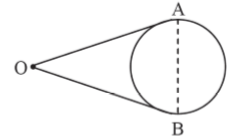
$\begin{array}{l}\text { Radius }= R =\sqrt{16+4-16}=2 \\ L= OA =\sqrt{ S _1}=\sqrt{16}=4 \\ \text { Length of } AB =\frac{2 LR }{\sqrt{ L ^2+ R ^2}} \\ \quad=\frac{2 \times 4 \times 2}{\sqrt{4^2+2^2}}=\frac{16}{\sqrt{20}}=\frac{8}{\sqrt{5}}\end{array}$
$\therefore AB ^2=\frac{64}{5}$ View full question & answer→MCQ 242 Marks
The equations of the tangents draws from the point (0, 1) to the circle $x^2+y^2-2 x+4=0$ are
- ✓
$2 x-y+1=0, x+2 y-2=0$
- B
$2 x-y+1=0, x+2 y+2=0$
- C
$2 x-y-1=0, x+2 y-2=0$
- D
$2 x-y-1=0, x+2 y+2=0$
AnswerCorrect option: A. $2 x-y+1=0, x+2 y-2=0$
(A)
Required equations are given by $SS _1= T ^2$
$ \Rightarrow\left(x^2+y^2-2 x+4 y\right)(1+4)=\{y-1(x)+2(y+1)\}^2$
$\Rightarrow 2 x^2-2 y^2-3 x+4 y+3 x y-2=0$
$\Rightarrow(2 x-y+1)(x+2 y-2)=0$
View full question & answer→MCQ 252 Marks
The equations of the tangets drawn the origin to the circle $x^2+y^2-2 r x-2 h y+h^2=0$ are
- A
$x=0, y=0$
- ✓
$\left( h ^2- r ^2\right) x-2 rh y=0, x=0$
- C
$y=0, x=4$
- D
$h ^2- r ^2 x+2 rh y=0, x=0$
AnswerCorrect option: B. $\left( h ^2- r ^2\right) x-2 rh y=0, x=0$
(B)
Required equations are given by $SS _1= T ^2$
$\Rightarrow h^2\left(x^2+y^2-2 r x-2 h y+h^2\right)=\left(r x+h y-h^2\right)^2$
$\Rightarrow\left(h^2-r^2\right) x^2-2 rh x y=0$
$\Rightarrow x\left\{\left(h^2-r^2\right) x-2 rh y\right\}=0$
$\Rightarrow x=0,\left(h^2-r^2\right) x-2 rh y=0$
View full question & answer→MCQ 262 Marks
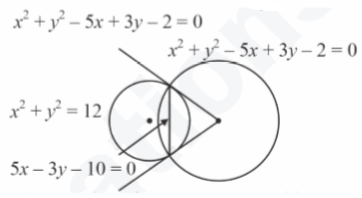
If tangents are drawn to the circle $x^2+y^2=12$ at the points where it intersects the circle $x^2+y^2-5 x+3 y-2=0$, then the coordinates of the point of intersection of those tangents are
- A
$\left(-6, \frac{18}{5}\right)$
- B
$\left(6, \frac{18}{5}\right)$
- C
$\left(-6, \frac{-18}{5}\right)$
- D
$\left(6, \frac{-18}{5}\right)$
View full question & answer→MCQ 272 Marks
The equations of tangents to the circle $x^2+y^2-22 x-4 y+25=0$ which are perpendicular to the line $5 x+12 y+8=0$ are
- ✓
$12 x-5 y+8=0,12 x-5 y=252$
- B
$12 x-5 y=0,12 x-5 y=252$
- C
$12 x-5 y-8=0,12 x-5 y+252=0$
- D
$12 x-5 y+25=0,12 x-5 y+16=0$
AnswerCorrect option: A. $12 x-5 y+8=0,12 x-5 y=252$
(A)
Equation of line perpendicular to
$5 x+12 y+8=0 \text { is } 12 x-5 y+k=0 .$
Now it is a tangent to the circle, if
Radius of circle $=$ Distance of line from centre of circle$\sqrt{121+4-25}=\left|\frac{12(11)-5(2)+k}{\sqrt{144+25}}\right|$
$\Rightarrow k =8$ or -252 .
Hence, equations of tangents are
$12 x-5 y+8=0,12 x-5 y=252$
View full question & answer→MCQ 282 Marks
The equation of the tangent to the circle $x^2+y^2-2 x-4 y-4=0$ which is perpendicular to $3 x-4 y-1=0$, is
- A
$4 x+3 y-15=0$
- B
$4 x+3 y+25=0$
- C
$4 x-3 y+15=0$
- ✓
$4 x+3 y-25=0$
AnswerCorrect option: D. $4 x+3 y-25=0$
(D)
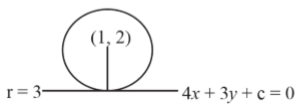
Tangent is of form $4 x+3 y+ c =0$. From condition of tangency to the circle, we get $c =-25$. Hence, equation is $4 x+3 y-25=0$. View full question & answer→MCQ 292 Marks
lf $a>2 b>0$, then the positive value of m for which $y=m x-b \sqrt{1+m^3}$ is a common tangent to $x^2+y^2= b ^2$ and $(x- a )^2+y^2= b ^2$, is
AnswerCorrect option: A. $\frac{2 b}{\sqrt{a^2-4 b^2}}$
(A)
Any tangent to $x^2+y^2= b ^2$ is $y= m x- b \sqrt{1+ m ^2}$
It touches $(x- a )^2+y^2= b ^2$
if $\frac{m a-b \sqrt{1+m^2}}{\sqrt{m^2+1}}=b$ or $m a=2 b \sqrt{1+m^3}$
or $m^2 a^2=4 b^2\left(1+m^2\right)$,
$\therefore$ $m= \pm \frac{2 b}{\sqrt{a^2-4 b^2}}$
View full question & answer→MCQ 302 Marks
Consider the circle $x^2+y^2-6 x+4 y=12$. The equation of a tangent to this circle that is parallel to the line $4 x+3 y+5=0$ is
- A
$4 x+3 y+10=0$
- B
$4 x+3 y-9=0$
- C
$4 x+3 y+9=0$
- ✓
$4 x+3 y-31=0$
AnswerCorrect option: D. $4 x+3 y-31=0$
(D)
Let the equation of tangent be
$\begin{array}{l}4 x+3 y+k=0 ...(i) \\S=x^2+y^2-6 x+4 y-12=0\end{array}$
The centre and radius of S are $(3,-2)$ and 5 units
Distance of (i) from centre of $S =$ radius
$\begin{array}{l}\Rightarrow\left|\frac{12-6+k}{5}\right|=5 \\\Rightarrow|6+k|=25 \\\Rightarrow 6+k= \pm 25 \\ \Rightarrow k=19 \text { or }-31\end{array}$
∴ Equation of tangent is $4 x+3 y+19=0$ or$4 x+3 y-31=0$
View full question & answer→MCQ 312 Marks
The equations of the tangents to the circle $x^2+y^2=a^2$ parallel to the line $\sqrt{3} x+y+3=0$ are
- ✓
$\sqrt{3} x+y \pm 2 a=0$
- B
$\sqrt{3} x+y \pm a =0$
- C
$\sqrt{3} x+y \pm 4 a=0$
- D
$\sqrt{3} y-x+3=0$
AnswerCorrect option: A. $\sqrt{3} x+y \pm 2 a=0$
(A)
Equation of line parallel to the
$\sqrt{3} x+y+3=0 \text { is } \sqrt{3} x+y+k=0$
But it is a tangent to the circle
$x^2+y^2= a ^2$, then
$\begin{array}{l}\left|\frac{k}{\sqrt{1+3}}\right|=a \\\Rightarrow k= \pm 2 a\end{array}$
Hence, the required equation is
$\sqrt{3} x+y \pm 2 a=0$
View full question & answer→MCQ 322 Marks
If the equation of the tangent to the circle $x^2+y^2-2 x+6 y-6=0$ parallel to $3 x-4 y+7=0$ is $3 x-4 y+k=0$, then the values of k are
Answer(A)
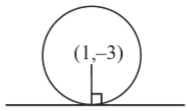
$3 x-4 y+ k =0$
Equation of circle is,
$x^2+y^2-2 x+6 y-6=0$
centre $(1,-3)$
Radius of circle $=4$
And centre of circle $=(1,-3)$
Equation of tangent is $3 x-4 y+ k =0$
$\therefore \frac{3 \times 1-4 \times(-3)+k}{\sqrt{(3)^2+(-4)^2}}= \pm 4$
Hence, $k =5,-35$ View full question & answer→MCQ 332 Marks
The equations of the tangents to circle $5 x^2+5 y^2=1$, parallel to line 3x + 4y = 1 are
AnswerCorrect option: C. $3 x+4 y= \pm \sqrt{5}$
(C)
Equations of tangents are
$y=\frac{-3}{4} x \pm \frac{1}{\sqrt{5}} \sqrt{1+\left(\frac{-3}{4}\right)^2}$
[∵ equation of tangent is $y= m x \pm a \sqrt{1+ m ^2}$ ]
$\begin{array}{ll}\therefore & y=\frac{-3}{4} x \pm \frac{1}{\sqrt{5}} \sqrt{\frac{16+9}{16}} \\ \therefore & 4 y=-3 x \pm \sqrt{5} \\ & \Rightarrow 3 x+4 y= \pm \sqrt{5}\end{array}$
View full question & answer→MCQ 342 Marks
The equation of the tangents to the circle $x^2+y^2-20 x+12 y+11=0$ having slope -2 are
- A
$y=-2 x+11$ and $y=-2 x+39$
- B
$y=-2 x-15$ and $y=-2 x+39$
- C
$y=-2 x-11$ and $y=-2 x+35$
- ✓
$y=-2 x-11$ and $y=-2 x+39$
AnswerCorrect option: D. $y=-2 x-11$ and $y=-2 x+39$
(D)
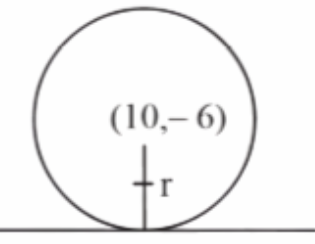
Equation of tangent $y= m x+ c$, where $m =-2$ is $y=-2 x+ c$
$\therefore 2 x+y-c=0$
Now, $x^2+y^2-20 x+12 y+11=0$
$\therefore 2 g=-20,2 f =12$
$\Rightarrow g =-10, f =6, c =11$
$\therefore$ Centre $(- g ,- f )=(10,-6)$
$\text { radius }=\sqrt{g^2+f^2-c}=\sqrt{125}=5 \sqrt{5}$
Since distance of tangent from the centre is equal to radius,
$\begin{array}{l} 5 \sqrt{5}=\left|\frac{2(10)-6-c}{\sqrt{4+1}}\right| \\ \Rightarrow 5 \sqrt{5} \times \sqrt{5}=|14-c| \\ \Rightarrow c=-11 \text { or } 39\end{array}$
∴ Equations of tangents are
$y=-2 x-11$ and $y=-2 x+39$ View full question & answer→MCQ 352 Marks
Tangents are drawn from the origin to a circle with centre at (2, -1). If the equation of one of the tangents is 3x + y = 0, the equation of the other tangent is
Answer(C)
Let the equation of other tangent from the origin be $y=m x$, then length of the perpendiculars from the centre $(2,-1)$ on the two tangents is same.
$\begin{array}{l}\left|\frac{2 m+1}{\sqrt{1+m^2}}\right|=\left|\frac{6-1}{\sqrt{9+1}}\right|=\frac{5}{\sqrt{10}} \\\Rightarrow m=-3 \text { or } \frac{1}{3}\end{array}$
∴ Slope of other tangent is $\frac{1}{3}$ and its equation is
$\begin{array}{l}y=\left(\frac{1}{3}\right) x \\\Rightarrow x-3 y=0\end{array}$
View full question & answer→MCQ 362 Marks
If the squares of the lengths tangents a point circles $x^2+y^2=a^2, x^2+y^2=b^2$ and $x^2+y^2=c^2$ are in A.P. then
- A
$a , b , c$ are in G.P.
- B
$a , b , c$ are in A.P.
- ✓
$a^2, b^2, c^2$ are in A.P.
- D
$a^2, b^2, c^2$ are in G.P.
AnswerCorrect option: C. $a^2, b^2, c^2$ are in A.P.
(C)
Let $P \left(x_1, y_1\right)$ be a point. Let $l_1^2, l_2^2, l_3^2$ be the squares of lengths of the tangents from the point P $\left(x_1, y_1\right)$.
$\begin{aligned}\therefore & l_1^2=x_1^2+y_1^2-a^2 \\& l_2^2=x_1^2+y_1^2-b^2 \\&l_3^2=x_1^2+y_1^2-c^2\end{aligned}$
Assume that $x_1^2+y_1^2= k$
$\therefore l_1^2=k-a^2 ; l_2^2=k-b^2 ; l_3^2=k-c^2$
or we can say that
$a^2=k-l_1^2 ; b^2=k-l_2^2 ; c^2=k-l_3^2$
Since $l_1^2, l_2^2$ and $l_3^2$ are in A. P., we have
$a ^2, b^2$ and $c ^2$ are in A.P.
View full question & answer→MCQ 372 Marks
The co-ordinates of the point from where the tangents are drawn to the circles, $x^2+y^2=1$, $x^2+y^2+8 x+15=0$ and $x^2+y^2+10 y+24=0$ are of same length ,are
- A
$\left(2, \frac{5}{2}\right)$
- ✓
$\left(-2, \frac{5}{2}\right)$
- C
$\left(-2, \frac{5}{2}\right)$
- D
$\left(2,-\frac{5}{2}\right)$
AnswerCorrect option: B. $\left(-2, \frac{5}{2}\right)$
(B)
Length of tangents is same i.e.,$\sqrt{S_1}=\sqrt{S_2}=\sqrt{S_3}$
We get the point from where tangent is drawn, by solving the 3 equations for $x$ and $y$.
i.e.,,$x^2+y^2=1$,
$x^2+y^2+8 x+15=0$ and
$x^2+y^2+10 y+24=0$
or $8 x+16=0$ and $10 y+25=0$
$\Rightarrow x=-2$ and $y=-\frac{5}{2}$
Hence, the point is $\left(-2,-\frac{5}{2}\right)$.
View full question & answer→MCQ 382 Marks
If the lengths of the tangents drawn from P to the circles $x^2+y^2-2 x+4 y-20=0$ and $x^2+y^2-2 x-8 y+1=0$ are in thr ratio 2 : 1 , then the locus of P is
- A
$x^2+y^2+2 x+12 y+8=0$
- B
$x^2+y^2-2 x+12 y+8=0$
- C
$x^2+y^2+2 x-12 y+8=0$
- ✓
$x^2+y^2-2 x-12 y+8=0$
AnswerCorrect option: D. $x^2+y^2-2 x-12 y+8=0$
(D)
(Let the point be $P\left(x_1, y_1\right)$
According to the given condition,
$\begin{array}{l}\frac{\sqrt{x_1^2+y_1^2-2 x_1+4 y_1-20}}{\sqrt{x_1^2+y_1^2-2 x_1-8 y_1+1}}-\frac{2}{1} \\\Rightarrow \frac{x_1^2+y_1^2-2 x_1+4 y_1-20}{x_1^2+y_1^2-2 x_1-8 y_1+1}=\frac{4}{1} \\\Rightarrow x_1^2+y_1^2-2 x_1+4 y_1-20 =4 x_1^2+4 y_1^2-8 x_1-32 y_1+4 \\\Rightarrow 3 x_1^2+3 y_1^2-6 x_1-36 y_1+24=0 \\\Rightarrow x_1^2+y_1^2-2 x_1-12 y_1+8=0\end{array}$
View full question & answer→MCQ 392 Marks
If P is a point such that the ratio of the squares of the lengths of the tangents from P to the circles $x^2+y^2+2 x-4 y-20=0$ and $x^2+y^2-4 x+2 y-44=0$ is $ 2: 3 $, then the locus of Pis a circle with centre
Answer(B)
$\frac{x^2+y^2+2 x-4 y-20}{x^2+y^2-4 x+2 y-44}=\frac{2}{3}$
$\Rightarrow x^2+y^2+14 x-16 y+28=0$
$\therefore $ Centre $=(-7,8)$
View full question & answer→MCQ 402 Marks
If the ratio of the lengths of tangents drawn from the point (f, g) to the given circle $x^2+y^2=6$ and $x^2+y^2+3 x+3 y=0$ be $ 2: 1 $, then
- A
$f^2+g^2+2 g+2 f+2=0$
- B
$f^2+g^2+4 g+4 f+4=0$
- ✓
$f^2+g^2+4 g+4 f+2=0$
- D
$f^2+g^2+4 g+2 f+4=0$
AnswerCorrect option: C. $f^2+g^2+4 g+4 f+2=0$
(C)
According to the given condition,
$\frac{f^2+g^2-6}{f^2+g^2+3 f+3 g}=\frac{4}{1}$
$\Rightarrow f^2+g^2+4 f+4 g+2=0$
View full question & answer→MCQ 412 Marks
Given the circles $x^2+y^2-4 x-5=0$ and $x^2+y^2+6 x-2 y+6=0$ let p be a point $(\alpha, \beta)$, such that the tangents from P to both the circles are equal, then
- A
$2 \alpha+10 \beta+11=0$
- B
$2 \alpha-10 \beta+11=0$
- ✓
$10 \alpha-2 \beta+11=0$
- D
$10 \alpha+2 \beta+11=0$
AnswerCorrect option: C. $10 \alpha-2 \beta+11=0$
(C)
According to the given condition,
$\alpha^2+\beta^2-4 \alpha-5=\alpha^2+\beta^2+6 \alpha-2 \beta+6$
$\therefore 10 \alpha-2 \beta+11=0$
View full question & answer→MCQ 422 Marks
The length of the tangents drawn from any point on the circle $x^2+y^2+2 g x+2 f y+ C _1=0$ to the circle $x^2+y^2+2 g x+2 f y+C_2=0$ is
- A
$\sqrt{C_1^2+C_2^2}$
- ✓
$\sqrt{C_2-C_1}$
- C
$C_1+C_2$
- D
$C _1= C _2$
AnswerCorrect option: B. $\sqrt{C_2-C_1}$
(B)
Let $\left(x_1, y_1\right)$ be any point on the circle
$x^2+y^2+2 g x+2 f y+ C _1=0$
$\therefore x_1^2+y_1^2+2 g x_1+2 f y_1+ C _1=0$
i.e. $x_1^2+y_1^2+2 g x_1+2 f y_1=- C _1$
Length of the tangent from $\left(x_1, y_1\right)$ to the circle
$x^2+y^2+2 g x+2 f y+ C _2=0$ is
$\begin{aligned}\sqrt{x_1^2+y_1^2+2 g x_1+2 f y_1+C_2} & =\sqrt{-C_1+C_2} \\& =\sqrt{C_2-C_1}\end{aligned}$
View full question & answer→MCQ 432 Marks
If the tangent at the point P on the circle $x^2+y^2+6 x+6 y=2$ meets the straight line $5 x-2 y+6=0$ at a point Q on the Y-axis, then the length of PQ is
- A
$2 \sqrt{5}$
- B
$3 \sqrt{5}$
- C
$4$
- ✓
$5$
Answer(D)
Tangent of the given circle meets the line $5 x-2 y+6=0$ at a point $Q (0,3)$ on the Y -axis.
$\therefore$ Length of tangent $=\sqrt{(0)^2+(3)^2+6(0)+6(3)-2}$
$\begin{aligned}PO & =\sqrt{9+18-2} \\& =\sqrt{25}=5\end{aligned}$
View full question & answer→MCQ 442 Marks
If circles $x^2+y^2-4 x-6 y+9=0$ and $x^2+y^2+2 x+2 y-7=0$ touch each other, then their point of contact is
- A
$\left(\frac{4}{5}, \frac{-7}{5}\right)$
- B
$\left(\frac{-4}{5}, \frac{7}{5}\right)$
- C
$\left(\frac{-4}{5}, \frac{-7}{5}\right)$
- ✓
$\left(\frac{4}{5}, \frac{7}{5}\right)$
AnswerCorrect option: D. $\left(\frac{4}{5}, \frac{7}{5}\right)$
(D)
Let $S _1: x^2+y^2-4 x-6 y+9=0$ and $S _2: x^2+y^2+2 x+2 y-7=0$
$\therefore$ the equation of the common tangent to both the circles is $S _1- S _2=0$
$\Rightarrow 6 x+8 y-16=0$
$\Rightarrow 3 x+4 y=8$ is the common equation of the tangent from the given choices,
it is clear that the point $\left(\frac{4}{5}, \frac{7}{5}\right)$ lies on the tangent.
View full question & answer→MCQ 452 Marks
If the circles given by $S \equiv x^2+y^2-14 x+6 y+33=0$ and $S^{\prime} \equiv x^2+y^2-a^2=0(a \in N)$ have 4 common tangents, then the pissible number of circles $S ^{\prime}=0$ is
Answer(B)
The centres and radii of the two circles are
$C _1(7,-3), C _2(0,0), r _1=5, r _2= a$
For 4 common tangents,
$r_1+r_2<\left|C_1 C_2\right|$
$C_1 C_2=\sqrt{7^2+(-3)^2}=\sqrt{58} \approx 7.6$
$r _1+ r _2<\left| C _1 C _2\right|$ for $a =1,2$
$\therefore$ Number of possible circles $=2$
View full question & answer→MCQ 462 Marks
The number of common tangents to the circles $x^2+y^2-4 x-6 y-12=0$ and $x^2+y^2+6 x+18 y+26=0$, is
Answer(C)
$x^2+y^2-4 x-6 y-12=0$
$\begin{array}{l} C_1=(2,3), r_1=\sqrt{4+9+12}=5 \\ x^2+y^2+6 x+18 y+26=0 \\ C_2=(-3,-9), r_2=\sqrt{9+81-26}=8 \\ C_1 C_2=\sqrt{(-3-2)^2+(-9-3)^2}=13 \\ C_1 C_2=r_1+r_2 \\ \Rightarrow \text { The given circles touch each other externally. } \\ \Rightarrow \text { Number of common tangents is } 3\end{array}$
View full question & answer→MCQ 472 Marks
The number of common tangents to circles $x^2+y^2+2 x+8 y-23=0$ and
$x^2+y^2-4 x-10 y+9=0$ is
Answer(C)
$x^2+y^2+2 x+8 y-23=0$
$\therefore \quad C _1(-1,-4), r _1=2 \sqrt{10}$
Again $x^2+y^2-4 x-10 y+9=0$
$\therefore C _2(2,5), r _2=2 \sqrt{5}$
Now $C _1 C _2$ = distance between centres.
$\therefore C _1 C _2=\sqrt{9+81}=3 \sqrt{10}=9.486$ and
$r_1+r_2=2(\sqrt{10}+\sqrt{5})=10.6$
$r_1-r_2=2 \sqrt{5}(\sqrt{2}-1)$
$=2 \times 2.2 \times 0.4$
$=4.4 \times 0.4$
$=1.76$
$C _1 C _2=2 \sqrt{10}> r _1- r _2$
$r_1-r_2 < C_1 C_2 < r_1+r_2$
⇒ Two tangents can be drawn.
View full question & answer→MCQ 482 Marks
If a circle, whose centre is (-1, 1) touches the straight line x + 2y + 12 = 0 then the co-ordinates of the point of contact are
- A
$\left(\frac{-7}{2},-4\right)$
- ✓
$\left(\frac{-18}{5}, \frac{-21}{5}\right)$
- C
- D
AnswerCorrect option: B. $\left(\frac{-18}{5}, \frac{-21}{5}\right)$
(B)
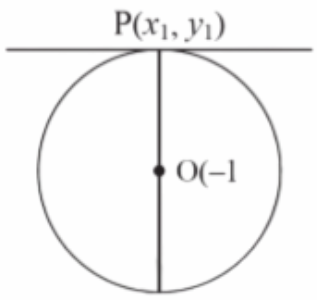
Let point of contact be $P \left(x_1, y_1\right)$.
This point lies on line $x_1+2 y_1=-12$ ...(i)
Gradient of OP $= m _1=\frac{y_1-1}{x_1+1}$
Gradient of $x+2 y+12= m _2=-\frac{1}{2}$
The two lines are perpendicular.
$\therefore \left(\frac{y_1-1}{x_1+1}\right)\left(\frac{-1}{2}\right)=-1$
$\Rightarrow 2 x_1-y_1=-3$ ...(ii)
On solving equations (i) and (ii), we get
$\left(x_1, y_1\right)=\left(\frac{-18}{5}, \frac{-21}{5}\right)$ View full question & answer→MCQ 492 Marks
The point of contact of the tangent to the circle $x^2+y^2=5$ at the point (1,-2) which touches the circle ,$x^2+y^2-8 x+6 y+20=0$ is
Answer(B)
Equation of the tangent at $(1,-2)$ to the circle $x^2+y^2=5$ is $x-2 y=5$
Here, only point $(3,-1)$ lies on the tangent.
View full question & answer→MCQ 502 Marks
The line $x \cos \alpha+y \sin \alpha= p$ will be a tangent to the circle $x^2+y^2-2 a x \cos \alpha-2 a y \sin \alpha=0$, if $p =$
AnswerCorrect option: D. $0$ or 2a
(D)
$x \cos \alpha+y \sin \alpha- p =0$ is a tangent, if perpendicular from centre on it is equal to radius of the circle. Here centre is
( $a \cos \alpha, a \sin \alpha$ ) and radius is a.
$\therefore$ $\left|\frac{a \cos ^2 \alpha+a \sin ^2 \alpha-p}{\sqrt{1}}\right|=a$
i.e., $|a-p|=a \Rightarrow p=0$ or $p=2 a$
View full question & answer→