MCQ 11 Mark
If the focus of the parabola is $(0, -3)$, its directrix is y $= 3$, then its equation is ________
- ✓
$x^2=-12 y$
- B
$x^2=12 y$
- C
$y^2=12 x$
- D
$y^2=-12 x$
AnswerCorrect option: A. $x^2=-12 y$
$x^2=-12 y$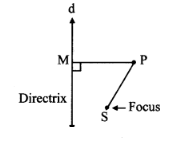
$S P^2= PM ^2 $
$ \Rightarrow(x-0)^2+(y+3)^2=\left|\frac{y-3}{\sqrt{1}}\right|^2 $
$\Rightarrow x^2+y^2+6 y+9=y^2-6 y+9 $
$\Rightarrow x^2=-12 y$ View full question & answer→MCQ 21 Mark
The length of latus rectum of the parabola $x^2-4 x-8 y+12=0$ is
Answer$8$
Hint:
Given equation of parabola is
$x^2-4 x-8 y+12=0$
$ \Rightarrow x^2-4 x=8 y-12$
$\Rightarrow x^2-4 x+4=8 y-12+4 $
$\Rightarrow(x-2)^2=8(y-1)$
Comparing this equation with $(x-h)^2=4 b(y-k)$, we get
4b = 8
∴ Length of latus rectum $= 4b = 8$
View full question & answer→MCQ 31 Mark
The line $y=m x+1$ is a tangent to the parabola $y^2=4 x$, if $m$ is
Answer$1$
hint:
$y^2=4 x$
Compare with $y^2=4 a x$
$∴ a = 1$ Equation of tangent is $y = mx + 1$
Compare with $y=m x+\frac{a}{m}$
$\frac{a}{m}=1 $
$ \therefore a=m=1$
View full question & answer→MCQ 41 Mark
The foci of hyperbola $4 x^2-9 y^2-36=0$ are
View full question & answer→MCQ 51 Mark
If the line $2 x-y=4$ touches the hyperbola $4 x^2-3 y^2=24$, the point of contact is
View full question & answer→MCQ 61 Mark
Centre of the ellipse $9 x^2+5 y^2-36 x-50 y-164=0$ is at
- ✓
$(2, 5)$
- B
$(1, -2)$
- C
$(-2, 1)$
- D
$(0, 0)$
AnswerCorrect option: A. $(2, 5)$
(2, 5)
$9 x^2+5 y^2-36 x-50 y-164=0 $
$ \Rightarrow 9(x-2)^2+5(y-5)^2=325$
$ \Rightarrow \frac{(x-2)^2}{\frac{325}{9}}+\frac{(y-5)^2}{65}=1$
⇒ centre of the ellipse = (2, 5)
View full question & answer→MCQ 71 Mark
Eccentricity of the hyperbola $16 x^2-3 y^2-32 x-12 y-44=0$ is
- A
$\sqrt{\frac{17}{3}}$
- B
$\sqrt{\frac{19}{3}}$
- ✓
$\frac{\sqrt{19}}{3}$
- D
$\frac{\sqrt{17}}{3}$
AnswerCorrect option: C. $\frac{\sqrt{19}}{3}$
$\sqrt{\frac{19}{3}}$ $16 x^2-3 y^2-32 x-12 y-44=0$
$\Rightarrow 16(x-1)^2-3(y+2)^2=48$
$\Rightarrow \frac{(x-1)^2}{3}-\frac{(y+2)^2}{16}=1$
Here, $a^2=3$ and $b^2=16$
$e=\frac{\sqrt{a^2+b^2}}{a}=\frac{\sqrt{3+16}}{\sqrt{3}}=\sqrt{\frac{19}{3}}$
View full question & answer→MCQ 81 Mark
The equation of the tangent to the ellipse $4 x^2+9 y^2=36$ which is perpendicular to $3 x+4 y$= 17 is
View full question & answer→MCQ 91 Mark
The equation of the ellipse is $16 x^2+25 y^2=400$. The equations of the tangents making anangle of 180° with the major axis are
View full question & answer→MCQ 101 Mark
If the line $4 x-3 y+k=0$ touches the ellipse $5 x^2+9 y^2=45$, then the value of $k$ is
View full question & answer→MCQ 111 Mark
The equation of the ellipse having eccentricity $\frac{\sqrt{3}}{2}$ and passing through $(-8,3)$ is
- A
$4 x^2+y^2=4$
- ✓
$x^2+4 y^2=100$
- C
$4 x^2+y^2=100$
- D
$x^2+4 y^2=4$
AnswerCorrect option: B. $x^2+4 y^2=100$
$x^2+4 y^2=100$
View full question & answer→MCQ 121 Mark
The equation of the ellipse having one of the foci at $(4,0)$ and eccentricity $\frac{1}{3}$ is
- A
$9 x^2+16 y^2=144$
- B
$144 x^2+9 y^2=1296$
- ✓
$128 x^2+144 y^2=18432$
- D
$144 x^2+128 y^2=18432$
AnswerCorrect option: C. $128 x^2+144 y^2=18432$
$128 x^2+144 y^2=18432$
View full question & answer→MCQ 131 Mark
The eccentricity of rectangular hyperbola is
AnswerCorrect option: C. $2^{\frac{1}{2}}$
$2^{\frac{1}{2}}$
View full question & answer→MCQ 141 Mark
If the parabola $y ^2=4$ ax passes through $(3,2)$, then the length of its latus rectum is
- A
$\frac{2}{3}$
- ✓
$\frac{4}{3}$
- C
$\frac{1}{3}$
- D
$4$
AnswerCorrect option: B. $\frac{4}{3}$
$\frac{4}{3}$Length of latus rectum = 4a The given parabola passes through $(3, 2)$
$\therefore(2)^2=4 a(3)$
$ \therefore 4 a=\frac{4}{3}$
View full question & answer→MCQ 151 Mark
The equation of the parabola having (2, 4) and (2, -4) as end points of its latus rectum is ________
- A
$y^2=4 x$
- ✓
$y^2=8 x$
- C
$y^2=-16 x$
- D
$x^2=8 y$
AnswerCorrect option: B. $y^2=8 x$
$y^2=8 x$ The given points lie in the 1st and 4th quadrants.
$\therefore$ Equation of the parabola is $y ^2=4 ax$
End points of latus rectum are (a, 2a) and (a, -2a)
∴ a = 2
∴ required equation of parabola is y = 8x
View full question & answer→MCQ 161 Mark
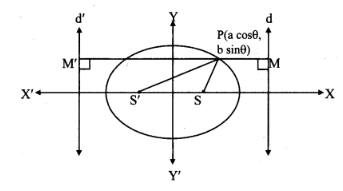
If $P \left(\frac{\pi}{4}\right)$ is any point on the ellipse $9 x^2+25 y^2=225, S$ and $S ^{\prime}$ are its foci, then $SP . S ^{\prime} P =$________
Answer$17$
$9 x^2+25 y^2=225$
$ \frac{x^2}{25}+\frac{y^2}{9}=1$
Here, $a = 5, b = 3$
$\text { Eccentricity }(e)=\frac{4}{5} $
$\therefore \frac{ a }{ e }=\frac{5}{\left(\frac{4}{5}\right)}=\frac{25}{4}$
Coordinates of foci are S(4, 0) and S'(-4, 0)
P(θ) = (a cos θ, b sin θ)
$\therefore \quad P \left(\frac{\pi}{4}\right)=\left(5 \cos \frac{\pi}{4}, 3 \sin \frac{\pi}{4}\right)=\left(\frac{5}{\sqrt{2}}, \frac{3}{\sqrt{2}}\right)$.
$ PM =\frac{25}{4}-\frac{5}{\sqrt{2}}=\frac{25-10 \sqrt{2}}{4} $
$ SP = ePM =\frac{4}{5}\left(\frac{25-10 \sqrt{2}}{4}\right)=5-2 \sqrt{2}$
$\text { Similarly, } S^{\prime} P=5+2 \sqrt{2}$
$\therefore \quad \text { SP.S'P }=(5-2 \sqrt{2})(5+2 \sqrt{2})=25-8=17$
View full question & answer→MCQ 171 Mark
The area of the triangle formed by the lines joining the vertex of the parabola $x^2=12 y$ to the endpoints of its latus rectum is ________
- A
$22$ sq. units
- B
$20$ sq. units
- ✓
$18$ sq. units
- D
$14$ sq. units
AnswerCorrect option: C. $18$ sq. units
$18$ sq. units
$x^2=12 y $
$ 4 b=12 $
$ b=3$
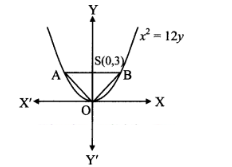
Area of triangle $=\frac{1}{2} \times A B \times O S$
$=\frac{1}{2} \times 4 a \times a $
$ =\frac{1}{2} \times 12 \times 3$
$ =18 sq . \text { units }$ View full question & answer→MCQ 181 Mark
Equation of the parabola with vertex at the origin and directrix with equation x + 8 = 0 is ________
- A
$y^2=8 x$
- ✓
$y^2=32 x$
- C
$y^2=16 x$
- D
$x^2=32 y$
AnswerCorrect option: B. $y^2=32 x$
$y^2=32 x$ Since directrix is parallel to Y-axis,
The X-axis is the axis of the parabola.
Let the equation of parabola be $y^2=4 a x$.
Equation of directrix is x + 8 = 0
∴ a = 8
$\therefore$ required equation of parabola is $y ^2=32 x$
View full question & answer→MCQ 191 Mark
The end points of latus rectum of the parabola $y^2=24 x$ are
View full question & answer→MCQ 201 Mark
The co-ordinates of a point on the parabola $y ^2=8 x$ whose focal distance is 4 are
AnswerCorrect option: C. $(2, \pm 4)$
View full question & answer→MCQ 212 Marks
The equation of the director circle of the hyperbola $\frac{x^2}{16}-\frac{y^2}{4}=1$ is given by
- A
$x^2+y^2=16$
- B
$x^2+y^2=4$
- C
$x^2+y^2=20$
- ✓
$x^2+y^2=12$
AnswerCorrect option: D. $x^2+y^2=12$
(D)
Equation of 'director-circle' of hyperbola is
$x^2+y^2= a ^2- b ^2$.
Here $a^2=16, b^2=4$
$\therefore x^2+y^2=12$ is the required 'director circle'
View full question & answer→MCQ 222 Marks
If the straight line $x \cos \alpha+y \sin \alpha= p$ be a tangent to the hyperbola $\frac{x^2}{a^2}-\frac{y^2}{b^2}=1$, then
- A
$a^2 \cos ^2 \alpha+b^2 \sin ^2 \alpha=p^2$
- ✓
$a^2 \cos ^2 \alpha-b^2 \sin ^2 \alpha=p^2$
- C
$a^2 \sin ^2 \alpha+b^2 \cos ^2 \alpha=p^2$
- D
$a^2 \sin ^2 \alpha-b^2 \cos ^2 \alpha=p^2$
AnswerCorrect option: B. $a^2 \cos ^2 \alpha-b^2 \sin ^2 \alpha=p^2$
(B)
$\begin{array}{l}x \cos \alpha+y \sin \alpha=p \\
\Rightarrow y=-\cot \alpha \cdot x+p \operatorname{cosec} \alpha\end{array}$
It is tangent to the hyperbola $\frac{x^2}{ a ^2}-\frac{y^2}{b^2}=1$
Therefore, $p ^2 \operatorname{cosec}^2 \alpha= a ^2 \cot ^2 \alpha- b ^2$
$\Rightarrow a^2 \cos ^2 \alpha-b^2 \sin ^2 \alpha=p^2$
View full question & answer→MCQ 232 Marks
The equation of the locus of the point intersection of the tangents to the hyperbola $\frac{x^2}{36}-\frac{y^2}{25}=1$, such that, the product of their slopes is 2 is
- A
$x^2-2 y^2=90$
- B
$2 x^2-y^2=104$
- ✓
$2 x^2-y^2=97$
- D
$x^2-2 y^2=70$
AnswerCorrect option: C. $2 x^2-y^2=97$
(C)
Equation of a tangent with slope $m$ to the hyperbola $\frac{x^2}{ a ^2}-\frac{y^2}{b^2}-1$ is
$y=m x \pm \sqrt{a^2 m^2-b^2}$
$\Rightarrow y=m x \pm \sqrt{36 m^2-25}$
$\Rightarrow(y-m x)^2=36 m^2-25$
$\Rightarrow m^2\left(x^2-36\right)-2 m x y+\left(y^2+25\right)=0 \quad\ldots(i)$
Given, product $m _1 m _2=2$
From (i),
$\frac{y^2+25}{x^2-36}=2 $
$\therefore y^2+25=2 x^2-72$
$\therefore 2 x^2-y^2=97$ which is the equation of locus of point of intersection.
View full question & answer→MCQ 242 Marks
Equation of tangents drawn from point $(-2, -1)$, to the hyperbola $2 x^2-3 y^2=6$ are
- A
3x - y + 7 = 0 and x - y + 1 = 0
- B
$3 x \pm y+7=0$
- ✓
3x - y + 5 = 0 and x - y + 1 = 0
- D
3y - x - 7 = 0 and x - y + 7 = 0
AnswerCorrect option: C. 3x - y + 5 = 0 and x - y + 1 = 0
(C)
$\begin{array}{l}\frac{x^2}{3}-\frac{y^2}{2}=1 \text { is hyperbola }
\\ \therefore a^2=3, b^2=2\end{array}$
Any tangent is $y= mx \pm \sqrt{ a ^2 m^2- b ^2}$
It passes through $(-2,-1)$
$\therefore -1=-2 m \pm \sqrt{a^2 m^2-b^2}$
$\begin{array}{l}\therefore(2 m-1)^2=3 m^2-2 \\ \therefore m^2-4 m+3=0 \\ \therefore m=3 \text { or } 1 \\ \therefore \text { tangents are }\end{array}$
$\begin{array}{l}3 x-y \pm 5=0 \\ \text {and } x-y \pm 1=0\end{array}$
View full question & answer→MCQ 252 Marks
Find the equation of axis of the given hyperbola $\frac{x^2}{3}-\frac{y^2}{2}=1$ which is equally inclined to the axes?
Answer(A)
We have, $\frac{x^2}{3}-\frac{y^2}{2}=1$
Since, equation of tangent are equally inclined to the axis i.e., $\tan \theta=1=m$.
Equation of tangent in slope form is
$y= m x+\sqrt{ a ^2 m^2- b ^2}$
Here, $a ^2=3, b^2=2$
$\therefore y=1 \cdot x+\sqrt{3 \times(1)^2-2}$
$\Rightarrow y=x+1$
View full question & answer→MCQ 262 Marks
The equation of the tangents to the hyperbola $3 x^2-4 y^2=12$ which cuts equal intercepts from the axes are
- A
$y+x= \pm 2$
- ✓
$y-x= \pm 1$
- C
$x-y= \pm 3$
- D
$x+y= \pm 4$
AnswerCorrect option: B. $y-x= \pm 1$
(B)
The tangent at $( h , k )$ is $\frac{x}{\frac{4}{h}}-\frac{y}{\frac{3}{k}}=1$
Given condition
$\Leftrightarrow \frac{4}{h}=\frac{3}{k} \Rightarrow \frac{h}{k}=\frac{4}{3} \quad\ldots(i)$
and $3 h^2-4 k ^2=12 \quad\ldots(ii)$
As point ( $h , k$ ) lies on it, using (i) and (ii), we get the tangents as $y-x= \pm 1$.
View full question & answer→MCQ 272 Marks
A line parallel to the straight line $2 x-y=0$ is tangent to the hyperbola $\frac{x^2}{4}-\frac{y^2}{2}=1$ at the point $\left(x_1, y_1\right)$. Then $x_1^2+5 y_1^2$ is equal to
Answer(C)
The equation of the tangent at $\left(x_1, y_1\right)$ is
$\frac{x x_1}{4}-\frac{y y_1}{2}=1$
Slope of tangent $=\frac{x_1}{2 y_1}$
Slope of the line $2 x-y=0$ is 2
$\Rightarrow \frac{x_1}{2 y_1}=2 \Rightarrow x_1=4 y_1 \quad\ldots(i)$
$\left(x_1, y_1\right)$ lies on the hyperbola $\frac{x^2}{4}-\frac{y^2}{2}=1$
$\Rightarrow \frac{x_1^2}{4}-\frac{y_1^2}{2}=1$
$\begin{array}{l}\Rightarrow \frac{\left(4 y_1\right)^2}{4}-\frac{y_1^2}{2}=1 \quad \ldots[\text { From (i) }] \\ \Rightarrow y_1^2=\frac{2}{7} \\ x_1^2+5 y_1^2=\left(4 y_1\right)^2+5 y_1^2=21 y_1^2=21\left(\frac{2}{7}\right)=6\end{array}$
View full question & answer→MCQ 282 Marks
The equation of the tangent to the hyperbola $2 x^2-3 y^2=6$ which is parallel to the line $y=3 x+4$, is
- A
- B
- ✓
y = 3x + 5 and y = 3x - 5
- D
AnswerCorrect option: C. y = 3x + 5 and y = 3x - 5
(C)
Let tangent be $y=3 x+ c$
$\begin{array}{l}c= \pm \sqrt{a^2 m^2-b^2}= \pm \sqrt{3(9)-2}= \pm 5 \\\Rightarrow y=3 x \pm 5\end{array}$
View full question & answer→MCQ 292 Marks
The equation of the tangents to the conic $3 x^2-y^2=3$ perpendicular to the line $x+3 y=2$ is
- ✓
$y=3 x \pm \sqrt{6}$
- B
$y=6 x \pm \sqrt{3}$
- C
$y=x \pm \sqrt{6}$
- D
$y=3 x \pm 6$
AnswerCorrect option: A. $y=3 x \pm \sqrt{6}$
(A)
Slope of $x+3 y-2=0$ is $-\frac{1}{3}$.
$\therefore$ Slope of required tangent $=3$
Tangent to $\frac{x^2}{1}-\frac{y^2}{3}=1$ and perpendicular to
$x+3 y-2=0$ is given by
$y=3 x \pm \sqrt{9-3}=3 x \pm \sqrt{6}$
View full question & answer→MCQ 302 Marks
Let the eccentricity of the hyperbola $\frac{x^2}{ a ^2}-\frac{y^2}{b^2}=1$ be the reciprocal to that of the ellipse $x^2+4 y^2=4$. If the hyperbola passes through a focus of the ellipse, then a focus of the hyperbola is at
Answer(A)
The equation of the ellipse is $\frac{x^2}{4}+\frac{y^2}{1}=1$
Let e be its eccentricity.
Then, $e =\sqrt{1-\frac{1}{4}}=\frac{\sqrt{3}}{2}$
The foci of the ellipse are $S(\sqrt{3}, 0)$ and $S ^{\prime}(-\sqrt{3}, 0)$.
Eccentricity of the hyperbola $=\frac{1}{ e }=\frac{2}{\sqrt{3}}$
$\therefore b^2=a^2\left(\frac{4}{3}-1\right)=\frac{a^2}{3}$
The hyperbola passes through $S (\sqrt{3}, 0)$.
$\therefore \frac{3}{a^2}-0=1 \Rightarrow a^2=3 \Rightarrow a=\sqrt{3}$
$\therefore$ the co-ordinates of the foci of hyperbola are $( \pm 2,0)$.
View full question & answer→MCQ 312 Marks
Let the eccentricity of the hyperbola $\frac{x^2}{a^2}-\frac{y^2}{b^2}=1$ be reciprocal to that of the ellipse $x^2+9 y^2=9$, then the ratio $a^2: b^2$ equals
Answer(A)
Eccentricity of ellipse $x^2+9 y^2=9$
i.e. $\frac{x^2}{9}+\frac{y^2}{1}=1$
$\left(e_1\right)^2=1-\frac{1}{9}=\frac{8}{9}$
Now, eccentricity of hyperbola $\frac{x^2}{ a ^2}-\frac{y^2}{b^2}=1$ is,
$\begin{aligned}& \left(e_2\right)^2=1+\frac{b^2}{a^2}=\frac{9}{8} \\\therefore & \frac{b^2}{a^2}=\frac{9}{8}-1 \\\therefore & \frac{a^2}{b^2}=\frac{8}{1}\end{aligned}$
View full question & answer→MCQ 322 Marks
If the foci of the ellipse $\frac{x^2}{16}+\frac{y^2}{b^2}=1$ and the hyperbola $\frac{x^2}{144}-\frac{y^2}{81}=\frac{1}{25}$ coincide, then the value of $b^2$ is
Answer(C)
Hyperbola is $\frac{x^2}{144}-\frac{y^2}{81}=\frac{1}{25}$
$\begin{array}{l}a=\sqrt{\frac{144}{25}}, b=\sqrt{\frac{81}{25}} \\\therefore e_1=\sqrt{1+\frac{81}{144}}=\sqrt{\frac{225}{144}}=\frac{15}{12}=\frac{5}{4} \\
\therefore f o c i=\left(a e_1, 0\right)=\left(\frac{12}{5} \times \frac{5}{4}, 0\right)=(3,0)\end{array}$
$\therefore$ focus of ellipse $=(4 e , 0)$
Since focus of ellipse and hyperbola is same
$\begin{array}{l}\therefore(4 e, 0)=(3,0) \\\Rightarrow e=\frac{3}{4}\end{array}$
Hence, $b^2=16\left(1-\frac{9}{16}\right)=7$
View full question & answer→MCQ 332 Marks
$x^2-4 y^2-2 x+16 y-40=0$ represents
Answer(C)
$\begin{array}{l}x^2-2 x-4 y^2+16 y-40=0 \\ \Rightarrow\left(x^2-2 x\right)-4\left(y^2-4 y\right)-40=0 \\ \Rightarrow(x-1)^2-1-4\left[(y-2)^2-4\right]-40=0 \\ \Rightarrow(x-1)^2-4(y-2)^2=25 \\ \Rightarrow \frac{(x-1)^2}{25}-\frac{(y-2)^2}{\frac{25}{4}}=1, \text { which is a hyperbola. }\end{array}$
View full question & answer→MCQ 342 Marks
If t is a parameter, then $x= a \left( t +\frac{1}{ t }\right), y= b \left( t -\frac{1}{ t }\right)$ represents
Answer(D)
$\begin{array}{l}\text { Given, } x=a\left(t+\frac{1}{t}\right) \\\Rightarrow \frac{x}{a}=t+\frac{1}{t} \quad\ldots(i) \\\text { and } y=b\left(t-\frac{1}{t}\right) \\\Rightarrow \frac{y}{b}=t-\frac{1}{t} \quad\ldots(ii)\end{array}$
Squaring and subtracting equation (ii) from (i), we get
$\begin{array}{l}\frac{x^2}{a^2}-\frac{y^2}{b^2}=t^2+2+\frac{1}{t^2}-t^2+2-\frac{1}{t^2} \\\Rightarrow \frac{x^2}{a^2}-\frac{y^2}{b^2}=4\end{array}$
which represents a hyperbola.
View full question & answer→MCQ 352 Marks
The equation $\frac{x^2}{12-k}+\frac{y^2}{8-k}=1$ represents
- A
- B
- ✓
a hyperbola if 8 < k < 12
- D
AnswerCorrect option: C. a hyperbola if 8 < k < 12
(C)
$\begin{array}{l}\frac{x^2}{12-k}+\frac{y^2}{8-k}=1 \\\Rightarrow \frac{x^2}{12-k}-\frac{y^2}{k-8}=1 \\\therefore12>k \text { and } k>8 \\\Rightarrow 8 < k < 12\end{array}$
$\therefore$ the given equation represents a hyperbola, if $8 < k< 12$.
View full question & answer→MCQ 362 Marks
If $\frac{x^2}{36}-\frac{y^2}{k^2}=1$ is a hyperbola, then which of the following statements can be true?
- A
(-3,1) lies on the hyperbola
- B
(3, 1) lies on the hyperbola
- ✓
(10, 4) lies on the hyperbola
- D
(5, 2) lies on the hyperbola
AnswerCorrect option: C. (10, 4) lies on the hyperbola
(C)
$\frac{x^2}{36}-\frac{y^2}{ k ^2}=1$ is a hyperbola $\Rightarrow k ^2>0$
Now, $\frac{y^2}{ k ^2}=\frac{x^2}{36}-1=\frac{x^2-36}{36}$
$\begin{array}{l}\Rightarrow k^2=\frac{36 y^2}{x^2-36}>0 \Rightarrow x^2-36>0 \\\Rightarrow x^2>36\end{array}$
This is true only for point $(10,4)$.
$\therefore(10,4)$ lies on given hyperbola
View full question & answer→MCQ 372 Marks
The locus of the point of intersection of the lines $ax$ $\sec \theta+b y \tan \theta=a$ and $a x \tan \theta+b y \sec \theta=b$, where $\theta$ is the parameter, is
Answer(D)
Squaring and subtracting, we get $a^2 x^2-b^2 y^2=a^2-b^2$, which is the equation of hyperbola.
View full question & answer→MCQ 382 Marks
If $e$ and $e^{\prime}$ are eccentricities of two conics of same type and $e ^2+ e ^{\prime 2}=3$, then they must be
Answer(C)
For ellipse, $e <1$ and also $e ^{\prime}<1$
$\therefore e^2+e^{\prime 2}<2$
For parabola, $e =1$ and $e ^{\prime}=1$
$\therefore e^2+e^{\prime 2}=2$
For hyperbola, $e >1$ and $\therefore e^{\prime}>1$
$\therefore e^2+e^{\prime 2}>2$
Hence, it can be 3 in case of hyperbola.
View full question & answer→MCQ 392 Marks
The distance between the directrices of a rectangular hyperbola is 10 units, then distance hetween its foci is
- A
$10 \sqrt{2}$
- B
- C
$5 \sqrt{2}$
- ✓
Answer(D)
Since distance between directrices $=\frac{2 a}{e}$ and
eccentricity of rectangular hyperbola $=\sqrt{2}$.
$\therefore$ Distance between directrices $=\frac{2 a }{\sqrt{2}}$
Given, $\frac{2 a }{\sqrt{2}}=10$
$\Rightarrow 2 a=10 \sqrt{2}$
Now, distance between foci $=2 ae$
$\begin{array}{l}=(10 \sqrt{2})(\sqrt{2}) \\=20\end{array}$
View full question & answer→MCQ 402 Marks
If $e$ and $e^{\prime}$ are the eccentricities of the ellipse $5 x^2+9 y^2=45$ and the hyperbola $5 x^2-4 y^2=45$, then $ee ^{\prime}=$
Answer(D)
$e ^2=1-\frac{ b ^2}{ a ^2}=\frac{4}{9}$
$\Rightarrow e =\frac{2}{3}$
$\text {and } e ^{\prime 2}=1+\frac{ b ^2}{ a ^2}=1+\frac{\frac{45}{4}}{9}=\frac{9}{4}$
$ \Rightarrow e ^{\prime}=\frac{3}{2}$
$\therefore ee^{\prime}=1$
View full question & answer→MCQ 412 Marks
If the eccentricities of the hyperbolas $\frac{x^2}{ a ^2}-\frac{y^2}{b^2}=1$ and $\frac{y^2}{b^2}-\frac{x^2}{ a ^2}=1$ be e and $e_1$, then $\frac{1}{e^2}+\frac{1}{e^2}=$
Answer(A)
Eccentricity of hyperbola $\frac{x^2}{ a ^2}-\frac{y^2}{b^2}=1$ is
$\begin{array}{l}e=\sqrt{1+\frac{b^2}{a^2}} \\\Rightarrow e^2=\frac{a^2+b^2}{a^2} \quad\ldots(i)\end{array}$
Eccentricity of hyperbola $\frac{y^2}{b^2}-\frac{x^2}{ a ^2}=1$ is
$\begin{array}{l} e_1=\sqrt{1+\frac{a^2}{b^2}} \\\Rightarrow e_1^2=\frac{b^2+a^2}{b^2}\quad\ldots(ii)\end{array}$
From (i) and (ii), we get
$\frac{1}{e_1^2}+\frac{1}{e^2}=1$
View full question & answer→MCQ 422 Marks
The eccentricity of the hyperooia whose length of the latus rectum is equal to 8 and the length of its conjugate axis is equal to half of the distance between its foci, is
- A
$\frac{4}{3}$
- B
$\frac{4}{\sqrt{3}}$
- ✓
$\frac{2}{\sqrt{3}}$
- D
$\sqrt{3}$
AnswerCorrect option: C. $\frac{2}{\sqrt{3}}$
(C)
Given length of $L R=8$
$\Rightarrow \frac{2 b^2}{a}=8$
Also, $2 b=\frac{1}{2}(2 ae )$
$\begin{array}{l}\Rightarrow 4 b^2=a^2 e^2 \Rightarrow 4 a^2\left(e^2-1\right)=a^2 e^2 \\\Rightarrow 4 e^2-e^2=4 \\\Rightarrow e=\frac{2}{\sqrt{3}}\end{array}$
View full question & answer→MCQ 432 Marks
A hyperbola, centred at the origin, has transverse axis 2 a . If it passes through a given point $\left(x_1, y_1\right)$, then its eccentricity is
- A
$\sqrt{\frac{x_1^2-y_1^2- a ^2}{x_1^2-y_1^2}}$
- ✓
$\sqrt{\frac{ a ^2-x_1^2-y_1^2}{ a ^2-x_1^2}}$
- C
$\sqrt{\frac{ a ^2+x_1^2+y_1^2}{ a ^2-x_1^2}}$
- D
AnswerCorrect option: B. $\sqrt{\frac{ a ^2-x_1^2-y_1^2}{ a ^2-x_1^2}}$
(B)
Equation of hyperbola passes through
$\begin{array}{l}\left(x_1, y_1\right) \\\Rightarrow \frac{x_1^2}{a^2}-\frac{y_1^2}{b^2}=1 \Rightarrow \frac{x_1^2}{a^2}-1=\frac{y_1^2}{b^2} \\
\Rightarrow \frac{x_1^2-a^2}{a^2}=\frac{y_1^2}{b^2} \Rightarrow \frac{b^2}{a^2}=\frac{y_1^2}{x_1^2-a^2}\end{array}$
Now, $\frac{b^2}{a^2}=e^2-1$
$\begin{array}{l}\Rightarrow \frac{y_1^2}{x_1^2-a^2}=e^2-1 \\
\Rightarrow e^2=\frac{y_1^2+\left(x_1^2-a^2\right)}{x_1^2-a^2} \\
\Rightarrow e=\sqrt{\frac{x_1^2-a^2+y_1^2}{x_1^2-a^2}}=\sqrt{\frac{a^2-x_1^2-y_1^2}{a^2-x_1^2}}\end{array}$
View full question & answer→MCQ 442 Marks
The latus rectum of the hyperbola $9 x^2-16 y^2+72 x-32 y-16=0$ is
- ✓
$\frac{9}{2}$
- B
$-\frac{9}{2}$
- C
$\frac{32}{3}$
- D
$-\frac{32}{3}$
AnswerCorrect option: A. $\frac{9}{2}$
(A)
Given, equation of hyperbola is
$\begin{array}{l}9 x^2-16 y^2+72 x-32 y-16=0 \\\Rightarrow 9\left(x^2+8 x\right)-16\left(y^2+2 y\right)-16=0 \\\Rightarrow 9(x+4)^2-16(y+1)^2=144 \\\Rightarrow \frac{(x+4)^2}{16}-\frac{(y+1)^2}{9}=1\end{array}$
$\therefore \text { Latus rectum }=\frac{2 b^2}{a}=2 \times \frac{9}{4}=\frac{9}{2}$
View full question & answer→MCQ 452 Marks
The equation of the directrices of the conic $x^2+2 x-y^2+5=0$ are
- A
$x= \pm 1$
- B
$y= \pm 2$
- ✓
$y= \pm \sqrt{2}$
- D
$x= \pm \sqrt{3}$
AnswerCorrect option: C. $y= \pm \sqrt{2}$
(C)
$\begin{array}{l}(x+1)^2-y^2-1+5=0 \\\Rightarrow-\frac{(x+1)^2}{4}+\frac{y^2}{4}=1\end{array}$
Equation of directrices of $\frac{y^2}{b^2}-\frac{x^2}{ a ^2}=1$ are
$y= \pm \frac{b}{e}$
Here, $b =2, e =\sqrt{1+1}=\sqrt{2}$
Hence, $y= \pm \frac{2}{\sqrt{2}}\$\Rightarrow y= \pm \sqrt{2}$
View full question & answer→MCQ 462 Marks
The vertices of the hyperbola $9 x^2-16 y^2-36 x+96 y-252=0$ are
Answer(B)
$\begin{array}{l}9 x^2-16 y^2-36 x+96 y-252=0 \\\Rightarrow \frac{(x-2)^2}{16}-\frac{(y-3)^2}{9}=1 \\\Rightarrow \frac{X^2}{16}-\frac{Y^2}{9}=1\end{array}$
$\therefore$ Vertices are ( $X = \pm a , Y =0$ )
i.e., $(x-2= \pm 4, y-3=0)$
$\therefore$ The vertices of the hyperbola are $(6,3)$ and $(-2,3)$
View full question & answer→MCQ 472 Marks
The equation of a hyperbola with foci at (6,5) and (-4,5) and eccentricity $=\frac{5}{4}$ is
- ✓
$\frac{(x-1)^2}{16}-\frac{(y-5)^2}{9}=1$
- B
$\frac{(x-5)^2}{16}-\frac{(y-5)^2}{9}=1$
- C
$\frac{(x-1)^2}{16}-\frac{(y-5)^2}{9}=-1$
- D
$\frac{(x-1)^2}{9}-\frac{(y-5)^2}{16}=1$
AnswerCorrect option: A. $\frac{(x-1)^2}{16}-\frac{(y-5)^2}{9}=1$
(A)
Centre of the hyperbola is midpoint of foci.
Hence, its centre is $(1,5)$.
Also, distance between foci is 2ae = 10
$\Rightarrow a=4 \quad\ldots[\because e =\frac{5}{4}]$
$\Rightarrow a^2=16$
$\text {Now,}b^2 =a^2\left(e^2-1\right)$
$=a^2 e^2-a^2=25-16 \Rightarrow b^2=9$
Hence, equation of hyperbola is
$\frac{(x-1)^2}{16}-\frac{(y-5)^2}{9}=1$
View full question & answer→MCQ 482 Marks
The equation of the hyperbola with vertices ( $0, \pm 15$ ) and foci $(0, \pm 20)$ is
- A
$\frac{x^2}{175}-\frac{y^2}{225}=1$
- B
$\frac{x^2}{625}-\frac{y^2}{125}=1$
- C
$\frac{y^2}{225}-\frac{x^2}{125}=1$
- ✓
$\frac{y^2}{225}-\frac{x^2}{175}=1$
AnswerCorrect option: D. $\frac{y^2}{225}-\frac{x^2}{175}=1$
(D)
Vertices $=(0, \pm 15)$, foci $=(0, \pm 20)$
$\therefore b =15 \text { and } b e=20 \Rightarrow e=\frac{4}{3}$
$a^2 =b^2\left(e^2-1\right)$
$=15^2\left(\frac{16}{9}-1\right)$
$=175$
$\therefore$ The equation of hyperbola is
$\frac{-x^2}{175}+\frac{y^2}{225}=1$
$\Rightarrow \frac{y^2}{225}-\frac{x^2}{175}=1$
View full question & answer→MCQ 492 Marks
The equation of hyperbola whose coordinates of the foci are $( \pm 8,0)$ and the length of latus rectum is 24 units, is
- ✓
$3 x^2-y^2=48$
- B
$4 x^2-y^2=48$
- C
$x^2-3 y^2=48$
- D
$x^2-4 y^2=48$
AnswerCorrect option: A. $3 x^2-y^2=48$
(A)
Given, $ae =8$ and $\frac{2 b^2}{ a }=24$
$\Rightarrow b ^2=12 a$
Now, $b^2=a^2\left(e^2-1\right)$
$\Rightarrow 12 a=a^2 e^2-a^2$
$\Rightarrow 12 a=64-a^2$
$\Rightarrow a^2+12 a-64=0$
$\Rightarrow a=4 \quad\ldots[\because a>0]$
$\therefore b^2=12(4)=48$
$\therefore $ The equation of hyperbola is
$\frac{x^2}{16}-\frac{y^2}{48}=1 \Rightarrow 3 x^2-y^2=48$
View full question & answer→MCQ 502 Marks
The distance between the foci of a hyperbola is 16 and its eccentricity is $\sqrt{2}$. Its equation is
AnswerCorrect option: A. $x^2-y^2=32$
(A)
$\begin{array}{l}\text {Given, } 2 a e=16, e=\sqrt{2} \\ \Rightarrow a e=8, e=\sqrt{2} \\ \therefore a=4 \sqrt{2}\end{array}$
$\begin{array}{l}\text {Now, } b^2=a^2\left(e^2-1\right) \\\Rightarrow b^2=32(2-1) \\\Rightarrow b^2=32\end{array}$
$\therefore$ The equation of hyperbola is $\frac{x^2}{32}-\frac{y^2}{32}=1$
$\therefore x^2-y^2=32$
View full question & answer→