Questions

Solve the Following Question.(5 Marks)

🎯

Test yourself on this topic

13 questions · timed · auto-graded

Question 15 Marks
Show that the product of the lengths of its perpendicular segments drawn from the foci to

any tangent line to the ellipse $\frac{x^2}{25}+\frac{y^2}{16}=1$ is equal to 16 .

Answer
Given equation of the ellipse is $\frac{x^2}{25}+\frac{y^2}{16}=1$

Comparing this equation with $\frac{x^2}{a^2}+\frac{y^2}{b^2}=1$, we get

$\begin{aligned} & \therefore a^2=25, b^2=16 \\ & \therefore a=5, b=4\end{aligned}$

We know that $e =\frac{\sqrt{a^2-b^2}}{a}$

$\begin{aligned} & \therefore e=\frac{\sqrt{25-16}}{5}=\frac{3}{5} \\ & a e=5\left(\frac{3}{5}\right)=3\end{aligned}$

Co-ordinates of foci are S(ae, 0) and S'(-ae, 0),

i.e., S(3, 0) and S'(-3, 0)

Equations of tangents to the ellipse $\frac{x^2}{a^2}+\frac{y^2}{b^2}=1$ having slope $m$ are

$y=m x \pm \sqrt{a^2 m^2+b^2}$

Equation of one of the tangents to the ellipse is

$\begin{aligned} & y=m x+\sqrt{25 m^2+16} \\ & \therefore m x-y+\sqrt{25 m^2+16}=0\end{aligned}$

p1 = length of perpendicular segment from S(3, 0) to the tangent (i)

$\begin{aligned} & =\left|\frac{ m (3)-0+\sqrt{25 m ^2+16}}{\sqrt{ m ^2+1}}\right| \\ & \therefore p _1=\left|\frac{3 m +\sqrt{25 m ^2+16}}{\sqrt{ m ^2+1}}\right|\end{aligned}$

p2 = length of perpendicular segment from S'(-3, 0) to the tangent (i)

$\begin{aligned} & =\left|\frac{ m (-3)-0+\sqrt{25 m^2+16}}{\sqrt{m^2+1}}\right| \\ & \therefore p_2=\left|\frac{-3 m+\sqrt{25 m^2+16}}{\sqrt{m^2+1}}\right|\end{aligned}$

$\begin{aligned} & \therefore p_1 p_2=\left|\frac{3 m+\sqrt{25 m^2+16}}{\sqrt{m^2+1}}\right|\left|\frac{-3 m+\sqrt{25 m^2+16}}{\sqrt{m^2+1}}\right| \\ & =\frac{\left(25 m^2+16\right)-9 m^2}{m^2+1} \\ & =\frac{16\left(m^2+1\right)}{m^2+1} \\ & =16\end{aligned}$
View full question & answer
Question 25 Marks
Two tangents to the parabola $y ^2=8 x$ meet the tangents at the vertex in $P$ and $Q$. If $PQ =4$,prove that the locus of the point of intersection of the two tangents is $y^2=8(x+2)$.
Answer
Given parabola is $y^2=8 x$Comparing with $y ^2=4 ax$, we get,
4a = 8
⇒ a = 2
Let $M\left(t_1\right)$ and $N\left(t_2\right)$ be any two points on the parabola.
The equations of tangents at M and N are
$ yt _1= x +2 t _1^2 \ldots . .(1)$
$yt _2= x +2 t _2^2 \ldots(2) \ldots[\because a =2]$
Let tangent at M meet the tangent at the vertex in P.
But tangent at the vertex is Y-axis whose equation is x = 0.
⇒ to find P, put x = 0 in (1)
$\Rightarrow yt _1=2 t _1^2$
$\Rightarrow y =2 t _1 \ldots . .\left( t _1 \neq 0 \text { otherwise tangent at } M \text { will be } x =0\right)$
$\Rightarrow P =\left(0,2 t _1\right)$
Similarly, $Q =\left(0,2 t _2\right)$
It is given that PQ = 4
$\therefore\left|2 t _1-2 t _2\right|=4$
$\therefore\left| t _1- t _2\right|=2 \ldots . .$
$\therefore\left|2 t _1-2 t _2\right|=4$
$\therefore\left| t _1- t _2\right|=2 \ldots . .$
Let R = (x1, y1) be any point on the required locus.
Then R is the point of intersection of tangents at M and N.
To find R, we solve (1) and (2).
Subtracting (2) from (1), we get
$y\left( t _1- t _2\right)=2 t _1^2-2 t _2^2$
$y \left( t _1- t _2\right)=2\left( t _1- t _2\right)\left( t _1+ t _2\right)$
$\therefore y =2\left( t _1+ t _2\right) \ldots . \ldots\left[\because M , N \text { are distinct } \therefore t _1 \neq t _2\right]$
$\text { i.e., } y _1=2\left( t _1+ t _2\right) \ldots . .(4)$
$\therefore from ^2(1) \text {, we get }$
$2 t _1\left( t _1+ t _2\right)= x +2 t _1^2$
$\therefore 2 t _1 t _2= x \text { i.e. } x _1=2 t _1 t _2 \ldots . .(5)$
To find the equation of locus of R(x1, y1),
we eliminate t1 and t2 from the equations (3), (4) and (5).
We know that,
$\left( t _1+ t _2\right)^2=\left( t _1+ t _2\right)^2+4 t _1 t _2$
$\Rightarrow\left(\frac{y_1}{2}\right)^2=4+4\left(\frac{x_1}{2}\right) \ldots[ By (3),(4) \text { and (5)] }$
$\Rightarrow y_1^2=16+8 x _1=8\left( x _1+2\right)$
Replacing $x_1$ by $x_{\text {and }} y_1$ by $y_{\text {, }}$
the equation of required locus is $y^2=8(x+2)$.
View full question & answer
Question 35 Marks
Find the coordinates of the foci, the vertices, the length of major axis, the eccentricity and the length of the latus rectum of the ellipse : $4 x^2+9 y^2-16 x+54 y+61=0$
Answer
Self
View full question & answer
Question 45 Marks
Find the coordinates of the foci, the vertices, the length of major axis, the eccentricity and the length of the latus rectum of the ellipse : $3 x^2+4 y^2=1$
Answer
Self
View full question & answer
Question 55 Marks
Find the coordinates of the foci, the vertices, the length of major axis, the eccentricity and the length of the latus rectum of the ellipse : $4 x^2+3 y^2=1$
Answer
Self
View full question & answer
Question 65 Marks
Find the coordinates of the foci, the vertices, the length of major axis, the eccentricity and the length of the latus rectum of the ellipse : $\frac{x^2}{16}+\frac{y^2}{9}=1$
Answer
Given equation of an ellipse is $\frac{x^2}{16}+\frac{y^2}{9}=1$
Comparing with standard equation $\frac{x^2}{a^2}+\frac{y^2}{b^2}=1$
$a^2=16 ; b^2=9$
$a=4 ; \mathrm{b}=3(a>b)$
$\mathrm{X}$-axis $(y=0)$ is the major axis and $y$-axis $(x=0)$ the minor axis.
Centre $O(0,0)$
Vertices $\mathrm{A}( \pm a, 0) \equiv( \pm 4,0), \mathrm{B}(0, \pm b) \equiv(0, \pm 3)$
Length of major axis $(2 a)=2(4)=9$
Length of minor axis $(2 b)=2(3)=6$
By relation between $a, \mathrm{~b}$ and $\mathrm{e}$.
$
\begin{aligned}
& b^2=a^2\left(1-\mathrm{e}^2\right) \\
& 9=16\left(1-\mathrm{e}^2\right) \\
& \frac{9}{16}=1-\mathrm{e}^2 \\
& \mathrm{e}^2=1-\frac{9}{16} \\
& \mathrm{e}^2=\frac{7}{16} \text { that is } \mathrm{e}= \pm \frac{\sqrt{7}}{4} \\
& \text { but } 0<\mathrm{e}<1 \text { therefore } e=\frac{\sqrt{7}}{4} \\
& \text { Foci } \mathrm{S}(a \mathrm{e}, 0) \equiv\left(4 \cdot \frac{\sqrt{7}}{4}, 0\right)=(\sqrt{7}, 0) \\
& \mathrm{S}^{\prime}(-a \mathrm{e}, 0)=\left(-4 \cdot \frac{\sqrt{7}}{4}, 0\right)=(-\sqrt{7}, 0)
\end{aligned}
$
$\mathrm{e}^2=\frac{7}{16}$ that is $\mathrm{e}= \pm \frac{\sqrt{7}}{4}$
but $0<\mathrm{e}<1$ therefore $e=\frac{\sqrt{7}}{4}$
Foci $\mathrm{S}(a \mathrm{e}, 0) \equiv\left(4 \cdot \frac{\sqrt{7}}{4}, 0\right)=(\sqrt{7}, 0)$
$\mathrm{S}^{\prime}(-a \mathrm{e}, 0)=\left(-4 \cdot \frac{\sqrt{7}}{4}, 0\right)=(-\sqrt{7}, 0)$
Distance between foc $=2$ ae $=2 \sqrt{7}$,
Equation of directrix $x= \pm \frac{a}{e}$
$x= \pm \frac{4}{\frac{\sqrt{7}}{4}}$ that is $x= \pm \frac{16}{\sqrt{7}}$
distance between directrix $=2 \frac{a}{e}=2\left(\frac{16}{\sqrt{7}}\right)=\frac{32}{\sqrt{7}}$
End coordinates of latus rectum
$\mathrm{L}\left(a e, \frac{b^2}{a}\right)=\left(\sqrt{7}, \frac{9}{4}\right)$
$L^{\prime}\left(a e, \frac{-b^2}{a}\right)=\left(\sqrt{7},-\frac{9}{4}\right)$
Length of latus rectum $=\frac{2 b^2}{a}=2\left(\frac{9}{4}\right)=\frac{9}{2}$

Parametric form x = a cosθ , y = b sinθ That is x = 4 cosθ , y = 3 sinθ

View full question & answer
Question 75 Marks
The eccentric angles of two points $P$ and $Q$ of the ellipse $4 x^2+y^2=4$ differ by $\frac{2 \pi}{3}$. Showthat the locus of the point of intersection of the tangents at $P$ and $Q$ is the ellipse $4 x^2+y^2$
$= 16.$
Answer
Given equation of the ellipse is $4 x^2+y^2=4$$\frac{x^2}{1}+\frac{y^2}{4}=1$
Let $P\left(\theta_1\right)$ and $Q\left(\theta_2\right)$ be any two points on the given ellipse such that
$\theta_1-\theta_2=\frac{2 \pi}{3}$
The equation of the tangent at point $P\left(\theta_1\right)$ is
$\underline{x \cos \theta_1}+\underline{y \sin \theta_1}=1 \ldots \ldots$ (i)
The equation of the tangent at point $Q\left(\theta_2\right)$ is
$\frac{x \cos \theta_2}{1}+\frac{y \sin \theta_2}{2}=1$
Multiplying equation (i) by $\cos \theta_2$ and equation (ii) by $\cos \theta_1$ and subtracting, we get
$\frac{y}{2}\left(\sin \theta_1 \cos \theta_2-\sin \theta_2 \cos \theta_1\right)=\cos \theta_2-\cos \theta_1$
$\frac{y}{2}\left[\sin \left(\theta_1-\theta_2\right)\right]=\cos \theta_2-\cos \theta_1$
$\frac{y}{2}\left[\sin \left(\frac{2 \pi}{3}\right)\right]=\cos \theta_2-\cos \theta_1$
$\frac{y}{2} \sin \left(\pi-\frac{\pi}{3}\right)=\cos \theta_2-\cos \theta_1$
$\frac{y}{2} \sin \left(\frac{\pi}{3}\right)=\cos \theta_2-\cos \theta_1$
$\frac{y}{2}\left(\frac{\sqrt{3}}{2}\right)=\cos \theta_2-\cos \theta_1$
$\frac{\sqrt{3} y}{4}=\cos \theta_2-\cos \theta_1$
$\ldots$..(iii)
Multiplying equation (i) by $\sin \theta_2$ and
equation (ii) by $\sin \theta_1$ and subtracting, we get
$x\left(\sin \theta_2 \cos \theta_1-\cos \theta_2 \sin \theta_1\right)=\sin \theta_2-\sin \theta_1$
$-x \sin \left(\theta_1-\theta_2\right)=\sin \theta_2-\sin \theta_1$
$-x \sin \left(\frac{2 \pi}{3}\right)=\sin \theta_2-\sin \theta_1$
$-x \sin \left(\pi-\frac{\pi}{3}\right)=\sin \theta_2-\sin \theta_1$
$-x \sin \frac{\pi}{3}=\sin \theta_2-\sin \theta_1$
$-\frac{\sqrt{3}}{2} x=\sin \theta_2-\sin \theta_1$
...(iv)
Squaring (iii) and (iv) and adding, we get
$\frac{3 x^2}{4}+\frac{3 y^2}{16}=\sin ^2 \theta_2-2 \sin \theta_2 \sin \theta_1+\sin ^2 \theta_1$
$\begin{aligned} & +\cos ^2 \theta_2-2 \cos \theta_2 \cos \theta_1+\cos ^2 \theta_1 \\ = & \left(\cos ^2 \theta_2+\sin ^2 \theta_2\right)+\left(\cos ^2 \theta_1+\sin ^2 \theta_1\right)\end{aligned}$
$-2 \cos \theta_2 \cos \theta_1-2 \sin \theta_2 \sin \theta_1$
$=1+1-2\left(\cos \theta_2 \cos \theta_1+\sin \theta_2 \sin \theta_1\right)$
$=2-2\left[\cos \left(\theta_1-\theta_2\right)\right]$
$=2-2 \cos \left(\frac{2 \pi}{3}\right)$
$=2-2\left(\frac{-1}{2}\right)$
$=2+1$
$\frac{3 x^2}{4}+\frac{3 y^2}{16}=3$
$\frac{x^2}{4}+\frac{y^2}{16}=1$
$4 x^2+y^2=16$,
which is the required equation of locus.
View full question & answer
Question 85 Marks
Show that the product of the lengths of the perpendicular segments drawn from the foci

to any tangent line to the ellipse $\frac{x^2}{25}+\frac{y^2}{16}=1$ is equal to 16 .

Answer
Given equation of the ellipse is $\frac{x^2}{25}+\frac{y^2}{16}=1$.

Comparing this equation with $\frac{x^2}{3^2}+\frac{y^2}{h^2}=1$, we get

$a^2=25, b^2=16$

a = 5, b = 4

We know that $\mathrm{e}=\frac{\sqrt{\mathrm{a}^2-\mathrm{b}^2}}{\mathrm{a}}$

$e=\frac{\sqrt{25-16}}{5}=\frac{\sqrt{9}}{5}=\frac{3}{5}$

ae $=5\left(\frac{3}{5}\right)=3$

Co-ordinates of foci are $S(a e, 0)$ and $S^{\prime}(-\mathrm{ae}, 0)$,

i.e. $S(3,0)$ and $S^{\prime}(-3,0)$

Equations of tangents to the ellipse

$\frac{x^2}{\mathrm{a}^2}+\frac{y^2}{\mathrm{~b}^2}=1$ having slope $\mathrm{m}$ are

$y=m x \pm \sqrt{a^2 m^2+b^2}$

Equation of one of the tangents to the ellipse is

$\begin{aligned} & y=m x+\sqrt{25 m^2+16} \\ & m x-y+\sqrt{25 m^2+16}=0\end{aligned}$

$\ldots$...(i)

$\mathrm{p}_1=$ length of perpendicular segment from

$S(3,0)$ to the tangent (i)

$\begin{aligned} & =\left|\frac{m(3)-0+\sqrt{25 m^2+16}}{\sqrt{m^2+1}}\right| \\ & p_1=\left|\frac{3 m+\sqrt{25 m^2+16}}{\sqrt{m^2+1}}\right|\end{aligned}$

$\mathbf{p}_2=$ length of perpendicular segment from

$S^{\prime}(-3,0)$ to the tangent (i)

$=\left|\frac{m(-3)-0+\sqrt{25 m^2+16}}{\sqrt{m^2+1}}\right|$

$p_2=\frac{-3 m+\sqrt{25 m^2}+16}{\sqrt{m^2+1}}$

$\begin{aligned} p_1 p_2= & \left|\frac{3 m+\sqrt{25 m^2+16}}{\sqrt{m^2+1}}\right|\left|\frac{-3 m+\sqrt{25 m^2+16}}{\sqrt{m^2+1}}\right| \\ & =\frac{\left(25 m^2+16\right)-9 m^2}{m^2+1}=\frac{16\left(m^2+1\right)}{m^2+1}=16\end{aligned}$

View full question & answer
Question 95 Marks
$3 x^2+4 y^2=1$
Answer
Given equation of the ellipse is $3 x^2+4 y=1$.

$\frac{x^2}{\frac{1}{3}}+\frac{y^2}{\frac{1}{4}}=1$

Comparing this equation with $\frac{x^2}{\mathrm{a}^2}+\frac{y^2}{\mathrm{~b}^2}=1$, we get

$\begin{aligned} & a^2=\frac{1}{3} \text { and } b^2=\frac{1}{4} \\ & a=\frac{1}{\sqrt{3}} \text { and } b=\frac{1}{2}\end{aligned}$

Since a > b,

X-axis is the major axis and Y-axis is the minor axis.

(i) Length of major axis $=2 a=2\left(\frac{1}{\sqrt{3}}\right)=\frac{2}{\sqrt{3}}$

Length of minor axis $=2 b=2\left(\frac{1}{2}\right)=1$

Lengths of the principal axes are $\frac{2}{\sqrt{3}}$ and 1 .

(ii) We know that $\mathrm{e}=\frac{\sqrt{a^2-b^2}}{a}$

$e=\frac{\sqrt{\frac{1}{3}-\frac{1}{4}}}{\frac{1}{\sqrt{3}}}=\frac{\sqrt{\frac{1}{12}}}{\frac{1}{\sqrt{3}}}=\sqrt{\frac{3}{12}}=\sqrt{\frac{1}{4}}=\frac{1}{2}$

Co-ordinates of the foci are S(ae, 0) and S'(-ae, 0),

$\begin{aligned} & \text { i.e. } S\left(\frac{1}{\sqrt{3}}\left(\frac{1}{2}\right), 0\right) \text { and } S^{\prime}\left(-\frac{1}{\sqrt{3}}\left(\frac{1}{2}\right), 0\right) \\ & \text { i.e., } S\left(\frac{1}{2 \sqrt{3}}, 0\right) \text { and } S^{\prime}\left(-\frac{1}{2 \sqrt{3}}, 0\right)\end{aligned}$

(iii) Equations of the directrices are $x= \pm \frac{a}{e}$,

$\begin{aligned} & = \pm \frac{\frac{1}{\sqrt{3}}}{\frac{1}{2}} \\ & = \pm \frac{2}{\sqrt{3}}\end{aligned}$

(iv) Length of latus rectum $=\frac{2 b^2}{a}$

$\begin{aligned} & =\frac{2\left(\frac{1}{2}\right)^2}{\frac{1}{\sqrt{3}}} \\ & =\frac{\sqrt{3}}{2}\end{aligned}$

$\begin{aligned} & =2\left(\frac{1}{\sqrt{3}}\right)\left(\frac{1}{2}\right) \\ & =\frac{1}{\sqrt{3}}\end{aligned}$

(v) Distance between foci = 2ae

$\begin{aligned} & =2\left(\frac{1}{\sqrt{3}}\right)\left(\frac{1}{2}\right) \\ & =\frac{1}{\sqrt{3}}\end{aligned}$

(vi) Distance between directrices $=\frac{2 a}{e}$

$\begin{aligned} & =\frac{2\left(\frac{1}{\sqrt{3}}\right)}{\frac{1}{2}} \\ & =\frac{4}{\sqrt{3}}\end{aligned}$

View full question & answer
Question 105 Marks
$2 x^2+6 y^2=6$
Answer
Given equation of the ellipse is $2 x^2+6 y^2=6$

$\frac{x^2}{3}+\frac{y^2}{1}=1$

Comparing this equation with $\frac{x^2}{\mathrm{a}^2}+\frac{y^2}{\mathrm{~b}^2}=1$, we get

$\begin{aligned} & a^2=3 \text { and } b^2=1 \\ & a=\sqrt{3} \text { and } b=1\end{aligned}$

Since a > b,

X-axis is the major axis and Y-axis is the minor axis.

(i) Length of major axis = 2a = 2√3

Length of minor axis = 2b = 2(1) = 2

Lengths of the principal axes are 2√3 and 2.

(ii) We know that e $=\frac{\sqrt{a^2-b^2}}{a}$

$\begin{aligned} & =\frac{\sqrt{3-1}}{\sqrt{3}} \\ & =\frac{\sqrt{2}}{\sqrt{3}}\end{aligned}$

Co-ordinates of the foci are S(ae, 0) and S'(-ae, 0),

i.e., $S\left(\sqrt{ } 3\left(\frac{\sqrt{2}}{\sqrt{3}}\right), 0\right)$ and $S^{\prime}\left(-\sqrt{ } 3\left(\frac{\sqrt{2}}{\sqrt{3}}\right), 0\right)$

i.e., S(√2, 0) and S'(-√2, 0)

(iii) Equations of the directrices are $x= \pm \frac{a}{e}$,

$\begin{aligned} & = \pm \frac{\sqrt{3}}{\frac{\sqrt{2}}{\sqrt{3}}} \\ & = \pm \frac{3}{\sqrt{2}}\end{aligned}$

(iv) Length of latus rectum $=\frac{2 b^2}{a}=\frac{2(1)^2}{\sqrt{3}}=\frac{2}{\sqrt{3}}$

(v) Distance between foci = 2ae

$\begin{aligned} & =2(\sqrt{3})\left(\frac{\sqrt{2}}{\sqrt{3}}\right) \\ & =2 \sqrt{2}\end{aligned}$

(vi) Distance between directrices $=\frac{2 \mathrm{a}}{\mathrm{e}}$

$\begin{aligned} & =\frac{2 \sqrt{3}}{\frac{\sqrt{2}}{\sqrt{3}}} \\ & =\frac{2 \times 3}{\sqrt{2}} \\ & =3 \sqrt{2}\end{aligned}$

View full question & answer
Question 115 Marks
$3 x^2+4 y^2=12$
Answer
Given equation of the ellipse is $3 x^2+4 y^2=12$

$\frac{x^2}{4}+\frac{y^2}{3}=1$

Comparing this equation with $\frac{x^2}{a^2}+\frac{y^2}{h^2}=1$, we get

$a^2=4$ and $b^2=3$

a = 2 and b = √3

Since a > b,

X-axis is the major axis and Y-axis is the minor axis.

(i) Length of major axis = 2a = 2(2) = 4

Length of minor axis = 2b = 2√3

Lengths of the principal axes are 4 and 2√3.

(ii) We know that $\mathrm{e}=\frac{\sqrt{a^2-b^2}}{a}$

$\begin{aligned} & =\frac{\sqrt{4-3}}{2} \\ & =\frac{1}{2}\end{aligned}$

Co-ordinates of the foci are S(ae, 0) and S'(-ae, 0),

i.e., $S\left(2\left(\frac{1}{2}\right), 0\right)$ and $S^{\prime}\left(-2\left(\frac{1}{2}\right), 0\right)$

i.e., S(1, 0) and S'(-1, 0)

(iii) Equations of the directrices are $x= \pm \frac{\mathrm{a}}{\mathrm{e}}$

$\begin{aligned} & = \pm \frac{2}{\frac{1}{2}} \\ & = \pm 4\end{aligned}$

(iv) Length of latus rectum $=\frac{2 b^2}{a}=\frac{2(\sqrt{3})^2}{2}=3$

(v) Distance between foci $=2 a e=2(2)\left(\frac{1}{2}\right)=2$

$\begin{aligned} & =\frac{2(2)}{\frac{1}{2}} \\ & =8\end{aligned}$

View full question & answer
Question 125 Marks
Find the (i) lengths of the principal axes (ii) co-ordinates of the foci (iii) equations of directrices (iv) length of the latus rectum (v) distance between foci (vi) distance between directrices of the ellipse:

(a) $\frac{x^2}{25}+\frac{y^2}{9}=1$

Answer
a)Given equation of the ellipse is $\frac{x^2}{25}+\frac{y^2}{9}=1$

Comparing this equation with $\frac{x^2}{a^2}+\frac{y^2}{b^2}=1$, we get

$\begin{aligned} & a^2=25 \text { and } b^2=9 \\ & a=5 \text { and } b=3\end{aligned}$

Since a > b, X-axis is the major axis and Y-axis is the minor axis.

(i) Length of major axis = 2a = 2(5) = 10 Length of minor axis = 2b = 2(3) = 6 Lengths of the principal axes are 10 and 6.

(ii) We know that $\mathrm{e}=\frac{\sqrt{a^2-b^2}}{a}$

$\begin{aligned} & =\frac{\sqrt{25-9}}{5} \\ & =\frac{\sqrt{16}}{5} \\ & =\frac{4}{5}\end{aligned}$

Co-ordinates of the foci are S(ae, 0) and S'(-ae, 0),

i.e., $S\left(5\left(\frac{4}{5}\right), 0\right)$ and $S^{\prime}\left(-5\left(\frac{4}{5}\right), 0\right)$

i.e., S(4, 0) and S'(-4, 0)

(iii) Equations of the directrices are $x= \pm \frac{a}{e}$

$\begin{aligned} & = \pm \frac{5}{\frac{4}{5}} \\ & = \pm \frac{25}{4}\end{aligned}$

(iv) Length of latus rectum $=\frac{2 b^2}{a}=\frac{2(3)^2}{5}=\frac{18}{5}$

(v) Distance between foci = 2ae

$\begin{aligned} & =2(5)\left(\frac{4}{5}\right) \\ & =8\end{aligned}$

(vi) Distance between directrices $=\frac{2 \mathrm{a}}{\mathrm{e}}$

$\begin{aligned} & =\frac{2(5)}{\frac{4}{5}} \\ & =\frac{25}{2}\end{aligned}$

View full question & answer
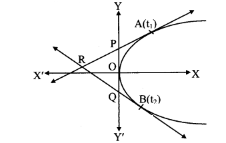
Question 135 Marks
Two tangents to the parabola $y^2=8 x$ meet the tangents at the vertex in the points $P$ and

Q. If PQ = 4, prove that the equation of the locus of the point of intersection of two

tangents is $y^2=8(x+2)$.

Answer
Given equation of the parabola is $y^2=8 x$

Comparing this equation with $y^2=4 a x$, we get

⇒ 4a = 8 ⇒ a = 2

Equation of tangent to given parabola at $A\left(t_1\right)$ is $y$

$t_1=x+2 t_1^2 \ldots \ldots$ (i)

Equation of tangent to given parabola at $B\left(t_2\right)$ is $y$

$t_2=x+2 t_2^2 \ldots$ (ii)

Image

A tangent at the vertex is Y-axis whose equation is x = 0.

x-coordinate of points P and Q is 0.

Let P be(0, k1) and Q be (0, k2).

Then, from (i) and (ii), we get

$\begin{aligned} & \mathrm{k}_1 \mathrm{t}_1=0+2 \mathrm{t}_1{ }^2 \text { and } \mathrm{k}_2 \mathrm{t}_2=0+2 \mathrm{t}_2{ }^2 \\ & \mathrm{k}_1=2 \mathrm{t}_1 \text { and } \mathrm{k}_2=2 t_2 \\ & \mathrm{P} \text { is }\left(0,2 \mathrm{t}_1\right) \text { and } \mathrm{Q} \text { is }\left(0,2 \mathrm{t}_2\right) \\ & \mathrm{PQ}=2\left|\mathrm{t}_1-\mathrm{t}_2\right|\end{aligned}$

But $P Q$ is given to be 4 .

$\begin{aligned} & 2\left|t_1-t_2\right|=4 \\ & \left(t_1-t_2\right)^2=4\end{aligned}$

...(iii)

Let $\mathrm{R}\left(x_1, y_1\right)$ be point of intersection of (i) and (ii).

$\begin{aligned} & y_1 t_1=x_1+2 t_1^2 \\ & \text { and } y_1 t_2=x_1+2 t_2^2\end{aligned}$

$\ldots$ (iv)

Subtracting, we get

$\begin{aligned} & y_1 t_1-y_1 t_2=2 t_1^2-2 t_2^2 \\ & y_1\left(t_1-t_2\right)=2\left(t_1+t_2\right)\left(t_1-t_2\right) \\ & y_1=2\left(t_1+t_2\right) \quad \ldots(v)\left[\because t_1 \neq t_2\right]\end{aligned}$

$\ldots(v)\left[\because t_1 \neq t_2\right]$

$\begin{aligned} & y_1 t_1=2\left(\mathrm{t}_1+\mathrm{t}_2\right) \mathrm{t}_1 \\ & x_1+2 t_1^2=2 t_1^2+2 t_1 t_2 \\ & \text {... From (iv)] } \\ & x_1=2 \mathrm{t}_1 \mathrm{t}_2 \\ & \end{aligned}$

To find the equation of locus of $\mathrm{R}\left(x_1, y_1\right)$,

eliminate $t_1$ and $t_2$ from the equations (iii), (v)

and (vi).

Squaring (v), we get

$\begin{aligned} y_1^2 & =4\left(\mathrm{t}_1+\mathrm{t}_2\right)^2 \\ & =4\left[\left(\mathrm{t}_1-\mathrm{t}_2\right)^2+4 \mathrm{t}_1 \mathrm{t}_2\right] \\ & =4\left[4+2 x_1\right] \quad \ldots[\text { From (iii) and (vi) }] . \\ y_1^2 & =8\left(x_1+2\right)\end{aligned}$

$\therefore$ Equation of locus of $R$ is $y^2=8(x+2)$.

View full question & answer
Solve the Following Question.(5 Marks) - Maths STD 11 Questions - Vidyadip