Questions

Solve the Following Question.(5 Marks)

🎯

Test yourself on this topic

7 questions · timed · auto-graded

Question 15 Marks
Find $a$ and $b$ if the following function is continuous at the point or on the interval indicated against them:
$
\begin{aligned}
f(x) & =a x^2+b x+1, & & \text { for }|2 x-3| \geq 2 \\
& =3 x+2, & & \text { for } \frac{1}{2}\end{aligned}
$
View full question & answer
Question 25 Marks
Find $a$ and $b$ if the following function is continuous at the point or on the interval indicated against them: $\begin{aligned} & =\frac{4 \tan x+5 \sin x}{a^2-1}, & & \text { for } x<0 \\ f(x) & =\frac{9}{\log 2}, & & \text { for } x=0 \\ & =\frac{11 x+7 x-\cos x}{b^2-1}, & & \text { for } x>0 \end{aligned}$
Answer
\begin{aligned}
& f(x) \text { is continuous at } x=0 \\
& \therefore \lim _{x \rightarrow 0} f(x)=f(0) \\
& \therefore \lim _{x \rightarrow 0}\left[\frac{4 \tan x+5 \sin x}{a^x-1}\right]=\frac{9}{\log 2} \\
& \therefore \lim _{x \rightarrow 0}\left[\frac{\frac{4 \tan x+5 \sin x}{x}}{\frac{a^x-1}{x}}\right] \ldots[\because x \rightarrow 0, x \neq 0] \\
& \left.=\frac{9}{\log 2}\right] \frac{\lim _{x \rightarrow 0}\left(\frac{4 \tan x}{x}+\frac{5 \sin x}{x}\right)}{\lim _{x \rightarrow 0} \frac{a^x-1}{x}}=\frac{9}{\log 2} \\
& \therefore \frac{4 \lim _{x \rightarrow 0} \frac{\tan x}{x}+5 \lim _{x \rightarrow 0} \frac{\sin x}{x}}{\lim _{x \rightarrow 0} \frac{a^x-1}{x}}=\frac{9}{\log 2} \\
& \therefore \frac{4(1)+5(1)}{\log a}=\frac{9}{\log 2} \cdots\left[\because \lim _{x \rightarrow 0} \frac{a^x-1}{x}=\log a\right] \\
& \therefore \frac{9}{\log a}=\frac{9}{\log 2} \\
& \therefore \log a=\log 2
\end{aligned}
\begin{aligned}
& \therefore \mathrm{a}=2 \\
& \text { Also } \lim _{x \rightarrow 0^{+}} f(x)=\mathrm{f}(0) \\
& \therefore \lim _{x \rightarrow 0} \frac{11 x+7 x \cdot \cos x}{\mathrm{~b}^x-1}=\frac{9}{\log 2} \\
& \therefore \lim _{x \rightarrow 0} \frac{\frac{11 x+7 x \cos x}{x}}{\frac{\mathrm{b}^x-1}{x}}=\frac{9}{\log 2} \ldots[\because x \rightarrow 0, x \neq 0] \\
& \therefore \frac{\lim _{x \rightarrow 0}(11+7 \cos x)}{\lim _{x \rightarrow 0}\left(\frac{\mathrm{b}^x-1}{x}\right)}=\frac{9}{\log 2} \\
& \therefore \frac{11+7 \cos 0}{\log \mathrm{b}}=\frac{9}{\log 2} \ldots\left[\because \lim _{x \rightarrow 0} \frac{\mathrm{a}^x-1}{x}=\log \mathrm{a}\right] \\
& \therefore \frac{11+7(1)}{\log \mathrm{b}}=\frac{9}{\log 2} \\
& \therefore 9 \log \mathrm{b}=18 \log 2 \\
& \therefore \log \mathrm{b}=2 \log 2 \\
& =\log (2)^2 \\
& \therefore \log \mathrm{b}=\log 4 \\
& \therefore \mathrm{b}=4 \\
& \therefore a=2 and b=4
\end{aligned}
View full question & answer
Question 35 Marks
Find $\mathrm{k}$ if the following function is continuous at the point indicated against them:
$
\left.\begin{array}{rl}
f(x)=\frac{45^x-9^2-5^x+1}{\left(k^2-1\right)\left(3^2-1\right)}, & \text { for } x \neq 0 \\
=\frac{2}{3}, & \text { for } x=0
\end{array}\right\} \text { at } \mathrm{x}=0
$
View full question & answer
Question 45 Marks
Determine the values of p and q such that the following function is continuous on the entire real number line.
f(x) = x + 1, for 1 < x < 3
= x2 + px + q, for |x – 2| ≥ 1.
Answer
|x – 2| ≥ 1
∴ x – 2 ≥ 1 or x – 2 ≤ -1
∴ x ≥ 3 or x ≤ 1
∴ f(x) = x2 + px + q for x ≥ 3 as well as x ≤ 1
Thus, f(x) = x2 + px + q; x ≤ 1
= x + 1; 1 < x < 3 = x2 + px + q; x > 3
f(x) is continuous for all x ∈ R.
∴ f(x) is continuous at x = 1 and x = 3.
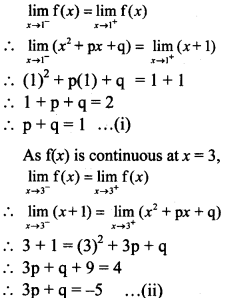
As f(x) is continuous at x = 1,
Image
Subtracting (i) from (ii), we get
2p = -6
∴ p = -3
Substituting p = -3 in (i), we get
-3 + q = 1
∴ q = 4
∴ p = -3 and q = 4
View full question & answer
Question 55 Marks
Discuss the continuity of $f(x)$ at $x=\frac{\pi}{4}$ where,
$f(x)=\frac{(\sin x+\cos x)^3-2 \sqrt{2}}{\sin 2 x-1}$, for $x \neq \frac{\pi}{4}$
$=\frac{3}{\sqrt{2}}$, for $x=\frac{\pi}{4}$
Answer
$
\begin{aligned}
& f\left(\frac{\pi}{4}\right)=\frac{3}{\sqrt{2}} \\
& \lim _{x \rightarrow \frac{\pi}{4}} f(x)=\lim _{x \rightarrow \frac{\pi}{4}} \frac{(\sin x+\cos x)^3-2 \sqrt{2}}{\sin 2 x-1} \\
& (\sin x+\cos x)^3=\left[(\sin x+\cos x)^2\right]^{\frac{3}{2}} \\
& =(1+\sin 2 x)^{\frac{3}{2}}
\end{aligned}
$
$
\therefore \quad \lim _{x \rightarrow \frac{\pi}{4}} f(x)=\lim _{x \rightarrow \frac{\pi}{4}} \frac{(1+\sin 2 x)^{\frac{3}{2}}-2^{\frac{3}{2}}}{\sin 2 x-1}
$
Put $1+\sin 2 x=t$
$
\therefore \quad \sin 2 x=\mathrm{t}-1
$
As $x \rightarrow \frac{\pi}{4}, t \rightarrow 1+\sin 2\left(\frac{\pi}{4}\right)$
$
\begin{aligned}
& \text { i.e., } t \rightarrow 1+\sin \frac{\pi}{2} \\
& \text { i.e., } t \rightarrow 1+1 \\
& \text { i.e., } t \rightarrow 2
\end{aligned}
$
$
\therefore \quad \lim _{x \rightarrow \frac{\pi}{4}} f(x)=\lim _{t \rightarrow 2} \frac{t^{\frac{3}{2}}-2^{\frac{3}{2}}}{t-1-1}
$
$
\begin{aligned}
& =\lim _{t \rightarrow 2} \frac{t^{\frac{3}{2}}-2^{\frac{3}{2}}}{\mathrm{t}-2} \\
& =\frac{3}{2}(2)^{\frac{1}{2}} \quad \cdots\left[\because \lim _{x \rightarrow 2} \frac{x^n-\mathrm{a}^n}{x-\mathrm{a}}=\mathrm{na}^{\mathrm{n}-1}\right] \\
& =\frac{3 \sqrt{2}}{2}=\frac{3}{\sqrt{2}} \\
\therefore \quad \lim _{x \rightarrow \frac{\pi}{4}} \mathrm{f}(x) & =\mathrm{f}\left(\frac{\pi}{4}\right)
\end{aligned}
$
$\therefore \quad \lim _{x \rightarrow \frac{\pi}{4}} \mathrm{f}(x)=\mathrm{f}\left(\frac{\pi}{4}\right)$
$\therefore \quad \mathrm{f}(x)$ is continuous at $x=\frac{\pi}{4}$.
View full question & answer
Question 65 Marks
Which of the following functions has a removable discontinuity?
$f(x)=\log _{(1+3 x)}(1+5 x)$ for $x>0$ $=\frac{32^x-1}{8^x-1} \quad, \quad$ for $x<0$, at $x=0$.
Answer
$f(x) =\log _{(1+3 x)}(1+5 x) , x>0$
$ =\frac{32^x-1}{8^x-1} , x<0$
Here, $\mathrm{f}(0)$ is not defined.
$\lim _{x \rightarrow 0^{+}} f(x)=\lim _{x \rightarrow 0^{+}} \log _{(1+3 x)}(1+5 x)$
$ =\lim _{x \rightarrow 0^{+}} \frac{\log (1+5 x)}{\log (1+3 x)}$
$ =\lim _{x \rightarrow 0^{+}}\left[\frac{\frac{\log (1+5 x)}{x}}{\frac{\log (1+3 x)}{x}}\right]...[ \because x \rightarrow 0, x \neq 0]$
$=\frac{\lim _{x \rightarrow 0^{+}} \frac{\log (1+5 x)}{5 x} \times 5}{\lim _{x \rightarrow 0^{+}} \frac{\log (1+3 x)}{3 x} \times 3}$
$=\frac{1 \times 5}{1 \times 3} \quad \cdots\left[\begin{array}{l}
\because x \rightarrow 0,3 x \rightarrow 0,5 x \rightarrow 0 \\
\text { and } \lim _{x \rightarrow 0} \frac{\log (1+x)}{x}=1
\end{array}\right]$
$=\frac{5}{3} \lim _{x \rightarrow 0^{-}} f(x)=\lim _{x \rightarrow 0^{-}} \frac{32^x-1}{8^x-1}$
$ =\lim _{x \rightarrow 0^{-}}\left[\frac{\frac{32^x-1}{x}}{\frac{8^x-1}{x}}\right] \ldots[\because x \rightarrow 0, x \neq 0]$
$=\frac{\lim _{x \rightarrow 0^{-}} \frac{32^x-1}{x}}{\lim _{x \rightarrow 0^{-}} \frac{8^x-1}{x}}$
$ =\frac{\log 32}{\log 8} \cdots\left[\because \lim _{x \rightarrow 0} \frac{\mathrm{a}^x-1}{x}=\log a\right]$
$ =\frac{\log (2)^5}{\log (2)^3}$
$ =\frac{5 \log 2}{3 \log 2}$
$ =\frac{5}{3}$
$\therefore \lim _{x \rightarrow 0^{+}} f(x)=\lim _{x \rightarrow 0^{-}} f(x)$
$\therefore \lim _{x \rightarrow 0} f(x) \text { exists. }$
But $\mathrm{f}(0)$ is not defined.
$\therefore \mathrm{f}(x)$ has a removable discontinuity at $x=0$. This discontinuity can be removed by defining $f(0)=\frac{5}{3}$.
$\therefore \mathrm{f}(x)$ can be redefined as
$f(x) =\log _{(1+3 x)}(1+5 x) ; x>0$
$ =\frac{5}{3} ; x=0$
$ =\frac{32^x-1}{8^x-1} ; x<0$
View full question & answer
Question 75 Marks
Which of the following functions has a removable discontinuity?
$f(x)=\frac{e^{5 \sin x}-e^{2 x}}{5 \tan x-3 x}$, for $x \neq 0$ $=3 / 4$, for $x=0$, at $x=0$.
Answer
$f(0)=\frac{3}{4}$
$\lim _{x \rightarrow 0} f(x)=\lim _{x \rightarrow 0} \frac{e^{5 \sin x}-e^{2 x}}{5 \tan x-3 x}$
$=\lim _{x \rightarrow 0} \frac{\left(e^{\sin x}-1\right)-\left(e^{2 x}-1\right)}{5 \tan x-3 x}$
$=\lim _{x \rightarrow 0}\left[\frac{\frac{\left( e ^{\sin x}-1\right)-\left( e ^{2 x}-1\right)}{x}}{\frac{5 \tan x-3 x}{x} \text { }}\right]$
$=\frac{\lim _{x \rightarrow 0}\left(\frac{ e ^{\sin x}-1}{x}-\frac{ e ^{2 x}-1}{x}\right)}{\lim _{x \rightarrow 0}\left(\frac{5 \tan x}{x}-3\right)}$
$=\frac{\lim _{x \rightarrow 0}\left(\frac{ e ^{\sin x}-1}{5 \sin x} \times \frac{5 \sin x}{x}\right)-\lim _{x \rightarrow 0}\left(\frac{ e ^{2 x}-1}{2 x} \times 2\right)}{5 \tan x}$
$\lim _{x \rightarrow 0} \frac{5 \tan x}{x}-\lim _{x \rightarrow 0} 3$
$=\frac{5 \lim _{x \rightarrow 0}\left(\frac{ e ^{5 \sin x}-1}{5 \sin x}\right) \cdot \lim _{x \rightarrow 0}\left(\frac{\sin x}{x}\right)-2 \lim _{x \rightarrow 0} \frac{ e ^{2 x}-1}{2 x}}{5 \lim _{x \rightarrow 0} \frac{\tan x}{x}-\lim _{x \rightarrow 0}(3)}$
$=\frac{5(1)(1)-2(1)}{5(1)-3} \\
\cdots\left[\begin{array}{l}
\because x \rightarrow 0,2 x \rightarrow 0, \sin x \rightarrow 0,5 \sin x \rightarrow 0 \\
\text { and } \lim _{x \rightarrow 0}\left(\frac{ e ^x-1}{x}\right)=1
\end{array}\right]$
$=\frac{3}{2} \quad$
$\therefore \quad \lim _{x \rightarrow 0} f (x) \neq f (0)...($ given$)$
$\therefore f (x)$ is discontinuous at $x=0$.
$\therefore f (x)$ has a removable discontinuity at $x=0$. This discontinuity can be removed by redefining $f(0)=\frac{3}{2}$.
$\therefore f (x)$ can be redefined as
$f(x) =\frac{ e ^{5 \sin x}- e ^{2 x}}{5 \tan x-3 x}, x \neq 0$
$ =\frac{3}{2}, x=0$
View full question & answer
Solve the Following Question.(5 Marks) - Maths STD 11 Questions - Vidyadip