MCQ 11 Mark
The domain and range of $f(x)=2-|x-5|$ are
- A
$R+,(-\infty, 1]$
- ✓
$R,(-\infty, 2]$
- C
$R,(-\infty, 2)$
- D
$R+,(-\infty, 2]$
AnswerCorrect option: B. $R,(-\infty, 2]$
(B) $R_t(-\infty, 2]$
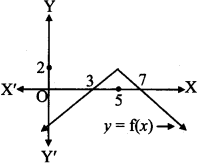
Hint:
$f(x)=2-|x-5| $
$=2-(5-x), x<5$
$=2-(x-5), x \geq 5 $
$\therefore f(x)=x-3, x<5 $
$=7-x, x \geq 5$
Domain $=R$,
Range (from graph) $=(-\infty, 2]$ View full question & answer→MCQ 21 Mark
The domain of $\frac{1}{|x|-x}$, where $[\mathrm{x}]$ is greatest integer function is
- A
$\mathrm{R}$
- B
$\mathrm{Z}$
- ✓
$R-Z$
- D
$Q-\{0\}$
Answer(C) $R-Z$
Hint:
$
f(x)=\frac{1}{[x]-x}=\frac{1}{-\{x\}}
$
For $f$ to be defined, $\{x\} \neq 0$
$\therefore \mathrm{x}$ cannot be integer.
$\therefore$ Domain $=\mathrm{R}-\mathrm{Z}$
View full question & answer→MCQ 31 Mark
If $f(x)=2 x^2+b x+c$ and $f(0)=3$ and $f(2)=1$, then $f(1)$ is equal to
Answer(B) $0$
Hint:
$f(x)=2 x^2+b x+c $
$f(0)=3 $
$\therefore 2(0)+b(0)+c=3 $
$\therefore c=3 \ldots \ldots .(i) $
$\therefore f(2)=1$
$\therefore 2(4)+2 b+c=1 $
$\therefore 2 b+c=-7$
$\therefore 2 b+3=-7 \ldots . .[\text { From (i)] }$
$\therefore b=-5 $
$\therefore f(x)=2 x^2-5 x+3 $
$\therefore f(1)=2(1)^2-5(1)+3=0$
View full question & answer→MCQ 41 Mark
Let the function $f$ be defined by $f(x)=\frac{2 x+1}{1-3 x}$ then $f^{-1}(x)$ is:
- ✓
$\frac{x-1}{3 x+2}$
- B
$\frac{x+1}{3 x-2}$
- C
$\frac{2 x+1}{1-3 x}$
- D
$\frac{3 x+2}{x-1}$
AnswerCorrect option: A. $\frac{x-1}{3 x+2}$
(A)
$\frac{x-1}{3 x+2}$
Hint:
$f(x)=\frac{2 x+1}{1-3 x}=y$, say. then
$2 \mathrm{x}+1=\mathrm{y}(1-3 \mathrm{x})$
$\therefore \mathrm{y}-1=\mathrm{x}(2+3 \mathrm{y}) $
$\therefore \mathrm{x}=\frac{y-1}{2+3 y}=\mathrm{f}^{-1}(\mathrm{y})$
$\therefore \mathrm{f}^{-1}(\mathrm{x})=\frac{x-1}{2+3 x}$
View full question & answer→MCQ 51 Mark
If $f: R \rightarrow R$ is defined by $f(x)=x^3$, then $f^{-1}(8)$ is equal to:
- ✓
$\{2\}$
- B
$\{-2.2\}$
- C
$\{-2\}$
- D
$(-2.2)$
AnswerCorrect option: A. $\{2\}$
(A) $\{2\}$
Hint:
$
\begin{array}{ll}
& \mathrm{f}(x)=x^3=y, \text { say } \\
\therefore & x=y^{\frac{1}{3}}=\mathrm{f}^{-1}(y) \\
\therefore \quad & \mathrm{f}^{-1}(8)=(8)^{\frac{1}{3}}=\left(2^3\right)^{\frac{1}{3}} \\
\therefore & \mathrm{f}^{-1}(8)=2
\end{array}
$
View full question & answer→MCQ 61 Mark
If $f(x)=\frac{1}{1-x}$, then $f(f(f(x)))$ is
Answer(C) $\mathrm{x}$
Hint:
$f(x)=\frac{1}{1-x}$
$f(f(x))=f\left(\frac{1}{1-x}\right)=\frac{1}{1-\left(\frac{1}{1-x}\right)}$
$=\frac{1-x}{1-x-1}=\frac{x-1}{x}$
$f(f(f(x)))=f\left(\frac{x-1}{x}\right)=\frac{1}{1-\left(\frac{x-1}{x}\right)}=\frac{x}{x-x+1}=x $
View full question & answer→MCQ 71 Mark
Find $x$, if $2 \log _2 x=4$
Answer(B) $4$
Hint:
$2 \log _2 x=4, x>0$
$\therefore \log _2\left(x^2\right)=4$
$\therefore x^2=16$
$\therefore x= \pm 4$
$\therefore x=4$
View full question & answer→MCQ 81 Mark
If $\log _{10}\left(\log _{10}\left(\log _{10} x\right)\right)=0$, then $x=$
- A
$1000$
- ✓
$10^{10}$
- C
$10$
- D
$0$
AnswerCorrect option: B. $10^{10}$
(B) $10^{10}$
Hint:
$\log _{10} \log _{10} \log _{10} x=0 $
$\therefore \log _{10}\left(\log _{10}(x)\right)=10^0=1$
$\therefore \log _{10} x=10^1=10$
$\therefore x=10^{10}$
View full question & answer→MCQ 91 Mark
If $\log (5 x-9)-\log (x+3)=\log 2$, then $x=$
Answer(B) $5$
Hint:
$\log (5 x-9)-\log (x+3)=\log 2 $
$\therefore \frac{5 x-9}{x+3}=2 $
$\therefore 3 x=9+6 $
$\therefore x=5$
View full question & answer→MCQ 102 Marks
If $f(x)=\frac{2 x-3}{3 x-4}, x \neq \frac{4}{3}$, then the value of $f^{-1}(x)$ is
- ✓
$\frac{4 x-3}{3 x-2}$
- B
$\frac{3 x-2}{4 x+3}$
- C
$\frac{3 x-4}{4 x-2}$
- D
$\frac{2 x+3}{4 x-3}$
AnswerCorrect option: A. $\frac{4 x-3}{3 x-2}$
(a) $\frac{4 x-3}{3 x-2}$
View full question & answer→MCQ 112 Marks
The money invested in a company is compounded continuously. If ₹ 200 invested today becomes $₹ 400$ in 6 years, then at the end of 33 years it will become ₹
- A
$1600 \sqrt{2}$
- B
$3200 \sqrt{2}$
- C
$12800 \sqrt{2}$
- ✓
$6400 \sqrt{2}$
AnswerCorrect option: D. $6400 \sqrt{2}$
(d) : We know that, $A=P\left(1+\frac{R}{100}\right)^n$
Here, $400=200\left(1+\frac{R}{100}\right)^6$ ...(i)
$
\Rightarrow 2=\left(1+\frac{R}{100}\right)^6 \Rightarrow\left(1+\frac{R}{100}\right)=2^{1 / 6}
$
$\therefore$ At the end of 33 years, $A=200\left(1+\frac{R}{100}\right)^{33}$
$
\begin{aligned}
& =200\left(2^{1 / 6}\right)^{33}=20-2^{11 / 2} \quad \text { [Using (i)] } \\
& =200 \times\left(2^{11}\right)^{1 / 2}=200\left(2^{10+1}\right)^{1 / 2}=2002^5 \cdot 2^{1 / 2}=6400 \sqrt{2}
\end{aligned}
$
View full question & answer→MCQ 122 Marks
The equation $x^3+x-1=0$ has
- A
- B
- ✓
- D
more than two real roots.
Answer(c) : $f(x)=x^3+x-1$ Now, $f(0)=0+0-1=-1<0$ and $f(1)=1+1-1=1>0$ So, $f(x)$ has a root in between 0 and 1 and $f^{\prime}(x)>0 \in R \forall$ $x>1 \therefore f(x)$ has exactly one real root.
View full question & answer→MCQ 132 Marks
The domain and range for the function $f(x)=e^{d x \sin x}$ are
- ✓
domain $=R$, range $(0, \infty)$
- B
domain $=R$, range $=R$
- C
domain $=R$, range $=[0, \infty)$
- D
domain $=R$, range $=[1, \infty$ )
AnswerCorrect option: A. domain $=R$, range $(0, \infty)$
(a) : $f(x)=e^{|x| \sin x}$
We know that domain of $|x|$ is from $(-\infty, \infty)$ and domain of $\sin x$ is also from $(-\infty, \infty)$
So, domain of $f(x)=e^{|x| \sin x}$ is from $(-\infty, \infty)$
We know that range of expononential function is from $(0, \infty)$. So, range of function $f(x)=e^{x \mid \sin x}$ is from $(0, \infty)$.
View full question & answer→MCQ 142 Marks
If $R$ denotes the set of all real numbers then the function $f: R \rightarrow R$ defined by $f(x)=|x|$ is
- A
- B
- ✓
neither injective nor surjective
- D
AnswerCorrect option: C. neither injective nor surjective
(c) : $f: R \rightarrow R, f(x)=|x|$
Now $_1 f(1)=|1|=1$ and $f(-1)=|-1|=1 \Rightarrow f(1)=f(-1)$, but $1 \neq-1$ $\therefore f$ is not one-one.
Also, $-1 \in R$, but $f(x)=|x|$ is non-negative.
$\Rightarrow f$ is not onto. $\Rightarrow f$ is neither injective nor surjective.
View full question & answer→MCQ 152 Marks
If $f(x)=3 x-2$ and $g(x)=x^2$, then $fog(x)=$
- ✓
$3 x^2-2$
- B
$3 x^2+2$
- C
$3 x-2$
- D
$2-3 x^2$
AnswerCorrect option: A. $3 x^2-2$
(a) : $f(x)=3 x-2, g(x)=x^2$
$fo g(x)=f(g(x))=3(g(x))-2=3 x^2-2$
View full question & answer→MCQ 162 Marks
If $f: R-\{2\} \rightarrow R$ is a function defined by $f(x)=\frac{x^2-4}{x-2}$, then its range is
- A
$R$
- B
$R-\{2\}$
- ✓
$R=\{4\}$
- D
$R=\{-2,2\}$
AnswerCorrect option: C. $R=\{4\}$
(c): We have, $y=f(x)=\frac{x^2-4}{x-2}, x \neq 2$ $=\frac{(x-2)(x+2)}{x-2}=x+2, x \neq 2$.
It follows from the above relation that $y$ take all real values except when $x$ takes values in the set $R-\{2\}$
$\therefore \quad$ Range $(f)=R-\{4\}$
View full question & answer→MCQ 172 Marks
$A=\{1,2,3,4\}, B=\{1,2,3,4,5,6\}$ are two sets and function $f : A \rightarrow B$ is defined by $f (x)=x+2 ; \forall x \in A$, then the function f is
Answer(C)
$f (x)= f (y)$
$\Rightarrow x+2=y+2 \Rightarrow x=y$
∴ Function f is one-one
View full question & answer→MCQ 182 Marks
If $f: A \rightarrow B$ is a bijection and $g: B \rightarrow A$ is the inverse of $f$, then fog is equal to
AnswerCorrect option: B. $I _{ B }$
View full question & answer→MCQ 192 Marks
If $f : R \rightarrow R$ be defined by $f (x)= e ^x$ and $g : R \rightarrow R$ be defined by $g (x)=x^2$. The mapping gof : $R \rightarrow R$ be defined by
$( gof )(x)= g [ f (x)] \forall x \in R$. Then
- A
gof is bijective but f is not injective
- B
gof is injective but g is not injective
- ✓
gof is injective but g is not bijective
- D
gof is surjective and g is not surjective
AnswerCorrect option: C. gof is injective but g is not bijective
(C)
$g (x)$ is neither injective nor surjective
$(\operatorname{gof})(x)=\left( e ^{ x }\right)^2= e ^{2 x}$
This is an injective function.
View full question & answer→MCQ 202 Marks
Let $S , T , U$ be three non-void sets and $f : S \rightarrow T$, $g : T \rightarrow U$ be so that g of $: S \rightarrow U$ is surjective. Then
- A
g and f are both surjective
- ✓
g is surjective,f may not be so
- C
f is surjective,g may not be so
- D
f and g both may not be surjective
AnswerCorrect option: B. g is surjective,f may not be so
View full question & answer→MCQ 212 Marks
Let $f, g: R \rightarrow R$ be two functions defined as $f (x)=|x|+x$ and $g (x)=|x|-x \forall x \in R$. Then $(fog)(x)$ for $x<0$ is
AnswerCorrect option: C. $-4 x$
(C)
$|x|=-x$, $\quad$if $x<0$
$=x$, $\quad$if $x \geq 0$
Now, $(fog)(x)= f [ g (x)]$
$=|g(x)|+g(x)$
$=| | x|-x|+|x|-x$
When, $x<0$
$(fog)(x)=|-x-x|+(-x)-x$
$=-2 x-2 x$
$=-4 x$
View full question & answer→MCQ 222 Marks
Let $f (x)=x^2$ and $g (x)=\sin x$ for all $x \in R$. Then the set of all $x$ satisfying
(fogogof) $(x)=($ gogof $)(x)$, where
$( fog )(x)= f ( g (x))$ is
- ✓
$\pm \sqrt{n \pi}, n \in\{0,1,2, \ldots\}$
- B
$\pm \sqrt{n \pi}, n \in\{1,2, \ldots\}$
- C
$\frac{\pi}{2}+2 n \pi, n \in\{\ldots,-2,-1,0,1,2, \ldots\}$
- D
$2 n \pi, n \in\{\ldots,-2,-1,0,1,2, \ldots\}$
AnswerCorrect option: A. $\pm \sqrt{n \pi}, n \in\{0,1,2, \ldots\}$
(A)
$($gof$)(x)=\sin x^2 \Rightarrow\left(\right.$ gogof $(x)=\sin \left(\sin x^2\right)$
$\Rightarrow($ fogogof $)(x)=\left(\sin \left(\sin x^2\right)\right)^2=\sin ^2\left(\sin x^2\right)$
Now, $\sin ^2\left(\sin x^2\right)=\sin \left(\sin x^2\right)$
$\Rightarrow \sin \left(\sin x^2\right)=0,1$
$\Rightarrow \sin x^2= n \pi,(4 n +1) \frac{\pi}{2} n \in I$
$\Rightarrow \sin x^2=0 \Rightarrow x^2= n \pi$
$\Rightarrow x= \pm \sqrt{ n \pi} n \in W$
View full question & answer→MCQ 232 Marks
Two functions $f: R \rightarrow R$ and $g: R \rightarrow R$ are defined as follows:
$f(x)=\left\{\begin{array}{l}0 ;(x \text { rational }) \\ 1 ;(x \text { irrational })\end{array}\right.$
$g(x)=\left\{\begin{array}{l}-1 ;(x \text { rational }) \\ 0 ;(x \text { irrational }),\end{array}\right.$
then $(gof)(e)+(fog)(\pi)=$
Answer(A)
$( gof )( e )+( fog )(\pi)= g ( f ( e ))+ f ( g (\pi))$
$=g(1)+f(0)$
$=-1+0=-1$
View full question & answer→MCQ 242 Marks
Let $g(x)=1+x-[x]$ and
$f(x)=\left\{\begin{array}{l}-1, x<0 \\ 0, x=0, \\ 1, x>0\end{array}\right.$ then for all $x, f(g(x))$ is equal to
Answer(B)
As $x-[x] \in[0,1), \forall x \in R$
$\therefore \quad 0 \leq x-[x]<1, \forall x \in R$
$\Rightarrow 1 \leq 1+x-[x]<2, \forall x \in R$
$\Rightarrow l \leq g (x)<2, \forall x \in R$
Hence, $f ( g (x))=1 \forall x \in R$
View full question & answer→MCQ 252 Marks
If $f(x)=\sin ^2 x+\sin ^2\left(x+\frac{\pi}{3}\right)+\cos x \cos \left(x+\frac{\pi}{3}\right)$ and $g\left(\frac{5}{4}\right)=1$, then $(gof)(x)$ is equal to:
- A
$\frac{1}{2}$
- B
$0$
- C
$\sin x$
- ✓
Answer(D)
$f(x)=\sin ^2 x+\sin ^2\left(x+\frac{\pi}{3}\right)+\cos x \cos \left(x+\frac{\pi}{3}\right)$
$=\sin ^2 x+\left[\sin \left(x+\frac{\pi}{3}\right)\right]^2$ $+\cos x\left[\cos x \cos \frac{\pi}{3}-\sin x \sin \frac{\pi}{3}\right]$
$=\sin ^2 x+\left[\sin x \cos \frac{\pi}{3}+\cos x \sin \frac{\pi}{3}\right]^2$ $+\cos x\left[\frac{1}{2} \cos x-\frac{\sqrt{3}}{2} \sin x\right]$
$=\sin ^2 x+\left[\frac{\sin x}{2}+\frac{\sqrt{3}}{2} \cos x\right]^2$ $+\frac{\cos ^2 x}{2}-\frac{\sqrt{3}}{2} \sin x \cos x$
$=\sin ^2 x+\frac{\sin ^2 x}{4}+\frac{3}{4} \cos ^2 x+\frac{\cos ^2 x}{2}$ $+\frac{\sqrt{3}}{2} \sin x \cos x-\frac{\sqrt{3}}{2} \sin x \cos x$
$=\frac{5}{4}\left(\sin ^2 x+\cos ^2 x\right)$
$=\frac{5}{4}$
$( gof )(x)= g [ f (x)]= g \left(\frac{5}{4}\right)=1$
View full question & answer→MCQ 262 Marks
If $f(x)=2 x+1$ and $g(x)=\frac{x-1}{2}$ for all real $x$, then $(fog)^{-1}\left(\frac{1}{x}\right)$ is equal to
- A
$x$
- ✓
$\frac{1}{x}$
- C
$-x$
- D
$-\frac{1}{x}$
AnswerCorrect option: B. $\frac{1}{x}$
(B)
(fog) $(x)= f ( g (x))$
$= f \left(\frac{x-1}{2}\right)$
$=2\left(\frac{x-1}{2}\right)+1=x$
$\Rightarrow( fog )(x)=x$
$\Rightarrow x=( fog )^{-1}(x)$
Hence, $(f o g)^{-1}\left(\frac{1}{x}\right)=\frac{1}{x}$
View full question & answer→MCQ 272 Marks
If $f(x)=a x+b$ and $g(x)=c x+d$, then $f(g(x))=g(f(x))$ is equivalent to
- A
$f(c)=g(a)$
- ✓
$f(d)=g(b)$
- C
$f(a)=g(c)$
- D
$f(b)=g(b)$
AnswerCorrect option: B. $f(d)=g(b)$
(B)
Given, $f (x)= ax + b , g (x)= cx + d$
and $f ( g (x))= g ( f (x))$
$\Rightarrow f ( c x+ d )= g ( a x+ b )$
$\Rightarrow a ( c x+ d )+ b = c ( a x+ b )+ d$
$\Rightarrow ad + b = cb + d$
$\Rightarrow f ( d )= g ( b )$
View full question & answer→MCQ 282 Marks
If $f (x)=\frac{\alpha x}{x+1}, x \neq-1$, then for what value of $\alpha$ is $f ( f (x))=x$
- A
$\sqrt{2}$
- B
$-\sqrt{2}$
- C
- ✓
Answer(D)
$f (x)=\frac{\alpha x}{x+1}$;
$f ( f (x))= f \left(\frac{\alpha x}{x+1}\right)=\frac{\alpha\left(\frac{\alpha x}{x+1}\right)}{\frac{\alpha x}{x+1}+1}$
But $f ( f (x))=x$
$\therefore \quad \frac{\alpha^2 x}{\alpha x+x+1}=x$
In L.H.S., Put $\alpha=-1$,
$\therefore \quad \frac{(-1)^2 x}{(-1) x+x+1}=\frac{x}{-x+x+1}=x ;$
$\therefore \quad \alpha=-1$
View full question & answer→MCQ 292 Marks
If $f(x)=\left(25-x^4\right)^{1 / 4}$ for $0 < x<\sqrt{5}$, then $f\left(f\left(\frac{1}{2}\right)\right)=$
- A
$2^{-4}$
- B
$2^{-3}$
- C
$2^{-2}$
- ✓
$2^{-1}$
AnswerCorrect option: D. $2^{-1}$
(D)
Here, $f \left(\frac{1}{2}\right)=\left(25-\frac{1}{16}\right)^{\frac{1}{4}}=\left(\frac{399}{16}\right)^{\frac{1}{4}}$
$\Rightarrow f \left[ f \left(\frac{1}{2}\right)\right]= f \left(\left(\frac{399}{16}\right)^{\frac{1}{4}}\right)$
$=\left(25-\frac{399}{16}\right)^{\frac{1}{4}}$
$=\left(\frac{1}{16}\right)^{\frac{1}{4}}$
$=\frac{1}{2}$
View full question & answer→MCQ 302 Marks
If $f (x)=\frac{1-x}{1+x}$, then $f [ f (\cos 2 \theta)]=$
- A
$\tan 2 \theta$
- B
$\sec 2 \theta$
- ✓
$\cos 2 \theta$
- D
$\cot 2 \theta$
AnswerCorrect option: C. $\cos 2 \theta$
(C)
$f [ f (\cos 2 \theta)]= f \left[\frac{1-\cos 2 \theta}{1+\cos 2 \theta}\right]$
$=f\left(\tan ^2 \theta\right)$
$=\frac{1-\tan ^2 \theta}{1+\tan ^2 \theta}$
$=\cos 2 \theta$
View full question & answer→MCQ 312 Marks
If $x \neq 1$ and $f (x)=\frac{x+1}{x-1}$ is a real function, then $f(f(f(2)))$ is
Answer(C)
Here, $f(2)=\frac{2+1}{2-1}=3$
$\therefore \quad f(f(2))=f(3)=\frac{3+1}{3-1}=\frac{4}{2}=2$
$\therefore \quad f(f(f(2)))=f(2)=\frac{2+1}{2-1}=3$
View full question & answer→MCQ 322 Marks
If $g(x)=x^2+x-2$ and $\frac{1}{2}(gof)(x)=2 x^2-5 x+2$ then $f (x)$ is equal to
- A
$2 x+3$
- ✓
$2 x-3$
- C
$2 x^2+3 x+1$
- D
$2 x^2-3 x-1$
AnswerCorrect option: B. $2 x-3$
(B)
Given, $g (x)=x^2+x-2$
and $\frac{1}{2}(\operatorname{gof})(x)=2 x^2-5 x+2$
$\Rightarrow g ( f (x))=4 x^2-10 x+4$
$\Rightarrow( f (x))^2+ f (x)-2=4 x^2-10 x+4$
$\Rightarrow( f (x))^2+ f (x)-\left(4 x^2-10 x+6\right)=0$
$\Rightarrow f (x)=\frac{-1 \pm \sqrt{1+16 x^2-40 x+24}}{2}$
$=\frac{-1 \pm(4 x-5)}{2}$
$=2 x-3,-2 x+2$
View full question & answer→MCQ 332 Marks
If $f(x)=\sin ^2 x+\sin ^2\left(x+\frac{\pi}{3}\right)+\cos \left(x+\frac{\pi}{3}\right) \cos x$ and $g\left(\frac{5}{4}\right)=1$, then $gof(x)$ is
Answer(B)
Given,
$f(x)=\sin ^2 x+\sin ^2\left(x+\frac{\pi}{3}\right)+\cos \left(x+\frac{\pi}{3}\right) \cos x$
$\begin{array}{l}=\frac{1}{2}\left\{1-\cos 2 x+1-\cos \left(2 x+\frac{2 \pi}{3}\right)\right. \left.+\cos \left(2 x+\frac{2 \pi}{3}\right)+\cos \frac{\pi}{3}\right\}\end{array}$
$=\frac{1}{2}\left[\frac{5}{2}-\left\{\cos 2 x+\cos \left(2 x+\frac{2 \pi}{3}\right)\right\}+\cos \left(2 x+\frac{\pi}{3}\right)\right]$
$=\frac{1}{2}\left[\frac{5}{2}-2 \cos \left(2 x+\frac{\pi}{3}\right) \cos \frac{\pi}{3}+\cos \left(2 x+\frac{\pi}{3}\right)\right]$
$=\frac{5}{4}$
$\therefore \operatorname{gof}(x)=g[f(x)]=g\left(\frac{5}{4}\right)$
$=1 \quad \ldots\left[\because g\left(\frac{5}{4}\right)=1\right]$
Hence, $\operatorname{gof}(x)$ is a constant function.
View full question & answer→MCQ 342 Marks
If $f$ be the greatest integer function and $g$ be the modulus function, then (gof) $\left(-\frac{5}{3}\right)-( fog )\left(-\frac{5}{3}\right)$=
Answer(A)
Given, (gof) $\left(-\frac{5}{3}\right)-( fog )\left(-\frac{5}{3}\right)$
$=g\left\{f\left(\frac{-5}{3}\right)\right\}-f\left\{g\left(\frac{-5}{3}\right)\right\}$
$=g(-2)-f\left(\frac{5}{3}\right)=2-1=1$
View full question & answer→MCQ 352 Marks
If the functions $f, g, h$ are defined from the sets of real numbers $R$ to $R$ such that
$f(x)=x^2-1, g(x)=\sqrt{x^2+1}, h(x)=\left\{\begin{array}{l}0, \text { if }{ }_{x=0} \\x, \text { if }{ }_{x>0} ,\end{array}\right.$
then the composite function $(hofog)(x)=$
- A
$\left\{\begin{array}{ll}0, & x=0 \\ x^2, & x>0 \\ -x^2, & x<0\end{array}\right.$
- ✓
$\left\{\begin{array}{l}0, x=0 \\ x^2, x \neq 0\end{array}\right.$
- C
$\left\{\begin{array}{l}0, x \leq 0 \\ x^2, x>0\end{array}\right.$
- D
AnswerCorrect option: B. $\left\{\begin{array}{l}0, x=0 \\ x^2, x \neq 0\end{array}\right.$
(B)
$(\operatorname{hofog})(x)=(\operatorname{hof})( g (x))$
$=(\operatorname{hof})\left(\sqrt{x^2+1}\right)$
$= h \left( f \left(\sqrt{x^2+1}\right)\right)$
$= h \left[\left(\sqrt{x^2+1}\right)^2-1\right]$
$= h \left(x^2+1-1\right)$
$= h \left(x^2\right)=\left\{\begin{array}{l}0, \text { if } x=0 \\ x^2, \text { if } x \neq 0\end{array}\right.$
View full question & answer→MCQ 362 Marks
$f: R \rightarrow R$ and $g:[0, \infty) \rightarrow R$ is defined by $f ( x )=x^2$ and $g (x)=\sqrt{x}$. Which one of the following is not true?
AnswerCorrect option: A. $fog(-4)=4$
(A)
Consider, fog $(-4)= f [ g (-4)]$
But $g(-4)$ is not defined.
$\therefore \quad$ fog $(-4)=4$ is not true
View full question & answer→MCQ 372 Marks
The inverse of the function $y=\frac{10^x-10^{-x}}{10^x+10^{-x}}$ is
- A
$\log _{10}(2-x)$
- ✓
$\frac{1}{2} \log _{10} \frac{1+x}{1-x}$
- C
$\frac{1}{2} \log _{10}(2 x-1)$
- D
$\frac{1}{4} \log _{10} \frac{2 x}{2-x}$
AnswerCorrect option: B. $\frac{1}{2} \log _{10} \frac{1+x}{1-x}$
(B)
Let $y= f (x)=\frac{10^x-10^{-x}}{10^x+10^{-x}}$
$\therefore \quad y=\frac{10^{2 x}-1}{10^{2 x}+1}$
$\Rightarrow 10^{2 x}=\frac{1+y}{1-y}$
$\Rightarrow 2 x=\log _{10} \frac{1+y}{1-y}$
$\Rightarrow x=\frac{1}{2} \log _{10} \frac{1+y}{1-y}$
$\Rightarrow f ^{-1}(y)=\frac{1}{2} \log _{10} \frac{1+y}{1-y}$
$\Rightarrow f ^{-1}(x)=\frac{1}{2} \log _{10} \frac{1+x}{1-x}$
View full question & answer→MCQ 382 Marks
If $f (x)=\frac{2 x-1}{x+5}(x \neq 5)$, then $f ^{-1}(x)$ is equal to
- A
$\frac{x+5}{2 x-1}, x \neq \frac{1}{2}$
- ✓
$\frac{5 x+1}{2-x}, x \neq 2$
- C
$\frac{5 x-1}{2-x}, x \neq 2$
- D
$\frac{x-5}{2 x+1}, x \neq \frac{1}{2}$
AnswerCorrect option: B. $\frac{5 x+1}{2-x}, x \neq 2$
(B)
Let $f (x)=y \Rightarrow x= f ^{-1}(y)$.
Now, $y=\frac{2 x-1}{x+5},(x \neq-5)$
$x y+5 y=2 x-1 \Rightarrow 5 y+1=2 x-x y$
$\Rightarrow x(2-y)=5 y+1$
$\Rightarrow x=\frac{5 y+1}{2-y}$
$\Rightarrow f ^{-1}(y)=\frac{5 y+1}{2-y}$
$\therefore f ^{-1}(x)=\frac{5 x+1}{2-x}, x \neq 2$
View full question & answer→MCQ 392 Marks
If $f : R \rightarrow R$ be a mapping defined by $f ( x )=x^3+5$, then $f ^{-1}(x)$ is equal to
- A
$\frac{1}{x^3+5}$
- B
$(x+5)^{\frac{1}{3}}$
- C
$(5-x)^{\frac{1}{3}}$
- ✓
$(x-5)^{\frac{1}{3}}$
AnswerCorrect option: D. $(x-5)^{\frac{1}{3}}$
(D)
Let $f (x)=y \Rightarrow x= f ^{-1}(y)$
Now, $y=x^3+5$
$\Rightarrow y-5=x^3$
$\Rightarrow x=(y-5)^{\frac{1}{3}}$
$\Rightarrow f ^{-1}(y)=(y-5)^{\frac{1}{3}}$
$\Rightarrow f ^{-1}(x)=(x-5)^{\frac{1}{3}}$
View full question & answer→MCQ 402 Marks
If $f: R \rightarrow R$ is defined by $f(x)=|x|$, then
AnswerCorrect option: C. The function $f ^{-1}(x)$ does not exist
(C)
$f (x)=|x|$
$f (x)=\left\{\begin{array}{lll}x, & \text { if } & x \geq 0 \\ -x, & \text { if } & x<0\end{array}\right.$
Therefore, the function $f ^{-1}(x)$ does not exist.
View full question & answer→MCQ 412 Marks
The inverse of the function $f (x)=\frac{ e ^x- e ^{-x}}{ e ^x+ e ^{-x}}+2$ is
- A
$\log _e\left(\frac{x-2}{x-1}\right)^{\frac{1}{2}}$
- ✓
$\log _e\left(\frac{x-1}{3-x}\right)^{\frac{1}{2}}$
- C
$\log _e\left(\frac{x}{2-x}\right)^{\frac{1}{2}}$
- D
$\log _e\left(\frac{x-1}{x+1}\right)^{-2}$
AnswerCorrect option: B. $\log _e\left(\frac{x-1}{3-x}\right)^{\frac{1}{2}}$
(B)
Let $y= f (x)=\frac{ e ^x- e ^{-x}}{ e ^x+ e ^{-x}}+2$
$\therefore \quad y-2=\frac{ e ^{2 x}-1}{ e ^{2 x}+1}$
$\Rightarrow(y-2) e ^{2 x}+y-2= e ^{2 x}-1$
$\Rightarrow e ^{2 x}=\frac{1-y}{y-3}=\frac{y-1}{3-y}$
$\Rightarrow 2 x=\log _{ e }\left(\frac{y-1}{3-y}\right)$
$\Rightarrow x=\frac{1}{2} \log _{ e }\left(\frac{y-1}{3-y}\right)$
$\Rightarrow f ^{-1}(y)=\frac{1}{2} \log _e\left(\frac{y-1}{3-y}\right)$
$\Rightarrow f ^{-1}(x)=\log _{ e }\left(\frac{x-1}{3-x}\right)^{\frac{1}{2}}$
View full question & answer→MCQ 422 Marks
If the function $f:[1, \infty) \rightarrow[1, \infty)$ is defined by $f(x)=2^{x(x-1)}$, then $f^{-1}(x)$ is
- A
$\left(\frac{1}{2}\right)^{x(x-1)}$
- ✓
$\frac{1}{2}\left(1+\sqrt{1+4 \log _2 x}\right)$
- C
$\frac{1}{2}\left(1-\sqrt{1+4 \log _2 x}\right)$
- D
AnswerCorrect option: B. $\frac{1}{2}\left(1+\sqrt{1+4 \log _2 x}\right)$
(B)
Given, $f (x)=2^{x(x-1)}$
$\Rightarrow x(x-1)=\log _2 f (x)$
$\Rightarrow x^2-x-\log _2 f (x)=0$
$\Rightarrow x=\frac{1 \pm \sqrt{1+4 \log _2 f (x)}}{2}$
Only $x=\frac{1+\sqrt{1+4 \log _2 f (x)}}{2}$ lies in the domain
$\therefore \quad f ^{-1}(x)=\frac{1}{2}\left[1+\sqrt{1+4 \log _2 x}\right]$
View full question & answer→MCQ 432 Marks
If $f:[0, \pi / 2) \rightarrow R$ is defined as
$f(\theta)=\left|\begin{array}{ccc}1 & \tan \theta & 1 \\ -\tan \theta & 1 & \tan \theta \\ -1 & -\tan \theta & 1\end{array}\right|$. Then the range of f is
- A
$(2, \infty)$
- B
$(-\infty,-2]$
- ✓
$[2, \infty)$
- D
$(-\infty, 2]$
AnswerCorrect option: C. $[2, \infty)$
(C)
$f(\theta)=\left|\begin{array}{ccc}1 & \tan \theta & 1 \\ -\tan \theta & 1 & \tan \theta \\ -1 & -\tan \theta & 1\end{array}\right|$
$\therefore f(\theta)=2 \sec ^2 \theta \geq 2$
∴ range of $f$ is $[2, \infty)$.
View full question & answer→MCQ 442 Marks
The range of function $f (x)=\log _{ e } \sqrt{4-x^2}$ is given by
- A
$(0, \infty)$
- B
$(-\infty, \infty)$
- ✓
$\left(-\infty, \log _e 2\right]$
- D
$\left(\log _e 2, \infty\right)$
AnswerCorrect option: C. $\left(-\infty, \log _e 2\right]$
(C)
Let $y=\log _e \sqrt{4-x^2} \Rightarrow e ^y=\sqrt{4-x^2}$
$\Rightarrow e ^{2 y}=4-x^2 \Rightarrow x^2=4- e ^{2 y} \Rightarrow x=\sqrt{4- e ^{2 y}}$
$\therefore 4-e^{2 y} \geq 0$
$\Rightarrow e ^{2 y} \leq 4 \Rightarrow 2 y \leq \log _{ e } 4$
$\Rightarrow y \leq \frac{1}{2} \log _{ e } 4 \Rightarrow y \leq \log _{ e } 2$
$\therefore y \in\left(-\infty, \log _e 2\right]$
View full question & answer→MCQ 452 Marks
The range of the function $f(x)=\log _e\left(3 x^2+4\right)$ is
- A
$\left[\log _e 2, \infty\right]$
- B
$\left[\log _e 3, \infty\right)$
- C
$\left[2 \log _e 3, \infty\right)$
- ✓
$\left[2 \log _e 2, \infty\right)$
AnswerCorrect option: D. $\left[2 \log _e 2, \infty\right)$
(D)
Let $y=\log _e\left(3 x^2+4\right)$
$\Rightarrow 3 x^2+4= e ^y$
$\Rightarrow x^2=\frac{ e ^y- 4}{3}$
Since, $x^2 \geq 0$
$\therefore \frac{ e ^y-4}{3} \geq 0 \Rightarrow e ^y-4 \geq 0 \Rightarrow y \geq \log _{ e } 4$
$\Rightarrow y \geq 2 \log _c 2$
So, range $=\left[2 \log _{ e } 2, \infty\right)$
View full question & answer→MCQ 462 Marks
The range of $f(x)=\cos x-\sin x$ is
AnswerCorrect option: D. $[-\sqrt{2}, \sqrt{2}]$
(D)
Since maximum and minimum values of $\cos -\sin x$ are $\sqrt{2}$ and $-\sqrt{2}$ respectively, therefore range of $f (x)$ is $[-\sqrt{2}, \sqrt{2}]$.
View full question & answer→MCQ 472 Marks
Range of the function $f (x)=\sqrt{x^2+x+1}$ is equal to
- A
$[0, \infty]$
- ✓
$\left[\frac{\sqrt{3}}{2}, \infty\right)$
- C
$\left(\frac{\sqrt{3}}{2}, \frac{-\sqrt{3}}{2}\right)$
- D
AnswerCorrect option: B. $\left[\frac{\sqrt{3}}{2}, \infty\right)$
(B)
Here, $f (x)=\sqrt{x^2+x+1}$
$\Rightarrow y^2=x^2+x+1$
$\Rightarrow x^2+x+\left(1-y^2\right)=0$
$\Rightarrow x=\frac{-1+\pm{1-4\left(1-y^2\right)}}{2}$
$\Rightarrow x=\frac{-1 \pm \sqrt{4 y^2-3}}{2}$
For $x$ real, $4 y^2-3 \geq 0$
$\therefore y \geq \pm \frac{\sqrt{3}}{2}$
$\therefore R _{ f }=\left[\frac{\sqrt{3}}{2}, \infty\right)$
View full question & answer→MCQ 482 Marks
Let f: R → R be defined as $f(x)=\frac{x^2-x+4}{x^2+x+4}$
Then the range of the function $f (x)$ is
- ✓
$\left[\frac{3}{5}, \frac{5}{3}\right]$
- B
$\left(\frac{3}{5}, \frac{5}{3}\right)$
- C
$\left(-\infty, \frac{3}{5}\right) \cup\left(\frac{5}{3}, \infty\right)$
- D
$\left[-\frac{5}{3},-\frac{3}{5}\right]$
AnswerCorrect option: A. $\left[\frac{3}{5}, \frac{5}{3}\right]$
(A)
Let $y=\frac{x^2-x+4}{x^2+x+4}$
$\Rightarrow(y-1) x^2+(y+1) x+4 y-4=0$
For real value of $x, b^2-4 ac \geq 0$
$\Rightarrow(y+1)^2-4(y-1)(4 y-4) \geq 0$
$\Rightarrow-15 y^2+34 y-15 \geq 0$
$\Rightarrow 15 y^2-34 y+15 \geq 0$
$\Rightarrow\left(y-\frac{3}{5}\right)\left(y-\frac{5}{3}\right) \leq 0$
$\Rightarrow \frac{3}{5} \leq y \leq \frac{5}{3}$
View full question & answer→MCQ 492 Marks
The range of the function $f(x)=\frac{x^2-3 x+2}{x^2+x-6}$ is
AnswerCorrect option: C. $R -\{1\}$
(C)
$f (x)$ is defined for $x^2+x-6 \neq 0$, i.e., $x \neq-3,2$
$\therefore \quad \operatorname{Dom}(f)=R-\{-3,2\}$
Let $y=\frac{x^2-3 x+2}{x^2+x-6}=\frac{x-1}{x+3}$
$\Rightarrow x-\frac{3 y+1}{y-1}$
$x$ is real for $y-1 \neq 0$, i.e., $y \neq 1$
Hence, $\operatorname{range}(f)=R-\{1\}$
View full question & answer→MCQ 502 Marks
The range of the function $f(x)=\frac{1+x^2}{x^2}$ is
- A
- B
- ✓
$(1, \infty)$
- D
$[1, \infty)$
AnswerCorrect option: C. $(1, \infty)$
(C)
$f (x)$ is defined for all $x \in R -\{0\}$.
So, $\operatorname{dom}(f)=R-\{0\}$
Let $y=\frac{1+x^2}{x^2}$
$\Rightarrow x= \pm \sqrt{\frac{1}{y-1}}$
For $x$ to be real, $y-1>0 \Rightarrow y \in(1, \infty)$
View full question & answer→