Question 11 Mark
Find $f(x)$,
if$g(x)=1+\sqrt{x}$ and $f[g(x)]=3+2 \sqrt{x}+x$.
Answer$ g(x)=1+\sqrt{x}$
$f(g(x))=3+2 \sqrt{x}+x$
$=x+2 \sqrt{ } x+1+2$
$=(\sqrt{ } x+1)^2+2$
$f(\sqrt{ } x+1)=(\sqrt{ } x+1)^2+2$
$\therefore f(x)=x^2+2 $
View full question & answer→Question 21 Mark
Find the range of the following function : $f(x)=1+2 x+4 x$
Answer$f(x)=1+2 x+4 x$
Since, $2 x>0,4 x>0$
$
\therefore \mathrm{f}(\mathrm{x})>1
$
$\therefore$ Range of $f=(1, \infty)$
View full question & answer→Question 31 Mark
Find the range of the following function : $f(x)=[x]-x$
Answer$f(x)=[x]-x=-\{x\}$
$\therefore$ Range of $f=(-1,0] \ldots . .[0 \leq\{x\}<1]$
View full question & answer→Question 41 Mark
Find the range of the following function : $f(x)=\frac{1}{1+\sqrt{x}}$
Answer$f(x)=\frac{1}{1+\sqrt{x}}=y$, (say)
$ \therefore \sqrt{ } \mathrm{x} y+\mathrm{y}=1$
$\therefore \sqrt{\mathrm{x}}=\frac{1-y}{y} \geq 0$
$\therefore \frac{y-1}{y} \leq 0$
$\therefore 0<\mathrm{y} \leq 1 $
$\therefore$ Range of $f=(0,1]$
View full question & answer→Question 51 Mark
Find the range of the following function : $f(x)=\frac{x}{9+x^2}$
Answer$f(x)=\frac{x}{9+x^2}=y$ (say)
$\therefore \mathrm{x}^2 \mathrm{y}-\mathrm{x}+9 \mathrm{y}=0$
For real $x$, Discriminant $>0$
$ \therefore 1-4(y)(9 y) \geq 0$
$\therefore y^2 \leq \frac{1}{36}$
$\therefore \frac{-1}{6} \leq y \leq \frac{1}{6}$
$\therefore \text { Range of } f=\left[\frac{-1}{6}, \frac{1}{6}\right] $
View full question & answer→Question 61 Mark
Find the range of the following function : $f(x)=|x-5|$
Answerf(x) = |x – 5|
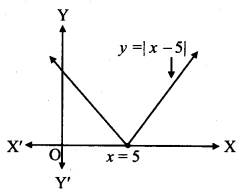
∴ Range of f = [0, ∞)
View full question & answer→Question 71 Mark
Find the domain of the following functions.$f(x)={ }^{5-x} P_{x-1}$
Answer$ f(x)={ }^{5-x} P_{x-1}$
$5-x>0, x-1 \geq 0, x-1 \leq 5-x$
$\therefore x<5, x \geq 1 \text { and } 2 x \leq 6$
$\therefore x \leq 3$
$\therefore \text { Domain of } f=\{1,2,3\} $
View full question & answer→Question 81 Mark
Find the domain of the following functions.$f(x)=x$ !
Answer$f(x)=x$ !
$\therefore$ Domain of $f=$ set of whole numbers $(W)$
View full question & answer→Question 91 Mark
Find the domain of the following functions.$f(x)=\sqrt{x-3}+\frac{1}{\log (5-x)}$
Answer$f(x)=\sqrt{x-3}+\frac{1}{\log (5-x)}$
For $f$ to be defined,
$ x-3 \geq 0,5-x>0 \text { and } 5-x \neq 1$
$x \geq 3, x<5 \text { and } x \neq 4$
$\therefore \text { Domain of } f=[3,4) \cup(4,5) $
View full question & answer→Question 101 Mark
Find the domain of the following functions.$f(x)=\frac{x^2+4 x+4}{x^2+x-6}$
Answer$f(x)=\frac{x^2+4 x+4}{x^2+x-6}=\frac{x^2+4 x+4}{(x+3)(x-2)}$
For $f$ to be defined, $x \neq-3,2$
$\therefore$ Domain of $\mathrm{f}=(-\infty,-3) \cup(-3,2) \cup(2, \infty)$
View full question & answer→Question 111 Mark
Solve the following for $x$, where $|x|$ is modulus function, $[x]$ is the greatest integer function, $\{x\}$ is a fractional part function.$\left[\frac{x}{2}\right]+\left[\frac{x}{3}\right]=\frac{5 x}{6}$
Answer$\left[\frac{x}{2}\right]+\left[\frac{x}{3}\right]=\frac{5 x}{6}$
L.H.S. = an integer
R.H.S. $=$ an integer
$\therefore \mathrm{x}=6 \mathrm{k}$, where $\mathrm{k}$ is an integer
View full question & answer→Question 121 Mark
Solve the following for $x$, where $|x|$ is modulus function, $[x]$ is the greatest integer function, $\{x\}$ is a fractional part function.$[x-2]+[x+2]+\{x\}=0$
Answer$ [x-2]+[x+2]+\{x\}=0$
$\therefore[x]-2+[x]+2+\{x\}=0$
$\therefore[x]+x=0 \ldots \ldots[\{x\}+[x]=x]$
$\therefore x=0$
View full question & answer→Question 131 Mark
Solve the following for $x$, where $|x|$ is modulus function, $[x]$ is the greatest integer function, $\{x\}$ is a fractional part function.$[\mathrm{x}] 2-5[\mathrm{x}]+6=0$
Answer$ [x]^2-5[x]+6=0$
$\therefore([x]-3)([x]-2)=0$
$\therefore[x]=3 \text { or } 2$
$\text { If }[x]=2 \text {, then } 2 \leq x<3$
$\text { If }[x]=3 \text {, then } 3 \leq x<4$
$\therefore \text { Solution set }=[2,4) $
View full question & answer→Question 141 Mark
Solve the following for $x$, where $|x|$ is modulus function, $[x]$ is the greatest integer function, $\{x\}$ is a fractional part function.$2[2 x-5]-1=7$
Answer$2[2 x-5]-1=7$
$ \therefore[2 x-5]=\frac{7+1}{2}=4$
$\therefore[2 x]-5=4$
$\therefore[2 x]=9$
$\therefore 9 \leq 2 x<10$
$\therefore \frac{9}{2} \leq x<5$
$\therefore$ Solution set $=\left[\frac{9}{2}, 5\right)$
View full question & answer→Question 151 Mark
Solve the following for $x$, where $|x|$ is modulus function, $[x]$ is the greatest integer function, $\{x\}$ is a fractional part function.$-2<[\mathrm{x}] \leq 7$
Answer$ -2<[\mathrm{x}] \leq 7$
$\therefore-2<\mathrm{x}<8$
$\therefore \text { Solution set }=(-2,8) $
View full question & answer→Question 161 Mark
Solve the following for $x$, where $|x|$ is modulus function, $[x]$ is the greatest integer function, $\{x\}$ is a fractional part function.$\left|x^2-x-6\right|=x+2$
Answer$\left|x^2-x-6\right|=x+2 \ldots$.(i)
R.H.S. must be non-negative
$ \therefore x \geq-2 \ldots \text {.(ii) }$
$|(x-3)(x+2)|=x+2$
$\therefore(x+2)|x-3|=x+2 \text { as } x+2 \geq 0$
$\therefore|x-3|=1 \text { if } x \neq-2$
$\therefore x-3= \pm 1$
$\therefore x=4 \text { or } 2 $
$\therefore \mathrm{x}=-2$ also satisfies the equation
$\therefore$ Solution set $=\{-2,2,4\}$
View full question & answer→Question 171 Mark
Solve the following for $x$, where $|x|$ is modulus function, $[x]$ is the greatest integer function, $\{x\}$ is a fractional part function.$1<|x-1|<4$
Answer$1<|x-1|<4$
$ \therefore-4<\mathrm{x}-1<-1 \text { or } 1<\mathrm{x}-1<4$
$\therefore-3<\mathrm{x}<0 \text { or } 2<\mathrm{x}<5$
$\therefore \text { Solution set }=(-3,0) \cup(2,5) $
View full question & answer→Question 181 Mark
Show that, $\log _y x^3 \cdot \log _z y^4 \cdot \log _x z^5=60$.
Answer$
\begin{aligned}
\text { L.H.S. } & =\log _y\left(x^3\right) \log _z\left(y^4\right) \log _x\left(z^5\right) \\
& =\left(3 \log _y x\right)\left(4 \log _z y\right)\left(5 \log _x z\right) \\
& =60\left(\frac{\log x}{\log y}\right)\left(\frac{\log y}{\log z}\right)\left(\frac{\log z}{\log x}\right) \\
& =60=\text { R.H.S. }
\end{aligned}
$
View full question & answer→Question 191 Mark
If $\log _3\left[\log _2\left(\log _3 x\right)\right]=1$, show that $x=6561$.
Answer$ \log _3\left[\log _2\left(\log _3 x\right)\right]=1$
$\therefore \log _2\left(\log _3 x\right)=3^1$
$\therefore \log _3 x=2^3$
$\therefore \log _3 x=8$
$\therefore x=3^8$
$\therefore x=6561 $
View full question & answer→Question 201 Mark
If $\log \left(\frac{a+b}{2}\right)=\frac{1}{2}(\log a+\log b)$, then show that $a=b$.
Answer$ \log \left(\frac{a+b}{2}\right)=\frac{1}{2}(\log a+\log b)$
$\therefore 2 \log \left(\frac{a+b}{2}\right)=\log a+\log b$
$\therefore \log \left(\frac{a+b}{2}\right)^2=\log a b$
$\therefore \frac{(a+b)^2}{4}=a b$
$\therefore a^2+2 a b+b^2=4 a b$
$\therefore a^2+2 a b-4 a b+b^2=0$
$\therefore a^2-2 a b+b^2=0$
$\therefore(a-b)^2=0$
$\therefore a-b=0$
$\therefore a=b$
View full question & answer→Question 211 Mark
Simplify $\log \left(\log x^4\right)-\log (\log x)$
Answer$ \log \left(\log x^4\right)-\log (\log x)$
$=\log (4 \log x)-\log (\log x) \ldots . .\left[\log m^n=n \log m\right]$
$=\log 4+\log (\log x)-\log (\log x) \ldots . .[\log (m n)=\log m+\log n]$
$=\log 4 $
View full question & answer→Question 221 Mark
Show that $\log \frac{\mathrm{a}^2}{\mathrm{bc}}+\log \frac{\mathrm{b}^2}{\mathrm{ca}}+\log \frac{\mathrm{c}^2}{\mathrm{ab}}=0$
Answer$
\begin{aligned}
\text { L.H.S. } & =\log \frac{a^2}{b c}+\log \frac{b^2}{c a}+\log \frac{c^2}{a b} \\
& =\log \left(\frac{a^2}{b c} \times \frac{b^2}{c a} \times \frac{c^2}{a b}\right) \\
& =\log \left(\frac{a^2 b^2 c^2}{a^2 b^2 c^2}\right)=\log 1=0=\text { R.H.S. }
\end{aligned}
$
View full question & answer→Question 231 Mark
Find $x$, if $x=3^{3 \log _3 2}$.
Answer$\mathrm{X}=3^{3 \log _3 2}$
$=3^{\log 3\left(2^3\right)}$
$=2^3 \ldots\left[a^{\log _a b}=\mathrm{b}\right]$
$=8 $
View full question & answer→Question 241 Mark
For any base show that $\log (1+2+3)=\log 1+\log 2+\log 3$
Answer$ \text { L.H.S. }=\log (1+2+3)=\log 6$
$\text { R.H.S. }=\log 1+\log 2+\log 3$
$=0+\log (2 \times 3)$
$=\log 6$
$\therefore \text { L.H.S. }=\text { R.H.S. }$
View full question & answer→Question 251 Mark
Let $f: R-\{2\} \rightarrow R$ be defined by $f(x)=\frac{x^2-4}{x-2}$ and $g: R \rightarrow R$ be defined by $g(x)=$ $x+2$. Examine whether $f=g$ or not.
Answer$ f(x)=\frac{x^2-4}{x-2}, x \neq 2$
$\therefore f(x)=x+2, x \neq 2 \text { and } g(x)=x+2, $
The domain of $f=R-\{2\}$
The domain of $g=R$
Here, $f$ and $g$ have different domains.
$\therefore \mathrm{f} \neq \mathrm{g}$
View full question & answer→Question 261 Mark
Find fog and gof:$f(x)=256 x^4, g(x)=\sqrt{x}$
Answer$f(x)=256 x^4, g(x)=\sqrt{ } x$
(fog) $(x)=f(g(x))=f(\sqrt{x})=256(\sqrt{x})^4=256 x^2$
$(g \circ f)(x)=g(f(x))=g\left(256 x^4\right)=\sqrt{256 x^4}=16 x^2$
View full question & answer→Question 271 Mark
Find fog and gof:$f(x)=3 x-2, g(x)=x^2$
Answer$ f(x)=3 x-2, g(x)=x^2$
$\text { (fog) }(x)=f(g(x))=f\left(x^2\right)=3 x^2-2$
$\text { (gof) }(x)=g(f(x))$
$=g(3 x-2)$
$=(3 x-2)^2$
$=9 x^2-12 x+4$
View full question & answer→Question 281 Mark
Find fog and gof:$f(x)=x^2+5, g(x)=x-8$
Answer$ f(x)=x^2+5, g(x)=x-8$
$\text { (fog) }(x)=f(g(x))$
$=f(x-8)$
$=(x-8)^2+5$
$=x^2-16 x+64+5$
$=x^2-16 x+69$
$(g \circ f)(x)=g(f(x))$
$=g\left(x^2+5\right)$
$=x^2+5-8$
$=x-3 $
View full question & answer→Question 291 Mark
If $f(x)=3 x+a$ and $f(1)=7$, find $a$ and $f(4)$.
Answer$ f(x)=3 x+a, f(1)=7$
$\therefore 3(1)+a=7$
$\therefore a=7-3=4$
$\therefore f(x)=3 x+4$
$\therefore f(4)=3(4)+4=12+4=16 $
View full question & answer→Question 301 Mark
A function $f$ is defined as $f(x)=5-x$ for $0 \leq x \leq 4$. Find the values of $x$ such that$f(x)=5$
Answer$ f(x)=5$
$\therefore 5-x=5$
$\therefore x=0 $
View full question & answer→Question 311 Mark
A function $f$ is defined as $f(x)=5-x$ for $0 \leq x \leq 4$. Find the values of $x$ such that$f(x)=3$
Answer$ f(x)=3$
$\therefore 5-x=3$
$\therefore x=5-3=2$
View full question & answer→Question 321 Mark
A function $f$ is defined as $f(x)=4 x+5$, for $-4 \leq x<0$. Find the values of $f(-1)$, $f(-2), f(0)$, if they exist.
Answer$f(x)=4 x+5,-4 \leq x<0$
$f(-1)=4(-1)+5=-4+5=1$
$f(-2)=4(-2)+5=-8+5=-3$
$x=0 \notin \text { domain of } f$
$\therefore f(0) \text { does not exist. } $
View full question & answer→Question 331 Mark
Find whether the following functions are onto or not.$f: R \rightarrow R$ defined by $f(x)=x^2+3$ for all $x \in R$
Answer$f(x)=x^2+3=y$ (say)
$
(x, y \in R)
$
Clearly $y \geq 3 \ldots . .\left[x^2 \geq 0\right]$
$\therefore$ All the real numbers less than 3 from codomain $\mathrm{R}$, have not been preassigned any element from the domain $\mathrm{R}$.
$\therefore \mathrm{f}$ is not onto.
View full question & answer→Question 341 Mark
Find whether the following functions are onto or not.$f: Z \rightarrow Z$ defined by $f(x)=6 x-7$ for all $x \in Z$
Answer$ \text { (i) } f(x)=6 x-7=y \text { (say) }$
$(x, y \in Z)$
$\therefore x=\frac{7+y}{6}$
Since every integer $\mathrm{y}$ does not give integer $\mathrm{x}, \mathrm{f}$ is not onto.
View full question & answer→Question 351 Mark
Find whether the following functions are one-one.$f: R \rightarrow R$ defined by $f(x)=x^2+5$
Answer$f: R \rightarrow R$, defined by $f(x)=x^2+5$
Note that $f(-x)=f(x)=x^2+5$
$\therefore \mathrm{f}$ is not one-one (i.e., many-one) function.
View full question & answer→Question 361 Mark
Which of the following relations are functions? If it is a function determine its domain and range.
{(2, 1), (3, 1), (5, 2)}
Answer{(2, 1), (3, 1), (5, 2)}
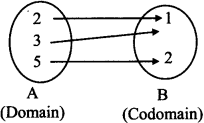
Every element of set A has been assigned a unique element in set B.
∴ Given relation is a function.
Domain = {2, 3, 5}, Range = {1, 2}
View full question & answer→Question 371 Mark
Which of the following relations are functions? If it is a function determine its domain and range.
{(0, 0), (1, 1), (1, -1), (4, 2), (4, -2) (9, 3), (9, -3), (16, 4), (16, -4)}
Answer{(0, 0), (1, 1), (1, -1), (4, 2), (4, -2) (9, 3), (9, -3) (16, 4), (16, -4)}
∵ (1, 1), (1, -1) ∈ the relation
∴ Given relation is not a function.
As element 1 of the domain has not been assigned a unique element of co-domain.
View full question & answer→Question 381 Mark
Which of the following relations are functions? If it is a function determine its domain and range.
{(2, 1), (4, 2), (6, 3), (8, 4), (10, 5) (12, 6), (14, 7)}
Answer{(2, 1), (4, 2), (6, 3), (8, 4), (10, 5) (12, 6), (14, 7)}
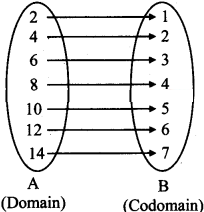
Every element of set A has been assigned a unique element in set B
∴ Given relation is a function
Domain = {2, 4, 6, 8, 10, 12, 14}, Range = {1, 2, 3, 4, 5, 6, 7}
View full question & answer→Question 391 Mark
Solve the following for $x$, where $|x|$ is modulus function, $[x]$ is the greatest integer function, $\{x\}$ is a fractional part function.$2\{x\}=x+[x]$
Answer$ 2\{x\}=x+[x]$
$=[x]+\{x\}+[x] \ldots . .[x=[x]+\{x\}]$
$\therefore\{x\}=2[x] $
R.H.S. is an integer
$\therefore$ L.H.S. is an integer
$ \therefore\{x\}=0$
$\therefore[x]=0$
$\therefore x=0 $
View full question & answer→Question 401 Mark
Solve the following for $x$, where $|x|$ is modulus function, $[x]$ is the greatest integer function, $\{x\}$ is a fractional part function.$\{x\}=0.5$
Answer$\{x\}=0.5$
$
\therefore x=\ldots . .,-2.5,-1.5,-0.5,0.5,1.5, \ldots .
$
$\therefore$ The solution set $=\{x: x=n+0.5, n \in Z\}$
View full question & answer→Question 411 Mark
Solve the following for $x$, where $|x|$ is modulus function, $[x]$ is the greatest integer function, $\{x\}$ is a fractional part function.$\{x\}=0$
Answer$\{\mathrm{x}\}=0$
$\therefore \mathrm{x}$ is an integer
$\therefore$ The solution set is $\mathrm{Z}$.
View full question & answer→Question 421 Mark
Solve the following for $x$, where $|x|$ is modulus function, $[x]$ is the greatest integer function, $\{x\}$ is a fractional part function.$\{x\}>4$
Answer$\{x\}>4$
This is a meaningless statement as $0 \leq\{\mathrm{X}\}<1$
$\therefore$ The solution set $=\{\}$ or $\Phi$
View full question & answer→Question 431 Mark
Solve the following for $x$, where $|x|$ is modulus function, $[x]$ is the greatest integer function, $\{x\}$ is a fractional part function.$[x+[x+[x]]]=9$
Answer$[x+[x+[x]]]=9$
$\therefore[\mathrm{x}+[\mathrm{x}]+[\mathrm{x}]]=9 \ldots \ldots .[\mathrm{x}+\mathrm{n}]=[\mathrm{x}]+\mathrm{n}$, if $\mathrm{n}$ is an integer $]$
$\therefore[\mathrm{x}+2[\mathrm{x}]]=9$
$\therefore[x]+2[x]=9 \ldots .[[2[x]$ is an integer $]]$
$\therefore[\mathrm{x}]=3$
$\therefore \mathrm{x} \in[3,4)$
View full question & answer→Question 441 Mark
Solve the following for $x$, where $|x|$ is modulus function, $[x]$ is the greatest integer function, $\{x\}$ is a fractional part function.$2|x|=5$
Answer$2|x|=5$
$\therefore|x|=\frac{5}{2}$
$\therefore x= \pm \frac{5}{2}$
View full question & answer→Question 451 Mark
Solve the following for $x$, where $|x|$ is modulus function, $[x]$ is the greatest integer function, $\{x\}$ is a fractional part function.$|x| \leq 3$
Answer$|x| \leq 3$ The solution set of $|x| \leq a$ is $-a \leq x \leq a$
$\therefore$ The required solution is $-3 \leq \mathrm{x} \leq 3$
$\therefore$ The solution set is $[-3,3]$
View full question & answer→Question 461 Mark
Solve the following for $x$, where $|x|$ is modulus function, $[x]$ is the greatest integer function, $\{x\}$ is a fractional part function.$x^2+7|x|+12=0$
Answer$x^2+7|x|+12=0$
$\therefore(|\mathrm{x}|)^2+7|\mathrm{x}|+12=0$
$\therefore(|x|+3)(|x|+4)=0$
$\therefore$ There is no $\mathrm{x}$ that satisfies the equation.
The solution set $=\{\}$ or $\Phi$
View full question & answer→Question 471 Mark
If $f(x)=4[x]-3$, where $[x]$ is greatest integer function of $x$, then find$\mathrm{f}(2 \pi)$, where $\pi=3.14$
Answer$ \text { (iv) } f(2 \pi)=4[2 \pi]-3$
$=4[6.28]-3 \ldots . .[\because \pi=3.14]$
$=4(6)-3 \ldots \ldots .[\because 6 \leq 6.28<7,[6.28]=6]$
$=21 $
View full question & answer→Question 481 Mark
If $f(x)=4[x]-3$, where $[x]$ is greatest integer function of $x$, then find.
$f\left(-\frac{5}{2}\right)$
Answer$ f\left(-\frac{5}{2}\right)=\mathrm{f}(-2.5)$
$=4[-2.5]-3$
$=4(-3)-3 \ldots \ldots .[\because-3 \leq-2.5 \leq-2,[-2.5]=-3]$
$=-15$
View full question & answer→Question 491 Mark
If $f(x)=4[x]-3$, where $[x]$ is greatest integer function of $x$, then find$f(0.5)$
Answer$ f(0.5)=4[0.5]-3$
$=4(0)-3 \ldots \ldots \ldots .[\because 0 \leq 0.5<1,[0.5]=0]$
$=-3$
View full question & answer→Question 501 Mark
If $f(x)=4[x]-3$, where $[x]$ is greatest integer function of $x$, then find$f(7.2)$
Answer$ f(x)=4[x]-3$
$f(7.2)=4[7.2]-3$
$=4(7)-3 \ldots \ldots . .[\because 47.2<8,[7.2]=7]$
$=25 $
View full question & answer→