MCQ 11 Mark
There are 5 girls and 2 boys, then the probability that no two boys are sitting together for a photograph is
- A
$\frac{1}{21}$
- B
$\frac{4}{7}$
- C
$\frac{2}{7}$
- ✓
$\frac{5}{7}$
AnswerCorrect option: D. $\frac{5}{7}$
$\frac{5}{7}$ There are 5 girls and 2 boys.
They can be arranged among themselves in ${ }^7 P _7=7$ ! ways.
$\therefore$ Girls can be arranged among themselves in ${ }^5 P _5=5$ ! ways.
No two boys should sit together.
Let girls be denoted by the letter G.
– G – G – G – G – G –
There are 6 places, marked by ‘-’ where boys can sit.
∴ Boys can be arranged in
$\begin{aligned} & { }^6 P _2=\frac{6 !}{(6-2) !} \\ & =\frac{6 \times 5 \times 4 !}{4 !} \\ & =30 \text { ways. }\end{aligned}$
$\therefore$ Required probability $=\frac{5 ! \times 30}{7 !}=\frac{5 ! \times 30}{7 \times 6 \times 5 !}=\frac{5}{7}$
View full question & answer→MCQ 21 Mark
The odds against an event are 5 : 3 and the odds in favour of another independent event are 7 : 5. The probability that at least one of the two events will occur is
- A
$\frac{52}{96}$
- ✓
$\frac{71}{96}$
- C
$\frac{69}{96}$
- D
$\frac{13}{96}$
AnswerCorrect option: B. $\frac{71}{96}$
$\frac{71}{96}$
View full question & answer→MCQ 31 Mark
A fair die is tossed twice. What are the odds in favour of getting 4, 5, or 6 on the first toss and 1, 2, 3, or 4 on the second toss?
Answer.1 : 2A fair dice is tossed twice.
∴ n(S) = 36
A: Getting 4, 5, or 6 on the first toss and Getting 1, 2, 3, or 4 on the second toss.
∴ A = {(4, 1), (4, 2), (4, 3), (4, 4), (5, 1), (5, 2), (5, 3), (5, 4), (6, 1), (6, 2), (6, 3), (6, 4)}
$\therefore P ( A )=\frac{n(A)}{n(S)}=\frac{12}{36}=\frac{1}{3}$
∴ Required answer = P(A) : P(A’) = 1 : 2
View full question & answer→MCQ 41 Mark
The bag I contain 3 red and 4 black balls while Bag II contains 5 red and 6 black balls. One ball is drawn at random from one of the bags and it is found to be red. The probability that it was drawn from Bag II is
- A
$\frac{33}{68}$
- B
$\frac{35}{69}$
- C
$\frac{34}{67}$
- ✓
$\frac{35}{68}$
AnswerCorrect option: D. $\frac{35}{68}$
$\frac{35}{68}$
View full question & answer→MCQ 51 Mark
The probability that a student knows the correct answer to a multiple-choice question is$\frac{2}{3}$. If the student does not know the answer, then the student guesses the answer. Theprobability of the guessed answer being correct is $\frac{1}{4}$. Given that the student has answered
the question correctly, the probability that the student knows the correct answer is
- A
$\frac{5}{6}$
- B
$\frac{6}{7}$
- C
$\frac{7}{8}$
- ✓
$\frac{8}{9}$
AnswerCorrect option: D. $\frac{8}{9}$
$\frac{8}{9}$Let event A: Student knows the correct answer,
event A’: Student guesses the answer,
event B: Answer is correct.
$\therefore P(A)=\frac{2}{3}, P\left(A^{\prime}\right)=\frac{1}{3}, P\left(B / A^{\prime}\right)=\frac{1}{4}$
Clearly, P(B/A) = 1 Required probability = P(A/B)
$\begin{aligned} & =\frac{ P ( A ) \cdot P ( B / A )}{ P ( A ) \cdot P ( B / A )+ P \left( A ^{\prime}\right) P \left( B / A ^{\prime}\right)} \\ & =\frac{\frac{2}{3} \times 1}{\frac{2}{3} \times 1+\frac{1}{3} \times \frac{1}{4}} \\ & =\frac{8}{9}\end{aligned}$
View full question & answer→MCQ 61 Mark
Two friends A and B apply for a job in the same company. The chances of A getting selected is 2/5 and that of B is 4/7. The probability that both of them get selected is
- A
$\frac{34}{35}$
- B
$\frac{1}{35}$
- ✓
$\frac{8}{35}$
- D
$\frac{27}{35}$
AnswerCorrect option: C. $\frac{8}{35}$
$\frac{8}{35}$
View full question & answer→MCQ 71 Mark
There are 2 shelves. One shelf has 5 Physics and 3 Biology books and the other has 4 Physics and 2 Biology books. The probability of drawing a Physics book is
- A
$\frac{9}{14}$
- ✓
$\frac{31}{48}$
- C
$\frac{9}{38}$
- D
$\frac{1}{2}$
AnswerCorrect option: B. $\frac{31}{48}$
$\frac{31}{48}$ Let event S1: First shelve is selected, event S2: Second shelve is selected, event P: Drawing a physics book.
$\therefore P \left( S _1\right)=\frac{1}{2}$ and $P \left( S _2\right)=\frac{1}{2}$
First shelve has 5 physics and 3 biology books, i.e., total 8 books.
$\therefore P \left( P / S _1\right)=\frac{{ }^5 C_1}{{ }^8 C_1}=\frac{5}{8}$
Similarly, $P \left( P / S _2\right)=\frac{{ }^4 C_1}{{ }^6 C_1}=\frac{4}{6}=\frac{2}{3}$
$\therefore P(P)=P\left(S_1\right) \cdot P\left(P / S_1\right)+P\left(S_2\right) \cdot P\left(P / S_2\right)$
$\begin{aligned} & =\frac{1}{2} \times \frac{5}{8}+\frac{1}{2} \times \frac{2}{3} \\ & =\frac{31}{48}\end{aligned}$
View full question & answer→MCQ 81 Mark
In a set of 30 shirts, 17 are white and the rest are black. 4 white and 5 black shirts are tagged as ‘PARTY WEAR’. If a shirt is chosen at random from this set, the possibility of choosing a black shirt or a ‘PARTY WEAR’ shirt is
- A
$\frac{11}{15}$
- B
$\frac{13}{30}$
- C
$\frac{9}{13}$
- ✓
$\frac{17}{30}$
AnswerCorrect option: D. $\frac{17}{30}$
$\frac{17}{30}$17 white + 13 black = 30 shirts
4 white and 5 black are ‘PARTY WEAR’
A: Choosing a black shirt
$\therefore P(A)=\frac{{ }^{13} C_1}{30 C_1}=\frac{13}{30}$
B: Choosing a ‘PARTY WEAR’ shirt.
$\therefore P(B)=\frac{{ }^9 C _1}{{ }^{30} C _1}=\frac{9}{30}$
There are 5 black ‘PARTY WEAR’ shirts.
$\therefore P(A \cap B)=\frac{{ }^5 C _1}{3_0 C _1}=\frac{5}{30}$
∴ Required probability
P(A ∪ B) = P(A) + P(B) – P(A ∩ B)
$\begin{aligned} & =\frac{13}{30}+\frac{9}{30}-\frac{5}{30} \\ & =\frac{17}{30}\end{aligned}$
View full question & answer→MCQ 91 Mark
Two dice are thrown simultaneously. Then the probability of getting two numbers whose product is even is
- ✓
$\frac{3}{4}$
- B
$\frac{1}{4}$
- C
$\frac{5}{7}$
- D
p>$\frac{1}{2}$
AnswerCorrect option: A. $\frac{3}{4}$
$\frac{3}{4}$ Two dice are thrown.
∴ n(S) = 36
Getting two numbers whose product is even, i.e., one of the two numbers must be even.
Let event A: Getting even number on first dice,
event B: Getting even number on second dice.
n(A) = 18, n(B) = 18, n(A ∩ B) = 9
Required probability = P(A ∩ B)
$\begin{aligned} & =\frac{n(A)+n(B)-n(A \cap B)}{n(S)} \\ & =\frac{18+18-9}{36} \\ & =\frac{3}{4}\end{aligned}$
View full question & answer→MCQ 101 Mark
In a jar, there are 5 black marbles and 3 green marbles. Two marbles are picked randomly one after the other without replacement. What is the possibility that both the marbles are black?
- ✓
$\frac{5}{14}$
- B
$\frac{5}{8}$
- C
$\frac{5}{7}$
- D
$\frac{5}{16}$
AnswerCorrect option: A. $\frac{5}{14}$
$\frac{5}{14}$
View full question & answer→MCQ 112 Marks
$A, B, C$ are three events, one of which must and only one can happen. The odds in favour of $A$ are $4: 6$, the odds against $B$ are $7: 3$. Thus, odds against $C$ are
- ✓
$7: 3$
- B
$4: 6$
- C
$6: 4$
- D
$3: 7$
AnswerCorrect option: A. $7: 3$
(a) : The odds in favour of $A$ are $4: 6$.
$
\therefore \quad P(A)=\frac{4}{4+6}=\frac{4}{10}
$
Now, odd against $B$ are $7: 3$, So odds in favour of $B$ are $3: 7$
$
\therefore \quad P(B)=\frac{3}{3+7}=\frac{3}{10}
$
Now, $A, B$ and $C$ are mutually exclusive as one and only one can happen
$
\begin{aligned}
\Rightarrow \quad P(A) & +P(B)+P(C)=1 \\
\Rightarrow \quad P(C) & =1-\frac{4}{10}-\frac{3}{10} \\
& =1-\frac{7}{10}=\frac{3}{10}
\end{aligned}
$
$
\therefore \quad P(\bar{C})=1-P(C)=1-\frac{3}{10}=\frac{7}{10}
$
$\therefore$ Odds in favour of $C$ are $3: 7$ and odds against C are 7:3.
View full question & answer→MCQ 122 Marks
Three critics review a book. For the three critics the odds in favour of the book are $2: 5,3: 4$ and $4: 3$ respectively. The probability that the majority is in favour of the book, is given by
- A
$\frac{183}{343}$
- B
$\frac{160}{343}$
- C
$\frac{209}{343}$
- ✓
$\frac{134}{343}$
AnswerCorrect option: D. $\frac{134}{343}$
(d) : Let the three critics are $A, B$ and $C$ and $P(A)$, $P(B)$ and $P(C)$ represents the probabilities of $A, B$ and $C$ respectively in the favour of the book.
$
\therefore P(A)=\frac{2}{7}, P(B)=\frac{3}{7} \text { and } P(C)=\frac{4}{7}
$
Now, probability that the majority is in the favour of the book
$
\begin{aligned}
& =P(A \bar{B} C)+P(\bar{A} B C)+P(A B \bar{C})+P(A B C) \\
& =\frac{2}{7} \cdot\left(1-\frac{3}{7}\right) \cdot \frac{4}{7}+\left(1-\frac{2}{7}\right) \cdot \frac{3}{7} \cdot \frac{4}{7}+\frac{2}{7} \cdot \frac{3}{7} \cdot\left(1-\frac{4}{7}\right)+\frac{2}{7} \cdot \frac{3}{7} \cdot \frac{4}{7} \\
& =\frac{32}{7^3}+\frac{60}{7^3}+\frac{18}{7^3}+\frac{24}{7^3}=\frac{134}{343}
\end{aligned}
$
View full question & answer→MCQ 132 Marks
A bag contains 5 red balls and 3 green balls. A ball is selected at random and not replaced. A second ball is then selected. The probability of selecting one red ball and one green ball is
- A
$\frac{15}{112}$
- ✓
$\frac{15}{56}$
- C
$\frac{15}{64}$
- D
$\frac{15}{28}$
AnswerCorrect option: B. $\frac{15}{56}$
(b) : Case I : When red ball is drawn at first.
$
P(\text { Selecting red ball })=\frac{5}{8}
$
$P($ Selecting green ball in second draw $)=\frac{3}{7}$
$
\therefore \quad P(\text { Selecting one red and one green ball })=\frac{5}{8} \times \frac{3}{7}=\frac{15}{56}
$
Case II : When green ball is drawn at first.
$P($ Selecting green ball $)=\frac{3}{8}$
$P($ Selecting red ball in second draw $)=\frac{5}{7}$
$\therefore \quad P($ Selecting one green and one red ball $)=\frac{3}{8} \times \frac{5}{7}=\frac{15}{56}$
View full question & answer→MCQ 142 Marks
Three unbiased coins are tossed once. What is the probability of getting at least 2 heads?
- A
$\frac{1}{7}$
- B
$\frac{1}{3}$
- C
$\frac{1}{5}$
- ✓
$\frac{1}{2}$
AnswerCorrect option: D. $\frac{1}{2}$
(d) : In tossing three coins, the sample space is
$S=\{$ HHH, HHT, HTH, THH, HTT, THT, TTH, TTT $\}$.
$\Rightarrow n(S)=8$.
Let $E=$ event of getting at least 2 heads. Then, $E=\{ HHT , HTH , THH , HHH \}$ and therefore $n(E)=4$.
Now $P$ (getting at least 2 heads) $=P(E)=\frac{n(E)}{n(S)}=\frac{4}{8}=\frac{1}{2}$.
View full question & answer→MCQ 152 Marks
A bag contain 6 white and 4 black balls. Two balls are drawn at random. The probability that they are of the same colour is
- A
$5 / 7$
- B
$1 / 7$
- ✓
$7 / 15$
- D
$1 / 15$
AnswerCorrect option: C. $7 / 15$
(c) : Number of white balls $=6$
Number of black balls $=4$
$\therefore$ Total number of balls $=10$
Now, probability of drawing 2 balls of same colour $=$ probability of drawing 2 white balls + probability of drawing 2 black balls
$
=\frac{{ }^6 C_2}{{ }^{10} C_2}+\frac{{ }^4 C_2}{{ }^{10} C_2}=\frac{15}{45}+\frac{6}{45}=\frac{21}{45}=\frac{7}{15}
$
View full question & answer→MCQ 162 Marks
If three dice are thrown then the probability that the sum of the numbers on their uppermost faces to be at least 5 is
- A
$1 / 53$
- ✓
$53 / 54$
- C
$1 / 54$
- D
$52 / 53$
AnswerCorrect option: B. $53 / 54$
(b) : In throwing three dice together, the number of all possible outcomes $=6 \times 6 \times 6=216$
Let $E$ be the event of getting a sum of atleast 5 Then, $\bar{E}$ be the event of getting a sum of less than 5 or event of getting a sum of 3 or 4 .
$
\therefore \quad \bar{E}=\{(1,1,1),(1,1,2),(1,2,1),(2,1,1)\}
$
So, $n(\bar{E})=4$
$
\therefore P(\bar{E})=\frac{n(\bar{E})}{n(S)}=\frac{4}{216}=\frac{1}{54}
$ View full question & answer→MCQ 172 Marks
A coin is tossed three times. If $X$ denotes the absolute difference between the number of heads and the number of tails, then $P(X=1)=$
- A
$\frac{1}{2}$
- B
$\frac{2}{3}$
- C
$\frac{1}{6}$
- ✓
$\frac{3}{4}$
AnswerCorrect option: D. $\frac{3}{4}$
(d) : Total number of outcomes $=8\{ HHH , HTH$, THH, HHT, HTT,THT, TTH, TTT\}
Favorable outcomes $=\{$ HTH, THH, HHT, HTT, THT, TTH $\}$ which are 6 in number.
$
\therefore \text { Required probability }=\frac{6}{8}=\frac{3}{4} \text {. }
$
View full question & answer→MCQ 182 Marks
Letters in the word HULULULU are rearranged. The probability of all three $L$ being together is
- A
$\frac{3}{20}$
- B
$\frac{2}{5}$
- ✓
$\frac{3}{28}$
- D
$\frac{5}{23}$
AnswerCorrect option: C. $\frac{3}{28}$
(c) : In the word 'HULULULU', there are 8 letters in which there are $4 U^{\prime} s, 3$ L's and $1 H$. $\therefore \quad$ Total number of arrangements $=\frac{8 !}{3 ! 4 !}=280$
We take all 3 L'S together and treating them as one letter. Now, the number of words in which 3L's come together $=\frac{6 !}{4 !}=30$
$\therefore \quad$ Required probability $=\frac{30}{280}=\frac{3}{28}$
View full question & answer→MCQ 192 Marks
A bag contains 4 red and 6 black balls. A ball is drawn at random from the bag, its colour is observed and this ball along with two additional balls of the same colour are returned to the bag. If now a ball is drawn at random from the bag, then the probability that this drawn ball is red, is
- A
$\frac{3}{4}$
- B
$\frac{3}{10}$
- ✓
$\frac{2}{5}$
- D
$\frac{1}{5}$
AnswerCorrect option: C. $\frac{2}{5}$
(c) : Let's draw a state diagram to understand whole condition
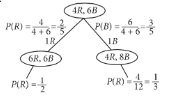
The requested probability is the sum of the product of the probabilities along the two possible paths and is equal to $\frac{2}{5} \cdot \frac{1}{2}+\frac{3}{5} \cdot \frac{1}{3}=\frac{1}{5}+\frac{1}{5}=\frac{2}{5}$ View full question & answer→MCQ 202 Marks
If odds against solving a question by three students are $2: 1,5: 2$ and $5: 3$ respectively, then probability that the question is solved only by one student is
- A
$\frac{31}{56}$
- B
$\frac{24}{56}$
- ✓
$\frac{25}{56}$
- D
AnswerCorrect option: C. $\frac{25}{56}$
(C)
The probability of solving the question by these three students are $\frac{1}{3}, \frac{2}{7}$ and $\frac{3}{8}$ respectively.
$\therefore P ( A )=\frac{1}{3} ; P ( B )=\frac{2}{7} ; P ( C )=\frac{3}{8}$
Then, probability of question solved by only one student $= P ( A \overline{ B } \overline{ C }$ or $\overline{ A } B \overline{ C }$ or $\overline{ A } \overline{ B } C )$
$= P ( A ) P (\overline{ B }) P (\overline{ C })+ P (\overline{ A }) P ( B ) P (\overline{ C }) + P (\overline{ A }) P (\overline{ B }) P ( C )$
$=\frac{1}{3} \cdot \frac{5}{7} \cdot \frac{5}{8}+\frac{2}{3} \cdot \frac{2}{7} \cdot \frac{5}{8}+\frac{2}{3} \cdot \frac{5}{7} \cdot \frac{3}{8}$
$=\frac{25+20+30}{168}=\frac{25}{56}$
View full question & answer→MCQ 212 Marks
Odds 8 to 5 against a person who is 40 years old living till he is 70 and 4 to 3 against another person now 50 till he will be living 80. Probability that one of them will be alive next 30 years
- A
$\frac{59}{91}$
- ✓
$\frac{44}{91}$
- C
$\frac{51}{91}$
- D
$\frac{32}{91}$
AnswerCorrect option: B. $\frac{44}{91}$
(B)
Probability [Person A will die in 30 years] $=\frac{8}{8+5}$
$\therefore \quad P ( A )=\frac{8}{13} \Rightarrow P (\overline{ A })=\frac{5}{13}$
Similarly, $P(B)=\frac{4}{7} \Rightarrow P(\bar{B})=\frac{3}{7}$
There are two ways in which one person is alive after 30 years. $\overline{ A } B$ and $A \overline{ B }$ are independent events.
So, required probability
$= P (\overline{ A }) \cdot P ( B )+ P ( A ) \cdot P (\overline{ B })$
$=\frac{5}{13} \times \frac{4}{7}+\frac{8}{13} \times \frac{3}{7}=\frac{44}{91}$
View full question & answer→MCQ 222 Marks
A party of 23 persons take their seats at a round table. The odds against two persons sitting together are
Answer(A)
Required probability $=\frac{(21)!2!}{(22)!}=\frac{1}{11}=\frac{1}{1+10}$
∴ Odds against $=10: 1$.
View full question & answer→MCQ 232 Marks
The odds against a certain event is $5: 2$ and the odds in favour of another event is $6: 5$. If both the events are independent, then the probability that at least one of the events will happen is
- A
$\frac{50}{77}$
- ✓
$\frac{52}{77}$
- C
$\frac{25}{88}$
- D
$\frac{63}{88}$
AnswerCorrect option: B. $\frac{52}{77}$
(B)
Let A and B be two given events. The odds against A are 5:2, therefore $P ( A )=\frac{2}{7}$.
And the odds in favour of B are $6: 5$,
therefore $P ( B )=\frac{6}{11}$
$\therefore $ The required probability $=1- P (\overline{ A }) P (\overline{ B })$
$=1-\left(1-\frac{2}{7}\right)\left(1-\frac{6}{11}\right)=\frac{52}{77}$
View full question & answer→MCQ 242 Marks
Three ships A, B and C sail from England to India. If the ratio of their arriving safely are 2 : 5, 3 : 7 and 6 : 11 respectively, then the probability of all the ships for arriving safely is
- ✓
$\frac{18}{595}$
- B
$\frac{6}{17}$
- C
$\frac{3}{10}$
- D
$\frac{2}{7}$
AnswerCorrect option: A. $\frac{18}{595}$
(A)
We have ratio of the ships $A , B$ and C for arriving safely are $2: 5,3: 7$ and $6: 11$ respectively,
$\therefore \quad$ The probability of ship A for arriving safely $=\frac{2}{2+5}=\frac{2}{7}$
Similarly, for $B=\frac{3}{3+7}=\frac{3}{10}$ and for $C=\frac{6}{6+11}=\frac{6}{17}$
$\therefore \quad$ Probability of all the ships for arriving safely
$=\frac{2}{7} \times \frac{3}{10} \times \frac{6}{17}=\frac{18}{595}$.
View full question & answer→MCQ 252 Marks
A card is drawn from a pack of 52 cards. A gambler bets that it is a spade or an ace. What are the odds against his winning this bet
Answer(C)
Probability of the card being a spade or an ace $=\frac{16}{52}=\frac{4}{13}$. Hence, odds in favour is $4: 9$.
So, the odds against his wiming is 9.4
View full question & answer→MCQ 262 Marks
A purse contains 4 copper coins and 3 silver coins, the second purse contains 6 copper coins and 2 silver coins. A coin is taken out from any purse, the probability that it is a copper coin is
- A
$\frac{4}{7}$
- ✓
$\frac{37}{56}$
- C
$\frac{3}{7}$
- D
$\frac{3}{4}$
AnswerCorrect option: B. $\frac{37}{56}$
(B)
Required probability $=\frac{1}{2} \times \frac{4}{7}+\frac{1}{2} \times \frac{6}{8}=\frac{37}{56}$
View full question & answer→MCQ 272 Marks
In a horse race the odds in favour of three horses are 1 : 2, 1 : 3 and 1 : 4. The probability that one of the horse will win the race is
- A
$\frac{37}{60}$
- ✓
$\frac{47}{60}$
- C
$\frac{1}{4}$
- D
$\frac{3}{4}$
AnswerCorrect option: B. $\frac{47}{60}$
(B)
Probabilities of winning the race by three horses are $\frac{1}{3}, \frac{1}{4}$ and $\frac{1}{5}$.
Hence, required probability $=\frac{1}{3}+\frac{1}{4}+\frac{1}{5}=\frac{47}{60}$
View full question & answer→MCQ 282 Marks
One and only one of the two events must occur. If the chance of one is $\frac{2}{3}$ of the other, then odds in favour of the other are
Answer(D)
Let p be the probability of the other event.
Then the probability of the first event is $\frac{2}{3} p$.
$\therefore \quad \frac{p}{p+\frac{2}{3} p}=\frac{3}{3+2}$
$\therefore$ odds in favour of the other are $3: 2$
View full question & answer→MCQ 292 Marks
An event has odds in favour $4: 5$, then the probability that event occurs, is
- A
$\frac{1}{5}$
- B
$\frac{4}{5}$
- ✓
$\frac{4}{9}$
- D
$\frac{5}{9}$
AnswerCorrect option: C. $\frac{4}{9}$
(C)
Required probability $=\frac{4}{4+5}=\frac{4}{9}$
View full question & answer→MCQ 302 Marks
If the odds in favour of an event be $3: 5$, then the probability of non-occurrence of the event is
- A
$\frac{3}{5}$
- B
$\frac{5}{3}$
- C
$\frac{3}{8}$
- ✓
$\frac{5}{8}$
AnswerCorrect option: D. $\frac{5}{8}$
(D)
Required probability $=\frac{5}{5+3}=\frac{5}{8}$
$\cdots\left[\begin{array}{l}\because \text { If odds in favours of an event are } a ; b, \\ \text { then the probability of non - occurrence } \\ \text { of that event is } \frac{b}{a+b}\end{array}\right]$
View full question & answer→MCQ 312 Marks
A letter is known to have come either from LONDON or CLIFTON; on the postmark only the two consecutive letters ON are legible. The probability that it came from LONDON is
- A
$\frac{5}{17}$
- ✓
$\frac{12}{17}$
- C
$\frac{17}{30}$
- D
$\frac{3}{5}$
AnswerCorrect option: B. $\frac{12}{17}$
(B)
We define the following events :
$A _1$ : Selecting a pair of consecutive letter from the word LONDON.
$A _2$ : Selecting a pair of consecutive letters from the word CLIFTON.
E : Selecting a pair of letters 'ON'.
Then $P \left( A _1 \cap E \right)=\frac{2}{5}$; as there are 5 pairs of consecutive letters out of which 2 are ON .
$P \left( A _2 \cap E \right)=\frac{1}{6}$; as there are 6 pairs of consecutive letters of which one is ON.
$\therefore \quad$ The required probability is
$P\left(\frac{A_1}{E}\right)=\frac{P\left(A_1 \cap E\right)}{P\left(A_1 \cap E\right)+P\left(A_2 \cap E\right)}=\frac{\frac{2}{5}}{\frac{2}{5}+\frac{1}{6}}=\frac{12}{17}$
View full question & answer→MCQ 322 Marks
A person goes to office by a car or scooter or bus or train, probability of which are $1 / 7,3 / 7$, $2 / 7$ and $1 / 7$ respectively. Probability that he reaches office late, if he takes car, scooter, bus or train is $2 / 9,1 / 9,4 / 9$ and $1 / 9$ respectively. Given that he reached office in time, the probability that he travelled by a car is
- ✓
$\frac{1}{7}$
- B
$\frac{2}{7}$
- C
$\frac{3}{7}$
- D
$\frac{4}{7}$
AnswerCorrect option: A. $\frac{1}{7}$
(A)
Required probability
$=\frac{\frac{1}{7} \times \frac{7}{9}}{\frac{1}{7} \times \frac{7}{9}+\frac{3}{7} \times \frac{8}{9}+\frac{2}{7} \times \frac{5}{9}+\frac{1}{7} \times \frac{8}{9}}=\frac{1}{7}$
View full question & answer→MCQ 332 Marks
In an entrance examination there are multiple choice questions. There are four possible answers to each question of which one is correct. The probability that a student knows the answer to a question is $90 \%$. If he gets the correct answer to the question, then the probability that he was guessing is
- A
$\frac{1}{9}$
- B
$\frac{36}{37}$
- ✓
$\frac{1}{37}$
- D
$\frac{37}{40}$
AnswerCorrect option: C. $\frac{1}{37}$
(C)
Consider the following events:
$E _1 \rightarrow$ He knows the answer, $E _2 \rightarrow$ He guesses the answer
$A \rightarrow$ He gets the correct answer.We have,
$P \left( E _1\right)=\frac{90}{100}=\frac{9}{10}, P \left( E _2\right)=\frac{1}{10}$,
$P \left( A / E _1\right)=1, P \left( A / E _2\right)=\frac{1}{4}$
$\therefore \quad$ Required probability $= P \left( E _2 / A \right)$
$=\frac{ P \left( E _2\right) P \left( A / E _2\right)}{ P \left( E _1\right) P \left( A / E _1\right)+ P \left( E _2\right) P \left( A / E _2\right)}$
$=\frac{\frac{1}{10} \times \frac{1}{4}}{\frac{9}{10} \times 1+\frac{1}{10} \times \frac{1}{4}}=\frac{1}{37}$
View full question & answer→MCQ 342 Marks
A student answers a multiple choice question with 5 alternatives, of which exactly one is correct. The probability that he knows the correct answer is $p, 0< p< 1$. If he does not know the correct answer, he randomly ticks one answer. Given that he has answered the question correctly, the probability that he did not tick the answer randomly,
- A
$\frac{3 p}{4 p+3}$
- B
$\frac{5 p}{3 p+2}$
- ✓
$\frac{5 p}{4 p+1}$
- D
$\frac{4 p}{3 p+1}$
AnswerCorrect option: C. $\frac{5 p}{4 p+1}$
(C)
$K = He$ knows the answers, $NK = He$ randomly ticks the answers, $C = He$ is correct
$P \left(\frac{ K }{ C }\right)=\frac{ P ( K ) \cdot P \left(\frac{ C }{ K }\right)}{ P ( K ) \cdot P \left(\frac{ C }{ K }\right)+ P ( NK ) \cdot P \left(\frac{ C }{ NK }\right)}$
$=\frac{p \times 1}{p \times 1+(1-p) \times \frac{1}{5}}=\frac{5 p}{4 p+1}$
View full question & answer→MCQ 352 Marks
A man speaks truth 2 out of 3 times. He picks one of the natural numbers in the set $S=\{1,2,3,4,5,6,7\}$ and reports that it is even. The probability that it is actually even is
- A
$\frac{1}{5}$
- ✓
$\frac{3}{5}$
- C
$\frac{2}{5}$
- D
$\frac{1}{10}$
AnswerCorrect option: B. $\frac{3}{5}$
(B)
Let A be the event that an even number is picked,
B be the event that an odd number is picked, and E be the event that man reports an even number
$P ( A )-\frac{3}{7}, \quad P ( D )-\frac{4}{7}$,
$P ( E / A )=\frac{2}{3}, \quad P ( E / B )=\frac{1}{3}$
Required probability $= P ( A / E )$
$=\frac{ P ( E / A ) P ( A )}{ P ( E / A ) P ( A )+ P ( E / B ) P ( B )}$
$=\frac{\left(\frac{2}{3}\right)\left(\frac{3}{7}\right)}{\left(\frac{2}{3}\right)\left(\frac{3}{7}\right)+\left(\frac{1}{3}\right)\left(\frac{4}{7}\right)}=\frac{3}{5}$
View full question & answer→MCQ 362 Marks
A man is known to speak the truth 3 out of 4 times. He throws a die and reports that it is a six. The probability that it is actually a six, is
- ✓
$\frac{3}{8}$
- B
$\frac{1}{5}$
- C
$\frac{3}{4}$
- D
$\frac{1}{4}$
AnswerCorrect option: A. $\frac{3}{8}$
(A)
Let E denote the event that a six occurs and A is the event that the man reports that it is a ' 6 ', we have
$P ( E )=\frac{1}{6}, P \left( E ^{\prime}\right)=\frac{5}{6}, P ( A / E )=\frac{3}{4}$ and
$P \left( A / E ^{\prime}\right)=\frac{1}{4}$
∴ From Baye's theorem,
$P(E / A)=\frac{P(E) \cdot P\left(\frac{A}{E}\right)}{P(E) \cdot P\left(\frac{A}{E}\right)+P\left(E^{\prime}\right) \cdot P\left(\frac{A}{E^{\prime}}\right)}$
$=\frac{\frac{1}{6} \times \frac{3}{4}}{\frac{1}{6} \times \frac{3}{4}+\frac{5}{6} \times \frac{1}{4}}=\frac{3}{8}$
View full question & answer→MCQ 372 Marks
The following table shows the probability of selcting the boxes A, B and C and the number of balls of different colours contained in them| | | Number of balls | | |
| Box | White | Green | Red | Probability |
| A | 1 | 2 | 3 | $\frac{1}{2}$ |
| B | 2 | 3 | 1 | $\frac{1}{3}$ |
| C | 3 | 1 | 2 | $\frac{1}{6}$ |
A box is selected at random and a ball is drawn from it. If it is given that the ball drawn is green, then the probability that it has come from box C is - ✓
$\frac{1}{13}$
- B
$\frac{6}{13}$
- C
$\frac{5}{13}$
- D
$\frac{7}{13}$
AnswerCorrect option: A. $\frac{1}{13}$
(A)
Let G be the event of getting green ball,
$E_1$ be the event of selecting box $A$,
$E_2$ be the event of selecting box $B$,
$E _3$ be the event of selecting box C .
∴ From the given informating, we have
$P\left(E_1\right)=\frac{1}{2}, P\left(\frac{G}{E_1}\right)=\frac{1}{3}$,
$P \left( E _2\right)=\frac{1}{3}, P \left(\frac{ G }{ E _2}\right)=\frac{1}{2}$,
$P\left(E_3\right)=\frac{1}{6}, P\left(\frac{G}{E_3}\right)=\frac{1}{6}$
Hence, by Baye's theorem, required probability
$=P\left(\frac{G}{E_3}\right)$
$=\frac{P\left(E_3\right) P\left(G / E_3\right)}{P\left(E_1\right) P\left(G / E_1\right)+P\left(E_2\right) P\left(G / E_2\right)+P\left(E_3\right) P\left(G / E_3\right)}$
$=\frac{\frac{1}{6} \times \frac{1}{6}}{\frac{1}{2} \times \frac{1}{3}+\frac{1}{3} \times \frac{1}{2}+\frac{1}{6} \times \frac{1}{6}}=\frac{1}{13}$
View full question & answer→MCQ 382 Marks
There are 3 bags which are known to contain 2 white and 3 black balls; 4 white and 1 black balls and 3 white and 7 black balls respectively. A ball is drawn at random from one of the bags and found to be a black ball. Then the probability that it was drawn from the bag containing the most black balls is
- ✓
$\frac{7}{15}$
- B
$\frac{5}{19}$
- C
$\frac{3}{4}$
- D
$\frac{7}{10}$
AnswerCorrect option: A. $\frac{7}{15}$
(A)
Consider the following events :
$A \rightarrow$ Ball drawn is black;
$E _1 \rightarrow$ Bag I is chosen;
$E _2 \rightarrow$ Bag II is chosen and
$E _3 \rightarrow$ Bag III is chosen.
Then $P \left( E _1\right)=\left( E _2\right)= P \left( E _3\right)=\frac{1}{3}, P \left(\frac{ A }{ E _1}\right)=\frac{3}{5}$
$P \left(\frac{ A }{ E _2}\right)=\frac{1}{5}, P \left(\frac{ A }{ E _3}\right)=\frac{7}{10}$
$\therefore \quad$ Required probability $= P \left(\frac{ E _3}{A}\right)$
$\begin{array}{l}=\frac{P\left(E_3\right) P\left(\frac{A}{E_3}\right)}{P\left(E_1\right) P\left(\frac{A}{E_1}\right)+P\left(E_2\right) P\left(\frac{A}{E_2}\right)+P\left(E_3\right) P\left(\frac{A}{E_3}\right)} \\ =\frac{7}{15}\end{array}$
View full question & answer→MCQ 392 Marks
A company produces 10,000 items per day. on a particular day 2500 items were produced on machine A, 3500 on machine B and 4000 on machine C. The probability that an item produced by the machines. A, B, C to be defective is respectively 2%, 3% and 5%. If one item is selected at random from the output and is found to be defective, then the probability that it was produced by machine C, is
- A
$\frac{10}{71}$
- B
$\frac{16}{71}$
- ✓
$\frac{40}{71}$
- D
$\frac{21}{71}$
AnswerCorrect option: C. $\frac{40}{71}$
(C)
Total number of defective items
$\begin{array}{l}=\frac{2}{100} \times 2500+\frac{3}{100} \times 3500+\frac{5}{100} \times 4000 \\ =355\end{array}$
Number of defective items from machine C
$=\frac{5}{100} \times 4000=200$
$\therefore \quad$ Required probability $=\frac{200}{355}=\frac{40}{71}$
View full question & answer→MCQ 402 Marks
A survey of people in a given region showed that 20% were smokers. The probability of death due to lung cancer, given that a person smoked, was 10 times the probability of death due to lung cancer, given that a person did not smoke. If the probability of death due to lung cancer in the region is 0.006, what is the probability of death due to lung cancer given that a person is a smoker?
- A
$\frac{1}{140}$
- B
$\frac{1}{70}$
- ✓
$\frac{3}{140}$
- D
$\frac{1}{10}$
AnswerCorrect option: C. $\frac{3}{140}$
(C)
Consider the following events:
$S =$ person is smoker,
$NS$ = person is non smoker,
$D =$ death due to lung cancer
$P ( D )= P ( S ) \cdot P \left(\frac{ D }{ S }\right)+ P ( NS ) \cdot P \left(\frac{ D }{ NS }\right)$
$\Rightarrow 0.006=\frac{20}{100} \times P\left(\frac{D}{S}\right)+\frac{80}{100} \times \frac{1}{10} \times P\left(\frac{D}{S}\right)$
$\Rightarrow P\left(\frac{D}{S}\right)=\frac{1000 \times 0.006}{280}=\frac{6}{280}=\frac{3}{140}$
View full question & answer→MCQ 412 Marks
A man is known to speak the truth 2 out of 3 times. If he throws a die and reports that it is six, then the probability that it is actually five, is
- A
$\frac{3}{8}$
- B
$\frac{1}{7}$
- ✓
$\frac{2}{7}$
- D
$\frac{4}{5}$
AnswerCorrect option: C. $\frac{2}{7}$
(C)
Let E denote the event that a five occurs and A be the event that the man reports it as ' 6 '.
Then, $P ( E )=\frac{1}{6}, \quad P \left( E ^{\prime}\right)=\frac{5}{6}$
$P ( A / E )=\frac{2}{3}, \quad P \left( A / E ^{\prime}\right)=\frac{1}{3}$
From Baye's theorem,
$P ( E / A)-\frac{ P ( E ) \cdot P ( A / E )}{ P ( E ) \cdot P ( A / E )+ P \left( E ^{\prime}\right) \cdot P \left( A / E ^{\prime}\right)}$
$=\frac{\frac{1}{6} \times \frac{2}{3}}{\frac{1}{6} \times \frac{2}{3}+\frac{5}{6} \times \frac{1}{3}}=\frac{2}{7}$
View full question & answer→MCQ 422 Marks
In solving any problem, odds against A are 4 to 3 and in favour of B in solving the same is 7 to 5 . The probability that problem will be solved is
- A
$\frac{5}{21}$
- ✓
$\frac{16}{21}$
- C
$\frac{15}{84}$
- D
$\frac{69}{84}$
AnswerCorrect option: B. $\frac{16}{21}$
(B)
Here, $P(A)=\frac{3}{7}, P(B)=\frac{7}{12}$
$\therefore P \left( A ^{\prime}\right)=\frac{4}{7}$ and $P \left( B ^{\prime}\right)=\frac{5}{12}$
$\therefore P$ (Problem will be considered solved even if one person solves it)
$=1-\left[ P \left( A ^{\prime}\right) \cdot P \left( B ^{\prime}\right)\right]=1-\frac{5}{21}=\frac{16}{21}$
View full question & answer→MCQ 432 Marks
For an event, odds against is $6: 5$. The probability that event does not occur, is
- A
$\frac{5}{6}$
- ✓
$\frac{6}{11}$
- C
$\frac{5}{11}$
- D
$\frac{1}{6}$
AnswerCorrect option: B. $\frac{6}{11}$
(B)
Required probability $=\frac{6}{6+5}=\frac{6}{11}$
$\quad\ldots$$[\because$ The probability of the occurrence $\left.=\frac{a}{a+b}\right]$
View full question & answer→MCQ 442 Marks
If the odds against an event be $2: 3$, then the probability of its occurrence is
- A
$\frac{1}{5}$
- B
$\frac{2}{5}$
- ✓
$\frac{3}{5}$
- D
AnswerCorrect option: C. $\frac{3}{5}$
(C)
Required probability $=\frac{3}{5}$
$\ldots\left[\because\right.$ The probability of the occurrence $\left.=\frac{b}{a+b}\right]$
View full question & answer→MCQ 452 Marks
A bag X contains 2 white and 3 black balls and another bag Y contains 4 white and 2 black balls. One bag is selected at random and a ball is drawn from it. Then the probability for the ball chosen to be white is
- A
$\frac{2}{15}$
- B
$\frac{7}{15}$
- ✓
$\frac{8}{15}$
- D
$\frac{14}{15}$
AnswerCorrect option: C. $\frac{8}{15}$
(C)
Let A be the event of selecting bag $X , B$ be the event of selecting bag Y and E be the event of drawing a white ball, then
$P ( A )=\frac{1}{2}, P ( B )=\frac{1}{2}, P ( E / A )=\frac{2}{5}$ and $P(E / B)=\frac{4}{6}=\frac{2}{3}$
$\therefore \quad P ( E )= P ( A ) P ( E / A )+ P ( B ) P ( E / B )$
$=\frac{1}{2} \cdot \frac{2}{5}+\frac{1}{2} \cdot \frac{2}{3}=\frac{8}{15}$
View full question & answer→MCQ 462 Marks
If $A$ and $B$ are two events of a sample space $S$ such that $P ( A )=0. 2, P ( B )=0. 6$ and $P ( A \mid B )=0.5$ then $P \left( A ^{\prime} \mid B \right)=$
- A
$\frac{2}{3}$
- B
$\frac{1}{3}$
- C
$\frac{3}{10}$
- ✓
$\frac{1}{2}$
AnswerCorrect option: D. $\frac{1}{2}$
(D)
$P ( A )=0.2, P ( B )=0.6$ and $P ( A \mid B )=0.5$
$P ( A \mid B )=\frac{ P ( A \cap B )}{ P ( B )} \Rightarrow 0.5=\frac{ P ( A \cap B )}{ P ( B )}$
$\Rightarrow P ( A \cap B )=0.5( P ( B ))=(0.5)(0.6)=0.3$
$P \left( A ^{\prime} \mid B \right)=\frac{ P \left( A ^{\prime} \cap B \right)}{ P ( B )}=\frac{ P ( B )- P ( A \cap B )}{ P ( B )}$
$=\frac{0.6-0.3}{0.6}=\frac{0.3}{0.6}=\frac{3}{6}=\frac{1}{2}$
View full question & answer→MCQ 472 Marks
Consider two events A and B such that $P ( A )=\frac{1}{4}, P \left(\frac{ B }{ A }\right)=\frac{1}{2}, P \left(\frac{ A }{ B }\right)=\frac{1}{4}$. For each of the following statements, which is true
I. $P \left( A ^{ c } / B ^{ c }\right)=\frac{3}{4}$
II. The events A and B are mutually exclusive
III. $P ( A / B )+ P \left( A / B ^{ c }\right)=1$
Answer(A)
$P \left(\frac{ B }{ A }\right)=\frac{ P ( A \cap B )}{ P ( A )} \Rightarrow \frac{1}{2}=\frac{ P ( A \cap B )}{1 / 4}$
$\Rightarrow P ( A \cap B )=\frac{1}{8}$
Hence, events A and B are not mutually exclusive.
∴ Statement II is incorrect.
$\begin{aligned}Now, P \left(\frac{ A }{ B }\right)= & \frac{ P ( A \cap B )}{ P ( B )} \Rightarrow P ( B )=\frac{1}{2} \\ & \ldots\left[\because P ( A \cap B )=\frac{1}{8}= P ( A ) \cdot P ( B )\right]\end{aligned}$
$\therefore $ events A and B are independent events
$\therefore P \left(\frac{ A ^{ c }}{ B ^{ c }}\right)=\frac{ P \left( A ^{ c } \cap B ^{ c }\right)}{ P \left( B ^{ c }\right)}=\frac{ P \left( A ^{ c }\right) P \left( B ^{ c }\right)}{ P \left( B ^{ c }\right)}$
$=\frac{3}{4} \cdot \frac{1}{2} \cdot \frac{2}{1}=\frac{3}{4}$
Hence, statement I is correct.
Again, $P \left(\frac{ A }{ B }\right)+ P \left(\frac{ A }{ B ^{ c }}\right)$
$=\frac{1}{4}+\frac{ P \left( A \cap B ^{ c }\right)}{ P \left( B ^{ c }\right)}$
$=\frac{1}{4}+\frac{ P ( A )- P ( A \cap B )}{ P \left( B ^{ c }\right)}$
$=\frac{1}{4}+\frac{\frac{1}{4}-\frac{1}{8}}{\frac{1}{2}}$
$=\frac{1}{4}+\frac{1}{4}=\frac{1}{2}$
Hence, statement III is incorrect.
View full question & answer→MCQ 482 Marks
If $E$ and $F$ are independent events such that $0< P ( E )<1$ and $0< P ( F )<1$, then
- A
E and $F ^{ c }$ (the complement of the event F ) are independent
- B
$E^c$ and $F^c$ are independent
- C
$P\left(\frac{E}{F}\right)+P\left(\frac{E^c}{F^c}\right)=1$
- ✓
Answer(D)
$P ( E \cap F )= P ( E ) \cdot P ( F )$
Now, $P \left( E \cap F ^{ c }\right)= P ( E )- P ( E \cap F )$
$= P ( E )[1- P ( F )]$
$= P ( E ) \cdot P \left( F ^{ c }\right)$
and $P \left( E ^c \cap F^c\right)=1- P ( E \cup F )$
$=1-[ P ( E )+ P ( F )- P ( E \cap F )$
$=[1- P ( E )][1- P ( F )]= P \left( E ^{ c }\right) P \left( F ^{ c }\right)$
Also $P \left(\frac{ E }{ F }\right)= P ( E )$ and $P \left(\frac{ E ^{ c }}{ F ^{ c }}\right)= P \left( E ^{ c }\right)$
$\Rightarrow P \left(\frac{ E }{ F }\right)+ P \left(\frac{ E ^{ c }}{ F ^{ c }}\right)=1$
View full question & answer→MCQ 492 Marks
For any two events A and B in a sample space
- ✓
$P \left(\frac{ A }{ B }\right) \geq \frac{ P ( A )+ P ( B )-1}{ P ( B )}, P ( B ) \neq 0$ is always true
- B
$P ( A \cap \overline{ B })= P ( A )- P ( A \cap B )$ does not hold
- C
$P ( A \cup B )=1- P (\overline{ A }) P (\overline{ B })$, if A and B are disjoint
- D
AnswerCorrect option: A. $P \left(\frac{ A }{ B }\right) \geq \frac{ P ( A )+ P ( B )-1}{ P ( B )}, P ( B ) \neq 0$ is always true
(A)
We know that $P ( A / B )=\frac{ P ( A \cap B )}{ P ( B )}$
Also we know that $P ( A \cup B ) \leq 1$
$\Rightarrow P ( A )+ P ( B )- P ( A \cap B ) \leq 1$
$\Rightarrow P ( A \cap B ) \geq P ( A )+ P ( B )-1$
$\Rightarrow \frac{ P ( A \cap B )}{ P ( B )} \geq \frac{ P ( A )+ P ( B )-1}{ P ( B )}$
$\Rightarrow P ( A / B ) \geq \frac{ P ( A )+ P ( B )-1}{ P ( B )}$
View full question & answer→MCQ 502 Marks
If A and B are two events such that $P(A \cup B)=P(A \cap B)$, then the true relation is
AnswerCorrect option: C. $P ( A )+ P ( B )=2 P ( A ) P \left(\frac{ B }{ A }\right)$
(C)
$\begin{array}{l}P(A \cup B)=P(A)+P(B)-P(A \cap B) \\
\Rightarrow P(A \cap B)=P(A)+P(B)-P(A \cap B) \\ \quad \ldots[\because P(A \cap B)=P(A \cup B)]\end{array}$
$\begin{array}{l}\Rightarrow 2 P ( A \cap B )= P ( A )+ P ( B ) \\
\Rightarrow 2 P ( A ) \cdot \frac{ P ( A \cap B )}{ P ( A )}= P ( A )+ P ( B )\end{array}$
$\Rightarrow 2 P ( A ) \cdot P \left(\frac{ B }{ A }\right)= P ( A )+ P ( B )$
View full question & answer→