MCQ 11 Mark
Which of the following lines passes through the origin?
Answer 2x – y = 0
Any line passing through origin is of the form y = mx or ax + by = 0.
Here in the given option, 2x – y = 0 is in the form ax + by = 0.
∴ Option (d) is the correct answer.
View full question & answer→MCQ 21 Mark
Distance between the two parallel lines y = 2x + 7 and y = 2x + 5 is
AnswerCorrect option: D. $\frac{2}{\sqrt{5}}$
$\frac{2}{\sqrt{5}}$ Here, c1 = 7, c2 = 5, a = 2 and b = -1
Distance between parallel lines$\begin{aligned} & =\mid \frac{c_1-c_2}{\sqrt{a^2+b^2} \mid} \\ & =\frac{|7-5|}{\sqrt{2^2+(-1)^2}} \\ & =\frac{2}{\sqrt{5}} \text { units }\end{aligned}$
View full question & answer→MCQ 31 Mark
If kx + 2y – 1 = 0 and 6x – 4y + 2 = 0 are identical lines, then determine k.
- ✓
- B
$-\frac{1}{3}$
- C
$\frac{1}{3}$
- D
AnswerA
Lines kx + 2y – 1 = 0 and 6x – 4y + 2 = 0 are identical.
$\therefore \frac{k}{6}=\frac{2}{-4}=\frac{-1}{2}$
∴ k = -3
View full question & answer→MCQ 41 Mark
The angle between the line √3x – y – 2 = 0 and x – √3y + 1 = 0 is
Answer30° Here, $m_1=\frac{-\sqrt{3}}{-1}=\sqrt{3}$,
$m_2=\frac{-1}{-\sqrt{3}}=\frac{1}{\sqrt{3}}$
Now, $\tan \theta=\left|\frac{\mathrm{m}_1-\mathrm{m}_2}{1+\mathrm{m}_1 \mathrm{~m}_2}\right|$
$\tan \theta=\left|\frac{\sqrt{3}-\frac{1}{\sqrt{3}}}{1+\sqrt{3} \frac{1}{\sqrt{3}}}\right|=\left|\frac{3-1}{2 \sqrt{3}}\right|=\frac{1}{\sqrt{3}}$
$\theta=30^{\circ}$
View full question & answer→MCQ 51 Mark
A line passes through (2, 2) and is perpendicular to the line 3x + y = 3. Its y-intercept is
- A
$\frac{1}{3}$
- B
$\frac{2}{3}$
- C
- ✓
$\frac{4}{3}$
AnswerCorrect option: D. $\frac{4}{3}$
$\frac{4}{3}$ Slope of line 3x + y = 3 is -3 $\therefore$ Slope of line perpendicular to given line $=\frac{1}{3}$
Equation of required line passing through $(2,2)$ and having slope $\frac{1}{a}$ is
$y-2=\frac{1}{3}(x-2)$
3y – 6 = x – 2 ∴ x – 3y + 4 = 0
$\therefore y$-intercept $=\frac{-4}{-3}=\frac{4}{3}$
View full question & answer→MCQ 61 Mark
The equation of a line, having inclination 120° with positive direction of X-axis, which is at a distance of 3 units from the origin is
- A
$\sqrt{3} x \pm y+6=0$
- ✓
$\sqrt{3} x+y \pm 6=0$
- C
- D
AnswerCorrect option: B. $\sqrt{3} x+y \pm 6=0$
$\sqrt{3} x+y \pm 6=0$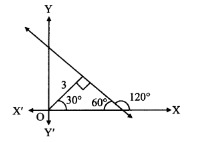
Here, α = 30° and p = 3 units Equation of line with inclination a and distance from origin as p is x cos α + y sin α = p ∴ x cos 30° + y sin 30° = ±3
$\therefore \frac{\sqrt{3} x}{2}+\frac{y}{2}= \pm 3$
∴ √3x + y ± 6 = 0 View full question & answer→MCQ 71 Mark
If the line kx + 4y = 6 passes through the point of intersection of the two lines 2x + 3y = 4 and 3x + 4y = 5, then k =
Answer2
Given two lines are
2x + 3y = 4 ……(i)
3x + 4y = 5 …….(ii)
Multiplying (i) by 3 and (ii) by 2 and then subtracting, we get
y = 2 Substituting y = 2 in (i), we get x = -1
∴ Point of intersection of lines (i) and (ii) is (-1, 2).
Given that the line kx + 4y = 6 passes through (-1, 2). k(-1) + 4(2) = 6
∴ k = 2
View full question & answer→MCQ 81 Mark
The equation of the line through (1, 2), which makes equal intercepts on the axes, is
Answerx + y = 3 Let the equation of required line be
$\frac{x}{a}+\frac{y}{b}=1 \ldots \ldots($ i)
Since the line makes equal intercepts on the axes, a = b
$\frac{x}{a}+\frac{y}{a}=1$
∴ x + y = a ……(ii) But, equation (ii) passes through (1, 2). 1 + 2 = a ∴ a = 3 Substituting a = 3 in equation (ii), we get x + y = 3
View full question & answer→MCQ 91 Mark
If A(1, -2), B(-2, 3) and C(2, -5) are the vertices of ΔABC, then the equation of median BE is
Answer13x + 7y + 5 = 0 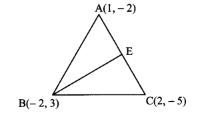
$\mathbf{E}=\left(\frac{1+2}{2}, \frac{-2-5}{2}\right)=\left(\frac{3}{2}, \frac{-7}{2}\right)$
Equation of median BE is
$\frac{y-3}{\frac{-7}{2}-3}=\frac{x+2}{\frac{3}{2}+2}$
$\frac{y-3}{\frac{-13}{2}}=\frac{x+2}{\frac{7}{2} M}$
$\begin{aligned} & 7(y-3)=-13(x+2) \\ & 7 y-21=-13 x-26 \\ & 13 x+7 y+5=0\end{aligned}$
View full question & answer→MCQ 101 Mark
If the point (1, 1) lies on the line passing through the points (a, 0) and (0, b), then
$\frac{1}{a}+\frac{1}{b}=$
Answer(C)
Line passes through (a, 0), (0, b). x-intercept = a, y-intercept = b
$\therefore$ Equation of line is $\frac{x}{a}+\frac{y}{b}=1 \ldots \ldots$ (i)
Since line (i) passes through (1, 1), (1, 1) satisfies (i)
$\therefore \frac{1}{a}+\frac{1}{b}=1$
View full question & answer→MCQ 111 Mark
If A is (5, -3) and B is a point on the X-axis such that the slope of line AB is -2, then B ≡
- A
- ✓
$\left(\frac{7}{2}, 0\right)$
- C
$\left(0, \frac{7}{2}\right)$
- D
$\left(\frac{2}{7}, 0\right)$
AnswerCorrect option: B. $\left(\frac{7}{2}, 0\right)$
$\left(\frac{7}{2}, 0\right)$Let B(x, 0) be the point on X-axis. We have A = (5, -3) slope of AB = -2
$\Rightarrow \frac{0-(-3)}{x-5}=-2$
⇒ 3 = -2(x – 5) ⇒ 3 = -2x + 10
$\Rightarrow x=\frac{7}{2}$
Co-ordinates of point $B=\left(\frac{7}{2}, 0\right)$
View full question & answer→MCQ 122 Marks
Let $P \equiv(-3,0), Q \equiv(0,0)$ and $R \equiv(3,3 \sqrt{3})$ be three points. Then the equation of the bisector of the angle $P Q R$ is
AnswerCorrect option: C. $\sqrt{3} x+y=0$
(c) : Given three points are $P(-3,0), Q(0,0)$ and $R(3,3 \sqrt{3})$
Let $Q S$ is the bisector of $\angle P Q R$.
Slope of line $Q R=\frac{3 \sqrt{3}-0}{3-0}=\sqrt{3}$
$\therefore \quad$ Angle made by $Q R$ with positive direction on $X$-axis is $\tan ^{-1} \sqrt{3}$ i.e., $\frac{\pi}{3}$ t.e., $60^{\circ}$
$
\therefore \angle P Q R=180^{\circ}-60^{\circ}=120^{\circ}
$
$\therefore \quad$ Angle made by bisector $Q S$ of $\angle P Q R$ with positive $x$-axis $=60^{\circ}+60^{\circ}=120^{\circ}$ and slope $(m)=\tan 120^{\circ}$
$\therefore$ Equation of $Q S$ is given by
$
y-0=\tan \left(120^{\circ}\right)(x-0) \text { [As QS passing through }(0,0) \text { ] }
$
$
\begin{aligned}
& \Rightarrow y=-\sqrt{3} x \\
& \Rightarrow \sqrt{3} x+y=0
\end{aligned}
$
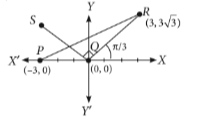
View full question & answer→MCQ 132 Marks
$p$ is the length of perpendicular from the origin to the line whose intercepts on the axes are $a$ and $b$ respectively, then $\frac{1}{a^2}+\frac{1}{b^2}$ equals
- A
$p^2$
- B
$\frac{2}{p^2}$
- ✓
$\frac{1}{p^2}$
- D
$\frac{1}{2 p^2}$
AnswerCorrect option: C. $\frac{1}{p^2}$
(c) : The equation of the line having $a$ and $b$ as intercepts on the $x$ axis and $y$ axis respectively is $\frac{x}{a}+\frac{y}{b}=1$
i.e., $b x+a y=a b$
Now, length of perpendicular from origin to the line is $p$.
$\Rightarrow p=\left|\frac{0+0-a b}{\sqrt{a^2+b^2}}\right|$
$\Rightarrow p^2=\frac{a^2 b^2}{a^2+b^2}$
$\Rightarrow \frac{1}{p^2}=\frac{1}{a^2}+\frac{1}{b^2}$
View full question & answer→MCQ 142 Marks
The equation of a line, whose perpendicular distance from the origin is 5 units and the angle, which is perpendicular to the line from the origin makes, is $210^{\circ}$ with positive $X$-axis, is
- ✓
$x \sqrt{3}+y+10=0$
- B
$x \sqrt{3}+y-10=0$
- C
$-x \sqrt{3}+y+10=0$
- D
$x \sqrt{3}-y+10=0$
AnswerCorrect option: A. $x \sqrt{3}+y+10=0$
(a) : We know that. if $p$ is the length of perpendicular distance normal from origin to a line and $\theta$ is the angle made by normal with positive $x$-axis then equation of the line is $x \cos \theta+y \sin \theta=p$
Here $p=5, q=210^{\circ}$
$\therefore$ Equation of the line is $x \cos 210^{\circ}+y \sin 210^{\circ}=5$
$\Rightarrow x \cos \left(180^{\circ}+30^{\circ}\right)+y \sin \left(180^{\circ}+30^{\circ}\right)=5$
$\Rightarrow-\frac{\sqrt{3} x}{2}-\frac{y}{2}=5$
$\Rightarrow \sqrt{3} x+y+10=0$ is the required equation of line.
View full question & answer→MCQ 152 Marks
$N(3,-4)$ is the foot of the perpendicular drawn from the origin to a line $L$. Then the equation of the line $L$ is
- ✓
$3 x-4 y-25=0$
- B
$4 x+3 y=0$
- C
$x-y-7=0$
- D
$4 x-3 y-24=0$
AnswerCorrect option: A. $3 x-4 y-25=0$
(a) : Equation of line $O N$ is
$
\begin{array}{rl}
& y-0=-\frac{4}{3}(x-0) \\
\Rightarrow & 3y+4 x=0
\end{array}
$
Since line $O N$ and line $L$ are perpendicular, so equation of line $L$ can be written as $3 x-4 y+\lambda=0$
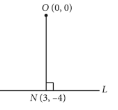
Now, line $L$ passes through point $(3,-4)$ so, it must satisfy the point.
$
\begin{aligned}
& \Rightarrow 3(3)-4(-4)+\lambda=0 \\
& \Rightarrow \lambda=-25
\end{aligned}
$
Equation of line $L$ is $3 x-4 y-25=0$ View full question & answer→MCQ 162 Marks
If the line through the points $(-2,6)$ and $(4,8)$ is perpendicular to the line passing through the points $(8,12)$ and $(x, 24)$, then the value of $x$ is
Answer(d) : Let $A(-2,6), B(4,8), C(8,12)$ and $D(x, 24)$ be the given points.
We know that if two lines are perpendicular then product of their slope is -1 .
$\therefore \quad$ Slope of $A B \times$ slope of $C D=-1$
$
\Rightarrow\left(\frac{8-6}{4+2}\right) \times\left(\frac{24-12}{x-8}\right)=-1
$
$\left[\because\right.$ Slope of line passing through $\left(x_1, y_1\right)$ and
$
\left(x_2, y_2\right) \text { is } \frac{y_2-y_1}{x_2-x_1} \text { ] }
$
$\Rightarrow \frac{1}{3} \times \frac{12}{x-8}=-1 \Rightarrow 4=-x+8 \Rightarrow x=4$
View full question & answer→MCQ 172 Marks
The acute angle between the lines $x=-y, z=0$ and $x=0, z=0$ is
- A
$\pi / 6$
- B
$\pi / 18$
- C
$\pi / 3$
- ✓
$\pi / 4$
AnswerCorrect option: D. $\pi / 4$
(d) : The equations $x=-y, z=0$ can be written as
$
\frac{x}{1}=\frac{y}{-1}, z=0
$
$\therefore$ The direction ratios of this line are $1,-1,0$.
The direction ratios of the line $x=0, z=0$ are $0,1,0$ (i.e, $y$-axis).
Let $\vec{a}$ and $\vec{b}$ be the vectors in the direction of the line $x=-y, z=0$ and $x=0, z=0$ respectively.
$
\therefore \vec{a}=\hat{i}-\hat{j}, \vec{b}=\hat{j} \quad \therefore \quad \vec{a} \cdot \vec{b}=-1
$
Also, $|\vec{a}|=\sqrt{(1)^2+(-1)^2}=\sqrt{2},|\vec{b}|=1$
Let $\theta$ be the acute angle between the given lines
$
\cos \theta=\left|\frac{\vec{a} \cdot \vec{b}}{|\vec{a}||\vec{b}|}\right|=\left|\frac{-1}{\sqrt{2}}\right|=\frac{1}{\sqrt{2}} \Rightarrow \theta=\cos ^{-1}\left(\frac{1}{\sqrt{2}}\right)=\frac{\pi}{4}
$
View full question & answer→MCQ 182 Marks
Find the equation of the line through the intersection of $3 x+4 y-7=0$ and $x=y-2$, and whose slope is 5 .
- ✓
$35 x-7 y+18=0$
- B
$33 x-7 y+18=0$
- C
$35 x-8 y+18=0$
- D
$35 x-7 y+20=0$
AnswerCorrect option: A. $35 x-7 y+18=0$
(a) : Given lines are $3 x+4 y-7=0$
and $x-y+2=0$.
Any line through the intersection of these lines is
$
3 x+4 y-7+k(x-y+2)=0,
.....(i)$
where $k$ is a parameter.
$\Rightarrow(3+k) x+(4-k) y-7+2 k=0$
Slope of this line $=-\left(\frac{3+k}{4-k}\right)=5$ (Given)
$\Rightarrow-3-k=20-5 k \Rightarrow 4 k=23 \Rightarrow k=\frac{23}{4}$
Substituting this value of $k$ in (i), we get
$
3 x+4 y-7+\frac{23}{4}(x-y+2)=0 \Rightarrow 35 x-7 y+18=0
$
View full question & answer→MCQ 192 Marks
If a line passing through $(2,2)$ is perpendicular to the line $3 x+y=3$, its $x$-intercept is given by
- A
$\frac{4}{3}$
- B
$-\frac{4}{3}$
- ✓
- D
Answer(c) : Slope of the line $3 x+y-3=0$ is -3 . Therefore, slope of line perpendicular to given line is $m=\frac{-1}{-3}=\frac{1}{3}$.
Now, equation of line having slope $\frac{1}{3}$ and passing through $(2,2)$ is $(y-2)=\frac{1}{3}(x-2)$
$\Rightarrow x-3 y+4=0 \Rightarrow \frac{x}{-4}+\frac{y}{4 / 3}=1$
$\Rightarrow x$-intercept is - 4
View full question & answer→MCQ 202 Marks
If $P(2,2), Q(-2,4)$ and $R(3,4)$ are the vertices of $\triangle P Q R$ then the equation of the median through vertex $R$ is
- A
$x+3 y+9=0$
- ✓
$x-3 y+9=0$
- C
$x-3 y-9=0$
- D
$x+3 y-9=0$
AnswerCorrect option: B. $x-3 y+9=0$
(b) : Let the median through vertex $R$ cuts the line segment $P Q$ at $S\left(x_1, y_1\right)$.
Since $R S$ is median, so, $S$ is mid point of $P Q$.
$\therefore\left(x_1, y_1\right)=\left(\frac{2+(-2)}{2}, \frac{2+4}{2}\right)$
$\Rightarrow x_1=0, y_1=3$
Now, equation of median RS is given by
$
\begin{aligned}
& y-4=\frac{3-4}{0-3}(x-3) \\
& \Rightarrow y-4=\frac{1}{3}(x-3) \Rightarrow x-3 y+9=0
\end{aligned}
$
View full question & answer→MCQ 212 Marks
The $y$-intercept of the line passing through $A(6,1)$ and perpendicular to the line $x-2 y=4$ is
Answer(b) : Let $y=m x+c$ be the line passing through $A(6,1)$ and perpendicular to line $x-2 y=4$.
Slope of line $x-2 y=4$ is $\frac{-1}{-2}=\frac{1}{2}$
$\because y=m x+c$ is perpendicular to $x-2 y=4$.
$\therefore m \times \frac{1}{2}=-1 \Rightarrow m=-2$
Also, $y=m x+c$ passes through $(6,1)$.
$\therefore 1=(-2)(6)+c \Rightarrow 1=-12+c \Rightarrow c=13$
View full question & answer→MCQ 222 Marks
The equation of the line passing through the point $(-3,1)$ and bisecting the angle between co-ordinate axes is
- ✓
$x+y+2=0$
- B
$-x+y+2=0$
- C
$x-y+4=0$
- D
$2 x+y+5=0$
AnswerCorrect option: A. $x+y+2=0$
(a) : Equation of line passing through $(-3,1)$ and making angle $135^{\circ}$ with $x$-axis is $y-1=\tan 135^{\circ}(x+3)$ $\left[\because m=\tan 135^{\circ}\right]$
$
\begin{aligned}
& \Rightarrow y-1=(-1)(x+3) \\
& \Rightarrow x+y-1+3=0 \Rightarrow x+y+2=0
\end{aligned}
$
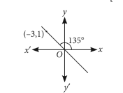
View full question & answer→MCQ 232 Marks
Let $\alpha$ be the distance between the line -x + y = 2 and x - y = 2 and \[\beta\] be the distance between the lines $4 x-3 y=5$ and $6 y-8 x=1$, then
- ✓
$20 \sqrt{2} \beta=11 \alpha$
- B
$20 \sqrt{2} \alpha=11 \beta$
- C
$11 \sqrt{2} \beta=20 \alpha$
- D
AnswerCorrect option: A. $20 \sqrt{2} \beta=11 \alpha$
(A)
Distance between lines $-x+y=2$ and$x-y=2 \text { is } \alpha=\left|\frac{2+2}{\sqrt{2}}\right|=2 \sqrt{2}$
Distance between lines $4 x-3 y=5$ and $6 y-8 x=1$ is
$\beta=\left|\frac{5-\left(\frac{-1}{2}\right)}{5}\right|=\frac{11}{10}$
From (i) and (ii), we get
\begin{array}{l}\frac{\alpha}{\beta}=\frac{2 \sqrt{2}}{11 / 10} \\\Rightarrow 20 \sqrt{2 \beta}=11 \alpha\end{array}
View full question & answer→MCQ 242 Marks
The equation of straight line equally inclined to the axis and equidistant from the points: (1, -2) and (3, 4) is ax + by + c = 0, where
Answer(B)
Slope of given line $a x+b y+c=0$ is $-\frac{a}{b}$.
$-\frac{a}{b}= \pm 1 \Rightarrow a= \pm b$
Distance of line $a x+b y+c=0$ from $(1,-2)$
$=\frac{|a-2 b+c|}{\sqrt{a^2+b^2}}$
Distance of line $a x+ b y+ c =0$ from $(3,4)$
$=\frac{|3 a+4 b+c|}{\sqrt{a^2+b^2}}$
According to the given condition,
$\frac{|a-2 b+c|}{\sqrt{a^2+b^2}}=\frac{|3 a+4 b+c|}{\sqrt{a^2+b^2}}$
$\Rightarrow 3 a+4 b+c= \pm(a-2 b+c)$
$\Rightarrow a +3 b=0 \quad$ (taking + ve $) \quad $ ...(ii)
$\Rightarrow 2 a + b + c =0$ (taking-ve) … (iii)
From, (i) and (ii), we get $a = b =0$ which is not possible so taking (i) and (iii), (taking $a =- b$ ) we get
a+c=0 $\Rightarrow c=-a$
∴ Option (B) satisfies the condition for $a , b , c$
∴ Option (B) is correct answer.
View full question & answer→MCQ 252 Marks
Number of points having distance $\sqrt{5}$ from the straight line x - 2y + 1 = 0 and a distance $\sqrt{13}$ from the line 2x + 3y - 1 = 0 is
Answer(C)
Let point $\left(x_1, y_1\right)$ be at distance $\sqrt{5}$ from
$x-2 y+1=0$
$\therefore \quad \sqrt{5}=\left|\frac{x_1-2 y_1+1}{\sqrt{1+4}}\right|$
$\therefore \quad x_1-2 y_1+1= \pm 5$ ...(i)
Let point $\left(x_2, y_2\right)$ be at distance $\sqrt{13}$ from
$2 x+3 y-1=0$
$\therefore \quad \sqrt{13}=\left|\frac{2 x_2+3 y_2-1}{\sqrt{4+9}}\right|$
$\therefore \quad 2 x_2+3 y_2-1= \pm 13$ ...(ii)
∴ Equation (i) and (ii) will give us total 4 points.
$\therefore$ answer is option (C)
View full question & answer→MCQ 262 Marks
The angular points of a triangle are A (-1, -7), B(5, 1) and C(1, 4). The equation of the bisector of the $\angle ABC$ is
Answer(B)
Equation of AB: $4 x-3 y-17=0$
Equation of BC: $3 x+4 y-19=0$
If $P (x, y)$ is a point on the bisector of $\angle ABC$ then,
$\left|\frac{4 x-3 y-17}{\sqrt{(4)^2+(-3)^2}}\right|=\left|\frac{3 x+4 y-19}{\sqrt{(3)^2+(4)^2}}\right|$
∴ $7 y=x+2$ is the required equation of the angle bisector.
View full question & answer→MCQ 272 Marks
The diagonals of the parallelogram whose sides are Lx + my + n = 0, lx + my + n' = 0, mx + ly + n = 0 mx + ly + n' = 0 include an angle
AnswerCorrect option: B. $\frac{\pi}{2}$
(B)
Since, the distance between the parallel lines $l x+ m y+ n =0$ and $l x+ m y+ n ^{\prime}=0$ is same as the distance between parallel lines $m x+y+ n =0$ and $m x+l y+ n ^{\prime}=0$. Therefore, the parallelogram is a rhombus. Since, the diagonals of a rhombus are at right angles, therefore the required angle is $\frac{\pi}{2}$.
View full question & answer→MCQ 282 Marks
The ratio in which the line 3x + 4y + 2 = 0 divides the distance between 3x + 4y + 5 = 0 and
3x + 4y - 5 = 0, is
Answer(B)
Lines $3 x+4 y+2=0$ and $3 x+4 y+5=0$ are on the same side of the origin.The distance between these lines is $d_1=\left|\frac{2-5}{\sqrt{3^2+4^2}}\right|=\frac{3}{5}$.
Lines $3 x+4 y+2=0$ and $3 x+4 y-5=0$ are on the opposite sides of the origin. The distance between these lines is $d_2=\left|\frac{2+5}{\sqrt{3^2+4^2}}\right|=\frac{7}{5}$.
Thus, $3 x+4 y+2=0$ divides the distance between $3 x+4 y+5=0$ and $3 x+4 y-5=0$ in the ratio $d _1: d _2$ i.e., $3: 7$.Thus, $3 x+4 y+2=0$ divides the distance between $3 x+4 y+5=0$ and $3 x+4 y-5=0$ in the ratio $d _1: d _2$ i.e., $3: 7$.
View full question & answer→MCQ 292 Marks
A line L makes intercepts a and b on the coordinate axes. The axes are rotated through an angle \[
\theta\] in the positive direction, keeping the origin fixed. If the line L makes intercepts p and q on the new coordinate axes, then $\frac{1}{a^2}+\frac{1}{b^2}=$
AnswerCorrect option: C. $\frac{1}{p^2}+\frac{1}{q^2}$
(C)
Let the equation of line L be $\frac{x}{ a }+\frac{y}{b}=1$
The equation of the line L making intercepts p and q on the new coordinate axes is $\frac{x}{ p }+\frac{y}{ q }=1$
When the axes are rotated through an angle $\theta$ in the positive direction, keeping the origin fixed, the length of the perpendicular from the origin remains the same.
∴ $\begin{array}{l}\left|\frac{1}{\sqrt{\frac{1}{a^2}+\frac{1}{b^2}}}\right|=\left|\frac{-1}{\sqrt{\frac{1}{p^2}+\frac{1}{q^2}}}\right| \\\Rightarrow \frac{1}{a^2}+\frac{1}{b^2}=\frac{1}{p^2}+\frac{1}{q^2}\end{array}$
View full question & answer→MCQ 302 Marks
If the equations $y= m x+ c$ and $x \cos \alpha+y \sin \alpha= p$ represent the same straight line, then
- A
$p=c \sqrt{1+m^2}$
- ✓
$c=p \sqrt{1+m^2}$
- C
$c p=\sqrt{1+m^2}$
- D
$p^2+c^2+m^2=1$
AnswerCorrect option: B. $c=p \sqrt{1+m^2}$
(B)
If the given lines represent the same line, then the length of the perpendiculars from the origin to the lines are equal.
∴ $\frac{c}{\sqrt{1+m^2}}=\frac{p}{\sqrt{\cos ^2 \alpha+\sin ^2 \alpha}}$
$\Rightarrow c = p \sqrt{1+ m ^2}$
View full question & answer→MCQ 312 Marks
A straight line makes an intercept on the Y-axis twice as long as that on X-axis and is at a unit distance from the origin. Then the line is represented by the equations
- A
$2 x+3 y= \pm \sqrt{5}$
- B
$x+y= \pm 2$
- C
$x-y= \pm 2$
- ✓
$2 x+y= \pm \sqrt{5}$
AnswerCorrect option: D. $2 x+y= \pm \sqrt{5}$
(D)
Given $b =2 a$
The equation of the line is $\frac{x}{a}+\frac{y}{b}=1$
$\begin{array}{l}\Rightarrow \frac{x}{a}+\frac{y}{2 a}=1 \\\Rightarrow 2 x+y=2 a\end{array}$
Distance of the line from $(0,0)$ is
$\begin{array}{l}d=\left|\frac{2(0)+1(0)-2 a}{\sqrt{4+1}}\right| \\\Rightarrow l=\left|\frac{-2 a}{\sqrt{5}}\right| \\\Rightarrow a= \pm \frac{\sqrt{5}}{2}\end{array}$
Equation of line is $2 x+y= \pm \sqrt{5}$
View full question & answer→MCQ 322 Marks
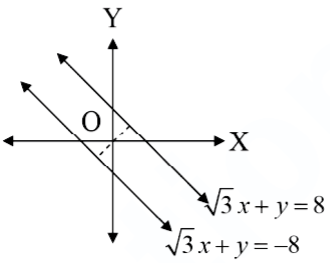
Equation of a straight line on which length of perpendicular from the origin is four units and the line makes an angle of $120^{\circ}$ with the X-axis, is
- A
$x \sqrt{3}+y+8=0$
- B
$x \sqrt{3}-y=-8$
- C
$x \sqrt{3}-y=8$
- D
$x-\sqrt{3} y+8=0$
View full question & answer→MCQ 332 Marks
The equation of one of the lines parallel to 4x - 3y = 5 and at a unit distance from the point (-1, -4) is
Answer(D)
Equation of straight line parallel to
$4 x-3 y=5$ is $4 x-3 y=\lambda$
According to the given condition,
$\frac{4(-1)-3(-4)-\lambda}{\sqrt{16+9}}= \pm 1$
$\Rightarrow 8-\lambda= \pm 5$
$\Rightarrow \lambda=3,13$
∴ the equation of one of the lines is $4 x-3 y-3=0$
View full question & answer→MCQ 342 Marks
The equations of the lines through the point of intersection of the lines x - y + 1 = 0 and 2x - 3y + 5 = 0 and whose distance from the point (3, 2) is $\frac{7}{5}$, are
- A
3x - 4y - 6 = 0 and 4x + 3y + 1 = 0
- B
3x - 4y + 6 = 0 and 4x - 3y - 1 = 0
- ✓
3x - 4y + 6 = 0 and 4x - 3y + 1 = 0
- D
3x - 4y - 6 = 0 and 4x + 3y - 1 = 0
AnswerCorrect option: C. 3x - 4y + 6 = 0 and 4x - 3y + 1 = 0
(C)
Point of intersection is $(2,3)$.
Therefore, the equation of line passing through $(2,3)$ is $y-3= m (x-2)$
or $m x-y-(2 m-3)=0$
According to the given condition,
$\begin{array}{l}\left|\frac{3 m-2-(2 m-3)}{\sqrt{1+m^2}}\right|=\frac{7}{5} \\\Rightarrow m=\frac{3}{4}, \frac{4}{3}\end{array}$
Hence, the equations are $3 x-4 y+6=0$ and $4 x-3 y+1=0$.
View full question & answer→MCQ 352 Marks
The equation of the line passing through the point of intersection of the lines 2x + y - 4 = 0 , x - 3y + 5 = 0 and lying at a distance of $\sqrt{5}$ units from the origin, is
Answer(B)
Point of intersection is $(1,2)$
Therefore, the equation of line passing through $(1,2)$ is $(y-2)= m (x-1)$
i.e., $m x-y+2-m=0$
Since, the line is at distance of $\sqrt{5}$ from origin i.e. $(0,0)$,
$\left|\frac{(0) m -(0)+2- m }{\sqrt{ m ^2+1}}\right|=\sqrt{5}$
$\Rightarrow m =\frac{-1}{2}$
∴ Equation of the line is $x+2 y-5=0$
View full question & answer→MCQ 362 Marks
The equations of the lines passing through the point (1, 0) and at a distance $\frac{\sqrt{3}}{2}$ from the origin, are
- ✓
$\sqrt{3} x+y-\sqrt{3}=0, \sqrt{3} x-y-\sqrt{3}=0$
- B
$\sqrt{3} x+y+\sqrt{3}=0, \sqrt{3} x-y+\sqrt{3}=0$
- C
$x+\sqrt{3} y-\sqrt{3}=0, x-\sqrt{3} y-\sqrt{3}=0$
- D
$x-\sqrt{3} y+\sqrt{3}=0, x-\sqrt{3} y-\sqrt{3}=0$
AnswerCorrect option: A. $\sqrt{3} x+y-\sqrt{3}=0, \sqrt{3} x-y-\sqrt{3}=0$
(A)
The equation of lines passing through $(1,0)$ is given by $y= m (x-1)$.
Its distance from origin is $\frac{\sqrt{3}}{2}$.
$\Rightarrow\left|\frac{-m}{\sqrt{1+m^2}}\right|=\frac{\sqrt{3}}{2} \Rightarrow m= \pm \sqrt{3}$
Hence, the lines are $\sqrt{3} x+y-\sqrt{3}=0$ and $\sqrt{3} x-y-\sqrt{3}=0$
Alternate Method:
Consider, option (A)
Point $(1,0)$ satisfies equations $\sqrt{3} x+y-\sqrt{3}=0$ and $\sqrt{3} x-y-\sqrt{3}=0$
View full question & answer→MCQ 372 Marks
The equations of two lines through (0, a) which are at distance 'a' from the point (2a, 2a) are
- A
y - a = 0 and 4x - 3y - 3a = 0
- B
y - a = 0 and 3x - 4y + 3a = 0
- ✓
y - a = 0 and 4x - 3y + 3a = 0
- D
y - a = 0 and 3x - 4y - 3a = 0
AnswerCorrect option: C. y - a = 0 and 4x - 3y + 3a = 0
(C)
Equation of any line through $(0, a)$ is
$y- a = m (x-0)$
If the length of perpendicular from $(2 a , 2 a )$ to the line (i) is 'a', then $a= \pm \frac{m(2 a)-2 a+a}{\sqrt{m^{\prime}+1}}$
$\Rightarrow m=0, \frac{4}{3}$
Hence, the required equations of lines are
$y- a =0,4 x-3 y+3 a =0$
View full question & answer→MCQ 382 Marks
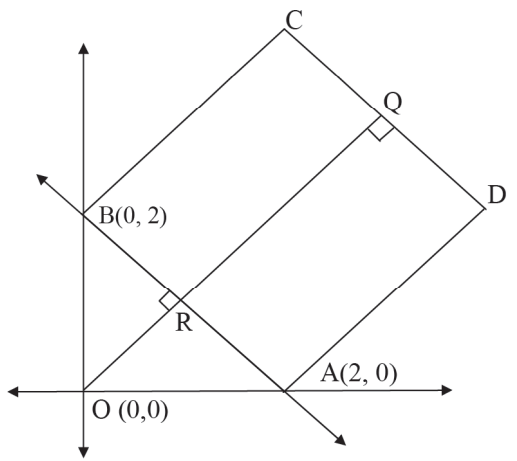
On the portion of the straight line x + y = 2 which is intercepted between the axes, a square is constructed away from the origin with this portion as one of its side. If p denotes the perpendicular distance of a side of this square from the origin, then the maximum value of p is
- A
$3 \sqrt{2}$
- B
$2 \sqrt{3}$
- C
$\frac{2}{\sqrt{3}}$
- D
$\frac{3}{\sqrt{2}}$
View full question & answer→MCQ 392 Marks
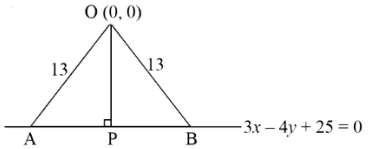
If O is the origin and A and B are points on the line 3x - 4y + 25 = 0 such that OA = OB = 13, then the area of $\triangle OAB$ (in sq.units) is
View full question & answer→MCQ 402 Marks
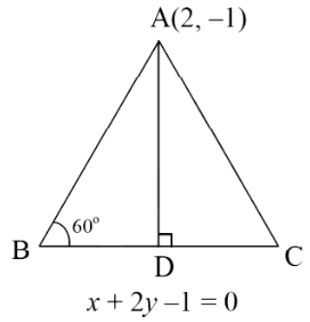
The vertex of an equilateral triangle is (2, -1) and the equation of its base is x + 2y = 1. The length of its sides is
- A
$\frac{4}{\sqrt{15}}$
- B
$\frac{2}{\sqrt{15}}$
- C
$\frac{4}{3 \sqrt{3}}$
- D
$\frac{1}{\sqrt{5}}$
View full question & answer→MCQ 412 Marks
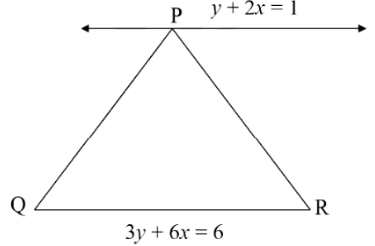
P is a point on the line y + 2x = 1 and Q and R are two points on the line 3y + 6x = 6 such that triangle PQR is an equilateral triangle. The length of the side of the triangle is
- A
$\frac{1}{\sqrt{15}}$
- B
$\frac{2}{\sqrt{15}}$
- C
$\frac{2}{\sqrt{5}}$
- D
$\frac{4}{\sqrt{5}}$
View full question & answer→MCQ 422 Marks
The points on the X-axis whose perpendicular distance from the line $\frac{x}{a}+\frac{y}{b}=1$ is a, are
- ✓
$\left[\frac{ a }{ b }\left( b \pm \sqrt{ a ^2+ b ^2}\right), 0\right]$
- B
$\left[\frac{ b }{ a }\left( b \pm \sqrt{ a ^2+ b ^2}\right), 0\right]$
- C
$\left[\frac{ a }{ b }\left( a \pm \sqrt{ a ^2+ b ^2}\right), 0\right]$
- D
AnswerCorrect option: A. $\left[\frac{ a }{ b }\left( b \pm \sqrt{ a ^2+ b ^2}\right), 0\right]$
(A)
Let the point be $(h, 0)$, then $a=\left|\frac{b h+0-a b}{\sqrt{a^2+b^2}}\right|$
$\Rightarrow bh = \pm a \sqrt{ a ^2+ b ^2}+ ab$
$\Rightarrow h =\frac{ a }{ b }\left( b \pm \sqrt{ a ^2+ b ^2}\right)$
Hence, the points are $\left\{\frac{a}{b}\left(b \pm \sqrt{a^2+b^2}\right), 0\right\}$.
View full question & answer→MCQ 432 Marks
The product of the perpendiculars drawn from the points $\left( \pm \sqrt{a^2-b^2}, 0\right)$ on the line $\frac{x}{a} \cos \theta+\frac{y}{b} \sin \theta=1$, is
- A
$a^2$
- ✓
$b^2$
- C
$a^2+b^2$
- D
$a^2-b^2$
Answer(B)
$\begin{array}{l}p_1 p_2=\left|\frac{b \sqrt{a^2-b^2} \cos \theta+0-a b}{\sqrt{b^2 \cos ^2 \theta+a^2 \sin ^2 \theta}}\right| \\ \times\left|\frac{-b \sqrt{a^2-b^2} \cos \theta+0-a b}{\sqrt{b^2 \cos ^2 \theta+a^2 \sin ^2 \theta}}\right| \\ =\left|\frac{-b^2\left(a^2-b^2\right) \cos ^2 \theta+a^2 b^2}{\left(b^2 \cos ^2 \theta+a^2 \sin ^2 \theta\right)}\right| \\ =\left|\frac{b^2\left(a^2-a^2 \cos ^2 \theta+b^2 \cos ^2 \theta\right)}{b^2 \cos ^2 \theta+a^2 \sin ^2 \theta}\right| \\ =\frac{b^2\left[a^2 \sin ^2 \theta+b^2 \cos ^2 \theta\right]}{b^2 \cos ^2 \theta+a^2 \sin ^2 \theta}=b^2\end{array}$
View full question & answer→MCQ 442 Marks
The points on the line x + y = 4 which lie at a unit distance from the line 4x + 3y = 10, are
Answer(A)
Let the point be $( h , k )$, then $h + k =4 \ldots$ (i)
and $1=\left|\frac{4 h+3 k -10}{\sqrt{4^2+3^2}}\right|$
$\Rightarrow 4 h+3 k =15$ ...(ii)
and $4 h+3 k=5$ (iii)
On solving (i) and (ii), and (i) and (iii), we get the required points $(3,1)$ and $(-7,11)$.
View full question & answer→MCQ 452 Marks
A point equidistant from the lines 4x + 3y + 10 = 0, 5x - 12y + 26 = 0 and 7x + 24y - 50 = 0 is
Answer(C)
Consider option (C), lengths of perpendiculars from $(0,0)$ on the given lines are each equal to 2 .
View full question & answer→MCQ 462 Marks
The line parallel to the X-axis and passing through the intersection of the lines ax + 2by + 3b = 0 and bx - 2ay - 3a = 0 where $(a, b) \neq(0,0)$ is
- A
above the X-axis at a distance of 3/2 from it
- B
above the X-axis at a distance of 2/3 from it
- ✓
below the X-axis at a distance of 3/2 from it
- D
below the X-axis at a distance of 2/3 from it
AnswerCorrect option: C. below the X-axis at a distance of 3/2 from it
(C)
Solving equations $a x+2 b y+3 b=0$ and $b x-2 a y-3 a =0$
we get,
$x=0$ and $y=\frac{-3}{2}$
i.e., it is $\frac{3}{2}$ unit bclow X -axis.
View full question & answer→MCQ 472 Marks
A line passes through the point of intersection of the lines 3x + y + 1 = 0 and 2x - y + 3 = 0 and makes equal intercepts with axes. equation of the line is
Answer(A)
The point of intersection of the lines
$3 x+y+1=0$ and $2 x-y+3=0$ are $\left(\frac{-4}{5}, \frac{7}{5}\right)$.
The equation of line which makes equal intercepts with the axes is $x+y= a$.
∴ $-\frac{4}{5}+\frac{7}{5}=a \Rightarrow a=\frac{3}{5}$
∴ the required equation of the line is
$x+y-\frac{3}{6}=0 \text { i.e., } 5 x+5 y-3=0$
View full question & answer→MCQ 482 Marks
The equation of straight line passing through point of intersection of the straight lines 3x - y + 2 = 0 and 5x - 2y + 7 = 0 and having infinite slope is
Answer(C)
Required equation is
$(3 x-y+2)+\lambda(5 x-2 y+7)=0 \quad \ldots$ (i)
$\Rightarrow(3+5 \lambda) x-(2 \lambda+1) y+(2+7 \lambda)=0$
$\Rightarrow y=\frac{3+5 \lambda}{2 \lambda+1}x+\frac{2+7 \lambda}{2 \lambda+1}$ ...(ii)
As the equation (ii), has infinite slope,
$2 \lambda+1=0$
$\Rightarrow \lambda=-1 / 2$
Putting $\lambda=-1 / 2$ in equation (i), we get
$(3 x-y+2)+(-1 / 2)(5 x-2 y+7)=0$
$\Rightarrow x=3$
Alternate Method :
The point of intersection of $3 x-y+2=0$ and $5 x-2 y+7=0$ is $(3,11)$
$\quad$$\quad$...[By solving equations simultaneously]
The required line has infinite slope (i .e. parallel to y- axis) and passes through (3, 11).
$\Rightarrow x=3$ is required equation.
View full question & answer→MCQ 492 Marks
The equation of the line joining the centroid with the orthocentre of the triangle formed by the points (-2, 3), (2, -1), (4, 0) is
Answer(B)
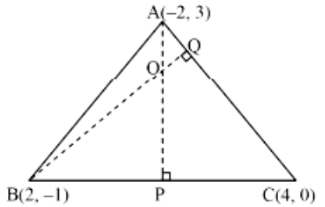
In $\triangle ABC$;
slope of $BC =\frac{0-(-1)}{4-2}=\frac{1}{2}$
slope of $AC =\frac{0-3}{4-(-2)}=\frac{-3}{6}=\frac{-1}{2}$
Since, $AP \perp BC$ and $BQ \perp AC$,
∴ slope of $AP =-2$,
slope of $BQ =2$
∴ Equation of AP is $2 x+y+1=0$ and equation of BQ is $2 x - y - 5 = 0$
Solving the above equations, we get orthocentre, $O =(1,-3)$
Also, centroid of the triangle,
$C=\left(\frac{-2+2+4}{3}, \frac{3-1+0}{3}\right)$
i.e., $C =\left(\frac{4}{3}, \frac{2}{3}\right)$
∴ Equation of line joining O and C
i.e., $\frac{y-\frac{2}{3}}{\frac{2}{3}-(-3)}-\frac{x\frac{4}{3}}{\frac{4}{3}-1}$
$\Rightarrow 11 x-y-14=0$
View full question & answer→MCQ 502 Marks
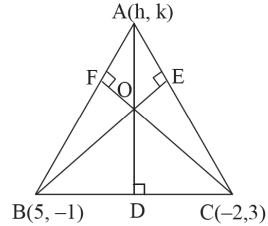
Two vertices of a triangle are (5, -1) and (-2, 3). If the origin is the orthocentre of this triangle, then the coordinates of the third vertex of that triangle are