Question 15 Marks
If $x = a \cos \theta, y = b \sin \theta$, show that $a^2\left[y \frac{d^2 y}{d x^2}+\left(\frac{d y}{d x}\right)^2\right]+b^2=0$
View full question & answer→Question 25 Marks
If $\log y=\log (\sin x)-x^2$, show that $\frac{d^2 y}{d x^2}+4 x \frac{d y}{d x}+\left(4 x^2+3\right) y=0$
View full question & answer→Question 35 Marks
If $y^2=a^2 \cos ^2 x+b^2 \sin ^2 x$, show that $y+\frac{d^2 y}{d x^2}=\frac{a^2 b^2}{y^3}$
View full question & answer→Question 45 Marks
Differentiate $\tan ^{-1}\left(\frac{\sqrt{1+x^2}-1}{x}\right)$ w.r.t. $\cos ^{-1}\left(\sqrt{\frac{1+\sqrt{1+x^2}}{2 \sqrt{1+x^2}}}\right)$
View full question & answer→Question 55 Marks
Differentiate $\log \left[\frac{\sqrt{1+x^2}+x}{\sqrt{1+x^2}-x}\right]$ w.r.t. $\cos (\log x)$
View full question & answer→Question 65 Marks
Differentiate $\tan ^{-1}\left(\frac{\sqrt{1+x^2}-1}{x}\right)$ w.r.t. $\tan ^{-1}\left(\frac{2 x \sqrt{1-x^2}}{1-2 x^2}\right)$
View full question & answer→Question 75 Marks
If $x \sin (a+y)+\sin a \cos (a+y)=0$, then show $\frac{d y}{d x}=\frac{\sin ^2(a+y)}{\sin a}$
View full question & answer→Question 85 Marks
If $x \sqrt{1-y^2}+y \sqrt{1-x^2}=1$, then show that $\frac{d y}{d x}=-\sqrt{\frac{1-y^2}{1-x^2}}$
View full question & answer→Question 95 Marks
If $\sqrt{y+x}+\sqrt{y-x}=c_i$ show that $\frac{d y}{d x}=\frac{y}{x}-\sqrt{\frac{y^2}{x^2}-1}$
View full question & answer→Question 105 Marks
Differentiate the following w.r.t. x:$\tan ^{-1}\left[\sqrt{\frac{\sqrt{1+x^2+x}}{\sqrt{1+x^2}-x}}\right]$
View full question & answer→Question 115 Marks
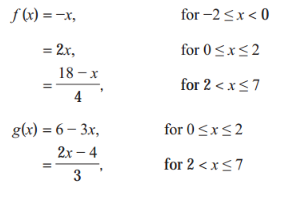
Let u(x) = f[g(x)], v(x) = g[f(x)] and w(x) = g[g(x)]. Find each derivative at x = 1, if it exists i.e. find u'(1), v'(1) and w'(1). if it doesn’t exist then explain why?
Question 125 Marks
Differentiate the following w. r. t. x.$y=\left(1+\cos ^2 x\right)^4 \times \sqrt{x+\sqrt{\tan x}}$
View full question & answer→Question 135 Marks
Find the $n^{\text {th }}$ derivative of the following : $e^{a x} \sin (b x+c)$
AnswerLet $y=e^{a x} \sin (b x+c)$
Differentiate w.r. t. $x$
$
\begin{aligned}
\frac{d y}{d x} & =\frac{d}{d x}\left[e^{a x} \sin (b x+c)\right]=e^{a x} \frac{d}{d x}[\sin (b x+c)]+[\sin (b x+c)] \frac{d}{d x}\left(e^{a x}\right) \\
& =e^{a x} \cos (b x+c) \frac{d}{d x}(b x+c)+\sin (b x+c) \cdot e^{a x} \cdot \frac{d}{d x}(a x) \\
& =e^{a x}[b \cos (b x+c)+a \sin (b x+c)] \\
& =e^{a x} \sqrt{a^2+b^2}\left[\frac{b}{\sqrt{a^2+b^2}} \cos (b x+c)+\frac{a}{\sqrt{a^2+b^2}} \sin (b x+c)\right]
\end{aligned}
$
Let $\frac{b}{\sqrt{a^2+b^2}}=\sin \alpha, \frac{b}{\sqrt{a^2+b^2}}=\cos \alpha, \alpha=\tan ^{-1}\left(\frac{b}{a}\right)$
$
\begin{aligned}
& \frac{d y}{d x}=e^{a x} \sqrt{a^2+b^2}[\sin \alpha \cdot \cos (b x+c)+\sin (b x+c) \cdot \cos \alpha] \\
& \frac{d y}{d x}=e^{a x}\left(a^2+b^2\right)^{\frac{1}{2}} \cdot \sin (b x+c+\alpha)
\end{aligned}
$
Differentiate $w . r . t . x$
$
\begin{aligned}
\frac{d}{d x}\left(\frac{d y}{d x}\right) & =\frac{d}{d x}\left[e^{a x}\left(a^2+b^2\right)^{\frac{1}{2}} \cdot \sin (b x+c+\alpha)\right] \\
& =\left(a^2+b^2\right)^{\frac{1}{2}} \cdot \frac{d}{d x}\left[e^{a x} \cdot \sin (b x+c+\alpha)\right] \\
& =\left(a^2+b^2\right)^{\frac{1}{2}}\left[e^{a x} \frac{d}{d x}[\sin (b x+c+\alpha)]+[\sin (b x+c+\alpha)] \frac{d}{d x}\left[e^{a x}\right]\right] \\
& =\left(a^2+b^2\right)^{\frac{1}{2}}\left[e^{a x} \cos (b x+c+\alpha) \frac{d}{d x}(b x+c+\alpha)+\sin (b x+c+\alpha) \cdot e^{a x} \frac{d}{d x}(a x)\right] \\
& =e^{a x}\left(a^2+b^2\right)^{\frac{1}{2}}[b \cos (b x+c+\alpha)+a \sin (b x+c+\alpha)] \\
& =e^{a x}\left(a^2+b^2\right)^{\frac{1}{2}} \sqrt{a^2+b^2}\left[\frac{b}{\sqrt{a^2+b^2}} \cos (b x+c+\alpha)+\frac{a}{\sqrt{a^2+b^2}} \sin (b x+c+\alpha)\right] \\
\frac{d^2 y}{d x^2} & =e^{a x}\left(a^2+b^2\right)^{\frac{2}{2}}[\sin \alpha \cos (b x+c+\alpha)+\sin (b x+c+\alpha) \cos \alpha] \quad \ldots[\text { from (I) ] } \\
\frac{d^2 y}{d x^2} & =e^{a x}\left(a^2+b^2\right)^{\frac{2}{2}} \cdot \sin (b x+c+2 \alpha)
\end{aligned}
$
Similarly,
$
\frac{d^3 y}{d x^3}=e^{a x}\left(a^2+b^2\right)^{\frac{3}{2}} \cdot \sin (b x+c+3 \alpha)
$
In general $n^{\text {th }}$ order derivative will be
$
\frac{d^n y}{d x^n}=e^{a x}\left(a^2+b^2\right)^{\frac{n}{2}} \cdot \sin (b x+c+n \alpha) \text { where } \alpha=\tan ^{-1}\left(\frac{b}{a}\right)
$
View full question & answer→Question 145 Marks
Find the $n^{\text {th }}$ derivative of the following : $\cos (a x+b)$
AnswerLet $y=\cos (a x+b)$
Differentiate w.r.t. $x$
$
\begin{aligned}
\frac{d y}{d x} & =\frac{d}{d x}[\cos (a x+b)] \\
& =-\sin (a x+b) \frac{d}{d x}(a x+b) \\
& =\cos \left(\frac{\pi}{2}+a x+b\right)(a) \\
\frac{d y}{d x} & =a \cos \left(\frac{\pi}{2}+a x+b\right)
\end{aligned}
$
Differentiate w.r.t. $x$
$
\begin{aligned}
& \frac{d}{d x}\left(\frac{d y}{d x}\right)=\frac{d}{d x}\left[a \cos \left(\frac{\pi}{2}+a x+b\right)\right] \\
& \frac{d}{d x}\left(\frac{d y}{d x}\right)=a \frac{d}{d x}\left[\cos \left(\frac{\pi}{2}+a x+b\right)\right] \\
& \frac{d^2 y}{d x^2}=a\left[-\sin \left(\frac{\pi}{2}+a x+b\right)\right] \frac{d}{d x}\left(\frac{\pi}{2}+a x+b\right) \\
& \quad=a \cos \left(\frac{\pi}{2}+\frac{\pi}{2}+a x+b\right)(a) \\
& \frac{d^2 y}{d x^2}=a^2 \cos \left(\frac{2 \pi}{2}+a x+b\right)
\end{aligned}
$
Differentiate w.r.t. $x$
$
\begin{aligned}
& \frac{d}{d x}\left(\frac{d^2 y}{d x^2}\right)=\frac{d}{d x}\left[a^2 \cos \left(\frac{2 \pi}{2}+a x+b\right)\right] \\
& \frac{d}{d x}\left(\frac{d^2 y}{d x^2}\right)=a^2 \frac{d}{d x}\left[\cos \left(\frac{2 \pi}{2}+a x+b\right)\right] \\
& \frac{d^3 y}{d x^3}=a^2\left[-\sin \left(\frac{2 \pi}{2}+a x+b\right)\right] \frac{d}{d x}\left(\frac{2 \pi}{2}+a x+b\right) \\
& \quad=a^2 \cos \left(\frac{\pi}{2}+\frac{2 \pi}{2}+a x+b\right)(a) \\
& \frac{d^3 y}{d x^3}=a^3 \cos \left(\frac{3 \pi}{2}+a x+b\right)
\end{aligned}
$
In general $n^{\text {th }}$ order derivative will be
$
\frac{d^n y}{d x^n}=a^n \cos \left(\frac{n \pi}{2}+a x+b\right)
$
View full question & answer→Question 155 Marks
Find $\frac{d^2 y}{d x^2}$ if, : $x=a \cos ^3 \theta, y=b \sin ^3 \theta$ at $\theta=\frac{\pi}{4}$
AnswerGiven that : $x=a \cos ^3 \theta$
Differentiate w. r.t. $\theta$
$
\begin{aligned}
& \frac{d x}{d \theta}=\frac{d}{d \theta}\left(a \cos ^3 \theta\right)=a(3)\left(\cos ^2 \theta\right) \frac{d}{d \theta}(\cos \theta) \\
& \frac{d x}{d \theta}=-3 a \cos ^2 \theta \sin \theta
\end{aligned}
$
$
y=b \sin ^3 \theta
$
Differentiate w.r.t. $\theta$
$
\begin{array}{ll}
\frac{d y}{d \theta}=\frac{d}{d \theta}\left(b \sin ^3 \theta\right)=b(3)\left(\sin ^2 \theta\right) \frac{d}{d \theta}(\sin \theta) \\
\frac{d y}{d \theta}=3 b \sin ^2 \theta \cos \theta & \ldots \text { (II) }
\end{array}
$
We know that,
$
\begin{aligned}
\frac{d y}{d x} & =\frac{\frac{d y}{d \theta}}{\frac{d x}{d \theta}}=\frac{3 b \sin ^2 \theta \cos \theta}{-3 a \cos ^2 \theta \sin \theta} \\
\therefore \frac{d y}{d x} & =-\frac{b}{a} \cdot \tan \theta
\end{aligned}
$
... [From (I) and (II)]
Differentiate w.r. t. $x$
$
\begin{aligned}
& \frac{d}{d x}\left(\frac{d y}{d x}\right)=-\frac{b}{a} \cdot \frac{d}{d x}(\tan \theta) \\
& \frac{d^2 y}{d x^2}=-\frac{b}{a} \cdot \frac{d}{d \theta} \cdot(\tan \theta) \times \frac{d \theta}{d x} \\
&=-\frac{b}{a}\left(\sec ^2 \theta\right) \times \frac{1}{\frac{d x}{d \theta}} \\
&=-\frac{b}{a}\left(\sec ^2 \theta\right) \times \frac{1}{-3 a \cos ^2 \theta \sin \theta} \\
& \frac{d^2 y}{d x^2}=\frac{b}{3 a^2} \times \frac{\sec ^2 \theta}{\cos ^2 \theta \sin \theta} \\
& \frac{d^2 y}{d x^2}=\frac{b \sec ^4 \theta}{3 a^2 \sin \theta} \\
& \text { When } \theta=\frac{\pi}{4} \\
&\left(\frac{d^2 y}{d x^2}\right)_\theta=\frac{\pi}{4}=\frac{b \sec (\mathrm{I})]}{3 a^2 \sin \left(\frac{\pi}{4}\right)}=\frac{b(\sqrt{2})^4}{3 a^2\left(\frac{1}{\sqrt{2}}\right)} \\
&\left(\frac{d^2 y}{d x^2}\right)_\theta=\frac{\pi}{4}=\frac{4 \sqrt{2} b}{3 a^2}
\end{aligned}
$
... [From (I)]
View full question & answer→Question 165 Marks
Find $\frac{d^2 y}{d x^2}$ if, : $x=\cot ^{-1}\left(\frac{\sqrt{1-t^2}}{t}\right)$ and $x=\operatorname{cosec}^{-1}\left(\frac{1+t^2}{2 t}\right)$
Answer$x=\cot ^{-1}\left(\frac{\sqrt{1-t^2}}{t}\right)$ and $x=\operatorname{cosec}^{-1}\left(\frac{1+t^2}{2 t}\right)$
Put $t=\sin \theta \quad \therefore \theta=\sin ^{-1} t$
$x=\cot ^{-1}\left(\frac{\sqrt{1-\sin ^2 \theta}}{\sin \theta}\right)=\cot ^{-1}\left(\frac{\sqrt{\sin ^2 \theta}}{\sin \theta}\right)$
$x=\cot ^{-1}(\cot \theta)=\theta \quad \therefore x=\sin ^{-1} t$
Differentiate w.r.t.t
$
\frac{d x}{d t}=\frac{d}{d t}\left(\sin ^{-1} t\right)=\left(\frac{1}{\sqrt{1-t^2}}\right) \ldots(\mathrm{I})
$
$\begin{aligned} & y=\operatorname{cosec}^{-1}\left(\frac{1+t^2}{2 t}\right)=\sin ^{-1}\left(\frac{2 t}{1+t^2}\right) \\ & \text { Put } t=\tan \theta \quad \therefore \theta=\tan ^{-1} t \\ & y=\sin ^{-1}\left(\frac{2 \tan \theta}{1+\tan ^2 \theta}\right)=\sin ^{-1}(\sin 2 \theta)=2 \theta \\ & \therefore \quad y=2 \tan ^{-1} t \\ & \quad \text { Differentiate w.r.t.t } \\ & \frac{d y}{d t}=2 \frac{d}{d t}\left(\tan ^{-1} t\right)=\frac{2}{1+t^2} \quad \ldots \text { (II) }\end{aligned}$
We know that,
$
\begin{aligned}
& \frac{d y}{d x}=\frac{\frac{d y}{d t}}{\frac{d x}{d t}}=\frac{\frac{2}{1+t^2}}{\frac{1}{\sqrt{1-t^2}}} \ldots[\text { From (I) and (II) }] \quad \therefore \frac{d y}{d x}=\left(\frac{2 \sqrt{1-t^2}}{1+t^2}\right) \\
& \text { Differentiate w.r. t. } x \\
& \frac{d}{d x} \cdot \frac{d y}{d x}=\frac{d}{d x} \cdot\left(\frac{2 \sqrt{1-t^2}}{1+t^2}\right) \\
& \frac{d^2 y}{d x^2}=2 \frac{d}{d t} \cdot\left(\frac{\sqrt{1-t^2}}{1+t^2}\right) \times \frac{d t}{d x} \\
& =2 \times\left[\frac{\left(1+t^2\right) \frac{d}{d t}\left(\sqrt{1-t^2}\right)-\sqrt{1-t^2} \frac{d}{d t}\left(1+t^2\right)}{\left(1+t^2\right)^2}\right] \times \frac{1}{\frac{d x}{d t}} \\
& =2 \times\left[\frac{\left(1+t^2\right) \frac{1}{2 \sqrt{1-t^2}} \frac{d}{d t}\left(\sqrt{1-t^2}\right)-\sqrt{1-t^2}(2 t)}{\left(1+t^2\right)^2}\right] \times \frac{1}{\frac{1}{\sqrt{1-t^2}}}[\text { From (I) }] \\
& =2 \times\left[\frac{\left(1+t^2\right) \frac{1}{2 \sqrt{1-t^2}}(-2 t)-2 t\left(\sqrt{1-t^2}\right)}{\left(1+t^2\right)^2}\right] \times \sqrt{1-t^2} \\
& =2 \times\left[\frac{\left(1+t^2\right) \frac{-t}{2 \sqrt{1-t^2}}-2 t\left(\sqrt{1-t^2}\right)}{\left(1+t^2\right)^2}\right] \times \sqrt{1-t^2} \\
& =2 \times\left[\frac{-t\left(1+t^2\right)-2 t\left(1-t^2\right)}{\left(1+t^2\right)^2}\right]=2 \times\left[\frac{-t-t^3-2 t+2 t^3}{\left(1+t^2\right)^2}\right] \\
& =2 \times\left[\frac{t^3-3 t}{\left(1+t^2\right)^2}\right] \\
& \frac{d^2 y}{d x^2}=\frac{2 t\left(t^2-3\right)}{\left(1+t^2\right)^2} \\
\end{aligned}
$
View full question & answer→Question 175 Marks
Prove the Theorem : If $x=f(t)$ and $y=g(t)$ are differentiable functions of $t$ so that $y$ is a differentiable function of $x$ and if $\frac{d x}{d t} \neq 0$ then $\frac{d y}{d x}=\frac{\frac{d y}{d t}}{\frac{d x}{d t}}$.
AnswerProof: Given that $x=f(t)$ and $y=g(t)$.
Let there be a small increment in the value of $t$ say $\delta t$ then $\delta x$ and $\delta y$ are the corresponding increments in $x$ and $y$ respectively.
As $\delta t, \delta x, \delta y$ are small increments in $t, x$ and $y$ respectively such that $\delta t \neq 0$ and $\delta x \neq 0$.
Consider, the incrementary ratio $\frac{\delta y}{\delta x}$, and note that $\delta x \rightarrow 0 \Rightarrow \delta t \rightarrow 0$.
i.e. $\frac{\delta y}{\delta x}=\frac{\frac{\delta y}{\delta t}}{\frac{\delta x}{\delta t}} \quad$, since $\frac{\delta x}{\delta t} \neq 0$
Taking the limit as $\delta t \rightarrow 0$ on both sides we get,
$
\lim _{\delta x \rightarrow 0}\left(\frac{\delta y}{\delta x}\right)=\lim _{\delta t \rightarrow 0}\left(\frac{\frac{\delta y}{\delta t}}{\frac{\delta x}{\delta t}}\right)
$
As $\delta t \rightarrow 0, \delta x \rightarrow 0$
$
\lim _{\delta x \rightarrow 0}\left(\frac{\delta y}{\delta x}\right)=\frac{\lim _{\delta t \rightarrow 0}\left(\frac{\delta y}{\delta t}\right)}{\lim _{\delta t \rightarrow 0}\left(\frac{\delta x}{\delta t}\right)}
$
Since $x$ and $y$ are differentiable function of $t$. we have,
$\lim _{\delta t \rightarrow 0}\left(\frac{\delta x}{\delta t}\right)=\frac{d x}{d t}$ and $\lim _{\delta t \rightarrow 0}\left(\frac{\delta y}{\delta t}\right)=\frac{d y}{d t}$ exist and are finite
From (I) and (II), we get
$
\lim _{\delta x \rightarrow 0}\left(\frac{\delta y}{\delta x}\right)=\frac{\frac{d y}{d t}}{\frac{d x}{d t}}
$
The R.H.S. of (III) exists and is finite, implies L.H.S.of (III) also exist and finite
$
\therefore \lim _{\delta x \rightarrow 0}\left(\frac{\delta y}{\delta x}\right)=\frac{d y}{d x}
$
Thus the equation (III) becomes,
$
\frac{d y}{d x}=\frac{\frac{d y}{d t}}{\frac{d x}{d t}} \quad \text { where } \frac{d x}{d t} \neq 0
$
where $\frac{d x}{d t} \neq 0$
View full question & answer→Question 185 Marks
Differentiate the following w. r. t. x.$(\sin x)^{\tan x}-x^{\log x}$
AnswerLet $y=(\sin x)^{\tan x}-x^{\log x}$
Let $u=(\sin x)^{\tan x}$ and $v=x^{\log x}$
$\therefore \quad y=u-v$, where $u$ and $v$ are differentiable functions of $x$.
$
\frac{d y}{d x}=\frac{d u}{d x}-\frac{d v}{d x}
$
Now, $u=(\sin x)^{\tan x}$, taking log of both the sides we get,
$
\log u=\log (\sin x)^{\tan x} \quad \therefore \quad \log u=\tan x \log (\sin x)
$
Differentiate w.r.t. $x$.
$
\begin{aligned}
\frac{d}{d x}(\log u) & =\frac{d}{d x}[\tan x \log (\sin x)] \\
\frac{1}{u} \frac{d u}{d x} & =\tan x \frac{d}{d x}[\log (\sin x)]+\log (\sin x) \frac{d}{d x}(\tan x) \\
& =\tan x \cdot \frac{1}{\sin x} \cdot \frac{d}{d x} \cdot(\sin x)+\log (\sin x) \cdot\left(\sec ^2\right)
\end{aligned}
$
$
\begin{aligned}
& \frac{d u}{d x}=u\left[\tan x \cdot \frac{1}{\sin x} \cdot(\cos x)+\sec ^2 x \cdot \log (\sin x)\right] \\
& \frac{d u}{d x}=(\sin x)^{\tan x}\left[\tan x \cdot \cot x+\sec ^2 x \cdot \log (\sin x)\right] \\
& \frac{d u}{d x}=(\sin x)^{\tan x}\left[1+\sec ^2 x \cdot \log (\sin x)\right]
\end{aligned}
$
And, $\quad v=x^{\log x}$
Taking log on both the sides we get,
$
\begin{aligned}
& \log v=\log \left(x^{\log x}\right) \\
& \log v=\log x \log x=(\log x)^2
\end{aligned}
$
Differentiate $w, r, t, x$.
$
\begin{gathered}
\frac{d}{d x}(\log v)=\frac{d}{d x}\left[(\log x)^2\right] \\
\frac{1}{v} \frac{d v}{d x}=2 \log x \frac{d}{d x}(\log x) \\
\frac{d v}{d x}=u\left[\frac{2 \log x}{x}\right]=\frac{2 x^{\log x} \log x}{x}
\end{gathered}
$
Substituting (II) and (III) in (I) we get,
$
\frac{d y}{d x}=(\sin x)^{\tan x}\left[1+\sec ^2 x \cdot \log (\sin x)\right]-\frac{2 x^{\log x} \log x}{x}
$
View full question & answer→Question 195 Marks
Differentiate the following w. r. t. x.$\frac{e^{x^2}(\tan x)^{\frac{x}{2}}}{\left(1+x^2\right)^{\frac{3}{2}} \cos ^3 x}$
AnswerLet $y=\frac{e^{x^2}(\tan x)^{\frac{x}{2}}}{\left(1+x^2\right)^{\frac{3}{2}} \cos ^3 x}$
Taking log of both the sides we get,
$
\begin{aligned}
\log y=\log \left(\frac{e^{x^2}(\tan x)^{\frac{x}{2}}}{\left(1+x^2\right)^{\frac{3}{2}}(\cos x)^3}\right) & =\log \left[e^{x^2}(\tan x)^{\frac{x}{2}}\right]-\log \left[\left(1+x^2\right)^{\frac{3}{2}}(\cos x)^3\right] \\
& =\log e^{x^2}+\log (\tan x)^{\frac{x}{2}}-\left[\log \left(1+x^2\right)^{\frac{3}{2}}+\log (\cos x)^3\right] \\
& =x^2 \log e+\frac{x}{2} \log (\tan x)-\frac{3}{2} \log \left(1+x^2\right)-3 \log (\cos x) \\
\therefore \quad \log y & =x^2+\frac{x}{2} \log (\tan x)-\frac{3}{2} \log \left(1+x^2\right)-3 \log (\cos x)
\end{aligned}
$
Differentiate w.r.t. $x$.
$
\begin{aligned}
\frac{d}{d x}(\log y) & =\frac{d}{d x}\left[x^2+\frac{x}{2} \log (\tan x)-\frac{3}{2} \log \left(1+x^2\right)-3 \log (\cos x)\right] \\
\frac{1}{y} \frac{d y}{d x} & =\frac{d}{d x}\left(x^2\right)+\frac{x}{2} \cdot \frac{d}{d x}[\log (\tan x)]+\log (\tan x) \frac{d}{d x}\left(\frac{x}{2}\right)-\frac{3}{2} \frac{d}{d x}\left[\log \left(1+x^2\right)\right]-3 \frac{d}{d x}[\log (\cos x)] \\
& =2 x+\frac{x}{2} \cdot \frac{1}{\tan x} \cdot \frac{d}{d x}(\tan x)+\log (\tan x) \frac{1}{2}-\frac{3}{2\left(1+x^2\right)} \cdot \frac{d}{d x}\left(1+x^2\right)-\frac{3}{\cos x} \cdot \frac{d}{d x}(\cos x) \\
& =2 x+\frac{x}{2} \cdot(\cot x)\left(\sec ^2 x\right)+\frac{1}{2} \log (\tan x)-\frac{3}{2\left(1+x^2\right)} \cdot(2 x)-\frac{3}{\cos x}(-\sin x) \\
& =2 x+\frac{x}{2} \times \frac{\cos x}{\sin x} \times \frac{1}{\cos ^2 x}+\frac{1}{2} \log (\tan x)-\frac{3 x}{1+x^2}+3 \tan x \\
\frac{d y}{d x} & =y\left[2 x+\frac{x}{2 \sin x \cos x}+\frac{1}{2} \log (\tan x)-\frac{3 x}{1+x^2}+3 \tan x\right] \\
\frac{d y}{d x} & =\frac{e^{x^2}(\tan x)^{\frac{x}{2}}}{\left(1+x^2\right)^{\frac{3}{2}} \cos ^3 x}\left[2 x+x \operatorname{cosec} 2 x+\frac{1}{2} \log (\tan x)-\frac{3 x}{1+x^2}+3 \tan x\right]
\end{aligned}
$
View full question & answer→Question 205 Marks
Find the nth derivative of the following:$y=e^{8 x} \cdot \cos (6 x+7)$
View full question & answer→Question 215 Marks
Find the nth derivative of the following:$y=e^{a x} \cdot \cos (b x+c)$
View full question & answer→Question 225 Marks
Find the nth derivative of the following:$\frac{1}{3 x-5}$
View full question & answer→Question 235 Marks
Find the nth derivative of the following:
log(2x + 3)
Question 245 Marks
Find the nth derivative of the following:
cos(3 – 2x)
Question 255 Marks
Find the nth derivative of the following:
sin(ax + b)
Question 265 Marks
Find the nth derivative of the following:$\frac{1}{x}$
View full question & answer→Question 275 Marks
Find the nth derivative of the following:$(a x+b)^m$
View full question & answer→Question 285 Marks
If $x ^2+6 xy + y ^2=10$, show that $\frac{d^2 y}{d x^2}=\frac{80}{(3 x+y)^3}$
View full question & answer→Question 295 Marks
If $y=\log (\log 2 x)$, show that $x y_2+y_1\left(1+x y_1\right)=0$
View full question & answer→Question 305 Marks
If $y =\log \left(x+\sqrt{x^2+a^2}\right)^m$, show that $\left(x^2+a^2\right) \frac{d^2 y}{d x^2}+x \frac{d y}{d x}=0$
View full question & answer→Question 315 Marks
If $2 y=\sqrt{x+1}+\sqrt{x-1}$, show that $4\left(x^2-1\right) y_2+4 x y_1-y=0$.
View full question & answer→Question 325 Marks
If $\sec ^{-1}\left(\frac{7 x^3-5 y^3}{7 x^3+5 y^3}\right)=m$, show that $\frac{d^2 y}{d x^2}=0$
View full question & answer→Question 335 Marks
If $y=e^{a x} \cdot \sin (b x)$, show that $y_2-2 a y_1+\left(a^2+b^2\right) y=0$
View full question & answer→Question 345 Marks
If $x =$ at $^2$ and $y =2$ at, then show that $x y \frac{d^2 y}{d x^2}+a=0$
View full question & answer→Question 355 Marks
Find $\frac{d^2 y}{d x^2}$ of the following:$x=a \cos \theta, y=b \sin \theta$ at $\theta=\frac{\pi}{4}$
View full question & answer→Question 365 Marks
Find $\frac{d^2 y}{d x^2}$ of the following:$x=\sin \theta, y=\sin ^3 \theta$ at $\theta=\frac{\pi}{2}$
View full question & answer→Question 375 Marks
Find $\frac{d^2 y}{d x^2}$ of the following:$x=2 a t^2, y=4 a t$
View full question & answer→Question 385 Marks
Find $\frac{d^2 y}{d x^2}$ of the following:x = a(θ – sin θ), y = a (1 – cos θ)
View full question & answer→Question 395 Marks
If $x =a \sqrt{\sec \theta-\tan \theta}, y =a \sqrt{\sec \theta+\tan \theta}$, then show that $\frac{d y}{d x}=-\frac{y}{x}$
View full question & answer→Question 405 Marks
If $e ^y= y ^{ x }$, then show that $\frac{d y}{d x}=\frac{(\log y)^2}{\log y-1}$
View full question & answer→Question 415 Marks
Differentiate the following w.r.t. x: $\left[(\tan x)^{\tan x}\right]^{\tan x}$ at $x=\frac{\pi}{4}$
View full question & answer→Question 425 Marks
Differentiate the following w.r.t. x: $10^{x^x}+x^{x^{10}}+x^{10^x}$
View full question & answer→Question 435 Marks
Differentiate the following w.r.t. x: $(\sin x)^{\tan x}+(\cos x)^{\cot x}$
View full question & answer→Question 445 Marks
Differentiate the following w.r.t. x: $e^{\tan x}+(\log x)^{\tan x}$
View full question & answer→Question 455 Marks
Differentiate the following w.r.t. x: $x^{e^x}+(\log x)^{\sin x}$
View full question & answer→Question 465 Marks
Differentiate the following w.r.t. x: $(\log x)^x-(\cos x)^{\cot x}$
View full question & answer→Question 475 Marks
Differentiate the following w.r.t. x: $x^{x^x}+e^{x^x}$
View full question & answer→Question 485 Marks
A table of values of f, g, f ‘ and g’ is given
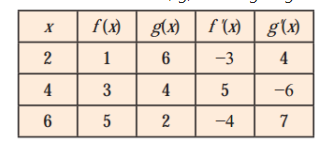
If r(x) = f [g(x)] find r’ (2).
(ii)If R(x) = g[3 + f(x)] find R’ (4).
(iii)If s(x) = f[9− f(x)] find s’ (4).
(iv)If S(x) = g[g(x)] find S’ (6)
Answer$\begin{aligned} & r(x)=f[g(x)] \\ & \therefore r^{\prime}(x)=\frac{d}{d x} f[g(x)] \\ & =f^{\prime}[g(x)] \cdot \frac{d}{d x}[g(x)] \\ & =f^{\prime}\left[g(x) \cdot\left[g^{\prime}(x)\right]\right. \\ & \therefore r^{\prime}(2)=f^{\prime}[g(2)] \cdot g^{\prime}(2) \\ & =f^{\prime}(6) \cdot g^{\prime}(2) \ldots[\because g(x)=6, \text { when } x=2] \\ & =-4 \times 4 \ldots[\text { From the table] } \\ & =-16 .\end{aligned}$2. $\begin{aligned} & R ( x )= g [3+ f ( x )] \\ & \therefore R ^{\prime}( x )=\frac{d}{d x}\{ g [3+ f ( x )]\} \\ & = g ^{\prime}[3+ f ( x )] \cdot \frac{d}{d x}[3+ f ( x )] \\ & = g ^{\prime}[3+ f ( x )] \cdot\left[0+ f ^{\prime}( x )\right] \\ & = g ^{\prime}[3+ f ( x )] \cdot f ^{\prime}( x ) \\ & \therefore R ^{\prime}(4)= g ^{\prime}[3+ f (4)] \cdot f ^{\prime}(4) \\ & = g ^{\prime}[3+3] \cdot f ^{\prime}(4) \ldots[\because f ( x )=3, \text { when } x =4] \\ & = g ^{\prime}(6) \cdot f ^{\prime}(4) \\ & =7 \times 5 \ldots[\text { From the table }] \\ & =35\end{aligned}$
3.$\begin{aligned} & s(x)=f[9-f(x)] \\ & \therefore s ^{\prime}( x )=\frac{d}{d x}\{f[9-f(x)]\} \\ & =f^{\prime}[9-f(x)] \cdot \frac{d}{d x}[0-f(x)] \\ & =f^{\prime}[9-f(x)] \cdot\left[0-f^{\prime}(x)\right] \\ & =-f^{\prime}[9-f(x)]-f^{\prime}(x) \\ & \therefore s^{\prime}(4)=-f^{\prime}\left[9-f^{\prime}(4)\right]-f^{\prime}(4) \\ & =-f^{\prime}[9-3]-f^{\prime}(4) \ldots[\because f(x)=3, \text { when } x=4] \\ & =-f^{\prime}(6)-f^{\prime}(4) \\ & =-(-4)(5) \ldots[\text { From the table] } \\ & =20 .\end{aligned}$
4. $\begin{aligned} & S ( x )= g [ g ( x )] \\ & \therefore S ^{\prime}( x )=\frac{d}{d x} g [ g ( x )] \\ & = g ^{\prime}[ g ( x )] \cdot \frac{d}{d x}[ g ( x )] \\ & = g ^{\prime}[ g ( x )] \cdot g ^{\prime}( x ) \\ & \therefore S ^{\prime}(6)= g ^{\prime}\left[ g ^{\prime}(6)\right] \cdot g ^{\prime}(6) \\ & = g ^{\prime}(2) \cdot g ^{\prime}(6) \ldots[\because g ( x )=2, \text { when } x =6] \\ & =4 \times 7 \ldots[\text { From the table }] \\ & =28 .\end{aligned}$
View full question & answer→