Question 13 Marks
Find the co-ordinates of the foot of the perpendicular drawn from the origin to the plane $2 x+y-2 z=18$.
AnswerThe direction ratios of the normal to the plane
$
\begin{aligned}
& 2 x+y-2 z=18 \text { are } 2,1,-2 \\
\therefore & \sqrt{4+1+4}=\sqrt{9}=3
\end{aligned}
$
$\therefore$ Direction cosines of normal are $\frac{2}{3}, \frac{1}{3}, \frac{-2}{3}$
The normal form of the equation of given plane
$
\begin{aligned}
& \text { is } \frac{2}{3} x+\frac{1}{3} y-\frac{2}{3} z=6 \\
\therefore & p=6
\end{aligned}
$
$\therefore$ The coordinates of the foot of perpendicular from the origin are
$
\text { (lp, mp, np), i.e. }\left(6 \times \frac{2}{3}, 6 \times \frac{1}{3}, 6 \times-\frac{2}{3}\right)
$
$
\text { 1.e. }(4,2,-4)
$
View full question & answer→Question 23 Marks
Find the shortest distance between the lines
$\bar{r}=(4 \hat{i}-\hat{j})+\lambda(\hat{i}+2 \hat{j}-3 \hat{k}) \text { and } \bar{r}=(\hat{i}-\hat{j}+2 \hat{k})+\mu(\hat{i}+4 \hat{j}-5 \hat{k})$
Answer$\bar r=(4 \hat{i}-\hat{\jmath})+\lambda(\hat{i}+2 \hat{\jmath}-3 \hat{k})$
$\bar{r}=(\hat{i}-\hat{\jmath}+2 \hat{k})+\mu(\hat{i}+4 \hat{\jmath}-5 \hat{k})$
Here $\overline{a_1}=4 \hat{i}-\hat{j}, \overline{a_2}=\hat{i}-\hat{j}+2 \hat{k}$
$\overline{b_1}=\hat{i}+2 \hat{j}-3 \hat{k}, \overline{b_2}=\hat{i}+4 \hat{j}-5 \hat{k}$
$\therefore \overline{a_2}-\overline{a_1}=(\hat{i}-\hat{j}+2 \hat{k})-(4 \hat{i}-\hat{\jmath})=-3 \hat{i}+2 \hat{k}$
and $\overline{b_1} \times \overline{b_2}=\left|\begin{array}{ccc}\hat{i} & \hat{j} & \hat{k} \\ 1 & 2 & -3 \\ 1 & 4 & -5\end{array}\right|$
$=\hat{i}(2)-\hat{j}(-2)+\hat{k}(2)$
$=2 \hat{i}+2 \hat{j}+2 \hat{k}$
$\therefore\left|\overline{b_1} \times \overline{b_2}\right|=\sqrt{4+4+4}=\sqrt{12}=2 \sqrt{3}$
$\left(\overline{a_2}-\overline{a_1}\right) \cdot\left(\overline{b_1} \times \overline{b_2}\right)=(-3 \hat{i}+2 \hat{k}) \cdot(2 \hat{\imath}+2 \hat{\jmath}+2 \hat{k})$
$=(-3)(2)+(0)(2)+(2)(2)$
$=-6+4=-2$
$\therefore$ The shortest distance between the lines $\bar{r}=\overline{a_1}+\lambda \overline{b_1}$ and $\bar{r}=\overline{a_2}+\mu \overline{b_2}$ is
$=\left|\frac{\left(\overline{a_2}-\overline{a_1}\right) \cdot\left(\overline{b_1} \times \overline{b_2}\right)}{\left|\overline{b_1} \times \overline{b_2}\right|}\right|$
$=\left|\frac{-2}{2 \sqrt{3}}\right|=\frac{1}{\sqrt{3}} \text { units }$
View full question & answer→Question 33 Marks
Find the length of the perpendicular from the point $(3,2,1)$ to the line $\frac{x-7}{-2}=\frac{y-7}{2}=\frac{z-6}{3} \quad$
AnswerLet M be the foot of the perpendicular drawn from point A (3, 2, 1) to the given line $\frac{x-7}{2}=\frac{y-7}{2}=\frac{z-6}{3}$
therefore x=7-2λ,y=7+2λ,z=6+3λ are the coordinates of any point on the given line M=(7-2λ,y=7+2λ,6+3λ)
The d.r.s of AM are 7 - 2λ - 3, 7 + 2λ - 2, 6 + 3λ-1
i.e. 4 - 2λ, 5 + 2λ, 5 + 3λ
The d.r.s of the given line are -2, 2, 3
Since, AM is perpendicular to the given line
(4 - 2λ) (-2) + (5 + 2λ) (2) + (5 + 3λ) (3) = 0
-8 + 4λ + 10 + 4λ + 15 + 9λ = 0
17λ+ 17 = 0
λ = -1 [1]
The coordinates of the foot of the perpendicular
i.e. M = (9, 5, 3)
The length of the perpendicular distance
i.e. $AM =\sqrt{(9-3)^2+(5-2)^2+(3-1)^2}$
$=\sqrt{49}$
l(AM) = 7 units
View full question & answer→Question 43 Marks
Find the shortest distance between the lines $\frac{x+1}{7}=\frac{y+1}{-6}=\frac{z+1}{1}$ and $\frac{x-3}{1}=\frac{y-5}{-2}=\frac{z+7}{1}$.
AnswerShortest distance between the lines
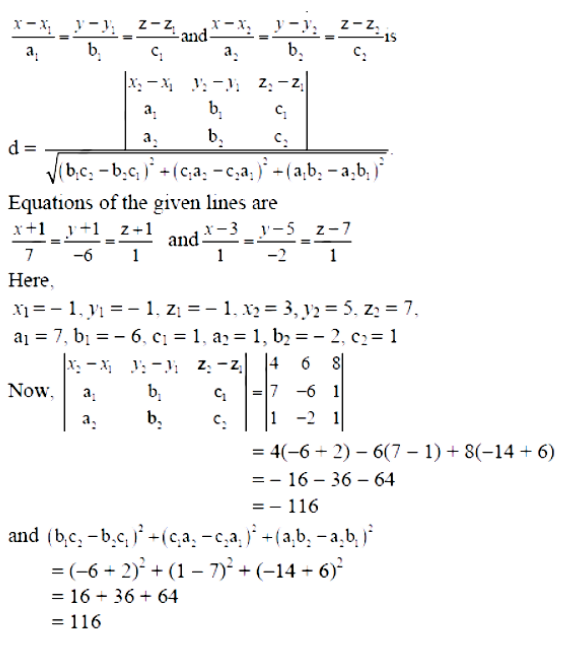
shortest distance between the given lines$=\left|-\frac{116}{\sqrt{116}}\right|$
$=\sqrt{116}$
$=2 \sqrt{29}$ units
] View full question & answer→Question 53 Marks
Find the vector equation of the plane passing through the point $A(-1,2,-5)$ and parallel to the vectors $4 \hat{i}-\hat{j}+3 \hat{k}$ and $\hat{i}+\hat{\jmath}-\hat{k}$.
AnswerThe vector equation of the plane passing through the point $A (\bar{a})$ and parallel to $\bar{b}$ and $\bar{c}$ is $\bar{r} \cdot(\bar{b} \times \bar{c})=\bar{a} \cdot(\bar{b} \times \bar{c})$
Here $\bar{a}=-\hat{i}+2 \hat{j}-5 \hat{k}, \bar{b}=4 \hat{i}-\hat{j}+3 \hat{k}$,
$
\bar{c}=\hat{i}+\hat{j}-\hat{k}
$
$
\therefore \bar{b} \times \bar{c}=\left|\begin{array}{ccc}
\hat{i} & \hat{j} & \hat{k} \\
4 & -1 & 3 \\
1 & 1 & -1
\end{array}\right|
$
$
\begin{aligned}
= & \hat{i}(1-3)-\hat{j}(-4-3)+\hat{k}(4+1) \\
= & -2 \hat{i}+7 \hat{j}+5 \hat{k} \\
\therefore \quad \bar{a} \cdot(\bar{b} \times \bar{c}) & =(-\hat{i}+2 \hat{j}-5 \hat{k}) \cdot(-2 \hat{i}+7 \hat{j}+5 \hat{k}) \\
& =(-1)(-2)+(2)(7)+(-5)(5) \\
& =2+14-25=-9
\end{aligned}
$
$\therefore$ Required equation is
$
\bar{r} \cdot(-2 \hat{i}+7 \hat{j}+5 \hat{k})=-9
$
View full question & answer→Question 63 Marks
Find the distance between the parallel lines $\frac{x}{2}=\frac{y}{-1}=\frac{z}{2}$ and $\frac{x-1}{2}=\frac{y-1}{-1}=\frac{z-1}{2}$.
AnswerThe vector equations of given lines are
$\bar{r}=\overline{0}+\lambda(2 \hat{i}-\hat{j}+2 \hat{k})$ and
$\bar{r}=(\hat{i}+\hat{j}+\hat{k})+\mu(2 \hat{i}-\hat{j}+2 \hat{k})$
The distance between the parallel lines
$\bar{r}=\overline{a_1}+\lambda \bar{b}$ and $\bar{r}=\overline{a_2}+\mu \bar{b}$ is given by
$d=\left|\left(\overline{a_2}-\overline{a_1}\right) \times \hat{b}\right|$
Here $\overline{a_1}=\overline{0}, \overline{a_2}=\hat{i}+\hat{j}+\hat{k}$ and
$\bar{b}=2 \hat{i}-\hat{j}+2 \hat{k}$
$\therefore \hat{b}=\frac{2 \hat{i}-\hat{j}+2 \hat{k}}{3}$
$\text { and } \overline{a_2}-\overline{a_1}=\hat{i}+\hat{j}+\hat{k}$
$\therefore\left(\overline{a_2}-\overline{a_1}\right) \times \hat{b}=\left|\begin{array}{ccc}\hat{i} & \hat{j} & \hat{k} \\1 & 1 & 1 \\\frac{2}{3} & -\frac{1}{3} & \frac{2}{3}\end{array}\right|=\frac{1}{3}\left|\begin{array}{ccc}\hat{i} & \hat{j} & \hat{k} \\1 & 1 & 1 \\2 & -1 & 2\end{array}\right| $
$=\frac{1}{3}(3 \hat{i}-3 \hat{k})=\hat{i}-\hat{k}$
$\therefore d=|\hat{i}-\hat{k}|=\sqrt{(1)^2+(-1)^2}=\sqrt{2} \text { unit }$
View full question & answer→Question 73 Marks
Find the distance of the point $\hat{i}+2 \hat{\jmath}-\hat{k}$ from the plane $\bar{r} \cdot(\hat{i}-2 \hat{j}+4 \hat{k})=10$.
View full question & answer→Question 83 Marks
Find the equation of the line passing through the point $(3,1,2)$ and perpendicular to the lines $\frac{x-1}{1}=\frac{y-2}{2}=\frac{z-3}{3}$ and $\frac{x}{-3}=\frac{y}{2}=\frac{z}{5}$.
View full question & answer→Question 93 Marks
Show that the points $A (2,1,-1), B (0,-1,0), C (4,0,4)$ and $D (2,0,1)$ are coplanar.
View full question & answer→Question 103 Marks
The equation of a line is $2 x-2=3 y+1=6 z-2$, find its direction ratios and also find the vector equation of the line.
AnswerThe Cartesian equation of a line is
2x -2 =3y + 1 = 6z -2
$2(x-1)=3\left(y+\frac{1}{3}\right)=6\left(z-\frac{1}{3}\right)$....dividing by 6 all side
$\frac{x-1}{3}=\frac{y+\frac{1}{3}}{2}=\frac{z-\frac{1}{3}}{1}$
The direction ratios of the line are 3, 2, 1
Further, the line passes through the point $\left(1,-\frac{1}{3}, \frac{1}{3}\right)$
Let $A =\left(1,-\frac{1}{3}, \frac{1}{3}\right)$
Thus, the line passes through the point having the position vector.
$\overline{ a }=1 \hat{ i }-\frac{1}{3} \hat{ j }+\frac{1}{3} \hat{ k }$
Let $\widehat{b}=3 \hat{i}+2 \hat{j}+\hat{k}$
Then, the line is parallel to the vector $\bar{b}$
Hence, the vector equation of the line is
$\overline{ r }=\overline{ a }+\lambda \overline{ b }$, where $\lambda \in R$
i.e. $\bar{r}=\left(1 \hat{i}-\frac{1}{3} \hat{j}+\frac{1}{3} \hat{k}\right)+\lambda(3 \hat{i}+2 \hat{j}+\hat{k})$
View full question & answer→Question 113 Marks
Find the angle between the lines $\frac{x-1}{4}=\frac{y-3}{1}=\frac{z}{8}$ and $\frac{x-2}{2}=\frac{y+1}{2}=\frac{z-4}{1}$
AnswerLet $\bar{a}$ and $\bar{b}$ be the vectors in the direction of the lines $\frac{x-1}{4}=\frac{y-3}{1}=\frac{z}{8}$ and
$\frac{x-2}{2}=\frac{y+1}{2}=\frac{z-4}{1}$ respectively.
$\therefore \bar{a}=4 \hat{i}+\hat{j}+8 \widehat{k}$ and $\bar{b}=2 \hat{i}+2 \hat{j}+\widehat{k}$
$\therefore \bar{a} \cdot \bar{b}=4 \times 2+1 \times 2+8 \times 1=8+2+8=18$
and
$|\bar{a}|=\sqrt{16+1+64}=\sqrt{81}=9$
$\bar{b}=\sqrt{4+1+4}=\sqrt{9}=3$
Let $\Theta$ be the acute angle between the two given lines.
$\therefore \cos \theta=\left\lvert\, \frac{\bar{a} \cdot \bar{b}}{|\bar{a}| \cdot|\bar{b}|}=\frac{18}{9 \times 3}=\frac{2}{3}\right.$
$\theta=\cos ^{-1}\left(\frac{2}{3}\right)$
View full question & answer→Question 123 Marks
Find the shortest distance between the lines $\frac{x-1}{2}=\frac{y-2}{3}=\frac{z-3}{4}$ and $\frac{x-2}{3}=\frac{y-4}{4}=\frac{z-5}{5}$
AnswerThe lines are
$\frac{x-1}{2}=\frac{y-2}{3}=\frac{z-3}{4} \ldots(1)$
$\frac{x-2}{3}=\frac{y-4}{4}=\frac{z-5}{5}$...(2)
Here
$x_1=1, y_1=2, z_1=3$ and $a_1=2, b_1=3, c_1=4$
$x_2=2, y_2=4, z_2=5$ and $a_2=3, b_2=4, c_2=5$
Shortest distance between the lines is
$d=\frac{\left|\begin{array}{ccc}x_2-x_1 & y_2-y_1 & z_2-z_1 \\ a_1 & b_1 & c_1 \\ a_2 & b_2 & c_2\end{array}\right|}{\sqrt{\left(b_1 c_2-b_2 c_1\right)^2+\left(c_1 a_2-c_2 a_1\right)^2+\left(a_1 b_2-a_2 b_1\right)^2}}$
Now $\left|\begin{array}{ccc}x_2-x_1 & y_2-y_1 & z_2-z_1 \\ a_1 & b_1 & c_1 \\ a_2 & b_2 & c_2\end{array}\right|=\left|\begin{array}{ccc}1 & 2 & 2 \\ 2 & 3 & 4 \\ 3 & 4 & 5\end{array}\right|$
$=1(15-16)-2(10-12)+2(8-9)=-1+4-2=1$
and
$\left(b_1 c_2-b_2 c_1\right)^2+\left(c_1 a_2-c_2 a_1\right)^2+\left(a_1 b_2-a_2 b_1\right)^2=(15-16)^2+(12-10)^2+(8-9)^2$
$=1+4+1=6$
Hence, the shortest distance between lines (1) and (2) $=\left|\frac{1}{\sqrt{6}}\right|=\frac{1}{\sqrt{6}}$ units
View full question & answer→Question 133 Marks
Find the shortest distance between the lines $\bar{r}=(4 \hat{i}-\hat{j})+\lambda(\hat{i}+2 \hat{j}-\hat{k})$ and $\bar{r}=(\hat{i}-\hat{j}+2 \hat{k})+\mu(\hat{i}+4 \hat{j}-5 \hat{k})$ where $\lambda$ and $\mu$ are parameters.
AnswerEquation of lines are.,
$\bar{r}=(4 \overline{ i }-\overline{ j })+\lambda(\overline{ i }+2 \overline{ j }-3 \overline{ k }) \&$
$\bar{r}=(\hat{i}-\hat{j}+2 \widehat{k})+\mu(\hat{i}+4 \hat{j}-5 \widehat{k})$
∴ above lines passes through
$\overline{ a }_1=(4 \overline{ i }-\overline{ j })$ and$\overline{ a }_2=(\overline{ i }-\overline{ j }+2 \overline{ k })$
and parallel to
$\overline{ b }_1=\overline{ i }+2 \overline{ j }-3 \overline{ k } \& \overline{ b }_2=\overline{ i }-4 \overline{ j }-5 \overline{ k }$
Shortest distance $=\left|\frac{\left(\overline{ a }_2-\overline{ a }_1\right) \cdot\left(\overline{ b }_1 \times \overline{ b }_2\right)}{\left|\left(\overline{ b }_1 \times \overline{ b }_2\right)\right|}\right|$
$\Rightarrow \overline{ a }_2-\overline{ a }_1=-3 \overline{ j }+2 \overline{ k }$
$\overline{ b }_1 \times \overline{ b }_2=\left|\begin{array}{ccc}\overline{ i } & \overline{ j } & \overline{ k } \\ 1 & 2 & -3 \\ 1 & 4 & -5\end{array}\right|=2 \overline{ i }+2 \overline{ j }+2 \overline{ k }$
$\therefore\left|\overline{ b }_1 \times \overline{ b }_2\right|=2 \sqrt{3}$
Shortest distance $=\left|\frac{(-3 \overline{ i }+2 \overline{ k }) \cdot(2 \overline{ i }+2 \overline{ j }+2 \overline{ k })}{2 \sqrt{3}}\right|$
$=\left|\frac{-6+4}{2 \sqrt{3}}\right|$
$=\left|-\frac{2}{2 \sqrt{3}}\right|$
$d =\frac{1}{\sqrt{3}}$ units
View full question & answer→Question 143 Marks
If the lines $\frac{x-1}{2}=\frac{y+1}{3}=\frac{z-1}{4}$ and $\frac{x-3}{1}=\frac{y-k}{2}=\frac{z}{1}$, intersect each other then find the value of $k$.
AnswerLet $\frac{x-1}{2}=\frac{y+1}{3}=\frac{z-1}{4}=u$ where is any constant.
So for any point on this line has co-ordinates in the form (2u+1,3u-1,4u+1)
$\frac{x-3}{1}=\frac{y-k}{2}=\frac{z}{1}=v$
So for any point on this line has co-ordinates in the form (v+3,2v+k,v).
Point of intersection of these two lines will have co-ordinates of the form (2u +1, 3u −1,4u +1) and (v +3, 2v + k,v) .
Equating the x, y and z co-ordinates for both the forms we get three equations
2u+1=v+3
2u-v=2.............(1)
3u-1=2v+k
3u-2v=k+1.......(2)
4u+1=v
4u-v=-1...........(3)
Subtracting equation (1)from equation(3) we get,
2u = -3
u=-3/2
Substitute value of u in equation (1) we get,
2(-3/2) - v=2
v=-5
Substitute value of v and in equation (2) we get,
3(-3/2) - 2(-5)=k+1
k=9/2
the value of k is 9/2
View full question & answer→Question 153 Marks
Show that the lines given by $\frac{x+1}{-10}=\frac{y+3}{-1}=\frac{z-4}{1}$. and $\frac{x+10}{-1}=\frac{y+1}{-3}=\frac{z-1}{4}$ intersect. Also find the co-ordinates of the point of intersection.
View full question & answer→Question 163 Marks
Find vector equation of line passing through the point whose position vector is $3 \hat{i}-4 \hat{j}+\hat{k}$ and parallel to the vector $2 \hat{i}+\hat{j}-3 \hat{k}$. Also write the equation in Cartesian form.
View full question & answer→Question 173 Marks
Find the vector equation of the line passing through the point $(-1,-1,2)$ and parallel to the line $2 x-2=3 y+1=6 z-2$.
View full question & answer→Question 183 Marks
Find the vector equation and Cartesian equation of a line passing through the points $A(3,4,7)$ and $B(6,-1,1)$.
View full question & answer→Question 193 Marks
Show that the points $(1,-1,3)$ and $(3,4,3)$ are equidistant from the plane $5 x+2 y-7 z+8=0$.
AnswerLet $p 1$ and $p 2$ be the distances of points $\hat{i}-\hat{j}+3 \hat{k}$ and $3 \hat{i}+4 \hat{j}+3 \widehat{k}$ from $\bar{r} \cdot(5 \hat{i}+2 \hat{j}-7 \hat{k})+8=0$
The distance of the point A with position vector a from the plane $\bar{r} \cdot \bar{n}= p$ is given by
$d=\frac{|\bar{a} \cdot \bar{n}-p|}{|\bar{n}|}$
$\therefore p_1=\frac{|(\hat{i}-\hat{j}+3 \widehat{k}) \cdot(5 \hat{i}+2 \hat{j}-7 \widehat{k})-(-8)|}{\sqrt{5^2+2^2+(-7)^2}}$
$=\frac{|1(5)-1(2)+3(-7)+8|}{\sqrt{25+4+49}}$
$=\frac{|5-2-21+8|}{\sqrt{78}}=\frac{|-10|}{\sqrt{78}}=\frac{10}{\sqrt{78}}$
and $p_2=\frac{|()()-(-8)|}{\sqrt{5^2+2^2+(-7)^2}}$
$=\frac{|3(5)+4(2)+3(-7)+8|}{\sqrt{25+4+49}}$
$=\frac{|15+8-21+8|}{\sqrt{78}}$
$=\frac{10}{\sqrt{78}}$
$\therefore p _1= p _2$
Hence, points are equidistant from the plane.
View full question & answer→Question 203 Marks
Find the Cartesian form of the equation of the plane $\bar{r}=(\hat{i}+\hat{j})+s(\hat{i}-\hat{j}+2 \hat{k})+t(\hat{i}+2 \hat{j}+\hat{k})$
AnswerThe equation $\bar{r}=\bar{a}+s \bar{b}+t \bar{c}$ represents a plane passing through a point having position vector $a$ and parallel to the vectors $b$ and $c$.
Here, $\bar{a}=\hat{i}+\hat{j}, \bar{b}=\hat{i}-\hat{j}+2 \widehat{k}$ and $\bar{c}=\hat{i}+2 \hat{j}+\widehat{k}$
The given plane is perpendicular to the vector$\bar{n}$
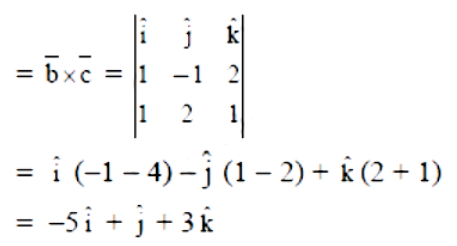
Vector equation of the plane in scalar product form is $\bar{r} \cdot \bar{n}=\bar{a} \cdot \bar{n}$
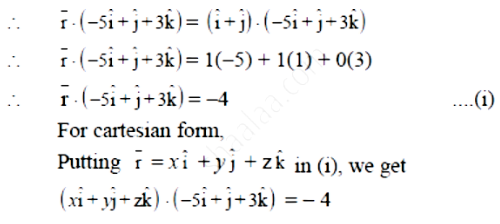
$\therefore x(-5)+y(1)+z(3)=-4$
$\therefore-5 x+y+3 z=-4$
$\therefore 5 x-y-3 z=4$
which is the cartesian form of the equation of the plane
View full question & answer→Question 213 Marks
Find the shortest distance between the lines $\frac{x+1}{7}=\frac{y+1}{-6}=\frac{z+1}{1}$ and $\frac{x-3}{1}=\frac{y-5}{-2}=\frac{z-7}{1}$
AnswerShortest distance between the lines
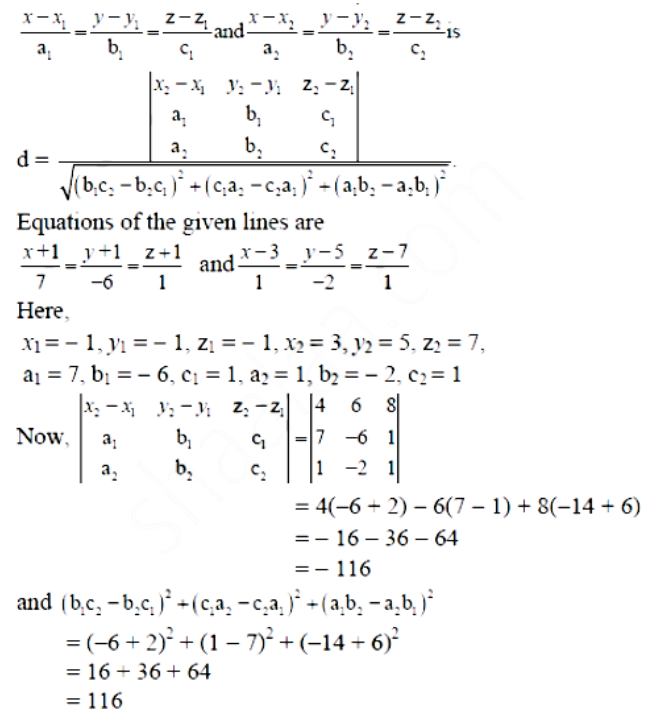
shortest distance between the given lines $=\left|-\frac{116}{\sqrt{116}}\right|$
$\begin{aligned} & =\sqrt{116} \\ & =2 \sqrt{29} \text { units }\end{aligned}$
View full question & answer→