Question 13 Marks
Represent the solution set of inequation 3x + 2y ≤ 6 graphically.
5 questions · timed · auto-graded
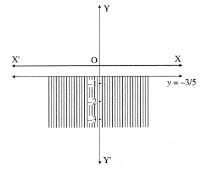
i.e. $y=\frac{-3}{5}$
This represents a line parallel to $X$-axis passing through the point $\left(0, \frac{-3}{5}\right)$
Draw the line $y=\frac{-3}{5}$.
To find the solution set, we have to check the position of the origin (0, 0). When y = 0, 5y + 3 = 5 × 0 + 3 = 3 ≰ 0 ∴ the coordinates of the origin does not satisfy the given inequality.
$\therefore$ the solution set consists of the line $y=\frac{-3}{5}$ and the non-origin side of the line which is
shaded in the graph.
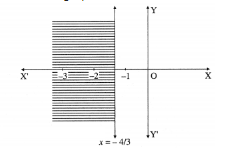
i.e. $x=-\frac{4}{3}$
This represents a line parallel to $Y$-axis passing through the point $\left(-\frac{4}{3}, 0\right)$.
Draw the line $x=-\frac{4}{3}$.
To find the solution set, we have to check the position of the origin (0, 0). When x = 0, 3x + 4 = 3 × 0 + 4= 4 ≰ 0 ∴ the coordinates of the origin does not satisfy the given inequality.
$\therefore$ the solution set consists of the line $x=-\frac{4}{3}$ and the non-origin side of the line which is
shaded in the graph.
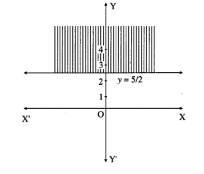
This represents a line parallel to $X$-axis passing through the point $\left(0, \frac{5}{2}\right)$.
Draw the line $y=\frac{5}{2}$.
To find the solution set, we have to check the position of the origin (0, 0). When y = 0, 2y – 5 = 2 × 0 – 5 = -5 ≱ 0 ∴ the coordinates of the origin does not satisfy the given inequality.
$\therefore$ the solution set consists of the line $y=\frac{5}{2}$ and the non-origin side of the line which is
shaded in the graph.
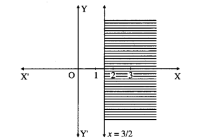
i.e. $x=\frac{3}{2}$
This represents a line parallel to $Y$-axis passing through the point $\left(\frac{3}{2}, 0\right)$
Draw the line $x=\frac{3}{2}$.
To find the solution set, we have to check the position of the origin (0, 0). When x = 0, 2x – 3 = 2 × 0 – 3 = -3 ≱ 0 ∴ the coordinates of the origin does not satisfy the given inequality.
$\therefore$ the solution set consists of the line $x=\frac{3}{2}$ and the non-origin side of the line which is
shaded in the graph.