MCQ 512 Marks
In a $\triangle P Q R$, if $3 \sin P+4 \cos Q=6$ and $4 \sin Q+$ $3 \cos P=1$, then the angle $R$ is equal to
- A
$\pi / 4$
- B
$3 \pi / 4$
- C
$5 \pi / 6$
- ✓
$\pi / 6$
AnswerCorrect option: D. $\pi / 6$
(d) : $3 \sin P+4 \cos Q=6$
$4 \sin Q+3 \cos P=1$
$\Rightarrow 16+9+24(\sin (P+Q))=37$
$\Rightarrow 24(\sin (P+Q))=12$
$\Rightarrow \sin (P+Q)=\frac{1}{2} \Rightarrow \sin R=\frac{1}{2} \Rightarrow R=\frac{5 \pi}{6}$ or $\frac{\pi}{6}$
But if $R=\frac{5 \pi}{6}$ then $P<\frac{\pi}{6}$ and then $3 \sin P<\frac{1}{2}$
and so $3 \sin P+4 \cos Q<\frac{1}{2}+4(\neq 6)$
Thus, $R=\frac{\pi}{6}$.
View full question & answer→MCQ 522 Marks
If $\cot \left(\cos ^{-1} x\right)=\sec \left(\tan ^{-1} \frac{a}{\sqrt{b^2-a^2}}\right)$, then $x$ is equal to
- ✓
$\frac{b}{\sqrt{2 b^2-a^2}}$
- B
$\frac{a}{\sqrt{2 b^2-a^2}}$
- C
$\frac{\sqrt{2 b^2-a^2}}{a}$
- D
$\frac{\sqrt{2 b^2-a^2}}{b}$
AnswerCorrect option: A. $\frac{b}{\sqrt{2 b^2-a^2}}$
(a) : We have,
$
\cot \left(\cos ^{-1} x\right)=\sec \left(\tan ^{-1} \frac{a}{\sqrt{b^2-a^2}}\right)
$
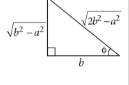
Let $\tan ^{-1} \frac{a}{\sqrt{b^2-a^2}}=\theta \Rightarrow \tan \theta=\frac{a}{\sqrt{b^2-a^2}}$
$\Rightarrow \sec \theta=\frac{b}{\sqrt{b^2-a^2}}$
$\therefore \quad \cot \left(\cos ^{-1} x\right)=\frac{b}{\sqrt{b^2-a^2}}$
$\Rightarrow \cos ^{-1} x=\cot ^{-1}\left(\frac{b}{\sqrt{b^2-a^2}}\right)$
Again, let $\cot ^{-1}\left(\frac{b}{\sqrt{b^2-a^2}}\right)=\phi \Rightarrow \cot \phi=\frac{b}{\sqrt{b^2-a^2}}$
$\Rightarrow \cos \phi=\frac{b}{\sqrt{2 b^2-a^2}}$
Now, $\cos ^{-1} x=\phi \Rightarrow x=\cos \phi$
$\Rightarrow x=\frac{b}{\sqrt{2 b^2-a^2}}$

View full question & answer→MCQ 532 Marks
If $\alpha=\cos ^{-1}\left(\frac{3}{5}\right), \beta=\tan ^{-1}\left(\frac{1}{3}\right)$, where $0<\alpha, \beta<\frac{\pi}{2}$, then $\alpha-\beta$ is equal to
- A
$\tan ^{-1}\left(\frac{9}{5 \sqrt{10}}\right)$
- B
$\cos ^{-1}\left(\frac{9}{5 \sqrt{10}}\right)$
- C
$\tan ^{-1}\left(\frac{9}{14}\right)$
- ✓
$\sin ^{-1}\left(\frac{9}{5 \sqrt{10}}\right)$
AnswerCorrect option: D. $\sin ^{-1}\left(\frac{9}{5 \sqrt{10}}\right)$
(D) $\alpha=\cos ^{-1}\left(\frac{3}{5}\right)$
$\Rightarrow \cos \alpha=\frac{3}{5}$
$\Rightarrow \tan \alpha=\frac{4}{3}$
$\beta=\tan ^{-1}\left(\frac{1}{3}\right)$
$\Rightarrow \tan \beta=\frac{1}{3}$
$\tan (\alpha-\beta)=\frac{\tan \alpha-\tan \beta}{1+\tan \alpha \cdot \tan \beta}$
$=\frac{\frac{4}{3}-\frac{1}{3}}{1+\frac{4}{3} \cdot \frac{1}{3}}=\frac{9}{13}$
$\alpha-\beta=\tan ^{-1}\left(\frac{9}{13}\right)=\sin ^{-1}\left(\frac{\frac{9}{13}}{\sqrt{1+\left(\frac{9}{13}\right)^2}}\right)$ $\ldots\left[\because \tan ^{-1} x=\sin ^{-1}\left(\frac{x}{\sqrt{1+x^2}}\right)\right]$
$=\sin ^{-1}\left(\frac{9}{5 \sqrt{10}}\right)$
View full question & answer→MCQ 542 Marks
The value of $\tan ^{-1}\left\{\sin \left(\cos ^{-1} \sqrt{\frac{2}{3}}\right)\right\}$ is
- A
$\frac{\pi}{4}$
- B
$\frac{\pi}{2}$
- C
$\frac{\pi}{3}$
- ✓
$\frac{\pi}{6}$
AnswerCorrect option: D. $\frac{\pi}{6}$
(D) $\tan ^{-1}\left\{\sin \left(\cos ^{-1} \sqrt{\frac{2}{3}}\right)\right\}$
$=\tan ^{-1}\left\{\sin \left(\sin ^{-1} \sqrt{\frac{1}{3}}\right)\right\}$ $\ldots\left[\because \cos ^{-1} x=\sin ^{-1} \sqrt{1-x^2}\right]$
$=\tan ^{-1}\left(\frac{1}{\sqrt{3}}\right)=\frac{\pi}{6}$
View full question & answer→MCQ 552 Marks
Which one of the following is true?
- ✓
$\sin \left(\cos ^{-1} x\right)=\cos \left(\sin ^{-1} x\right)$
- B
$\sec \left(\tan ^{-1} x\right)=\tan \left(\sec ^{-1} x\right)$
- C
$\cos \left(\tan ^{-1} x\right)=\tan \left(\cos ^{-1} x\right)$
- D
$\tan \left(\sin ^{-1} x\right)=\sin \left(\tan ^{-1} x\right)$
AnswerCorrect option: A. $\sin \left(\cos ^{-1} x\right)=\cos \left(\sin ^{-1} x\right)$
(A) Consider option (A),
$\sin \left(\cos ^{-1} x\right)=\cos \left(\sin ^{-1} x\right)=\sqrt{1-x^2}$ $\ldots\left[\because \sin ^{-1} x=\cos ^{-1} \sqrt{1-x^2}, \cos ^{-1} x=\sin ^{-1} \sqrt{1-x^2}\right]$
View full question & answer→MCQ 562 Marks
$\tan \left(\cos ^{-1} x\right)$ is equal to
- ✓
$\frac{\sqrt{1-x^2}}{x}$
- B
$\frac{x}{1+x^2}$
- C
$\frac{\sqrt{1+x^2}}{x}$
- D
$\sqrt{1-x^2}$
AnswerCorrect option: A. $\frac{\sqrt{1-x^2}}{x}$
(A) $\tan \left(\cos ^{-1} x\right)$
$=\tan \left[\tan ^{-1} \frac{\sqrt{1-x^2}}{x}\right]$ $\ldots\left[\because \cos ^{-1} x=\tan ^{-1} \frac{\sqrt{1-x^2}}{x}\right]$
$=\frac{\sqrt{1-x^2}}{x}$
View full question & answer→MCQ 572 Marks
$\cos \left(\tan ^{-1} x\right)=$
- A
$\sqrt{1+x^2}$
- ✓
$\frac{1}{\sqrt{1+x^2}}$
- C
$1+x^2$
- D
$\frac{1}{1+x^2}$
AnswerCorrect option: B. $\frac{1}{\sqrt{1+x^2}}$
(B) $\cos \left(\tan ^{-1} x\right)=\cos \left[\cos ^{-1} \frac{1}{\sqrt{1+x^2}}\right]$ $\ldots\left[\because \tan ^{-1} x=\cos ^{-1}\left(\frac{1}{\sqrt{1+x^2}}\right)\right]$
$=\frac{1}{\sqrt{1+x^2}}$
View full question & answer→MCQ 582 Marks
$\left[\sin \left(\tan ^{-1} \frac{3}{4}\right)\right]^2=$
- A
$\frac{3}{5}$
- B
$\frac{5}{3}$
- ✓
$\frac{9}{25}$
- D
$\frac{25}{9}$
AnswerCorrect option: C. $\frac{9}{25}$
(C) $\left[\sin \left(\tan ^{-1} \frac{3}{4}\right)\right]^2$
$=\left[\sin \left\{\sin ^{-1}\left(\frac{\frac{3}{4}}{\sqrt{1+\left(\frac{3}{4}\right)^2}}\right)\right]\right]^2$ $\ldots\left[\because \tan ^{-1} x=\sin ^{-1}\left(\frac{x}{\sqrt{1+x^2}}\right)\right]$
$=\left[\sin \left(\sin ^{-1} \frac{3}{5}\right)\right]^2=\left(\frac{3}{5}\right)^2=\frac{9}{25}$
View full question & answer→MCQ 592 Marks
If $\sin ^{-1} x+\sin ^{-1} y=\frac{2 \pi}{3}$, then $\cos ^{-1} x+\cos ^{-1} y=$
- A
$\frac{2 \pi}{3}$
- ✓
$\frac{\pi}{3}$
- C
$\frac{\pi}{6}$
- D
$\pi$
AnswerCorrect option: B. $\frac{\pi}{3}$
(B) Given, $\sin ^{-1} x+\sin ^{-1} y=\frac{2 \pi}{3}$
$\therefore \quad \cos ^{-1} x+\cos ^{-1} y=\pi-\frac{2 \pi}{3}=\frac{\pi}{3}$ $\ldots\left[\begin{array}{l}\text { If } \sin ^{-1} x+\sin ^{-1} y=\theta, \\ \text { then } \cos ^{-1} x+\cos ^{-1} y-\pi-\theta\end{array}\right]$
View full question & answer→MCQ 602 Marks
If $\sin ^{-1} \frac{1}{3}+\sin ^{-1} \frac{2}{3}=\sin ^{-1} x$, then $x$ is equal to
AnswerCorrect option: C. $\frac{\sqrt{5}+4 \sqrt{2}}{9}$
(C) $\sin ^{-1} \frac{1}{3}+\sin ^{-1} \frac{2}{3}$
$=\sin ^{-1}\left[\frac{1}{3} \sqrt{1-\frac{4}{9}}+\frac{2}{3} \sqrt{1-\frac{1}{9}}\right]$
$=\sin ^{-1}\left[\frac{\sqrt{5}+4 \sqrt{2}}{9}\right]$
$\therefore \quad x=\frac{\sqrt{5}+4 \sqrt{2}}{9}$
View full question & answer→MCQ 612 Marks
$4 \tan ^{-1} \frac{1}{5}-\tan ^{-1} \frac{1}{70}+\tan ^{-1} \frac{1}{99}=$
- A
$\frac{\pi}{2}$
- B
$\frac{\pi}{3}$
- ✓
$\frac{\pi}{4}$
- D
$\frac{\pi}{6}$
AnswerCorrect option: C. $\frac{\pi}{4}$
(C) $4 \tan ^{-1} \frac{1}{5}-\tan ^{-1} \frac{1}{70}+\tan ^{-1} \frac{1}{99}$
$=\tan ^{-1} \frac{120}{119}+\tan ^{-1} \frac{1}{99}-\tan ^{-1} \frac{1}{70}$
$=\tan ^{-1}\left(\frac{120}{119}\right)+\tan ^{-1}\left[\frac{\frac{1}{99}-\frac{1}{70}}{1+\frac{1}{99} \cdot \frac{1}{70}}\right]$
$=\tan ^{-1}\left(\frac{120}{119}\right)+\tan ^{-1}\left(\frac{-29}{6931}\right)$
$=\tan ^{-1} \frac{120}{119}-\tan ^{-1} \frac{29}{6931}$
$=\tan ^{-1} \frac{120}{119}-\tan ^{-1} \frac{1}{239}$
$=\tan ^{-1} 1=\frac{\pi}{4}$
View full question & answer→MCQ 622 Marks
If $a, b, c$ be positive real numbers and the value of
$\theta=\tan ^{-1} \sqrt{\frac{a(a+b+c)}{b c}}+\tan ^{-1} \sqrt{\frac{b(a+b+c)}{c a}}$ $+\tan ^{-1} \sqrt{\frac{c(a+b+c)}{a b}}$,
then $\tan \theta$ is equal to
Answer(A) $\theta=\tan ^{-1} \sqrt{\frac{a(a+b+c)}{b c}}+\tan ^{-1} \sqrt{\frac{b(a+b+c)}{c a}}$ $+\tan ^{-1} \sqrt{\frac{c(a+b+c)}{a b}}$
Let $s ^2=\frac{ a + b + c }{ abc }$
$\therefore \quad \theta=\tan ^{-1} \sqrt{a^2 s^2}+\tan ^{-1} \sqrt{b^2 s^2}+\tan ^{-1} \sqrt{c^2 s^2}$
$=\tan ^{-1}( as )+\tan ^{-1}( bs )+\tan ^{-1}( cs )$
$=\tan ^{-1}[\frac{ as + bs + cs - abcs ^3}{1- abs ^2- acs ^2- bcs ^2}]$
$\therefore \quad \tan \theta=[\frac{s[(a+b+c)-a b c s^2]}{1-(a b+b c+c a) s^2}]$
$=[\frac{ s [( a + b + c )-( a + b + c )]}{1- s ^2( ab + bc + ca )}]$ $\ldots .[\because s^2(a b c)=(a+b+c)]$
$=0$
Alternate Method :
Let $a = b = c =1$. Then,
$\theta=\tan ^{-1} \sqrt{3}+\tan ^{-1} \sqrt{3}+\tan ^{-1} \sqrt{3}=\pi$
$\Rightarrow \tan \theta=0$
View full question & answer→MCQ 632 Marks
$4 \tan ^{-1} \frac{1}{5}-\tan ^{-1} \frac{1}{239}$ is equal to
- A
$\pi$
- B
$\frac{\pi}{2}$
- C
$\frac{\pi}{3}$
- ✓
$\frac{\pi}{4}$
AnswerCorrect option: D. $\frac{\pi}{4}$
(D) Since, $2 \tan ^{-1} x=\tan ^{-1} \frac{2 x}{1-x^2}$
$\therefore 4 \tan ^{-1} \frac{1}{5}=2\left[2 \tan ^{-1} \frac{1}{5}\right]=2 \tan ^{-1} \frac{\frac{2}{5}}{1-\frac{1}{25}}$
$=2 \tan ^{-1} \frac{10}{24}=\tan ^{-1} \frac{\frac{20}{24}}{1-\frac{100}{576}}=\tan ^{-1} \frac{120}{119}$
$\therefore 4 \tan ^{-1} \frac{1}{5}-\tan ^{-1} \frac{1}{239}=\tan ^{-1} \frac{120}{119}-\tan ^{-1} \frac{1}{239}$
$=\tan ^{-1} \frac{\frac{120}{119}-\frac{1}{239}}{1+\frac{120}{119} \cdot \frac{1}{239}}=\tan ^{-1} \frac{(120 \times 239)-119}{(119 \times 239)+120}$
$=\tan ^{-1} 1=\frac{\pi}{4}$
View full question & answer→MCQ 642 Marks
If $\tan ^{-1} x+\tan ^{-1} y+\tan ^{-1} z=\frac{\pi}{2}$, then
- A
$x+y+z-x y z=0$
- B
$x+y+z+x y z=0$
- C
$x y+y z+z x+1=0$
- ✓
$x y+y z+z x-1=0$
AnswerCorrect option: D. $x y+y z+z x-1=0$
(D) $\tan ^{-1} x+\tan ^{-1} y+\tan ^{-1} z=\frac{\pi}{2}$
$\Rightarrow \tan ^{-1}[\frac{x+y+z-x y z}{1-x y-y z-x z}]=\frac{\pi}{2}$ ...[Using Shortcut 4]
$\Rightarrow[\frac{x+y+z-x y z}{1-x y-y z-z x}]=\tan \frac{\pi}{2}$
$\Rightarrow x y+y z+z x-1=0$
Alternate Method:
Let $x=y= z =\frac{1}{\sqrt{3}}$
Then, $\tan ^{-1} \frac{1}{\sqrt{3}}+\tan ^{-1} \frac{1}{\sqrt{3}}+\tan ^{-1} \frac{1}{\sqrt{3}}=\frac{\pi}{2}$
Option (D) holds for these values of $x, y, z$
View full question & answer→MCQ 652 Marks
$\cot ^{-1}\left(\frac{a b+1}{a-b}\right)+\cot ^{-1}\left(\frac{b c+1}{b-c}\right)+\cot ^{-1}\left(\frac{c a+1}{c-a}\right)$ is equal to
- ✓
$0$
- B
$1$
- C
$\frac{\pi}{4}$
- D
Answer(A) Since, $\cot ^{-1} x-\cot ^{-1} y=\cot ^{-1}\left(\frac{x y+1}{y-x}\right)$
$\therefore \quad \cot ^{-1} \frac{a b+1}{a-b}+\cot ^{-1} \frac{b c+1}{b-c}+\cot ^{-1} \frac{c a+1}{c-a}$
$=\cot ^{-1} b-\cot ^{-1} a+\cot ^{-1} c-\cot ^{-1} b$ $+\cot ^{-1} a -\cot ^{-1} c$
$=0$
View full question & answer→MCQ 662 Marks
If $\cot ^{-1} \alpha+\cot ^{-1} \beta=\cot ^{-1} x$, then $x=$
AnswerCorrect option: D. $\frac{\alpha \beta-1}{\alpha+\beta}$
(D) $\cot ^{-1} \alpha+\cot ^{-1} \beta=\cot ^{-1} x$
$\Rightarrow \cot ^{-1}\left(\frac{\alpha \beta-1}{\alpha+\beta}\right)=\cot ^{-1} x$ $\ldots\left[\because \cot ^{-1} x+\cot ^{-1} y=\cot ^{-1}\left(\frac{x y-1}{x+y}\right)\right]$
$\Rightarrow x=\frac{\alpha \beta-1}{\alpha+\beta}$
View full question & answer→MCQ 672 Marks
If $\tan ^{-1} x+2 \cot ^{-1} x=\frac{2 \pi}{3}$, then $x=$
AnswerCorrect option: C. $\sqrt{3}$
(C) The given equation can be written as
$\tan ^{-1} x+\cot ^{-1} x+\cot ^{-1} x=\frac{2 \pi}{3}$
$\Rightarrow \cot ^{-1} x=\frac{2 \pi}{3}-\frac{\pi}{2}$ $\ldots\left[\because \tan ^{-1} x+\cot ^{-1} x=\frac{\pi}{2}\right]$
$\Rightarrow \cot ^{-1} x=\frac{\pi}{6} \Rightarrow x=\cot \frac{\pi}{6} \Rightarrow x=\sqrt{3}$
View full question & answer→MCQ 682 Marks
A solution of the equation $\tan ^{-1}(1+x)+\tan ^{-1}(1-x)=\frac{\pi}{2}$ is
- A
$x=1$
- B
$x=-1$
- ✓
$x=0$
- D
$x=\pi$
Answer(C) $\tan ^{-1}(1+x)+\tan ^{-1}(1-x)=\frac{\pi}{2}$
$\Rightarrow \tan ^{-1}(1+x)=\frac{\pi}{2}-\tan ^{-1}(1-x)$
$\Rightarrow \tan ^{-1}(1+x)=\cot ^{-1}(1-x)$
$\Rightarrow \tan ^{-1}(1+x)=\tan ^{-1}\left(\frac{1}{1-x}\right)$
$\Rightarrow 1+x=\frac{1}{1-x} \Rightarrow 1-x^2=1 \Rightarrow x=0$
View full question & answer→MCQ 692 Marks
$\cos \left[2 \cos ^{-1} \frac{1}{5}+\sin ^{-1} \frac{1}{5}\right]=$
- A
$\frac{2 \sqrt{6}}{5}$
- ✓
$-\frac{2 \sqrt{6}}{5}$
- C
$\frac{1}{5}$
- D
$-\frac{1}{5}$
AnswerCorrect option: B. $-\frac{2 \sqrt{6}}{5}$
(B) $\cos \left(\cos ^{-1} \frac{1}{5}+\sin ^{-1} \frac{1}{5}+\cos ^{-1} \frac{1}{5}\right)$
$=\cos \left(\frac{\pi}{2}+\cos ^{-1} \frac{1}{5}\right)=-\sin \left(\cos ^{-1} \frac{1}{5}\right)$
$=-\sin \left(\sin ^{-1} \sqrt{\frac{24}{25}}\right)$
$=-\frac{2 \sqrt{6}}{5}$
View full question & answer→MCQ 702 Marks
$\cot ^{-1}\left[\frac{\sqrt{1-\sin x}+\sqrt{1+\sin x}}{\sqrt{1-\sin x}-\sqrt{1+\sin x}}\right]=$
- A
$\pi-x$
- B
$2 \pi-x$
- C
$\frac{x}{2}$
- ✓
$\pi-\frac{x}{2}$
AnswerCorrect option: D. $\pi-\frac{x}{2}$
(D) $\cot ^{-1}\left[\frac{\sqrt{1-\sin x}+\sqrt{1+\sin x}}{\sqrt{1-\sin x}-\sqrt{1+\sin x}}\right]$
$=\cot ^{-1}\left[\frac{(\sqrt{1-\sin x}+\sqrt{1+\sin x})}{(\sqrt{1-\sin x}-\sqrt{1+\sin x})}\right.$ $\left.\times \frac{(\sqrt{1-\sin x}+\sqrt{1+\sin x})}{(\sqrt{1-\sin x}+\sqrt{1+\sin x})}\right]$
$=\cot ^{-1}\left[\frac{(1-\sin x)+(1+\sin x)+2 \sqrt{1-\sin ^2 x}}{(1-\sin x)-(1+\sin x)}\right]$
$=\cot ^{-1}\left[\frac{2(1+\cos x)}{-2 \sin x}\right]$
$=\cot ^{-1}\left[-\frac{2 \cos ^2\left(\frac{x}{2}\right)}{2 \sin \left(\frac{x}{2}\right) \cos \left(\frac{x}{2}\right)}\right]$
$=\cot ^{-1}\left(-\cot \frac{x}{2}\right)=\cot ^{-1}\left[\cot \left(\pi-\frac{x}{2}\right)\right]$
$=\pi-\frac{x}{2}$
View full question & answer→MCQ 712 Marks
$\sin ^{-1} \frac{2 a}{1+a^2}-\cos ^{-1} \frac{1-b^2}{1+b^2}=\tan ^{-1} \frac{2 x}{1-x^2}$, then $x=$
- A
- B
- C
$\frac{a+b}{1-a b}$
- ✓
$\frac{a-b}{1+a b}$
AnswerCorrect option: D. $\frac{a-b}{1+a b}$
(D) Putting
$a =\tan \theta, b =\tan \phi$ and $x=\tan \psi$ in the given expression, we get
$\sin ^{-1}(\sin 2 \theta)-\cos ^{-1}(\cos 2 \phi)=\tan ^{-1}(\tan 2 \psi)$
$\Rightarrow 2 \theta-2 \phi=2 \psi \Rightarrow \theta-\phi=\psi$
Taking 'tan' on both sides, we get $\tan (\theta-\phi)=\tan \psi$
$\Rightarrow \frac{\tan \theta-\tan \phi}{1+\tan \theta \tan \phi}=\tan \psi$
$\Rightarrow \frac{ a - b }{1+ ab }=x$
View full question & answer→MCQ 722 Marks
The value of $\sin \left[\cot ^{-1}\left(\tan \cos ^{-1} x\right)\right]$ is equal to
- ✓
$x$
- B
$\frac{\pi}{2}$
- C
$1$
- D
$\pi$
Answer(A) Let $\cos ^{-1} x=\theta \Rightarrow x=\cos \theta \Rightarrow \sec \theta=\frac{1}{x}$
$\Rightarrow \tan \theta=\sqrt{\sec ^2 \theta-1}=\sqrt{\frac{1}{x^2}-1}=\frac{1}{x} \sqrt{1-x^2}$
Now,
$\sin \left[\cot ^{-1}(\tan \theta)\right]=\sin \left[\cot ^{-1}\left(\frac{1}{x} \sqrt{1-x^2}\right)\right]$
Again, putting $x=\sin \theta$
$\therefore \quad \sin \cot ^{-1}\left(\frac{1}{x} \sqrt{1-x^2}\right)=\sin \cot ^{-1}\left(\frac{\sqrt{1-\sin ^2 \theta}}{\sin \theta}\right)$
$\begin{array}{l}=\sin \cot ^{-1}(\cot \theta) \\ =\sin \theta=x\end{array}$
View full question & answer→MCQ 732 Marks
$\sin \left(\cot ^{-1} x\right)=$
AnswerCorrect option: D. $\left(1+x^2\right)^{\frac{-1}{2}}$
(D) Let $\cot ^{-1} x=\theta \Rightarrow x=\cot \theta$
Now $\operatorname{cosec} \theta=\sqrt{1+\cot ^2 \theta}=\sqrt{1+x^2}$
$\therefore \quad \sin \theta=\frac{1}{\operatorname{cosec} \theta}=\frac{1}{\sqrt{1+x^2}}$
$\Rightarrow \theta=\sin ^{-1} \frac{1}{\sqrt{1+x^2}}$
$\therefore \quad \sin \left(\cot ^{-1} x\right)=\sin \left(\sin ^{-1} \frac{1}{\sqrt{1+x^2}}\right)$
$=\frac{1}{\sqrt{1+x^2}}$
$=\left(1+x^2\right)^{\frac{-1}{2}}$
View full question & answer→MCQ 742 Marks
The number of real solutions of $\tan ^{-1} \sqrt{x(x+1)}+\sin ^{-1} \sqrt{x^2+x+1}=\frac{\pi}{2}$ is
Answer(C) $\tan ^{-1} \sqrt{x(x+1)}+\sin ^{-1} \sqrt{x^2+x+1}=\frac{\pi}{2}$
$\tan ^{-1} \sqrt{x(x+1)}$ is defined when
$x(x+1) \geq 0$ …. (i)
$\sin ^{-1} \sqrt{x^2+x+1}$ is defined when
$x(x+1)+1 \leq 1$ or $x(x+1) \leq 0$ ....(ii)
From (i) and (ii),
$x(x+1)=0$ or $x=0$ and -1.
Hence, number of solutions is 2 .
View full question & answer→MCQ 752 Marks
If $\sin ^{-1} a+\sin ^{-1} b+\sin ^{-1} c=\pi$, then the value of a
$\sqrt{\left(1-a^2\right)}+b \sqrt{\left(1-b^2\right)}+c \sqrt{\left(1-c^2\right)}$ will be
- ✓
- B
- C
$\frac{1}{2} abc$
- D
$\frac{1}{3} abc$
Answer(A) $Let \sin ^{-1} a=A,$
$\sin ^{-1} b=B,$
$\sin ^{-1} c=C$
$\therefore \quad \sin A=a, \sin B=b, \sin C=c$
and $A + B + C =\pi$ then
$\sin 2 A+\sin 2 B+\sin 2 C$ $=4 \sin A \sin B \sin C$
$\Rightarrow \sin A \cos A +\sin B \cos B +\sin C \cos C$ $=2 \sin A \sin B \sin C$
$\Rightarrow \sin A \sqrt{\left(1-\sin ^2 A\right)}+\sin B \sqrt{\left(1-\sin ^2 B\right)}$ $+\sin C \sqrt{1-\sin ^2 C }=2 \sin A \sin B \sin C$
$\Rightarrow a \sqrt{\left(1-a^2\right)}+b \sqrt{\left(1-b^2\right)}+c \sqrt{\left(1-c^2\right)}=2 a b c$
View full question & answer→MCQ 762 Marks
$\sin \left\{\tan ^{-1}\left(\frac{1-x^2}{2 x}\right)+\cos ^{-1}\left(\frac{1-x^2}{1+x^2}\right)\right\}$ is equal to
- A
$0$
- ✓
- C
$\sqrt{2}$
- D
$\frac{1}{\sqrt{2}}$
Answer(B) Putting $x=\tan \theta$, we get
$\sin \left[\tan ^{-1}\left(\frac{1-x^2}{2 x}\right)+\cos ^{-1}\left(\frac{1-x^2}{1+x^2}\right)\right]$
$=\sin \left[\tan ^{-1}\left(\frac{1-\tan ^2 \theta}{2 \tan \theta}\right)+\cos ^{-1}\left(\frac{1-\tan ^2 \theta}{1+\tan ^2 \theta}\right)\right]$
$\begin{array}{l}=\sin \left[\tan ^{-1}(\cot 2 \theta)+\cos ^{-1}(\cos 2 \theta)\right] \\ =\sin \left[\tan ^{-1}\left\{\tan \left(\frac{\pi}{2}-2 \theta\right)\right\}+\cos ^{-1}(\cos 2 \theta)\right]\end{array}$
$=\sin \frac{\pi}{2}=1$
View full question & answer→MCQ 772 Marks
$\sin ^{-1} \frac{1}{\sqrt{5}}+\cot ^{-1} 3$ is equal to
- A
$\frac{\pi}{6}$
- ✓
$\frac{\pi}{4}$
- C
$\frac{\pi}{3}$
- D
$\frac{\pi}{2}$
AnswerCorrect option: B. $\frac{\pi}{4}$
(B) $\sin ^{-1} \frac{1}{\sqrt{5}}+\cot ^{-1} 3=\cot ^{-1}\left(\frac{\sqrt{1-\frac{1}{5}}}{\frac{1}{\sqrt{5}}}\right)+\cot ^{-1} 3$
$\begin{array}{l}=\cot ^{-1}(2)+\cot ^{-1}(3) \\ =\cot ^{-1}\left(\frac{2 \times 3-1}{3+2}\right)\end{array}$
$=\cot ^{-1}(1)=\frac{\pi}{4}$
View full question & answer→MCQ 782 Marks
If we consider only the principal values of the inverse trigonometric functions, then the value of $\tan \left(\cos ^{-1} \frac{1}{5 \sqrt{2}}-\sin ^{-1} \frac{4}{\sqrt{(17)}}\right)$ is
- A
$\sqrt{\frac{29}{3}}$
- B
$\frac{29}{3}$
- C
$\sqrt{\frac{3}{29}}$
- ✓
$\frac{3}{29}$
AnswerCorrect option: D. $\frac{3}{29}$
(D) $\tan \left(\cos ^{-1} \frac{1}{5 \sqrt{2}}-\sin ^{-1} \frac{4}{\sqrt{17}}\right)$
$=\tan \left(\tan ^{-1} 7-\tan ^{-1} 4\right)$
$=\tan \left[\tan ^{-1}\left(\frac{7-4}{1+28}\right)\right]=\frac{3}{29}$
View full question & answer→MCQ 792 Marks
The value of $\sin ^{-1}\left(\cos \frac{53 \pi}{5}\right)$ is
- A
$\frac{-3 \pi}{5}$
- ✓
$\frac{-\pi}{10}$
- C
$\frac{3 \pi}{5}$
- D
$\frac{\pi}{10}$
AnswerCorrect option: B. $\frac{-\pi}{10}$
(B) $\cos \frac{53 \pi}{5}=\cos \left(\frac{50 \pi}{5}+\frac{3 \pi}{5}\right)$
$=\cos \left(10 \pi+\frac{3 \pi}{5}\right)$
$=\cos \frac{3 \pi}{5}$
$=\sin \left(\frac{\pi}{2}-\frac{3 \pi}{5}\right)=\sin \left(\frac{-\pi}{10}\right)$
$\therefore \quad \sin ^{-1}\left(\cos \frac{53 \pi}{5}\right)=\sin ^{-1}\left(\sin \frac{-\pi}{10}\right)=\frac{-\pi}{10}$
View full question & answer→MCQ 802 Marks
If $\sin ^{-1}\left(\frac{2 a}{1+a^2}\right)+\sin ^{-1}\left(\frac{2 b}{1+b^2}\right)=2 \tan ^{-1} x$, then $x=$
- A
$\frac{a-b}{1+a b}$
- B
$\frac{b}{1+a b}$
- C
$\frac{ b }{1- ab }$
- ✓
$\frac{a+b}{1-a b}$
AnswerCorrect option: D. $\frac{a+b}{1-a b}$
(D) $\sin ^{-1}\left(\frac{2 a}{1+a^2}\right)+\sin ^{-1}\left(\frac{2 b}{1+b^2}\right)=2 \tan ^{-1} x$
Putting $a =\tan \theta$ and $b =\tan \phi$, we get
$\sin ^{-1}\left(\frac{2 \tan \theta}{1+\tan ^2 \theta}\right)+\sin ^{-1}\left(\frac{2 \tan \phi}{1+\tan ^2 \phi}\right)=2 \tan ^{-1} x$
$\Rightarrow \sin ^{-1}[\sin (2 \theta)]+\sin ^{-1}[\sin (2 \phi)]=2 \tan ^{-1} x$
$\begin{array}{l}\Rightarrow 2(\theta+\phi)=2 \tan ^{-1} x \\ \Rightarrow x=\tan (\theta+\phi)\end{array}$
$\Rightarrow x=\frac{\tan \theta+\tan \phi}{1-\tan \theta \tan \phi}$
Resubstituting the values of $a$ and $b$, we get
$x=\frac{ a + b }{1- ab }$
View full question & answer→MCQ 812 Marks
If $\cos \left(\cot ^{-1}\left(\frac{1}{2}\right)\right)=\cot \left(\cos ^{-1} x\right)$, then a value of $x$ is
- ✓
$\frac{1}{\sqrt{6}}$
- B
$\frac{-1}{\sqrt{2}}$
- C
$\frac{2}{\sqrt{6}}$
- D
$\frac{-2}{\sqrt{6}}$
AnswerCorrect option: A. $\frac{1}{\sqrt{6}}$
(A) $\cos \left[\cot ^{-1}\left(\frac{1}{2}\right)\right]=\cos \left(\tan ^{-1} 2\right)$
$=\cos \left[\cos ^{-1}\left(\frac{1}{\sqrt{1+(2)^2}}\right)\right]=\frac{1}{\sqrt{5}}$
and $\cot \left(\cos ^{-1} x\right)=\cot \left[\tan ^{-1} \frac{\sqrt{1-x^2}}{x}\right]$
$=\cot \left(\cot ^{-1} \frac{x}{\sqrt{1-x^2}}\right)=\frac{x}{\sqrt{1-x^2}}$
Given, $\cos \left[\cot ^{-1}\left(\frac{1}{2}\right)\right]=\cot \left(\cos ^{-1} x\right)$
$\Rightarrow \frac{1}{\sqrt{5}}=\frac{x}{\sqrt{1-x^2}} \Rightarrow \frac{1}{5}=\frac{x^2}{1-x^2}$
$\Rightarrow 6 x^2=1$
$\Rightarrow x= \pm \frac{1}{\sqrt{6}}$
View full question & answer→MCQ 822 Marks
If $\cos \left(2 \tan ^{-1} x\right)=\frac{1}{2}$, then the value of $x$ is
- A
$1-\frac{1}{\sqrt{3}}$
- B
$\pm \sqrt{3}$
- C
$\sqrt{3}-1$
- ✓
$\pm \frac{1}{\sqrt{3}}$
AnswerCorrect option: D. $\pm \frac{1}{\sqrt{3}}$
(D) $\cos \left(2 \tan ^{-1} x\right)=\frac{1}{2}$
$\Rightarrow 2 \tan ^{-1} x=\frac{\pi}{3}, \frac{-\pi}{3}$
$\Rightarrow \tan ^{-1} x=\frac{\pi}{6}, \frac{-\pi}{6}$
$\Rightarrow x=\frac{1}{\sqrt{3}}, \frac{-1}{\sqrt{3}}$
View full question & answer→MCQ 832 Marks
The value of $x$ which satisfies the equation $\tan ^{-1} x=\sin ^{-1}\left(\frac{3}{\sqrt{10}}\right)$ is
- ✓
- B
- C
$\frac{1}{3}$
- D
$-\frac{1}{3}$
Answer(A) Given, $\tan ^{-1} x=\sin ^{-1}\left[\frac{3}{\sqrt{10}}\right]$
$\Rightarrow x=\tan \left\{\sin ^{-1}\left[\frac{3}{\sqrt{10}}\right]\right\}=\tan \left\{\tan ^{-1} 3\right\}$
$\Rightarrow x=3$
View full question & answer→MCQ 842 Marks
$\cos \left(\cot ^{-1}\left(\operatorname{cosec}\left(\cos ^{-1} a\right)\right)\right)=\ldots($ where, $0< a <1)$
AnswerCorrect option: A. $\frac{1}{\sqrt{2- a ^2}}$
(A) Let $\cos ^{-1} a =\theta$
$\therefore \quad \cos \theta= a$
$\therefore \quad \operatorname{cosec} \theta=\frac{1}{\sqrt{1-\cos ^2 \theta}}=\frac{1}{\sqrt{1-a^2}}$
Let $\cot ^{-1}\left(\frac{1}{\sqrt{1- a ^2}}\right)=\phi$
$\therefore \quad \cot \phi=\frac{1}{\sqrt{1-a^2}}$
$\therefore \quad \tan \phi=\sqrt{1- a ^2}$
$\therefore \quad \cos \phi=\frac{1}{\sqrt{1+\tan ^2 \phi}}=\frac{1}{\sqrt{2- a ^2}}$
View full question & answer→MCQ 852 Marks
$\sin ^2\left(\sin ^{-1} \frac{1}{2}\right)+\tan ^2\left(\sec ^{-1} 2\right)+\cot ^2\left(\operatorname{cosec}^{-1} 4\right)=$
- ✓
$\frac{73}{4}$
- B
$\frac{37}{2}$
- C
$\frac{89}{4}$
- D
$19$
AnswerCorrect option: A. $\frac{73}{4}$
(A) Let $\operatorname{cosec}^{-1} 4=\theta \Rightarrow \operatorname{cosec} \theta=4$
$\cot ^2 \theta=\operatorname{cosec}^2 \theta-1=(4)^2-1=15$
$\sin ^2\left(\sin ^{-1} \frac{1}{2}\right)+\tan ^2\left(\sec ^{-1} 2\right)+\cot ^2\left(\operatorname{cosec}^{-1} 4\right)$
$=\sin ^2 30^{\circ}+\tan ^2 60^{\circ}+\cot ^2 \theta$
$=\left(\frac{1}{2}\right)^2+(\sqrt{3})^2+15$
$=\frac{73}{4}$
View full question & answer→MCQ 862 Marks
$\sec ^2\left(\tan ^{-1} 2\right)+\operatorname{cosec}^2\left(\cot ^{-1} 3\right)=$
Answer(C) Let $\tan ^{-1} 2=\alpha \Rightarrow \tan \alpha=2$
and $\cot ^{-1} 3=\beta \Rightarrow \cot \beta=3$
$\therefore \quad \sec ^2\left(\tan ^{-1} 2\right)+\operatorname{cosec}^2\left(\cot ^{-1} 3\right)$
$\begin{array}{l}=\sec ^2 \alpha+\operatorname{cosec}^2 \beta=1+\tan ^2 \alpha+1+\cot ^2 \beta \\ =2+(2)^2+(3)^2=15\end{array}$
View full question & answer→MCQ 872 Marks
The value of $\sin \left(2 \tan ^{-1}\left(\frac{1}{3}\right)\right)+\cos \left(\tan ^{-1} 2 \sqrt{2}\right)=$
- A
$\frac{16}{15}$
- ✓
$\frac{14}{15}$
- C
$\frac{12}{15}$
- D
$\frac{11}{15}$
AnswerCorrect option: B. $\frac{14}{15}$
(B) $\sin \left[2 \tan ^{-1}\left(\frac{1}{3}\right)\right]+\cos \left[\tan ^{-1}(2 \sqrt{2})\right]$
$=\sin \left[\tan ^{-1} \frac{2 / 3}{1-1 / 9}\right]+\cos \left[\tan ^{-1}(2 \sqrt{2})\right]$
$=\sin \left[\tan ^{-1} \frac{3}{4}\right]+\cos \left[\tan ^{-1} 2 \sqrt{2}\right]$
$=\sin \left[\sin ^{-1} \frac{\left(\frac{3}{4}\right)}{\sqrt{1+\left(\frac{3}{4}\right)^2}}\right]+\cos \left[\cos ^{-1} \frac{1}{\sqrt{1+(2 \sqrt{2})^2}}\right]$
$=\frac{3}{5}+\frac{1}{3}=\frac{14}{15}$
View full question & answer→MCQ 882 Marks
If $\cos \left(2 \sin ^{-1} x\right)=\frac{1}{9}$, then $x=$
AnswerCorrect option: C. $\frac{2}{3}, \frac{-2}{3}$
(C) Let $\sin ^{-1} x=\theta \Rightarrow x=\sin \theta$
$\cos \left(2 \sin ^{-1} x\right)-\frac{1}{9} \quad \Rightarrow \cos 2 \theta-\frac{1}{9}$
$\Rightarrow 1-2 \sin ^2 \theta=\frac{1}{9} \quad \Rightarrow 1-2 x^2=\frac{1}{9}$
$\Rightarrow 2 x^2=1-\frac{1}{9}=\frac{8}{9} \quad \Rightarrow x^2=\frac{4}{9}$
$\Rightarrow x= \pm \frac{2}{3}$
View full question & answer→MCQ 892 Marks
$\cot \left[\cos ^{-1}\left(\frac{7}{25}\right)\right]=$
- A
$\frac{25}{24}$
- B
$\frac{25}{7}$
- C
$\frac{24}{25}$
- ✓
$\frac{7}{24}$
AnswerCorrect option: D. $\frac{7}{24}$
(D) $\cot \left[\cos ^{-1}\left(\frac{7}{25}\right)\right]=\cot \left[\cot ^{-1}\left(\frac{7}{24}\right)\right]=\frac{7}{24}$ $\ldots\left[\because \cos ^{-1} x=\cot ^{-1} \frac{x}{\sqrt{1-x^2}}\right]$
View full question & answer→MCQ 902 Marks
$\sin \left[3 \sin ^{-1}\left(\frac{1}{5}\right)\right]=$
- ✓
$\frac{71}{125}$
- B
$\frac{74}{125}$
- C
$\frac{3}{5}$
- D
$\frac{1}{2}$
AnswerCorrect option: A. $\frac{71}{125}$
(A) $\sin \left[3 \sin ^{-1}\left(\frac{1}{5}\right)\right]=\sin \left[\sin ^{-1}\left\{3\left(\frac{1}{5}\right)-4\left(\frac{1}{5}\right)^3\right\}\right]$
$=\sin \left[\sin ^{-1}\left\{\frac{3}{5}-\frac{4}{125}\right\}\right]=\sin \left[\sin ^{-1}\left(\frac{75-4}{125}\right)\right]$
$=\sin \left[\sin ^{-1} \frac{71}{125}\right]=\frac{71}{125}$
View full question & answer→MCQ 912 Marks
$\tan \left[2 \tan ^{-1}\left(\frac{1}{5}\right)-\frac{\pi}{4}\right]=$
- A
$\frac{17}{7}$
- B
$-\frac{17}{7}$
- C
$\frac{7}{17}$
- ✓
$-\frac{7}{17}$
AnswerCorrect option: D. $-\frac{7}{17}$
(D) $\tan \left[2 \tan ^{-1}\left(\frac{1}{5}\right)-\frac{\pi}{4}\right]$
$=\tan \left[\tan ^{-1} \frac{\frac{2}{5}}{1-\frac{1}{25}}-\tan ^{-1}(1)\right]$
$=\tan \left[\tan ^{-1} \frac{5}{12}-\tan ^{-1}(1)\right]$
$=\tan \left[\tan ^{-1}\left(\frac{\frac{5}{12}-1}{1+\frac{5}{12}}\right)\right]$
$=-\frac{7}{17}$
View full question & answer→MCQ 922 Marks
Let $\tan ^{-1} y=\tan ^{-1} x+\tan ^{-1}\left(\frac{2 x}{1-x^2}\right)$ where $|x|<\frac{1}{\sqrt{3}}$. Then, a value of $y$ is
- ✓
$\frac{3 x-x^3}{1-3 x^2}$
- B
$\frac{3 x+x^3}{1-3 x^2}$
- C
$\frac{3 x-x^3}{1+3 x^2}$
- D
$\frac{3 x+x^3}{1+3 x^2}$
AnswerCorrect option: A. $\frac{3 x-x^3}{1-3 x^2}$
(A) $\tan ^{-1} y=\tan ^{-1} x+\tan ^{-1}\left(\frac{2 x}{1-x^2}\right)$
$=\tan ^{-1} x+2 \tan ^{-1} x$
$\therefore \quad \tan ^{-1} y=3 \tan ^{-1} x$
Since, $3 \tan ^{-1} x=\tan ^{-1}\left(\frac{3 x-x^3}{1-3 x^2}\right)$
$\therefore \quad y=\frac{3 x-x^3}{1-3 x^2}$
View full question & answer→MCQ 932 Marks
If $a_1, a_2, a_3, \ldots, a_n$ is an A.P. with common difference d , then
$\tan \left[\tan ^{-1}\left(\frac{d}{1+a_1 a_2}\right)+\tan ^{-1}\left(\frac{d}{1+a_2 a_3}\right)\right.$ $\left.+\ldots+\tan ^{-1}\left(\frac{d}{1+a_{n-1} a_n}\right)\right]=$
- A
$\left(\frac{(n-1) d}{a_1+a_n}\right)$
- ✓
$\left(\frac{(n-1) d}{1+a_1 a_n}\right)$
- C
$\left(\frac{n d}{1+a_1 a_n}\right)$
- D
$\left(\frac{a_n-a_1}{a_n+a_1}\right)$
AnswerCorrect option: B. $\left(\frac{(n-1) d}{1+a_1 a_n}\right)$
(B) $\tan ^{-1}\left(\frac{d}{1+a_1 a_2}\right)+\tan ^{-1}\left(\frac{d}{1+a_2 a_3}\right)$ $+\ldots \ldots \ldots+\tan ^{-1}\left(\frac{d}{1+a_{n-1} a_n}\right)$
$=\tan ^{-1}\left(\frac{a_2-a_1}{1+a_1 a_2}\right)+\tan ^{-1}\left(\frac{a_3-a_2}{1+a_2 a_3}\right)$ $+\ldots \ldots .+\tan ^{-1}\left(\frac{a_n-a_{n-1}}{1+a_{n-1} a_n}\right)$
$=\left(\tan ^{-1} a_2-\tan ^{-1} a_1\right)+\left(\tan ^{-1} a_3-\tan ^{-1} a_2\right)$ $+\ldots \ldots+\left(\tan ^{-1} a_n-\tan ^{-1} a_{n-1}\right)$
$=\tan ^{-1} a_n-\tan ^{-1} a_1=\tan ^{-1}\left(\frac{a_n-a_1}{1+a_n a_1}\right)$
$=\tan ^{-1}\left(\frac{(n-1) d}{1+a_1 a_n}\right)$
View full question & answer→MCQ 942 Marks
$\tan ^{-1} \frac{c_1 x-y}{c_1 y+x}+\tan ^{-1} \frac{c_2-c_1}{1+c_2 c_1}$ $+\tan ^{-1} \frac{c_3-c_2}{1+c_3 c_2}+\ldots+\tan ^{-1} \frac{1}{c_n}=$
- A
$\tan ^{-1} \frac{y}{x}$
- B
$\tan ^{-1} y x$
- ✓
$\tan ^{-1} \frac{x}{y}$
- D
$\tan ^{-1}(x-y)$
AnswerCorrect option: C. $\tan ^{-1} \frac{x}{y}$
(C) $\tan ^{-1}\left(\frac{ c _1 x-y}{ c _1 y+x}\right)+\tan ^{-1}\left(\frac{ c _2- c _1}{1+ c _2 c _1}\right)$ $+\tan ^{-1}\left(\frac{c_3-c_2}{1+c_3 c_2}\right)+\ldots .+\tan ^{-1} \frac{1}{c_n}$
$=\tan ^{-1}\left(\frac{\frac{x}{y}-\frac{1}{c_1}}{1+\frac{x}{y} \cdot \frac{1}{c_1}}\right)+\tan ^{-1}\left(\frac{\frac{1}{c_1}-\frac{1}{c_2}}{1+\frac{1}{c_1 c_2}}\right)$ \[
+\tan ^{-1}\left(\frac{\frac{1}{c_3}-\frac{1}{c_3}}{1+\frac{1}{c_2 c_3}}\right)+\ldots .+\tan ^{-1} \frac{1}{c_n}
\]
$=\tan ^{-1}\left(\frac{x}{y}\right)-\tan ^{-1}\left(\frac{1}{c_1}\right)+\tan ^{-1}\left(\frac{1}{c_1}\right)-\tan ^1\left(\frac{1}{c_2}\right)$
$+\tan ^{-1}\left(\frac{1}{c_2}\right)-\tan ^{-1}\left(\frac{1}{c_3}\right)+\cdots+\tan ^{-1}\left(\frac{1}{c_{n-1}}\right)$ $-\tan ^{-1}\left(\frac{1}{c_n}\right)+\tan ^{-1}\left(\frac{1}{c_n}\right)$
$=\tan ^{-1}\left(\frac{x}{y}\right)$
View full question & answer→MCQ 952 Marks
If $0 \leq A \leq \frac{\pi}{4}$, then $\tan ^{-1}\left(\frac{1}{2} \tan 2 A\right)+\tan ^{-1}(\cot A)+\tan ^{-1}\left(\cot ^3 A\right)$ is equal to
- A
$\frac{\pi}{4}$
- ✓
$\pi$
- C
$0$
- D
$\frac{\pi}{2}$
Answer(B) $\tan ^{-1}\left(\frac{1}{2} \tan 2 A\right)+\tan ^{-1}(\cot A)+\tan ^{-1}\left(\cot ^3 A\right)$
$=\tan ^{-1}\left[\frac{1}{2}\left(\frac{2 \tan A}{1-\tan ^2 A}\right)\right]+\pi+\tan ^{-1}\left(\frac{\cot A+\cot ^3 A}{1-\cot ^4 A}\right)$
$\ldots\left[\begin{array}{l}\because \quad 0 \leq A \leq \frac{\pi}{4}, \\ \tan ^{-1} x+\tan ^{-1} y=\pi+\tan ^{-1}\left(\frac{x+y}{1-x y}\right), \\ \text { for } x, y>0 \text { and } x y>1\end{array}\right]$
$=\pi+\tan ^{-1}\left(\frac{\tan A}{1-\tan ^2 A}\right)+\tan ^{-1}\left[\frac{\cot A\left(1+\cot ^2 A\right)}{\left(1+\cot ^2 A\right)\left(1-\cot ^2 A\right)}\right]$
$=\pi+\tan ^{-1}\left(\frac{\tan A}{1-\tan ^2 A}\right)+\tan ^{-1}\left(\frac{\cot A}{1-\cot ^2 A}\right)$
$=\pi+\tan ^{-1}\left(\frac{\tan A}{1-\tan ^2 A}\right)+\tan ^{-1}\left(\frac{\tan A}{\tan ^2 A-1}\right)$
$=\pi+\tan ^{-1}\left(\frac{\tan A}{1-\tan ^2 A}\right)+\tan ^{-1}\left(\frac{-\tan A }{1-\tan ^2 A}\right)$
$=\pi+0$ $\ldots\left[\tan ^{-1}(-x)=-\tan ^{-1} x\right]$
$=\pi$
View full question & answer→MCQ 962 Marks
If $x^2+y^2+z^2= r ^2$, then $\tan ^{-1}\left(\frac{x y}{z r}\right)+\tan ^{-1}\left(\frac{y z}{x r}\right)+\tan ^{-1}\left(\frac{z x}{y r}\right)=$
- A
$\pi$
- ✓
$\frac{\pi}{2}$
- C
$0$
- D
$\frac{\pi}{3}$
AnswerCorrect option: B. $\frac{\pi}{2}$
(B) $\tan ^{-1}\left(\frac{x y}{ zr }\right)+\tan ^{-1}\left(\frac{y z }{x r }\right)+\tan ^{-1}\left(\frac{x z }{y r }\right)$
$=\tan ^{-1}\left[\frac{\frac{x y}{z \tau}+\frac{y z}{x \tau}+\frac{x z}{y \tau}-\frac{x y z}{r^3}}{1-\left(\frac{x^2+y^2+z^2}{r^2}\right)}\right] \ldots[$ Using Shortcut 4$]$
$=\tan ^{-1}(\infty)=\frac{\pi}{2}$
View full question & answer→MCQ 972 Marks
$\tan ^{-1} \frac{3}{4}+\tan ^{-1} \frac{3}{5}-\tan ^{-1} \frac{8}{19}=$
- ✓
$\frac{\pi}{4}$
- B
$\frac{\pi}{3}$
- C
$\frac{\pi}{6}$
- D
$\frac{2 \pi}{3}$
AnswerCorrect option: A. $\frac{\pi}{4}$
(A) $\tan ^{-1} \frac{3}{4}+\tan ^{-1} \frac{3}{5}-\tan ^{-1} \frac{8}{19}$
$=\tan ^{-1}[\frac{\frac{3}{4}+\frac{3}{5}}{1-\frac{3}{4} \times \frac{3}{5}}]-\tan ^{-1} \frac{8}{19}$
$=\tan ^{-1} \frac{27}{11}-\tan ^{-1} \frac{8}{19}=\tan ^{-1}[\frac{\frac{27}{11}-\frac{8}{19}}{1+\frac{27}{11} \times \frac{8}{19}}]$
$=\tan ^{-1}(\frac{425}{425})=\tan ^{-1}(1)=\frac{\pi}{4}$
Alternate method:
$=\tan ^{-1}[\frac{\frac{3}{4}+\frac{3}{5}+\frac{8}{19}-\frac{3}{4} \times \frac{3}{5} \times \frac{8}{19}}{1-\frac{3}{4} \times \frac{3}{5}-\frac{3}{4} \times \frac{8}{19}-\frac{3}{5} \times \frac{8}{19}}]$ ...[Using Shortcut 4]
$=\tan ^{-1}(1)=\frac{\pi}{4}$
View full question & answer→MCQ 982 Marks
In a triangle $ABC , \angle C =90^{\circ}$, then the value of $\tan ^{-1}\left(\frac{a}{b+c}\right)+\tan ^{-1}\left(\frac{b}{c+a}\right)$ is
- A
$\frac{\pi}{3}$
- ✓
$\frac{\pi}{4}$
- C
$\pi$
- D
$\frac{\pi}{2}$
AnswerCorrect option: B. $\frac{\pi}{4}$
(B) $\tan ^{-1}\left(\frac{ a }{ b + c }\right)+\tan ^{-1}\left(\frac{b}{ c + a }\right)$
$=\tan ^{-1}\left(\frac{a c+b c+a^2+b^2}{a c+b c+c^2}\right)$ $\ldots\left[\because \tan ^{-1} x+\tan ^{-1} y=\tan ^{-1}\left(\frac{x+y}{1-x y}\right)\right]$
$=\tan ^{-1}(1)$ $\ldots .\left[\because c^2=a^2+b^2\right]$
$=\frac{\pi}{4}$
View full question & answer→MCQ 992 Marks
If $\tan ^{-1} \frac{a+x}{a}+\tan ^{-1} \frac{a-x}{a}=\frac{\pi}{6}$, then $x^2=$
- A
$2 \sqrt{3 a}$
- B
$\sqrt{3 a}$
- ✓
$2 \sqrt{3} a ^2$
- D
$\sqrt{3} a ^2$
AnswerCorrect option: C. $2 \sqrt{3} a ^2$
(C) $\tan ^{-1} \frac{a+x}{a}+\tan ^{-1} \frac{a-x}{a}=\frac{\pi}{6}$
$\therefore \quad \tan ^{-1}\left(\frac{\frac{a+x}{a}+\frac{a-x}{a}}{1-\frac{a+x}{a} \cdot \frac{a-x}{a}}\right)=\frac{\pi}{6}$
$\therefore \quad \frac{2 a ^2}{x^2}=\tan \frac{\pi}{6}=\frac{1}{\sqrt{3}} \Rightarrow x^2=2 \sqrt{3} a ^2$
View full question & answer→MCQ 1002 Marks
$\cot ^{-1}\left[(\cos \alpha)^{\frac{1}{2}}\right]-\tan ^{-1}\left[(\cos \alpha)^{\frac{1}{2}}\right]=x$, then $\sin x=$
- ✓
$\tan ^2\left(\frac{\alpha}{2}\right)$
- B
$\cot ^2\left(\frac{\alpha}{2}\right)$
- C
$\tan \alpha$
- D
$\cot \left(\frac{\alpha}{2}\right)$
AnswerCorrect option: A. $\tan ^2\left(\frac{\alpha}{2}\right)$
(A) $\tan ^{-1}\left[\frac{1}{\sqrt{\cos \alpha}}\right]-\tan ^{-1}[\sqrt{\cos \alpha}]=x$
$\Rightarrow \tan ^{-1}\left[\frac{\frac{1}{\sqrt{\cos \alpha}}-\sqrt{\cos \alpha}}{1+\frac{\sqrt{\cos \alpha}}{\sqrt{\cos \alpha}}}\right]=x$
$\Rightarrow \tan x=\frac{1-\cos \alpha}{2 \sqrt{\cos \alpha}}$
$\therefore \quad \sin x=\frac{1-\cos \alpha}{1+\cos \alpha}=\frac{2 \sin ^2 \frac{\alpha}{2}}{2 \cos ^2 \frac{\alpha}{2}}=\tan ^2\left(\frac{\alpha}{2}\right)$
View full question & answer→