Questions

MCQ

🎯

Test yourself on this topic

13 questions · timed · auto-graded

MCQ 11 Mark
The xy-plane divided the line joining the point $(-1, 3, 4)$ and $(2, -5, 6)$
  • A
    Internally in the ratio $2 : 3$
  • Externally in the ratio $2 : 3$
  • C
    Internally in the ratio $3 : 2$
  • D
    Externally in the ratio $3 : 2$
Answer
Correct option: B.
Externally in the ratio $2 : 3$
Let the $XY-$plane divide the line segment joining points
$P(-1, 3, 4)$ and $Q(2, -5, 6)$ in the ratio $k : 1.$
Using the section formula, the coordinates of the point of intersection are given by
$\Big(\frac{\text{k}(2)-1}{\text{k}+1},\frac{\text{k}(-5)+3}{\text{k}+1},\frac{\text{k}(6)+4}{\text{k}+1}\Big) $
On the $XY-$plane, the $Z-$coordinate of any point is zero.
$\Rightarrow\frac{\text{k}(6)+4}{\text{k}+1}=0$
$\Rightarrow6\text{k}+4=0$
$\Rightarrow\text{k}=\frac{-2}{3}$
Thus, the $XY-$plane divides the line segment joining the given points in the ratio $2 : 3$ externally.
View full question & answer
MCQ 21 Mark
For every point $P(x, y, z)$ on the $x-$axis $($except the origin$),$
  • A
    $x = 0, y = 0, z ≠ 0$
  • B
    $y = 0, z = 0, y ≠$ 0
  • $y = 0, z = 0, x ≠ 0$
  • D
    $x = y = z = 0$
Answer
Correct option: C.
$y = 0, z = 0, x ≠ 0$
Both $Y$ and $Z$ coordinates on each point of the $x-$axis are equal to zero.
The $X-$coordinate on the origin is also equal to zero.
Therefore, the $Y$ and $Z$ coordinates on each point of the $x-$axis, except the origin, are equal to zero,
While the $X-$coordinate is non$-$zero.
View full question & answer
MCQ 31 Mark
If $O$ is the origin, $OP = 3$ with direction ratios proportional to $-1, 2, -2$ then the coordinates of $P$ are:
  • $(-1, 2,-2)$
  • B
    $(1, 2, 2)$
  • C
    $\Big(\frac{-1}{9},\frac{2}{9},\frac{-2}{9}\Big)$
  • D
    $(3,6,-9)$
Answer
Correct option: A.
$(-1, 2,-2)$
Let the coordinates of $P$ be $(x, y, z).$ Then,
Direction ratios of $OP =$ Coordinates of $P-$Coordinates of $O-1, 2, 2 = (x - 0), (y - 0), (z - 0)$
Thus, coordinates of $P$ are $(-1, 2, -2).$
View full question & answer
MCQ 41 Mark
$A(3, 2, 0), B(5, 3, 2)$ and $C(-9, 6, -3)$ are the vertices of a tringle $\text{ABC.}$ if the bisector of $\angle\text{ABC}$ meets $BC$ at $D,$ then coordinates of $D$ are:
  • $\Big(\frac{19}{8},\frac{57}{16},\frac{17}{16}\Big)$
  • B
    $\Big(-\frac{19}{8},\frac{57}{16},\frac{17}{16}\Big)$
  • C
    $\Big(\frac{19}{8},-\frac{57}{16},\frac{17}{16}\Big)$
  • D
    $\text{none of these}$
Answer
Correct option: A.
$\Big(\frac{19}{8},\frac{57}{16},\frac{17}{16}\Big)$
Since the bisector of $\angle\text{ABC}$ cannot meet $\text{BC,}$
the solution of this quation is not possible.
Disclaimer: This quation is wrong,
so the solution has not been provide.
View full question & answer
MCQ 51 Mark
Ratio in which the $xy-$plane divided the join of $(1, 2, 3)$ and $(4, 2, 1)$ is:
  • A
    $3 : 1$ internally
  • $3 : 1$ externally
  • C
    $2 : 1$ internally
  • D
    $2 : 1$ externally
Answer
Correct option: B.
$3 : 1$ externally
Suppose the $XY-$plane divides the line segment joining the points $P(1, 2, 3)$ and $Q(4, 2, 1)$ in the ratio $k : 1.$
Using the section formula,
the coordinates of the point of intersection are given by
$\Big(\frac{\text{k}(4)+1}{\text{k}+1},\frac{\text{k}(2)+2}{\text{k}+1},\frac{\text{k}(1)+3}{\text{k}+1}\Big)$
The $Z-$coordinate of any point on the $XY-$plane is zero
$\Rightarrow\frac{\text{k}(1)+3}{\text{k}+1}=0$
$\Rightarrow\text{k}+3=0$
$\Rightarrow\text{k}=-3=\frac{-3}{1}$
Thus, the $XY-$plane divided the line segment joining the given points in the ratio $3 : 1$ externally.
View full question & answer
MCQ 61 Mark
A rectangular parallelopiped is formed by planes drawn through the point $(5, 7, 9)$ and $(2, 3, 7)$ parallel to the coordinate planes. The length of an edge of this rectangular parallelopiped is:
  • A
    $2$
  • B
    $3$
  • C
    $4$
  • all of these
Answer
Correct option: D.
all of these
The give point $(5, 7, 9)$ and $(2, 3, 7)$ are two diagonally opposite vertices of the parallelopiped as all of theire coordinates.
Edges of the paralleloppiped $= |5 - 2|, |7 - 3|, |9 - 7|$
$=3, 4, 2.$
View full question & answer
MCQ 71 Mark
The angle between the two diagonals of a cube is:
  • $30^\circ$
  • B
    $45^\circ$
  • C
    $\cos^{-1}\Big(\frac{1}{\sqrt{3}}\Big)$
  • D
    $\cos^{-1}\Big(\frac{1}{{3}}\Big)$
Answer
Correct option: A.
$30^\circ$

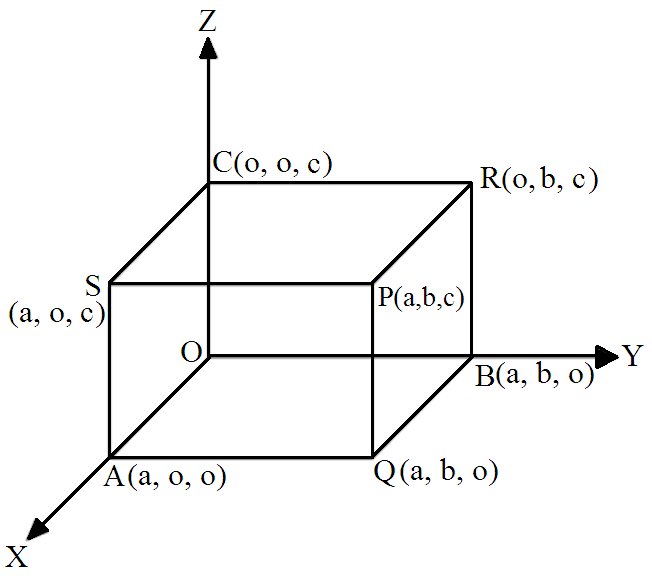
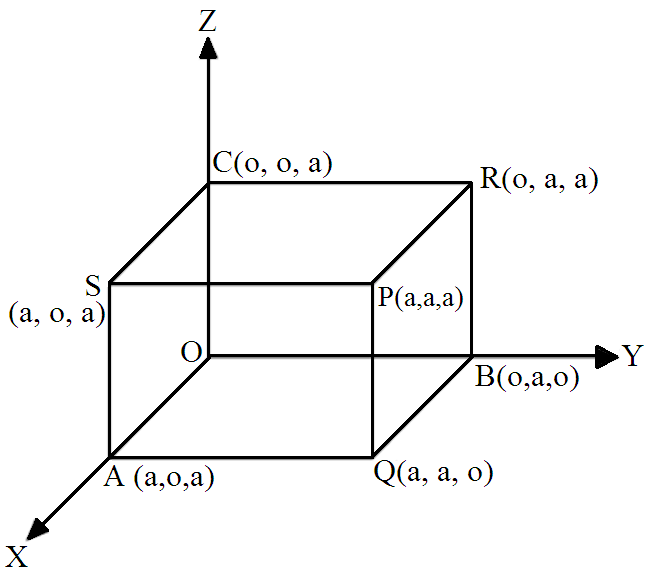
Let a be the length of an edge of the cube and let one corner be at the origin as shown in the figure.
Clearly, $\text{OP, AR,}$ Consider the diagonals $\text{OP}$ and $\text{AR.}$
Direction ratios of $\text{OP}$ and $\text{AR}$ are proportional to $a - 0, a - 0, a - 0$ and $0 - a, a - 0, a - 0,$
i.e. $a, a, a$ and $-a, a, a,$ respectivelly.
Let $\theta$ be the angle between $\text{OP}$ and $\text{AR.}$ Then,
$\cos\theta=\frac{\text{a}\times-\text{a}+\text{a}\times\text{a}+\text{a}\times\text{a}}{\sqrt{\text{a}^2+\text{a}^2+\text{a}^2}\sqrt{(-\text{a})^2+\text{a}^2+\text{a}^2}}$
$\Rightarrow\cos\theta=\frac{-\text{a}+\text{a}^2+\text{a}^2}{\sqrt{3\text{a}^2}\sqrt{3\text{a}^2}}$
$\Rightarrow\cos\theta=\frac{1}{3}$
$\Rightarrow\theta=\cos^{-1}\Big(\frac{1}{3}\Big)$
Similarly, the angles between other pairs of the diagonals are equal to $\cos^{-1}\Big(\frac{1}{3}\Big)$ as the angle between any two diagonals.
View full question & answer
MCQ 81 Mark
For every point $P(x, y, z)$ on the $xy-$plane,
  • A
    $x = 0$
  • B
    $y = 0$
  • $z = 0$
  • D
    $x = y = z = 0$
Answer
Correct option: C.
$z = 0$
The $Z-$coordinate of every point on the $XY-$plane is zero.
View full question & answer
MCQ 91 Mark
If the $x-$coordinate of a point $P$ on the join of $Q(2, 2, 1)$ and $R(5, 1, -2)$ is $4$, then its $z-$coordinate is:
  • A
    $2$
  • B
    $1$
  • $-1$
  • D
    $-2$
Answer
Correct option: C.
$-1$
Suppose the point $P$ divided the line segment joining the point $Q(2, 2, 1)$ and $R(5, 1, -2)$ in the ratio $k : 1.$
Using the section formula, the coordinates of the point of intersection are given by
$\Big(\frac{\text{k}(5)+2}{\text{k}+2},\frac{\text{k}(1)+2}{\text{k}+1},\frac{\text{k}(-2)+1}{\text{k}+1}\Big) $
On the $XY-$plane, the $Z-$coordinate of any point is zero.
$\Rightarrow\frac{\text{k}(5)+2}{\text{k}+2}=4$
$\Rightarrow5\text{k}+2=4(\text{k}+1)$
$\Rightarrow\text{k}=2$
Now,
$Z-$coordinate of $P =\frac{\text{k}(-2)+1}{\text{k}+1}$
$\frac{2(-2)+1}{2+1}\ [\text{Substituting} \text{ k}=2]$
$=-1$
View full question & answer
MCQ 101 Mark
If $P(3, 2, -4), Q(5, 4, -6)$ and $R(9, 8, -10)$ are collinear, then $R$ divided $PQ$ in the ratio:
  • A
    $3 : 2$ internally
  • $3 : 2$ externally
  • C
    $2 : 1$ internally
  • D
    $2 : 1$ externally
Answer
Correct option: B.
$3 : 2$ externally
Suppose the point $R$ divides $PQ$ in the ratio $\lambda:1$.
Coordinates of $R$ are $\Big(\frac{5\lambda+3}{\lambda+1},\frac{4\lambda+2}{\lambda+1},\frac{-6\lambda-4}{\lambda+1}\Big)$.
But the coordinates of $R$ are $(9, 8, -10)$.
$\therefore\frac{5\lambda+3}{\lambda+1}=9,\frac{4\lambda+2}{\lambda+1}=8$ and $\frac{-6\lambda-4}{\lambda+1}=-10$
From each of these equations, we get
$\lambda=-\frac{3}{2}$
$\therefore$ $R$ divided $PQ$ in the ratio $3 : 2$ externally.
View full question & answer
MCQ 111 Mark
A parallelopiped is formed by planes drawn through the point $(2, 3, 5)$ and $(5, 9, 7)$ parallel to the coordinate planes. The length of a diagonal of the parallelopiped is:
  • $7$
  • B
    $\sqrt{38}$
  • C
    $\sqrt{155}$
  • D
    $\text{none of these}$
Answer
Correct option: A.
$7$
The given point $(2, 3, 5)$ and $(5, 9, 7)$ are two diagonally opposite vertices of the parallelopiped as all of theire coordinates are different.
$\therefore$ Edges of the paralleloppiped
$= |2 - 5|, |3 - 9|$ and $|5 - 7|$
$=3, 6$ and $2.$
Now,
Length of the diagonal of the parallelopiped
$=\sqrt{3^2+6^2+2^2}$
$=\sqrt{9+36+4}$
$=\sqrt{49}$
$=7$
Hence, length of the diagonal of the parallelepiped formed by the planes
Parallel to coordinate planes and drawn through point $(2, 3, 5)$ and $(5, 9, 7)$ is $7$ units.
View full question & answer
MCQ 121 Mark
The distance of the point $P(a, b, c)$ from the $x-$axis is:
  • $\sqrt{\text{b}^2+\text{c}^2}$
  • B
    $\sqrt{\text{a}^2+\text{c}^2}$
  • C
    $\sqrt{\text{a}^2+\text{b}^2}$
  • D
    $\text{none of these}$
Answer
Correct option: A.
$\sqrt{\text{b}^2+\text{c}^2}$
The projection of the point $P(a, b, c)$ on the $x-$axis is $a, (0, 0)$ as both $Y$ and $Z$ coordinates on any point on the $x-$axis are equal to zero.
$\therefore$ Distance of $P(a, b, c)$ from $x-$axis $=$ Distance of $P(a, b, c)$ from $a, (0, 0)$
$=\sqrt{(\text{a}-\text{a})^2+(\text{b}-0)^2+(\text{c}-0)^2}$
$=\sqrt{\text{b}^2+\text{c}^2}$
View full question & answer
MCQ 131 Mark
If a line makes angles $\alpha,\beta,\gamma,\delta$ with four diagonals of a cube, then $\cos^2\alpha+\cos^2\beta+\cos^2\gamma+\cos^2\delta$ is equal to:
  • A
    $\frac{1}{3}$
  • B
    $\frac{2}{3}$
  • $\frac{4}{3}$
  • D
    $\frac{8}{3}$
Answer
Correct option: C.
$\frac{4}{3}$

Let a be the length of an edge of the cube and let one corner be at the origin as shown in the figure. Clearly, $\text{OP, AR}$
The direction ratiosm of $\text{OP, AR, BS}$ and $\text{CQ}$ are
$a - 0, a - 0, a - 0,$ i.e. $a, a, a$
$0 - a, a - 0, a - 0,$ i.e. $-a, a, a$
$a - 0, 0 - a, a - 0,$ i.e. $a, -a, a$
$a - 0, a - 0, 0 - a,$ i.e. $a, a, -a$
Let the direction ratios of a line be proportional to $l, m$ and $n.$
Suppose this line makes angles $\alpha,\beta,\gamma$ and $\delta$ with $\text{OP, AR.}$
Now, $\alpha$ is the angle between $OP$ and the line whose direction ratios are proportional to $l, m$ and $n.$
$\cos\alpha=\frac{\text{a}.\text{l}+\text{a}.\text{m}+\text{a}.\text{n}}{\sqrt{\text{a}^2+\text{a}^2+\text{a}^2}\sqrt{\text{l}^2+\text{m}^2+\text{n}^2}}$
$\Rightarrow\cos\alpha=\frac{\text{l}+\text{m}+\text{n}}{\sqrt{3}\sqrt{\text{l}^2+\text{m}^2+\text{n}^2}}$
Since $\beta$ is the angle between $AR$ and the line with direction ratios proportional to $l, m$ and $n,$ we get
$\cos\beta=\frac{-\text{a}.\text{l}+\text{a}.\text{m}+\text{a}.\text{n}}{\sqrt{\text{a}^2+\text{a}^2+\text{a}^2}\sqrt{\text{l}^2+\text{m}^2+\text{n}^2}}$
$\Rightarrow\cos\beta=\frac{-\text{l}+\text{m}+\text{n}}{\sqrt{3}\sqrt{\text{l}^2+\text{m}^2+\text{n}^2}}$
Similarly,
$\cos\gamma=\frac{\text{a}.\text{l}-\text{a}.\text{m}+\text{a}.\text{n}}{\sqrt{\text{a}^2+\text{a}^2+\text{a}^2}\sqrt{\text{l}^2+\text{m}^2+\text{n}^2}}$
$\Rightarrow\cos\gamma=\frac{\text{l}-\text{m}+\text{n}}{\sqrt{3}\sqrt{\text{l}^2+\text{m}^2+\text{n}^2}}$
$\cos\delta=\frac{\text{a}.\text{l}+\text{a}.\text{m}-\text{a}.\text{n}}{\sqrt{\text{a}^2+\text{a}^2+\text{a}^2}\sqrt{\text{l}^2+\text{m}^2+\text{n}^2}}$
$\Rightarrow\cos\delta=\frac{\text{l}+\text{m}-\text{n}}{\sqrt{3}\sqrt{\text{l}^2+\text{m}^2+\text{n}^2}}$
$\cos^2\alpha+\cos^2\beta+\cos^2\gamma+\cos^2\delta$
$=\frac{(\text{l}+\text{m}+\text{n})^2}{3(\text{l}^2+\text{m}^2+\text{n}^2)}+\frac{(-\text{l}+\text{m}+\text{n})^2}{3(\text{l}^2+\text{m}^2+\text{n}^2)}+\frac{(\text{l}-\text{m}+\text{n})^2}{3(\text{l}^2+\text{m}^2+\text{n}^2)}+\frac{(\text{l}+\text{m}-\text{n})^2}{\sqrt{3}\sqrt{\text{l}^2+\text{m}^2+\text{n}^2}}$
$=\frac{1}{3(\text{l}^2+\text{m}^2+\text{n}^2)}\Big\{(\text{l}+\text{m}+\text{n})^2+(-\text{l}+\text{m}+\text{n})^2+(\text{l}-\text{m}+\text{n})^2+(\text{l}+\text{m}-\text{n})^2\Big\}$
$=\frac{1}{3(\text{l}^2+\text{m}^2+\text{n}^2)}4\big(\text{l}^2+\text{m}^2+\text{n}^2\big)$
$=\frac{4}{3}$.

View full question & answer
MCQ - Maths STD 12 Questions - Vidyadip