MCQ 1012 Marks
A plane II passes through the point $(1,1,1)$. If c , a are the direction ratios of a normal to the plane, where $a , b , c ( a < b < c )$ are the prime factors of 2001, then the equation of the plane II is
- A
$29 x+31 y+3 z=63$
- B
$23 x+29 y-29 z=23$
- ✓
$23 x+29 y+3 z=55$
- D
$31 x+37 y+3 z=71$
AnswerCorrect option: C. $23 x+29 y+3 z=55$
(C)
The equation of the plane is
$b (x-1)+ c (y-1)+ a ( z -1)=0...(i)$
Now, $2001=3 \times 23 \times 29$
Since, $a < b < c$
$\therefore \quad a=3, b=23$ and $c=29$
Substituting the values of $a, b, c$ in equation (i), we get
$23 x+29 y+3 z=55$
View full question & answer→MCQ 1022 Marks
The equation of the plane through the intersection of planes $x+2 y+3 z-4=0$ and $2 x+y-z+5=0$ and perpendicular to plane $5 x+3 y-6 z+8=0$ is
- ✓
$33 x+45 y+50 z-41=0$
- B
$33 x+50 y+45 z-41=0$
- C
$33 x+45 y+50 z+41=0$
- D
$45 x+33 y+50 z-41=0$
AnswerCorrect option: A. $33 x+45 y+50 z-41=0$
(A)
The equation of the required plane is
$x+2 y+3 z-4+\lambda(2 x+y-z+5)=0$
$\Rightarrow(1+2 \lambda) x+(2+\lambda) y+(3-\lambda) z-4+5 \lambda=0...(i)$
Let $a , b , c$ be the d.r.s of the required plane
$\begin{array}{l}\therefore \text { From equation (i), } a =1+2 \lambda ; b =2+\lambda ; \\ c =3-\lambda\end{array}$
The required plane is perpendicular to $5 x+3 y-6 z+8=0$
$\therefore \quad 5 a+3 b-6 c=0$
$\Rightarrow 5(1+2 \lambda)+3(2+\lambda)-6(3-\lambda)=0$
$\Rightarrow 5+10 \lambda+6+3 \lambda-18+6 \lambda=0$
$\Rightarrow-7+19 \lambda=0$
$\Rightarrow \lambda=\frac{7}{19}$
Substituting the value of $\lambda$ in equation (i), we get
$\left(1+2 \times \frac{7}{19}\right) x+\left(2+\frac{7}{19}\right) y+\left(3-\frac{7}{19}\right) z$ $- 4+5\left(\frac{7}{19}\right)=0$
$\Rightarrow \frac{33}{19} x+\frac{45}{19} y+\frac{50}{19} z-\frac{41}{19}=0$
$\Rightarrow 33 x+45 y+50 z-41=0$
View full question & answer→MCQ 1032 Marks
The line of intersection of the planes $\bar{r} \cdot(3 \hat{i}-\hat{j}+\hat{k})=1$ and $\bar{r} \cdot(\hat{i}+4 \hat{j}-2 \hat{k})=2$ is parallel to the vector
- A
$-2 \hat{ i }-7 \hat{ j }+3 \hat{ k }$
- B
$2 \hat{i}+7 \hat{j}-13 \hat{k}$
- C
$2 \hat{ i }+7 \hat{ j }+13 \hat{ k }$
- ✓
$-2 \hat{i}+7 \hat{j}+13 \hat{j}$
AnswerCorrect option: D. $-2 \hat{i}+7 \hat{j}+13 \hat{j}$
(D)
The line of intersection of the planes $\overline{ r } \cdot(3 \hat{ i }-\hat{ j }+\hat{ k })=1$ and $\overline{ r } \cdot(\hat{ i }+4 \hat{ j }-2 \hat{ k })=2$ is perpendicular to each of the normal vectors $\overline{ n _1}=3 \hat{ i }-\hat{ j }+\hat{ k }$ and $\overline{ n _2}=\hat{ i }+4 \hat{ j }-2 \hat{ k }$.
$\therefore \quad$ The line is parallel to the vector $\overline{ n }_1 \times \overline{ n }_2$
$\therefore \quad \bar{n}_1 \times \bar{n}_2=\left|\begin{array}{ccc}\hat{i} & \hat{j} & \hat{k} \\ 3 & -1 & 1 \\ 1 & 4 & -2\end{array}\right|$
$=-2 \hat{i}+7 \hat{j}+13 \hat{k}$
View full question & answer→MCQ 1042 Marks
The equation of the plane which contains the origin and the line of intersection of the planes $\overline{ r } \cdot \overline{ a }= p$ and $\overline{ r } \cdot \overline{ b }= q$ is
- A
$\bar{r} \cdot(p \bar{a}-q \bar{b})=0$
- ✓
$\bar{r} \cdot(q \bar{a}-q \bar{b})=0$
- C
$\bar{r} \cdot(p \bar{a}+q \bar{b})=0$
- D
$\bar{r} \cdot(q \bar{a}+p \bar{b})=0$
AnswerCorrect option: B. $\bar{r} \cdot(q \bar{a}-q \bar{b})=0$
(B)
The equation of the plane passing through the intersection of the planes $r \cdot a = p$ and
$\overline{ r } \cdot \overline{ b }= q$ is
$\overline{ r } \cdot(\overline{ a }+\lambda \overline{ b })= p +\lambda q...(i)$
Since, the plane passes through the origin,
$p+\lambda q=0$
$\Rightarrow \lambda=\frac{- p }{ q }$
Substituting the value of $\lambda$ in (i), we get
$\bar{r} \cdot\left(\bar{a}-\frac{p}{q} \bar{b}\right)=p+\left(\frac{-p}{q}\right)(q)$
$\Rightarrow \overline{ r } \cdot(\overline{ a } q -\overline{ b } p )= pq - pq$
$\Rightarrow \overline{ r } \cdot( q \overline{ a }- p \overline{ b })=0$
View full question & answer→MCQ 1052 Marks
The equation of the plane passing through the points $(3,2,-1),(3,4,2)$ and $(7,0,6)$ is $5 x+3 y-2 z=\lambda$, where $\lambda$ is
Answer(A)
$(3,2,-1)$ lies on the plane $5 x+3 y-2 z=\lambda$
$\therefore 5(3)+3(2)-2(-1)=\lambda$
$\Rightarrow \lambda=23$
View full question & answer→MCQ 1062 Marks
If $\bar{a}, \bar{b}, \bar{c}$ are three non-coplanar vectors, then the vector equation $\overline{ r }=(1-p-q) \overline{ a }+p \overline{b}+q \overline{ c }$ represents a
- A
- ✓
- C
plane passing through the origin
- D
Answer(B)
$\overline{ r }=(1- p - q ) \overline{ a }+ p \overline{ b }+ q \overline{ c }$
$\Rightarrow \overline{ r }=\overline{ a }+ p (\overline{ b }-\overline{ a })+ q (\overline{ c }-\overline{ a })...(i)$
Comparing with $\overline{ r }=\overline{ A }+\lambda \overline{ B }+\mu \overline{ C }$, the equation (i) represents a plane passing through a point having position vector $\overline{ a }$ and parallel to the vectors $\overline{ b }-\overline{ a }$ and $\overline{ c }-\overline{ a }$.
View full question & answer→MCQ 1072 Marks
If the vector equation of a plane passing through three points $\left(1,0, z_1\right),(1,-1,1)$, and $(4,-3,2)$ is $\bar{r} \cdot(-\hat{i}+3 \hat{k})=2$, then the value of $z_1$ is
Answer(B)
Since, the point $\left(1.0 . z_1\right)$ lies on the plane
$\overline{ r } .(-\hat{ i }+3 \hat{ k })=2$
i.e. $-x+3 z=2$
$\Rightarrow z _1=1$
View full question & answer→MCQ 1082 Marks
The equation of the plane through the points $(2,-1,0)$, and $(3,-4,5)$ and parallel to a line with direction cosines proportional to $2,3,4$ is $9 x-2 y-3 z=k$, where $k$ is
Answer(A)
$(2,-1,0)$ lies on the plane $9 x-2 y-3 z=k$
$\therefore \quad 9(2)-2(-1)-3(0)= k$
$\Rightarrow k =20$
View full question & answer→MCQ 1092 Marks
The equation of the line passing through $(1,2,3)$ and parallel to the planes $x-y+2 z =5$ and $3 x+y+z=6$, is
- ✓
$\frac{x-1}{-3}=\frac{y-2}{5}=\frac{z-3}{4}$
- B
$\frac{x+3}{1}=\frac{y-5}{2}=\frac{z-4}{3}$
- C
$\frac{x-3}{-1}=\frac{y-5}{2}=\frac{z-4}{3}$
- D
$\frac{x-1}{3}=\frac{y-2}{5}=\frac{z-3}{4}$
AnswerCorrect option: A. $\frac{x-1}{-3}=\frac{y-2}{5}=\frac{z-3}{4}$
(A)
$\bar{n}=\left|\begin{array}{ccc}\hat{i} & \hat{j} & \hat{k} \\ 1 & -1 & 2 \\ 3 & 1 & 1\end{array}\right|=-3 \hat{i}+5 \hat{j}+4 \hat{k}$
$\therefore \quad$ the d.r.s. of line are $-3,5,4$
∴ The equation of the line passing through
$(1,2,3)$ and having d.r.s. $-3,5,4$ is
$\frac{x-1}{-3}=\frac{y-2}{5}=\frac{z-3}{4}$
View full question & answer→MCQ 1102 Marks
The equation of a line passing through point $(1,2,3)$ and perpendicular to the plane $x+2 y-5 z+9=0$ are
- ✓
$\frac{x-1}{1}=\frac{y-2}{2}=\frac{z-3}{-5}$
- B
$\frac{x+1}{1}=\frac{y+2}{2}=\frac{z+3}{-5}$
- C
$\frac{x+1}{1}=\frac{y+2}{2}=\frac{z+3}{3}$
- D
$\frac{x-1}{1}=\frac{y-2}{-2}=\frac{z-3}{5}$
AnswerCorrect option: A. $\frac{x-1}{1}=\frac{y-2}{2}=\frac{z-3}{-5}$
View full question & answer→MCQ 1112 Marks
The equation of the line passing through $3 \hat{i}-5 \hat{j}+7 \hat{k}$ and perpendicular to the plane $3 x-4 y+5 z=0$ is
- ✓
$\overline{ r }=3 \hat{ i }-5 \hat{ j }+7 \hat{ k }+\lambda(3 \hat{ i }-4 \hat{ j }+5 \hat{ k })$
- B
$\overline{ r }=3 \hat{ i }-4 \hat{ j }+5 \hat{ k }+\lambda(3 \hat{ i }-5 \hat{ j }+7 \hat{ k })$
- C
$\overline{ r }=3 \hat{ i }+5 \hat{ j }-7 \hat{ k }+\lambda(3 \hat{ i }-4 \hat{ j }-5 \hat{ k })$
- D
$\bar{r}=3 \hat{i}+4 \hat{j}-5 \hat{k}+\mu(3 \hat{i}+5 \hat{j}+7 \hat{k})$
AnswerCorrect option: A. $\overline{ r }=3 \hat{ i }-5 \hat{ j }+7 \hat{ k }+\lambda(3 \hat{ i }-4 \hat{ j }+5 \hat{ k })$
(A)
The d.r.s. of the line are $3,-4,5$ and it passes through is $3,-5,7$
$\therefore \quad$ The equation of line is
$\overline{ r }=3 \hat{ i }-5 \hat{ j }+7 \hat{ k }+\lambda(3 \hat{ i }-4 \hat{ j }+5 \hat{ k })$
View full question & answer→MCQ 1122 Marks
The vector equation of the line passing through the point $2 \hat{i}-3 \hat{j}-5 \hat{k}$ and perpendicular to the plane $\overline{ r } \cdot(6 \hat{ i }-3 \hat{ j }+5 \hat{ k })+2=0$ is
- A
$\overline{ r }=6 \hat{ i }-3 \hat{ j }+5 \hat{ k }+\lambda(2 \hat{ i }+3 \hat{ j }-5 \hat{ k })$
- B
$\overline{ r }=(6 \hat{ i }-3 \hat{ j }+5 \hat{ k })+\lambda(2 \hat{ i }-3 \hat{ j }-5 \hat{ k })$
- C
$\bar{r}=(2 \hat{i}-3 \hat{j}-5 \hat{k})+\lambda(6 \hat{i}+3 \hat{j}-5 \hat{k})$
- ✓
$\bar{r}=(2 \hat{i}-3 \hat{j}-5 \hat{k})+\lambda(6 \hat{i}-3 \hat{j}+5 \hat{k})$
AnswerCorrect option: D. $\bar{r}=(2 \hat{i}-3 \hat{j}-5 \hat{k})+\lambda(6 \hat{i}-3 \hat{j}+5 \hat{k})$
(D)
Vector perpendicular to plane is
$\overline{ n }=6 \hat{ i }-3 \hat{ j }+5 \hat{ k }$
Thus, the line perpendicular to the given line
will be parallel to $\bar{n}$
$\therefore \quad$ The equation of line which passes through
$\overline{ a }=2 \hat{ i }-3 \hat{ j }-5 \hat{ k }$ and parallel to $\overline{ n }$ is $\overline{ r }=\overline{ a }+\lambda \overline{ n }$
$\Rightarrow \overline{ r }=(2 \hat{ i }-3 \hat{ j }-5 \hat{ k })+\lambda(6 \hat{ i }-3 \hat{ j }+5 \hat{ k })$
View full question & answer→MCQ 1132 Marks
The equation of the plane passing through A $\left(x_1, y_1, z_1\right)$ and containing the line $\frac{x-x_2}{d_1}=\frac{y-y_2}{d_2}=\frac{ z - z _2}{d_3}$ is
- A
$\left|\begin{array}{ccc}x+x_1 & y+y_1 & z + z _1 \\ x_2+x_1 & y_2+y_1 & z _2+ z _1 \\ d_1 & d_2 & d_3\end{array}\right|=0$
- ✓
$\left|\begin{array}{ccc}x-x_1 & y-y_1 & z - z _1 \\ x_2-x_1 & y_2-y_1 & z _2- z _1 \\ d_1 & d_2 & d_3\end{array}\right|=0$
- C
$\left|\begin{array}{ccc}x- d _1 & y- d _2 & z - d _3 \\ x_1 & y_1 & z _1 \\ x_2 & y_2 & z _2\end{array}\right|=0$
- D
$\left|\begin{array}{ccc}x & y & z \\ x_1-x_2 & y_1-y_2 & z _1- z _2 \\ d_1 & d_2 & d_3\end{array}\right|=0$
AnswerCorrect option: B. $\left|\begin{array}{ccc}x-x_1 & y-y_1 & z - z _1 \\ x_2-x_1 & y_2-y_1 & z _2- z _1 \\ d_1 & d_2 & d_3\end{array}\right|=0$
(B)
Equation of any plane through $\left(x_1, y_1, z_1\right)$ is
$a \left(x-x_1\right)+ b \left(y-y_1\right)+ c \left( z - z _1\right)=0...(i)$
it contains the line
$\frac{x-x_2}{d_1}=\frac{y-y_2}{d_2}=\frac{ z - z _2}{d_3}=0$
i.e. it passes through $\left(x_2, y_2, z_2\right)$
$\therefore \quad a \left(x_2-x_1\right)+ b \left(y_2-y_1\right)+ c \left( z _2- z _1\right)=0...(ii)$
Also, $ad _1+ bd _2+ cd _3=0...(iii)$
Eliminating $a , b , c$ from (i), (ii), (iii), we get the equation of the required plane as
$\left|\begin{array}{ccc}x-x_1 & y-y_1 & z - z _1 \\ x_2-x_1 & y_2-y_1 & z _2- z _1 \\ d_1 & d_2 & d_3\end{array}\right|=0$
View full question & answer→MCQ 1142 Marks
Equation of plane which contains the line $\frac{x-1}{1}=\frac{y-2}{3}=\frac{z-3}{2}$ and which is perpendicular to the plane $2 x+7 y+5 z=2$, is
- A
$x+y+z=6$
- B
$-x+y+z=2$
- C
$2 x-y+z=3$
- ✓
$x-y+ z =2$
AnswerCorrect option: D. $x-y+ z =2$
(D)
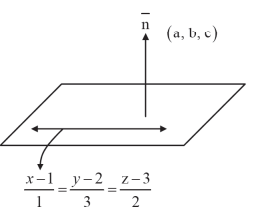
$\bar{n}=\left|\begin{array}{ccc}\hat{i} & \hat{j} & \hat{k} \\ 1 & 3 & 2 \\ 2 & 7 & 5\end{array}\right|=\hat{i}-\hat{j}+\hat{k}$
∴ the d.r.s of the normal to the plane are $1,-1,1$
∴ the equation of plane passing through the point (1, 2, 3)
$1(x-1)-1(y-2)+1(z-3)=0$
$\Rightarrow x-y+ z =2$ View full question & answer→MCQ 1152 Marks
The equation of the plane passing through Z -axis and perpendicular to line $\frac{x-1}{\cos \theta}=\frac{y+2}{\sin \theta}=\frac{z-3}{0}$ is
- A
$y+x \tan \theta=0$
- ✓
$x+y \tan \theta=0$
- C
$y+z \tan \theta=0$
- D
$x+z \tan \theta=0$
AnswerCorrect option: B. $x+y \tan \theta=0$
(B)
Let $a , b , c$ be the d.r.s. of the required plane. Since, the plane passes through Z -axis,
$\therefore \quad a(0)+b(0)+c(1)=0$
$\Rightarrow c =0$
Given that the required plane is perpendicular to $\frac{x-1}{\cos \theta}=\frac{y+2}{\sin \theta}=\frac{z-3}{0}$
∴ d.r.s of normal to plane are $\cos \theta, \sin \theta, 0$
∴ the equation of required plane is
$x \cos \theta+y \sin \theta=0$
$\Rightarrow x+y \tan \theta=0$
View full question & answer→MCQ 1162 Marks
The equation of a plane which passes through $(2,-3,1)$ and is normal to the line joining the points $(3,4,-1)$ and $(2,-1,5)$ is given by
- ✓
$x+5 y-6 z+19=0$
- B
$x-5 y+6 z-19=0$
- C
$x+5 y+6 z+19=0$
- D
$x-5 y-6 z-19=0$
AnswerCorrect option: A. $x+5 y-6 z+19=0$
(A)
The plane passes through $(2,-3,1)$
This point satisfies the equation of plane in option (A)
Also, it has d.r.s. $3-2,4+1,-1-5$
i.e. $1,5,-6$.
∴ option (A) is correct answer.
Alternate method:
The d.r.s. of the line joining the points $(3,4,-1)$ and $(2,-1,5)$ are $1,5,-6$.
The plane passes through $(2,-3,1)$
∴ the equation of required plane is
$1\left(\begin{array}{ll}x & 2\end{array}\right)+5(y+3) \quad 6\left(\begin{array}{ll}z & 1\end{array}\right)-0$
$\Rightarrow x+5 y-6 z+19=0$
View full question & answer→MCQ 1172 Marks
The intercepts made on the axes by the plane which bisects the line joining the points $(1,2,3)$ and $(-3,4,5)$ at right angles are
- ✓
$\left(-\frac{9}{2}, 9,9\right)$
- B
$\left(\frac{9}{2}, 9,9\right)$
- C
$\left(9,-\frac{9}{2}, 9\right)$
- D
$\left(9, \frac{9}{2}, 9\right)$
AnswerCorrect option: A. $\left(-\frac{9}{2}, 9,9\right)$
(A)
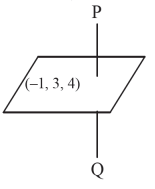
Mid-point of line joining $P (1,2,3)$ and $Q(-3,4,5)$ is $(-1,3,4)$
It lies on the plane
The d.r.s. of normal to the plane are $-4,2,2$
i.e. $-2,1,1$
$\therefore \quad$ The equation of the plane is
$-2(x+1)+1(y-3)+1(z-4)=0$
$\Rightarrow 2 x-y-z=-9$
$\Rightarrow \frac{x}{\frac{-9}{2}}+\frac{y}{9}+\frac{z}{9}=1$
∴ Intercepts are $\frac{-9}{2}, 9,9$ View full question & answer→MCQ 1182 Marks
Equation of the plane which bisects the line segment joining points $(-1,2,3)$ and $(3,-5,6)$ perpendicularly, is
- A
$4 x+2 y-3 z=28$
- B
$4 x-7 y-3 z=28$
- ✓
$4 x-7 y+3 z=28$
- D
$4 x-7 y-3 z=8$
AnswerCorrect option: C. $4 x-7 y+3 z=28$
(C)
Mid-point of the line segment joining the points $(-1,2,3)$ and $(3,-5,6)$ is
$M \equiv\left(\frac{-1+3}{2}, \frac{2-5}{2}, \frac{3+6}{2}\right)$
$M \equiv\left(1, \frac{-3}{2}, \frac{9}{2}\right)$
The plane passes through point M
It satisfies option (C)
Alternate method:
The required plane bisects the line segment perpendicularly.
∴ the d.r.s. of the normal to the plane are
$3-(-1),-5-2,6-3$
i.e. $4,-7,3$
Since, the mid-point $\left(1,-\frac{3}{2}, \frac{9}{2}\right)$ lies in the plane,
$\therefore \quad$ The equation of the plane is
$4(x-1)-7\left(y+\frac{3}{2}\right)+3\left(z-\frac{9}{2}\right)=0$
$\Rightarrow 4 x-7 y+3 z=28$
View full question & answer→MCQ 1192 Marks
Equation of the plane passing through point $P ( a , b , c )$ and perpendicular to OP is
- A
$a x+ b y+ cz = a + b + c$
- ✓
$a x+b y+c z=a^2+b^2+c^2$
- C
$\frac{x}{a}+\frac{y}{b}+\frac{z}{c}=3$
- D
$a x+ b y+ cz =( a + b + c )^2$
AnswerCorrect option: B. $a x+b y+c z=a^2+b^2+c^2$
(B)
P be the point $( a , b , c )$.
$\therefore \quad$ The d.r.s of OP are $a, b, c$.
∴ Equation of the plane passing through the point $( a , b , c )$ is
$a (x- a )+ b (y- b )+ c ( z - c )=0$
$\Rightarrow ax + by + cz = a ^2+ b ^2+ c ^2$
View full question & answer→MCQ 1202 Marks
The equation of plane passing through mid-point of the points joining $\hat{i}+2 \hat{j}+4 \hat{k}$ and $-\hat{ i }+2 \hat{ j }-6 \hat{ k }$ and perpendicular to it is
- A
$\overline{ r } .(\hat{ i }-5 \hat{ k })-10=0$
- B
$\overline{ r } .(\hat{ i }-5 \hat{ k })+10=0$
- C
$\overline{ r } .(\hat{ i }+5 \hat{ k })-10=0$
- ✓
$\overline{ r } \cdot(\hat{ i }+5 \hat{ k })+10=0$
AnswerCorrect option: D. $\overline{ r } \cdot(\hat{ i }+5 \hat{ k })+10=0$
(D)
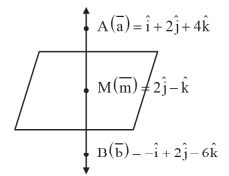
$\therefore \quad M(\bar{m})=\frac{(1-1)}{2} \hat{i}+\frac{(2+2)}{2} \hat{j}+\frac{(4-6)}{2} \hat{k}$
$=2 \hat{ j }-\hat{ k }$
∴ equation of plane passing through the vector
$2 \hat{ j }-\hat{ k }$ and perpendicular to $\overline{ AB }=-2 \hat{ i }-10 \hat{ k }$ is
$\overline{ r } \cdot(-2 \hat{ i }-10 \hat{ k })=(2 \hat{ j }-\hat{ k }) \cdot(-2 \hat{ i }-10 \hat{ k })$
$\Rightarrow \overline{ r } \cdot(\hat{ i }+5 \hat{ k })=-10$ View full question & answer→MCQ 1212 Marks
The equation of a plane which cuts equal intercepts of unit length on the axes is
AnswerCorrect option: B. $x+y+z=1$
(B)
Here, $a=b=c=1$
$\therefore \quad$ the equation of the required plane is $\frac{x}{1}+\frac{y}{1}+\frac{z}{1}=1$
$\Rightarrow x+y+z=1$
View full question & answer→MCQ 1222 Marks
If the plane $x-3 y+5 z=d$ passes through the point $(1,2,4)$, then the lengths of intercepts cut by it on the axes of $X , Y , Z$ are respectively
- ✓
$15,-5,3$
- B
$1,-5,3$
- C
$-15,5,-3$
- D
$1,-6,20$
AnswerCorrect option: A. $15,-5,3$
(A)
The plane $x-3 y+5 z = d$ passes through $(1,2,4)$.
$\therefore \quad d =15$
$\therefore \quad$ the equation of plane becomes $x-3 y+5 z=15$
$\Rightarrow \frac{x}{15}+\frac{y}{-5}+\frac{ z }{3}=1$
$\therefore$ length of intercept cut by plane on the $X , Y , Z$ axes are $15,-5,3$ respectively.
View full question & answer→MCQ 1232 Marks
The equation of the plane through $(2,3,4)$ and parallel to the plane $x+2 y+4 z=5$ is
- A
$x+2 y+4 z=10$
- B
$x+2 y+4 z=3$
- C
$x+y+2 z=2$
- ✓
$x+2 y+4 z=24$
AnswerCorrect option: D. $x+2 y+4 z=24$
(D)
The plane passes through $(2,3,4)$
This point satisfies the equation of plane in option (D)
Also, it has d.r.s. $1,2,4$.
∴ option (D) is correct answer.
Alternate method:
The equation of the required plane parallel to the plane $x+2 y+4 z=5$ is
$x+2 y+4 z+k=0$
The plane passes through $(2,3,4)$
$\therefore 2+2(3)+4(4)+ k =0$
$\Rightarrow k =-24$
$\therefore \quad$ the equation of the required plane is
$x+2 y+4 z=24$
View full question & answer→MCQ 1242 Marks
Equation of the plane passing through points $(1,-1,3)$ and $(2,3,-4)$ and parallel to $X$-axis is
- A
$7 y+4 z+5=0$
- ✓
$7 y+4 z-5=0$
- C
$7 y-4 z-5=0$
- D
$7 y-4 z+5=0$
AnswerCorrect option: B. $7 y+4 z-5=0$
(B)
The plane passes through $(1,-1,3)$ and $(2,3-4)$
The points satisfies the equation of plane in option (B)
∴ option (B) is correct answer.
Alternate method:
Let $ax + by + cz + d =0$ be the equation of the required plane.
Since, the plane is parallel to X -axis,
$\therefore \quad a=0$
The points $(1,-1,3)$ and $(2,3,-4)$ lie in the plane,
$\therefore \quad-b+3 c+d=0$, and ...(i)
$3 b-4 c+d=0$ ...(ii)
Solving the equations (i) and (ii), we get
$\frac{b}{3-(-4)}=\frac{c}{3+1}=\frac{d}{4-9}$
$\Rightarrow \frac{b}{7}=\frac{c}{4}=\frac{d}{-5}$
∴ Equation of the required plane is $7 y+4 z-5=0$
View full question & answer→MCQ 1252 Marks
Equation of a plane passing through $(1,1,1)$ and containing $X$-axis is
- A
$x-y=0$
- B
$x- z =0$
- ✓
$y- z =0$
- D
$x+y+ z =3$
AnswerCorrect option: C. $y- z =0$
(C)
Since, the plane contains the X -axis, it passes through the origin
$\therefore \quad d =0$
$\therefore \quad$ The equation of the plane is
$a x+b y+c z=0...(i)$
Also, plane passes through $(1,1,1)$
$\therefore \quad a+b+c=0...(ii)$
The equation of the X-axis is $\frac{x}{1}=\frac{y}{0}=\frac{z}{0}$
As the plane contains the X -axis, the d.r.s of the normal to the plane are perpendicular to X-axis
$\therefore \quad a(1)+b(0)+c(0)=0$
$\Rightarrow a =0$
Substituting value of $a$ in (ii) we get
$b+c=0 \Rightarrow b=-c$
$\therefore \quad$ The equation of the required plane is $b y- bz =0$
$\Rightarrow y-z=0$
View full question & answer→MCQ 1262 Marks
A line from the origin meets the lines $\frac{x-2}{1}=\frac{y-1}{-2}=\frac{z+1}{1}$ and $\frac{x-\frac{8}{3}}{2}=\frac{y+3}{-1}=\frac{z-1}{1}$ at P and Q respectively. If length $PQ =d$, then $d ^2$ is equal to
Answer(D)
Let the equation of a line passing through the origin be $\frac{x}{a}=\frac{y}{b}=\frac{z}{c}$.
This meets the lines
$\frac{x-2}{1}=\frac{y-1}{-2}=\frac{z+1}{1}$ and $\frac{x-\frac{0}{3}}{2}=\frac{y+3}{-1}=\frac{z-1}{1}$
$\therefore\left|\begin{array}{ccc}2 & 1 & -1 \\ a & b & c \\ 1 & -2 & 1\end{array}\right|=0$ and $\left|\begin{array}{ccc}\frac{8}{3} & -3 & 1 \\ a & b & c \\ 2 & -1 & 1\end{array}\right|=0$
$\Rightarrow a+3 b+5 c=0$ and $3 a+b-5 c=0$
$\Rightarrow \frac{ a }{5}=\frac{ b }{-5}=\frac{ c }{2}$
Thus, the equation of the line through the origin intersecting the given lines is
$\frac{x}{5}=\frac{y}{-5}=\frac{z}{2}=\lambda($ say $)$
The co-ordinates of any point on this line are $(5 \lambda,-5 \lambda, 2 \lambda)$.
The co-ordinates of any point on
$\frac{x-2}{1}=\frac{y-1}{-2}=\frac{z+1}{1}=\lambda_1$ (say) are
$\left(\lambda_1+2,-2 \lambda_1+1, \lambda_1-1\right)$.
If these two lines intersect, then
$5 \lambda=\lambda_1+2,-5 \lambda=-2 \lambda_1+1$ and $2 \lambda=\lambda_1-1$
$\Rightarrow \lambda_1=3$ and $\lambda=1$
So, the co-ordinates of P are $(5,-5,2)$.
Similarly, co-ordinates of Q are $\left(\frac{10}{3}, \frac{-10}{3}, \frac{8}{3}\right)$
$\therefore \quad PQ ^2=\left(\frac{10}{3}-5\right)^2+\left(\frac{-10}{3}+5\right)^2+\left(\frac{8}{3}-2\right)^2=6$
View full question & answer→MCQ 1272 Marks
If the lines $\frac{x-1}{k}=\frac{y+1}{3}=\frac{z-1}{4}$ and $\frac{x-3}{1}=\frac{2 y-9}{2 k }=\frac{ z }{1}$ intersect, then the value of k is
Answer(A)
The given equation of lines are
$\frac{x-1}{ k }=\frac{y+1}{3}=\frac{ z -1}{4}$ and
$\frac{x-3}{1}=\frac{2 y-9}{2 k }=\frac{ z }{1}$
i.e. $\frac{x-3}{1}=\frac{y-\frac{9}{2}}{ k }=\frac{ z }{1}$
Since the line intersect,
$\left|\begin{array}{ccc}x_2-x_1 & y_2-y_1 & z _2- z _1 \\ a _1 & b_1 & c _1 \\ a _2 & b_2 & c _2\end{array}\right|=0$
$\therefore\left|\begin{array}{rrr}2 & \frac{11}{2} & -1 \\ k & 3 & 4 \\ 1 & k & 1\end{array}\right|-0$
$\therefore \quad 2(3-4 k )-\frac{11}{2}( k -4)-1\left( k ^2-3\right)=0$
$\therefore \quad 6-8 k-\frac{11}{2} k+22-k^2+3=0$
$\therefore \quad 2 k ^2+27 k -62=0$
$\therefore \quad 2 k ^2-4 k +31 k -62=0$
$\therefore \quad 2 k ( k -2)+31( k -2)=0$
$\therefore \quad k =2$ or $k =\frac{-31}{2}$
View full question & answer→MCQ 1282 Marks
The shortest distance between lines $\overline{ r }=(1- t ) \hat{ i }+( t -2) \hat{ j }+(3- t ) \hat{ k }$ and $\overline{ r }=( s +1) \hat{ i }+(2 s-1) \hat{ j }-(2 s+1) \hat{ k }$ is
- A
$\frac{1}{\sqrt{2}}$
- B
$\frac{7}{\sqrt{2}}$
- ✓
$\frac{3}{\sqrt{2}}$
- D
$\frac{5}{\sqrt{2}}$
AnswerCorrect option: C. $\frac{3}{\sqrt{2}}$
(C)
The lines can be rewritten as
$\overline{ r }=(\hat{ i }-2 \hat{ j }+3 \hat{ k })+ t (-\hat{ i }+\hat{ j }-\hat{ k })$ and
$\overline{ r }=(\hat{ i }-\hat{ j }-\hat{ k })+ s (\hat{ i }+2 \hat{ j }-2 \hat{ k })$
Here, $\left(x_1, y_1, z _1\right)=(1,-2,3)$
$\left(x_2, y_2, z_2\right)=(1,-1,-1)$
$\left(a_1, b_1, c_1\right)=(-1,1,-1)$
$\left(a_2, b_2, c_2\right)=(1,2,-2)$
$\therefore \quad$ Shortest distance (d)
$d=\left|\frac{\left|\begin{array}{ccc}1-1 & -1+2 & -1-3 \\ -1 & 1 & -1 \\ 1 & 2 & -2\end{array}\right|}{\sqrt{(-2+2)^2+(-1-2)^2+(-2-1)^2}}\right|$
$=\left|\frac{0-1(3)-4(-3)}{3 \sqrt{2}}\right|=\frac{9}{3 \sqrt{2}}=\frac{3}{\sqrt{2}}$
View full question & answer→MCQ 1292 Marks
Find the equation of the perpendicular drawn from the point $(2,4,-1)$ to the line $x+5=\frac{1}{4}(y+3)=-\frac{1}{9}(z-6)$ and obtain the co-ordinates of the foot of this perpendicular
- ✓
$\frac{x-2}{6}=\frac{y-4}{3}=\frac{z+1}{2} ;(-4,1,-3)$
- B
$\frac{x-3}{2}=\frac{y-4}{6}=\frac{z+1}{2} ;(-1,4,3)$
- C
$\frac{x+3}{6}=\frac{y-4}{3}=\frac{z-2}{2} ;(3,4,1)$
- D
$\frac{x-2}{3}=\frac{y+4}{6}=\frac{z+1}{2} ;(4,1,3)$
AnswerCorrect option: A. $\frac{x-2}{6}=\frac{y-4}{3}=\frac{z+1}{2} ;(-4,1,-3)$
(A)
Any point on the line
$\frac{x+5}{1}=\frac{y+3}{4}=\frac{z-6}{-9}=\lambda$ is given by
$M \equiv(\lambda-5,4 \lambda-3,-9 \lambda+6)$.
The d.r.s. of PM are
$\lambda-7,4 \lambda-7,-9 \lambda+7$
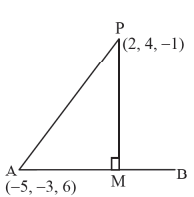
Since, PM is perpendicular to AM,
$\therefore 1(\lambda-7)+4(4 \lambda-7)-9(-9 \lambda+7)=0$
$\Rightarrow 98 \lambda-98=0 \Rightarrow \lambda=1$
$\therefore \quad M =(-4,1,-3)$
Now, Equation of perpendicular passing through $P (2,4,-1)$ and $M (-4,1,-3)$ is
$\frac{x-2}{-4-2}=\frac{y-4}{1-4}=\frac{z+1}{-3+1}$
$\Rightarrow \frac{x-2}{6}=\frac{y-4}{3}=\frac{z+1}{2}$ View full question & answer→MCQ 1302 Marks
A line passes through two points $A (2,-3,-1)$ and $B (8,-1,2)$. The co-ordinates of a point on this line nearer to the origin at a 14 units from A are
- A
$(14,-1,5)$
- ✓
$(-10,-7,-7)$
- C
$(10,7,7)$
- D
$(-4,-1,-5)$
AnswerCorrect option: B. $(-10,-7,-7)$
(B)
The equation of the line joining the points
$A (2,-3,-1)$ and $B (8,-1,2)$ is
$\frac{x-2}{8-2}=\frac{y+3}{-1+3}=\frac{z+1}{2+1}$
$\Rightarrow \frac{x-2}{6}=\frac{y+3}{2}=\frac{z+1}{3}=\lambda$
Any point on the line is
$(6 \lambda+2,2 \lambda-3,3 \lambda-1)$
The distance of this point from the point
$A (2,-3,-1)$ is 14 units.
$\therefore(6 \lambda)^2+(2 \lambda)^2+(3 \lambda)^2=(14)^2$
$\therefore \quad 49 \lambda^2=196$
$\therefore \quad \lambda^2=4 \Rightarrow \lambda= \pm 2$
$\therefore \quad$ The points are $(14,1,5)$ and $(-10,-7,-7)$
$\therefore \quad$ The point nearer to the origin is $(-10,-7,-7)$.
View full question & answer→MCQ 1312 Marks
The co-ordinates of a point on the line $\frac{x-1}{2}=\frac{y+1}{-3}= z$ at a distance $4 \sqrt{14}$ from the point $(1,-1,0)$ nearer to the origin are
- A
$(9,-13,4)$
- B
$(8 \sqrt{14}+1,-12 \sqrt{14}-1,4 \sqrt{14})$
- ✓
$(-7,11,-4)$
- D
$(-8 \sqrt{14}+1,12 \sqrt{14}-1,-4 \sqrt{14})$
AnswerCorrect option: C. $(-7,11,-4)$
(C)
The given equation of line is
$\frac{x-1}{2}=\frac{y+1}{-3}=z$
The co-ordinates of any point on the given
line are $(2 \lambda+1,-3 \lambda-1, \lambda)$
The distance of this point from the point
$(1,-1,0)$ is $4 \sqrt{14}$.
$\therefore \quad(2 \lambda)^2+(-3 \lambda)^2+(\lambda)^2=(4 \sqrt{14})^2 \Rightarrow \lambda= \pm 4$
$\therefore \quad$ The co-ordinates of the required point are
$(9,-13,4)$ or $(-7,11,-4)$
The point nearer to the origin is $(-7,11,-4)$.
View full question & answer→MCQ 1322 Marks
The length of the perpendicular from the point (2,-1,4) on the straight line, $\frac{x+3}{10}=\frac{y-2}{-7}=\frac{z}{1}$ is
- ✓
greater than 3 but less than 4
- B
- C
greater than 2 but less than 3
- D
AnswerCorrect option: A. greater than 3 but less than 4
(A)
Let $P =(2,-1,4)$
Let the point Q on the line
$\frac{x+3}{10}=\frac{y-2}{-7}=\frac{z}{1}=\lambda$
be $(10 \lambda-3,-7+2 \lambda)$ such that
$PQ \perp$ give line.
The direction ratios of given line are $10,-7,1$
$\therefore 10(10 \lambda-5)-7(-7 \lambda+3) 1+(\lambda-4)=0$
$\Rightarrow 100 \lambda-50+49 \lambda-21+\lambda-4=0$
$\Rightarrow \lambda=\frac{1}{2}$
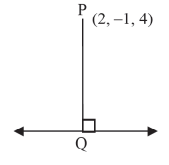
$\Rightarrow Q =\left(2,-\frac{3}{2}, \frac{1}{2}\right)$
$\therefore|P Q|=\sqrt{0+\frac{1}{4}+\frac{49}{4}}$
$=\sqrt{\frac{50}{4}} \in(3,4)$ View full question & answer→MCQ 1332 Marks
The length of perpendicular drawn from the point $(5,4,-1)$ on the line $\frac{x-1}{2}=\frac{y}{9}=\frac{z}{5}$ is
AnswerCorrect option: A. $\sqrt{\frac{2109}{110}}$
(A)
Any point on the line $\frac{x-1}{2}=\frac{y}{9}=\frac{z}{5}=\lambda$ is
$P (2 \lambda+1,9 \lambda, 5 \lambda)$
Let $A \equiv(5,4,-1)$
The d.r.s. of the line AP are
$2 \lambda+1-5,9 \lambda-4,5 \lambda-(-1)$
$\Rightarrow 2 \lambda-4,9 \lambda-4,5 \lambda+1$
Since, AP is perpendicular to the given line
$\therefore \quad 2(2 \lambda-4)+9(9 \lambda-4)+5(5 \lambda+1)=0$
$\Rightarrow 4 \lambda-8+81 \lambda-36+25 \lambda+5=0$
$\Rightarrow \lambda=\frac{39}{110}$
$\therefore \quad P =\left(\frac{188}{110}, \frac{351}{110}, \frac{195}{110}\right)$
$\therefore \quad AP =\sqrt{\left(5-\frac{188}{110}\right)^2+\left(4-\frac{351}{110}\right)^2+\left(-1-\frac{195}{110}\right)^2}$
$=\frac{1}{\sqrt{110^2}} \sqrt{131044+7921+93025}=\sqrt{\frac{2109}{110}}$
View full question & answer→MCQ 1342 Marks
The length of the perpendicular from origin to the line $t=4 \hat{i}+2 \hat{j}+4 \hat{k}+\lambda(3 \hat{i}+4 \hat{j}-5 \hat{k})$ is
- A
$2 \sqrt{5}$
- B
- C
$5 \sqrt{2}$
- ✓
Answer(D)
Distance of point $P (\bar{\alpha})$ from the
line $\overline{ r }=\overline{ a }+\lambda \overline{ b }$ is $\sqrt{|\bar{\alpha}-\bar{a}|^2-\left[\frac{(\bar{\alpha}-\bar{a}) \cdot \bar{b}}{|\bar{b}|}\right]^2}$
Given, $P (\bar{\alpha}) \equiv(0,0,0)$ and
$\bar{t}=4 \hat{i}+2 \hat{j}+4 \hat{k}+\lambda(3 \hat{i}+4 \hat{j}-5 \hat{k})$
$\therefore \quad \bar{a}=4 \hat{i}+2 \hat{j}+4 \hat{k}$ and
$\overline{ b }=3 \hat{ i }+4 \hat{ j }-5 \hat{ k }$
∴ Distance of point
$=\sqrt{\left[(-4)^2+(-2)^2+(-4)^2\right]-\left[\frac{-4(3)-2(4)-4(-5)}{\sqrt{3^2+4^2+(-5)^2}}\right]^2}$
$=\sqrt{16+4+16}$
$=6$
Alternate method:
$\overline{ AO }=4 \hat{ i }+2 \hat{ j }+4 \hat{ k }$
$\therefore \quad OA =\sqrt{16+4+16}=6$
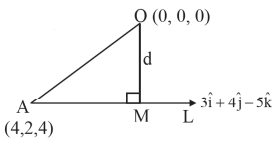
$AM =$ Projection of OA on AL
$=\frac{12+8-20}{\sqrt{9+16+25}}=0$
In right angled $\triangle OAM , d ^2= OA ^2- AM ^2$
$\Rightarrow d^2=6^2-0 \Rightarrow d=6$ View full question & answer→MCQ 1352 Marks
If the sum of the squares of the distance of a point from the three co-ordinate axes be 36 , then its distance from the origin is
- A
$6$
- ✓
$3 \sqrt{2}$
- C
$2 \sqrt{3}$
- D
$5 \sqrt{3}$
AnswerCorrect option: B. $3 \sqrt{2}$
(B)
Let $P (x, y, z)$ be any point
Now by the given condition, we get
$\left[\sqrt{\left(x^2+y^2\right)}\right]^2+\left[\sqrt{\left(y^2+z^2\right)}\right]^2+\left[\sqrt{\left(z^2+x^2\right)}\right]^2=36$
i.e., $x^2+y^2+z^2=18$
$\therefore \quad$ The distance from origin
$=\sqrt{x^2+y^2+z^2}=\sqrt{18}=3 \sqrt{2}$
View full question & answer→MCQ 1362 Marks
The image of the point $(1,6,3)$ in the line $\frac{x}{1}=\frac{y-1}{2}=\frac{ z -2}{3}$ is
- ✓
$(1,0,7)$
- B
$(7,0,1)$
- C
$(2,7,0)$
- D
$(-1,-6,-3)$
AnswerCorrect option: A. $(1,0,7)$
(A)
Let $\frac{x}{1}=\frac{y-1}{2}=\frac{z-2}{3}=\lambda$
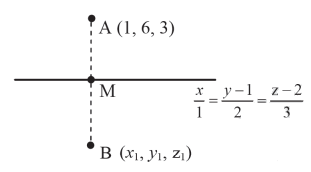
Any general point on this line is
$M \equiv(\lambda, 2 \lambda+1,3 \lambda+2)$
Let $A \equiv(1,6,3)$
d.r.s. of AM are $\lambda-1,2 \lambda-5,3 \lambda-1$
Since AM is perpendicular to the given line,
$1(\lambda-1)+2(2 \lambda-5)+3(3 \lambda-1)=0$
$\Rightarrow 14 \lambda=14$
$\Rightarrow \lambda=1$
$\therefore \quad M =(1,3,5)$
Now, $M$ is the midpoint of $A B$.
$\therefore \quad\left(\frac{1+x_1}{2}, \frac{6+y_1}{2}, \frac{3+z_1}{2}\right)=(1,3,5)$
$\Rightarrow x_1=1, y_1=0, z _1=7$ View full question & answer→MCQ 1372 Marks
The point in which the joint of $(-9,4,5)$ and $(11,0,-1)$ is met by the perpendicular from the origin is
- A
$(-2,1,2)$
- B
$(-2,-2,1)$
- ✓
$(1,2,2)$
- D
$(1,-2,2)$
AnswerCorrect option: C. $(1,2,2)$
(C)
The equation of the line joining the points
$(-9,4,5)$ and $(11,0,-1)$ is
$\frac{x+9}{11+9}=\frac{y-4}{0-4}=\frac{z-5}{-1-5}$
$\Rightarrow \frac{x+9}{20}=\frac{y-4}{-4}=\frac{z-5}{-6}$
$\Rightarrow \frac{x+9}{10}=\frac{y-4}{-2}=\frac{z-5}{-3}$
∴ The d.r.s. of the given line are $10,-2,3$
Let $\frac{x+9}{10}=\frac{y-4}{-2}=\frac{z-5}{-3}=\lambda$
∴ Any point on the line is
$P \equiv(10 \lambda-9,-2 \lambda+4,-3 \lambda+5)$
$\therefore \quad$ The d.r.s.of OP are
$10 \lambda-9,-2 \lambda+4,-3 \lambda+5$
Since the given line is perpendicular to OP ,
$10(10 \lambda-9)-2(-2 \lambda+4)-3(-3 \lambda+5)=0$
$\Rightarrow 100 \lambda-90+4 \lambda-8+9 \lambda-15=0$
$\Rightarrow 113 \lambda=113$
$\Rightarrow \lambda=1$
$\therefore \quad P \equiv(1,2,2)$
View full question & answer→MCQ 1382 Marks
The foot of the perpendicular drawn from the point $(1,8,4)$ on the line joining the points $(0,-11,4)$ and $(2,-3,1)$ is
- A
$(4,5,2)$
- B
$(-4,5,2)$
- C
$(4,-5,2)$
- ✓
$(4,5,-2)$
AnswerCorrect option: D. $(4,5,-2)$
(D)
d.r.s. of the line joining $(0,-11,4)$ and $(2,-3,1)$ are $2,8,-3$.
∴ Equation of line is $\frac{x}{2}=\frac{y+11}{8}=\frac{z-4}{-3}$
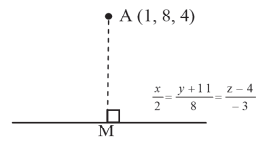
Let $\frac{x}{2}=\frac{y+11}{8}=\frac{z-4}{-3}=\lambda$
Any general point on this line is
$M \equiv(2 \lambda, 8 \lambda-11,-3 \lambda+4)$
Let $A=(1,8,4)$
d.r.s. of AM are $2 \lambda-1,8 \lambda-19,-3 \lambda$
Since AM is perpendicular to the given line,
$2(2 \lambda-1)+8(8 \lambda-19)-3(-3 \lambda)=0$
$\Rightarrow 77 \lambda=154$
$\Rightarrow \lambda=2$
$\therefore \quad M \equiv(4,5,-2)$ View full question & answer→MCQ 1392 Marks
The co-ordinates of the foot of the perpendicular from the point $(3,-1,11)$ on the line $\frac{x}{2}=\frac{y-2}{3}=\frac{z-3}{4}$ are
- ✓
$(2,5,7)$
- B
$(-2,-1,-1)$
- C
$(0,2,3)$
- D
$(2,3,4)$
AnswerCorrect option: A. $(2,5,7)$
(A)
Let $\frac{x}{2}=\frac{y-2}{3}=\frac{z-3}{4}=\lambda$
Any point on the line is
$P \equiv(2 \lambda, 3 \lambda+2,4 \lambda+3)$
Given point is $A (3,-1,11)$
$\therefore \quad$ The d.r.s. of AP are
$2 \lambda-3,3 \lambda+3,4 \lambda-8$
Since, the line AP is perpendicular to the given line
$\therefore \quad 2(2 \lambda-3)+3(3 \lambda+3)+4(4 \lambda-8)=0$
$\Rightarrow 29 \lambda-29=0$
$\Rightarrow \lambda=1$
$\therefore \quad P \equiv(2,5,7)$
View full question & answer→MCQ 1402 Marks
A line with direction cosines proportional to 2, 1, 2 meets each of the lines $x=y+ a = z$ and $x+ a =2 y=2 z$. The co-ordinates of each of the points of intersection are given by
- A
$(2 a, a, 3 a),(2 a, a, a)$
- ✓
$(3 a , 2 a , 3 a ),( a , a , a )$
- C
$(3 a, 2 a, 3 a),(a, a, 2 a)$
- D
$(3 a , 3 a , 3 a ),( a , a , a )$
AnswerCorrect option: B. $(3 a , 2 a , 3 a ),( a , a , a )$
(B)
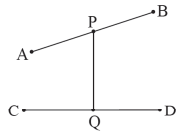
Let the two lines be AB and CD having equations $\frac{x}{1}=\frac{y+ a }{1}=\frac{ z }{1}=\lambda$ and
$\frac{x+ a }{2}=\frac{y}{1}=\frac{ z }{1}=\mu$.
Then, $P \equiv(\lambda, \lambda-a, \lambda)$ and $Q \equiv(2 \mu-a, \mu, \mu)$
According to the given condition,
$\frac{\lambda-2 \mu+ a }{2}=\frac{\lambda- a -\mu}{1}=\frac{\lambda-\mu}{2}$
$\Rightarrow \mu= a$ and $\lambda=3 a$
$\therefore \quad P \equiv(3 a , 2 a , 3 a )$ and $Q \equiv( a , a , a )$ View full question & answer→MCQ 1412 Marks
Let $\bar{a}=\hat{i}+\hat{j}$ and $\bar{b}=2 \hat{i}-\hat{k}$, then the point of intersection of the lines $\overline{ r } \times \overline{ a }=\overline{ b } \times \overline{ a }$ and $\overline{ r } \times \overline{ b }=\overline{ a } \times \overline{ b }$ is
- A
$(-1,1,1)$
- B
$(3,-1,1)$
- ✓
$(3,1,-1)$
- D
$(1,-1,-1)$
AnswerCorrect option: C. $(3,1,-1)$
(C)
Let $\overline{ r }=x \hat{ i }+y \hat{ j }+z \hat{ k }$, then
$\overline{ r } \times \overline{ a }=\overline{ b } \times \overline{ a } \Rightarrow(\overline{ r }-\overline{ b }) \times \overline{ a }=0$
$\therefore \quad\left|\begin{array}{ccc}\hat{ i } & \hat{ j } & \hat{ k } \\ x-2 & y & z +1 \\ 1 & 1 & 0\end{array}\right|=0$
$\Rightarrow(-z-1) \hat{ i }-(-z-1) \hat{ j }+(x-y-2) \hat{ k }=0$
$\Rightarrow z=-1, x-y=2...(i)$
Now, $\overline{ r } \times \overline{ b }=\overline{ a } \times \overline{ b } \Rightarrow(\overline{ r }-\overline{ a }) \times \overline{ b }=0$
$\therefore\left|\begin{array}{ccc}\hat{ i } & \hat{ j } & \hat{ k } \\ x-1 & y-1 & z \\ 2 & 0 & -1\end{array}\right|=0$
$\Rightarrow(1-y) \hat{ i }-(1-x-2 z) \hat{ j }+(2-2 y) \hat{ k }=0$
$\Rightarrow y=1, x+2 z=1...(ii)$
Solving (i) and (ii), we get
$x=3, y=1, z =-1$
View full question & answer→MCQ 1422 Marks
Lines $\bar{r}=(3+t) \hat{i}+(1-t) \hat{j}+(-2-2 t) \hat{k}, t \in R$ and $x=4+ k , y=- k , z =-4-2 k , k \in R$, then the relation between the lines is _________ .
Answer(B)
Given equation of line is
$\overline{ r }=(3+ t ) \hat{ i }+(1- t ) \hat{ j }+(-2-2 t ) \hat{ k }$
$\Rightarrow \overline{ r }=3 \hat{ i }+\hat{ j }-2 \hat{ k }+(\hat{ i }-\hat{ j }-2 \hat{ k }) t$, where $t \in R$
∴ The line passes through $(3,1,-2)$ and is parallel to the vector $\hat{i}-\hat{j}-2 \hat{k}$
Equation of second line is
$x=4+ k , y=- k , z =-4-2 k$
$\Rightarrow \frac{x-4}{1}=\frac{y}{-1}=\frac{ z +4}{-2}= k$, where $k \in R$
∴ d.r.s. of the line are $1,-1,-2$. Also, it passes through $(3,1,-2)$.
∴ Both lines are coincident
View full question & answer→MCQ 1432 Marks
$\triangle ABC$ is formed by $A (1,8,4), B (0,-11,4)$ and $C(2,-3,1)$. If $D$ is the foot of the perpendicular from A to BC , then the coordinates of $D$ are
- ✓
$(4,5,-2)$
- B
$(4,-5,2)$
- C
$(-4,5,2)$
- D
$(4,-5,-2)$
AnswerCorrect option: A. $(4,5,-2)$
(A)
Equation of line BC is
$\frac{x-0}{2-0}=\frac{y+11}{-3+11}=\frac{z-4}{1-4}$
$\Rightarrow \frac{x}{2}=\frac{y+11}{8}=\frac{z-4}{-3}$
Let $\frac{x}{2}=\frac{y+11}{8}=\frac{z-4}{-3}=\lambda$
Any point D on the line is $\equiv(2 \lambda, 8 \lambda-11,-3 \lambda+4)$
Given point $A \equiv(1,8,4)$
$\therefore$ d.r.s of AD are $2 \lambda-1,8 \lambda-11-8,-3 \lambda+4-4$
$=2 \lambda-1,8 \lambda-19,-3 \lambda$
Since $AD \perp BC$,
$aa _1+ bb _1+ cc _1=0$
$\Rightarrow 2(2 \lambda-1)+8(8 \lambda-19)-3(-3 \lambda)=0$
$\Rightarrow 4 \lambda-2+64 \lambda-152+9 \lambda=0$
$\Rightarrow 77 \lambda=154$
$\Rightarrow \lambda=2$
$\therefore \quad D \equiv(4,5,-2)$
View full question & answer→MCQ 1442 Marks
The lines $x= a y+ b , z = c y+ d$ and $x= a ^{\prime} y+ b ^{\prime}$, $z = c ^{\prime} y+ d ^{\prime}$ are perpendicular to each other, if
- A
$aa ^{\prime}+ cc ^{\prime}=1$
- ✓
$aa ^{\prime}+ cc ^{\prime}=-1$
- C
$a c+a^{\prime} c^{\prime}=1$
- D
$a c+a^{\prime} c^{\prime}=-1$
AnswerCorrect option: B. $aa ^{\prime}+ cc ^{\prime}=-1$
(B)
Given equations of lines are
$x= a y+ b , z = c y+ d$
$\Rightarrow \frac{x- b }{ a }=\frac{y}{1}, \frac{ z - d }{ c }=\frac{y}{1}$
$\Rightarrow \frac{x- b }{ a }=\frac{y}{1}=\frac{ z - d }{ c }$
and $x= a ^{\prime} y+ b ^{\prime}, z = c ^{\prime} y+ d ^{\prime}$
$\Rightarrow \frac{x- b ^{\prime}}{ a ^{\prime}}=\frac{y}{1}, \frac{ z - d ^{\prime}}{ c ^{\prime}}=\frac{y}{1}$
$\Rightarrow \frac{x- b ^{\prime}}{ a ^{\prime}}=\frac{y}{ l }=\frac{ z - d ^{\prime}}{ c ^{\prime}}$
Since the lines are perpendicular to each other, $a _1 a _2+ b _1 b_2+ c _1 c _2=0$
$\Rightarrow aa ^{\prime}+1(1)+ cc ^{\prime}=0$
$\Rightarrow aa ^{\prime}+ cc ^{\prime}=-1$
View full question & answer→MCQ 1452 Marks
The lines $\frac{x-1}{2}=\frac{y-2}{3}=\frac{z-3}{4}$ and $\frac{x-1}{3}=\frac{y-2}{4}=\frac{z-3}{5}$ are
Answer(C)
Given lines pass through common point $(1,2,3)$
Also, $a_1 a_2+b_1 b_2+c_1 c_2=2(3)+3(4)+4(5) \neq 0$
$\therefore \quad$ lines are intersecting
View full question & answer→MCQ 1462 Marks
The angle between the lines $2 x=3 y=- z$ and $6 x=-y=-4 z$ is
- A
$0^{\circ}$
- B
$45^{\circ}$
- ✓
$90^{\circ}$
- D
$30^{\circ}$
AnswerCorrect option: C. $90^{\circ}$
(C)
The equation of given lines are
$\frac{x}{3}=\frac{y}{2}=\frac{ z }{-6}$ and $\frac{x}{2}=\frac{y}{-12}=\frac{ z }{-3}$
$a_1 a_2+b_1 b_2+c_1 c_2=3(2)+2(-12)+(-6)(-3)$
$=0$
∴ Lines are perpendicular
$\therefore \quad \theta=90^{\circ}$
View full question & answer→MCQ 1472 Marks
If the lines $\frac{x-1}{2}=\frac{y-1}{\lambda}=\frac{z-3}{0}$ and $\frac{x-2}{1}=\frac{y-3}{3}=\frac{z-4}{1}$ are perpendicular, then $\lambda$ is
- ✓
$\frac{-2}{3}$
- B
$\frac{-3}{2}$
- C
$\frac{2}{3}$
- D
$\frac{3}{2}$
AnswerCorrect option: A. $\frac{-2}{3}$
(A)
$a_1, b_1, c_1-2, \lambda, 0$ and $a_2, b_2, c_2-1,3,1$
Since, the lines are perpendicular.
$a_1 a_2+b_1 b_2+c_1 c_2=0$
$\therefore 2(1)+\lambda(3)+0(1)=0$
$\therefore \quad 2+3 \lambda=0$
$\therefore \quad \lambda=\frac{-2}{3}$
View full question & answer→MCQ 1482 Marks
Lines $\bar{r}=(2 \hat{i}-3 \hat{j}+7 \hat{k})+\lambda(2 \hat{i}+p \hat{j}+5 \hat{k})$ and $\bar{r}=(p \hat{i}+2 \hat{j}+3 \hat{k})+\mu(3 \hat{i}-p \hat{j}+p \hat{k})$ are perpendicular for all values of $\lambda$ and $\mu$ then $p$ is equal to
AnswerCorrect option: D. $-1,6$
(D)
$a_1, b_1, c_1=2, p, 5$ and $a _2, b_2, c _2=3,- p , p$
Since, the given lines are perpendicular.
$\therefore \quad(2)(3)+p(-p)+(5)(p)=0$
$\Rightarrow 6- p ^2+5 p =0$
$\Rightarrow p ^2-5 p -6=0$
$\Rightarrow( p -6)( p +1)=0$
$\Rightarrow p=6$ or $p=-1$
View full question & answer→MCQ 1492 Marks
The lines $\bar{r}=(2 \hat{i}+\hat{j}-3 \hat{k})+\left(\frac{t}{\sqrt{6}}\right)(2 \hat{i}-\hat{j}+\hat{k})$ and $\overline{ r }=(\hat{ i }+\hat{ k })+ t (4 \hat{ i }-\hat{ j }+\lambda \hat{ k })$ are perpendicular to each other, then value of $\lambda$ is
Answer(B)
The d.r.s. of the two lines are $2,-1,1$ and $4,-1, \lambda$
Since, the lines are perpendicular
$a_1 a_2+b_1 b_2+c_1 c_2=0$
$\Rightarrow 2(4)+(-1)(-1)+(1)(\lambda)=0$
$\Rightarrow \lambda+9=0$
$\Rightarrow \lambda=-9$
View full question & answer→MCQ 1502 Marks
The direction angles of the line $x=4 z+3$, $y=2-3 z$ are $\alpha, \beta$ and $\gamma$, then $\cos \alpha+\cos \beta+\cos \gamma=$ __________ .
- ✓
$\frac{2}{\sqrt{26}}$
- B
$\frac{8}{\sqrt{26}}$
- C
- D
AnswerCorrect option: A. $\frac{2}{\sqrt{26}}$
(A)
Given equation of line $x=4 z+3, y=2-3 z$
$\Rightarrow z=\frac{x-3}{4}, z=\frac{y-2}{-3}$
∴ Equation of line is $\frac{x-3}{4}=\frac{y-2}{-3}=\frac{z-0}{1}$
d.r.s of line are $4,-3,1$
$\therefore \quad \cos \alpha=\frac{4}{\sqrt{4^2+(-3)^2+1^2}}=\frac{4}{\sqrt{26}}$, $\cos \beta=\frac{-3}{\sqrt{26}}, \cos \gamma=\frac{1}{\sqrt{26}}$
$\therefore \quad \cos \alpha+\cos \beta+\cos \gamma=\frac{4}{\sqrt{26}}-\frac{3}{\sqrt{26}}+\frac{1}{\sqrt{26}}$
$=\frac{2}{\sqrt{26}}$
View full question & answer→