Questions

Solve the Following Question.(5 Marks)

🎯

Test yourself on this topic

6 questions · timed · auto-graded

Question 15 Marks
Identify the random variable as either discrete or continuous in each of the following. If the random variable is discrete, list its possible values:
(i) An economist is interested in the number of unemployed graduates in the town of population 1 lakh.
(ii) Amount of syrup prescribed by a physician.
(iii) The person on a high protein diet is interesting to gain weight in a week.
(iv) 20 white rats are available for an experiment. Twelve rats are males. A scientist randomly selects 5 rats, the number of female rats selected on a specific day.
(v) A highway-safety group is interested in studying the speed (in km/hr) of a car at a checkpoint.
Answer
(i) Let X = number of unemployed graduates in a town.
Since the population of the town is 1 lakh, X takes the finite values.
∴ random variable X is discrete.
Range = {0, 1, 2, …, 99999, 100000}.

(ii) Let X = amount of syrup prescribed by a physician.
Then X takes uncountable infinite values.
∴ random variable X is continuous.

(iii) Let X = gain of weight in a week
Then X takes uncountable infinite values
∴ random variable X is continuous.

(iv) Let X = number of female rats selected on a specific day.
Since the total number of rats is 20 which includes 12 males and 8 females, X takes the finite values.
∴ random variable X is discrete.
Range = {0, 1, 2, 3, 4, 5}

(v) Let X = speed of .the car in km/hr.
Then X takes uncountable infinite values
∴ random variable X is continuous.
View full question & answer
Question 25 Marks
Suppose the p.d.f. of a continuous random variable $X$ is defined as:
$f(x)=x+1$, for $-1<x<0$, and $f(x)=1-x, \quad$ for $0 \leq x<1$.
Find the c.d.f. $F(x)$.
View full question & answer
Question 35 Marks
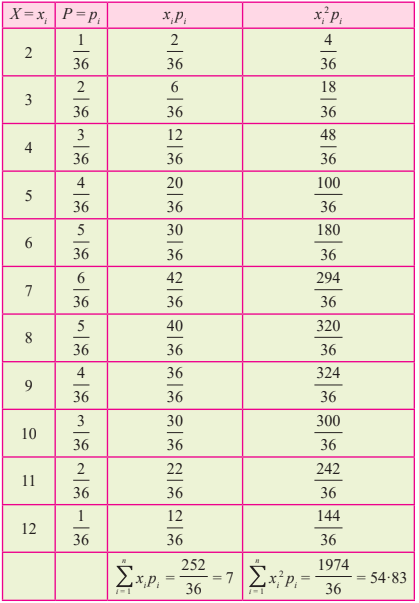
Let a pair of dice be thrown and the random variable $X$ be the sum of the numbers that appear on the two dice. Find the mean or expectation of $X$ and variance of $X$.
Answer
The sample space of the experiment consists of 36 elementary events in the form of ordered pairs $\left(x_i, y_i\right)$, where $x_i=1,2,3,4,5,6$ and $y_i=1,2,3,4,5,6$.
The random variable $\mathrm{X}$ i.e. the sum of the numbers on the two dice takes the values $2,3,4,5,6$, $7,8,9,10,11$ or 12 .

Image

$\begin{aligned} \text { Then } \mathrm{E}(X) & =\sum_{i=1}^n x_i p_i=7 \\ \operatorname{Var}(X) & =\left(\sum_{i=1}^n x_i^2 p_i\right)-\left(\sum_{i=1}^n x_i p_i\right)^2=54 \cdot 83-(7)^2 \\ & =54 \cdot 83-49 \\ & =5 \cdot 83\end{aligned}$

View full question & answer
Question 45 Marks
Suppose the error involved in making a certain measurement is a continuous r.v. X with p.d.f.
f(x) = k(4 – x2), -2 ≤ x ≤ 2 and 0 otherwise.
Compute:
(i) P(X > 0)
(ii) P(-1 < X < 1)
(iii) P(-0.5 < X or X > 0.5).
View full question & answer
Question 55 Marks
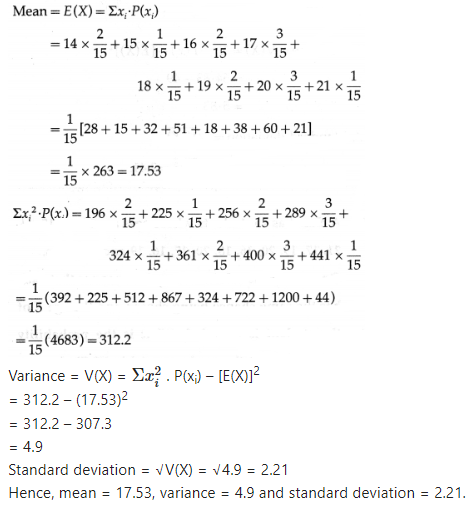
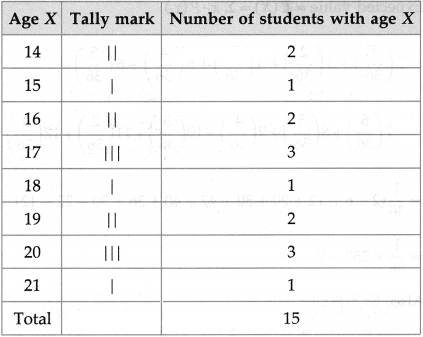
A class has 15 students whose ages are 14, 17, 15, 14, 21, 17, 19, 20, 16, 18, 20, 17, 16, 19 and 20 years. One student is selected in such a manner that each has the same chance of being chosen and the age X of the student is recorded. What is the probability distribution of the random variable X? Find mean, variance, and standard deviation of X.
Answer
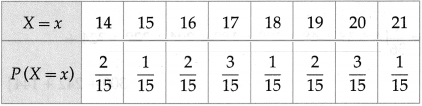
Let X denote the age of the chosen student. Then X can take values 14, 15, 16, 17, 18, 19, 20, 21.
We make a frequency table to find the number of students with age X:
Image
The chances of any student selected are equally likely.
If there are m students with age X, then P(X) = $\frac{m}{15}$
Using this, the following is the probability distribution of X:
ImageImage
View full question & answer
Question 65 Marks
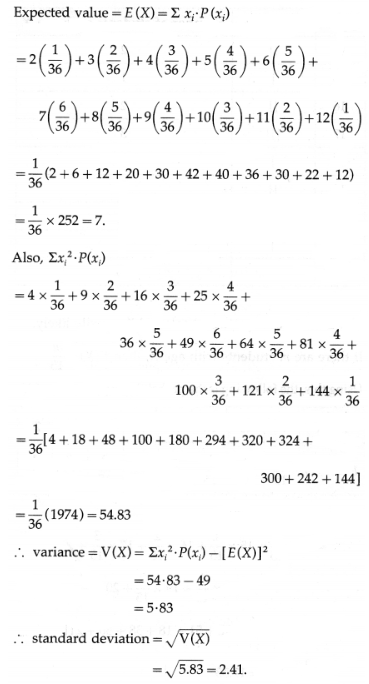
Let X denote the sum of numbers obtained when two fair dice are rolled. Find the standard deviation of X.
Answer
If two fair dice are rolled then the sample space S of this experiment is
S = {(1, 1), (1, 2), (1, 3), (1, 4), (1, 5), (1, 6), (2, 1), (2, 2), (2, 3), (2, 4), (2, 5), (2, 6), (3, 1), (3, 2), (3, 3), (3, 4), (3, 5), (3, 6), (4, 1), (4, 2), (4, 3), (4, 4), (4, 5), (4, 6), (5, 1), (5, 2), (5, 3), (5, 4), (5, 5), (5, 6), (6, 1), (6, 2), (6, 3), (6, 4), (6, 5), (6, 6)}
∴ n(S) = 36
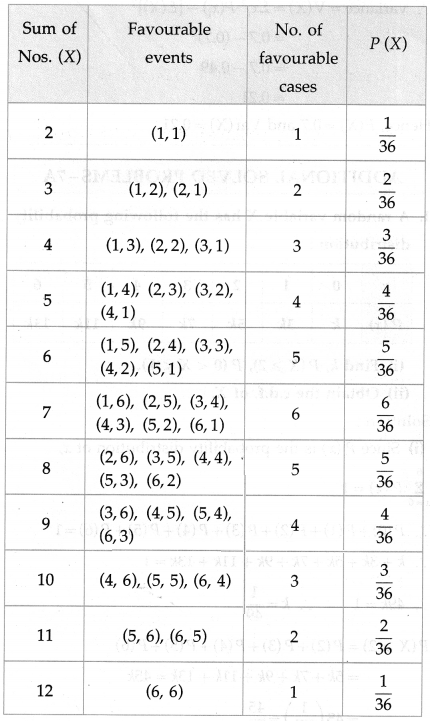
Let X denote the sum of the numbers on uppermost faces.
Then X can take the values 2, 3, 4, 5, 6, 7, 8, 9, 10, 11, 12
Image
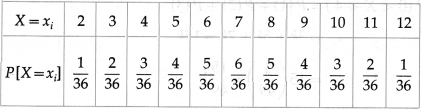
∴ the probability distribution of X is given by
Image
Image
View full question & answer
Solve the Following Question.(5 Marks) - Maths STD 12 Questions - Vidyadip