Question 13 Marks
Find the area of the ellipse $\frac{x^2}{36}+\frac{y^2}{64}=1$, using integration
AnswerBy the symmetry of the ellipse, required area of the ellipse is $4$ times the area of the region OPQO.
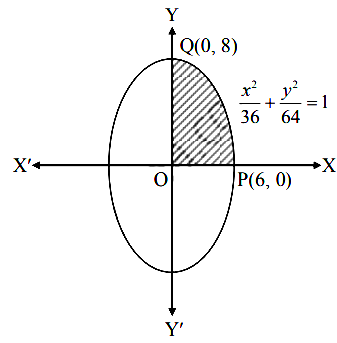
For the region OPQO, the limits of integration are $x=0$ and $x=6$.
Given equation of the ellipse is $\frac{x^2}{36}+\frac{y^2}{64}=1$
$ \therefore \frac{y^2}{64}=1-\frac{x^2}{36}$
$\therefore y ^2=64\left(1-\frac{x^2}{36}\right)$
$\therefore y ^2=\frac{64}{36}\left(36-x^2\right)$
$\therefore y = \pm \frac{8}{6} \sqrt{36-x^2} $
$\therefore y=\frac{4}{3} \sqrt{36-x^2} \ldots \ldots .[\because$ In first quadrant, $y>0]$
$\therefore$ Required area $=4$ (area of the region OPQO)
$=4 \int_0^6 y d x$
$=4 \int_0^6 \frac{4}{3} \sqrt{36-x^2} d x$
$=\frac{16}{3}\left[\frac{x}{2} \sqrt{36-x^2}+\frac{36}{2} \sin ^{-1}\left(\frac{x}{6}\right)\right]_0^6$
$=\frac{16}{3}\left[\frac{6}{2} \sqrt{36-36}+\frac{36}{2} \sin ^{-1}(1)-\left\{0+\frac{36}{2} \sin ^{-1}(0)\right\}\right]$
$=\frac{16}{3}\left(0+\frac{36}{2} \cdot \frac{\pi}{2}-0\right)$
$=48 \pi \text { sq.units }$ View full question & answer→Question 23 Marks
Find the area of the region bounded by the curve $y = \sin x,$ the $X−$ axis and the given lines $x = −\pi, x = \pi$
AnswerGiven equation of the parabola is $x^2=8 y$
$\therefore x= \pm 2 \sqrt{2 y}$
$\therefore x =2 \sqrt{2 y} \quad \ldots . .[\because$ In first quadrant, $x >0]$
$\therefore \text { Required area }=\int_2^4 x d y$
$=\int_2^4 2 \sqrt{2 y} d y$
$=2 \sqrt{2}\left[\frac{y^{\frac{3}{2}}}{\frac{3}{2}}\right]_2^4$
$=\frac{4 \sqrt{2}}{3}\left[(4)^{\frac{3}{2}}-(2)^{\frac{3}{2}}\right]$
$=\frac{4 \sqrt{2}}{3}(8-2 \sqrt{2})$
$=\frac{8 \sqrt{2}}{3}(4-\sqrt{2}) \text { sq.units }$ View full question & answer→Question 33 Marks
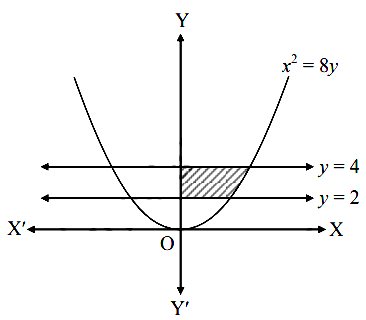
Find the area of the region bounded by the curves $x^2 = 8y, y = 2, y = 4$ and the $Y-$axis, lying in the first quadrant
AnswerGiven equation of the parabola is $x^2=8 y$
$\therefore x= \pm 2 \sqrt{2 y}$
$\therefore x =2 \sqrt{2 y} \quad \ldots . .[\because$ In first quadrant, $x >0]$
$\therefore \text { Required area }=\int_2^4 x d y$
$=\int_2^4 2 \sqrt{2 y} d y$
$=2 \sqrt{2}\left[\frac{y^{\frac{3}{2}}}{\frac{3}{2}}\right]_2^4$
$=\frac{4 \sqrt{2}}{3}\left[(4)^{\frac{3}{2}}-(2)^{\frac{3}{2}}\right]$
$=\frac{4 \sqrt{2}}{3}(8-2 \sqrt{2})$
$=\frac{8 \sqrt{2}}{3}(4-\sqrt{2}) \text { sq.units }$ View full question & answer→Question 43 Marks
Find the area of the region bounded by the parabola $y^2 = 16x$ and the line $x = 4$
AnswerGiven equation of the curve is $y^2=16 x$
$ y ^2=$
$\therefore y = \pm 4 \sqrt{x}$
$\therefore y =4 \sqrt{x} \quad \ldots . .[\because \text { In first quadrant, } y >0] $
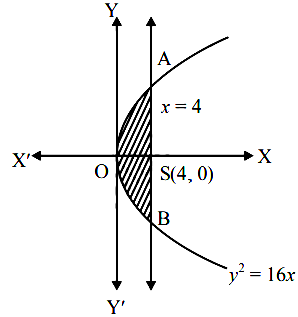
Required area $=$ Area of the region $O B S A O$
$ =2 \ldots . .(\text { Area of the region OSAO) }$
$=2 \int_0^4 y d x$
$=2 \int_0^4 4 \sqrt{x} d x$
$=8\left[\frac{x^{\frac{3}{2}}}{\frac{3}{2}}\right]_0^4$
$=\frac{16}{3}\left[(4)^{\frac{3}{2}}-0\right]$
$=\frac{16}{3}(8)$
$=\frac{128}{3} \text { sq.units } $ View full question & answer→Question 53 Marks
Find the area of the region bounded by the parabola $x^2 = 4y$ and The X-axis and the line $x = 1, x = 4$
AnswerGiven equation of the parabola is $x^2=4 y$.
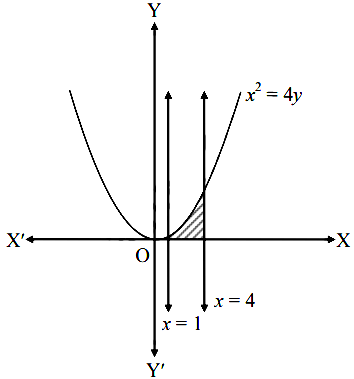
$\text { Required area }=\int_1^4 y d x$
$=\int_1^4 \frac{x^2}{4} d x$
$=\frac{1}{4}\left[\frac{x^3}{3}\right]_1^4$
$=\frac{1}{12}\left(4^3-1^3\right)$
$=\frac{1}{12}(64-1)$
$=\frac{63}{12}$
$=\frac{21}{4} \text { sq.units }$ View full question & answer→Question 63 Marks
Find the area enclosed between the $X-$ axis and the curve $y = \sin x$ for values of $x$ between $0$ to $2\pi$
AnswerLet $A$ be the required area.
Consider the equation $y=\sin x$.
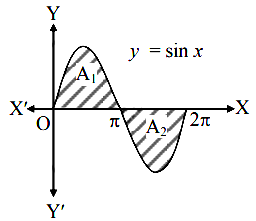
$ A _1=\int_0^{ a } \sin x d x$
$=[-\cos x]_0^\pi$
$=-(\cos \pi-\cos 0)$
$=-(-1-1)$
$=2$
$A _2=\int_\pi^{2 \pi} \sin x d x$
$=[-\cos x]_\pi^{2 \pi}$
$=-[1-(-1)]$
$= A = A _1+\left| A _2\right|$
$=2+|(-2)|$
$=4 \operatorname{sq} \cdot units $ View full question & answer→Question 73 Marks
Evaluate: $\int_0^1 x \cdot \tan ^{-1} x d x$
Answer$\text { Let } I =\int_0^1 x \tan ^{-1} x d x$
$=\left[\tan ^{-1} x \int x d x\right]_0^1-\int_0^1\left[\frac{ d }{ d x}\left(\tan ^{-1} x\right) \int x d x\right] d x$
$=\left[\tan ^{-1} x \cdot \frac{x^2}{2}\right]_0^1-\int_0^1 \frac{1}{1+x^2} \cdot \frac{x^2}{2} d x$
$=\left[\frac{x^2}{2} \tan ^{-1} x\right]_0^1-\frac{1}{2} \int_0^1 \frac{x^2}{1+x^2} d x$
$=\left[\frac{1}{2} \tan ^{-1}-0\right]_{-\frac{1}{2}} \frac{x^2+1-1}{1+x^2} d x$
$=\frac{1}{2} \cdot \frac{\pi}{4}-\frac{1}{2} \int_0^1\left(1-\frac{1}{1+x^2}\right) d x$
$=\frac{\pi}{8}-\frac{1}{2}\left[x-\tan ^{-1} x\right]_0^1$
$=\frac{\pi}{8}-\frac{1}{2}\left[\left(1-\tan ^{-1} 1\right)-\left(0-\tan ^{-1} 0\right)\right]$ $=\frac{\pi}{8}-\frac{1}{2}\left(1-\frac{\pi}{4}-0\right)$
$=\frac{\pi}{8}-\frac{1}{2}+\frac{\pi}{8}$
$\therefore I =\frac{\pi}{4}-\frac{1}{2}$
View full question & answer→Question 83 Marks
$\int \sec ^2 x d x$
Answer$\text { Let } I =\int \sec ^2 x d x$
$=\int \sec x \cdot \sec ^2 x d x$
$=\sec x \int \sec ^2 x d x-\int\left[\frac{ d }{ d x}(\sec x) \int \sec ^2 x d x\right] d x$
$=\sec x \cdot \tan x-\int \sec x \tan x \cdot \tan x d x$
$=\sec x \cdot \tan x-\int \sec x \tan { }^2 x d x$
$=\sec x \cdot \tan x-\int \sec x\left(\sec { }^2 x-1\right) d x$
$=\sec x \cdot \tan x-\int \sec { }^3 x d x+\int \sec x d x$
$\therefore \text { I }=\sec x \cdot \tan x- I +\log |\sec x+\tan x|+ c _1$
$\therefore \log [\sec x \tan x+\log |\sec x+\tan x|]+ c \text { where c }=\frac{ c _1}{2}$
View full question & answer→Question 93 Marks
A wire of length $36$ metres is bent in the form of a rectangle. Find its dimensions if the area of the rectangle is maximum.
AnswerLet $x$ metres and $y$ metre be the length and breadth of the rectangle.
Then its perimeter is $2(x+y)=36$
$\therefore x+y=18$
$\therefore y=18-x$
Area of the rectangle
$ =x y$
$=x(18-x) $
Let $f^{\prime}(x)$
$ =x(18-x)$
$=18 x-x^2 $
$ \therefore f ^{\prime}( x )=\frac{d}{d x}\left(18 x-x^2\right)$
$=18-2 x $
and
$ f^{\prime}( x )=\frac{d}{d x}(18-2 x)$
$=0-2 \times 1$
$=-2 $
Now, $f^{\prime}(x)=0$, if $18-2 x=0$
i.e. if $x=9$
and
$f^{\prime}(9)-2<0$
$\therefore$ By the second derivative test $f$ has maximum value at $x =9$.
When $x=9, y=18-9=9$
$\therefore x=9 cm , y=9 cm$
$\therefore$ Rectangle is a square of side $9\ cm$.
View full question & answer→Question 103 Marks
$x \sin (a+y)+\sin a \cos (a+y)=0$ then show that $\frac{d y}{d x}=\frac{\sin ^2(a+y)}{\sin a}$
Answer$x \sin (a+y)+\sin a \cos (a+y)=0$ $\ldots(i)$
$x \cdot \cos ( a +y) \cdot \frac{ d }{ d x}( a +y)+\sin ( a +y) \cdot \frac{ d }{ d x}(x)+\sin a [-\sin ( a +y)] \cdot \frac{ d }{ d x}( a +y)=0$
$\therefore x \cos ( a +y) \frac{ d y}{ d x}+\sin ( a +y)(1)-\sin ( a +y) \frac{ d y}{ d x}=0$
$\therefore[x \cos ( a +y)-\sin a \sin ( a +y)] \frac{ d y}{ d x}=-\sin ( a + y ) \quad \ldots \ldots . . \text { (ii) }$
From (i), we get
$x=\frac{-\sin a \cos ( a +y)}{\sin ( a +y)}$
Substituting the value of $x$ in (ii), we get
$\left[\frac{-\sin a \cos ( a +y)}{\sin ( a +y)} \cdot \cos ( a +y)-\sin a \sin ( a +y)\right] \frac{ d y}{ d x}=-\sin ( a + y )$
$\therefore-\sin a \left[\frac{\cos ^2( a +y)}{\sin ( a +y)}+\sin ( a +y)\right] \frac{ d y}{ d x}=-\sin ( a + y )$
$\therefore \frac{-\sin a \left[\cos ^2( a +y)+\sin ^2( a +y)\right]}{\sin ( a +y)} \frac{ d y}{ d x}-\sin ( a + y )$
$\therefore-\frac{\sin a (1)}{\sin ( a +y)} \cdot \frac{ d y}{ d x}=-\sin ( a + y )$
$\therefore \frac{ d y}{ d x}=\sin ( a +y)\left[\frac{\sin ( a +y)}{\sin a }\right]$
$\therefore \frac{ d y}{ d x}=\frac{\sin ^2( a +y)}{\sin a }$
View full question & answer→Question 113 Marks
Find the distance between the parallel lines $\frac{x}{2}=\frac{y}{-1}=\frac{z}{2}$ and $\frac{x-1}{2}=\frac{y-1}{-1}=\frac{z-3}{2}$
AnswerLine $\frac{x}{2}=\frac{y}{-1}=\frac{z}{2}$ passes through $(0,0,0)$ and has direction ratios $2,-1,2$
$\therefore$ Vector equation of the line is
$r=(0 \hat{ i }+0 \hat{ j }+0 \widehat{ k })+\lambda(2 \hat{ i }-\hat{ j }+2 \widehat{ k })$
i.e., $r=\lambda(2 \hat{ i }-\hat{ j }+2 \widehat{ k })$
Line $\frac{x-1}{2}=\frac{y-1}{-1}=\frac{z-1}{2}$ passes through $(1,1,1)$ and has direction ratios $2,-1,2$.
$\therefore$ Vector equation of the line is
$
r=(\hat{i}+\hat{j}+\widehat{k})+\lambda(2 \hat{i}-\hat{j}+2 \widehat{k})
$
The distance between parallel lines $\overline{ r }=\overline{ a }_1+\lambda \overline{ b }$ and $\overline{ r }=\overline{ a }_2+\lambda \overline{ b }$ is $\left|\left(\overline{ a }_2-\overline{ a }_1\right) \times \widehat{ b }\right|$
Here, $\overline{ a }_1=0, \overline{ a }_2=\hat{ i }+\hat{ j }+\widehat{ k }, \overline{ b }=2 \hat{ i }-\hat{ j }+2 \widehat{ k }$
$\therefore \overline{ b }=\frac{\overline{ b }}{|\overline{ b }|}$
$=\frac{2 \hat{ i }-\hat{ j }+2 \widehat{ k }}{\sqrt{2^2+(-1)^2+2^2}}$
$=\frac{2}{3} \hat{ i }-\frac{1}{3} \hat{ j }+\frac{2}{3} \widehat{ k }$
$\therefore\left(\bar{a}_2-\bar{a}_1\right) \times \hat{b}=\left|\begin{array}{ccc}\hat{i} & \hat{j} & \hat{k} \\ 1 & 1 & 1 \\ \frac{2}{3} & \frac{-1}{3} & \frac{2}{3}\end{array}\right|$
$=\hat{ i }\left(\frac{2}{3}+\frac{1}{3}\right)-\hat{ j }\left(\frac{2}{3}-\frac{2}{3}\right)+\widehat{ k }\left(\frac{-1}{3}-\frac{2}{3}\right)$
$=\hat{ i }-\hat{ k }$
$\therefore\left|\left(\overline{ a }_2-\overline{ a }_1\right) \times \widehat{ b }\right|=\sqrt{(1)^2+(-1)^2}$
$=\sqrt{2}$
View full question & answer→Question 123 Marks
Prove by vector method, that the angle subtended on semicircle is a right angle.
AnswerLet seg $A B$ be a diameter of a circle with centre $C$ and $P$ be any point on the circle other than $A$ and $B$.
Then $\angle A P B$ is an angle subtended on a semicircle.
Let $\overline{ AC }=\overline{ CB }=\overline{ a }$ and $\overline{ CP }=\overline{ r }$
Then $|\overline{ a }|=|\overline{ r }|$$\ldots(1)$
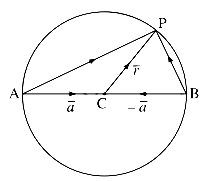
$ \overline{ AP }=\overline{ AC }+\overline{ CP }$
$=\overline{ a }+\overline{ r }$
$=\overline{ r }+\overline{ a }$
$\overline{ BP }=\overline{ BC }+\overline{ CP }$
$=-\overline{ CB }+\overline{ CP }$
$=-\overline{ a }+\overline{ r }$
$\therefore \overline{ AP } \cdot \overline{ BP }=(\overline{ r }+\overline{ a }) \cdot(\overline{ r }-\overline{ a })$
$=\overline{ r } \cdot \overline{ r }-\overline{ r } \cdot \overline{ a }+\overline{ a } \cdot \overline{ r }-\overline{ a } \cdot \overline{ a }$
$=|\overline{ r }|^2-|\overline{ a }|^2$
$=0 \quad \ldots .(\because \overline{ r } \cdot \overline{ a }=\overline{ a } \cdot \overline{ r })$
$\therefore \overline{ AP } \perp \overline{ BP } $
$\therefore \angle APB$ is a right angle.
Hence, the angle subtended on a semicircle is the right angle. View full question & answer→Question 133 Marks
Find the matrix $X$ such that $\left[\begin{array}{lll}1 & 2 & 3 \\ 2 & 3 & 2 \\ 1 & 2 & 2\end{array}\right] \quad X=\left[\begin{array}{ccc}2 & 2 & -5 \\ -2 & -1 & 4 \\ 1 & 0 & -1\end{array}\right]$
AnswerGiven that $\left[\begin{array}{lll}1 & 2 & 3 \\ 2 & 3 & 2 \\ 1 & 2 & 2\end{array}\right] X=\left[\begin{array}{ccc}2 & 2 & -5 \\ -2 & -1 & 4 \\ 1 & 0 & -1\end{array}\right]$
Applying $R_2 \rightarrow R_2-2 R_1$ and $R_3 \rightarrow R_3-R_1$,
we get $\left[\begin{array}{ccc}1 & 2 & 3 \\ 0 & -1 & -4 \\ 0 & 0 & -1\end{array}\right] X=\left[\begin{array}{ccc}2 & 2 & -5 \\ -6 & -5 & 14 \\ -1 & -2 & 4\end{array}\right]$
Applying $R_2 \rightarrow R_2-4 R_3$, we get
$\left[\begin{array}{ccc}1 & 2 & 3 \\0 & -1 & 0 \\0 & 0 & -1\end{array}\right] X=\left[\begin{array}{ccc}2 & 2 & -5 \\-2 & 3 & -2 \\-1 & -2 & 4\end{array}\right]$
Applying $R_1 \rightarrow R_1+2 R_2$, we get
$\left[\begin{array}{ccc}1 & 0 & 3 \\0 & -1 & 0 \\0 & 0 & -1\end{array}\right] X=\left[\begin{array}{ccc}-2 & 8 & -9 \\-2 & 3 & -2 \\-1 & -2 & 4\end{array}\right]$
Applying $R_1 \rightarrow R_1+3 R_3$, we get
$\left[\begin{array}{ccc}1 & 0 & 0 \\0 & -1 & 0 \\0 & 0 & -1\end{array}\right] X=\left[\begin{array}{ccc}-5 & 2 & 3 \\-2 & 3 & -2 \\-1 & -2 & 4\end{array}\right]$
Applying $R_2 \rightarrow(-1) R_2$ and $R_3 \rightarrow(-1) R_3$, we get
$\begin{array}{l}{\left[\begin{array}{lll}1 & 0 & 0 \\0 & 1 & 0 \\0 & 0 & 1\end{array}\right] X=\left[\begin{array}{ccc}-5 & 2 & 3 \\2 & -3 & 2 \\1 & 2 & -4\end{array}\right]} \end{array}$
$\therefore X=\left[\begin{array}{ccc}-5 & 2 & 3 \\2 & -3 & 2 \\1 & 2 & -4\end{array}\right]$
View full question & answer→Question 143 Marks
Evaluate: $\int_0^1 \frac{1}{\sqrt{3+2 x-x^2}} d x$
Answer$\text { Let } I =\int_0^1 \frac{1}{\sqrt{3+2 x-x^2}} d x$
$=\int_0^1 \frac{1}{\sqrt{4-1+2 x-x^2}} d x$
$=\int_0^1 \frac{1}{\sqrt{4-\left(x^2-2 x+1\right)}} d x$
$=\int_0^1 \frac{1}{\sqrt{(2)^2-(x-1)^2}} d x$
$\left.=\sin ^{-1}\left(\frac{x-1}{2}\right)\right]_0^1(0)-\sin ^{-1}\left(\frac{1}{2}\right)$
$=0-\left(-\frac{\pi}{6}\right)$
$\therefore I =\frac{\pi}{6}$
View full question & answer→Question 153 Marks
$\int \frac{1}{2+\cos x-\sin x} d x$
Answer$\text { Let } I =\int \frac{1}{2+\cos x-\sin x} d x$
$\text { Put } \tan \left(\frac{x}{2}\right)= t$
$\therefore x =2 \tan ^{-1} t$
$\therefore dx =\frac{2 dt }{1+ t ^2} \text { and } \sin x =\frac{2 t }{1+ t ^2}, \cos x =\frac{1- t ^2}{1+ t ^2}$
$\therefore I=\int \frac{1}{2+\left(\frac{1- t ^2}{1+ t ^2}\right)-\frac{2 t }{1+ t ^2}} \times \frac{2 dt }{1+ t ^2}$
$=\int \frac{2}{2+2 t ^2+1- t ^{-2} t } dt$
$=2 \int \frac{1}{ t ^2-2 t +3} dt$
$\left(\frac{1}{2} \text { coefficient of } t \right)^2=\left(\frac{1}{2} \times-2\right)^2$
$=(-1)^2$
$=1$
$\therefore I =2 \int \frac{1}{ t ^2-2 t +1-1+3} dt$
$=2 \int \frac{1}{( t -1)^2+2} dt$
$=2 \int \frac{1}{( t -1)^2+(\sqrt{2})^2} dt$
$=2 \cdot \frac{1}{\sqrt{2}} \tan ^{-1}\left(\frac{ t -1}{\sqrt{2}}\right)+ c$
$\therefore I =\sqrt{2} \tan ^{-1}\left[\frac{\tan \left(\frac{x}{2}\right)-1}{\sqrt{2}}\right]+ c $
View full question & answer→Question 163 Marks
Divide the number $30$ into two parts such that their product is maximum.
AnswerLet the first part of $30-x$.
$\therefore$ Their product
$ =x(30- x )$
$=30 x - x ^2$
$= f ^{\prime}( x ) \quad \ldots . . \text { (Say) }$
$\therefore f ^{\prime}( x )=\frac{ d }{ d x}(30-2 x)$
$=0-2 \times 1$
$=-2 $
The root of the equation $f^{\prime}(x)=0$
i.e. $30-2 x=0$ is $x=15$
and $f^{\prime}(15)=-2<0$
$\therefore$ By the second derivative test, $f$ is maximum at $x =15$.
Hence, the required parts of $30$ are $15$ and $15.$
View full question & answer→Question 173 Marks
Find the derivative of $\cos ^{-1} x$ w.r. to $\sqrt{1-x^2}$
AnswerLet $u =\cos ^{-1} x$
Differentiating w. r. t. x, we get
$ \frac{ d u}{ d x}=\frac{ d }{ d x}\left(\cos ^{-1} x\right)$
$=\frac{-1}{\sqrt{1-x^2}} $
Let $v =\sqrt{1-x^2}$
Differentiating w. r. t. x, we get
$ \frac{ dv }{ d x}=\frac{ d }{ d x}\left(\sqrt{1-x^2}\right)$
$=\frac{1}{2 \sqrt{1-x^2}} \cdot \frac{ d }{ d x}\left(1-x^2\right)$
$=\frac{1}{2 \sqrt{1-x^2}} \cdot(-2 x)$
$=\frac{-x}{\sqrt{1-x^2}}$
$\therefore \frac{ d u}{ dv }=\frac{\frac{ d u}{ d x}}{\frac{ dv }{ d x}}$
$=\frac{-1}{\frac{\sqrt{1-x^2}}{\frac{-x}{\sqrt{1-x^2}}}}$
$=\frac{1}{x} $
View full question & answer→Question 183 Marks
Find acute angle between the lines $\frac{x-1}{1}=\frac{y-2}{-1}=\frac{z-3}{2}$ and $\frac{x-1}{2}=\frac{y-1}{1}=\frac{z-3}{1}$
AnswerGiven equations of lines are $\frac{x-1}{1}=\frac{y-2}{-1}=\frac{z-3}{2}$ and $\frac{x-1}{2}=\frac{y-1}{1}=\frac{z-3}{1}$
Direction ratios of above lines are
$a_1=1, b_1=-1, c_1=2 \text { and } a_2=2, b_2=1, c_2=1$
Angle between two lines is
$ \cos \theta=\left|\frac{ a _1 a _2+ b _1 b _2+ c _1 c _2}{\sqrt{ a _1^2+ b _1^2+ c _1^2} \sqrt{ a _2^2+ b _2^2+ c _2^2}}\right|$
$\therefore \cos \theta=\left|\frac{(1)(2)+(-1)(1)+(2)(1)}{\sqrt{1^2+(-1) 2+2^2 \sqrt{2^2+1^2+1^2}}}\right|$
$\therefore \cos \theta=\left|\frac{2-1+2}{\sqrt{6} \sqrt{6}}\right|$
$\therefore \cos \theta=\left|\frac{3}{6}\right|$
$\therefore \theta=\cos ^{-1}\left(\frac{1}{2}\right)$
$\therefore \theta=60^{\circ} $
View full question & answer→Question 193 Marks
If $A(5,1, p), B(1, q, p)$ and $C(1,-2,3)$ are vertices of triangle and $G\left(r,-\frac{4}{3}, \frac{1}{3}\right)$ is its centroid then find the values of $p, q$ and $r$
AnswerLet $\vec{a}, \vec{b}, \vec{c}$ be the position vectors of points $A , B , C$ respectively of $\triangle ABC$ and $\vec{G}$ be the position vector of its centroid $G$.
$ \therefore \vec{a}=5 \hat{i}+\hat{j}+p \widehat{k}_{,}$
$\vec{b}=\hat{i}+q \hat{j}+p \widehat{k},$
$\vec{c}=\hat{i}-2 \hat{j}+3 \widehat{k} $
And $\vec{G}=r \hat{i}-\frac{4}{3} \hat{j}+\frac{1}{3} \widehat{k}$
$\therefore$ By using centroid formula,
$ \vec{G}=\frac{\vec{a}+\vec{b}+\vec{c}}{3}$
$\therefore 3 \vec{G}=\vec{a}+\vec{b}+\vec{c}$
$\therefore 3\left(r \hat{i}-\frac{4}{3} \hat{j}+\frac{1}{3} \widehat{k}\right)=(5 \hat{i}+\hat{j}+p \widehat{k})+(\hat{i}+q \hat{j}+p \widehat{k})+(\hat{i}-2 \hat{j}+3 \widehat{k})$
$\therefore 3 r \hat{i}-4 \hat{j}+\widehat{k}=7 \hat{i}+(q-1) \hat{j}+(2 p+3) \widehat{k} $
$\therefore$ By equality of vectors, we get
$3 r=7,-4=q-1 \text { and } 1=2 p+3$
$\Rightarrow r =\frac{7}{3}, q =-3 \text { and } p =-1$
View full question & answer→Question 203 Marks
Prove that $\cot ^{-1}(7)+2 \cot ^{-1}(3)=\frac{\pi}{4}$
Answer$\text { L.H.S. }=\cot ^{-1}(7)+2 \cot ^{-1}(3)$
$=\cot ^{-1}(7)+\cot ^{-1}(3)+\cot ^{-1}(3)$
$=\frac{\pi}{2}-\tan ^{-1}(7)+\frac{\pi}{2}-\tan ^{-1}(3)+\frac{\pi}{2}-\tan ^{-1}(3) \quad \ldots \ldots . .\left[\because \tan ^{-1} x+\cot ^{-1} x=\frac{\pi}{2}\right]$
$=\frac{3 \pi}{2}-\left[\pi+\tan ^{-1}\left(\frac{7+3}{1-7 \times 3}\right)+\tan ^{-1}(3)\right] \ldots \ldots . .$
${\left[\because \tan ^{-1} x+\tan ^{-1} y=\pi+\tan ^{-1} \frac{x+y}{1-x y}, \text { if } x, y>0 \text { and } x y>1\right]}$
$=\frac{3 \pi}{2}-\pi-\left[\tan ^{-1}\left(\frac{10}{-20}\right)+\tan ^{-1}(3)\right]$
$=\frac{\pi}{2}-\left[\tan ^{-1}\left(\frac{1}{2}\right)+\tan ^{-1}(3)\right]$
$=\frac{\pi}{2}-\left[\tan ^{-1}(3)-\tan ^{-1}\left(\frac{1}{2}\right)\right] \ldots \ldots . .\left[\because \tan ^{-1}(-x)=-\tan ^{-1}(x)\right]$
$=\frac{\pi}{2}-\left[\tan ^{-1}\left(\frac{3-\frac{1}{2}}{1+(3)\left(\frac{1}{2}\right)}\right)\right]$
$=\frac{\pi}{2}-\left[\tan ^{-1}\left(\frac{\frac{5}{2}}{\frac{5}{2}}\right)\right]$
$=\frac{\pi}{2}-\tan ^{-1}(1)$
$=\frac{\pi}{2}-\frac{\pi}{4}$
$=\frac{\pi}{4}$
$=\text { R.H.S. }$
View full question & answer→Question 213 Marks
Find the adjoint of matrix $A=\left[\begin{array}{ccc}2 & 0 & -1 \\ 3 & 1 & 2 \\ -1 & 1 & 2\end{array}\right]$
Answer$A_{11}=(-1)^{1+1} M_{11}=1\left|\begin{array}{ll}1 & 2 \\ 1 & 2\end{array}\right|=1(2-2)=0 $
$ A_{12}=(-1)^{1+2} M_{12}=(-1)\left|\begin{array}{cc}3 & 2 \\ -1 & 2\end{array}\right|=(-1)(6+2)=-8 $
$ A_{13}=(-1)^{1+3} M_{13}=1\left|\begin{array}{cc}3 & 1 \\ -1 & 1\end{array}\right|=1(3+1)=4 $
$ A_{21}=(-1)^{2+1} M_{21}=(-1)\left|\begin{array}{cc}0 & -1 \\ 1 & 2\end{array}\right|=(-1)(0+1)=-1 $
$ A_{22}=(-1)^{2+2} M_{22}=1\left|\begin{array}{cc}2 & -1 \\ -1 & 2\end{array}\right|=1(4-1)=3 $
$ A_{23}=(-1)^{2+3} M_{23}=(-1)\left|\begin{array}{cc}2 & 0 \\ -1 & 1\end{array}\right|=(-1)(2-0)=-2 $
$ A_{31}=(-1)^{3+1} M_{31}=1\left|\begin{array}{cc}0 & -1 \\ 1 & 2\end{array}\right|=1(0+1)=1 $
$ A_{32}=(-1)^{3+2} M_{32}=(-1)\left|\begin{array}{cc}2 & -1 \\ 3 & 2\end{array}\right|=(-1)(4+3)=-7$
$A_{33}=(-1)^{3+3} M_{33}=1\left|\begin{array}{ll}2 & 0 \\ 3 & 1\end{array}\right|=1(2-0)=2 $
$ \therefore \operatorname{adj}(A)=\left[\begin{array}{lll}A_{11} & A_{12} & A_{13} \\ A_{21} & A_{22} & A_{23} \\ A_{31} & A_{32} & A_{33}\end{array}\right]^{ T } $
$ =\left[\begin{array}{ccc}0 & -8 & 4 \\ -1 & 3 & -2 \\ 1 & -7 & 2\end{array}\right]^{ T } $
$ =\left[\begin{array}{ccc}0 & -1 & 1 \\ -8 & 3 & -7 \\ 4 & -2 & 2\end{array}\right]$
View full question & answer→Question 223 Marks
Find the probability distribution of the number of successes in two tosses of a die, where a success is defined as six appears on at least one die
AnswerSuccess is defined as a number six appears on at least one die.Let $X$ denotes the number of successes.
$\therefore$ The possible values of $X$ are $0,1,2$.Let $P ($ getting six $)=p$
$ =\frac{1}{6}$
$\therefore q=1-p$
$=1-\frac{1}{6}$
$=\frac{5}{6}$
$\therefore P(X=0)=P(\text { no success })$
$=q q$
$=q^2$
$=\frac{25}{36} $
$ P(X=1)=P(\text { one success })$
$=p q+q p$
$=2 p q$
$=2 \times \frac{1}{6} \times \frac{5}{6}$
$=\frac{10}{36}$
$P(X=2)=P(\text { two successes })$
$=p p$
$=p^2$
$=\frac{1}{36} $
$\therefore$ Probability distribution of $X$ is as follows:
| X |
0 |
1 |
2 |
| P(X=x) |
$\frac{25}{36}$ |
$\frac{10}{36}$ |
$\frac{1}{36}$ |
View full question & answer→Question 233 Marks
Evaluate: $\int_{-4}^2 \frac{1}{x^2+4 x+13} d x$
Answer$\text { Let } I =\int_{-4}^2 \frac{1}{x^2+4 x+13} d x$
$=\int_{-4}^2 \frac{1}{x^2+4 x+4+9} d x$
$=\int_{-4}^2 \frac{1}{(x+2)^2+(3)^2} d x$
$=\left[\frac{1}{3} \tan ^{-1}\left(\frac{x+2}{3}\right)\right]_{-4}^2$
$=\frac{1}{3}\left[\tan ^{-1}\left(\frac{4}{3}\right)-\tan ^{-1}\left(-\frac{2}{3}\right)\right]$
$\therefore I =\frac{1}{3}\left[\tan ^{-1}\left(\frac{4}{3}\right)+\tan -1\left(\frac{2}{3}\right)\right] \ldots \ldots .\left[\because \tan ^{-1}(-\theta)=-\tan ^{-1} \theta\right]$
View full question & answer→Question 243 Marks
$\int \frac{\sin x}{\sin 3 x} d x$
Answer$ \text { Let } I =\int \frac{\sin x}{\sin 3 x} d x$
$=\int \frac{\sin x}{3 \sin x-4 \sin ^3 x} \cdot d x$
$=\int \frac{\sin x}{\sin x\left(3-4 \sin ^2 x\right)} \cdot d x$
$=\int \frac{1}{3-4 \sin ^2 x} d x $
Dividing numerator and denominator by $\cos ^2 x$, we get
$ I =\int \frac{\sec ^2 x}{3 \sec ^2 x-4 \tan ^2 x} \cdot d x$
$=\int \frac{\sec ^2 x}{3\left(1+\tan ^2 x\right)-4 \tan ^2 x} \cdot d x$
$=\int \frac{\sec ^2 x}{3-\tan ^2 x} d x $
Put $\tan x=t$
$\therefore \sec ^2 x d x=d t$
$\therefore I =\int \frac{ dt }{3- t ^2}$
$=\int \frac{1}{(\sqrt{3})^2- t ^2} dt$
$=\frac{1}{2 \sqrt{3}} \log \left|\frac{\sqrt{3}+ t }{\sqrt{3}- t }\right|+ c$
$\therefore I =\frac{1}{2 \sqrt{3}} \log \left|\frac{\sqrt{3}+\tan x}{\sqrt{3}-\tan x}\right|+c I $
View full question & answer→Question 253 Marks
The profit function $P(x)$ of a firm, selling x items per day is given by $P(x) = (150 – x)x – 1625.$ Find the number of items the firm should manufacture to get maximum profit. Find the maximum profit.
AnswerProfit function $P(x)$ is given by
$ P(x)=(150-x) x-1625$
$=150 x-x^2-1625$
$\therefore P^{\prime}(x)=\frac{d}{d x}\left(150 x-x^2-1625\right)$
$=150 \times 1-2 x-0$
$=150-2 x $
and
$ P ^{\prime \prime}( x )=\frac{ d }{ d x}(150-2 x)$
$=0-2 \times 1$
$=-2 $
Now, $P^{\prime}(x)=0$ gives, $150-2 x=0$
$\therefore x=75$
and
$P^{\prime \prime}(75)=-2<0$
$\therefore$ by the second derivative test, $P ( x )$ is maximum when $x =75$
Maximum profit $= P (75)$
$ =(150-75) 75-1625$
$=75 \times 75-1625$
$=4000 $
Hence, the profit will be maximum, if the manufacturer manufactures $75$ items and maximum profit is $4000.$
View full question & answer→Question 263 Marks
If $y =\sqrt{\cos x+\sqrt{\cos x+\sqrt{\cos x+\ldots \ldots \infty}}}$, show that $\frac{ d y}{ d x}=\frac{\sin x}{1-2 y}$
Answer$ y =\sqrt{\cos x+\sqrt{\cos x+\sqrt{\cos x+\ldots \infty}}}$
$\therefore y ^2=\cos x+\sqrt{\cos x+\sqrt{\cos x+\ldots \infty}}$
$\therefore y ^2=\cos x+y $
Differentiating w. r. t. $x$, we get
$ 2 y \frac{ d y}{ d x}=-\sin x+\frac{ d y}{ d x}$
$\therefore \frac{ d y}{ d x}(1-2 y)=\sin x$
$\therefore \frac{ d y}{ d x}=\frac{\sin x}{1-2 y} $
View full question & answer→Question 273 Marks
Find the Cartesian equation of the plane passing through the points $A(1, 1, 2), B(0, 2, 3) C(4, 5, 6)$
AnswerIf $A \left( x _1, y _1, z _1\right), B \left( x _2, y _2, z _2\right)$ and $C \left( x _3, y _3, z _3\right)$ be three non$-$collinear points and $P ( x , y , z )$ be any point on a plane, then the Cartesian equation of the plane passing through $A, B, C$ is
$\left|\begin{array}{ccc}x-x_1 & y-y_1 & z-z_1 \\x_2-x_1 & y_2-y_1 & z_2-z_1 \\x_3-x_1 & y_3-y_1 & z_3-z_1\end{array}\right|=0$
$\therefore$ The Cartesian equation of the plane passing through $A (1,1,2), B (0,2,3)$ and $C (4,5,6)$ is
$\left|\begin{array}{lrr}x-1 & y-1 & z-2 \\0-1 & 2-1 & 3-2 \\4-1 & 5-1 & 6-2\end{array}\right|=0 $
$\therefore\left|\begin{array}{ccc}x-1 & y-1 & z-2 \\-1 & 1 & 1 \\3 & 4 & 4\end{array}\right|=0 $
$\therefore(x-1)(4-4)-(y-1)(-4-3)+(z-2)(-4-3)=0$
$\therefore 7 y-7-7 z+14=0$
$\therefore y-z+1=0$
View full question & answer→Question 283 Marks
If $G(a, 2, −1)$ is the centroid of the triangle with vertices $P(1, 2, 3), Q(3, b, −4)$ and $R(5, 1, c)$ then find the values of $a, b$ and $c$
AnswerLet $\overline{ p }, \overline{ q }, \overline{ r }$ be the position vectors of points $P , Q , R$ respectively of $\triangle PQR$ and $g$ be the position vector of its centroid $G$.
$\therefore \bar{p}=\hat{i}+2 \hat{j}+3 \widehat{k}, \bar{q}=3 \hat{i}+b \hat{j}-4 \widehat{k}, \bar{r}=5 \hat{i}+\hat{j}+c \widehat{k} \text { and } \bar{g}=a \hat{i}+2 \hat{j}-\widehat{k}$
$\therefore$ By using centroid formula,
$\overline{ g }=\frac{\overline{ p }+\overline{ q }+\overline{ r }}{3}$
$ \therefore 3 \overline{ g }=\overline{ p }+\overline{ q }+ r$
$\therefore 3( a \hat{ i }+2 \hat{ j }-\widehat{ k })=(\hat{ i }+2 \hat{ j }+3 \widehat{ k })+(3 \hat{ i }+ b \hat{ j }-4 \widehat{ k })+(5 \hat{ i }+\hat{ j }+ ck )$
$\therefore 3 a \hat{ i }+6 \hat{ j }-3 \widehat{ k }=(1+3+5) \hat{ i }+(2+ b +1) \hat{ j }+(3-4+ c ) \widehat{ k }$
$\therefore 3 a \hat{ i }+6 \hat{ j }-3 \widehat{ k }=9 \hat{ i }+( b +3) \hat{ j }+( c -1) \widehat{ k } $
$\therefore$ By equality of vectors, we get
$3 a=9,6=b+3 \text { and }-3=c-1$
$\therefore a=3, b=3$ and $c=-2$
View full question & answer→Question 293 Marks
If the angles $A, B, C$ of $\triangle ABC$ are in A.P. and its sides $a, b, c$ are in G.P., then show that $a^2, b^2, c^2$ are in A.P.
Answer$A, B, C$ are in A.P.
$\therefore A+C=2 B$
We know that $A + B + C =180^{\circ}$
$ \therefore 2 B+B=180^{\circ}$
$\therefore 3 B=180^{\circ}$
$\therefore \angle B=60^{\circ} \ldots . . . \text { (i) } $
Also, it is given that sides a, b, c are in G.P.
$\therefore ac = b ^2\ldots(ii)$
Consider, $\cos B =\frac{ a ^2+ c ^2- b ^2}{2 ac }$ [By cosine rule]
$\therefore \cos \left(60^{\circ}\right)=\frac{ a ^2+ c ^2- b ^2}{2 b ^2}$
[From (i) and (ii)]
$\therefore \frac{1}{2}=\frac{ a ^2+ c ^2- b ^2}{2 b ^2}$
$\therefore b^2=a^2+c^2-b^2$
$\therefore a^2+c^2=2 b^2$
$\therefore a^2, b^2, c^2$ are in A.P.
View full question & answer→Question 303 Marks
If $A =\left[\begin{array}{ll}4 & 5 \\ 2 & 1\end{array}\right]$, show that $A ^{-1}=\frac{1}{6}( A -5 I )$.
Answer$ |A|=\left|\begin{array}{ll} 4 & 5 \\ 2 & 1 \end{array}\right|=4-10=-6 \neq 0$
$\therefore A ^{-1}$ exists.
Consider $AA ^{-1}=1$
$\therefore\left[\begin{array}{ll} 4 & 5 \\2 & 1 \end{array}\right] A ^{-1}=\left[\begin{array}{ll} 1 & 0 \\ 0 & 1
\end{array}\right]$
By $\left(\frac{1}{4}\right) R_1$, we get,
$ \left[\begin{array}{ll} 1 & \frac{5}{4} \\ 2 & 1 \end{array}\right] A ^{-1}=\left[\begin{array}{ll} \frac{1}{4} & 0 \\
0 & 1 \end{array}\right] $
By $R_2-2 R_1$ we get,
$ \left[\begin{array}{cc} 1 & \frac{5}{4} \\ 0 & -\frac{3}{2} \end{array}\right] A ^{-1}=\left[\begin{array}{cc} \frac{1}{4} & 0 \\ -\frac{1}{2} & 1 \end{array}\right]$
By $\left(-\frac{2}{3}\right) R _2$, we get,
$ {\left[\begin{array}{ll} 1 & 0 \\ 0 & 1 \end{array}\right] A ^{-1}=\left[\begin{array}{cc} -\frac{1}{6} & \frac{5}{6} \\ \frac{1}{3} & -\frac{2}{3}\ \end{array}\right]} $
$ \therefore A ^{-1}=\frac{1}{6}\left[\begin{array}{cc} -1 & 5 \\ 2 & -4 \end{array}\right] \ldots .(1) $
$ \frac{1}{6}( A -5 I )=\frac{1}{6}\left\{\left[\begin{array}{ll} 4 & 5 \\ 2 & 1 \end{array}\right]-5\left[\begin{array}{ll}
1 & 0 \\ 0 & 1 \end{array}\right]\right\} $
$ =\frac{1}{6}\left\{\left[\begin{array}{ll} 4 & 5 \\ 2 & 1 \end{array}\right]-\left[\begin{array}{ll} 5 & 0 \\ 0 & 5
\end{array}\right]\right\} $
$ =\frac{1}{6}\left[\begin{array}{cc} -1 & 5 \\ 2 & -4 \end{array}\right]$
From $(1)$ and $(2)$, we get $A ^{-1}=\frac{1}{6}( A -5 I )$
View full question & answer→Question 313 Marks
Let the $p.m.f.$ of $r.v. X$ be $P(x)\left\{\begin{array}{l}\frac{3-x}{10}, \text { for } x=-1,0,1,2 \\ 0, \text { otherwise }\end{array}\right.$ Calculate $E(X)$ and Var$(X)$
Answer$ E ( X )=\sum_{ i =1}^4 x_{ i } P \left(x_{ i }\right)$
$=-1 \times\left(\frac{3-(-1)}{10}\right)+0 \times\left(\frac{3-0}{10}\right)+1 \times\left(\frac{3-1}{10}\right)+2 \times\left(\frac{3-2}{10}\right)$
$=\frac{-4+0+2+2}{10}$
$=0$
$E \left( X ^2\right)=\sum_{ i =1}^4 x_{ i }^2 P \left(x_{ i }\right)$
$=(-1)^2 \times \frac{4}{10}+(0)^2 \times \frac{3}{10}+(1)^2 \times \frac{2}{10}+(2)^2 \times \frac{1}{10}$
$=\frac{4+0+2+4}{10}$
$=1$
$\operatorname{Var}( X )= E \left( X ^2\right)-[ E ( X )]^2$
$=1-(0)^2$
$=1$
View full question & answer→Question 323 Marks
Evaluate: $\int_{-1}^1|5 x-3| d x$
Answer$\text { Let } I =\int_{-1}^1|5 x-3| d x$
$|5 x-3|=-(5 x-3) \text { when }(5 x-3)<0 \text { i.e. } x<\frac{3}{5}$
$=5 x-3 \text { when }(5 x-3)>0 \text { i.e., } x>\frac{3}{5}$
$\therefore I =\int_{-1}^{\frac{3}{5}}|5 x-3| d x+\int_{\frac{3}{5}}^1|5 x-3| d x$
$=\int_{-1}^{\frac{3}{5}}-(5 x-3) d x+\int_{\frac{3}{5}}^1(5 x-) d x$
$=-5 \int_{-1}^{\frac{3}{5}} x d x+3 \int_{-1}^{\frac{3}{5}} d x+5 \int_{\frac{3}{5}}^1 x d x-3 \int_{\frac{3}{5}}^1 d x$
$=-\frac{5}{2}\left[\frac{x^2}{2}\right]_{-1}^{\frac{3}{5}}+3[x]_{-1}^{\frac{3}{5}}+5\left[\frac{x^2}{2}\right]_{\frac{3}{5}}^1-3[x]_{\frac{3}{5}}^1$
$=-\frac{5}{2}\left[\left(\frac{3}{5}\right)^2-(-1)^2\right]+3\left[\frac{3}{5}-(-1)\right]+\frac{5}{2}\left[(1)^2-\left(\frac{3}{2}\right)^2\right]-3\left(1-\frac{3}{5}\right)$
$=\frac{5}{2}\left(\frac{9}{25}-1\right)+3\left(\frac{3}{5}+1\right)+\frac{5}{2}\left(1-\frac{9}{25}\right)-3\left(\frac{2}{5}\right)$
$=-\frac{5}{2}\left(\frac{-16}{25}\right)+3\left(\frac{8}{5}\right)+\frac{5}{2}\left(\frac{16}{25}\right)-\frac{6}{5}$
$=\frac{8}{5}+\frac{24}{5}+\frac{8}{5}-\frac{6}{5}$
$=\frac{34}{5}$
View full question & answer→Question 333 Marks
$\int \frac{1}{4 x^2-20 x+17} d x$
Answer$\text { Let } I =\int \frac{1}{4 x^2-20 x+17} d x$
$=\int \frac{1}{4\left(x^2-5 x+\frac{17}{4}\right)} d x$
$\left(\frac{1}{2} \text { coefficient of } x\right)^2=\left(\frac{1}{2} \times(-5)\right)^2$
$=\frac{25}{4}$
$\therefore I=\frac{1}{4} \int \frac{1}{x^2-5 x+\frac{25}{4}-\frac{25}{4}+\frac{17}{4}} d x$
$=\frac{1}{4} \int \frac{1}{\left(x-\frac{5}{2}\right)^2-2} d x$
$=\frac{1}{4} \int \frac{1}{\left(x-\frac{5}{2}\right)^2-(\sqrt{2})^2} d x$
$=\frac{1}{4} \cdot \frac{1}{2 \sqrt{2}} \log \left|\frac{x-\frac{5}{2}-\sqrt{2}}{x-\frac{5}{2}+\sqrt{2}}\right|+ c$
$\therefore I=\frac{1}{8 \sqrt{2}} \log \left|\frac{2 x-5-2 \sqrt{2}}{2 x-5+2 \sqrt{2}}\right|+ c$
View full question & answer→Question 343 Marks
Find the values of x, for which the function $f(x) = x^3 + 12x^2 + 36? + 6$ is monotonically decreasing
Answer$f(x) = x^3 + 12x^2 + 36? + 6$
$\therefore f′(x) = 3x^2 + 24x + 36$
$= 3(x^2 + 8x + 12)$
$= 3(x + 2)(x + 6)$
$f(x)$ is monotonically decreasing, if $f′(x) < 0$
$\therefore 3(x + 2)(x + 6) < 0$
$\therefore (x + 2)(x + 6) < 0$
$ab < 0 ⇔ a > 0$ and $b < 0$ or $a < 0$ and $b > 0$
$\therefore $ Either $x + 2 > 0$ and $x + 6 < 0$
or
$x + 2 < 0$ and $x + 6 > 0$
Case I: $x + 2 > 0$ and $x + 6 < 0$
$\therefore x > – 2$ and $x < – 6,$
which is not possible.
Case II: $x + 2 < 0$ and $x + 6 > 0$
$\therefore x < – 2$ and $x > – 6$
Thus, $f(x)$ is monotonically decreasing for $x \in (– 6, – 2)$.
View full question & answer→Question 353 Marks
If $\log _5\left(\frac{x^4+y^4}{x^4-y^4}\right)=2$, show that $\frac{d y}{d x}=\frac{12 x^3}{13 y^2}$
Answer$ \log _5\left(\frac{x^4+y^4}{x^4-y^4}\right)=2$
$\log _5\left(\frac{x^4+y^4}{x^4-y^4}\right)=2 \log _5^5 \quad\left(\therefore \log _5^5=1\right)$
$\therefore \log _5\left(\frac{x^4+y^4}{x^4-y^4}\right)=\log _5^{5^2}$
$\therefore \frac{x^4+y^4}{x^4-y^4}=5^2 \quad(\therefore \log a=\log b \Rightarrow a=b)$
$\therefore x^4+y^4=25\left(x^4-y^4\right)$
$\therefore x^4+y^4=25 x^4-25 y^4$
$\therefore y^4+25 y^4=25 x^4-x^4$
$\therefore 26 y^4=24 x^4 $
Differentiating w. r. t. x, we get
$ \therefore 26 \times 4 y^3 \frac{ dy }{ d x}=24 \times 4 x^3$
$\therefore \frac{ dy }{ d x}=\frac{24 \times 4 x^3}{26 \times 4 y ^3}$
$\therefore \frac{ dy }{ d x}=\frac{12 x^3}{13 y ^3} $
Hence proved.
View full question & answer→Question 363 Marks
Find the vector equation of a plane at a distance 6 units from the origin and to which vector $2 \hat{ i }-\hat{ j }+2 \widehat{ k }$ is normal
Answer$\text { Let } \overline{ n }=2 \hat{ i }-\hat{ j }+2 \widehat{ k }$
$\therefore \widehat{ n }$ is the unit vector along normal
$ \therefore \widehat{ n }=\frac{\overline{ n }}{|\overline{ n }|}$
$=\frac{2 \hat{ i }-\hat{ j }+2 \widehat{ k }}{\sqrt{2^2+(-1)^2 2^2}}$
$=\frac{2 \hat{ i }-\hat{ j }+2 \widehat{ k }}{\sqrt{4+1+4}}$
$=\frac{2 \hat{ i }-\hat{ j }+2 \widehat{ k }}{3} $
and $p=6$
Vector equation of plane is $\overline{ r } \cdot \widehat{ n }= p$
$ \therefore \overline{ r } \cdot \frac{(2 \hat{ i }-\hat{ j }+2 \widehat{ k })}{3}=6$
$\therefore \overline{ r } \cdot(2 \hat{ i }-\hat{ j }+2 \widehat{ k })=18 $
View full question & answer→Question 373 Marks
The direction ratios of $\overline{ AB }$ are $-2,2,1$. If $A=(4,1,5)$ and $I ( AB )=6$ units, Then find $B$.
AnswerThe direction ratios of $\overline{ AB }$ are $-2,2,1$
Let $I , m , n$ be the direction cosines of $A B$.
$ \therefore I= \pm \frac{(-2)}{\sqrt{(-2)^2+2^2+1^2}}$
$= \pm\left(-\frac{2}{3}\right)$
$m= \pm \frac{2}{\sqrt{(-2)^2+2^2+1^2}}$
$= \pm \frac{2}{3}$
$n= \pm \frac{1}{\sqrt{(-2)^2+2^2+1^2}}$
$= \pm \frac{1}{3} $
Now, $A \equiv(4,1,5)$ and $|\overline{ AB }|=6$ [Given]
If $B \equiv(x, y, z)$, then
$ x -4= \pm\left(-\frac{2}{3}\right)|\overline{ AB }|$
$y-1= \pm \frac{2}{3}|\overline{ AB }| $
$z-5= \pm \frac{1}{3}|\overline{ AB }|$
$\therefore x =4 \pm\left(-\frac{2}{3}\right)(6)$
$\therefore x =0 \text { or } x =8$
$y =1 \pm \frac{2}{3}(6)$
$\therefore y =5 \text { or } y =-3$
$z =5 \pm \frac{1}{3}(6)$
$\therefore z =7 \text { or } z =3$
$\therefore B \equiv(0,5,7) \text { or } B \equiv(8,-3,3)$
View full question & answer→Question 383 Marks
In $\triangle ABC$, prove that $\sin \left(\frac{ A - B }{2}\right)=\left(\frac{ a - b }{ c }\right) \cos \left(\frac{ C }{2}\right)$
AnswerIn $\triangle A B C$ by sine rule, we have
$\frac{a}{\sin A }=\frac{ b }{\sin B }=\frac{ c }{\sin C }= k$
$\therefore a=k \sin A, b=k \sin B, c=k \sin C$
Consider R.H.S. $=\left(\frac{ a - b }{ c }\right) \cos \left(\frac{ C }{2}\right)$
$ =\left(\frac{ k \sin A - k \sin B }{ k \sin C }\right) \cos \left(\frac{ C }{2}\right)$
$=\left(\frac{\sin A -\sin B }{\sin C }\right) \cos \left(\frac{ C }{2}\right)$
$=\frac{2 \cos \left(\frac{ A + B }{2}\right) \sin \left(\frac{ A - B }{2}\right)}{\sin C } \cos \left(\frac{ C }{2}\right) $
But $A+B+C=\pi$
$ \therefore A+B=\pi-C$
$\therefore \frac{A+B}{2}=\frac{\pi}{2}-\frac{C}{2}$
$\therefore \cos \left(\frac{A B}{2}\right)=\cos \left(\frac{\pi}{2}-\frac{C}{2}\right)$
$=\sin \left(\frac{C}{2}\right) $
Substituting (ii) in (i), we get
$\text { R.H.S. }=\frac{\left(2 \sin \frac{ C }{2} \cos \frac{ C }{2}\right) \sin \left(\frac{ A - B }{2}\right)}{\sin C }$
$=\frac{\sin C \sin \left(\frac{ A - B }{2}\right)}{\sin C }$
$=\sin \left(\frac{ A - B }{2}\right)$
$=\text { L.H.S. }$
$\therefore \sin \left(\frac{ A - B }{2}\right)=\left(\frac{ a - b }{ c }\right) \cos \left(\frac{ C }{2}\right)$
View full question & answer→Question 393 Marks
Three chairs and two tables cost $₹ 1850$. Five chairs and three tables cost $₹2850$. Find the cost of four chairs and one table by using matrices
AnswerLet the cost of $1$ chair and $1$ table be $\text{₹}\ x$ and $\text{₹} y$ respectively.
According to the first condition,
$3 x+2 y=1850$
According to the second condition,
$5 x+3 y=2850$
Matrix form of the above system of equations is
$\left[\begin{array}{ll}3 & 2 \\ 5 & 3\end{array}\right]\left[\begin{array}{l}x \\ y\end{array}\right]=\left[\begin{array}{l}1850 \\ 2850\end{array}\right]$
Applying $R_2 \rightarrow 3 R_2-5 R_1$, we get
$\left[\begin{array}{cc}3 & 2 \\ 0 & -1\end{array}\right]\left[\begin{array}{l}x \\ y\end{array}\right]=\left[\begin{array}{c}1850 \\ -700\end{array}\right]$
$\therefore$ By equality of matrices, we get
$3 x+2 y=1850$
$-y=-700$
i.e., $y=700$
Substituting $y=700$ in equation $(i),$ we get
$3 x+2(700)=1850$
$\therefore 3 x=450$
$\therefore x =150$
$\therefore$ The cost of four chairs $=4 \times 150=\text{₹} 600$
$\therefore$ The cost of four chairs and one table is $\text{₹}$
$600+\text{₹} 700=\text{₹} 1300$ .
View full question & answer→Question 403 Marks
Find the mean and variance of the number randomly selected from $1$ to $15$
AnswerThe sample space of the experiment is $S=\{1,2,3, \ldots, 15\}$
Let $X$ denotes the selected number.
Then $X$ is a random variable which can take values $1,2,3, \ldots, 15$.
$ \therefore P (1)= P (2)= P (3)=\ldots= P (15)=\frac{1}{15}$
$E ( X )=\sum_{ i =1}^{ n } x_{ i }^2 P _{ i }$
$=1 \times \frac{1}{15}+2 \times \frac{1}{15}+3 \times \frac{1}{15}+\ldots+15 \times \frac{1}{15}$
$=(1+2+3+\ldots+15) \times \frac{1}{15}$
$=\left(\frac{15 \times 16}{2}\right) \times \frac{1}{15}$
$=8$
$\operatorname{Var}( X )=\left(\sum_{ i =1}^{ n } x_{ i }^2 p _{ i }\right)-\left(\sum_{ i =1}^{ n } x_{ i } p _{ i }\right)^2 $
$=1^2 \times \frac{1}{15}+2^2 \times \frac{1}{15}+3^2 \times \frac{1}{15}+\ldots+15^2 \times \frac{1}{15}-(8)^2$
$=\left(1^2+2^2+3^2+\ldots+15^2\right) \times \frac{1}{15}-(8)^2$
$=\left(\frac{15 \times 16 \times 31}{6}\right) \times \frac{1}{15}-(8)^2$
$=82.67-64$
$=18.67$
View full question & answer→Question 413 Marks
Evaluate: $\int_3^8 \frac{(11-x)^2}{x^2+(11-x)^2} d x$
Answer$ \text { Let } I =\int_3^8 \frac{(11-x)^2}{x^2+(11-x)^2} d x \quad \ldots \ldots . . \text { (i) }$
$=\int_3^8 \frac{[11-(1-x)]^2}{(11-x)^2+[11-(11-x)] 2} d x \quad \ldots \ldots . .\left[\because \int_{ a }^{ b } f (x) d x=\int_{ a }^{ b } f ( a + b -x) d x\right]$
$\therefore I =\int_3^8 \frac{x^2}{(11-x)^2+x^2} d x \ldots \ldots \text { (ii) } $
Adding (i) and (ii), we get
$ 2 I =\int_3^8 \frac{(11-x)^2}{x^2+(11-x)^2} d x+\int_3^8 \frac{x^2}{(11-x)^2+x^2} d x$
$=\int_3^8 \frac{(11-x)^2+x^2}{x^2+(11-x)^2} d x$
$\therefore 2 I =\int_3^8 1 \cdot d x$
$\therefore I =\frac{1}{2}[x]_3^8$
$\therefore I =\frac{1}{2}(8-3)$
$\therefore I =\frac{5}{2} $
View full question & answer→Question 423 Marks
$\int \sqrt{\frac{9+x}{9-x}} d x$
Answer$\text { Let } I =\int \sqrt{\frac{9+x}{9-x}} d x$
$=\int \sqrt{\frac{9+x}{9-x} \times \frac{9+x}{9+x}} d x$
$=\int \frac{9+x}{\sqrt{(9)^2-x^2}} d x$
$=\int\left[\frac{9}{\sqrt{(9)^2-x^2}}+\frac{x}{\sqrt{(9)^2-x^2}}\right] d x$
$=9 \int \frac{1}{\sqrt{(9)^2-x^2}} d x+\int \frac{x}{\sqrt{(9)^2-x^2}} d x$
$=9 \sin ^{-1}\left(\frac{x}{9}\right)+ I _1$
$\ln I_1 \text {, put }(9)^2- x ^2= t$
$\therefore-2 xdx = dt$
$\therefore xdx =-\frac{1}{2} dt$
$\therefore I _1=-\frac{1}{2} \int \frac{ dt }{\sqrt{ t }}$
$\therefore=-\frac{1}{2} \cdot\left(\frac{ t ^{\frac{1}{2}}}{\frac{1}{2}}\right)+ c$
$=-\sqrt{9^2-x^2}+ c$
$\therefore I =9 \sin ^{-1}\left(\frac{x}{9}\right)-\sqrt{81-x^2}+ c$
View full question & answer→Question 433 Marks
Find the values of $x$ for which the function $f(x) = x^3 – 6x^2 – 36x + 7$ is strictly increasing
Answer$f(x) = x^3 – 6x^2 – 36x + 7$
$\therefore f′(x) = 3x^2 – 12x – 36$
$= 3(x^2 – 4x – 12)$
$= 3(x – 6)(x + 2)$
$f(x)$ is strictly increasing, if $f′(x) > 0$
$\therefore 3(x – 6)(x + 2) > 0$
$\therefore (x – 6)(x + 2) > 0$
$ab > 0 ⇔ a > 0$ and $b > 0$ or $a < 0$ and $b < 0$
Either $x – 6 > 0$ and $x + 2 > 0$
or
$x – 6 < 0$ and $x + 2 < 0$
Case I: $x – 6 > 0$ and $x + 2 > 0$
$\therefore x > 6$ and $x > – 2$
$\therefore x > 6$
Case II: $x – 6 < 0$ and $x + 2 < 0$
$\therefore x < 6$ and $x < – 2$
$\therefore x < – 2$
Thus, $f(x)$ is strictly increasing for $x \in (−\infty −2) ∪ (6, \infty ).$
View full question & answer→Question 443 Marks
Differentiate $\tan ^{-1}\left(\frac{8 x}{1-15 x^2}\right)$ w.r. to $x$
Answer$ \text { Let } y =\tan ^{-1}\left(\frac{8 x}{1-15 x^2}\right)$
$=\tan ^{-1}\left(\frac{5 x+3 x}{1-(5 x)(3 x)}\right)$
$=\tan ^{-1} 5 x +\tan ^{-1} 3 x $
Differentiating w. r. t. x, we get
$ \frac{ d y}{ d x}=\frac{ d }{ d x}\left(\tan ^{-1} 5 x+\tan ^{-1} 3 x\right)$
$=\frac{1}{1+(5 x)^2} \cdot \frac{ d }{ d x}(5 x)+\frac{1}{1+(3 x)^2} \cdot \frac{ d }{ d x}(3 x)$
$=\frac{1}{1+25 x^2} \cdot(5)+\frac{1}{1+9 x^2} \cdot 3$
$\therefore \frac{ d y}{ d x}=\frac{5}{1+25 x^2}+\frac{3}{1+9 x^2} $
View full question & answer→Question 453 Marks
Find the coordinates of the foot of perpendicular from the origin to the plane $2x + 6y − 3z = 63$
AnswerGiven equation of plane is $2 x+6 y-3 z=63$
$\therefore$ The direction ratios of the normal to the plane
$2 x+6 y-3 z=63 \text { are } 2,6,-3$
$\therefore$ Direction cosines are,
$ I =\frac{2}{\sqrt{2^2+6^2+(-3)^2}}$
$m =\frac{6}{\sqrt{2^2+6^2+(-3)^2}}$
$n =\frac{-3}{\sqrt{2^2+6^2+(-3)^2}}$
$\therefore I =\frac{2}{7}, m =\frac{6}{7}, n =\frac{-3}{7} $
The normal form of the plane is $\frac{2}{7} x+\frac{6}{7} y-\frac{3}{7} z=\frac{63}{7}$
$\therefore \frac{2}{7} x+\frac{6}{7} y-\frac{3}{7} z=9$
The co-ordinates of the foot of the perpendicular are
$ ( lp , mp , np )=\left[\left(\frac{2}{7}\right) 9,\left(\frac{6}{7}\right) 9,\left(\frac{-3}{7}\right) 9\right]$
$=\left(\frac{18}{7}, \frac{54}{7}, \frac{-27}{7}\right) $
View full question & answer→Question 463 Marks
Using properties of scalar triple product, prove that $\left[\begin{array}{llll}\overline{ a }+\overline{ b } & \overline{ b }+\overline{ c } & \overline{ c }+\overline{ a }\end{array}\right]=2\left[\begin{array}{lll}\overline{ a } & \overline{ b } & \overline{ c }\end{array}\right]$.
Answer$\text { L.H.S }=\left[\begin{array}{lll}\overline{ a }+\overline{ b } & \overline{ b }+\overline{ c } & \overline{ c }+\overline{ a }\right]$
$=(\overline{ a }+\overline{ b }) \cdot[(\overline{ b }+\overline{ c }) \times(\overline{ c }+\overline{ a })]$
$=(\overline{ a }+\overline{ b }) \cdot[\overline{ b } \times \overline{ c }+\overline{ b } \times \overline{ a }+\overline{ c } \times \overline{ c }+\overline{ c } \times \overline{ a }]$
$=(\overline{ a }+\overline{ b }) \cdot[\overline{ b } \times \overline{ c }+\overline{ b } \times \overline{ a }+\overline{ c } \times \overline{ a }] \quad \ldots[\because \overline{ c } \times \overline{ c }=\overline{0}]$
$=\overline{ a } \cdot[(\overline{ b } \times \overline{ c })+(\overline{ b } \times \overline{ a })+(\overline{ c } \times \overline{ a })]+\overline{ b } \cdot[(\overline{ b } \times \overline{ c })+(\overline{ b } \times \overline{ a })+(\overline{ c } \times \overline{ a })]$
$=\overline{ a } \cdot(\overline{ b } \times \overline{ c })+\overline{ a } \cdot(\overline{ b } \times \overline{ a })+\overline{ a } \cdot(\overline{ c } \times \overline{ a })+\overline{ b } \cdot(\overline{ b } \times \overline{ c })+\overline{ b }(\overline{ b } \times \overline{ a })+\overline{ b }(\overline{ c } \times \overline{ a })$
$=[\overline{ a } \overline{ b } \overline{ c }]+[\overline{ a } \overline{ b } \overline{ a }]+[\overline{ a } \overline{ c } \overline{ a }]+[\overline{ b } \overline{ b } \overline{ c }]+[\overline{ b } \overline{ b } \overline{ a }]+[\overline{ b } \overline{ c } \overline{ a }]$
$=[\overline{ a } \overline{ b } \overline{ c }]+0+0+0+0+[\overline{ a } \overline{ b } \overline{ c }]$
$=2[\overline{ a } \overline{ b } \overline{ c }]$
$=R \cdot H \cdot S$
View full question & answer→Question 473 Marks
In $\triangle A B C$, if $\frac{2 \cos A}{a}+\frac{\cos B}{b}+\frac{2 \cos C}{c}=\frac{a}{b c}+\frac{b}{c a}$, then show that the triangle is a right angled
AnswerIn $\triangle A B C$ by cosine rule, we get
$ \cos A=\frac{b^2+c^2-a^2}{2 b c}, \cos B=\frac{a^2+c^2-b^2}{2 a c}, \cos C=\frac{a^2+b^2-c^2}{2 a b}$
$\frac{2 \cos A}{a}+\frac{\cos B}{b}+\frac{2 \cos C}{c}=\frac{a}{b c}+\frac{b}{c a} \ldots \ldots . .[\text { Given }]$
$\therefore \frac{2\left(b^2+c-a^2\right)}{2 a b c}+\frac{a^2+c^2-b^2}{2 a b c}+\frac{2\left(a^2+b^2-c^2\right)}{2 a b c}=\frac{2 a^2+2 b^2}{2 a b c}$
$\therefore 2 b^2+2 c^2-2 a^2+a^2+c^2-b^2+2 a^2+2 b^2-2 c^2=2 a^2+2 b^2$
$\therefore b^2-a^2+c^2=0$
$\therefore a^2=b^2+c^2 $
Hence, $\triangle A B C$ is a right angled triangle.
View full question & answer→Question 483 Marks
If $A=\left[\begin{array}{ccc}1 & 2 & -1 \\ 3 & -2 & 5\end{array}\right]$, apply $R_1 \leftrightarrow R_2$ and then $C_1 \rightarrow C_1+2 C_3$ on $A$
Answer$
A=\left[\begin{array}{ccc}
1 & 2 & -1 \\
3 & -2 & 5
\end{array}\right]
$
Applying $R_1 \leftrightarrow R_2$, we get
$
\left[\begin{array}{ccc}
3 & -2 & 5 \\
1 & 2 & -1
\end{array}\right]
$
Applying $C_1 \rightarrow C_1+2 C_3$, we get
$
\left[\begin{array}{ccc}
13 & -2 & 5 \\
-1 & 2 & -1
\end{array}\right]
$
View full question & answer→Question 493 Marks
The probability that a person who undergoes a kidney operation will be recovered is $0.5.$ Find the probability that out of $6$ patients who undergo similar operation half of them recover.
AnswerLet $X$ denote the number of patients recovered.
$ P(\text { patient recovers })=p=0.5$
$\therefore q=1-p=1-0.5=0.5 $
Given, $n =6$
$\therefore X \sim B (6,0.5)$
The p.m.f. of $X$ is given by
$ P(X=x)={ }^6 C_x(0.5)^x(0.5)^{6-x}, x=0,1, \ldots, 6$
$P(\text { half of them recover })=P(X=3)$
$={ }^6 C_3(0.5)^3(0.5)^3$
$=\frac{6 !}{3 ! \times 3 !} \times \frac{1}{2^6}$
$=\frac{6 \times 5 \times 4}{3 \times 2} \times \frac{1}{64}$
$=\frac{20}{64}$
$=\frac{5}{16} $
View full question & answer→Question 503 Marks
The probability that a person who undergoes a kidney operation will be recovered is $0.5.$ Find the probability that out of $6$ patients who undergo similar operation none will recover
AnswerLet $X$ denote the number of patients recovered.
$ P(\text { patient recovers })=p=0.5$
$\therefore q=1-p=1-0.5=0.5 $
Given, $n=6$
$\therefore X \sim B (6,0.5)$
The p.m.f. of $X$ is given by
$ P(X=x)={ }^6 C_x(0.5)^x(0.5)^{6-x}, x=0,1, \ldots, 6$
$P(\text { none will recover })=P(X=0)$
$={ }^6 C_0(0.5)^0(0.5)^6$
$={ }^{\wedge} 1 / 2^{\wedge} 6$
$=\frac{1}{64} $
View full question & answer→