MCQ 11 Mark
A particle executing SHM of amplitude $5 cm$ has an acceleration of $27 cm / s ^2$ when it is $3 cm$ from the mean position. Its maximum velocity is
- ✓
$15 cm / s$
- B
$30 cm / s$
- C
$45 cm / s$
- D
$60 cm / s$.
AnswerCorrect option: A. $15 cm / s$
$15 cm / s$
View full question & answer→MCQ 21 Mark
The period of SHM of a particle with maximum velocity $50 cm / s$ and maximum acceleration $10 cm / s ^2$ is
- A
$31.42 s$
- B
$6.284 s$
- ✓
$3.142 s$
- D
$0.3142 s$.
AnswerCorrect option: C. $3.142 s$
$3.142 s$
View full question & answer→MCQ 31 Mark
A simple harmonic oscillator has an amplitude $A$ and period $T$. The time required by the oscillator to cover the distance from $x = A$ to $x =\frac{A}{2}$ is
- A
$\frac{T}{2}$
- B
$\frac{T}{3}$
- C
$\frac{T}{4}$
- ✓
$\frac{T}{6}$
AnswerCorrect option: D. $\frac{T}{6}$
$\frac{T}{6}$
View full question & answer→MCQ 41 Mark
A vertical spring-and-block system has a block of mass $10 g$ and oscillates with a period $1 s$. The period of SHM of a block of mass $90 g$, suspended from the same spring, is
- A
$\frac{1}{9} s$
- B
$\frac{1}{3} s$
- ✓
$3 s$
- D
$9 s$.
View full question & answer→MCQ 51 Mark
A horizontal spring-and-block system consists of a block of mass $1 kg$, resting on a frictionless surface, and an ideal spring. A force of $10 N$ is required to compress the spring by $10 cm$. The spring constant of the spring is
- A
$100 N \cdot m ^{-1}$
- B
$10 N \cdot m ^{-1}$
- ✓
$N \cdot m ^{-1}$
- D
$0.1 N \cdot m ^{-1}$.
AnswerCorrect option: C. $N \cdot m ^{-1}$
$N \cdot m ^{-1}$
View full question & answer→MCQ 61 Mark
A spring-and-block system constitutes a simple harmonic oscillator. To double the frequency of oscillation, the mass of the block must be the initial mass.
AnswerCorrect option: A. $\frac{1}{4}$ times
$\frac{1}{4}$ times
View full question & answer→MCQ 71 Mark
A magnet is suspended to oscillate in the horizontal plane. It makes 20 oscillations per minute at a place where the dip angle is $30^{\circ}$ and 15 oscillations per minute where the dip angle is $60^{\circ}$. The ratio of the Earth's total magnetic field at the two places is
- A
$3 \sqrt{3}: 16$
- ✓
$16: 9 \sqrt{3}$
- C
$4: 9 \sqrt{3}$
- D
$9: 16 \sqrt{3}$.
AnswerCorrect option: B. $16: 9 \sqrt{3}$
$16: 9 \sqrt{3}$
View full question & answer→MCQ 81 Mark
Two bar magnets of identical size have magnetic moments $M_A$ and $M_B$. If the magnet $A$ oscillates at twice the frequency of magnet $B$, then
- A
$M_A=2 M_B$
- B
$M_A=8 M_B$
- ✓
$M_A=4 M_B$
- D
$M_B=8 M_A$.
AnswerCorrect option: C. $M_A=4 M_B$
$M_A=4 M_B$
View full question & answer→MCQ 91 Mark
If the equation of motion of a particle performing SHM is $x=0.028 \cos (2.8 \pi t+\pi)$ (all quantities in SI units), the frequency of the motion is
- A
$0.7 Hz$
- ✓
$1.4 Hz$
- C
$2.8 Hz$
- D
$14 Hz$.
AnswerCorrect option: B. $1.4 Hz$
$1.4 Hz$
View full question & answer→MCQ 101 Mark
Two springs of force constants $k_1$ and $k_2\left(k_1>k_2\right)$ are stretched by the same force. If $W_1$ and $W_2$ be the work done in stretching the springs, then
- A
$W_1=W_2$
- ✓
$W_1<W_2$
- C
$W _1> W _2$
- D
$W _1= W _2=0$.
AnswerCorrect option: B. $W_1<W_2$
$W_1<W_2$
View full question & answer→MCQ 111 Mark
The average displacement over a period of SHM is (A = amplitude of SHM)
MCQ 121 Mark
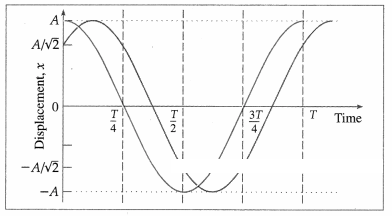
Two particles perform linear simple harmonic motion along the same path of length 2A and period T as shown in the graph below. The phase difference between them is:
- A
- ✓
$\frac{\pi}{4} rad$
- C
$\frac{\pi}{2} rad$
- D
$\frac{3 \pi}{4}$ rad
AnswerCorrect option: B. $\frac{\pi}{4} rad$
$\frac{\pi}{4} rad$
View full question & answer→MCQ 131 Mark
The total work done by a restoring force in simple harmonic motion of amplitude $A$ and angular frequency $\omega$, in one oscillation is
View full question & answer→MCQ 141 Mark
A seconds pendulum is suspended in an elevator moving with a constant speed in the downward direction. The periodic time (T) of that pendulum is
- A
- ✓
- C
- D
very much greater than two seconds.
View full question & answer→MCQ 151 Mark
If $T$ is the time period of a simple pendulum in an elevator at rest, its time period in a freely falling elevator will be
- A
$\frac{T}{\sqrt{2}}$
- B
$\sqrt{2} T$
- C
$2 T$
- ✓
View full question & answer→MCQ 161 Mark
In 20 s, two simple pendulums, $P$ and $Q$, complete 9 and 7 oscillations, respectively, on the Earth. On theMoon, where the acceleration due to gravity is $\frac{1}{6}$ th that on the Earth, their periods are in the ratio
- A
$8: 1$
- B
$9: 7$
- ✓
$7: 9$
- D
$3: 14$.
AnswerCorrect option: C. $7: 9$
(C) $7: 9$
View full question & answer→MCQ 171 Mark
The amplitude of oscillations of a simple pendulum of period $T$ and length $L$ is increased by $5 \%$. The new period of the pendulum will be
- A
$T / 8$
- B
$T / 4$
- C
$T / 2$
- ✓
$T$.
View full question & answer→MCQ 181 Mark
If the length of a simple pendulum is doubled keeping its amplitude constant, its energy will be
- A
- B
- ✓
- D
increased to four times the initial energy.
View full question & answer→MCQ 191 Mark
If the length of a simple pendulum is increased to 4 times its initial length, its frequency of oscillation will
AnswerCorrect option: A. reduce to half its initial frequency
reduce to half its initial frequency
View full question & answer→MCQ 201 Mark
The phase change of a particle performing SHM between successive passages through the mean position is
- A
$2 \pi rad$
- ✓
$\pi rad$
- C
$\frac{\pi}{2} rad$
- D
$\frac{\pi}{4} rad$.
AnswerCorrect option: B. $\pi rad$
$\pi rad$
View full question & answer→MCQ 211 Mark
Two spring-and-block oscillators oscillate harmonically with the same amplitude and a constant phase difference of $90^{\circ}$. Their maximum velocities are $v$ and $v+x$. The value of $x$ is
- ✓
- B
$\frac{v}{3}$
- C
- D
$\frac{v}{\sqrt{2}}$.
View full question & answer→MCQ 221 Mark
The total energy of a particle executing SHM is proportional to
- A
the frequency of oscillation
- ✓
the square of the amplitude of motion
- C
the velocity at the equilibrium position
- D
the displacement from the equilibrium position.
AnswerCorrect option: B. the square of the amplitude of motion
the square of the amplitude of motion
View full question & answer→MCQ 231 Mark
A particle performing linear SHM with a frequency $n$ is confined within limits $x= \pm A$. Midway between an extremity and the equilibrium position, its speed is
- A
$\sqrt{6} nA$
- ✓
$\sqrt{3} \pi n A$
- C
$\sqrt{6} \pi AA$
- D
$\sqrt{12} \pi nA$
AnswerCorrect option: B. $\sqrt{3} \pi n A$
$\sqrt{3} \pi n A$
View full question & answer→MCQ 241 Mark
The acceleration of a particle performing SHM is $3 m / s ^2$ at a distance of $3 cm$ from the mean position.The periodic time of the motion is
- A
$0.02 \pi s$
- B
$0.04 \pi s$
- ✓
$0.2 \pi s$
- D
$2 \pi s$.
AnswerCorrect option: C. $0.2 \pi s$
$0.2 \pi s$
View full question & answer→MCQ 251 Mark
In simple harmonic motion, the acceleration of a particle is zero when its
- A
- ✓
- C
both velocity and displacement are zero
- D
both velocity and displacement are maximum.
View full question & answer→MCQ 261 Mark
The minimum time taken by a particle in SHM with period T to go from an extreme position to a point half way to the equilibrium position is
- A
$\frac{T}{12}$
- B
$\frac{T}{8}$
- ✓
$\frac{T}{6}$
- D
$\frac{T}{4}$
AnswerCorrect option: C. $\frac{T}{6}$
$\frac{T}{6}$
View full question & answer→MCQ 271 Mark
A particle executes linear SHM with period $12 s$. To traverse a distance equal to half its amplitude from the equilibrium position, it takes
- A
$6 s$
- B
$4 s$
- C
$2 s$
- ✓
$1 s$.
AnswerCorrect option: D. $1 s$.
$1 s$
View full question & answer→MCQ 281 Mark
A particle executing linear SHM has velocities $v _1$ and $v _2$ at distances $x _1$ and $x _2$, respectively, from the mean position. The angular velocity of the particle is
- A
$\sqrt{\frac{x_1^2-x_2^2}{v_2^2-v_1^2}}$
- ✓
$\sqrt{\frac{v_2^2-v_1^2}{x_1^2-x_2^2}}$
- C
$\sqrt{\frac{x_1^2+x_2^2}{v_2^2+v_1^2}}$
- D
$\sqrt{\frac{v_2^2+v_1^2}{x_1^2+x_2^2}}$.
AnswerCorrect option: B. $\sqrt{\frac{v_2^2-v_1^2}{x_1^2-x_2^2}}$
$\sqrt{\frac{v_2^2-v_1^2}{x_1^2-x_2^2}}$
View full question & answer→MCQ 291 Mark
A spring-and-block oscillator with an ideal spring of force constant $180 N / m$ oscillates with a frequency of $6 Hz$. The mass of the block is, approximately,
- ✓
$\frac{1}{8} kg$
- B
$\frac{1}{4} kg$
- C
$4 kg$
- D
$8 kg$.
AnswerCorrect option: A. $\frac{1}{8} kg$
$\frac{1}{8} kg$
View full question & answer→MCQ 301 Mark
A particle performs linear SHM with a period of $6 s$, starting from the positive extremity. At time $t=7 s$, its displacement is $3 cm$. The amplitude of the motion is
- A
$4 cm$
- ✓
$6 cm$
- C
$8 cm$
- D
$12 cm$.
AnswerCorrect option: B. $6 cm$
$6 cm$
View full question & answer→MCQ 311 Mark
The differential equation of SHM for a seconds pendulum is
- A
$\frac{d^2 x}{d t^2}+ x =0$
- B
$\frac{d^2 x}{d t^2}+\pi x=0$
- C
$\frac{d^2 x}{d t^2}+4 \pi x=0$
- ✓
$\frac{d^2 x}{d t^2}+\pi^2 x=0$.
AnswerCorrect option: D. $\frac{d^2 x}{d t^2}+\pi^2 x=0$.
$\frac{d^2 x}{d t^2}+\pi^2 x=0$.
View full question & answer→MCQ 321 Mark
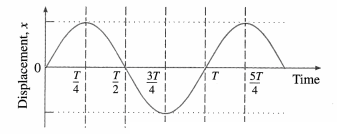
The graph shows variation of displacement of a particle performing S.H.M. with time t. Which of the following statements is correct from the graph?
- A
The acceleration is maximum at time T.
- ✓
The force is maximum at time 3T/4.
- C
The velocity is zero at time T/2.
- D
The kinetic energy is equal to total energy at time T/4.
AnswerCorrect option: B. The force is maximum at time 3T/4.
The force is maximum at time 3T/4.
View full question & answer→MCQ 331 Mark
Two identical springs of constant k are connected, first in series and then in parallel. A metal block of mass m is suspended from their combination. The ratio of their frequencies of vertical oscillations will be in a ratio
- A
$ 1: 4 $
- ✓
$ 1: 2 $
- C
$ 2: 1 $
- D
$ 4: 1 $
AnswerCorrect option: B. $ 1: 2 $
$ 1: 2 $
View full question & answer→MCQ 341 Mark
The length of second’s pendulum on the surface of earth is nearly 1 m. Its length on the surface of moon should be [Given: acceleration due to gravity (g) on moon is 1/6 th of that on the earth’s surface]
- ✓
$\frac{1}{6} m$
- B
$6 m$
- C
$\frac{1}{36} m$
- D
$\frac{1}{\sqrt{6}} m$.
AnswerCorrect option: A. $\frac{1}{6} m$
$\frac{1}{6} m$
View full question & answer→MCQ 351 Mark
A body of mass 1 kg is performing linear S.H.M. Its displacement x (cm) at t (second) is given by x = 6 sin (100t + π/4). Maximum kinetic energy of the body is
MCQ 361 Mark
A particle performs linear S.H.M. starting from the mean position. Its amplitude is A and time period is T. At the instance when its speed is half the maximum speed, its displacement x is
- ✓
$\frac{\sqrt{3}}{2} A$
- B
$\frac{2}{\sqrt{3}}$
- C
$A / 2$
- D
$\frac{1}{\sqrt{2}}$
AnswerCorrect option: A. $\frac{\sqrt{3}}{2} A$
$\frac{\sqrt{3}}{2} A$
View full question & answer→MCQ 371 Mark
Equation of simple harmonic progressive wave is given by $y=\frac{1}{\sqrt{a}} \sin \omega t \pm \frac{1}{\sqrt{b}} \cos \omega t$, then the resultant amplitude of the wave is $\left(\cos 90^{\circ}=0\right)$
AnswerCorrect option: D. $\sqrt{\frac{a+b}{a b}}$
(d) : $y=\frac{1}{\sqrt{a}} \sin \omega t \pm \frac{1}{\sqrt{b}} \cos \omega t$ $=\frac{1}{\sqrt{a}} \sin \omega t \pm \frac{1}{\sqrt{b}} \sin \left(\omega t+\frac{\pi}{2}\right)$
Phase difference $=\frac{\pi}{2}$
Resultant amplitude
$
=\sqrt{\left(\frac{1}{\sqrt{a}}\right)^2+\left(\frac{1}{\sqrt{b}}\right)^2}=\sqrt{\frac{1}{a}+\frac{1}{b}}=\sqrt{\frac{a+b}{a b}}
$
View full question & answer→MCQ 381 Mark
A simple pendulum of length $2 m$ is given a horizontal push through angular displacement of $60^{\circ}$. If the mass of bob is $200$ gram, the angular velocity of the bob will be $($Take acceleration due to gravity $=10\ m / s ^2)$
$\left(\sin 30^{\circ}=\cos 60^{\circ}=0.5, \cos 30^{\circ}=\sin 60^{\circ}=\sqrt{3} / 2\right)$
- A
$2 \sqrt{2} \ rad / s$
- B
$3 \sqrt{2} \ rad / s$
- ✓
$2 \sqrt{2.5} \ rad / s$
- D
$3 \sqrt{2.5} \ rad / s$
AnswerCorrect option: C. $2 \sqrt{2.5} \ rad / s$
Given$, \theta=60^{\circ},$
$L=2 m , A B=L \cos \theta$
$h=L-L \cos \theta=L(1-\cos \theta)$
$\text { P.E. }=\text { K.E. }$
$m g L(1-\cos \theta)=\frac{1}{2} m v^2$
$2 \times 10 \times 2\left(1-\frac{1}{2}\right)=\frac{1}{2} v^2$
$v^2=4 \times 10 $
$\Rightarrow v=2 \sqrt{10} m / s$
$\omega=\frac{v}{L}=\frac{2 \sqrt{10}}{2}$
$=2 \sqrt{2.5}\ rad / s $

View full question & answer→MCQ 391 Mark
A particle is vibrating in S.H.M. with an amplitude of $4 cm$. At what displacement from the equilibrium position is its energy half potential and half kinetic?
- A
$1 cm$
- B
$\sqrt{2} cm$
- C
$2 cm$
- ✓
$2 \sqrt{2} cm$
AnswerCorrect option: D. $2 \sqrt{2} cm$
(d) : Given, $A=4 cm$
$
\begin{aligned}
& \frac{ PE }{2}=\frac{ KE }{2} ; \frac{1}{2} \times \frac{1}{2} m \omega^2 y^2=\frac{1}{2} \times \frac{1}{2} \times m \omega^2\left(A^2-y^2\right) \\
& y^2=A^2-y^2 ; 2 y^2=A^2 \Rightarrow y=\frac{A}{\sqrt{2}}=2 \sqrt{2} cm
\end{aligned}
$
View full question & answer→MCQ 401 Mark
A spring has a certain mass suspended from it and its period for vertical oscillations is ' $T_1$ '. The spring is now cut into two equal halves and the same mass is suspended from one of the halves. The period of vertical oscillations is now ' $T_2$ ' The ratio $T_1 / T_2$ is
- A
- ✓
$\sqrt{2}$
- C
$\frac{1}{\sqrt{2}}$
- D
$\frac{1}{2}$
AnswerCorrect option: B. $\sqrt{2}$
(b) : When the spring cut into half, the spring constant becomes doubled.
As, $T \propto \frac{1}{\sqrt{k}} \quad \therefore \frac{T_2}{T_1}=\sqrt{\frac{k_1}{k_2}}=\sqrt{\frac{k}{2 k}} \quad \Rightarrow \frac{T_1}{T_2}=\sqrt{2}$
View full question & answer→MCQ 411 Mark
Two S.H.Ms are represented by equations $y_1=0.1 \sin \left(100 \pi t+\frac{\pi}{3}\right)$ and $y_2=0.1 \cos (100 \pi t)$ The phase difference between the speeds of the two particles is
- A
$\frac{\pi}{3}$
- ✓
$-\frac{\pi}{6}$
- C
$+\frac{\pi}{6}$
- D
$-\frac{\pi}{3}$
AnswerCorrect option: B. $-\frac{\pi}{6}$
(b) : $y_1=0.1 \sin (100 \pi t+\pi / 3), y_2=0.1 \cos (100 \pi t)$
$
\begin{aligned}
& v_1=\frac{d y_1}{d t}=0.1 \times 100 \pi \cos \left(100 \pi t+\frac{\pi}{3}\right) ...(i)\\
& v_2=\frac{d y_2}{d t}=0.1 \times 100 \pi \cos \left(100 \pi t+\frac{\pi}{2}\right)...(ii)
\end{aligned}
$
From (i) and (ii), $\Delta \phi=\frac{\pi}{3}-\frac{\pi}{2}=-\frac{\pi}{6}$
View full question & answer→MCQ 421 Mark
A seconds pendulum is placed in a space laboratory orbiting round the earth at a height ' $3 R$ ' from the earth's surface. The time period of the pendulum will be ( $R=$ radius of earth)
Answer(d) : In laboratory $g_{\text {eff }}=0$
$
\therefore \quad T=2 \pi \sqrt{\frac{L}{g_{\text {eff }}}}=2 \pi \sqrt{\frac{L}{0}}=\infty
$
View full question & answer→MCQ 431 Mark
A rubber ball filled with water, having a small hole is used as the bob of a simple pendulum. The time period of such a pendulum
- A
- B
- C
- ✓
first increases and then decreases, finally having same value as at the beginning.
AnswerCorrect option: D. first increases and then decreases, finally having same value as at the beginning.
(d) : As the water starts leaking, the effective length increases, and thus the time period increases $(T \propto \sqrt{l})$. Now as all the water has drained off, the effective length become same as beginning. So the time period becomes same as the beginning.
View full question & answer→MCQ 441 Mark
The maximum velocity of a particle performing S.H.M. is 'V'. If the periodic time is made $\left(\frac{1}{3}\right)^{ rd }$ and the amplitude is doubled, then the new maximum velocity of the particle will be
- A
$\frac{V}{6}$
- B
$\frac{3 V }{2}$
- C
$3 V$
- ✓
$6 V$
Answer(d) : Maximum velocity, $V=A \omega$...(i)
$
T^{\prime}=\frac{T}{3} ; A^{\prime}=2 A
$
$
\omega^{\prime}=\frac{2 \pi}{T^{\prime}}=\frac{2 \pi \times 3}{T}
$
So,
$
\begin{aligned}
& V^{\prime}=A^{\prime} \omega^{\prime}=\frac{2 A \times 2 \pi \times 3}{T} \\
& V^{\prime}=6 A \omega=6 V \quad \text { (from (i)) }
\end{aligned}
$
View full question & answer→MCQ 451 Mark
A light spring is suspended with mass $m_1$ at its lower end and its upper end fixed to a rigid support. The mass is pulled down a short distance and then released. The period of oscillation is $T$ second. When a mass $m_2$ is added to $m_1$ and the system is made to oscillate, the period is found to be $\frac{3}{2} T$. The ratio of $m_1: m_2$ is
- A
$2: 3$
- B
$3: 4$
- ✓
$4: 5$
- D
$5: 6$
AnswerCorrect option: C. $4: 5$
As, $T=2 \pi \sqrt{\frac{m}{K}}$$T=2 \pi \sqrt{\frac{m_1}{K}} \ldots \text { (i) } ;$
$\frac{3 T}{2}=2 \pi \sqrt{\frac{m_1+m_2}{K}} \ldots \text { (ii) }$
Divide equation $(i)$ by equation $(ii)$
$ \frac{2}{3}=\sqrt{\frac{m_1}{m_1+m_2}} ;$
$\frac{4}{9}=\frac{m_1}{m_1+m_2}$
$4 _1+4 m_2=9 m_1$
$4 m_2=5 m_1$
$m_1: m_2=4: 5$
View full question & answer→MCQ 461 Mark
A block of mass $'M\ '$ rests on a piston executing $\text{S.H.M.}$ of period one second. The amplitude of oscillations, so that the mass is separated from the piston, is $($acceleration due to gravity, $g=10 ms ^{-2}, \pi^2=10)$
- ✓
$0.25 m$
- B
$0.5 m$
- C
$1 m$
- D
$\infty$
AnswerCorrect option: A. $0.25 m$
$T=1 s , g=10 m / s ^2$
$T=2 \pi \sqrt{\frac{m}{K}}$
For no contact of block and spring
Spring force $\geq$ Weight $K x \geq m g$
$x \geq \frac{m g}{K} $
$\Rightarrow x \geq \frac{T^2}{4 \pi^2} g\ ($ As $\omega=\sqrt{\frac{k}{m}})$
$x \geq \frac{1 \times 1 \times 10}{4 \times 10}$
$x=0.25 m$
View full question & answer→MCQ 471 Mark
- A
$230 N m ^{-1}$
- B
$120 N m ^{-1}$
- ✓
$60 N m ^{-1}$
- D
$30 N m ^{-1}$
AnswerCorrect option: C. $60 N m ^{-1}$
(c) : The springs are in parallel combination.
$
K_{\text {eff }}=2 K
$
Time period is given by $T=2 \pi \sqrt{\frac{M}{K_{\text {eff }}}}$
$
\begin{aligned}
& 2=2 \pi \sqrt{\frac{12}{2 K}} ; 1=\pi^2 \times \frac{12}{2 K} ; 2 K=120 \quad\left(\therefore \pi^2=10\right) \\
& K=60 N / m
\end{aligned}
$
View full question & answer→MCQ 481 Mark
The displacement of a particle executing S.H.M. is $x=a \sin (\omega t-\phi)$. Velocity of the particle at time $t=\frac{\phi}{\omega}$ is $\left(\cos 0^{\circ}=1\right)$
Answer(b) : $x=a \sin (\omega t-\phi)$
$
\begin{aligned}
& v=\frac{d x}{d t}=a \omega \cos (\omega t-\phi) \quad At _3 t=\frac{\phi}{\omega} \\
& v=a \omega \cos \left(\frac{\omega \phi}{\omega}-\phi\right)=a \omega
\end{aligned}
$
View full question & answer→MCQ 491 Mark
The bob of simple pendulum of length $L$ is released from a position of small angular displacement $\theta$. Its linear displacement at time $t$ is ( $g=$ acceleration due to gravity)
- ✓
$L \theta \cos \left[\sqrt{\frac{g}{L}} \cdot t\right]$
- B
$L \theta \sin \left[2 \pi \sqrt{\frac{g}{L}} \cdot t\right]$
- C
$L \theta \cos \left[2 \pi \sqrt{\frac{g}{L}} \cdot t\right]$
- D
$L \theta \sin \left[\sqrt{\frac{g}{L}} \cdot t\right]$
AnswerCorrect option: A. $L \theta \cos \left[\sqrt{\frac{g}{L}} \cdot t\right]$
(a) : As, $\theta=\theta_0 \cos \omega t$ and $\omega=\frac{2 \pi}{T}$
$
T=2 \pi \sqrt{\frac{L}{g}} ; \omega=\sqrt{\frac{g}{L}}
$
Angular displacement, $\theta^{\prime}=\theta \cos \sqrt{\frac{g}{L}} t$
Linear displacement, $x=L \theta^{\prime}$
$
\therefore \quad x=L \theta \cos \sqrt{\frac{g}{L}} t
$
View full question & answer→MCQ 501 Mark
A simple pendulum of length ' $l$ ' and a bob of mass ' $m$ ' is executing S.H.M. of small amplitude ' $A$ '. The maximum tension in the string will be ( $g=$ acceleration due to gravity)
- A
$2 m g$
- ✓
$m g\left[1+\left(\frac{A}{l}\right)^2\right]$
- C
$m g\left[1+\left(\frac{A}{l}\right)\right]^2$
- D
$m g\left[1+\left(\frac{A}{l}\right)\right]$
AnswerCorrect option: B. $m g\left[1+\left(\frac{A}{l}\right)^2\right]$
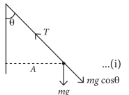
(b) : Tension in the string will be maximum when bob will be passing through mean position.
$
\therefore T=m g \cos \theta+\frac{m v^2}{l}
$
$T$ is maximum when, $\cos \theta=1_l$
$
\therefore \quad T_m=m g+\frac{m v^2}{l}
$
At mean position, $\omega=\sqrt{\frac{g}{l}}$
And, $v=\omega \sqrt{A^2-x^2}$, At mean position,
$
v_{\max }=\omega A \text { or } v=\sqrt{\frac{g}{l}} A \text { or } v^2=\frac{A^2 g}{l}
$
From eq (i), we have
$
T_m=m g+\frac{m g A^2}{l^2}=m g\left[1+\frac{A^2}{l^2}\right]
$
View full question & answer→