Questions · Page 3 of 3

M.C.Q (1 Marks)

MCQ 1011 Mark
From Brewster's law, except for polished metallic surfaces, the polarising angle
  • depends on wavelength and is different for different colours
  • B
    independent of wavelength and is different for different colours
  • C
    independent of wavelength and is same for different colours
  • D
    depends on wavelength and is same for different colours
Answer
Correct option: A.
depends on wavelength and is different for different colours
(a) : From Brewster's law $i_p=\tan ^{-1}(\mu)$ i.e., the polarising angle depends on refractive index and hence on wavelength and therefore is different for different colours.
View full question & answer
MCQ 1021 Mark
A ray of light travelling through rarer medium is incident at very small angle $i$ on a glass slab and after refraction its velocity is reduced by $20 \%$. The angle of deviation is
  • A
    $\frac{i}{8}$
  • $\frac{i}{5}$
  • C
    $\frac{i}{2}$
  • D
    $\frac{4 i}{5}$
Answer
Correct option: B.
$\frac{i}{5}$
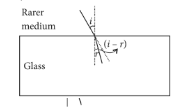
(b) : Let velocity of light in rarer medium be $v$. Then velocity of light in glass is $\frac{4 v}{5}$.
Image
$\therefore \quad$ Refractive index of glass with respect to given rarer medium is $\mu=\frac{v}{4 v / 5}=\frac{5}{4}$
From Snell's law, $\mu=\frac{\sin i}{\sin r} \approx \frac{i}{r}$
( $\because$ for small angles, $\sin \theta=\theta$ )
$\therefore \quad \frac{i}{r}=\frac{5}{4}$
or $r=\frac{4 i}{5}$
$\therefore \quad$ Angle of deviation $=i-r=i-\frac{4 i}{5}=\frac{i}{5}$
View full question & answer
MCQ 1031 Mark
In Young's double slit experiment, the ratio of intensities of bright and dark bands is 16 which means
  • A
    the ratio of their amplitudes is 5
  • intensities of individual sources are 25 and 9 units respectively
  • C
    the ratio of their amplitudes is 4
  • D
    intensities of individual sources are 4 and 3 units respectively.
Answer
Correct option: B.
intensities of individual sources are 25 and 9 units respectively
(b) : Here, $\frac{I_{\max }}{I_{\min }}=16, a_1=$ ?, $a_2=$ ?
$
\text { As } \frac{I_{\max }}{I_{\min }}=\left(\frac{r+1}{r-1}\right)^2 ; r=\frac{a_1}{a_2} ; 16=\left(\frac{r+1}{r-1}\right)^2 \Rightarrow \frac{r+1}{r-1}=4
$
$\begin{aligned} & r+1=4 r-4 \Rightarrow 3 r=5 \\ & r=\frac{5}{3}=\frac{a_1}{a_2} \therefore \frac{I_1}{I_2}=\left(\frac{a_1}{a_2}\right)^2=\frac{25}{9}\end{aligned}$
View full question & answer
MCQ 1041 Mark
Two coherent monochromatic light beams of intensities ' $4 I$ and ' $9 I$ ' are superimposed. The maximum and minimum possible intensities in the resulting beam are
  • A
    $3 I$ and $2 I$
  • B
    $9 I$ and $5 I$
  • C
    $16 I$ and $3 I$
  • $25 I$ and $I$
Answer
Correct option: D.
$25 I$ and $I$
(d) : Here, $I_1=4 I, I_2=9 I$
$
I_{\max }=\text { ?, } I_{\min }=\text { ? }
$
Also, amplitude $\propto \sqrt{\text { Intensity }}$
$
\begin{aligned}
& I_{\max }=\left(A_1+A_2\right)^2=(2 \sqrt{I}+3 \sqrt{I})^2=25 I \\
& I_{\min }=\left(A_1-A_2\right)^2=(2 \sqrt{I}-3 \sqrt{I})^2=I
\end{aligned}
$
View full question & answer
MCQ 1051 Mark
The distance of a point on the screen from two slits in biprism experiment is $1.8 \times 10^{-5} m$ and $1.23 \times 10^{-5} m$. If wavelength of light used is 6000 Å, the fringe formed at that point is
  • A
    $10^{\text {th }}$ bright
  • $10^{\text {th }}$ dark
  • C
    $9^{\text {th }}$ bright
  • D
    $9^{\text {th }}$ dark
Answer
Correct option: B.
$10^{\text {th }}$ dark
(b) : Fordark fringe, $\Delta x=0.57 \times 10^{-5}=\left(\frac{2 n-1}{2}\right) \lambda$
$
\begin{aligned}
& n=\frac{1}{2}\left(\frac{2 \times 0.57 \times 10^{-5}}{6000 \times 10^{-10}}\right) \\
& n=10^{\text {th }} \text { (dark fringe). }
\end{aligned}
$
View full question & answer
MCQ 1061 Mark
For the same angle of incidence, the angles of refraction of media ' $P$ ', ' $Q$, ' $R$ ' and ' $S$ ' are $50^{\circ}, 40^{\circ}$, $30^{\circ}, 20^{\circ}$ respectively. The speed of light is minimum in medium
  • A
    $P$
  • B
    $Q$
  • C
    $R$
  • $S$
Answer
Correct option: D.
$S$
(d) : According to Snell's law
$\sin i=\mu \sin r$
[From air to a medium]
$
\mu=\frac{\sin i}{\sin r}
$
Let $v$ be speed of light in the medium.
$
v=\frac{c}{\mu}=\frac{c}{(\sin r) /(\sin r)}=\left(\frac{c}{\sin i}\right) \sin r
$
For a given angle of incidence,
$
\begin{aligned}
& v \propto \sin r \\
& \therefore \quad v_P>v_Q>v_R>v_S
\end{aligned}
$
Hence, the speed of light in medium $S$ is minimum.
View full question & answer
MCQ 1071 Mark
A light is travelling from air into a medium. Velocity of light in a medium is reduced to 0.75 times the velocity in air. Assume that angle of incidence ' $i$ ' is very small, the deviation of the ray is
  • A
    $i$
  • B
    $\frac{i}{3}$
  • $\frac{i}{4}$
  • D
    $\frac{3 i}{4}$
Answer
Correct option: C.
$\frac{i}{4}$
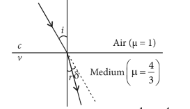
(c) : Given situation is shown in the figure.
Image
Refractive index of medium, $\mu=\frac{c}{v}=\frac{1}{0.75}=\frac{4}{3}$
Deviation of ray, $\delta=$ ?
Using Snell's law at the interface of media,
$
\begin{aligned}
& \text { (1) } \sin i=\left(\frac{4}{3}\right) \sin r \\
& \frac{\sin i}{\sin r}=\frac{4}{3}
\end{aligned}
$
Since $i$ and $r$ is very small so, $\sin i \approx i$ and $\sin r \approx r$ then
$
\begin{aligned}
& \frac{i}{r}=\frac{4}{3} ; \frac{i}{i-\delta}=\frac{4}{3} \quad(\because r=i-\delta) \\
& 3 i=4 i-4 \delta \therefore \quad \delta=\frac{i}{4}
\end{aligned}
$
View full question & answer
MCQ 1081 Mark
Two coherent sources of intensity ratio $\alpha$ interfere.In interference pattern $\frac{I_{\max }-I_{\min }}{I_{\max }+I_{\min }}=$
  • A
    $\frac{2 \alpha}{1+\alpha}$
  • $\frac{2 \sqrt{\alpha}}{1+\alpha}$
  • C
    $\frac{2 \alpha}{1+\sqrt{\alpha}}$
  • D
    $\frac{1+\alpha}{2 \alpha}$
Answer
Correct option: B.
$\frac{2 \sqrt{\alpha}}{1+\alpha}$
(b) : Let two coherent sources of intensity $I_1$ and $I_2$ interfere. Then
$
\frac{I_{\max }}{I_{\min }}=\frac{\left(\sqrt{I_1}+\sqrt{I_2}\right)^2}{\left(\sqrt{I_1}-\sqrt{I_2}\right)^2}=\frac{\left(\sqrt{\frac{I_1}{I_2}}+1\right)^2}{\left(\sqrt{\frac{I_1}{I_2}}-1\right)^2}
$
As $\frac{I_1}{I_2}=\alpha$ (Given)
$
\therefore \frac{I_{\max }}{I_{\min }}=\frac{(\sqrt{\alpha}+1)^2}{(\sqrt{\alpha}-1)^2}=\left(\frac{\sqrt{\alpha}+1}{\sqrt{\alpha}-1}\right)^2
$
$
\begin{aligned}
& \text { Then, } \frac{I_{\max }-I_{\min }}{I_{\max }+I_{\min }}=\frac{\frac{I_{\max }}{I_{\min }}-1}{\frac{I_{\max }}{I_{\min }}+1} \\
& =\frac{\left(\frac{\sqrt{\alpha}+1}{\sqrt{\alpha}-1}\right)^2-1}{\left(\frac{\sqrt{\alpha}+1}{\sqrt{\alpha}-1}\right)^2+1}=\frac{(\sqrt{\alpha}+1)^2-(\sqrt{\alpha}-1)^2}{(\sqrt{\alpha}+1)^2+(\sqrt{\alpha}-1)^2} \\
& =\frac{\alpha+1+2 \sqrt{\alpha}-\alpha-1+2 \sqrt{\alpha}}{\alpha+1+2 \sqrt{\alpha}+\alpha+1-2 \sqrt{\alpha}} \Rightarrow=\frac{4 \sqrt{\alpha}}{2+2 \alpha}=\frac{4 \sqrt{\alpha}}{2(1+\alpha)}=\frac{2 \sqrt{\alpha}}{1+\alpha}
\end{aligned}
$
View full question & answer