Questions · Page 1 of 2

2 Mark Question

🎯

Test yourself on this topic

50 questions · timed · auto-graded

Question 12 Marks
In the following numbers, replace * by the smallest number to make it divisible by 9:
835*86
Answer
835686
Here, 8 + 3 + 5 + * + 8 + 6 = 30 + * should be a multiple of 9.
To be divisible of 9, the least value of * should be 6, i.e., 30 + 6 = 36, which is a multiple of 9.
$\therefore$ * = 6
View full question & answer
Question 22 Marks
Test the divisibility of the following numbers by 6:
251780
Answer
A number is divisible by 6 if it is divisible by both 2 and 3.
Since 251780 is not divisible by 3, it is not divisible by 6.
Checking the divisibility by 3: The sum of the digits of the number, 2 + 5 + 1 + 7 + 8 + 0, is 23, which is not divisible by 3.
So, the number is not divisible by 3.
View full question & answer
Question 32 Marks
Test the divisibility of:
12030624 by 8
Answer
12030624 by 8
12030624 is divisible by 8.
It is because the number formed by its hundreds, tens and ones digits is 624, which is divisible by 8.
View full question & answer
Question 42 Marks
Find the HCF of the numbers in the following using the prime factorization method:504, 980
Answer
The given numbers are 504 and 980.We have:
$\begin{array}{c|c}2&504\\\hline2&252\\\hline2&126\\\hline3&63\\\hline3&21\\\hline7&7\\\hline&1\end{array}$
$\begin{array}{c|c}2&980\\\hline2&490\\\hline5&245\\\hline7&49\\\hline7&7\\\hline&1\end{array}$
$504=2\times2\times2\times3\times3\times7=2^3\times3^2\times7$
$980=2\times2\times5\times7\times7=2^2\times5\times7^2$
$\therefore$ HCF of the given numbers = $2^2$ × $7$ = $28$
View full question & answer
Question 52 Marks
Give the prime factorization of the following number:
1323
Answer
We will use the didvision method as shown below:
$\begin{array}{c|c}3&1323\\\hline3&441\\\hline3&147\\\hline7&49\\\hline7&7\\\hline&1\end{array}$
$\therefore1323=3\times3\times3\times7\times7\times1$
$=3^3\times7^2$
View full question & answer
Question 62 Marks
Give the prime factorization of the following number:
18
Answer
We will use the didvision method as shown below:
$\begin{array}{c|c}2&18\\\hline2&9\\\hline3&3\\\hline&1\end{array}$
$\therefore18=2\times3\times3$
$=2\times3^2$
View full question & answer
Question 72 Marks
Which of the following are prime numbers?
137
Answer
A number between 100 and 200 is a prime number if it is not divisible by any prime number less than 15.
Similarly, a number between 200 and 300 is a prime number if it is not divisible by any prime number less than 20.
137 is a prime number, because it is not divisible by 2, 3, 5, 7 and 11.
View full question & answer
Question 82 Marks
The product of two numbers is 2560 and their LCM is 320. Find their HCF.
Answer
Product of the two numbers = 2560.HCF = 320
We know that,
LCM × HCF = Product of two numbers
$\therefore$ HCF $=\frac{2560}{320}=8$
View full question & answer
Question 92 Marks
Test the divisibility of the following numbers by 7:
2345
Answer
To determine if a number is divisible by 7, double the last digit of the number and subtract it from the number formed by the remaining digits.
2345 is divisible by 7.
We have 234 - 2 × 5 = 224, which is a multiple of 7.
View full question & answer
Question 102 Marks
Which of the following are prime numbers?
331
Answer
A number between 100 and 200 is a prime number if it is not divisible by any prime number less than 15.
Similarly, a number between 200 and 300 is a prime number if it is not divisible by any prime number less than 20.
331 is a prime number, because it is not divisible by 2, 3, 5, 7, 11, 13, 17 and 19.
View full question & answer
Question 112 Marks
In the following numbers, replace * by the smallest number to make it divisible by 3:
8*711
Answer
81711
Here, 8 + * + 7 + 1 + 1 = 17 + * should be a multiple of 3.
To be divisible by 3, the least value of * should be 1, i.e., 17 + 1 = 18, which is a multiple of 3.
$\therefore$ * = 1
View full question & answer
Question 122 Marks
Find the LCM of the numbers given below:60, 75
Answer
The given numbers are 60 and 75.We have:
$\begin{array}{c|c}3&60,75\\\hline5&20,25\\\hline5&4,5\\\hline2&4,5\\\hline2&2,1\\\hline&1,1\end{array}$
$\therefore$ LCM = 3 × 5 × 5 × 2 × 2
= 300
View full question & answer
Question 132 Marks
Test the divisibility of the following numbers by 7:
6021
Answer
To determine if a number is divisible by 7, double the last digit of the number and subtract it from the number formed by the remaining digits.
6021 is divisible by 7.
We have 602 - 2 × 1 = 600, which is not a multiple of 7.
View full question & answer
Question 142 Marks
Write all prime numbers between 50 and 100.
Answer
53, 59, 61, 67, 71, 73, 79, 83, 89, 97 are the prime numbers between 50 and 100.
View full question & answer
Question 152 Marks
Which of the following are prime numbers?
161
Answer
A number between 100 and 200 is a prime number if it is not divisible by any prime number less than 15.
Similarly, a number between 200 and 300 is a prime number if it is not divisible by any prime number less than 20.
161 is a not prime number, because it is divisible by 7.
View full question & answer
Question 162 Marks
Show that the following pairs are co-primes:59, 97
Answer
The given numbers are 59 and 97.
59 = 59 × 1
97 = 97 × 1
$\therefore$ HCF = 1
Since 59 and 97 does not have any common factor other than 1, the two numbers are co-primes.
View full question & answer
Question 172 Marks
Which of the following are prime numbers?
397
Answer
A number between 100 and 200 is a prime number if it is not divisible by any prime number less than 15.
Similarly, a number between 200 and 300 is a prime number if it is not divisible by any prime number less than 20.
397 is a prime number, because it is not divisible by 2, 3, 5, 7, 11, 13, 17 and 19.
View full question & answer
Question 182 Marks
Test the divisibility of the following numbers by 7:
14126
Answer
To determine if a number is divisible by 7, double the last digit of the number and subtract it from the number formed by the remaining digits.
14126 is divisible by 7.
We have 1412 - 2 × 6 = 1400, which is a multiple of 7.
View full question & answer
Question 192 Marks
In the following numbers, replace * by the smallest number to make it divisible by 3:
6*1054
Answer
621054
Here, 6 + * + 1 + 0 + 5 + 4 = 16 + * should be a multiple of 3.
To be divisible by 3, the least value of * should be 2, i.e., 16 + 2 = 18, which is a multiple of 3.
$\therefore$ * = 2
View full question & answer
Question 202 Marks
Test the divisibility of:
10001001 by 3
Answer
10001001 by 3
10001001 is divisible by 3.
It is because the sum of its digits, 1 + 0 + 0 + 0 + 1 + 0 + 0 + 1, is 3, which is divisible by 3.
View full question & answer
Question 212 Marks
In the following numbers, replace * by the smallest number to make it divisible by 9:
6678*1
Answer
667881
Here, 6 + 6 + 7 + 8 + * + 1 = 28 + * should be a multiple of 9.
To be divisible by 9, the least value of * should be 8, i.e., 28 + 8 = 36, which is a multiple of 9.
$\therefore$ * = 8
View full question & answer
Question 222 Marks
What are composite numbers? Can a composite number be odd? If yes, write the smallest odd composite number.
Answer
COMPOSITE NUMBERS: Numbers having more than two factors are known as composite numbers.
Yes a composite number can odd. The smallest odd composite number is 9.
View full question & answer
Question 232 Marks
Find the LCM of the numbers given below:42, 63
Answer
The given numbers are 42 and 63.We have:
$\begin{array}{c|c}7&42,63\\\hline3&6,9\\\hline3&2,3\\\hline2&2,1\\\hline&1,1\end{array}$
$\therefore$ LCM = 7 × 3 × 3 × 2 × 1
= 126
View full question & answer
Question 242 Marks
Test the divisibility of the following numbers by 11:
66311
Answer
A number is divisible by 11 if the difference of the sum of its digits at odd places and the sum of its digits at even places is either 0 or a multiple of 11.
66311 is not divisible by 11.
Sum of the digits at odd places = (1 + 3 + 6) = 10
Sum of the digits at even places = (1 + 6) = 7
Difference of the two sums = (10 - 7) = 3, which is not divisible by 11.
View full question & answer
Question 252 Marks
Write seven consecutive composite numbers less than 100 having no prime number between them.
Answer
Seven consecutive composite numbers less than 100 having no prime number between them are 90, 91, 92, 93, 94, 95 and 96.
View full question & answer
Question 262 Marks
Give the prime factorization of the following number:
1035
Answer
We will use the didvision method as shown below:
$\begin{array}{c|c}3&1035\\\hline3&345\\\hline5&115\\\hline23&23\\\hline&1\end{array}$
$\therefore1035=3\times3\times5\times23$
$=3^2\times5\times23$
View full question & answer
Question 272 Marks
In the following numbers, replace * by the smallest number to make it divisible by 9:
2*135
Answer
27135
Here, 2 + * + 1 + 3 + 5 = 11 + * should be a multiple of 9.
To be divisible by 9, the least value of * should be 7, i.e., 11 + 7 = 18, which is a multiple of 9.
$\therefore$ * = 7
View full question & answer
Question 282 Marks
Test the divisibility of the following numbers by 11:
137269
Answer
A number is divisible by 11 if the difference of the sum of its digits at odd places and the sum of its digits at even places is either 0 or a multiple of 11.
137269 is divisible by 11.
Sum of the digits at odd places = (9 + 2 + 3) = 14
Sum of the digits at even places = (6 + 7 + 1) = 14
Difference of the two sums = (14 - 14) = 0, which is a divisible by 11.
View full question & answer
Question 292 Marks
Test the divisibility of the following numbers by 7:
826
Answer
To determine if a number is divisible by 7, double the last digit of the number and subtract it from the number formed by the remaining digits.
If their difference is a multiple of 7, the number is divisible by 7.
826 is divisible by 7.
We have 82 - 2 × 6 = 70, which is a multiple of 7.
View full question & answer
Question 302 Marks
In the following numbers, replace * by the smallest number to make it divisible by 3:
27*4
Answer
2724
Here, 2 + 7 + * + 4 = 13 + * should be a multiple of 3.
To be divisible by 3, the least value of * should be 2, i.e., 13 + 2 = 15, which is a multiple of 3.
$\therefore$ * = 2
View full question & answer
Question 312 Marks
Test the divisibility of:
1000001 by 11
Answer
10000001 by 11
10000001 is divisible by 11.
Sum of digits at odd places = (1 + 0 + 0 + 0) = 1
Sum of digits at even places = (0 + 0 + 0 + 1) = 1
Difference of the two sums = (1 - 1) = 0, which is divisible by 11.
View full question & answer
Question 322 Marks
Test the divisibility of the following numbers by 8:
901674
Answer
A number is divisible by 8 if the number formed by the last three digits (digits in the hundreds, tens and units places) is divisible by 8.
901674 is not divisible by 8.
It is because the number formed by its hundreds, tens and ones digits, i.e., 674, is not divisible by 8.
View full question & answer
Question 332 Marks
The HCF of two numbers is 145 and their LCM is 2175. If one of the numbers is 725, find the other.
Answer
HCF = 145LCM = 2175
One of the numbers = 725
We know that,
HCF × LCF = Product of two numbers
$\therefore$ Other number $=\frac{145\times2175}{725}=435$
View full question & answer
Question 342 Marks
Find the LCM of the numbers given below:36, 60, 72
Answer
The given numbers are 36, 60 and 72.We have:
$\begin{array}{c|c}2&36,60,72\\\hline2&18,30,36\\\hline3&9,15,18\\\hline3&3,5,6\\\hline5&1,5,2\\\hline2&1,1,2\\\hline&1,1,1\end{array}$
$\therefore$ LCM = 2 × 2 × 2 × 3 × 3 × 5
= 360
View full question & answer
Question 352 Marks
Give the prime factorization of the following number:
9317
Answer
We will use the didvision method as shown below:
$\begin{array}{c|c}7&9317\\\hline11&1331\\\hline11&121\\\hline11&11\\\hline&1\end{array}$
$\therefore9317=7\times11\times11\times11$
$=7\times11^3$
View full question & answer
Question 362 Marks
Test the divisibility of the following numbers by 8:
36792
Answer
A number is divisible by 8 if the number formed by the last three digits (digits in the hundreds, tens and units places) is divisible by 8.
36792 is divisible by 8.
It is because the number formed by its hundreds, tens and ones digits, i.e., 792, is divisible by 8
View full question & answer
Question 372 Marks
Test the divisibility of the following numbers by 8:
1790184
Answer
A number is divisible by 8 if the number formed by the last three digits (digits in the hundreds, tens and units places) is divisible by 8.
1790184 is divisible by 8.
It is because the number formed by its hundreds, tens and ones digits, i.e., 184, is divisible by 8.
View full question & answer
Question 382 Marks
Find the HCF of:2 and an even number.
Answer
2 and 4 are two prime numbers.
Now, HCF of 2 and 4 is as follows:
2 = 2 × 1
4 = 2 × 2 × 1
$\therefore$ HCF =2 × 1 = 2
View full question & answer
Question 392 Marks
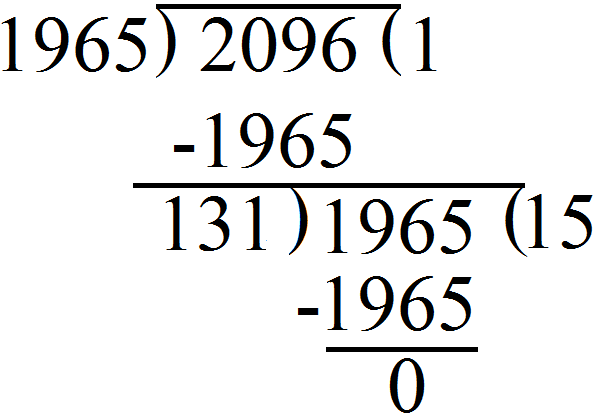
Find the HCF of the numbers in the following using the division method:1965, 2096
Answer
The given numbers are 1965 and 2096.We have:

$\therefore$ The HFC is 131.
View full question & answer
Question 402 Marks
Which of the following are prime numbers?
217
Answer
A number between 100 and 200 is a prime number if it is not divisible by any prime number less than 15.Similarly, a number between 200 and 300 is a prime number if it is not divisible by any prime number less than 20.
217 is a not prime number, because it is divisible by 7.
View full question & answer
Question 412 Marks
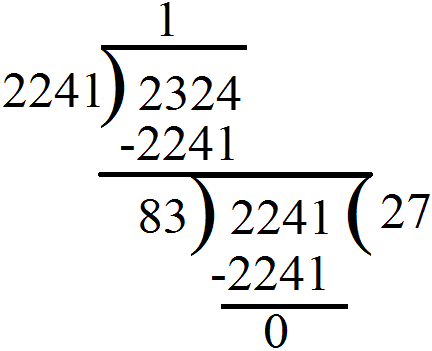
Find the HCF of the numbers in the following using the division method:2241, 2324
Answer
The given numbers are 2241 and 2341.
We have:

$\therefore$ The HFC = 83.
View full question & answer
Question 422 Marks
Test the divisibility of the following numbers by 8:
2138
Answer
A number is divisible by 8 if the number formed by the last three digits (digits in the hundreds, tens and units places) is divisible by 8.
2138 is not divisible by 8.
It is because the number formed by its hundreds, tens and ones digits, i.e., 138, is not divisible by 8.
View full question & answer
Question 432 Marks
Test the divisibility of the following numbers by 11:
4334
Answer
A number is divisible by 11 if the difference of the sum of its digits at odd places and the sum of its digits at even places is either 0 or a multiple of 11.
4334 is divisible by 11.
Sum of the digits at odd places = (4 + 3) = 7
Sum of the digits at even places = (3 + 4) = 7
Difference of the two sums = (7 - 7) = 0, which is divisible by 11.
View full question & answer
Question 442 Marks
Test the divisibility of the following numbers by 6:
872536
Answer
A number is divisible by 6 if it is divisible by both 2 and 3.Since 872536 is not divisible by 3, it is not divisible by 6.
Checking the divisibility by 3: The sum of the digits of the number, 8 + 7 + 2 + 5 + 3 + 6, is 31, which is not divisible by 3.
So, the number is not divisible by 3.
View full question & answer
Question 452 Marks
Give the prime factorization of the following number:
2907
Answer
We will use the didvision method as shown below:
$\begin{array}{c|c}3&2907\\\hline3&969\\\hline17&323\\\hline19&19\\\hline&1\end{array}$
$\therefore4641=3\times3\times17\times19$
$=3^2\times17\times19$
View full question & answer
Question 462 Marks
Test the divisibility of:
2134563 by 9
Answer
2134563 by 9
2134563 is not divisible by 9.
It is because the sum of its digits, 2 + 1 + 3 + 4 + 5 + 6 + 3, is 24, which is not divisible by 9.
View full question & answer
Question 472 Marks
Which of the following are prime numbers?
103
Answer
A number between 100 and 200 is a prime number if it is not divisible by any prime number less than 15.
Similarly, a number between 200 and 300 is a prime number if it is not divisible by any prime number less than 20.
103 is a prime number, because it is not divisible by 2, 3, 5, 7, 11 and 13.
View full question & answer
Question 482 Marks
In the following numbers, replace * by the smallest number to make it divisible by 3:
234*17
Answer
234117
Here, 2+ 3 +4 + * + 1 + 7 = 17 + * should be a multiple of 3.
To be divisible by 3, the least value of * should be 1, i.e., 17 + 1 = 18, which is a multiple of 3.
$\therefore$ * = 1
View full question & answer
Question 492 Marks
Give the prime factorization of the following number:
252
Answer
We will use the didvision method as shown below:
$\begin{array}{c|c}2&252\\\hline2&126\\\hline3&63\\\hline3&21\\\hline7&7\\\hline&1\end{array}$
$\therefore252=2\times2\times3\times3\times7\times1$
$=2^2\times3^2\times7\times1$
View full question & answer
Question 502 Marks
Give the prime factorization of the following number:
945
Answer
We will use the didvision method as shown below:
$\begin{array}{c|c}3&945\\\hline3&315\\\hline3&105\\\hline5&35\\\hline7&7\\\hline&1\end{array}$
$\therefore945=3\times3\times3\times5\times7\times1$
$=3^3\times5\times7$
View full question & answer
2 Mark Question - Maths STD 6 Questions - Vidyadip