Questions · Page 1 of 2

2 Mark Question

🎯

Test yourself on this topic

50 questions · timed · auto-graded

Question 12 Marks
Determine the L.C.M of the numbers given below:
18, 17
Answer
18, 17
Prime factorization of 18 = 2 × 3 × 3
Prime factorization of 17 = 17
Therefore, Required LCM = 2 × 3 × 3 × 17 = 306
View full question & answer
Question 22 Marks
Determine the L.C.M of the numbers given below:
180, 384, 144
Answer
180, 384, 144
Prime factorization of 180 = 2 × 2 × 3 × 3 × 5
Prime factorization of 384 = 2 × 2 × 2 × 2 × 2 × 2 × 2 × 3
Therefore, Required LCM = 2 × 2 × 2 × 2 × 2 × 2 × 2 × 3 × 3 × 5 = 5,760
View full question & answer
Question 32 Marks
Find the H.C.F of the following numbers using prime factorization method:
150, 140, 210
Answer
504 and 980
Prime factorization of 504 = 2 × 2 × 2 × 3 × 3 × 7
Prime factorization of 980 = 2 × 2 × 5 × 7 × 7
Therefore, HCF = 2 × 2 × 7 = 28
View full question & answer
Question 42 Marks
Which of the following numbers are divisible by 21?
21063
Answer
21063
Sum of the digits of the given number = 2 + 1 + 0 + 6 + 3 = 12 which is divisible by 3.
Hence, 21,063 is divisible by 3.
Again, a number is divisible by 7 if the difference between twice the one’s digit and the number formed by the other digits is either 0 or a multiple of 7. 2,106 - (2 × 3) = 2,100 which is a multiple of 7. Thus, 21,063 is divisible by 21.
View full question & answer
Question 52 Marks
Determine prime factorization of the following numbers:
468
Answer
468
We have:
2
468
2
234
3
117
3
39
13
13
 
1
Therefore, Prime factorization of 468 = 2 × 2 × 3 × 3 × 13
View full question & answer
Question 62 Marks
What are prime numbers? List all primes between 1 and 30.
Answer
Those numbers with only two factors, i.e., 1 and the number itself, are known as prime numbers.
Examples: 2, 3, 5, 7. 11 and 13
The prime numbers between 1 and 30 are 2, 3, 5, 7, 11, 13, 17, 19, 23 and 29.
View full question & answer
Question 72 Marks
Determine prime factorization of the following numbers:
13915
Answer
13915
We have:
5
13915
11
2783
11
253
23
23
 
1
Therefore, Prime factorization of 13915 = 5 × 11 × 11 × 23
View full question & answer
Question 82 Marks
What are composite numbers? Can a composite number be odd? If yes, write the smallest odd composite number.
Answer
A number which has more than two factors is called a composite number.
For example, the numbers 4, 6, 8, 9 10 and 15 are composite numbers.
Yes, a composite number can be an odd number. The smallest odd number is 9.
View full question & answer
Question 92 Marks
Find the common factors of:
35 and 50
Answer
35 and 50
35 = 1 × 35
35 = 5 × 7 i.e., the factors of 35 are 1, 5, 7 and 35.
Again, 50 = 1 × 50
50 = 2 × 25
50 = 5 × 10
i.e., the factors of 50 are 1, 2, 5, 10, 25 and 50.
Therefore, the common factors of the two numbers are 1 and 5.
View full question & answer
Question 102 Marks
Determine the L.C.M of the numbers given below:
28, 36, 45, 60
Answer
28, 36, 45, 60
Prime factorization of 28 = 2 × 2 × 7
Prime factorization of 36 = 2 × 2 × 3 × 3
Prime factorization of 45 = 3 × 3 × 5
Prime factorization of 60 = 2 × 2 × 3 × 5
Therefore, Required LCM = 2 × 2 × 3 × 3 × 5 × 7 = 1,260
View full question & answer
Question 112 Marks
Find the H.C.F of the following numbers using prime factorization method:
225,450
Answer
225 and 450
Prime factorization of 225 = 3 × 3 × 5 × 5
Prime factorization of 198 = 2 × 3 × 3 × 5 × 5
Therefore, HCF = 3 × 3 × 5 × 5 = 225
View full question & answer
Question 122 Marks
Find the common factors of:
5, 15 and 25
Answer
5, 15 and 25
Factors of 5 are 1 and 5
Factors of 15 are 1, 3, 5 and 15
Factors of 25 are 1, 5 and 25
Therefore, the common factors of 5, 15, and 25 are 1 and 5.
View full question & answer
Question 132 Marks
Without actual division show that 11 is a factor of the following numbers:
110011
Answer
110011
The sum of the digits at the odd places = 1 + 0 + 1 = 2
The sum of the digits at the even places = 1 + 0 + 1 = 2
The difference of the two sums = 2 - 2 = 0
Therefore, 1, 10,011 is divisible by 11 because the difference of the sums is zero.
View full question & answer
Question 142 Marks
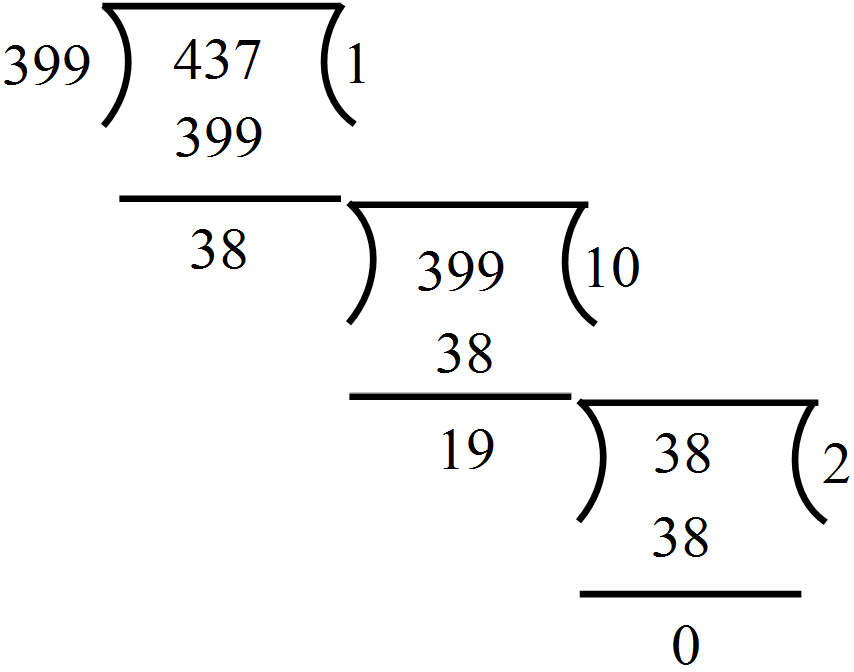
Determine the H.C.F of the following numbers by using Euclid's algorithm (i-x):
399,437
Answer
399 and 437
We have dividend = 399 and divisor= 437

Clearly, the last divisor is 19.
Hence, HCF of the given number is 19
View full question & answer
Question 152 Marks
Determine prime factorization of the following numbers:
240
Answer
420
We have:
2
420
2
210
3
105
5
35
7
7
 
1
Therefore, Prime factorization of 420 = 2 × 2 × 3 × 5 × 7
View full question & answer
Question 162 Marks
Find the common factors of:
15 and 25
Answer
15 and 25
15 = 1 × 15
15 = 3 × 5
i.e., the factors of 15 are 1, 3, 5 and 15.
Again, 25 = 1 × 25
25 = 5 × 5 i.e., the factors of 25 are 1, 5 and 25.
Therefore, the common factors of the two numbers are 1 and 5.
View full question & answer
Question 172 Marks
Test the divisibility of the following numbers by 6:
7020
Answer
Rule: A number is divisible by 6 if it is divisible by 2 as well as 3.
7020
Here, the units digit = 0
Thus, the given number is divisible by 2.
Also, the sum of the digits = 7 + 0 + 2 + 0 = 9 which is divisible by 3. So, the given number is
divisible by 3. Hence, 7,020 is divisible by 6.
View full question & answer
Question 182 Marks
In the following numbers, replace * by the smallest number to make it divisible by 9:
66784 *
Answer
66784 *
Sum of the given digits = 6 + 6 + 7 + 8 + 4 = 31
The multiple of 9 which is greater than 31 is 36.
Therefore, the smallest required number = 36 - 31 = 5
View full question & answer
Question 192 Marks
What is the smallest prime number? Is it an even number?
Answer
The number 2 is the smallest prime number.
It is an even prime number. Except 2, all other even numbers are composite numbers.
View full question & answer
Question 202 Marks
What is the smallest odd prime? Is every odd number a prime number? If not, give an example of an odd number which is not prime.
Answer
The smallest odd prime number is 3.
No, every odd number is not a prime number. For example, 9 is an odd number but it is not a prime number because its three factors are 1, 3 and 9.
View full question & answer
Question 212 Marks
Test the divisibility of the following numbers by 6:
56423
Answer
Rule: A number is divisible by 6 if it is divisible by 2 as well as 3.
56423
Here, the units digit = 3 Thus, the given number is not divisible by 2.
Also, the sum of the digits = 5 + 6 + 4 + 2 + 3 = 20 which is not divisible by 3.
So, the given number is not divisible by 3. Since 3,56,423 is neither divisible by 2 nor by 3, it is
not divisible by 6.
View full question & answer
Question 222 Marks
Find the common factors of:
20 and 28
Answer
20 and 28
20 = 1 × 20
20 = 2 × 10
20 = 4 × 5
i.e., the factors of 20 are 1, 2, 4, 5, 10 and 20.
Again, 28 = 1 × 28
28 = 2 × 14
28 = 7 × 4
i.e., the factors of 28 are 1, 2, 4, 7, 14 and 28.
Therefore, the common factors of the two numbers are 1, 2 and 4.
View full question & answer
Question 232 Marks
Find the H.C.F of the following numbers using prime factorization method:
106, 159, 265
Answer
106, 159 and 265
Prime factorization of 106 = 2 × 53
Prime factorization of 159 = 2 × 53
Prime factorization of 265 = 5 × 53
Therefore, HCF = 53
View full question & answer
Question 242 Marks
What are the twin-primes? Write all pairs of twin-primes between 50 and 100.
Answer
Twin primes: Two prime numbers are said to be twin primes if there is only one composite number between them.
For example, (3, 5) and (5, 7) are twin primes.
Twin primes between 50 and 100 are (59, 61) and (71, 73).
View full question & answer
Question 252 Marks
Find the H.C.F of the following numbers using prime factorization method:
84, 120, 138
Answer
84, 120 and 138
Prime factorization of 84 = 2 × 2 × 3 × 7
Prime factorization of 120 = 2 × 2 × 2 × 3 × 5
Prime factorization of 138 = 2 × 3 × 23
Therefore, HCF = 2 × 3 = 6
View full question & answer
Question 262 Marks
Find the H.C.F of the following numbers using prime factorization method:
144,198
Answer
144 and 198
Prime factorization of 144 = 2 × 2 × 2 × 3 × 3
Prime factorization of 198 = 2 × 3 × 3 ×11
Therefore, HCF = 2 × 2 × 3 = 18
View full question & answer
Question 272 Marks
Determine the L.C.M of the numbers given below:
48, 60
Answer
48, 60
Prime factorization of 48 = 2 × 2 × 2 × 2 × 3
Prime factorization of 60 = 2 × 2 × 3 × 5
Therefore, Required LCM = 2 × 2 × 2 × 2 × 3 × 5 = 240
View full question & answer
Question 282 Marks
A number is divisible by 24. By what other numbers will that number be divisible?
Answer
Since the number is divisible by 24, it will be divisible by all the factors of 24.
The factors of 24 are 1, 2, 3, 4, 6, 8, 12 and 24.
Hence, the number is also divisible by 1, 2, 3, 4, 6, 8 and 12.
View full question & answer
Question 292 Marks
A list consists of the following pairs of numbers:
51, 53; 55, 57; 59, 61; 63, 65; 67, 69; 71, 73
Categorize them as pairs of:
Primes
Answer
Primes: Natural numbers which have exactly two distinct factors, i.e., 1 and the number itself are called prime numbers.
Hence, (59, 61) and (71, 73) are pairs of prime numbers.
View full question & answer
Question 302 Marks
In the following numbers, replace * by the smallest number to make it divisible by 9:
67 * 19
Answer
67 *19
Sum of the given digits = 6 + 7 + 1 + 9 = 23
The multiple of 9 which is greater than 23 is 27.
Therefore, the smallest required number = 27 - 23 = 4
View full question & answer
Question 312 Marks
Test the divisibility of the following numbers by 11:
10000001
Answer
The given number is 1,00,00,001.
The sum of the digit at the odd places = 1 + 0 + 0 + 0 = 1
The sum of the digits at the even places = 0 + 0 + 0 + 1 = 1
Their difference = 1 - 1 = 0
Therefore, 1,00,00,001 is divisible by 11.
View full question & answer
Question 322 Marks
Write first five multiples of the following numbers:
25
Answer
25
The first five multiples of 25 are as follows:
25 × 1 = 25
25 × 2 = 50
25 × 3 = 75
25 × 4 = 100
25 × 5 = 125
View full question & answer
Question 332 Marks
Which factors are not included in the prime factorization of a composite number?
Answer
1 and the number itself are not included in the prime factorization of a composite number.
Example: 4 is a composite number.
Prime factorization of 4 = 2 × 2.
View full question & answer
Question 342 Marks
Find the H.C.F of the following numbers using prime factorization method:
504, 980
Answer
504 and 980
Prime factorization of 504 = 2 × 2 × 2 × 3 × 3 × 7
Prime factorization of 980 = 2 × 2 × 5 × 7 × 7
Therefore, HCF = 2 × 2 × 7 = 28
View full question & answer
Question 352 Marks
Write the smallest 4-digit number and express it as a product of primes.
Answer
The smallest 4-digit number is 1000.
1000 = 2 × 500
=2 × 2 × 250
=2 × 2 × 2 × 125
=2 × 2 × 2 × 5 × 25
=2 × 2 × 2 × 5 × 5 × 5
Therefore, 1000=2 × 2 × 2 × 5 × 5 × 5
View full question & answer
Question 362 Marks
Find the H.C.F and L.C.F of the following pairs of numbers:
145,232
Answer
145 and 232
Prime factorization of 145 = 5 × 29
Prime factorization of 232 = 2 × 2 × 2 × 29
Therefore, Required HCF of 145 and 232 = 289
Therefore, Required LCM of 145 and 232 = 2 × 2 × 2 × 5 × 29 = 1160
View full question & answer
Question 372 Marks
Which of the following pairs are always co-primes?
One prime and one composite number
Answer
One prime and one composite number
One prime and one composite number are not always co-prime
Example: 3 and 21 are not co-primes to each other.
View full question & answer
Question 382 Marks
Test the divisibility of the following numbers by 11:
5335
Answer
The given number is 5,335.
The sum of the digit at the odd places = 5 + 3 = 8
The sum of the digits at the even places = 3 + 5 = 8
Their difference = 8 - 8 = 0
Therefore, 5,335 is divisible by 11.
View full question & answer
Question 392 Marks
Write all factors of the following numbers:
125
Answer
125
125 = 1 × 125
125 = 5 × 25
Therefore, the factors of 125 are 1, 5, 25 and 125.
View full question & answer
Question 402 Marks
H.C.F of co-prime numbers 4 and 15 was found as follow:
4 = 2 × 2 and 15 = 3 × 5
Since there is no common prime factor. So, H.C.F of 4 and 15 is 0. Is the answer correct? If not, what is the correct H.C.F?
Answer
No, it is not correct.
We know that HCF of two co-prime number is 1.
4 and 15 are co-prime numbers because the only factor common to them is 1.
Thus, HCF of 4 and 15 is 1.
View full question & answer
Question 412 Marks
Test the divisibility of the following numbers by 11:
70169803
Answer
The given number is 7,01,69,803.
The sum of the digit at the odd places = 7 + 1 + 9 + 0 = 17
The sum of the digits at the even places = 0 + 6 + 8 + 3 = 17
Their difference = 17 - 17 = 0
Therefore, 7,01,69,803 is divisible by 11.
View full question & answer
Question 422 Marks
Find the H.C.F of the following numbers using prime factorization method:
81,117
Answer
81 and 117
Prime factorization of 81 = 3 × 3 × 3 × 3
Prime factorization of 117 = 3 × 3 × 13
Therefore, HCF = 3 × 3 = 9
View full question & answer
Question 432 Marks
Find the H.C.F and L.C.F of the following pairs of numbers:
234,572
Answer
234 and 572.
Prime factorization of 234 = 2 × 3 × 3 × 13
Prime factorization of 572 = 2 × 2 × 11 × 13
Therefore, Required HCF of 234 and 572 = 226
Therefore, Required LCM of 117 and 221 = 2 × 2 × 3 × 3 × 11 × 13 = 5148
View full question & answer
Question 452 Marks
In the following numbers, replace * by the smallest number to make it divisible by 9:
538 * 8
Answer
538 * 8
Sum of the given digits = 5 + 3 + 8 + 8 = 24
The multiple of 9 which is greater than 24 is 27.
Therefore, the smallest required number = 27 - 24 = 3
View full question & answer
Question 462 Marks
Write all factors of the following numbers:
60
Answer
60
60 = 1 × 60
60 = 2 × 30
60 = 3 × 20
60 = 4 × 15
60 = 5 × 12
60 = 6 × 10
The factors of 60 are 1, 2, 3, 4, 5, 6, 10, 12, 15, 20, 30 and 60.
View full question & answer
Question 472 Marks
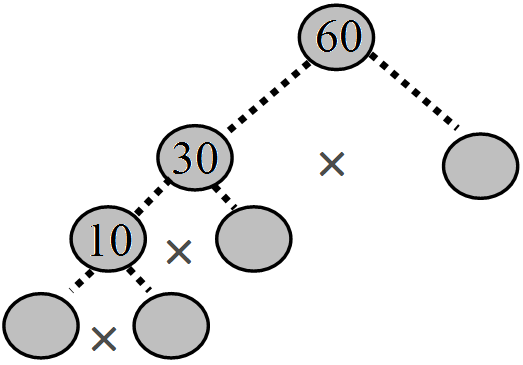
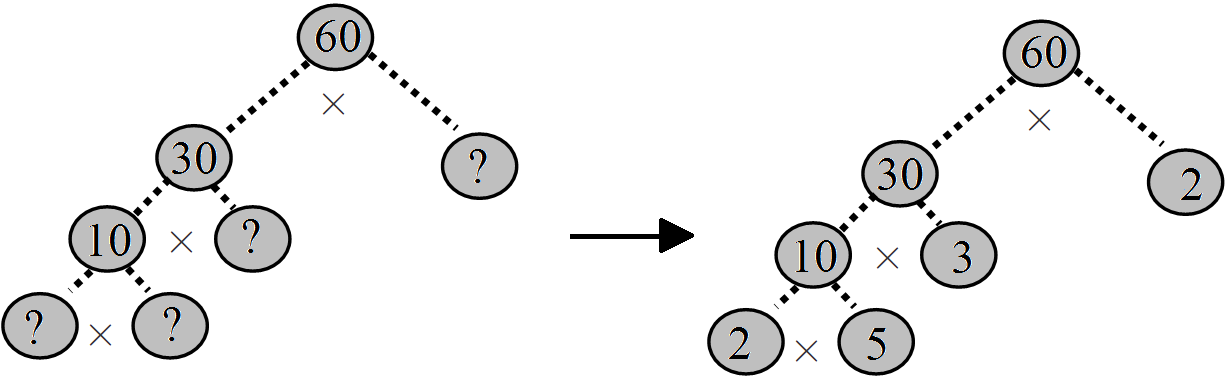
Here are two different factor trees for 60. Write the missing numbers:
Answer
Since 60 = 30 x 2.
30 = 10 × 3 and 10 = 5 × 2 we have:
View full question & answer
Question 482 Marks
Find the H.C.F of the following numbers using prime factorization method:
170, 238
Answer
170 and 238
Prime factorization of 170 = 2 × 5 × 17
Prime factorization of 238 = 2 × 7 × 17
Therefore, HCF = 2 × 17 = 34
View full question & answer
Question 492 Marks
Without actual division show that 11 is a factor of the following numbers:
1100011
Answer
1100011
the sum of the digits at the odd places = 1 + 0 + 0 + 1 = 2
The sum of the digits at the even places = 1 + 0 + 1 = 2
The difference of the two sums = 2 - 2 = 0
Therefore, 11, 00,011 is divisible by 11 because the difference of the sums is zero.
View full question & answer
Question 502 Marks
Determine prime factorization of the following numbers:
216
Answer
216
We have:
2
216
2
108
2
54
3
27
3
9
3
3
 
1
Therefore, Prime factorization of 216 = 2 × 2 × 2 × 3 × 3
View full question & answer
2 Mark Question - Maths STD 6 Questions - Vidyadip