Question types

Quadrilaterals question types

16 questions across 4 question groups — pick any mix to generate a Maths paper with step-by-step answer keys.

16
Questions
4
Question groups
5
Question types
Sample Questions

Quadrilaterals questions

One sample from each question group in this chapter. Select any group above to see the full set with answer keys.

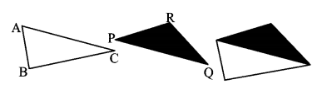
Take two triangular pieces of paper such that . one side of one triangle is equal to one side of the other. Let us suppose that in ∆ABC and ∆PQR, sides AC and PQ are the equal sides. Join the triangles so that their equal sides lie B side by side. What figure do we get?

Image

View full solution
Cut out a paper in the shape of a quadrilateral. Make folds in it that join the vertices of opposite angles. What can these folds be called?

Image

View full solution
Q 84 Mark Question4 Marks
Kaprekar Number.
i. Take any 4-digit number in which all the digits are not the same.
ii. Obtain a new 4-digit number by arranging the digits in descending order.
iii. Obtain another 4-digit number by arranging the digits of the new number in ascending order.
iv. Subtract the smaller of these two new numbers from the bigger number. The difference obtained will be a 4-digit number. If it is a 3-digit number, put a 0 in the thousands place. Repeat the above steps with the difference obtained as a result of the subtraction.
v. After some repetitions, you will get the number 6174. If you continue to repeat the same steps you will get the number 6174 every time. Let us begin with the number 8531.
8531 → 7173 → 6354 → 3087 → 8352 → 6174 → 6174
This discovery was made by the mathematician, Dattatreya Ramchandra Kaprekar. That is why the number 6174 was named the Kaprekar number.
View full solution
Q 94 Mark Question4 Marks
From your compass boxes, collect set squares of the same shapes and place them side by side in all possible different ways. What figures do you get? Write their names.
a. Two set squares
b. Three set squares
c. four set squares
View full solution
Q 104 Mark Question4 Marks
Kaprekar Number.
i. Take any 4-digit number in which all the digits are not the same.
ii. Obtain a new 4-digit number by arranging the digits in descending order.
iii. Obtain another 4-digit number by arranging the digits of the new number in ascending order.
iv. Subtract the smaller of these two new numbers from the bigger number. The difference obtained will be a 4-digit number. If it is a 3-digit number, put a 0 in the thousands place. Repeat the above steps with the difference obtained as a result of the subtraction.
v. After some repetitions, you will get the number 6174. If you continue to repeat the same steps you will get the number 6174 every time. Let us begin with the number 8531.
8531 → 7173 → 6354 → 3087 → 8352 → 6174 → 6174
This discovery was made by the mathematician, Dattatreya Ramchandra Kaprekar. That is why the number 6174 was named the Kaprekar number.

View full solution
Q 114 Mark Question4 Marks
From your compass boxes, collect set squares of the same shapes and place them side by side in all possible different ways. What figures do you get? Write their names.
a. Two set squares
b. Three set squares
c. four set squares
View full solution
Q 124 Mark Question4 Marks
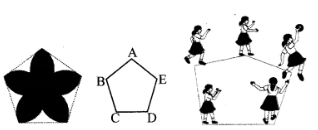
For the pentagon shown in the figure below, answer the following: (Textbook pg. no. 84)

  1. Write the names of the five vertices of the pentagon.
  2. Name the sides of the pentagon.
  3. Name the angles of the pentagon.
  4. See if you can sometimes find players on a field forming a pentagon.

Image

View full solution
Q 135 Mark Question5 Marks
Draw a quadrilateral. Draw one diagonal of this quadrilateral and divided it into two triangles. Measures all the angles in the figure. Is the sum of the measures of the four angles of the quadrilateral equal to the sum of the measures of the six angles of the two triangles? Verity that this is so with other quadrilaterals.
View full solution

Generate a Quadrilaterals paper free

Pick question groups from the list above, set marks and difficulty, and export a branded PDF with step-by-step answer keys. First 3 chapters free — no signup.

Download App