In Monsoon region, ______ is the main occupation of the people. (agriculture, animal husbandary, secondary)
Question types
Natural Regions question types
62 questions across 10 question groups — pick any mix to generate a Geography paper with step-by-step answer keys.
62
Questions
10
Question groups
5
Question types
01
Complete the sentences by choosing the correct option
8 Q→02Answer the question
6 Q→03Read the following extract and answer the questions below.
4 Q→04Answer in brief
13 Q→05Give geographical resons.
9 Q→06Answer the following questions in details.
3 Q→07Name the following
12 Q→08State whether the following statements are True or False, with reasons
5 Q→09Match the column.
1 Q→10Read the map given below and answer the Questions
1 Q→Sample Questions
Natural Regions questions
One sample from each question group in this chapter. Select any group above to see the full set with answer keys.
View full solution →
Seat of Greek and Roman civilization is found in the ______ region. (Taiga, Hot desert, Mediterranean)
The ________ region receives rainfall in winter. (Mediterranean, Equatorial, Taiga)
The _______ type of forest is found in the Equatorial region.(Coniferous, Evergreen, Deciduous)
Sailors and explorers are mainly found in the ______ region. (Mediterranean, Monsoon, West European)
What type of forest are found in the Taiga region?
What are the characteristics of plants in the hot desert region?
Which animal is commonly found in the hot deserts? Why?
What are the annual rainfall in the Equatorial region?
How are the summers and winters in Sudan region?
Observe the table then answer the following questions
| Natural vegetation | Animal life | Human life |
| Short lived vegetal life. Short grass, small shrubs, . flowers, lichens, moss | Caribou, Reindeer, etc. Polar bears, foxes, walrus and seal. Animals with soft, thick fur. | Hunting and fisheries. Hide tents, igloo (tupik) houses. Use of sledges. Eskimo people. Tough life. Population distribution highly sparse. |
| Coniferous forests. Leaves are narrow, pointed; branches leaning towards the ground. Wood is light and soft. Spruce," fir, pine, redwood, etc. | Have soft and thick fur. Caribous, elks, ermine, beavers, silver fox, minks, bears etc. | Population is less. Lumbering and hunting are major occupations. Few agrarian activities. |
| Extensive grass ranches are seen. Short grasses growing in lumps. Grass gets dried up in winter. Elder, poplar trees are found | Wild life includes deer, horses, dogs, wolves, bisons, rabbits, hares kangaroos, dingos etc. Domesticated animals like sheep, goat, cattle, horse, donkeys are also found. | Rearing animals is the main occupation. Earlier people had a nomadic life. Lived in hide tents (Yurts). Kirgiz people are no more nomadic, now stay in well built houses. Grow wheat |
| Thorny bushes with hardly any leaves. Leaves are narrow, oily, have thick bark. Once moisture in soil is consumed, plants die. Examples: cactus, sisal, palm, date palm etc. | Camels survive for days without water. Number of animals living on the ground is less. Daytime live inside the ground E.g. snakes, rats, lizards, scorpions, etc. Domesticated animals like horse, donkeys, sheep, oxen etc. | Bedouins (Sahara), Bushmen (Kalahari) Aborigines (Australia) Most of the needs get fulfilled through animals. Agriculture is confined to river valleys and oases. |
| Tall and thick grass. Height of grass around 6 m. (Elephant grass) Trees are rare and have umbrella like canopy Examples: acacia, agave, sisal, pineapple, cactus etc. | Large number of herbivorous and carnivorous animals. Nature has gifted them with speedy legs. Skin of the animals has colorful spots or stripes/bands. Examples: lion, cheetoh hyenas, wolf, zebra, giraffe, elephant, rhino, wild ox, buffalo, kangaroo, emu, etc. | Houses are simple, with mud walls and thatched roof, Without windows. Short in height and dome shaped huts called kraals. Hunting and rearing are main occupations. Examples: main tribes include Zulu, Hausa, Masai, etc. |
| Dense evergreen forests Variety of trees and bushes. Swampy land. Tall hard-wooded trees . Examples: mahogany, greenheart, rosewood, ebony, etc. | A great variety in animals. In marshy lands, crocodiles, anaconda and hippopotamus, etc. Animals/Birds living on trees Examples: chimpanzee, gorilla, hombills, etc. Poisonous insects such as the tse-tse fly | Human settlements are few. Human life is dependent on nature. Population is mostly tribal. Houses are built on the trees. Tribes like Pygmies (Africa), Boro Indians, Semang. etc. |
(1) In which natural region is the land surface in the forests devoid of vegetation?
(2) Which regions favour dairy farming?
(3) Which region is favourable for fruit production?
Observe the table then answer the following questions
| Natural vegetation | Animal life | Human life |
| Short lived vegetal life. Short grass, small shrubs, . flowers, lichens, moss | Caribou, Reindeer, etc. Polar bears, foxes, walrus and seal. Animals with soft, thick fur. | Hunting and fisheries. Hide tents, igloo (tupik) houses. Use of sledges. Eskimo people. Tough life. Population distribution highly sparse. |
| Coniferous forests. Leaves are narrow, pointed; branches leaning towards the ground. Wood is light and soft. Spruce," fir, pine, redwood, etc. | Have soft and thick fur. Caribous, elks, ermine, beavers, silver fox, minks, bears etc. | Population is less. Lumbering and hunting are major occupations. Few agrarian activities. |
| Extensive grass ranches are seen. Short grasses growing in lumps. Grass gets dried up in winter. Elder, poplar trees are found | Wild life includes deer, horses, dogs, wolves, bisons, rabbits, hares kangaroos, dingos etc. Domesticated animals like sheep, goat, cattle, horse, donkeys are also found. | Rearing animals is the main occupation. Earlier people had a nomadic life. Lived in hide tents (Yurts). Kirgiz people are no more nomadic, now stay in well built houses. Grow wheat |
| Thorny bushes with hardly any leaves. Leaves are narrow, oily, have thick bark. Once moisture in soil is consumed, plants die. Examples: cactus, sisal, palm, date palm etc. | Camels survive for days without water. Number of animals living on the ground is less. Daytime live inside the ground E.g. snakes, rats, lizards, scorpions, etc. Domesticated animals like horse, donkeys, sheep, oxen etc. | Bedouins (Sahara), Bushmen (Kalahari) Aborigines (Australia) Most of the needs get fulfilled through animals. Agriculture is confined to river valleys and oases. |
| Tall and thick grass. Height of grass around 6 m. (Elephant grass) Trees are rare and have umbrella like canopy Examples: acacia, agave, sisal, pineapple, cactus etc. | Large number of herbivorous and carnivorous animals. Nature has gifted them with speedy legs. Skin of the animals has colorful spots or stripes/bands. Examples: lion, cheetoh hyenas, wolf, zebra, giraffe, elephant, rhino, wild ox, buffalo, kangaroo, emu, etc. | Houses are simple, with mud walls and thatched roof, Without windows. Short in height and dome shaped huts called kraals. Hunting and rearing are main occupations. Examples: main tribes include Zulu, Hausa, Masai, etc. |
| Dense evergreen forests Variety of trees and bushes. Swampy land. Tall hard-wooded trees . Examples: mahogany, greenheart, rosewood, ebony, etc. | A great variety in animals. In marshy lands, crocodiles, anaconda and hippopotamus, etc. Animals/Birds living on trees Examples: chimpanzee, gorilla, hombills, etc. Poisonous insects such as the tse-tse fly | Human settlements are few. Human life is dependent on nature. Population is mostly tribal. Houses are built on the trees. Tribes like Pygmies (Africa), Boro Indians, Semang. etc. |
(1) Which natural region consists of short-lived vegetation?
(2) In which natural region will you find the kraals?
(3) Which region has winter rains?
(4) In which natural regions are gorillas and chimpanzees found?
Observe the map and answer the following questions
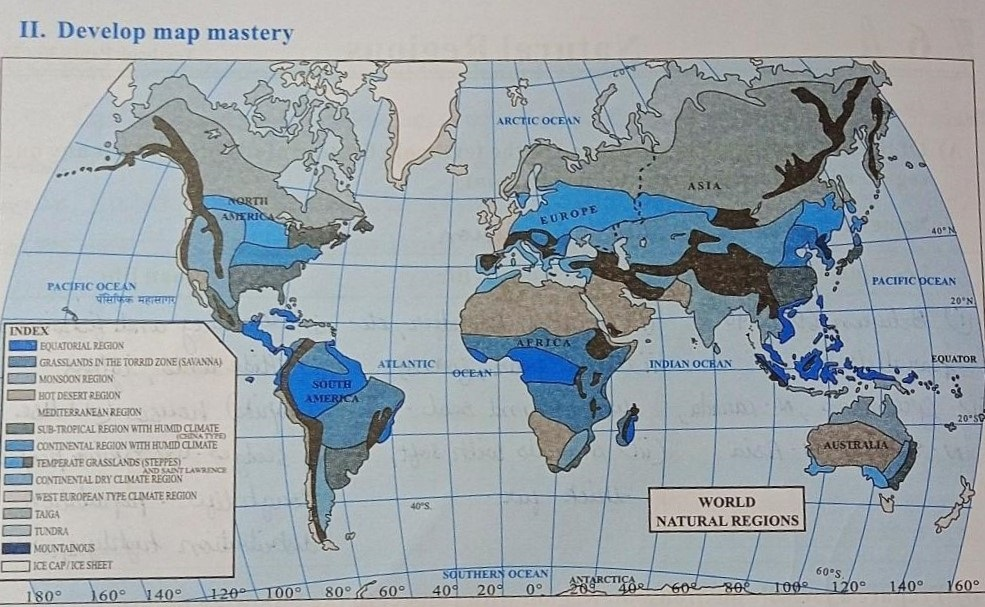
(1) Why are there fewer natural regions in the southern hemisphere than those in the northern hemisphere?
(2) Which natural region occupies the largest area in the world.
(3) Where else do we find conditions similar to the continent of Antarctica?
(4) Throughout which natural regions does the Prime Meridian pass?
(1) Why are there fewer natural regions in the southern hemisphere than those in the northern hemisphere?
(2) Which natural region occupies the largest area in the world.
(3) Where else do we find conditions similar to the continent of Antarctica?
(4) Throughout which natural regions does the Prime Meridian pass?
Observe the map and answer the following questions
(1) Which natural regions are found in India?
(2) Which continent comprises a major portion of the hot desert type of region?
(3) Which continent has the highest diversity in terms of natural regions?
(1) Which natural regions are found in India?
(2) Which continent comprises a major portion of the hot desert type of region?
(3) Which continent has the highest diversity in terms of natural regions?
Why are carnivorous animals found in the grasslands?
Why do people in hot deserts live a nomadic life?
Why are people in the hot deserts engaged mostly in animal rearing?
Why are the hot deserts mainly located along the western side of the continents?
Why are animals like lions not found in Equatorial forests?
Vegetation is short-lived in the Tundra region.
Trees in equatorial forests grow tall.
People in monsoon region are mainly engaged in agriculture.
Equatorial region has a number of diseases.
There are variations in the biodiversity in different parts of the world.
What are the characteristics of the Monsoon region?
What are the characteristics of the Mediterranean region?
What are the characteristics of the West European Region?
I am found in California.
I am found in Greenland and North Canada
I am found from the Alaska to the Atlantic coast
I am found in South America and North America
I am found in the Colorado and the Atacama
Carnivorous animals like tigers and lions are found in large numbers in the equatorial regions.
The camel is an important animal of the hot desert region as it can survive without water and is useful for transport.
The trees in the Mediterranean region have oily leaves and the bark is quite thick. There is a high rate of transpiration.
The prairie region is called the wheat basket of the world.
Due to its mild and warm climate, people from the West European region are not energetic.
| Region | Latitudinal extent |
| (1) Tundra region | (a) 5° to 20° N and S |
| (2) Taiga region | (b) 20° to 30° N and S |
| (3) Grassland (Steppes and Prairies | (c) 30° to 55° N and S |
| (4) Hot Desert | (d) 55° to 65° N and S |
| (5) Grassland (Sudan type) | (e) 65° to 90° N and S |
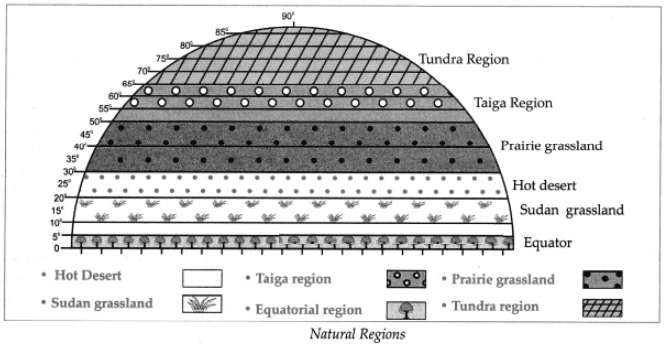
Arrange the name of the region given in the semicircular globe depending on the parallels they lie
Generate a Natural Regions paper free
Pick question groups from the list above, set marks and difficulty, and export a branded PDF with step-by-step answer keys. First 3 chapters free — no signup.