Hot winds blowing in the Thar Desert are called the _______ (simoons, loo, chinook)
Question types
Winds question types
81 questions across 13 question groups — pick any mix to generate a Geography paper with step-by-step answer keys.
81
Questions
13
Question groups
5
Question types
01
Complete the sentences by choosing the correct option
10 Q→02Answer the question
25 Q→03Read the following extract and answer the questions below.
4 Q→04MCQ
14 Q→05Give reasons why the following sentences are right or wrong
6 Q→06Answer in brief
2 Q→07Distinguish between
3 Q→08Answer the following questions in details.
4 Q→09Draw the diagram as following infortmation.
3 Q→10Name the following
7 Q→11Match the column.
1 Q→12Fill the map with the given information and make a legend.
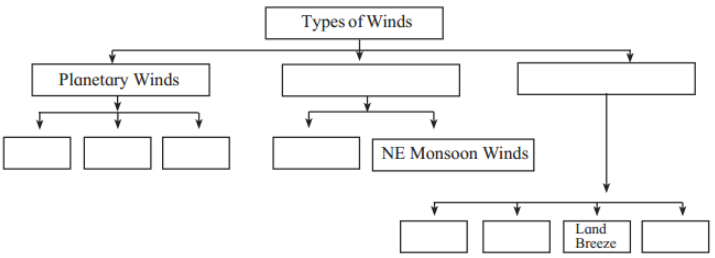
1 Q→13Complete the concpt charts.
1 Q→Sample Questions
Winds questions
One sample from each question group in this chapter. Select any group above to see the full set with answer keys.
View full solution →
Cyclones occurring in the western part of the Pacific ocean are called ______.(hurricane, typhoons)
Winds that blow at night in coastal areas are called ________ breeze, (sea, land, valley)
Mountain winds blow during ______ .(morning, night, midday)
Winds that blow for a short duration of time, over a limited area are called ______. wind. (polar, local, easterlies)
Try this:
Can a bottle filled with water be moved to the other end of the table in this manner? Can we use the same method that you tried for moving paper rolls?
Try this: What can we do to move the rolls to the other end of the table with a greater speed?
Try this:
What could be the reason of the delay in making the rolls reach to the other end of the table?
Try this: See who moves the paper roll first to the other end of the table:
Try this: Without touching the roll of the paper on the table, what can be done to move the paper rolls to the other end of the table?
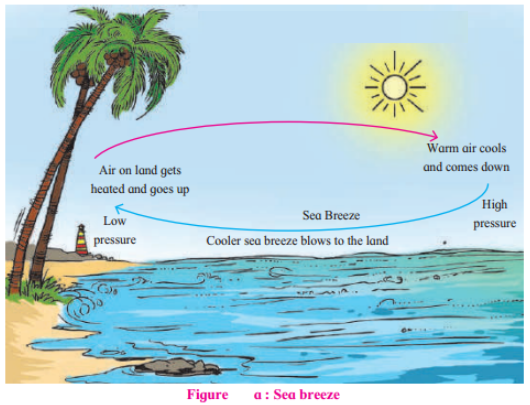
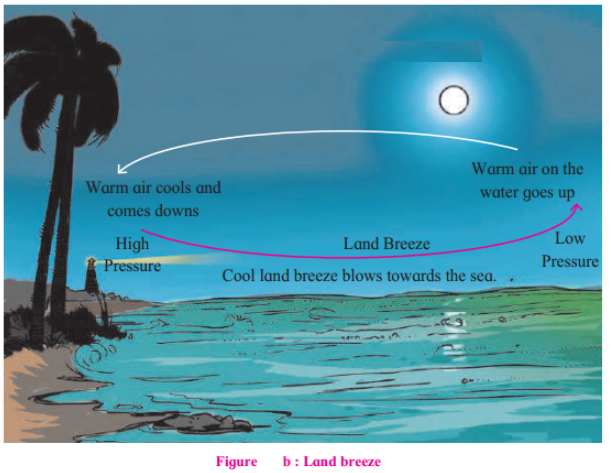
(1) Compare fig.(a) and (b) with reference fo temperature conditions, air pressure and winds.
(2) Which winds are called sea breezes and which are called land breezes? Why?
(3) In which part of India are land and sea breezes experienced?
(4) Do you experience sea and land breezes in your area?
(1) Why do the breezes blow from the sea to the land during the day?
(2) When do the winds blow from the d to the sea?
(3) Describe the winds shown in fig. (a).
Observe the picture given below and answer the following questions.:
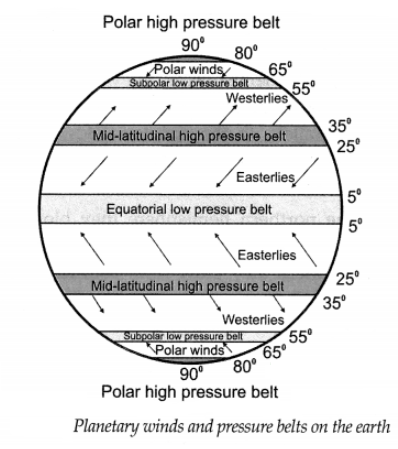
(1) Name the winds that blow in the southern hemisphere.
(2) In which direction do the Easterlies blow in the Northern and Southern hemisphere?
Observe the picture given below and answer the following questions.:
(1) Which are the winds in the northern hemisphere that blow from the mid latitudinal high pressure belt to the equatorial low pressure belt?
(2) What is the direction of the Westerlies in the southern hemisphere?
(3) Which planetary winds blow from the mid-latitudinal high pressure belts to the subpolar low pressure belts in the northern hemisphere?
(4) Why is the direction of polar winds not the same in both the hemispheres?
The Roaring Forties in the southern hemisphere ______.
- Ablow towards the equator.
- ✓blow in the areas around 40°S parallel.
- Cblow from the subpolar region of low pressure.
Answer: B.
View full solution →The direction of seasonal winds blowing over the Indian subcontinent during winter is from the _____.
- Asouth-east to north-west.
- Bsouth-west towards north-east.
- ✓north-east to south-west.
- Dnorth-west to south-east.
Answer: C.
View full solution →In the northern hemisphere, winds blowing towards the equator due to the ________________
rotation of the earth.
- Aturn to the south
- Bturn to the east,
- ✓turn to the west
- Dturn to the north.
Answer: C.
View full solution →From high air pressure regions, winds ______.
- Ablow to regions of still higher pressure.
- Bblow towards regions of cooler air.
- ✓blow towards regions of low air pressure.
- Dremains still.
Answer: C.
View full solution →When the air expands, it ______.
- Abecomes solid
- ✓becomes thinner
- Cgets lost.
- Dbecomes humid.
Answer: B.
View full solution →The monsoon winds in the summer come from the sea but the retreating monsoon winds come from land.
The winds coming from the north-west in the southern hemisphere have greater velocities than the winds coming from the south-west in the northern hemisphere.
A belt of calm exists near the equator.
The Indian subcontinent experiences monsoon and retreating monsoon seasons.
The air pressure in land and water is different
Read the following information carefully and draw a diagram for the mountain breeze accordingly.
Characteristics of the Mountain breeze:
Characteristics of the Mountain breeze:
- Mountains cool down quickly at night.
- The valley zone is comparatively warmer.
- Air pressure is greater on the mountains.
- Winds blow from the mountain towards the valley.
- The hot and light air from the valley is pushed upwards and the cool air rushes down into the valley.
- Mountain winds set in after sunset.
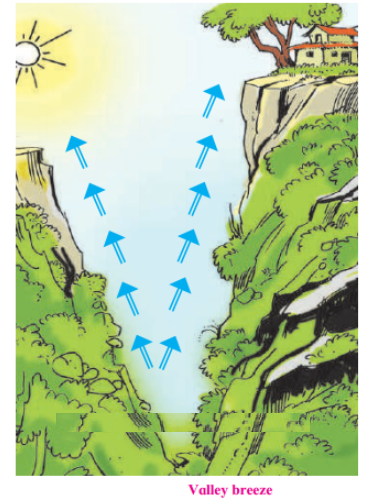
Observe the pictures given below and describe the valley breeze considering the elevation of land, the heating and cooling properties of land and water, the air pressure, etc.
Cyclones and Anticyclones:
Valley breeze and Mountain breeze:
Easterlies and Westerlies:
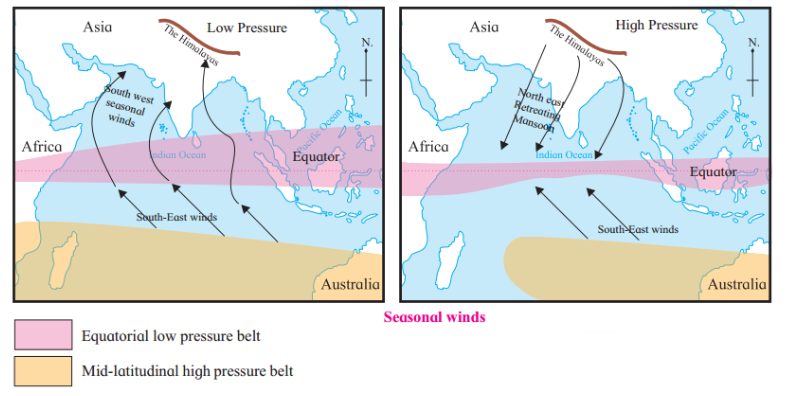
Observe the pictures given below of Seasonal winds and write its characteristics:
What are anticyclones?
Write in detail about cyclonic storms.
Give detailed information about the types of planetary winds.
Given below are the values of air pressure in millibars. Using the same, draw diagrams to show a cyclone and an anticyclone:
1030,1020,1010,1000
Given below are the values of air pressure in millibars. Using the same, draw diagrams to show a cyclone and an anticyclone: 990, 994, 996,1000
Planetary winds and pressure belts on the earth
Identify the type of winds from the description:
Hilltops get heated quickly during the day. The air in this part becomes hot, light and starts ascending. Hence, a low pressure area forms in this region. At the same time the air at the foothills become cooler and also experiences high pressure. Air in that area blows towards low pressure.
Identify the type of winds from the description:
These winds blowing from the north pole region towards 60°N parallel cause cold wave conditions in extensive areas covering North America, Europe and Russia
Identify the type of winds from the description:
These winds from the south-west bring rains to Indian subcontinent. During June to September, India gets rains. After this period these winds retreat.
Identify the type of winds from the description:
The winds that blow for a short duration of time, originate in specific regions & blow over a limited area.
Identify the type of winds from the description:
The winds blowing over the earth’s surface throughout the year and covering a large portion of the earth.
| Name of the Wind | Nature of the Wind |
| (1) Loo | (a) Hot and dry |
| (2) Simoom | (b) Cold and dry |
| (3) Chinook | (c) Hot, dry and destructive |
| (4) Mistral | (d) Warm and dry |
| Pressure Belts | Northern Hemisphere | Southern Hemisphere |
| Mid Latitudes | ……….. | ………….. |
| ………… | ………….. | |
| Poles | ……………….. | ……………. |
Generate a Winds paper free
Pick question groups from the list above, set marks and difficulty, and export a branded PDF with step-by-step answer keys. First 3 chapters free — no signup.