Questions

5 Mark Question

🎯

Test yourself on this topic

5 questions · timed · auto-graded

Question 15 Marks
Observe the table given below and draw your conclusion
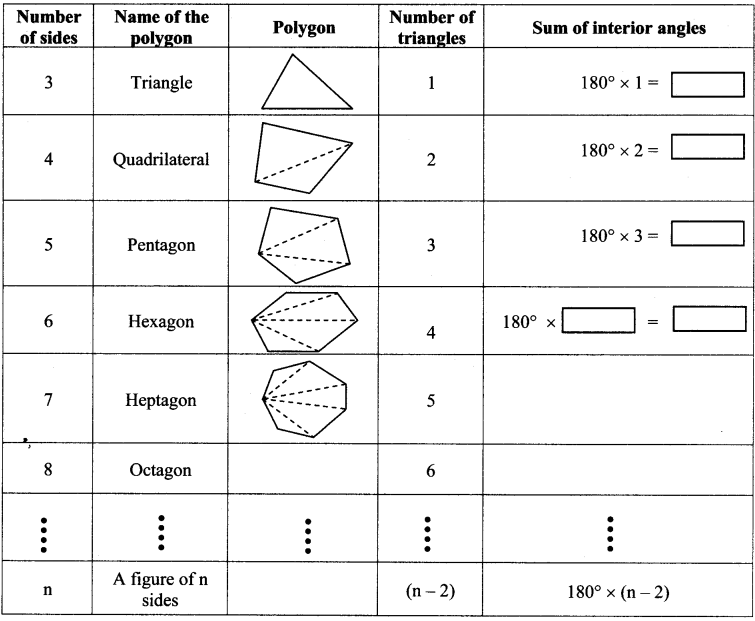
Image
Answer
i. 180°
ii. 360°
iii. 540°
iv. 720°
v. 180° x 5 = 900°
vi.Image, 180° x 6 = 1080°
View full question & answer
Question 25 Marks
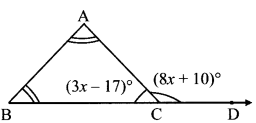
In the isosceles triangle ABC, ∠A and ∠B are equal. ∠ACD is an exterior angle of ∆ABC. The measures of ∠ACB and ∠ACD are (3x – 17)° and (8x + 10)° respectively. Find the measures of ∠ACB and ∠ACD. Also find the measures of ∠A and ∠B.
Image
Answer
Let the measure of ∠A be y°. A
∴ m∠A = m∠B = y°
∠ACB and ∠ACD form a pair of linear angles.
∴ m∠ACB + m∠ACD = 180°
∴ (3x – 17) + (8x + 10) = 180
∴ 3x + 8x – 17 + 10 = 180
∴ 11x – 7 = 180
∴ 11x – 7 + 7 = 180 + 7 …(Adding 7 on both sides.)
∴ 11x = 187
\therefore x=\frac{187}{11}=17
m∠ACB = 3x – 17 = (3 x 17) – 17 = 51 – 17 = 34°
m∠ACD = 8x + 10 = 8 x 17 + 10 = 136 + 10 = 146°
Here ∠ACD is the exterior angle of ∆ABC and ∠A and ∠B are its remote interior angles.
∴ m∠ACD = m∠A + m∠B
∴ 146 = y + y
∴ 146 = 2y
∴ 2y = 146
\therefore y=\frac{146}{2}=73
∴ The measures of ∠ACB, ∠ACD, ∠A and ∠B are 34°, 146°, 73° and 73° respectively.
View full question & answer
Question 35 Marks
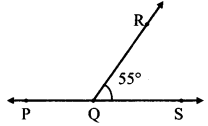
Observe the adjacent figure and answer the following questions :
Image


  1. Write the names of the angles in the figure alongside.
  2. What type of a pair of angles is it?
  3. Which arms of the angles are not the common arms?
  4. m∠PQR = __.
  5. m∠RQS = __.
Answer
  1. ∠PQR and ∠RQS
  2. Angles in a linear pair
  3. Ray QP and ray QS
  4. 125
  5. 55
    Here, m∠PQR + m∠RQS = 125° + 55°
    = 180°
    ∴The adjacent angles ∠PQR and ∠RQS are supplementary.
View full question & answer
Question 45 Marks
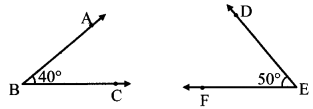
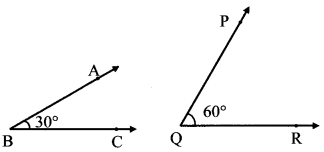
Draw the pairs of angles as described below. If that is not possible, say why.
i. Complementary angles that are not adjacent.
ii. Angles in a linear pair which are not supplementary.
iii. Complementary angles that do not form a linear pair.
iv. Adjacent angles which are not in linear pair.
v. Angles which are neither complementary nor adjacent.
vi. Angles in a linear pair which are complementary.
Answer
i.
Image

ii. Sum of angles in a linear pair is 180°.
i.e. they are supplementary .
∴ Angles in a linear pair which are not supplementary cannot be drawn.

iii.
Image

iv.
Image

v.
Image

vi. Angles in linear pair have their sum as 180° But, complementary angles have their sum as 90°.
∴ Angles in a linear pair which are complementary cannot be drawn.

Note : Problem No. i, iii, iv, and v have more than one answers students may draw angles other than the once given.

View full question & answer
Question 55 Marks
The measures of some angles are given below. Use them to make pairs of complementary and supplementary angles.
m∠B = 60°
m∠N = 30°
m∠Y = 90°
m∠J = 150°
m∠D = 75°
m∠E = 0°
m∠F = 15°
m∠G = 120°
Answer
i. m∠B + m∠N = 60° + 30°
= 90°
∴∠B and ∠N are a pair of complementary angles.

ii. m∠Y + m∠E = 90° + 0°
= 90°
∴∠Y and ∠E are a pair of complementary angles.

iii. m∠D + m∠F = 75° + 15°
= 90°
∴∠D and ∠F are a pair of complementary angles.

iv. m∠B + m∠G = 60° + 120°
= 180°
∴∠B and ∠G are a pair of supplementary angles.

v. m∠N + m∠J = 30° + 150°
= 180°
∴∠N and ∠J are a pair of supplementary angles.

View full question & answer
5 Mark Question - Maths STD 7 Questions - Vidyadip