Questions

[5 marks Questions]

🎯

Test yourself on this topic

18 questions · timed · auto-graded

Question 15 Marks
How is Gram Sabha a key factor in making the Gram Panchayat play its role and be responsible.
Answer
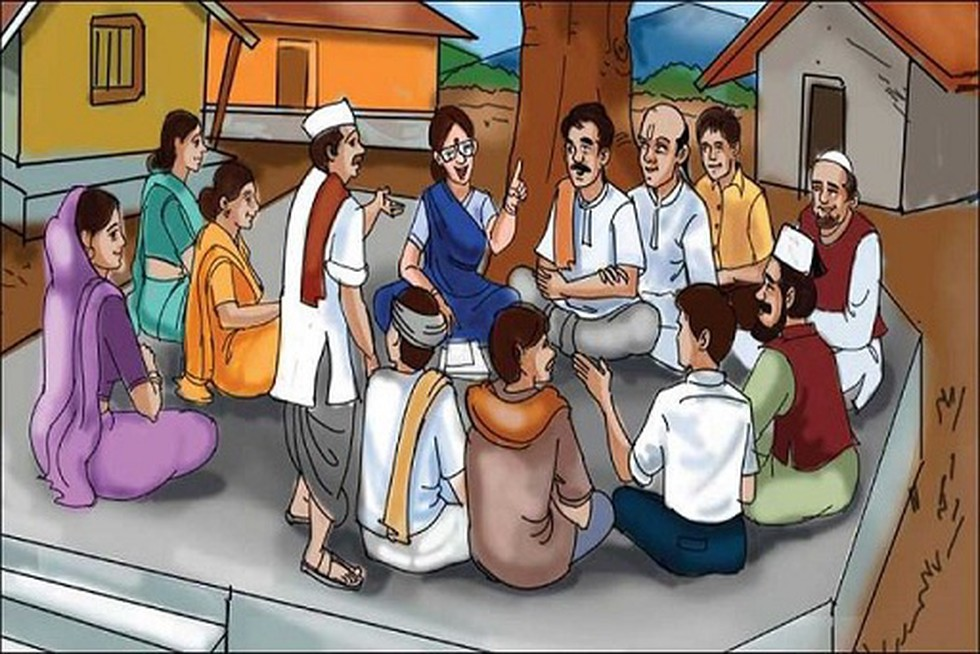
  1. The Gram Sabha is a key factor in making the Gram Panchayat play its role and be responsible.
  2. It is the place where all plans for the work of the Gram Panchayat are placed: before the people.
  3. The Gram Sabha prevents the Panchayat from doing wrong things like misusing money or favouring certain people.
  4. It plays an important role in keeping an eye on the elected representatives and in making them responsible to the persons who elected them.
View full question & answer
Question 25 Marks
Explain the role of the Chairman and Vice- Chairman of the Panchayat Samiti.
Answer
Every Panchayat Samiti elects two of its members as Chairman and Vice- Chairman. Their tenure of office is for five years. They can be removed by the Panchayat Samiti members by passing a resolution supported by 2/3rd majority. Seats for the post of Chairman are reserved for the scheduled castes and scheduled tribes.
View full question & answer
Question 35 Marks
Examine the functions of Panchayat Samiti.
Answer
The functions of Panchayat Samiti are as follows:
  1. To supervise developmental projects of the block including provision for water, goods, seeds and manure, arrangement of farm loans and metalling of roads.
  2. To take care of all health matters like checking diseases and managing health infrastructure.
  3. To look after literacy and adult education.
  4. To make provision for animal husbandry, job opportunities and small scale industries.
View full question & answer
Question 45 Marks
The Gram Sabha meeting begins with the Panchayat President (who is also called the Sarpanch) and the members of the Panchayat (the Panchs) presenting a plan on repairing the road that connects the village to the main highway. After this, the discussion moves to the subject of water and water shortages.
A villager called Tijia begins the meeting by saying, “The water problem in Hardas has become very acute. The handpump water has gone well below the point up to which the ground has been drilled. We hardly get any water in the taps. Women have to go to the Suru river which is 3 k.m. away to get water.” One of the members suggests piping water from the Suru and making an overhead tank in the village to increase the supply. But the others think that this will be expensive. It’s better, they feel, to deepen the handpumps and clean the wells for this season. Tijia says, “This is not enough. We need to do something more permanent as groundwater levels seem to be going down every year. We’re using more water than is seeping into the ground.”
Another member, Anwar then tells everyone that he has seen ways of conserving water and recharging (refilling) it in a village in Maharashtra where he’d once gone to visit his brother. It was called watershed development and he had heard that the government gave money for this work.
In his brother’s village people had planted trees, constructed check-dams and tanks. Everyone thought this was an interesting idea and the Gram Panchayat was asked to find out about it in detail.
  1. What is a Gram Sabha?
  2. In the meeting of the Gram Sabha so far what are the problems that are being discussed? What sort of solutions are being suggested?
Answer
  1. A Gram Sabha is an institution of the adult village people:
  1. The people ask the questions.
  2. The elected representatives answer to these questions.
  1. Problems being discussed in the Gram Sabha are:
  1. Water and water shortage.
  2. Watershed development – conserving water and recharging the underground water.
View full question & answer
Question 55 Marks
Examine the functions of Gram Sabha.
Answer
The functions of Gram Sabha are:
  1. It looks after the needs of people and overall development of the village.
  2. It holds its meetings twice a year. In one meeting it makes the budget while in the other it reviews the progress of development.
  3. It also elects its President and Vice-President who are called Pradhan or Sarpanch and Up-Pradhanrespectively.
  4. They even elect the other members of the village panchayat.
View full question & answer
Question 65 Marks
What in your opinion is the importance of the Gram Sabha? Do you think all members should attend Gram Sabha meetings and why?
Answer
The Gram Sabha is of great importance to all of us who are living in villages. In the Gram Sabha, all important issues regarding the development of a village are discussed and Gram Panchayat works according to the agenda laid down in and passed by the Gram Sabha. Yes, all the members should attend Gram Sabha meetings because this practice will automatically educate the participants and they would learn the procedure for calling the meeting.
View full question & answer
Question 75 Marks
Examine the functions of Zila Parishad at the district level.
Answer
The functions of Zila Parishad are as follows:
  1. To coordinate the functioning of Block Samities.
  2. To pass their annual budget.
  3. To coordinate functions of Panchayat committees.
  4. It also coordinates implementation of plans ordered by the state government.
View full question & answer
Question 85 Marks
In some states Gram Sabhas form committees. Why?
Answer
In some states Gram Sabhas form committees to carry out specific works.
  1. Construction committee is formed to carry out the construction work.
  2. Development committee is engaged in development work.
  3. These committees are composed of some members of Gram Sabha and some members of the Gram Panchayats.
  4. They work together to carry out specific tasks.
View full question & answer
Question 95 Marks
State five rules that became effective from April 1993 regarding Panchayati Raj.
Answer
In 1992, the Parliament amended the constitution and formulated rules for the Panchayati Raj system. The state and the centre had to follow these rules from April 1993 onwards.
The rules are listed below: It should be a three- tier system– the village level, the intermediate or block level and the district level. Direct elections should be conducted for all the seats in the panchayats. The state should ensure representation of the Scheduled Caste and Scheduled Tribes in proportion to their population in the area. Minimum of one third of the total number of seats is to be reserved for women. A member of panchayat should not be less than 21 years of age. The State Election Commission should hold regular panchayat elections.
View full question & answer
Question 105 Marks
Why do we need a local government?
Answer
A local government is very important. The aim of the local bodies is to solve the local problems by cooperation and without depending upon others. The local people only know their problems and for meeting their needs, it is the local people who take interest. They also finish the work with speed and with least expenditure. The local government also lightens the work of the Central and State government. They also provide training of administration to the people at lower levels.
View full question & answer
Question 115 Marks
Explain Mahatma Gandhi’s belief related to Panchayati Raj.
Answer
Gandhi’s idea of village Swaraj is that of a complete republic. The working of the day to day activities of the village will be conducted by the Panchayat of five persons, annually elected by elderly men villagers, male and female, possessing minimum prescribed qualifications. Panchayats will have all the power and authority required. He believed that strengthening of village Panchayats would help the process of effective de-centralisation.
View full question & answer
Question 125 Marks
Describe the composition of the Gram Panchayat.
Answer
Composition of the Gram Panchayat:
  1. Every village Panchayat is divided into wards, i.e., smaller areas.
  2. Each ward elects a representative who is known as the Ward Member (Panch).
  3. All the members of the Gram Sabha also elect a Sarpanch who is the Panchayat President. ,
  4. The Ward Panchs and the Sarpanch form the Gram Panchayat.
The Gram Panchayat has a Secretary who is also the Secretary of the Gram Sabha.
  1. This person is not an elected person but is appointed by the government.
  2. He is responsible for calling the meeting of the Gram Sabha and Gram Panchayat.
  3. He also keeps record of the proceedings.
View full question & answer
Question 135 Marks
Describe the three levels of Panchayats.
Answer
Panchayati Raj System is a process through which people participate in their own government.
There are three levels of Panchayats:
  1. Gram Panchayat.
  2. Block level Panchayat (Janpad Panchayat or Panchayat Samiti)
District Panchayat or Zila Parishad:
  1. Gram Panchayat: at village level, Panchayat President and ward members.
  2. Block Level Panchayat (Panchayat Samiti): Numerous village Panchayats as its members.
  3. Zila Parishad:
  4. Prepares the developmental plans for the whole district.
  5. Controls the money distributed to Block and Village Panchayats.
View full question & answer
Question 145 Marks
Examine the functions of Gram/ Village Panchayat.
Answer
Functions of Villages/ Gram Panchayat are as follows:
  1. To undertake public welfare activities like lighting streets, planting trees, building roads and bridges, cleaning ponds, tanks and lakes.
  2. To open health centres and provide vaccination programmes.
  3. To keep a record of birth and death in the state.
  4. To promote primary and adult education.
  5. To promote cottage industries.
  6. To impose and collect taxes.
View full question & answer
Question 155 Marks
The next item on the agenda for the Gram Sabha is the finalisation of list of people below the poverty line (BPL) which had to be approved by the Gram Sabha. As soon as the list is read out people begin to whisper. “Natwar has just bought a colour T.V. and his son has sent him a new motorcycle. How can he be below the poverty line?” Soorajmal mutters to the person sitting next to him. Saroj says to Sukhi Bai “How did Birju’s name get on to the list? He has so much land. This list should have only poor people. And Om Prakctsh is a landless labourer who can barely make ends meet, yet his name is not on the list.” “You know that both Natwar and Birju are friends of Amirchand. Who can counter Amirchand’s power?’ Sukhi Bai says, “Amirchand was the earlier Zamindar (landowner) of the village and still has control over a lot of land. But we should get Om Prakash’s name put in.”
The Sarpanch (Panchayat President) notices people whispering and asks if anyone has anything to say. Saroj tries to provoke Soorajmal to ask about Natwar arid Birju. But he keeps quiet. Amirchand is sitting in the Gram Sabha keeping an eye on everyone. Then Saroj gets up and says that Om Prakash’s name should be in the BPL list. Others agree that he and his family are very poor.

The Sarpanch asks how his name had been missed out. The teacher who did the survey of BPL families says, “Om Prakash’s house was locked when I went there. He may have gone somewhere to look for work.” The Sarpanch gives instructions that Om Prakash’s family income be looked at and if it is less than what has been decided by the government, his name should be included in the list.
  1. What is being discussed in this meeting of the Gram Sabha?
  2. Who are Natwar and Birju?
  3. Who is Om Prakash?
  4. Who is Amirchand? What did he do in the past?
  5. Why was Om Prakash’s name missed from the BPL list according to the teacher who surveyed the BPL families?
Answer
  1. List of BPL families was being discussed in the meeting of the Gram Sabha.
  2. Natwar and Birju are affluent people of the village but their names appeared in the list of BPL families because of the interference or manipulation of Sh. Amirchand, a big landlord of the village.
  3. Om Prakash is a poor villager. His name was missed from the list of the BPL families.
  4. Amirchand was the landlord of the village. He got the names of Natwar and Birju enlisted in the BPL families.
  5. According to the teacher who surveyed the BPL families the name of Om Prakash was missed from the list of BPL families as his house was locked at the time of the survey and he could not be listed in the BPL families.
View full question & answer
Question 165 Marks
Why do you think Panchayats are so important in our country?
Answer
Panchayats have been in existence since ages. After 73rd amendment of the Indian constitution in 1993, they got the constitutional status. The panchayats have been conceived as development agencies. They aim at rural development by involving the rural community. Panchayati Raj strengthens the foundation of the Indian democracy. It provides representation to the weaker sections of the society namely, Scheduled Tribes, Scheduled Castes, Other Backward Classes and women. The Gram Panchayat maintains water sources, village wells, tanks and pumps, street lighting and drainage system. The Panchayati Raj system also reduces the burden of the state government. Though the Panchayati raj system functions independently, but it is the state government that formulates the rules and regulations regarding the functioning of the local self-government. Due to all these reasons, the Panchayati Raj system is very important for the successful administration of a democratic country like India.
View full question & answer
Question 175 Marks
Enumerate the works of Gram Panchayats? What are the sources of funds of Gram Panchayats?
Answer
The works of a Gram Panchayat:
  1. The construction and maintenance of water sources, roads, drainage, school buildings and other common property resources.
  2. Levying and collecting local taxes.
  3. Executing government schemes related to generating employment in the village. Sources of funds for the.
Gram Panchayat:
  1. Collection of taxes on houses, market places etc.
  2. Government scheme funds received through various departments of the government - through the Janpad and Zila Panchayats.
  3. Donations for community works etc.
View full question & answer
Question 185 Marks
Take an example of any one task done by a Panchayat in your area/ nearby rural area and find out the following:
  1. Why it was taken up.
  2. Where the money came from.
  3. Whether or not the work has been completed.
Answer
  1. There was acute shortage of drinking water in village Rampur. Situation was worse especially during the summer season. So, the Gram Panchayat worked on finding a permanent solution to this problem.
  2. Part of the money came from grants from the government. Another part came from the taxes collected by the Panchayat.
  3. The work has been completed. Two ponds in the village were cleaned and deepened. Trees were planted on all sides of the pond. Arrangements were made to allow rainwater to flow into the pond.
View full question & answer
[5 marks Questions] - Social Science STD 6 Questions - Vidyadip