Questions

M.C.Q (1 Marks)

🎯

Test yourself on this topic

13 questions · timed · auto-graded

Question 11 Mark

The length of the latus rectum of the ellipse 3x2 + y2 = 12 is:

  1. 4
  2. 3
  3. 8
  4. $\frac{4}{\sqrt{3}}$
Answer
  1. $\frac{4}{\sqrt{3}}$

Solution:

$3\text{x}^2+\text{y}^2=12$

$\Rightarrow\frac{\text{x}^2}{4}+\frac{\text{y}^2}{12}=1$

$\therefore\text{ a}^2=4$

$\Rightarrow\text{a}=2$

and $\text{b}^2=12$

$\Rightarrow\text{b}=2\sqrt{3}$

Since b > a, length of latus rectum $=\frac{2\text{a}^2}{\text{b}}=\frac{2\times4}{2\sqrt{3}}=\frac{4}{\sqrt{3}}$
View full question & answer
Question 21 Mark

The equation of a circle with origin as centre and passing through the vertices of an equilateral triangle whose median is of length 3a is:

  1. x2 + y2 = 9a2
  2. x2 + y2 = 16a2
  3. x2 + y2 = 4a2
  4. x2 + y2 = a2

[Hint: Centroid of the triangle coincides with the centre of the circle and the radius of the circle is $\frac{2}{3}$ of the length of the mediam]

Answer
  1. x2 + y2 = 4a2

Solution:

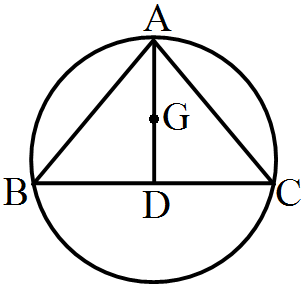
Let ABC be an equilateral triangle in which mediam AD = 3a

Centre of the circle is same as the centroid of the triangle i.e., (0, 0)

AG : GD = 2 : 1

So, $\text{AG}=\frac{2}{3}\text{AD}=\frac{2}{3}\times3\text{a}=2\text{a}$

$\therefore$ The equation of the circle is,

(x - 0)2 + (y - 0)2 = (2a)2

⇒ x2 + y2 = 4a2

View full question & answer
Question 31 Mark

Equation of a circle which passes through (3, 6) and touches the axes is:

  1. x2 + y2 + 6x + 6y + 3 = 0
  2. x2 + y2 - 6x - 6y - 9 = 0
  3. x2 + y2 - 6x - 6y + 9 = 0
  4. none of these.
Answer
  1. x2 + y2 - 6x - 6y + 9 = 0

Solution:

Given that the circle touches both axes.

Therefore, equation of the circle is, (x - a)2 + (y - a)2 = a2

Circle passes through the point (3, 6)

$\therefore$ (3 - a)2 + (6 - a)2 = a2

⇒ a2 - 18a + 45 = 0

⇒ (a - 3)(a - 15) = 0

$\therefore$ a = 3, a = 15

For a = 3, the equation of circle is,

(x - 3)2 + (y - 3)2 = 9

⇒ x2 + y2 - 6x - 6y + 9 = 0

View full question & answer
Question 41 Mark

If the vertex of the parabola is the point (-3, 0) and the directrix is the line x + 5 = 0, then its equation is:

  1. y2 = 8(x + 3)
  2. x2 = 8(y + 3)
  3. y2 = -8(x + 3)
  4. y2 = 8(x + 5)
Answer
  1. y2 = 8(x + 3)

Solution:

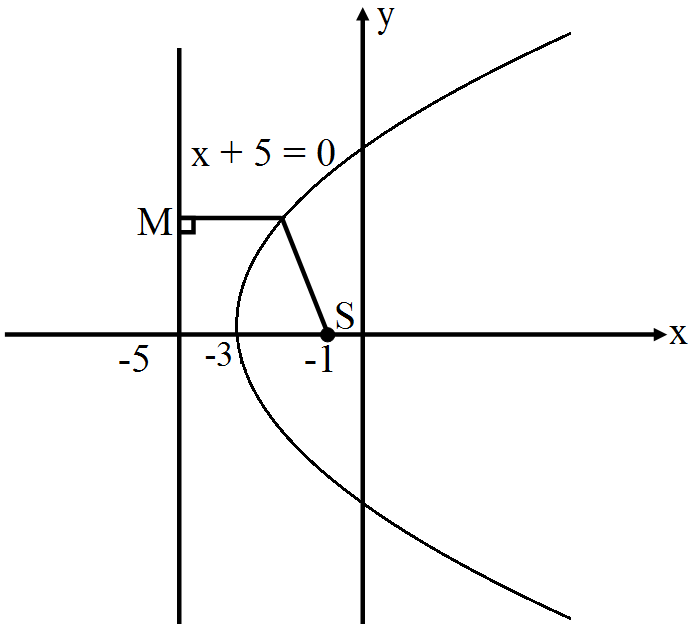
Given that vertex $\equiv(-3,0)$ and directrix, x + 5 = 0

So, focus $\equiv\text{S}(-1,0)$

For any point of parabola P(x, y) we have,

$\text{SP}=\text{PM}$

$\Rightarrow\sqrt{(\text{x}+1)+\text{y}^2}=|\text{x}+5|$

$\Rightarrow\text{x}^2+2\text{x}+1+\text{y}^2=\text{x}^2+10\text{x}+25$

$\Rightarrow\text{y}^2=8\text{x}+24$

$\Rightarrow\text{y}^2=8(\text{x}+3)$

View full question & answer
Question 51 Mark

If e is the eccentricity of the ellipse $\frac{\text{x}^2}{\text{a}^2}+\frac{\text{y}^2}{\text{b}^2}=1(\text{a}<\text{b}),$ then:

  1. b2 = a2(1 - e2)
  2. a2 = b2(1 - e2)
  3. a2 = b2(e2 - 1)
  4. b2 = a2(e2 - 1)
Answer
  1.   a2 = b2(1 - e2)

Solution:

Given equation is $\frac{\text{x}^2}{\text{a}^2}+\frac{\text{y}^2}{\text{b}^2}=1(\text{a}<\text{b})$

$\therefore\text{ Eccentricity e}=\sqrt{1-\frac{\text{a}^2}{\text{b}^2}}$

$\Rightarrow\text{e}^2=1-\frac{\text{a}^2}{\text{b}^2}$

$\Rightarrow\frac{\text{a}^2}{\text{b}^2}=(1-\text{e}^2)$

$\Rightarrow\text{a}^2=\text{b}^2(1-\text{e}^2)$  

View full question & answer
Question 61 Mark

Equation of the hyperbola with eccentricty $\frac{3}{2}$ and foci at $(\pm2,0)$ is:

  1. $\frac{\text{x}^2}{4}-\frac{\text{y}^2}{5}=\frac{4}{9}$

  2. $\frac{\text{x}^2}{9}-\frac{\text{y}^2}{9}=\frac{4}{9}$

  3. $\frac{\text{x}^2}{4}-\frac{\text{y}^2}{9}=1$

  4. none of these.

Answer
  1. $\frac{\text{x}^2}{4}-\frac{\text{y}^2}{5}=\frac{4}{9}$

Solution:

Given that $\text{e}=\frac{3}{2}$

and foci $=(\pm\text{ae},0)=(\pm2,0)$

$\therefore\ \text{ae}=2$

$\text{a}\times\frac{3}{2}=2$

$\Rightarrow\text{a}=\frac{4}{3}$

Now we know that $\text{b}^2=\text{a}^2(\text{e}^2-1)$

$\text{b}^2=\frac{16}{9}\Big(\frac{9}{4}-1\Big)$

$\Rightarrow\text{b}^2=\frac{16}{9}\times\frac{5}{4}$

$\Rightarrow\text{b}^2=\frac{20}{9}$

So, the equation of the hyperbola is,

$\frac{\text{x}^2}{\big(\frac{4}{3}\big)^2}-\frac{\text{y}^2}{\frac{20}{9}}=1$

$\Rightarrow\frac{9\text{x}^2}{16}-\frac{9\text{y}^2}{20}=1$

$\Rightarrow\frac{\text{x}^2}{16}-\frac{\text{y}^2}{20}=\frac{1}{9}$

$\Rightarrow\frac{\text{x}^2}{4}-\frac{\text{y}^2}{5}=\frac{4}{9}$

View full question & answer
Question 71 Mark

The eccentricity of the hyperbola whose latus rectum is 8 and conjugate axis is equal to half of the distance between the foci is:

  1. $\frac{4}{3}$

  2. $\frac{4}{\sqrt{3}}$

  3. $\frac{2}{\sqrt{3}}$

  4. none of these.

Answer
  1. $\frac{2}{\sqrt{3}}$

Solution:

Let the equation of the hyperbola be $\frac{\text{x}^2}{\text{a}^2}-\frac{\text{y}^2}{\text{b}^2}=1$

Length of latus rectum = 8

$\therefore\ \frac{2\text{b}^2}{2}=8$

$\Rightarrow\text{b}^2=4\text{a}$

Conjugate axis = half of the distance between the foci

$\therefore\ 2\text{b}=\text{ae}$

Now, $\text{b}^2=\text{a}^2(\text{e}^2-1)$

From eqs. (i) and (iii), we get

$\frac{\text{a}^2\text{e}^2}{4}=\text{a}^2(\text{e}^2-1)$

$\Rightarrow\text{e}^2=4\text{e}^2-4$

$\Rightarrow\text{e}^2=\frac{4}{3}$

$\Rightarrow\text{e}=\frac{2}{\sqrt{3}}$

View full question & answer
Question 81 Mark

The equation of the ellipse whose focus is (1, -1), the directrix the line x - y - 3 = 0 and eccentricity $\frac{1}{2}$ is:

  1. 7x2 + 2xy + 7y2 - 10x + 10y + 7 = 0
  2. 7x2 + 2xy + 7y2 + 7 = 0
  3. 7x2 + 2xy + 7y2 + 10x - 10y - 7 = 0
  4. none
Answer
  1. 7x2 + 2xy + 7y2 - 10x + 10y + 7 = 0

Solution:

Given that, fouus of the ellipse is S(1, -1) and the equation of directrix is x - y - 3 = 0

Also, $\text{e}=\frac{1}{2}$

From definition of ellipse, for any point P(x, y) on the ellipse, we have SP = ePM, where M is foot of the perpendicular from point P to the directrix.

$\therefore\ \sqrt{(\text{x}-1)^2+(\text{y}+1)^2}=\frac{1}{2}\frac{|\text{x}-\text{y}-3|}{\sqrt{2}}$

⇒ 8x2 - 16x + 16 + 8y2 + 16y = x2 + y2 + 9 - 2xy + 6y - 6x

⇒ 7x2 + 2xy + 7y2 - 10x + 10y + 7 = 0

View full question & answer
Question 91 Mark

The area of the circle centred at (1, 2) and passing through (4, 6) is:

  1. $5\pi$

  2. $10\pi$

  3. $25\pi$

  4. none of these.

Answer
  1. $25\pi$

Solution:

Given that the centre of the circle is (1, 2)

Radius of the circle $=\sqrt{(4-1)^2+(6-2)^2}$

$=\sqrt{9+16}=5$

So, the area of the circle $=\pi\text{r}^2$

$=\pi\times(5)^2=25\pi$

View full question & answer
Question 101 Mark

The distance between the foci of a hyperbola is 16 and its eccentricity is 2. Its equation is:

  1. $\text{x}^2-\text{y}^2=32$

  2. $\frac{\text{x}^2}{4}-\frac{\text{y}^2}{9}=1$

  3. $2\text{x}-3\text{y}^2=7$

  4. none of these.

Answer
  1. $\text{x}^2-\text{y}^2=32$

Solution:

We know that distance between the foci = 2ae

$\therefore\ 2\text{ae}=16$

$\Rightarrow​​\text{ae}=8$

Given that $\text{e}=\sqrt{2}$

$\therefore\ \sqrt{2}\text{a}=8$

$\Rightarrow\text{a}=4\sqrt{2}$

Now, $\text{b}^2=\text{a}^2(\text{e}^2-1)$

$\Rightarrow\text{b}^2=32(32-1)$

$\Rightarrow\text{b}^2=32$

So, the equation of the hyperbola is,

$\frac{\text{x}^2}{\text{a}^2}-\frac{\text{y}^2}{\text{b}^2}=1$

$\Rightarrow\frac{\text{x}^2}{32}-\frac{\text{y}^2}{32}=1$

 $\Rightarrow\text{x}^2-\text{y}^2=32$

View full question & answer
Question 111 Mark

If the focus of a parabola is (0, -3) and its directrix is y = 3, then its equation is:

  1. x2 = -12y
  2. x2 = 12y
  3. y2 = -12x
  4. y2 = 12x
Answer
  1.  x2 = -12y

Solution:

According to the definition of parabola,

$\sqrt{(\text{x}-0)^2+(\text{y}+3)^2}=\Bigg|\frac{\text{y}-3}{\sqrt{(0)^2+(1)^2}}\Bigg|$

$\Rightarrow\sqrt{\text{x}^2+\text{y}^2+9+6\text{y}}=|\text{y}-3|$

Squaring both sides, we get

x2 + y2 + 9 + 6y = y2 + 9 - 6y

⇒ x2 + 9 + 6y = 9 - 6y

⇒ x2 = -12y

View full question & answer
Question 121 Mark

If the parabola y2 = 4ax passes through the point (3, 2), then the length of its latus rectum is:

  1. $\frac{2}{3}$

  2. $\frac{4}{3}$

  3. $\frac{1}{3}$

  4. $4$

Answer
  1. $\frac{4}{3}$

Solution:

Given parabola is y2 = 4ax

If the parabola is passing through (3, 2)

Then (2)2 = 4a × 3

⇒ 4 = 12a

$\Rightarrow\text{a}=\frac{1}{3}$

Nowm length of the latus rectum $=4\text{a}=4\times\frac{1}{3}=\frac{4}{3}$

View full question & answer
Question 131 Mark

Equation of the circle with centre on the y-axis and passing through the origin and the point (2, 3) is:

  1. x2 + y2 + 13y = 0
  2. 3x2 + 3y2 + 13x + 3 = 0
  3. 6x2 + 6y2 - 13x = 0
  4. x2 + y2 + 13x + 3 = 0
Answer
  1. x2 + y2 + 13y = 0

Solution:

Let the equation of the circle be,

(x - h)2 + (y - k)2 = r2

Let the centre be (0, a)

$\therefore$ Radius r = a

So, the equation of the circle is

(x - 0)2 + (y - a)2 = a2

⇒ x2 + (y - a)2 = a2

⇒ x2 + y2 + a2 - 2ay = a2

⇒ x2 + y2 - 2ay = 0 .....(i)

(image)

Now, CP = r

$\Rightarrow\sqrt{(2-0)^2+(3-\text{a}^2)}=\text{a}$

$\Rightarrow\sqrt{4+9+\text{a}^2-6\text{a}}=\text{a}$

$\Rightarrow\sqrt{13+\text{a}^2-6\text{a}}=\text{a}$

$\Rightarrow13+\text{a}^2-6\text{a}=\text{a}^2$

$\Rightarrow13-6\text{a}=0$

$\therefore\ \text{a}=\frac{13}{6}$

Putting the value of a in eq. (i) we get

$\text{x}^2+\text{y}^2-2\Big(\frac{13}{6}\Big)\text{y}=0$

$\Rightarrow3\text{x}^2+3\text{y}^2-3\text{y}=0$

Note: (a) option is correct and is should be (dout solution)

View full question & answer
M.C.Q (1 Marks) - MATHS STD 11 Science Questions - Vidyadip