Questions

3 Marks Question

🎯

Test yourself on this topic

9 questions · timed · auto-graded

Question 13 Marks
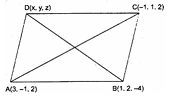
Three vertices of a parallelogram ABCD are A(3, -1, 2), B(1, 2, -4) and C(-1, 1, 2). Find the coordinates of the fourth vertex.
Answer
Let D (x, y, z) be the fourth vertex of parallelogram ABCD.
We know that diagonals of a parallelogram bisect each other. So the mid points of AC and BD coincide.
Image

$\therefore$ Coordinates of mid point of $AC \left(\frac{3-1}{2}, \frac{-1+1}{2}, \frac{2+2}{2}\right)$
= (1, 0, 2) 
Also coordinates of mid point of $BD \left(\frac{x+1}{2}, \frac{y+2}{2}, \frac{z-4}{2}\right)$
$\therefore \frac{x+1}{2}=1 \Rightarrow x+1=2 \Rightarrow x=1$
$\begin{array}{l}\frac{y+2}{2}=0 \Rightarrow y+2=0 \Rightarrow y=-2 \\ \frac{z-4}{2}=2 \Rightarrow z-4=4 \Rightarrow z=8\end{array}$
Thus the coordinates of point D are (1, -2, 8)

View full question & answer
Question 23 Marks
If ${ }^{22} P_{r+1}:{ }^{20} P_{r+2}=11: 52$. find r .
Answer
Here ${ }^{22} P_{r+1}:{ }^{20} P_{r+2}=11: 52$
$\begin{array}{l}\Rightarrow \frac{22!}{(21-r)!} \times \frac{(18-r)!}{20!}=\frac{11}{52} \\ \Rightarrow=\frac{22 \times 21 \times 20!}{(21-r)(20-r)(19-r)(18-r)!} \times \frac{(18-r)!}{20!}=\frac{11}{52} \\ \Rightarrow \frac{22 \times 21}{(21-r)(20-r)(19-r)}=\frac{11}{52} \\ \Rightarrow(21-r)(20-r)(19-r)=2 \times 21 \times 52 \\ \Rightarrow(21-r)(20-r)(19-r)=14 \times 13 \times 12 \\ \Rightarrow(21-r)(20-r)(19-r)=(21-7)(20-7)(19-7) \\ \Rightarrow r=7\end{array}$
View full question & answer
Question 33 Marks
In a class, 18 students took Physics, 23 students took Chemistry and 24 students took
Mathematics of these 13 took both Chemistry and Mathematics, 12 took both Physics and Chemistry and 11 took both Physics an Mathematics. If 6 students offered all the three subjects, find:
i. The total number of students.
ii. How many took Maths but not Chemistry.
iii. How many took exactly one of the three subjects.
Answer
$\begin{array}{l}\text { Given, } n(p)=18, n(C)=23, n(M)=24, n(C \cap M)=13 \\ n(P \cap C)=12, n(P \cap M)=11 \text { and } n(P \cap C \cap M)=6\end{array}$
i. Total no. of students in the class 
$\begin{array}{l}=n(P \cup C \cup M) \\ =n(P)+n(C)+n(M)-n(P \cap C)-n(P \cap M)-n(C \cap M)+n(P \cap C \cap M) \\ =18+23+24-12-11-13+6=35\end{array}$
ii. No. of students who took Mathematics but not Chemistry 
$\begin{array}{l}=n(M-C) \\ =n(M)-n(M \cap C) \\ =24-13=11\end{array}$
iii. No. of students who took exactly one of the three subjects 
$\begin{array}{l}=n(P)+n(C)+n(M)-2 n(M \cap P)-2 n(P \cap C)-2 n(M \cap C)+3 n(P \cap C \cap M) \\ =18+23+24-2 \times 11-2 \times 12-2 \times 13+3 \times 6 \\ =65-22-24-26+18 \\ =83-72=11\end{array}$
View full question & answer
Question 43 Marks
Evaluate: $\sum_{k=1}^{11}\left(2+3^k\right)$
Answer
Given: $\sum_{k=1}^{11}\left(2+3^k\right)$
$=\left(2+3^1\right)+\left(2+3^2\right)+\left(2+3^3\right)+\left(2+3^{11}\right)$
$=(2+2+2+\ldots \ldots \ldots 11$ times $)+\left(3+3^2+3^3+\ldots \ldots . .+3^{11}\right)$
$=22+\left(3+3^2+3^3+\ldots \ldots+3^{11}\right) \ldots \ldots \ldots$ (i)
Here $3,3^2, 3^3 \ldots \ldots . ., 3^{11}$ is in G.P.
$\therefore a=3$ and $r=\frac{3^2}{3}=3$
$S _n=\frac{3\left(3^{11}-1\right)}{3-1}=\frac{3}{2}\left(3^{11}-1\right)$
Putting the value of $S _{ n }$ in eq. (i), we get $\sum_{k=1}^{11}\left(2+3^k\right)=22+\frac{3}{2}\left(3^{11}-1\right)$
View full question & answer
Question 53 Marks
If the AM and GM of two positive numbers a and b are in the ratio $m : n$, show that $a : b =\left(m+\sqrt{m^2-n^2}\right):\left(m-\sqrt{m^2-n^2}\right)$
Answer
$\begin{array}{l}\frac{a+b}{2}=\frac{m}{n} \\ \frac{a+b}{2 \sqrt{a b}}=\frac{m}{n}\end{array}$
By C and D
$\begin{array}{l}\frac{a+b+2 \sqrt{b}}{a+b-2 \sqrt{b}}=\frac{m+n}{m-n} \\ \frac{(\sqrt{a}+\sqrt{b})^2}{(\sqrt{a}-\sqrt{b})^2}=\frac{m+n}{m-n} \\ \frac{\sqrt{a}+\sqrt{b}}{\sqrt{a}-\sqrt{b}}=\frac{\sqrt{m+n}}{\sqrt{m-n}}\end{array}$
By C and D 
$\frac{\sqrt{a}}{\sqrt{b}}=\frac{\sqrt{m+n}+\sqrt{m-n}}{\sqrt{m+n}-\sqrt{m-n}}$
Squaring both side 
$\begin{array}{l}\frac{a}{b}=\frac{m+n+m-n+2 \sqrt{m^2-n^2}}{m+n+m-n-2 \sqrt{m^2-n^2}} \\ \frac{a}{b}=\frac{m+\sqrt{m^2-n^2}}{m-\sqrt{m^2-n^2}}\end{array}$
View full question & answer
Question 63 Marks
Find the derivative of $\frac{(x-1)(x-2)}{(x-3)(x-4)}$.
Answer
Let $y=\frac{(x-1)(x-2)}{(x-3)(x-4)}$
On differentiating both sides w.r.t. x, we get 
$\begin{array}{l}\frac{d y}{d x}=\frac{\left[\begin{array}{r}{[x-3)(x-4) \frac{d}{d x}[(x-1)(x-2)]-(x-1)} \\ (x-2) \frac{d}{d x}[(x-3)(x-4)]\end{array}\right]}{[(x-3)(x-4)]^2} \\ {\left[\because \frac{d}{d x}\left(\frac{u}{v}\right)=\frac{v \frac{d u}{d x}-u \frac{d v}{d x}}{v^2}\right]}\end{array}$
$\begin{array}{l}=\frac{(x-3)(x-4)\left[(x-1) \frac{d}{d x}(x-2)+(x-2) \frac{d}{d x}(x-1)\right]-(x-1)(x-2)\left[(x-3) \frac{d}{d x}(x-4)+(x-4) \frac{d}{d x}(x-3)\right]}{(x-3)^2(x-4)^2} \\ =\frac{(x-3)(x-4)[(x-1) \cdot 1+(x-2) \cdot 1]-(x-1)(x-2)[(x-3) \cdot 1+(x-4) \cdot 1)]}{(x-3)^2(x-4)^2} \\ =\frac{(x-3)(x-4)[2 x-3]-(x-1)(x-2)[2 x-7]}{(x-3)^2(x-4)^2} \\ =\frac{\left(x^2-7 x+12\right)(2 x-3)-\left(x^2-3 x+2\right)(2 x-7)}{(x-3)^2(x-4)^2} \\ =\frac{2 x^3-14 x^2+24 x-3 x^2+21 x-36-2 x^3+6 x^2-4 x+7 x^2-21 x+14}{\left.(x-3)^{2( } x-4\right)^2} \\ =\frac{-4 x^2+20 x-22}{(x-3)^2(x-4)^2}\end{array}$

View full question & answer
Question 73 Marks
Find the derivative of $x^{-4}\left(3-4 x^{-5}\right)$
Answer
Here $f(x)=x^{-4}\left(3-4 x^{-5}\right)$
$f^{\prime}(x)=\frac{d}{d x}\left[x^{-4}\left(3-4 x^{-5}\right)\right]$
$=x^{-4} \frac{d}{d x}\left(3-4 x^{-5}\right)+\left(3-4 x^{-5}\right) \frac{d}{d x}\left(x^{-4}\right)$
$\begin{array}{l}=x^{-4}\left(20 x^{-6}\right)+\left(3-4 x^{-5}\right)\left(-4 x^{-5}\right) \\ =20 x^{-10}-12 x^{-5}+16 x^{-10} \\ =36 x^{-10}-12 x^{-5}=\frac{36}{x^{10}}-\frac{12}{x^5}\end{array}$
View full question & answer
Question 83 Marks
Show that $2^{4 n+4}-15 n-16$ where $n \in N$ is divisible by 225
Answer
From the given equation we have $2^{4 n+4}-15 n-16=2^{4(n+1)}-15 n-16$
$\begin{array}{l}=16^{n+1}-15 n-16 \\ =(1+15)^{n+1}-15 n-16\end{array}$
Using binomial expression we have 
$\begin{array}{l}={ }^{n+1} C _0 15^0+{ }^{n+1} C _1 15^1+{ }^{n+1} C _2 15^2+{ }^{n+1} C _3 15^3 \\ +\ldots+x+[C],(15)^{n+1}-15 n-16 \\ =1+(n+1) 15+{ }^{n+1} C _2 15^2+{ }^{n+1} C _3 15^3\end{array}$
$\begin{array}{l}+\ldots+n+1 C_{n+1}(15)^{n+1}-15 n-16 \\ =1+15 n+15+{ }^{n+1} C _2 15^2+{ }^{n+1} C _3 15 \\ +\ldots+{ }^{n+1} C _{n+1}(15)^{n+1}-15 n-16 \\ =15^2\left[{ }^{n+1} C _2+{ }^{n+1} C _3 15+\ldots \text { so on }\right]\end{array}$
Thus, $2^{4 n+4}-15 n-16$ is divisible 225 .
View full question & answer
Question 93 Marks
Using binomial theorem, expand: $\left(x^2-\frac{2}{x}\right)^7$.
Answer
To find: Expansion of $\left(x^2-\frac{3 x}{7}\right)^7$
Formula used: ${ }^n C_r=\frac{n!}{(n-r)!(r)!}$
We know that, $(a+b)^n={ }^n C_0 a^n+{ }^n C_1 a^{n-1} b+{ }^n C_2 a^{n-2} b^2+\ldots \ldots .+{ }^n C_{n-1} a^{n-1}+{ }^n C_n b^n$
Here We have, $\left(x^2-\frac{3 x}{7}\right)^7$
$\begin{array}{l}\Rightarrow\left[{ }^7 C _0\left( x ^2\right)^{7-0}\right]+\left[7 C _1\left( x ^2\right)^{7-1}\left(-\frac{3 x }{7}\right)^1\right]+\left[7 c_2\left(x^2\right)^{7-2}\left(-\frac{3 x}{7}\right)^2\right]+\left[7 C _3\left( x ^2\right)^{7-3}\left(-\frac{3 x }{7}\right)^3\right]+\left[7 C _4\left( x ^2\right)^{7-4}\left(-\frac{3 x }{7}\right)^4\right] \\ +\left[7 C _5\left( x ^2\right)^{7-5}\left(-\frac{3 x }{7}\right)^5\right]+\left[7 C _6\left( x ^2\right)^{7-6}\left(-\frac{3 x }{7}\right)^6\right]+\left[7 C _7\left(-\frac{3 x }{7}\right)^7\right] \\ \Rightarrow\left[\frac{7!}{0!(7-0)!}\left(x^2\right)^7\right]-\left[\frac{7!}{1!(7-1)!}\left(x^2\right)^6\left(\frac{3 x}{7}\right)\right]+\left[\frac{7!}{2!(7-2)!}\left(x^2\right)^5\left(\frac{9 x^2}{49}\right)\right]-\left[\frac{7!}{3!(7-3)!}\left(x^2\right)^4\left(\frac{27 x^3}{343}\right)\right] \\ +\left[\frac{7!}{4!(7-4)!}\left(x^2\right)^3\left(\frac{81 x^4}{2401}\right)\right]-\left[\frac{7!}{5!(7-5)!}\left(x^2\right)^2\left(\frac{243 x^5}{16807}\right)\right]+\left[\frac{7!}{6!(7-6)!}\left(x^2\right)^1\left(\frac{729 x^6}{117649}\right)\right]-\left[\frac{7!}{7!(7-7)!}\left(\frac{2187 x^7}{823543}\right)\right] \\ -\left[\frac{7!}{7!(7-7)!}\left(\frac{2187 x^7}{823543}\right)\right]+\left[21\left(x^{10}\right)\left(\frac{9 x^2}{49}\right)\right]-\left[35\left(x^8\right)\left(\frac{27 x^3}{343}\right)\right] \\ +\left[35\left(x^6\right)\left(\frac{81 x^4}{2401}\right)\right]-\left[21\left(x^4\right)\left(\frac{243 x^5}{16807}\right)\right]+\left[7\left(x^2\right)\left(\frac{729 x^6}{117649}\right)\right]-\left[1\left(\frac{2187 x^7}{823543}\right)\right] \\ \Rightarrow x^{24}-3 x^{13}+\left(\frac{27}{7}\right) x^{12}-\left(\frac{135}{49}\right) x^{11}+\left(\frac{405}{343}\right) x^{10}-\left(\frac{729}{2401}\right) x^9+\left(\frac{729}{16807}\right) x^8-\left(\frac{2187}{823543}\right) x^7 \\ x^{14}-3 x^{13}+\left(\frac{27}{7}\right) x^{12}-\left(\frac{135}{49}\right) x^{11}+\left(\frac{405}{343}\right) x^{10}-\left(\frac{729}{2901}\right) x^9+\left(\frac{729}{12807}\right) x^8-\left(\frac{2187}{825353}\right) x^7\end{array}$
View full question & answer
3 Marks Question - MATHS STD 11 Science Questions - Vidyadip