Questions

3 Marks Question

🎯

Test yourself on this topic

9 questions · timed · auto-graded

Question 13 Marks
Out of 100 students; 15 passed in English, 12 passed in Mathematics, 8 in Science, 6 in English and Mathematics, 7 in Mathematics and Science, 4 in English and Science, 4 in all the three. Find how many passed
i. in English and Mathematics but not in Science
ii. in Mathematics and Science but not in English
iii. in Mathematics only
iv. in more than one subject only
Answer
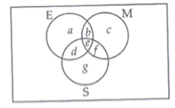
Let the set of students who passed in Mathematics be M, the set of students who passed in English be E and the set of students who passed in Science be S. 
Then $n(U)=100, n(M)=12, n(E)=15, n(S)=8, n(E \cap M)=6, n(M \cap S)=7, n(E \cap S)=4$ and $n(E \cap M \cap S)=4$
Let us draw a Venn diagram
Image
According to the Venn diagram, 
$\begin{array}{l}n(E \cap S)=4 \Rightarrow e=4 \\ n(E \cap M)=6 \Rightarrow b+e=6 \Rightarrow b+4=6 \Rightarrow b=2 \\ n(M \cap S)=7 \Rightarrow e+f=7 \Rightarrow 4+f=7 \Rightarrow f=3 \\ n(E \cap S)=4 \Rightarrow d+e=4 \Rightarrow d+4=4 \Rightarrow d=0 \\ n(E)=15 \Rightarrow a+b+d+e=15 \Rightarrow a+2+0+4=15 \Rightarrow a=9 \\ n(M)=12 \Rightarrow b+c+e+f=12 \Rightarrow 2+c+4+3=12 \Rightarrow c=3 \\ n(S)=8 \Rightarrow d+e+f+g=8 \Rightarrow 0+4+3+g=8 \Rightarrow g=1\end{array}$
Hence we get,
i. Number of students who passed in English and Mathematics but not in Science, $b=2$.
ii. Number of students who passed in Mathematics and Science but not in English, $f =3$.
iii. Number of students who passed in Mathematics only, $c =3$.
iv. Number of students who passed in more than one subject $= b + e + d + f =2+4+0+3=9$.
View full question & answer
Question 23 Marks
Differentiate $\frac{x^2-1}{x}$ from first principle.
Answer
We need to find derivative of $f(x)=\frac{x^2-1}{x}$
Derivative of a function f(x) from first principle is given by 
$f ^{ f }( x )=\underset{{h \rightarrow 0}}{\lim}=\frac{f(x+h)-f(x)}{h}$ \{where h is a very small positive number $\}$
$\therefore$ Derivative of $f(x)=\frac{x^2-1}{x}$ is given as
$f ^{\prime}( x )=\underset{{h \rightarrow 0}}{\lim}=\frac{f(x+h)-f(x)^x}{h}$
$\begin{array}{l}\Rightarrow f ^{\prime}( x )=\underset{{h \rightarrow 0}}{\lim}\frac{\frac{(x+h)^2-1}{x+h}-\frac{x^2-1}{\alpha}}{h} \\
\Rightarrow f ^{\prime}(x)=\underset{{h \rightarrow 0}}{\lim}\frac{\left\{(x+h)^2-1\right\} x-(x+h)\left(x^2-1\right)}{h x(x+h)} \\
\Rightarrow f ^{\prime}(x)=\underset{{h \rightarrow 0}}{\lim} \frac{\left\{(x+h)^2-1\right\} x-(x+h)\left(x^2-1\right)}{h} \times \underset{{h \rightarrow 0}}{\lim} \frac{1}{x(x+h)} \\
\Rightarrow f ^{\prime}(x)=\frac{1}{x^2} \underset{{h \rightarrow 0}}{\lim} \frac{\left\{(x+h)^2-1\right\} x-(x+h)\left(x^2-1\right)}{h} \\
\Rightarrow f^{\prime}(x)=\frac{1}{x^2} \underset{{h \rightarrow 0}}{\lim} \frac{\left\{x^2+h^2+2 x h-1\right\} x-\left\{x^3+h x^2-x-h\right\}}{h} \\
\Rightarrow f^{\prime}(x)=\frac{1}{x^2} \underset{{h \rightarrow 0}}{\lim} \frac{x^3+h^2 x+2 x^2 h-x-x^3-h x^2+x+h}{h} \\
\Rightarrow f ^{\prime}(x)=\frac{1}{x^2} \underset{{h \rightarrow 0}}{\lim} \frac{h^2 x+x^2 h+h}{h} \\
\Rightarrow f ^{\prime}(x)=\frac{1}{x^2} \underset{{h \rightarrow 0}}{\lim} \frac{h\left(h x+x^2+1\right)}{h} \\
\Rightarrow f ^{\prime}( x )=\frac{1}{x^2} \underset{{h \rightarrow 0}}{\lim}\left(h h+x^2+1\right) \\
\Rightarrow f^{\prime}(x)=\frac{1}{x^2}\left(0 \times x+x^2+1\right)=\frac{x^2+1}{x^2}=1+\frac{1}{x^2}\end{array}$
$\therefore f^{\prime}(x)=1+\frac{1}{x^2}$
Hence,
Derivative of $f(x)=\frac{x^2-1}{x^2}=1+\frac{1}{x^2}$

View full question & answer
Question 33 Marks
Show that the coefficient of the middle term in the expansion of $(1+ x )^{2 n }$ is equal to the sum of the coefficients of middle terms in the expansion of $(1+x)^{2 n -1}$.
View full question & answer
Question 43 Marks
The letters of the word SURITI are written in all possible orders and these words are written out as in a dictionary. Find the rank of the word SURITI.
Answer
Given the word SURITI.
Arranging the permutations of the letters of the word SURITI in a dictionary:
To find: Rank of word SURITI in dictionary. 
First comes, words starting with letter I = 5! = 120 
words starting from letter $R =\frac{51}{21}=60$
words starting from $SI =4!=24$ (4 letters no repetation)
words starting from $SR =\frac{4!}{2!}=12$ (4 letters, one repetation of I $)$
words starting from $ST =\frac{4!}{2!}=12$ (4 letters, one repetation of I )
words starting from SUI $=3!=6$ (3 letters no repetation)
words starting from SUR; SURIIT = 1
SURITI = 1 
Rank of the word SURITI =120+60+24+12+12+6+1+1
=236
View full question & answer
Question 53 Marks
Find a G.P. for which sum of the first two term is -4 and the fifth term is 4 times the third term.
Answer
$\begin{array}{l}S_2=-4, a_5=4 a_3 \\ 
\frac{a\left(1-r^2\right)}{1-r}=-4\end{array}$
$\begin{array}{l} a (1+ r )=-4 \\ 
ar ^4=4 ar ^2 \\ 
r= \pm 2\end{array}$
when r = 2 
$a=-4 / 3$
sequence is $\frac{-4}{3}, \frac{-8}{3}, \frac{-16}{3}, \ldots \ldots$
when r = -2
a = 4 
sequence is
4, 8, 16, 32, 64,......
View full question & answer
Question 63 Marks
If the $p^{\text {th }}$ and $q^{\text {th }}$ terms of a GP are $q$ and $p$ respectively, then show that $(p+q)^{\text {th }}$ term is $\left(\frac{q^p}{p^f}\right)^{\frac{1}{p-q}}$.
Answer
Let first term be A and common ratio be R of a GP. 
Given, $p ^{\text {th }}$ term, $T _{ p }= q$ and $q ^{\text {th }}$ term, $T _{ q }= p$
Then, $AR ^{ p -1}= q$ and $AR ^{ q -1}= p \ldots( i )$
$\therefore \frac{A R^{p-1}}{A R^{i^{-1}}}=\frac{q}{p}$
$\Rightarrow R ^{p-q}=\frac{q}{p} \Rightarrow R =\left(\frac{q}{p}\right)^{\frac{1}{\rho-q}}\left[\because\right.$ rasisint power $\frac{1}{p-q}$ on both sides $]$
On putting the value of R in Eq. (i), we get 
$\begin{array}{l}A \cdot\left(\frac{q}{p}\right)^{\frac{p-1}{p-q}}=q \\
\Rightarrow A=q \cdot\left(\frac{p}{q}\right)^{\frac{p-1}{p-q}}\end{array}$
Now. $( D + q )^{\text {th }}$ term.
$\begin{array}{l} T _{ p + q }= AR ^{ p + q -1}=q \cdot\left(\frac{p}{q}\right)^{\frac{p-1}{p-q}} \times\left(\frac{q}{p}\right)^{\frac{p+q-1}{p-q}} \\ =\frac{q^{1-\frac{p-1}{p-q}+\frac{p+q-1}{p-q}}}{\frac{p+q-1}{p-q}-\frac{p-1}{p-q}}=\frac{\frac{p-q-p+1+p+q-1}{p-q}}{\frac{p+q-1-p+1}{p-q}} \\ =\frac{q^{\frac{p}{p-q}}}{p^{\frac{q}{p-q}}}=\left(\frac{q^p}{p^q}\right)^{\frac{1}{p-q}}\end{array}$
Hence proved.

View full question & answer
Question 73 Marks
Find the derivative of function $\frac{a x+b}{c x+d}$ (it is to be understood that $a , b , c , d , p , q , r$ and s are fixed non-zero constants and m and n are integers).
Answer
Here,
$\begin{array}{l}\therefore f^{\prime}(x)=\frac{d}{d x}\left[\frac{a x+b}{c x+d}\right] \\
=\frac{(c x+d) \frac{d}{d x}(a x+b)-(a x+b) \frac{d}{d x}(c x+d)}{(c x+d)^2} \\
=\frac{(c x+d)(a)-(a x+b)(c)}{(c x+d)^2} \\
=\frac{a c x+a d-a c x-b c}{(c x+d)^2}=\frac{a d-b c}{(c x+d)^2}\end{array}$

View full question & answer
Question 83 Marks
Find $a , b$ and n in the expansion of $( a + b )^{ n }$ if the first three terms of the expansion are 729,7290 and 30375 respectively.
Answer
We have $T_1={ }^n C_0 a^n b^0=729 \ldots$
$\begin{array}{l}T_2={ }^n C_1 a^{n-1} b=7290 \ldots \text { (ii) } \\ 
T_3={ }^n C_2 a^{n-2} b^2=30375 \ldots \text { (iii) }\end{array}$
From (i) $a^{ n }=729 \ldots$ (iv)
From (ii) $n a^{ n -1} b=7290 \ldots$ (v)
From (iii) $\frac{n(n-1)}{2} a^{n-2} b^2=30375 \ldots$ (vi)
Multiplying (iv) and (vi), we get 
$\frac{n(n-1)}{2} a^{2 n-2} b^2=729 \times 30375 \ldots$ (vii)
Squaring both sides of (v) we get 
$n^2 a^{2 n-2} b^2=(7290)(7290)($ viii $)$
Dividing (vii) by (viii), we get 
$\begin{array}{l}\frac{n(n-1) a^{2 n-2} b^2}{2 n^2 a^{2 n-2} b^2}=\frac{729 \times 30375}{7290 \times 7290} \\ 
\Rightarrow \frac{(n-1)}{2 n}=\frac{30375}{72900} \Rightarrow \frac{n-1}{2 n}=\frac{5}{12} \Rightarrow 12 n-12=10 n \\
\Rightarrow 2 n=12 \Rightarrow n=6\end{array}$
From (iv) $a^6=729 \Rightarrow a^6=(3)^6 \Rightarrow a=3$
From (v) $6 \times 3^5 \times b=7290 \Rightarrow b=5$
Thus a = 3, b = 5 and n = 6.
View full question & answer
Question 93 Marks
If the origin is the centroid of the triangle PQR with vertices P(2a, 2, 6), Q(-4, 3b, -10) and R(8, 14, 2c), then find the values of a, b and c.
Answer
Here $P (2 a , 2,6), Q(-4,3 b,-10)$ and $R (8,14,2 c )$ are vertices of triangle PQR.
$\therefore$ Coordinates of centriod of $\triangle P Q R$ is $\left(\frac{2 a-4+8}{3}, \frac{2+3 b+14}{3}, \frac{6-10+2 c}{3}\right)$
$=\left(\frac{2 a+4}{3}, \frac{3 b+16}{3}, \frac{2 c-4}{3}\right)$
But is it given that coordinates of centroid is (0, 0, 0) 
$\begin{array}{l}\frac{2 a+4}{3}=0 \Rightarrow 2 a+4=0 \therefore a=-2 \\ 
\frac{3 b+16}{3}=0 \Rightarrow 3 b+16=0 \Rightarrow b=\frac{-16}{3} \\ 
\frac{2 c-4}{3}=0 \Rightarrow 2 c-4=0 \Rightarrow c=2\end{array}$

View full question & answer
3 Marks Question - MATHS STD 11 Science Questions - Vidyadip