Questions · Page 3 of 4

M.C.Q (1 Marks)

MCQ 1011 Mark

One coin is tossed once. Find the probability of getting A tail.

  • A
    $\frac{1}{2}$
  • B
    $1$
  • C
    $\text{Data} \text{ insufficient}$
  • D
    $\text{None}\text{ of}\text{ these}$
Answer
  1. $\frac{1}{2}$

Solution:

There are 2 possible outcomes of a throw of coin.

$\text{P(tail)}=\frac{1}{2}$

View full question & answer
MCQ 1021 Mark

Two dice are thrown together. The probability that at least one will show its digit greater than 3 is:

  • A
    $\frac{1}{4}$
  • B
    $\frac{3}{4}$
  • C
    $\frac{1}{2}$
  • D
    $\frac{1}{8}$
Answer
  1. $\frac{3}{4}$

Solution: 

When two dice are thrown, there are (6 × 6) = 36 outcomes. The set of all these outcomes is the sample space, given by

S = (1, 1) , (1, 2), (1, 3), (1, 4), (1, 5), (1, 6)

(2, 1) , (2, 2), (2, 3), (2, 4), (2, 5), (2, 6)

(3, 1) , (3, 2), (3, 3), (3, 4), (3, 5), (3, 6)

(4, 1) , (4, 2), (4, 3), (4, 4), (4, 5), (4, 6)

(5, 1) , (5, 2), (5, 3), (5, 4), (5, 5), (5, 6)

(6, 1) , (6, 2), (6, 3), (6, 4), (6, 5), (6, 6)

i.e. n(S) = 36

Let E be the event of getting at least one digit greater than 3.

Then E = {(1, 4), (1, 5), (1, 6), (2, 4), (2, 5), (2, 6), (3, 4), (3, 5), (3, 6), (4, 1) , (4, 2), (4, 3), (4, 4), (4, 5), (4, 6),

(5, 1) , (5, 2), (5, 3), (5, 4), (5, 5), (5, 6), (6, 1) , (6, 2), (6, 3), (6, 4), (6, 5), (6, 6) }

$\therefore\ \text{n(E)}=27$

Hence, required probability $=\frac{27}{36}=\frac{3}{4}$
View full question & answer
MCQ 1031 Mark

If A and B are mutually exclusive events then:

  • A
    $\text{P(A)}\leq\text{P}(\overline{\text{B}})$
  • B
    $\text{P(A)}\geq\text{P}(\overline{\text{B}})$
  • C
    $\text{P(A)}<\text{P}(\overline{\text{B}})$
  • D
     None of these
Answer

It is given that A and B are mutually exclusive events.

We know that,

$\text{P}(\text{A}\cup\text{B})=\text{P}(\text{A)}+\text{(B})-\text{P}(\text{A}\cap\text{B})$$\big[\text{From(1)}\big]$

$\Rightarrow\text{P}(\text{A}\cup\text{B})=\text{P}(\text{A)}+\text{P}\text{(B})$ $\big[\text{P}(\text{A}\cup\text{B})\leq1\big]$

$\Rightarrow\text{P}(\text{A)}+\text{P}\text{(B})\leq1$

$\Rightarrow\text{P}(\text{A)}\leq1-\text{P}\text{(B})=\text{P}(\overline{\text{B}})$

$\therefore\text{P}(\text{A)}\leq\text{P}\text{(B})$

Hence, the correct answer is option (a).$\therefore\text{P}(\text{A }\cap\text{B})=0\ ...(1)$

View full question & answer
MCQ 1041 Mark

The length of the latus rectum of the parabola x=ay2+by+c is:

  • A
    $\frac{\text{a}}{4}$
  • B
    $\frac{\text{a}}{3}$
  • C
    $\frac{1}{\text{a}}$
  • D
    $\frac{1}{4\text{a}}$
Answer
  1. $\frac{1}{\text{a}}$

Solution:

x = ay2 + by + c

ay2 + by = x - c

$=\text{a}\Big(\text{y}+\frac{\text{b}}{\text{a}}\Big)^2$

$=\text{x}+\frac{\text{a}\text{b}^2}{4}-\text{c}$

$=\Big(\text{y}+\frac{\text{b}}{\text{a}}\Big)^2$

$=\frac{1}{\text{a}}\Big(\text{x}+\frac{\text{a}\text{b}^2}{4}-\text{c}\Big)$

Length of latus rectum

$=\frac{1}{\text{a}}$

View full question & answer
MCQ 1051 Mark

If A, B, C are three mutually exclusive and exhaustive events of an experiment such that 3 $\text{P(A)}=2\text{P(B)}=\text{C},$ then P(A) is equal to:

  • A
    $\frac{1}{11}$
  • B
    $\frac{2}{11}$
  • C
    $\frac{5}{11}$
  • D
    $\frac{6}{11}$
Answer

Let 3 P(A) = 2 P(B) = P(C) = p.

Then, ​​$\text{P(A)}=\frac{\text{P}}{3},\text{P(B)}=\frac{\text{P}}{2}$ and $\text{P(C)}=\text{P}$

It is given that A, B, C are three mutually exclusive and exhaustive events.

$\therefore\text{P(A)}+\text{P(B)}+\text{P(C)}=1$

$=0 $ and $\big[\text{P}(\text{A}\cup\text{B)=}\text{P}(\text{B}\cap\text{C)}=\text{P}(\text{C}\cap\text{A)=}\text{P}(\text{A}\cup\text{B }\cup\text{C}=1\big]$

$\Rightarrow\frac{\text{P}}{3}+\frac{\text{p}}{2}+\text{P}=1$

$\Rightarrow\frac{\text{11P}}{6}=1$

$\Rightarrow\text{P}=\frac{6}{11}$

$\therefore\text{P(A)}=\frac{\text{P}}{3}=\frac{\frac{6}{11}}{3}=\frac{2}{11}$

Hence, the correct answer is option (b).

View full question & answer
MCQ 1061 Mark

Two coins are tossed, what is the sample space?

  • A
    (H, T), (H, T), (T, H), (H, H)
  • B
    (H, T), (T, T), (T, H), (H, H)
  • C
    (T, T), (H, H), (T, T), (H, H)
  • D
    (H, T), (T, T), (H, T), (T, T)
Answer
  1. (H, T), (T, T), (T, H), (H, H)

Solution:

Sample space is the collection of all possible events.

So, sample space of tossing two coins, S=(H, T), (T, T), (T, H), (H, H)

View full question & answer
MCQ 1071 Mark

Sample space is a set of ..... of an experiment.

  • A
    All possible outcomes
  • B
    Selected outcomes
  • C
    Both
  • D
    None of these
Answer
  1. All possible outcomes

Solution:

A sample space is usually denoted using set notation, and the possible outcomes are listed as elements in the set. For example, if the

experiment is tossing a coin, the sample space is typically the set {head, tail}, i.e all possible outcomes.

View full question & answer
MCQ 1081 Mark

Three numbers are chosen from 1 to 20. The probability that they are not consecutive is:

  • A
    $\frac{186}{190}$
  • B
    $\frac{187}{190}$
  • C
    $\frac{188}{190}$
  • D
    $\frac{18}{\ ^{20}\text{C}_3}$
Answer

Number of ways to choose three numbers from 1 to 20 $=\ ^{20}\text{C}_3=1140$

Now, the set of three consecutive numbers from 1 to 20 are (1, 2, 3), (2, 3, 4), (3, 4, 5), ...., (18, 19, 20).

So, the number of ways to choose three numbers from 1 to 20 such that they are consecutive is 18.

P(three numbers choosen are consecutive) 

$=\frac{\text{Number of ways to choose three consecutive numbers from 1 to 20 }}{\text{Number of ways to choose three numbers from 1 to 20}}$

$=\frac{18}{\ ^{20}\text{c}_3}=\frac{18}{1140}=\frac{3}{190}$

$\therefore$P(three numbers choosen are not consecutive) = 1 - P(three numbers choosen are consecutive) $=1-\frac{3}{190}=\frac{187}{190}$

Hence, the correct answer is option (b).

View full question & answer
MCQ 1091 Mark

Three digit numbers are formed using the digits 0, 2, 4, 6, 8. A number is chosen at random out of these numbers. What is the probability that this number has the same digits?

  • A
    $\frac{1}{16}$
  • B
    $\frac{16}{25}$
  • C
    $\frac{1}{645}$
  • D
    $\frac{1}{25}$
Answer

The given digits are 0, 2, 4, 6, 8.


____ ____ ____
Hundreds Tens Ones

Now, there are 4 ways to fill the hundreds place (0 cannot occupy the hundreds place), 5 ways to fill the tens place and 5 ways to fill the ones place.

Total number of 3 digit numbers formed using the given digits = 4 × 5 × 5 = 100

The three digit numbers formed using given digits that have the same digits are 222, 444, 666 and 888

Number of 3 digit numbers that have the same digits = 4

$\therefore$ P(three digit number formed has the same digits) 

$\frac{\text{Number of 3 digits numbers that have the same digits}}{\text{Total number of 3 digit numbers formed using the given digits}}$

$=\frac{4}{100}=\frac{1}{25}$

Hence, the correct answer is option (d).

View full question & answer
MCQ 1101 Mark

What is the sample space for choosing an odd number from 2 to 10 at random?

  • A
    2, 4, 6, 8, 10
  • B
    1, 2, 3, 5
  • C
    3, 5, 7, 9
  • D
    1, 2, 3, 5, 7
Answer
  1. 3, 5, 7, 9

Solution:

Sample space is the collection of all possible events.

So, the sample space for choosing an odd number from 2 to 10 at random = 3, 5, 7, 9.


View full question & answer
MCQ 1111 Mark

One card is drawn from a pack of 52 cards. The probability that it is the card of a king or spade is:

  • A
    $\frac{1}{26}$
  • B
    $\frac{3}{26}$
  • C
    $\frac{4}{13}$
  • D
    $\frac{3}{13}$
Answer
  1. $\frac{4}{13}$

Solution:

If A and B denote the events of drawing a king and a spade card, respectively, then event A consists of four sample points, whereas event B consists of 13 sample points.

Thus, $\text{P(A)}=\frac{4}{52}$ and $\text{P(B)}=\frac{13}{52}$

The compound event (A n B) consists of only one sample point, king of spade.

So, $\text{P}(\text{A}\cap\text{B})=\frac{1}{52}$

By addition theorem , we have:

$\text{P}(\text{A}\cup\text{B})=\text{P(A)}+\text{P(B)}-\text{P}(\text{A}\cap\text{B})$

$=\frac{4}{52}+\frac{13}{52}-\frac{1}{52}=\frac{16}{52}=\frac{4}{13}$

Hence, the probability that the card drawn is either a king or a spade is given by $\frac{4}{13}.$

View full question & answer
MCQ 1121 Mark

Two dice are thrown simultaneously. The probability of obtaining total score of seven is:

  • A
    $\frac{5}{36}$
  • B
    $\frac{6}{36}$
  • C
    $\frac{7}{36}$
  • D
    $\frac{8}{36}$
Answer
  1. $\frac{6}{36}$

Solution:

When two dices are thrown, there are (6 × 6) = 36 outcomes.

The set of all these outcomes is the sample space given by

S = (1, 1), (1, 2), (1, 3), (1, 4), (1, 5), (1, 6)

(2, 1), (2, 2), (2, 3), (2, 4), (2, 5), (2, 6)

(3, 1), (3, 2), (3, 3), (3, 4), (3, 5), (3, 6)

(4, 1), (4, 2), (4, 3), (4, 4), (4, 5), (4, 6)

(5, 1), (5, 2), (5, 3), (5, 4), (5, 5), (5, 6)

(6, 1), (6, 2), (6, 3), (6, 4), (6, 5), (6, 6)

$\therefore$ n(S) = 36

Let E be the event of getting a total score of 7.

Then E = {(1, 6), (2, 5), (3, 4), (4, 3), (5, 2), (6, 1)}

$\therefore$ n(E) = 6

Hence, required probability $=\frac{\text{n}(\text{E})}{\text{n}(\text{S})}=\frac{6}{36}$

View full question & answer
MCQ 1131 Mark

If the vertex = (2, 0) and the extremities of the latus rectum are (3, 2) and (3, -2), then the equation of the parabola is:

  • A
    y2 = 2x - 4
  • B
    x2 = 4y - 8
  • C
    y2 = 4x - 8
  • D
    None
Answer
  1. y2 = 4x - 8

Solution:

y2 = 4ax

(y - 0)2 = 4a (x - 2)

y2 = 4a (x - 2)

y2 = 4 (x - 2)

y2 = 4 x - 8

View full question & answer
MCQ 1141 Mark

The radius of circle x2 + y2 - 6x - 8y = 0:

  • A
    5
  • B
    4
  • C
    3
  • D
    2
Answer
  1. 5

Solution:

The radius of circel x2 + y2 - 6x - 8y =0 is

$=\sqrt{\text{g}^2+\text{f}-\text{c}}$

Here g = -3, f = -4, c = 0

$\Rightarrow\text{r}=\sqrt{(-3)^2+(-4)^2}\sqrt{9+16}$

$=\sqrt{25}=25$

View full question & answer
MCQ 1151 Mark

The line segment joining the foci of the hyperbola x- y2 + 1 = 0 is one of the diameters of a circle. The equation of the circle is:

  • A
    $\text{x}^2+\text{y}^2=4$
  • B
    $\text{x}^2+\text{y}^2=\sqrt{2}$
  • C
    $\text{x}^2+\text{y}^2=2$
  • D
    $\text{x}^2+\text{y}^2=2\sqrt{2}$
Answer
  1. $\text{x}^2+\text{y}^2=2$

Solution:

x2 - y2 + 1 = 0

⟹ (x - 0)2 + (y - 0)2 = 0 Foci of the given hyperbola

$=(0,+\sqrt{2)}$ Centre of the hyperbola is (0, 0) Diameter of the circle is

the distance between foci of the hyperbola and which is given by

$\text{D}=\sqrt{(0-0)^2+(\sqrt{2}+\sqrt{2})^2}=2\sqrt{2}$  Centre of the circle will be same as that of the hyperbola 

Centre = (0, 0) and Radius $=\sqrt{2}$

Equation of the circle is x2 + y2 = 2

View full question & answer
MCQ 1161 Mark

A pack of cards contains 4 aces, 4 kings, 4 queens and 4 jacks. Two cards are drawn at random. The probability that at least one of them is an ace is

  • A
    $\frac{1}{5}$
  • B
    $\frac{3}{16}$
  • C
    $\frac{9}{20}$
  • D
    $\frac{1}{9}$
Answer
  1. $$$\frac{9}{20}$

Solution:

We have:

$\text{P(both are aces)}=\frac{\ ^{4}\text{C}_2}{\ ^{16}\text{C}_2}$

$=\frac{4}{16}\times\frac{3}{15}=\frac{1}{20}$

$\text{P(one are ace)}=\frac{\ ^{4}\text{C}_1\times\ ^{12}\text{C}_1}{\ ^{16}\text{C}_2}=\frac{2}{5}$

$\therefore\text{P(at least one are ace)}=\frac{1}{20}+\frac{2}{5}=\frac{9}{20}$

View full question & answer
MCQ 1171 Mark

The events A, B, C are mutually exclusive events such that $\text{P(A)}=\frac{(3\text{x}+1)}{3,\text{P(B)}}=\frac{(\text{x}-1)}{4\text{ and}\text{ P}}\text{(C)}=\frac{(1-2\text{x})}{4}.$The set of possible values of x are in the interval:

  • A
    $\Big[\frac{1}{3},\frac{1}{2}\Big]$
  • B
    $\Big[\frac{1}{3},\frac{2}{3}\Big]$
  • C
    $\Big[\frac{1}{3},\frac{13}{3}\Big]$
  • D
    $\Big[0,1\Big]$
Answer
  1. $\Big[\frac{1}{3},\frac{1}{2}\Big]$

Solution:

$\text{P(A)}=\frac{(3\text{x}+1)}{3}$

$\text{P(B)}=\frac{(\text{x}-1)}{4}$

$\text{P(C)}=\frac{(1-2\text{x})}{4}$

These are mutually exclusive events.

$\Rightarrow-1\leq3\text{x}\leq2,-3\leq\text{x}\leq,-\leq2\text{x}\leq1$

$\Rightarrow-\frac{1}{3}\leq\text{x}\leq\frac{2}{3},-2\leq\text{x}\leq1,-\frac{1}{2}\leq\text{x}\leq\frac{1}{2}$

Also, 0  $\leq\frac{(3\text{x}+1)}{3}+\frac{\text{x}-1}{4}+\frac{(1-2\text{x)}}{4\leq1}$

$\Rightarrow\frac{1}{3}\leq\text{x}\leq\frac{13}{3}$

$\Rightarrow\text{max}\Big\{\frac{-1}{3},-3,-\frac{1}{2},\frac{1}{3}\Big\}$

$\Rightarrow\frac{1}{3}\leq\text{x}\leq\frac{1}{2}$

$\Rightarrow\text{x}\in\Big[\frac{1}{3},\frac{1}{2}\Big]$

View full question & answer
MCQ 1181 Mark

If $\frac{(1-3\text{P})}{2},\frac{(1+4\text{P})}{3},\frac{(1+\text{P})}{6}$ are the probabilities of three mutually exclusive and exhaustive events, then the set of all values of p is:

  • A
    $(0,1)$
  • B
    $\Big(\frac{-1}{4},\frac{1}{3}\Big)$
  • C
    $\big(0,\frac{1}{3}\big)$
  • D
    $(0,\infty)$
Answer
  1. $$$\Big(\frac{-1}{4},\frac{1}{3}\Big)$

Solution:

$\text{P(A)}=\frac{(1-3\text{P})}{2}$

$\text{P(B)}=\frac{(1+4\text{P})}{3}$

$\text{P()}=\frac{(1+\text{P})}{6}$

The events are mutually exclusive and exhaustive.

$\therefore\text{P}(\text{A}\cup\text{B }\cup\text{C})=\text{P(A)}+\text{P(B)}+\text{P(C)}=1$

$\Rightarrow0\leq\text{P(A)}\leq1,0\leq\text{P(B)}\leq1,0\leq\text{P(C)}\leq1$

$\Rightarrow0\leq\frac{1-3\text{P}}{2}\leq1$$0\leq\frac{1-4\text{P}}{3}\leq1$$0\leq\frac{1-\text{P}}{6}\leq1$

$\Rightarrow\frac{-1}{3}\leq\text{P}\leq\frac{1}{3}\ ...(1)$

$\frac{-1}{4}\leq\text{P}\leq\frac{1}{2}\ ...(2)$

$\text{and }{-1}\leq\text{P}\leq{5}\ ...(3)$

The common solution of (1), (2), and (3) is $\frac{-1}{4}\leq\text{P}\leq\frac{1}{3}$

$\therefore\text{The set values of P are}\Big(\frac{-1}{4},\frac{1}{3}\Big)$

View full question & answer
MCQ 1191 Mark

Two dice are thrown simultaneously. The probability of getting a pair of aces is

  • A
    $\frac{1}{36}$
  • B
    $\frac{1}{3}$
  • C
    $\frac{1}{6}$
  • D
    none of these
Answer
  1. $\frac{1}{36}$

Solution:

When two dice are thrown simultaneously, the sample space associated with the random experiment is given by:

S = {(1, 1), (1, 2), (1, 3), (6, 4), (6, 5), (6, 6)}

Clearly, total number of elementary events = 36

Let A be the event of getting a pair of aces.

Then A = {(1, 1)}

$\therefore\text{n(A)}=1$

Hence, required probability $=\frac{\text{n(A)}}{\text{n(S)}}=\frac{1}{36}$ 

View full question & answer
MCQ 1201 Mark

Two unbiased coins are tossed simultaneously. Find the probability of getting at least one head.

  • A
    $\frac{1}{2}$
  • B
    $\frac{1}{4}$
  • C
    $\frac{3}{4}$
  • D
    $\text{None}\text{ of}\text{ these}$
Answer
  1. $\frac{3}{4}$

Solution:

If two unbiased coins are tossed simultaneously, then the sample space will be S.

S: {H H, H T, T H, T T} n(S) = 4n

E: At least one head is obtained {H H, H T, T H} n(E) = 3n(E) = 3

Hence, P(At least one head) $=\frac{3}{4}$ 

View full question & answer
MCQ 1211 Mark

A bag contains 2 red, 3 green and 2 blue balls. Two balls are drawn at random. The probability that none of the balls drawn is blue is:

  • A
    $\frac{10}{21}$
  • B
    $\frac{11}{21}$
  • C
    $\frac{2}{7}$
  • D
    $\frac{5}{7}$
Answer
  1. $\frac{10}{21}$

Solution:

Total number of balls = 2 + 3 + 2 = 7

Two balls are drawn.

Now, P(none of them is blue) $=\frac{^5\text{C}_2}{^7\text{C}_2}$

$=\frac{\Big\{\frac{(5\times4)}{(2\times1)}\Big\}}{\Big\{\frac{(7\times6)}{(2\times1)}\Big\}}$

$=\frac{(5\times4)}{(7\times6)}$

$=\frac{(5\times2)}{(7\times3)}$

$=\frac{10}{21}$

View full question & answer
MCQ 1221 Mark

Two dice are thrown together. The probability that neither they show equal digits nor the sum of their digits is 9 will be:

  • A
    $\frac{13}{15}$
  • B
    $\frac{13}{18}$
  • C
    $\frac{1}{9}$
  • D
    $\frac{8}{9}$
Answer
  1. $\frac{13}{18}$

Solution:

When two dices are thrown, there are (6 × 6) = 36 outcomes.

The set of all these outcomes is the sample space is given by

S = (1, 1), (1, 2), (1, 3), (1, 4), (1, 5), (1, 6)

(2, 1), (2, 2), (2, 3), (2, 4), (2, 5), (2, 6)

(3, 1), (3, 2), (3, 3), (3, 4), (3, 5), (3, 6)

(4, 1), (4, 2), (4, 3), (4, 4), (4, 5), (4, 6)

(5, 1), (5, 2), (5, 3), (5, 4), (5, 5), (5, 6)

(6, 1), (6, 2), (6, 3), (6, 4), (6, 5), (6, 6)

$\therefore\text{n}\text{(S)} = 36$

Let E be the event of getting the digits which are neither equal nor give a total of 9.

Then E' = event of getting either a doublet or a total of 9

Thus, E' = {{1, 1), (2, 2), (3, 3), (4, 4), (5, 5), (6, 6), (3, 6), (4, 5), (5, 4), (6, 3)}

i.e. n(E') = 10

$\text{P(E}')=\frac{\text{n(E}')}{\text{n(E)}}=\frac{10}{36}=\frac{5}{18}$

Hence, required probability P(E) = 1 - P(E')

$=1-\frac{5}{18}=\frac{13}{18}$

View full question & answer
MCQ 1231 Mark

The length of latus rectum of the parabola (x - 2a) 2 + y2 = x2 is:

  • A
    2a
  • B
    3a
  • C
    6a
  • D
    4a
Answer
  1. 4a

Solution:

We have, (x - 2a)2 + y2 = x2

⇒x2 - 4ax + 4a+ y2 = x2

⇒ y= 4ax - 4a2 = 4a (x - a)

Comparing it with standard parabola Y2 = 4bX

Y = y, X = x - a, b = a

We know length of latus rectum of parabola Y2 = 4bX is 4b

Hence length of latus rectum of given parabola is = 4 × a = 4a

View full question & answer
MCQ 1241 Mark

What is the probability of getting the number 6 at least once in a regular die if it can roll it 6 times?

  • A
    1 - (5/6)6
  • B
    1 - (1/6)6
  • C
    (5/6)6
  • D
    (1/6)6
Answer
  1. 1 - (5/6)6

Solution:

Let A be the event that 6 does not occur at all.

Now, the probability of at least one 6 occurs = 1 – PA.

= 1 – (5/6)6

View full question & answer
MCQ 1251 Mark

lf the lines 2x - 3y = 5 and 3x - 4y = 7 are two diameters of a circle of radius 7 then the equation of the circle is:

  • A
    x2 + y2 + 2x - 4y - 47 = 0
  • B
    x2 + y2 = 49
  • C
    x2 + y2 - 2x + 2y - 47 = 0
  • D
    x+ y2 = 17
Answer
  1. x2 + y2 - 2x + 2y - 47 = 0

Solution:

2x - 3y = 5−−−− (1)

3x - 4y = 7−−−− (2)

Intersection of this lines given centre of circle

∴ from (1) &amp; (2),

n = 1, y = -1

So, equation of circle is

(x - 1)2 + (y + 1)2 = (7)2

⇒ x2 + y2 - 2x + 2y - 47 = 0

View full question & answer
MCQ 1261 Mark

One of the two events must occur. If the chance of one is $\frac{2}{3}$ of the other, then odds in favour of the other are

  • A
    $\text{1 : 3}$
  • B
    $\text{3 : 1}$
  • C
    $\text{2 : 3}$
  • D
    $\text{3 : 2}$
Answer
  1. ​​​​$\text{3 : 2}$

Solution:

 Let $\text{P(B)}=\text{X}$

 Than, $\text{P(A)}=\frac{2\text{x}}{3}$

$\text{P(A)}+\text{P(B)}=\text{x}+\frac{2x}{3}=\frac{5x}{3}$

$\Rightarrow\frac{5\text{x}}{3}=1$ $\big(\therefore$ They are exhaustive events $\big)$

$\Rightarrow\text{x}=\frac{3}{5}$

Now, $\text{P(A)}=\frac{2}{5}\text{ and }\text{P(B)}=\frac{3}{5}$

$\therefore\text{odd in favour of B}=\frac{\frac{3}{5}}{\frac{1-3}{5}}=\frac{3}{2}=\text{3 : 1}$

View full question & answer
MCQ 1271 Mark

Choose the correct answer.

6 boys and 6 girls sit in a row at random. The probability that all the girls sit together is:

  • A
    $\frac{1}{432}$
  • B
    $\frac{12}{431}$
  • C
    $\frac{1}{132}$
  • D
    none of these.
Answer
  1. $\frac{1}{132}$

Solution:

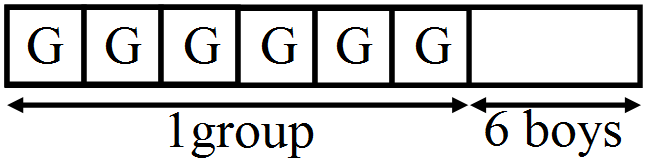
If all the girls sit together, then we consider it as 1 group

$\therefore$ Total number of arrangement of 6 + 1 = 7 persons in a row = 7! And the girls also interchanged their places with 6! Ways.

$\therefore\ \text{Required probability}=\frac{6!7!}{12!}$

$=\frac{6\times5\times4\times3\times2\times7!}{12\times11\times10\times9\times8\times7!}=\frac{1}{132}$

View full question & answer
MCQ 1281 Mark

The equation of a locus is y2 + 2ax + 2by + c = 0. Then:

  • A
    it is an ellipse
  • B
    it is a parabola
  • C
    latus rectum = a
  • D
    latus rectum = 2a
Answer
  1. it is a parabola

Solution:

Given equation of locus is y2 + 2ax + 2by + c = 0, which can be written

= as (y + b)2

$=-4\Big(\frac{\text{a}}{2}\Big)\Big(\text{a}+\frac{\text{c}-\text{b}^2}{2\text{a}}\Big)$

which is locus of parabola. For parabola with equation  y2

 = 4ax, 4a is length of latus rectum.

Then for given locus, length of latus rectum is

$=4\Big(\frac{\text{a}}{\text{b}}\Big)=2\text{a}.$

View full question & answer
MCQ 1291 Mark

An urn contains 6 balls of which two are red and four are black. Two balls are drawn at random. What is the probability that they are of different colours?

  • A
    $\frac{2}{5}$
  • B
    $\frac{1}{15}$
  • C
    $\frac{8}{15}$
  • D
    $\frac{4}{15}$
Answer
  1. $\frac{8}{15}$

Solution:

Given that, the total number of balls = 6 balls

Let A and B be the red and black balls, respectively,

The probability that two balls are drawn are different = P(the first ball drawn is red)(the second ball drawn is black)+ P(the first ball drawn is black)P(the second ball drawn is red)

$=\Big(\frac{2}{6}\Big)\Big(\frac{4}{5}\Big)+\Big(\frac{4}{6}\Big)\Big(\frac{2}{5}\Big)$

$=\Big(\frac{8}{30}\Big)+\Big(\frac{8}{30}\Big)$

$=\frac{16}{30}=\frac{8}{15}$

View full question & answer
MCQ 1301 Mark

One mapping is selected at random from all mappings of the set A = {1, 2, 3, ..., n} into itself. The probability that the mapping selected is one to one is:

  • A
    $\frac{1}{\text{n}^n}$
  • B
    $\frac{1}{\text{n}}$
  • C
    $\frac{\text{n}-1}{\text{n}^n-1}$
  • D
    None of these
Answer

Number of ways to map 1st element in set A = n

Number of ways to map 2nd element in set A = n and so on

$\therefore$Total number of mapping from set A to itself

$=\text{n}\times\text{n}\times\ ...\ \times\text{n}(\text{n times})=\text{n}^\text{n}$

For one to one mapping,

Number of ways to map 1st element in set A = n

Number of ways to map 2nd element in set A = n −1

Number of ways to map nth element in set A = 1

Total number of one to one mappings from set A to itself 

$=\text{n}\times\text{(n -1)}\times\text{(n - 2)}\ \times\ ...\times1=\text{n}$

$\therefore$ Required probability

$=\frac{\text{Total number of one mappings from set A to inselp} }{\text{Total number of mappings form set A to itself}}$


$=\frac{\text{n}}{\text{n}^\text{n}}=\frac{(\text{n}-1)}{\text{n}^\text{n-1}}$

Hence, the correct answer is option (c).

View full question & answer
MCQ 1311 Mark

 A bag contains 5 brown and 4 white socks. Ram pulls out two socks. What is the probability that both the socks are of the same colour?

  • A
    9/20
  • B
    2/9
  • C
    3/20
  • D
    4/9
Answer
  1. 4/9

Solution:

Total number of socks = 5 + 4 = 9

Two socks are pulled.

Now, P(Both are same colour) = (5C2 + 4C2)/9C2

= {(5×4)/(2×1) + (4×3)/(2×1)}/{(9×8)/(2×1)}

= {(5×4) + (4×3)/}/{(9×8)

= (5 + 3)/(9×2)

= 8/18

= 4/9

View full question & answer
MCQ 1321 Mark

The centre of a circle is (x - 2, x + 1) and it passes through the points (4, 4) Find the value ( or values ) of x, if the diameter of the circle is of length  $2\sqrt{5} \text{ units.}$

  • A
    1 or 3
  • B
    -1 or 4
  • C
    5 or 4
  • D
    3 or -2
Answer
  1.  5 or 4

Solution:

Radius of the circle = dist. between the center and given pt. on the circle.

Distance between two points < br / > < br / >(x1​, y1​) and (x2​, y2​ <br /> <br / >) can be calculated using the formula.

$=\sqrt{(\text{x}_2}-<\text{br}/><\text{br}/>\text{x}_1)^2+(\text{y}_2-\text{y}_1)^2$

Distance between the points (x - 2, x + 1) and D (4, 4)

$=\sqrt{(4-\text{x}+2)^2+(4-\text{x}-1)^2}$

$=\sqrt{(6-\text{x}^2+(3-\text{x)}^2}$

$=\sqrt{36+\text{x}^2-12\text{x}+9+\text{x}^2-6\text{x}}$

$=\sqrt{2}\text{x}^2-18\text{x}+45$

Given, diameter  $2\sqrt{5}$  ⇒ Radius $=\sqrt{5}$

$\Rightarrow\sqrt{2\text{x}^2-18\text{x}+45<\text{br}/><\text{br}/>=\sqrt{5}}$

Squaring both sides,

2x2 - 18x + 45 = 5

2x-18x + 40 = 0

x- 9x + 20 = 0

(x - 5)(x - 4) = 0

x = 5 or 4 

View full question & answer
MCQ 1331 Mark

What is the sample space for choosing a letter from a set of vowel ?

  • A
    {a, b, c........z}
  • B
    {a, e, i, o, u}
  • C
    {a, e, i, o}
  • D
    None of the these
Answer
  1. {a, e, i, o, u}

Solution:

A letter is choose from set of vowels i.e. {a, e, i, o, u}.

View full question & answer
MCQ 1341 Mark

If two coins are tossed then find the probability of the events that at the most one tail turns up:

  • A
    $\frac{1}{4}$
  • B
    $\frac{1}{3}$
  • C
    $\frac{1}{2}$
  • D
    $\frac{3}{4}$
Answer
  1. $\frac{3}{4}$

Solution:

The sample space of 2 coins tossed = (h, h), (h, t), (t, h), (t, t)

for having atmost one tail we need = (h, t), (t, h), (h, h)

Thus the probability is $\frac{3}{4}$

View full question & answer
MCQ 1351 Mark

The equation of the circle which touches x - axis at (0,0) and touches the line 3x + 4y - 5 = 0 is:

  • A
    x2 + y2 - 4y = 0
  • B
    x2 + y2 - 10y = 0
  • C
    x2 + y2 + 10x = 0
  • D
    x2 + y2 + 10y = 0
Answer
  1. x2 + y2 + 10y = 0

Solution:

Equation of circle touching x - axis at (0, 0), means centre of circle lie on Y - axis i.e. (0, k).

(x - 0)2 + (y - k)2 = k2

S : x2 + y2 - 2ky = 0 ......(1) Circle S touches

= 3x + 4y - 5 = 0

$∴\text{k}=\frac{4\text{k}-5}{5}$

= 5k = 4k - 5

= k = -5

$∴$ Equation of circle is

= x2 + y2  - (-5) × 2y = 0

⇒ x2 + y2 + 10y = 0

View full question & answer
MCQ 1361 Mark

Let A and B are two mutually exclusive events and if P(A) = 0.5 and P(B ̅) =0.6 then P(AUB) is:

  • A
    0
  • B
    1
  • C
    0.6
  • D
    0.9
Answer
  1. 0.9

Solution:

Given, A and B are two mutually exclusive events.

So, P(A ∩ B) = 0

Again given P(A) = 0.5 and P(B ̅) = 0.6

P(B) = 1 – P(B ̅) = 1 – 0.6 = 0.4

Now, P(A ∪ B) = P(A) + P(B) – P(A ∩ B)

⇒ P(A ∪ B) = P(A) + P(B)

⇒ P(A ∪ B) = 0.5 + 0.4 = 0.9

View full question & answer
MCQ 1371 Mark

A die is thrown then find the probability of getting a number greater than 3.

  • A
    $\frac{1}{3}$
  • B
    $\frac{1}{2}$
  • C
    $\frac{2}{3}$
  • D
    $0$
Answer
  1. $\frac{1}{2}$

Solution:

Sample space = 1, 2, 3, 4, 5, 6

a no >3 in sample space = 4, 5, 6 = 3

probability of getting no greater than $3=\frac{1}{2}$

View full question & answer
MCQ 1381 Mark

The length of the latus rectum of the parabola whose focus is (3, 3) and directrix is 3x - 4y - 2 = 0 is

  • A
    1
  • B
    2
  • C
    4
  • D
    8
Answer
  1. 2

Solution:

Length of the latus rectum (1) = 2 (perpendicular distance from focus to directix)

$1=2 \ \frac{3\ (3)\ -4\ (3)\ -2}{\sqrt{3^2\ +\ 4^2}}=2$

View full question & answer
MCQ 1391 Mark

Two numbers are chosen from {1, 2, 3, 4, 5, 6} one after another without replacement. Find the probability that the smaller of the two is less than 4.

  • A
    $\frac{4}{5}$
  • B
    $\frac{1}{15}$
  • C
    $\frac{1}{5}$
  • D
    $\frac{14}{15}$
Answer
  1. $\frac{4}{5}$

Solution:

Total number of ways of choosing two numbers out of six  $=\ ^6\text{C}_6=\frac{(6\times2)}{2}=3\times5=15$

If smaller number is chosen as 3 then greater has choice are 4, 5, 6 So, total choices = 3

If smaller number is chosen as 2 then greater has choice are 3, 4, 5, 6 So, total choices = 4

If smaller number is chosen as 1 then greater has choice are 2, 3, 4, 5, 6 So, total choices = 5

Total favourable case = 3 + 4 + 5 = 12

Now, required probability

$=\frac{12}{15}=\frac{4}{5}$

View full question & answer
MCQ 1401 Mark

Find the sample space for choosing a prime number less than 2020 at random.

  • A
    2, 3, 5, 7, 11, 13, 17, 19
  • B
    2, 3, 4, 5, 7, 11, 13, 17, 19
  • C
    2, 3, 5, 7, 11, 13, 17, 19, 20
  • D
    2, 3, 5, 7, 11, 13, 17, 19, 15
Answer
  1. 2, 3, 5, 7, 11, 13, 17, 19

Solution:

Sample space is the collection of all possible events.

So, sample space for choosing a prime number less than 20 = 2, 3, 5, 7, 11, 13, 17, 19.

View full question & answer
MCQ 1411 Mark

On the parabola y = x2,  the point least distant from the straight line y = 2x - 4 is:

  • A
    (1, 1)
  • B
    (1, 0)
  • C
    (1, -1)
  • D
    (0, 0)
Answer
  1. (1, 1)

Solution:

Given, parabola is is y = x2 ....(i)

d straight line is y = 2x - 4 ....(ii)

From equations (i) and (ii), we get

x- 2x - 4 = 0

Let f (x) = x2 - 2x - 4

Thus f (x) = 2x - 2

or least distance, put f' (x) = 0

⇒ 2x - 2 = 0

⇒ x = 1

From equation (i), we have y = 1

Hence, the point least distant from the line is (1, 1)

View full question & answer
MCQ 1421 Mark

There are 30 tickets numbered from 1 to 30 in a box . A ticket is drawn at random. What is the probability that the ticket drawn bears an odd number?

  • A
    $\frac{1}{2}$
  • B
    $\frac{1}{3}$
  • C
    $\frac{2}{3}$
  • D
    $\frac{1}{4}$
Answer
  1. $\frac{1}{2}$

Solution:

Total number of outcomes = 30

Favourable outcomes (odd number on the ticket) = 15

Probability $=\frac{15}{30}=\frac{1}{2}$

View full question & answer
MCQ 1431 Mark

The probability that a leap year will have 53 Fridays or 53 Saturdays is:

  • A
    $\frac{2}{7}$
  • B
    $\frac{3}{7}$
  • C
    $\frac{4}{7}$
  • D
    $\frac{1}{7}$
Answer
  1. $\frac{3}{7}$

Solution:

We know that a leap year has 366 days (i.e. 7 × 52 + 2) = 52 weeks and 2 extra days .

The sample space for these 2 extra days is given below:

S = {(Sunday, Monday), (Monday, Tuesday), (Tuesday, Wednesday), (Wednesday, Thursday), (Thursday, Friday), (Friday, Saturday), (Saturday, Sunday)} There are 7 cases.

$\therefore\text{n(S)}=7$

Let E be the event that the leap year has 53 Fridays or 53 Saturdays.

E = { (Thursday, Friday), (Friday, Saturday), (Saturday, Sunday)}

i.e. n(E) = 3

$\therefore\text{P(E)}=\frac{\text{n(E)}}{\text{n(S)}}=\frac{3}{7}$

Hence, the probability that a leap year has 53 Fridays or 53 Saturdays is $\frac{3}{7}$.

View full question & answer
MCQ 1441 Mark

If (a, b) lies on circle with centre as origin, then its radius will be:

  • A
    $\text{a} - \text{ b}$
  • B
    $\text{a + b}$
  • C
    $\sqrt{\text{a}^2+\text{b}^2}$
  • D
    $\text{a}^2+\text{b}^2$
Answer
  1. $\sqrt{\text{a}^2+\text{b}^2}$

Solution:

We know the formula,

The equation of a circle of radius r and centre the origin is

x+ y= r2

Here the center is (a, b)

so Radius, $\text{r} = \sqrt{\text{a}^{2} + \text{b}^{2}}$

View full question & answer
MCQ 1451 Mark

Choose the correct answer.

If $\text{P}(\text{A}\cup\text{B})=\text{P}(\text{A}\cap\text{B})$ for any two events A and B, then:

  • A
    $\text{P(A)}=\text{P(B)}$
  • B
    $\text{P(A)}>\text{P(B)}$
  • C
    $\text{P}(\text{A})<\text{P(B)}$
  • D
    none of these.
Answer
  1. $\text{P(A)}=\text{P(B)}$

Solution:

Given that, $\text{P}(\text{A}\cup\text{B})=\text{P}(\text{A}\cap\text{B})$

$\Rightarrow\text{P}(\text{A})+\text{P}(\text{B})-\text{P}(\text{A}\cap\text{B})=\text{P}(\text{A}\cap\text{B})$

$\Rightarrow\big[\text{P(A)}-\text{P}(\text{A}\cap\text{B})\big]+\big[\text{P(B)}-\text{P}(\text{A}\cap\text{B})\big]=0$

But $\text{P(A)}-\text{P}(\text{A}\cap\text{B})\geq0\ ....(\text{i})$

$\big[\because\ \text{P}(\text{A}\cap\text{B})\leq\text{P(A)}\text{ or }\text{P(B)}\big]$

And $\text{P}(\text{B})-\text{P}(\text{A}\cap\text{B})\geq0\ ...(\text{ii})$

From eq. (i) and (ii) we get

$\text{P(A)}=\text{P(B)}$

View full question & answer
MCQ 1461 Mark

If three dice are throw simultaneously, then the probability of getting a score of 5 is:

  • A
    $\frac{5}{216}$
  • B
    $\frac{1}{6}$
  • C
    $\frac{1}{36}$
  • D
    $\text{None of these}$
Answer
  1. $$$\frac{1}{36}$

Solution:

When three dice are thrown together, the sample space S associated with the random experiment is given by,

S = {(1, 1, 1), (1, 1, 2), (1, 1, 3) ...(6, 6, 5), (6, 6, 6)}

Clearly, total number of elementary events n(S) = 216

Let A be the event of getting a total score of 5.

Then A = { (1, 1, 3), (1, 3, 1), (3, 1, 1), (1, 2, 2), (2, 1, 2), (2, 2, 1)}

$\therefore$ Favourable number of elementary events = 6

i.e. n(A) = 6

Hence, required probability $=\frac{6}{216}=\frac{1}{36}$

View full question & answer
MCQ 1471 Mark

Choose the correct answer.

If A and B are mutually exclusive events, then:

  • A
    $\text{P(A)}\leq\text{P}(\bar{\text{B}})$
  • B
    $\text{P(A)}\geq\text{P}(\bar{\text{B}})$
  • C
    $\text{P}(\text{A})<\text{P}(\bar{\text{B}})$
  • D
    none of these.
Answer
  1. $\text{P(A)}\leq\text{P}(\bar{\text{B}})$

Solution:

For mutually exclusive events,

$\text{P}(\text{A}\cap\text{B})=0$

$\therefore\ \text{P}(\text{A}\cup\text{B})=\text{P(A)}+\text{P(B)}$ $\big[\because\text{ P}(\text{A}\cap\text{B})=0\big]$

$\Rightarrow\text{P}(\text{A})+\text{P(B)}\leq1$

$\Rightarrow\text{P(A)}+1-\text{P}(\bar{\text{B}})\leq1$ $\big[\text{P(B)}=1-\text{P}(\bar{\text{B}})\big]$

$\Rightarrow\text{P(A)}-\text{P}(\bar{\text{B}})\leq0$

$\Rightarrow\text{P(A)}-\text{P}(\bar{\text{B}})$

View full question & answer
MCQ 1481 Mark

Find the latus rectum of the parabola  x2 + 2y - 3x + 5 = 0:

  • A
    1
  • B
    2
  • C
    4
  • D
    8
Answer
  1. 2

Solution:

x2+2y−3x+5=0

$\Rightarrow\text{x}^2-3\text{x}=-2\text{y}-5$

$\Rightarrow\text{x}^2-2.$

$=\frac{3}{2}\text{x}+\frac{9}{4}$

$=-2\text{y}-5+\frac{9}{4}$

$=-2\text{y}-\frac{11}{4}$

$\Rightarrow\Big(\text{x}-\frac{3}{2}\Big)^2$

$=-2\Big(\text{y}-\frac{11}{4}\Big)$

Hence latus rectum

$=4\times\frac{1}{2}=2$

View full question & answer
MCQ 1491 Mark

If the probability of A to fail in an examination is $\frac{1}{5}$ and that of B is$\frac{3}{10}$Then, the probability that either A or B fails is

  • A
    $\frac{1}{2}$
  • B
    $\frac{11}{25}$
  • C
    $\frac{19}{50}$
  • D
    None of these
Answer
  1. ​​​​​​$\frac{19}{50}$

Solution:

Given:

$\text{P(A)}=\frac{1}{5}$

$\therefore\text{P(A}')=1-\frac{1}{5}=\frac{4}{5}$

$\text{P(B)}=\frac{3}{10}$

$\therefore\text{P(B}')=1-\frac{3}{10}=\frac{7}{30}$

Hence, required probability $=\text{P}(\text{A}\cap\text{B}')+\text{P}(\text{A}'\cap\text{B})$

$=\frac{1}{5}\times\frac{7}{10}+\frac{4}{5}\times\frac{3}{10}$

$=\frac{7}{50}+\frac{12}{50}$

$=\frac{19}{50}$

View full question & answer
MCQ 1501 Mark

Coordinates of centre and radius of the circle (x - 3)+ (y + 4)= 25 are respectively:

  • A
    (3, 4), 25
  • B
    (-3, 4), 5
  • C
    (3, -4), 5
  • D
    (3, -4), 25
Answer
  1. (3, -4), 5

Solution:

= (x - 3)2 + (y + 4)2 = 25

= (x - 3)2 + (y - (-4))2 - (5)2

= (x - 4)2 + (y - k)2 - (r)2

= r = 5 (h, k) = (3, -4)

View full question & answer