Questions · Page 1 of 4

M.C.Q (1 Marks)

🎯

Test yourself on this topic

50 questions · timed · auto-graded

Question 11 Mark
Out of the following, the strongest base in aqueous solution is:
Answer

When we compare the basicity of the aliphatic amines, we would expect the basicity of tertiary amines to be the greatest, followed by secondary amine and then primary amine.
But this is not so. The order of basicity is
$NH_3​ <$ primary amine $~$ tertiary amine $<$ secondary amine
This is because:

  1. Steric hindrance: The size of an alkyl group is more than that of a hydrogen atom. So, an alkyl group would hinder the attack of a hydrogen atom, thus decreasing the basicity of the molecule. So, the more the number of alkyl groups attached, lesser will be its basicity. 
  2. Solvation of ions: When amines are dissolved in water, they form protonated amines. Also, the number of possibilities for hydrogen bonding also increases. More the number of hydrogen bonding more is the hydration that is released in the process of the formation of hydrogen bonds.
The combined effect of the pushing effect of the alkyl group $(+I$ effect$)$, steric hindrance and the salvation of amines causes the basicity order to be $($basicity of tertiary is almost the same as that of primary$).$
$NH_3​ <$ primary amine $~$ tertiary amine $<$ secondary amine
So, here Dimethylamine is the strongest base.
View full question & answer
Question 31 Mark
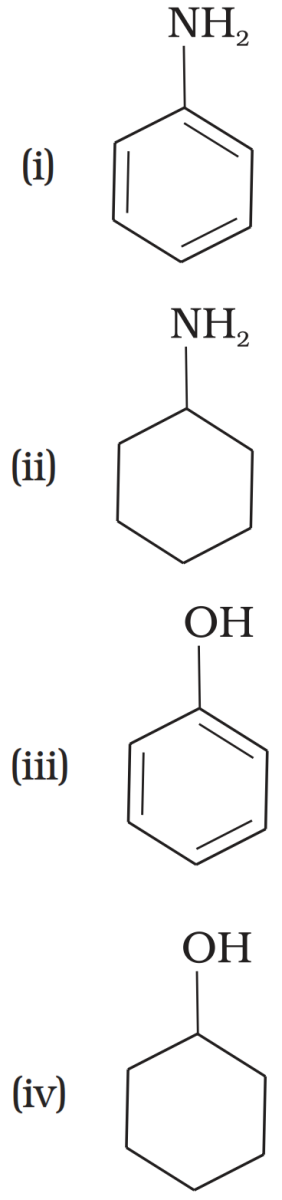
Which of the following compounds is the weakest Brönsted base?
Answer
​ii
Explanation:
Phenol is the weakest Bronsted base as it is the strongest acid among the four choices given above. Stronger the acid weaker is its conjugate base.
View full question & answer
Question 41 Mark
Arrange the following compounds in increasing order of basicity$: \ce{CH_3​NH_2​, (CH_3​)_2​NH, NH_3​ ,C_6​H_5​NH_2​}$
Answer
$\ce{C_6​H_5​NH_2 ​< NH_3 ​< CH_3​NH_2​ < (CH_3​)_2​NH}$
View full question & answer
Question 51 Mark
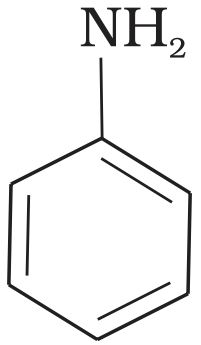
Which of the following is more appropriate reason for aniline being less basic than aliphatic amines?
Answer
$NH_2​$ gives $e-$ away from the group. So $e-$ density of $N$ decrease and hence less available for Protonation. So less Basicity. In aliphatic amines, no mesomerism $($resonance$)$ takes place. Thus it has more electrons available for donation thus shows more basic property.
View full question & answer
Question 61 Mark
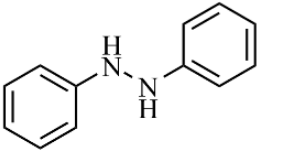
Diphenyl hydrazine is same as:
Answer
  1. Hydrazobenzene
Explanation:
Diphenyl hydrazine is same as hydrazobenzene.
Two phenyl groups are attached to two nitrogen atoms of hydrazine.
View full question & answer
Question 71 Mark
Which of the following is a primary arylalkyl amine?
Answer
Since it should be primary, it should have an alkyl$/$aryl group attached to the $NH_2$ molecule, and because it is arylalkyl, the nitrogen should be linked to an $sp^3$ hybridised benzyl carbon rather than to an aryl carbon.
View full question & answer
Question 81 Mark
Which of the following represents the decreasing order of basic strength of amines in the gas phase?
Answer
  1. Tertiary amine > Secondary amine > Primary amine.
Explanation:
The following represents the decreasing order of basic strength of amines in the gas phase.
Tertiary amine > secondary amine > primary  amine 
This is due +I (electron releasing) effect of alkyl groups.
With an increase in the number of alkyl groups, the electron density on N increases and the lone pair of electrons can be easily donated.
View full question & answer
Question 91 Mark
Which of the folllowing catalysts are used in the preparation amines by the reduction of isonitriles:
Answer
  1. All of the above
Explanation:
The carbon - nitrogen triple bond in a nitrile can also be reduced by reaction with hydrogen gas in the presence of a variety of metal catalysts like palladium, platinum or nickel.
View full question & answer
Question 101 Mark
Which of the following is not a classification of amines?
Answer
Amines may be classified as primary, secondary or tertiary depending on whether $1, 2$ or $3$ hydrogen atoms of $NH_3$ are replaced by alkyl$/$aryl groups respectively.
Quaternary ammonium compounds are a different class of compounds where all four hydrogen atoms of ammonium salts are replaced by alkyl$/$aryl groups.
View full question & answer
Question 111 Mark
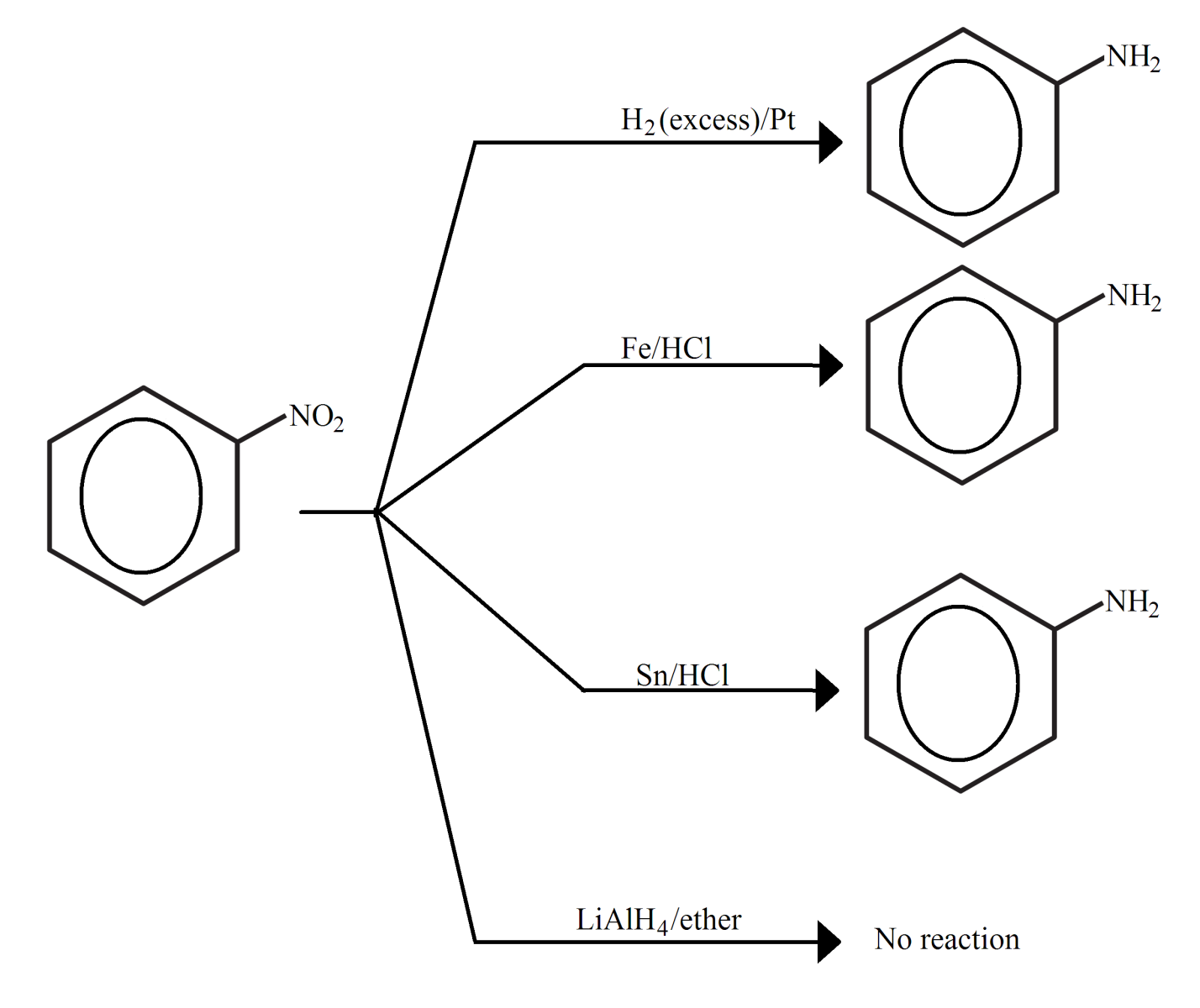
Which of the following reagents would not be a good choice for reducing an aryl nitro compound to an amine?
Answer
Aryl nitro compound cannot be converted into amine using $\ce{LiAlH_4}$ in ether.
View full question & answer
Question 121 Mark
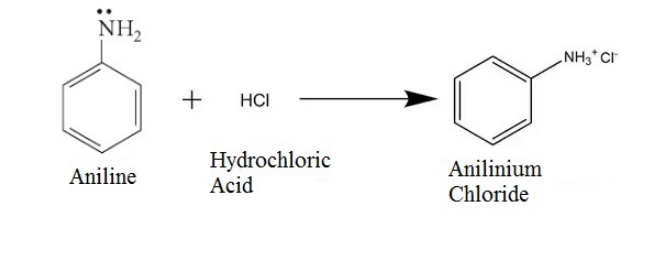
Aniline dissolves in HCl due to the formation of:
Answer
  1. Anilinium chloride
Explanation:
Aniline is basic in nature and HCl is an acid. So, acid - base reaction will take place.
In aniline, the lone pair of electrons is partially delocalized into the benzene ring and is thus, available for protonation by an acid.
Hence, aniline dissolves in acid like HCl forming anilinium chloride salt.
View full question & answer
Question 161 Mark
The total number of $\sigma$ and $\pi$ bonds present in azobenzene are:
Answer
  1. $25\sigma, 7\pi$
Explanation:
A single bond contains $1\sigma-$bond and a double bond contains one $\sigma$ and one $\pi-$bond. 
Azobenzene contains $25\sigma$ bonds and $7\pi$ bonds.
The total number of σ and pi bonds present in azobenzene are:
View full question & answer
Question 171 Mark
The correct order of boiling points of the following amines $\ce{C_4​H_9​NH_2​, (C_2​H_5​)_2​NH, C_2​H_5​N(CH_3​)_2}$​ is$:$
Answer
Because $\ce{C_4​H_9​NH_2}$​ is primary amine and can form hydrogen bonding more than secondary amine $\ce{(C_2​H_5​)_2​NH}$ and tertiary amine $\ce{C_2​H_{5​}N(CH_3​)_2}​.$ More hydrogen bonding leads to strong bonding between the molecules, hence increases the boiling point.
View full question & answer
Question 181 Mark
The correct order of increasing basic nature for the bases $\ce{NH_3​, CH_3​NH_2​}$ and $\ce{(CH_3​)_2​NH}$ is?
Answer
$\ce{(H_3​C)_2​NH, CH_3​NH_2​, NH_3​}$
Among the above molecules $\ce{(CH_{3})_2​NH}$ is most basic as two electron donating group are attached to it which increase its basicity is $\ce{NH_3 ​< CH_3​NH_2​ < (CH_3)​_2NH}$
View full question & answer
Question 191 Mark
The test used to distinguish primary, secondary and tertiary amines is:
Answer
$\ce{C_{6​}H_5​SO_2​Cl}$
View full question & answer
Question 201 Mark
When only two hydrogen atoms are attached to the nitrogen of an amine, it is classified as a ________ amine.
Answer
  1. Primary
Explanation:
When an amine has two hydrogen atoms individually bonded to the nitrogen, it means that the third group is an alkyl or aryl substituent. This is called as a primary or 1° amine as only one H atom is replaced.
View full question & answer
Question 211 Mark
Benzyl amine is............. basis than aniline while ethyl amine is..............basis than diethyl amine 
Answer
  1. More, less
Explanation:
Benzyl amine is more basic than anniline.
while ethyl amine is less basic than diethyl amine.
View full question & answer
Question 221 Mark
For the successful diazotization of arylamines, how many mole of mineral acid $\ce{(HCl}$ or $\ce{H_2​SO_4​)}$ are required for each mole of the amine?
Answer
$3$
View full question & answer
Question 231 Mark
The best reagent for converting, $2-$phenylpropanamide into $1-$phenylethanamine is$.......$
Answer
$\text{CH}_3-\text{CH}-\text{CONH}_2\xrightarrow[\text{(Hofmann's bromamide reaction)}]{\text{Br}_2/\text{N}_\text{a}\text{OH}}\text{CH}_3-\text{CH}-\text{NH}_2\\\ \ \ \ \ \ \ \ \ \ \ \ \ |\ \ \ \ \ \ \ \ \ \ \ \ \ \ \ \ \ \ \ \ \ \ \ \ \ \ \ \ \ \ \ \ \ \ \ \ \ \ \ \ \ \ \ \ \ \ \ \ \ \ \ \ \ \ \ \ \ \ \ \ \ \ \ \ \ \ \ \ \ \ \ \ \ \ \ \ \ \ \ \ \ \ |\\\ \ \ \ \ \ \ \ \ \ \ \ \text{C}_6\text{H}_5\ \ \ \ \ \ \ \ \ \ \ \ \ \ \ \ \ \ \ \ \ \ \ \ \ \ \ \ \ \ \ \ \ \ \ \ \ \ \ \ \ \ \ \ \ \ \ \ \ \ \ \ \ \ \ \ \ \ \ \ \ \ \ \ \ \ \ \ \ \ \ \ \ \ \text{C}_6\text{H}_5\\2-\text{Phenylpropanamide}\ \ \ \ \ \ \ \ \ \ \ \ \ \ \ \ \ \ \ \ \ \ \ \ \ \ \ \ \ \ \ \ \ \ \ \ \ \ \ \ 1-\text{Phenyletanamine}$
View full question & answer
Question 241 Mark
What is the expected geometry of $\ce{CH_{3 }- NH - CH_3}$?
Answer
$\ce{CH_3 - NH - CH_3}$ is an amine in which two hydrogen atoms are replaced by methyl groups.
The hybridisation of $N$ atom of amines is same as that of ammonia, and is also expected to have a pyramidal geometry, with $N$ at the apex and the groups $\ce{CH_3, H}$ and $\ce{CH_3}$ occupying the corners of a trigonal base.
View full question & answer
Question 261 Mark
Which of the following is the correct order of the boiling points?
Answer
  1. Propane < Ethylamine < Ethyl alcohol.
Explanation:
The following is the correct order of the boiling points.
propane < ethylamine < ethyl alcohol
In general, amines have higher boiling points than alkanes but lower boiling points than alcohols.
View full question & answer
Question 271 Mark
Which of the following is the $\text{IUPAC}$ name of the compound in which one hydrogen of ammonia is replaced by an ethyl group?
Answer
Ethylamine and aminoethane are the names of $\ce{CH_3CH_2NH_2}$ according to the common system and second system respectively. In the $\text{IUPAC}$ system, the naming is done by replacing the $' e \ '$ of the alkane by amine.
View full question & answer
Question 291 Mark
The source of nitrogen in Gabriel synthesis of amines is $..... .$
Answer
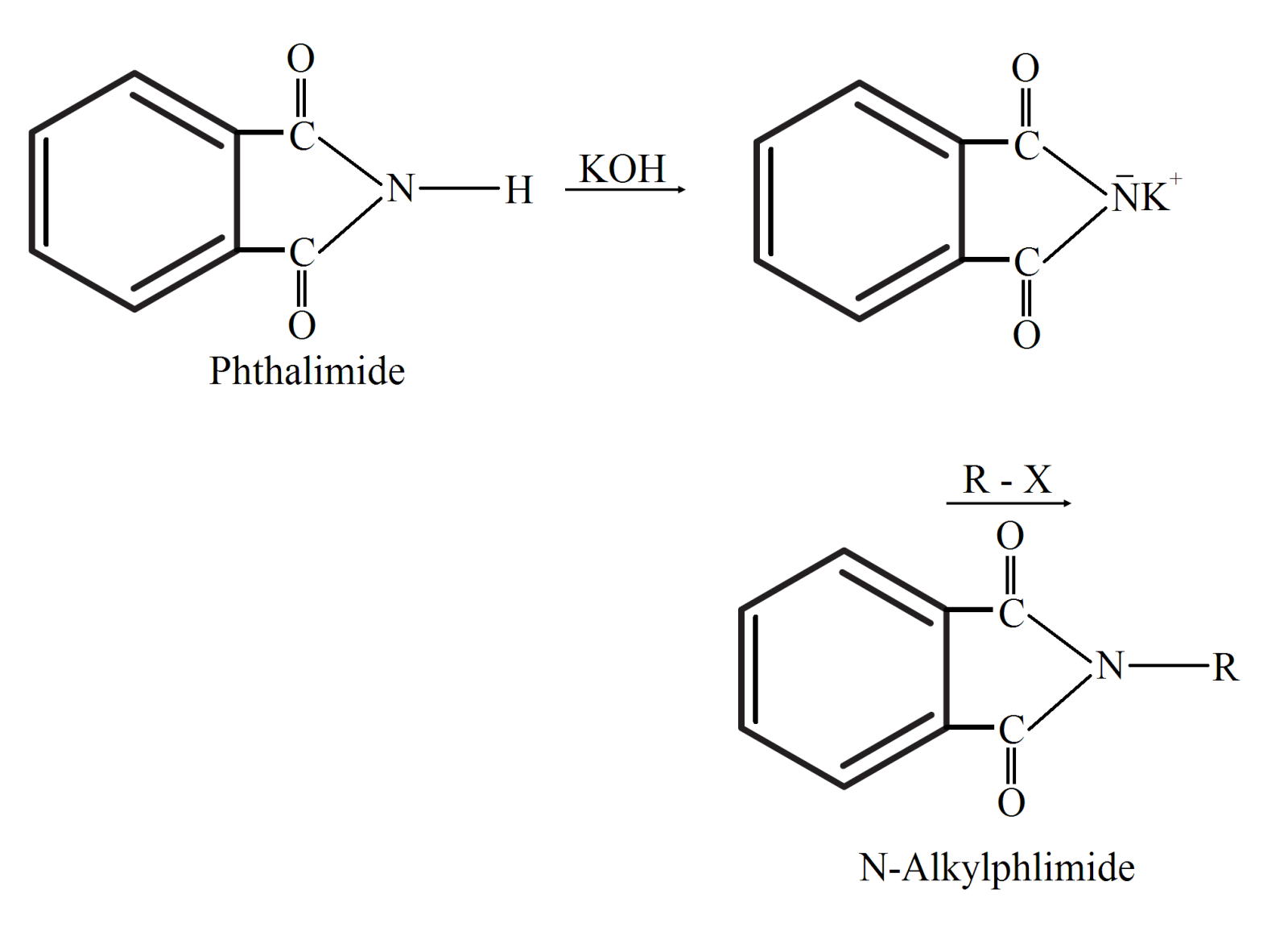
Potassium phthalimide $,\ce{C_6H_4(CO)_2N^–K^+}$.
Gabriel synthesis is used for the preparation of primary amines.
Phthalimide on treatment with ethanolic potassium hydroxide forms potassium salt of phthalimide which on heating with alkyl halide followed by alkaline hydrolysis produces the corresponding primary amine.
Aromatic primary amines cannot be prepared by this method because aryl halides do not undergo nucleophilic substitution with the anion formed by phthalimide.
View full question & answer
Question 301 Mark
By the presence of a halogen atom in the ring, basic properties of aniline is:
Answer
  1. Increased
Explanation:
By the presence of a halogen atom in the ring, basic properties of aniline is increased because it is more electronegative so donation of electron will be easy, so basicity increases.
View full question & answer
Question 311 Mark
Which of the following cannot be prepared by Sandmeyer’s reaction?
Answer
  1. Iodobenzene.
  2. Fluorobenzene.
Explanation:
Chloro and bromo arenes are easily prepared by Sandmeyer’s reaction. Iodoarenes are prepared by simply warming the diazonium salt solution with aqueous KI solution.
Fluoroarenes are prepared by Balz-Schiemann reaction.
All other reagents give aniline.
View full question & answer
Question 321 Mark
The correct order of the basic strength of methyl substitited amines in aqueous solution is$:$
Answer
In aqueous solution, electron donating inductive effect, solvation effect $(H-$bonding$)$ and steric hindrance all together affect basic strength of substituted amines.
Basic character$:$
$(\text{CH}_3)_2\text{NH}>\text{CH}_3\text{NH}_2>(\text{CH}_3)_3\text{N}$
$\ \ \ \ \ \ \ \ \ 2^\circ\ \ \ \ \ \ \ \ \ \ \ \ \ \ \ \ \ \ 1^\circ\ \ \ \ \ \ \ \ \ \ \ \ \ \ \ \ 3^\circ$
View full question & answer
Question 331 Mark
What is the geometry of ammonia molecule?
Answer
The nitrogen atom of ammonia undergoes hybridisation to form $4 sp^3$ orbitals. Three of these overlap with s orbital of $H$ forming three $N-H$ bonds.
This results in a pyramidal geometry with $N$ atom at the apex and three H atoms at the corners of a triangle base.
View full question & answer
Question 341 Mark
Which of the following is obtained by reducing methyl cyanide with $\ce{Na + C_2​H_5​OH}$?
Answer
Sodium in alcohol is a strong reducing agent and reduces nitriles to amines.
$\ce{CH_3​ − CN + Na + C_2​H_5​OH \rightarrow C_2​H_5 ​− NH_2}$
This reaction is also known as Mendius Reduction.
View full question & answer
Question 351 Mark
Which of these alkyl halides can be used to prepare amines using Gabriel phthalimide synthesis?
Answer
  1. 1 - bromo - 3 - methylpentane
View full question & answer
Question 361 Mark
Which of the following is most basic?
Answer
Benzylamine $\ce{C_6​H_5​CH_2​NH_2}$​ is more basic because benzyl group is electron donating group due to $+I$ effect.
So it is able to increase electron density of $N$ of $\ce{-NH_2}$​ group.
Thus due to higher electron density rate of donation of a free pair of electron is increased I.e basic character is higher While phenyl and nitro group are electron withdrawing group so they are able to decrease the electron density of $N$ of $\ce{−NH_2}$​ group. Hence they are less basic.
View full question & answer
Question 371 Mark
The molecule which does not exhibit strong hydrogen bonding is$:$
Answer
The molecule which does not exhibit strong hydrogen bonding is diethylether $\ce{CH_3​ − O − CH_3}​.$ Hydrogen bonding is possible when $H$ atom is attached to an electronegative $N,O$ or $F$ atom.
View full question & answer
Question 381 Mark
The correct statement among the following is:
Answer
  1. The order of boiling point of isomeric amines is primary > secondary > tertiary.
Explanation:
  1. Boiling point of amines have high boiling point due to presence of hydrogen bonding between amine molecules.
  2. But the boiling point decreases with increase in alkyl groups attached to the N atom, because the number of H atoms present for hydrogen bonding decreases.
View full question & answer
Question 391 Mark
Aniline and methyl amine can be differentiated by:
Answer
  1. Diazotisation followed by coupling with phenol.
Explanation:
Phenol react with aniline to give diazonium salt by coupling but Methyl amine not react with phenolss.
View full question & answer
Question 401 Mark
In order to prepare a $1^\circ$ amine from an alkyl halide with simultaneous addition of one $\ce{CH_2}$ group in the carbon chain, the reagent used as source of nitrogen is $........ . $
Answer
$\text{KCN}$ is used to increase number of carbon atoms.
$\text{RX + KCN}\xrightarrow{\ \ \ \ \ \ }\text{RCN}+\text{KX}$
$\text{R}-\text{CN}+4\text{H}\xrightarrow[]{\text{H}_2/\text{Raney Ni}}\text{RCH}_2\text{NH}_2$
View full question & answer
Question 411 Mark
$\ce{C_3​H_9​N}$ cannot represent:
Answer
Quaternary salts of ammonia contain atleast $4$ carbon atoms
Here we are given only $3$ carbon atoms
So, it cannot represent a quaternary salt
View full question & answer
Question 421 Mark
In the diazotization of aryl amines with sodium nitrite and hydrochloric acid, an excess of hydrochloric acid is used primarily to :
Answer
  1. Supress the concentration of free aniline available for coupling.
Explanation:
 
If excess HCl is not used, the arene diazonium salt will react with free aniline to form azo compound.
Excess HCl forms hydrochloride salt of aniline. This prevents azo coupling.
View full question & answer
Question 431 Mark
By heating ammonium chloride with two equivalents of formaldehyde it forms$:$
Answer
$\ce{6HCHO + 4NH_{4​}Cl \rightarrow (CH_{2​6})N_4 ​+ 4HCl + 6H_2O}$ So Methylamine is formed
View full question & answer
Question 451 Mark
What is the decreasing order of basicity?
Answer
$\ce{(C_2​H_5​)_{2​}NH > C_2​H_5​NH_2 ​> (C_2​H_5​)_3​N > NH_3}$
View full question & answer
Question 461 Mark
Basic strength of different alkyl amines depends upon:
Answer
  1. All of these
Explanation:
The basic strength of different alkyl amines depends on many factors like:
  1. +I effect is the polarization of a sigma bond due to electron donating effect of adjacent groups or atoms.
  2. In water, the ammonium salts of primary and secondary amines undergo solvation effects due to hydrogen bonding to a much greater degree than ammonium salts of tertiary amines.
  3. Steric effect is the effect faced by incoming group or hydrogen by the already present bulky −R groups on the Nitrogen atom.
View full question & answer
Question 471 Mark
Which of the following amine will be prepared by Gabriel phthalimide reaction?
Answer
  1. N - Butylamine
Explanation:
Gabriel phthalimide reaction is used to prepare primary unhindered amine only. because in Gabriel phthalimide reaction no other place for nitrogen, therefor it attack at terminal position only and after hydrolysis it give primary amine i.e N - Butylamine.
Which of the following amine will be prepared by Gabriel phthalimide reaction?
View full question & answer
Question 481 Mark
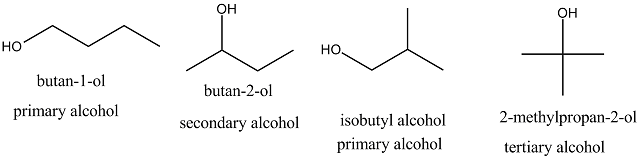
Which compound is a secondary alcohol?
Answer
  1. Butan - 2 - ol
Explanation:
Butan - 2 - ol is a secondary alcohol. The −OH group is attached to a C atom which is attached to 2 other C atoms and 1 H atom.
View full question & answer
Question 491 Mark
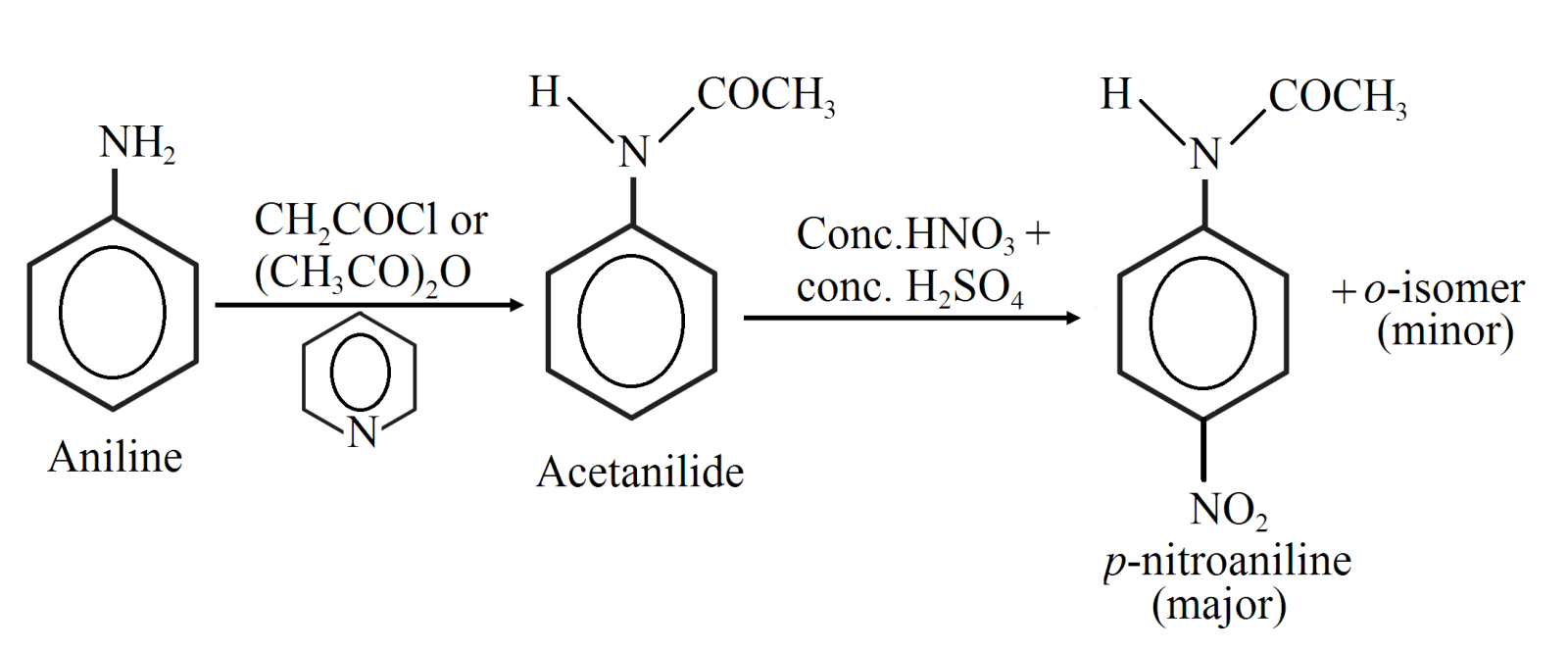
Under which of the following reaction conditions, aniline gives $p-$ nitro derivative as the major product?
Answer
Acetyl chloride/ pyridine followed by reaction with conc. $\ce{H_2SO_4+}$ conc. $\ce{HNO_3}$.
Acetic anyhdride/ pyridine followed by conc. $\ce{H_2SO_4 +}$ conc. $\ce{HNO_3}$.
Aniline or reaction with acetyl chloride or acetic anhydride in the presence of pyridine produces $N-$ acetyl aniline which is a ortho, para directing group which on further reaction with nitrating mixture $($cone.$\ce{HNO_{3 }}+$ conc. $\ce{H_2SO_4)}$ produces $p-$ nitroaniline preferentially as shown below:
View full question & answer
Question 501 Mark
Alkyl and aryl amines are prepared using which of the following reducing agent.
Answer
Alkyl and aryl cyanides $($nitriles$)$ can be reduced to their corresponding primary amines using lithium aluminium hydride $\ce{(LiAlH_4​)}$ or catalytic hydrogenation.
View full question & answer
M.C.Q (1 Marks) - Chemistry STD 12 Science Questions - Vidyadip