MCQ 11 Mark
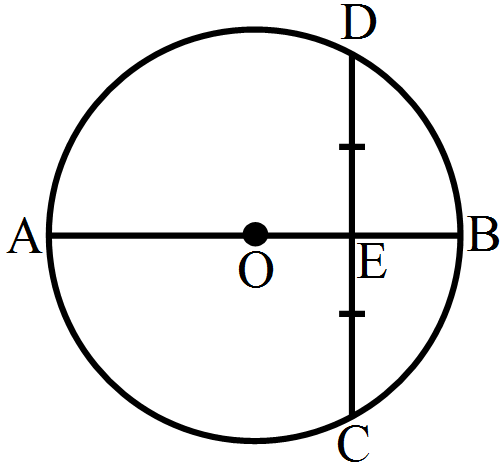
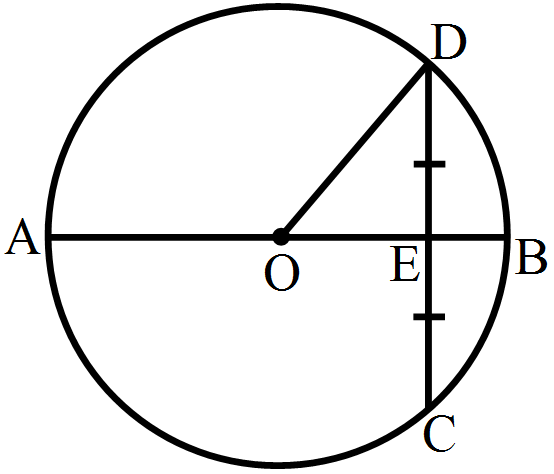
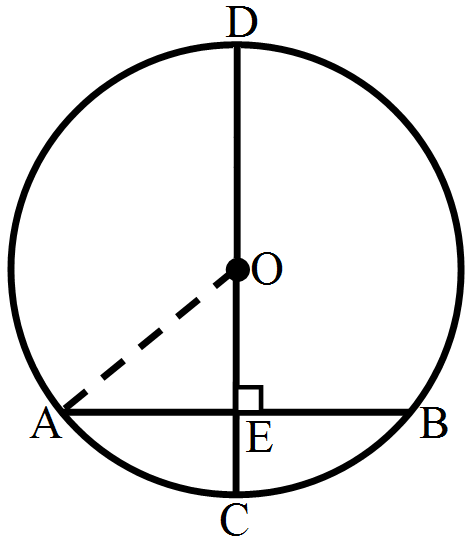
In the given figure$, CD$ is the diameter of a circle with centre $O$ and $CD$ is perpendicular to chord $AB.$ If $AB = 12\ cm$ and $CE = 3\ cm,$ then radius of the circles is:
- A$6\ cm$
- B$9\ cm$
- ✓$7.5\ cm$
- D$8\ cm$
Answer
View full question & answer→Correct option: C.
$7.5\ cm$
$OA = OC$
$\Rightarrow OA = OE + CE$
$\Rightarrow OA = OE + 3$
$\Rightarrow OE = OA - 3 ...(i)$
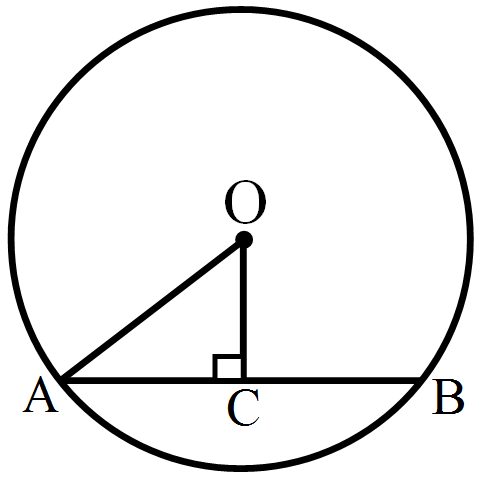
$\text{AE}=\frac{1}{2}\text{AB}$ [Perpendicular drawn from the centre of a circle to the chord bisect the chord]
$=\frac{1}{2}(12)=6\text{ cm}$
In right $\triangle\text{OEA},$
$OA^2 = OE^2 + AE^2$
$\Rightarrow OA^2 = (OA - 3)^2 + AE^2 [$From $(i)]$
$\Rightarrow OA^2 = OA^2 - 6OA + 9 + AE^2$
$\Rightarrow 6OA = 9 + 6^2$
$\Rightarrow 6OA = 9 + 36$
$\Rightarrow\ \text{OA}=\frac{45}{6}=7.5\text{ cm}$
So, the radius of the circle is $7.5\ cm.$
$\Rightarrow OA = OE + CE$
$\Rightarrow OA = OE + 3$
$\Rightarrow OE = OA - 3 ...(i)$
$\text{AE}=\frac{1}{2}\text{AB}$ [Perpendicular drawn from the centre of a circle to the chord bisect the chord]
$=\frac{1}{2}(12)=6\text{ cm}$
In right $\triangle\text{OEA},$
$OA^2 = OE^2 + AE^2$
$\Rightarrow OA^2 = (OA - 3)^2 + AE^2 [$From $(i)]$
$\Rightarrow OA^2 = OA^2 - 6OA + 9 + AE^2$
$\Rightarrow 6OA = 9 + 6^2$
$\Rightarrow 6OA = 9 + 36$
$\Rightarrow\ \text{OA}=\frac{45}{6}=7.5\text{ cm}$
So, the radius of the circle is $7.5\ cm.$