Questions

5 Marks Questions

🎯

Test yourself on this topic

7 questions · timed · auto-graded

Question 15 Marks
If diagonals of a cyclic quadrilateral are diameters of the circle through the vertices of the quadrilateral, prove that it is a rectangle.
Answer
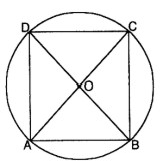
$\triangle OAB$ and $\triangle OCD$
$OA = OC [$Radii of a circle$]$
$OB = OD$ |Radii of a circle
$\angle AOB = \angle COD \ [$Vertically opposite angles$]$
$\therefore \triangle OAB \cong \triangle OCD |SAS$ rule
$\therefore AB = CD\  [c.p.c.t]$
$\Rightarrow$ Ar $CAB =$ Ar $\text{CCD} ---- (1)$
Similarly, we can show that
$\Rightarrow$ Arc $AD =$ Arc $CB ---- (2)$
Adding $(1)$ and $(2),$ we get
Arc $AB +$ Arc$ AD =$ Arc $CD +$ Arc $CB$
$\Rightarrow$ Ar $cBAD =$ Arcn $BCD$
$\Rightarrow BD$ divides the circle into two equal parts $($each a semicircle$)$
$\therefore \angle A = 90^\circ, \angle C \ [$Angle of a semi$-$circle is $90^\circ]$
Similarly, we can show that
$\angle B = 90^\circ, \angle D = 90^\circ$
$\therefore \angle A = \angle B = \angle C = \angle D = 90^\circ$
$\therefore ABCD$ is a rectangle.
View full question & answer
Question 25 Marks
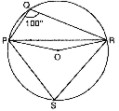
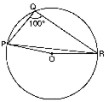
In figure, $\angle \mathrm { PQR } = 100 ^ { \circ }$, where $P, Q$ and $R$ are points on a circle with centre $O.$ Find $\angle O P R$
Answer
Take a point $S$ in the major arc. Join $PS$ and $RS.$

$\because PQRS$ is a cyclic quadrilateral.
$\therefore \angle \mathrm { PQR } + \angle \mathrm { PSQ } = 180 ^ { \circ }$
|The sum of either pair of opposite angles of a cyclic quadrilateral is $180^\circ$
$\Rightarrow 100 ^ { \circ } + \angle P S R = 180 ^ { \circ }$
$\Rightarrow \angle P S R = 180 ^ { \circ } - 100 ^ { \circ }$
$\Rightarrow \angle P S R = 80 ^ { \circ } ......... (1)$
Now, $\angle \mathrm { POR } = 2 \angle \mathrm { PSR }$
|The angle subtended by an arc at the centre is double the angle subtended by it at any point on the remaining part of the circle
$= 2 \times 80 ^ { \circ } = 160 ^ { \circ } ........ (2) |$Using $(1)$
In $\triangle O P R$
$\because O P = O R$ |Radii of a circle
$\therefore \angle \mathrm { OPR } = \angle \mathrm { ORP } ....... (3)$
|Angles opposite to equal sides of a triangle are equal
In $\triangle O P R$
$\angle O P R + \angle O R P + \angle P O R = 180 ^ { \circ }$ | Sum of all the angles of a triangle is $180^\circ$
$\Rightarrow \angle \mathrm { OPR } + \angle \mathrm { OPR } + 160 ^ { \circ } = 180 ^ { \circ }$ |Using $(2)$ and $(1)$
$\Rightarrow 2 \angle O P R + 160 ^ { \circ } = 180 ^ { \circ }$
$\Rightarrow 2 \angle O P R = 180 ^ { \circ } - 160 ^ { \circ } = 20 ^ { \circ }$
$\Rightarrow \angle \mathrm { OPR } = 10 ^ { \circ }$
View full question & answer
Question 35 Marks
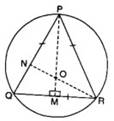
The circular park of radius $20 m$ is situated in a colony. Three boys Ankur, Syed and David are sitting at equal distance on its boundary each having a toy telephone in his hands to talk each other. Find the length of the string of each phone.
Answer
Construction: Draw $PM \perp QR$ and $RN \perp PQ$
Determination : $PQ = QR = RP$
$\therefore \triangle PQR$ is equilateral. We know that in an equilateral triangle, the medians and the altitudes are the same. So, $PM$ and $RN$ are median. They intersect at $O$ where $O$ is the centre of the circle.

Also, $PO = 2 \ OM = 20 ($medians intersect each other in the ratio $2: 1)$
$\Rightarrow OM = 10 m \Rightarrow PM = OP + OM = 20 + 10 = 30 m$
Let $QM = x$
Then, $QM = MR = x [\because PM$ bisects $QR]$
$\therefore QM = \frac {1} {2}QR \Rightarrow x = \frac {1} {2}QR \Rightarrow QR = 2x$
Similarly, $PQ = 2x$
In right triangle $PMQ,$
$PQ^2 = PM^2 + QM^2 $ By Pythagoras Theorem
$\Rightarrow (2x)^2 = (30)^2 + x^2$
$\Rightarrow 4x^2 = 900 + x^2$
$\Rightarrow 4x^2 - x^2 = 900$
$\Rightarrow 3x^2 = 900$
$\Rightarrow x^{2}=\frac{900}{3}=300$
$\Rightarrow x=\sqrt{300}=10 \sqrt{3}$
$\Rightarrow PQ = 2x = 2(10 \sqrt{3})$
Hence, the length of the string of each phone is $20 \sqrt{3} m.$
View full question & answer
Question 45 Marks
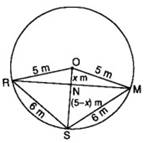
Three girls Reshma, Salma and Mandip are playing a game by standing on a circle of radius $5 m$ drawn in a park. Reshma throws a ball to Salma. Salma to Mandip, Mandip to Reshma. If the distance between Reshma and Salma and between Salma and Mandip is 6 m each, what is the distance between Reshma and Mandip?
Answer

In $\Delta \mathrm { NOR }$ and $\Delta \mathrm { NOM }$
$ON = ON$ Common
$\angle \mathrm { NOR } = \angle \mathrm { NOM }$
$ \because$ Equal chords of a circle subtend equal
angle at the centre
$OR = OM$ Radii of a circle
$\therefore \triangle \mathrm { NOR } \cong \Delta \mathrm { NOM } \ [\text{SAS}$ Rule$]$
$\therefore \angle O N R = \angle O N M \ [\text{c.p.c.t}]$
and $NR = NM \ [\text{c.p.c.t.}]$
But $\angle O N R + \angle O N M = 180 ^ { \circ }$ Linear Pair Axiom
$\therefore \angle O \mathrm { NR } = \angle \mathrm { O } \mathrm { NM } = 90 ^ { \circ }$
$\triangle ON$ is the perpendicular bisector of $RM,$
Draw bisector $SN$ of $\angle \mathrm { R } \mathrm { SM }$ to intersect the chord $RM$ in $N.$
In $\Delta \mathrm { RSN }$ and $\Delta \mathrm { MSN }$
$RS = MS \ (= 6 \ cm$ each$)$
$SN = SN \ [$Common$]$
$\angle R S N = \angle M S N$ [By construction]
$\therefore \Delta R S N \cong \Delta \mathrm { NSN } [\text{SAS}$ Rule$]$
$\therefore \angle R N S = \angle M N S \ [\text{c.p.c.t}]$
and $RN = MN [\text{c.p.c.t}]$
But $\angle \mathrm { RNS } + \angle \mathrm { MNS } = 180 ^ { \circ }$ Linear Pair Axion
$\therefore \angle R N S = \angle M N S = 90 ^ { \circ }$
$\therefore \mathrm { SN }$ is the perpendicular bisector of $RM$ and therefore passes through $O$ when produced.
Let $ON = x \ m$
Then $SN = (5 - x) m$
In right triangle $ONR,$
$x^2 + RN^2= 5^2, .....(1)$ By Pythagoras theorem
In right triangle $SNR,$
$(5-x)^2 + RN^2 = 6^2.....(2)$ By Pythagoras theorem
From $(1),$
$RN^2 = 5^2 - x^2$
From $(2),$
$RN^2 = 6^2 - (5 - x)^2$
Equating the two values of $RN^2,$ we get
$5^2 - x^2 = 6^2 - (5 -x)^2$
$\Rightarrow 25 - x ^ { 2 } = 36 - ( 25 - 10 x + x ) ^ { 2 }$
$\Rightarrow 25 - x ^ { 2 } = 36 - 25 + 10 x - x ^ { 2 }$
$\Rightarrow 25 - x ^ { 2 } = 11 + 10 x - x ^ { 2 }$
$\Rightarrow 25 - 11 = 10 x$
$\Rightarrow 14 = 10 x $
$ \Rightarrow10x = 14$
$\Rightarrow x = \frac { 14 } { 10 } = 1.4$
Putting $x = 1.4$ in $(1),$ we get
$(1.4)^2 + RN^2 = 5^2$
$\Rightarrow R N ^ { 2 } = 5 ^ { 2 } - ( 1.4 ) ^ { 2 }$
$ \Rightarrow \mathrm { RN } ^ { 2 } = 25 - 1.96$
$\Rightarrow \mathrm { RN } ^ { 2 } = 23.04$
$ \Rightarrow \mathrm { RN } = \sqrt { 23.04 }$
$\Rightarrow RN = 4.8$
$\therefore RM = 2 RN = 2 \times 4.8 \mathrm { m } = 9.6 \mathrm { m }$
Hence, the distance between Reshma and Mandip is $9.6 m.$
View full question & answer
Question 55 Marks
If two equal chords of a circle intersect within a circle, prove that the segments of one chord are equal to corresponding segments of the other chord.
Answer
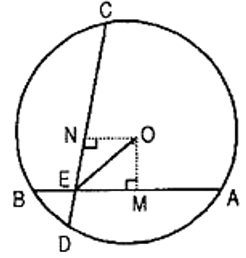
Given: Let AB and CD are two equal chords of a circle of centers
O intersecting each other at point E within the circle.
To prove: (a) AE = CE (b) BE = DE
Construction: Draw OM $\bot $ AB, ON $\bot $ CD. Also join OE.

Proof: In right triangles OME and ONE,
$\angle $OME = $\angle $ONE = 90°
OM = ON
[Equal chords are equidistance from the centre]
OE = OE [Common]
$\therefore$ $\triangle$OME $\cong$ $\triangle$ONE [RHS rule of congruency]
$\therefore$ ME = NE [By CPCT] ...(i)
Now, O is the centre of circle and OM $\bot $ AB
$\therefore$ AM = $\frac{1}{2}$ AB [Perpendicular from the centre bisects the chord] ...(ii)
Similarly, NC = $\frac{1}{2}$ CD ...(iii)
But AB = CD [Given]
From eq. (ii) and (iii), AM = NC ...(iv)
Also MB = DN ...(v)
Adding (i) and (iv), we get,
AM + ME = NC + NE
$\Rightarrow$ AE = CE [Proved part (a)]
Now AB = CD [Given] ...(v)
AE = CE [Proved] ...(vi)
Subtracting eq. (vi) from eq. (v), we have
$\Rightarrow$ AB - AE = CD - CE
$\Rightarrow$ BE = DE [Proved part (b)]
View full question & answer
Question 65 Marks
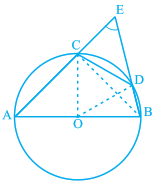
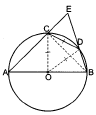
In given figure, AB is a diameter of the circle, CD is a chord equal to the radius of the circle. AC and BD when extended intersect at point E. Prove that $\angle$AEB = 60°.

View full question & answer
Question 75 Marks
If two intersecting chords of a circle make equal angles with the diameter passing through their point of intersection, prove that the chords are equal.
Answer


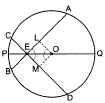
Given: AB and CD are two chords of a circle with centre O, intersecting at point E. PQ is a diameter through E, such that $\angle$AEQ = $\angle$DEQ.
To prove: AB = CD
Construction: Draw OL $\perp$ AB and OM $\perp$ CD
Proof: $\angle $LOE + $\angle $LEO + $\angle $OLE = 180° (Angle sum property of a triangle)
$\Rightarrow$ $\angle $LOE + $\angle $LEO + 90° = 180°
$\angle $LOE + $\angle $LEO =90° .........................(i)
Similarly, $\angle $MOE + $\angle $MEO + $\angle $OME = 180°
$\Rightarrow$$\angle $MOE + $\angle $MEO + 90° = 180°
$\angle $MOE + $\angle $MEO = 90° . .........................(ii)
From (i) and (ii) we get
$\angle $LOE + $\angle $LEO = $\angle $MOE + $\angle $MEO ..........(iii)
Also, $\angle $LEO = $\angle $MEO (Given) ...(iv)
From (iii) and (iv) we obtain
$\angle $LOE = $\angle $MOE
Now in triangles OLE and OME
$\angle $LEO = $\angle $MEO (Given)
$\therefore$  $\angle $LOE = $\angle $MOE (Proved above)
EO = EO (Common)
$\therefore$  by ASA congruence criterion we have:
  $\triangle$OLE $\cong$ $\triangle$ OME
$\therefore$ OL = OM ( by CPCT)
Thus, chords AB and CD are equidistant from the centre O of the circle. Since, chords of a circle which are equidistant from the centre are equal.
$\therefore$ AB = CD
View full question & answer
5 Marks Questions - MATHS STD 9 Questions - Vidyadip