Questions

4 Marks Questions

🎯

Test yourself on this topic

28 questions · timed · auto-graded

Question 14 Marks
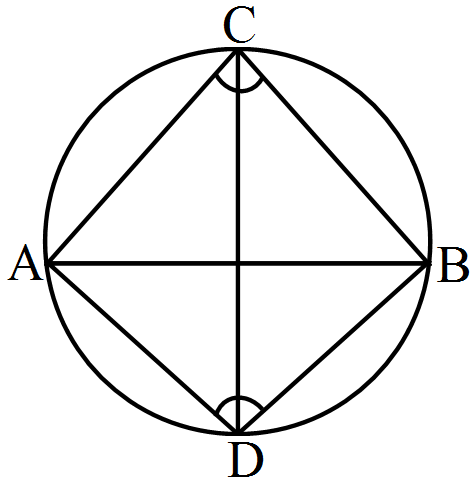
A quadrilateral ABCD is inscribed in a circle such that AB is a diameter and $\angle\text{ADC}=130^\circ.$ Find $\angle\text{BAC}.$
Answer
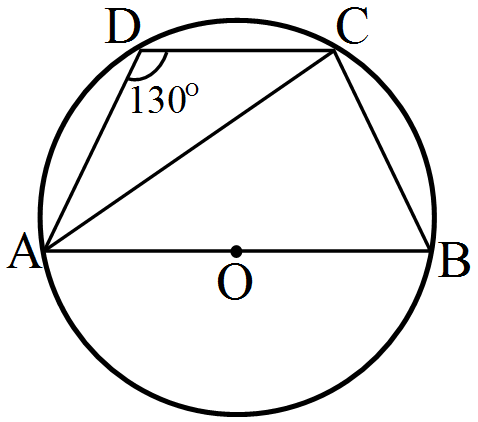
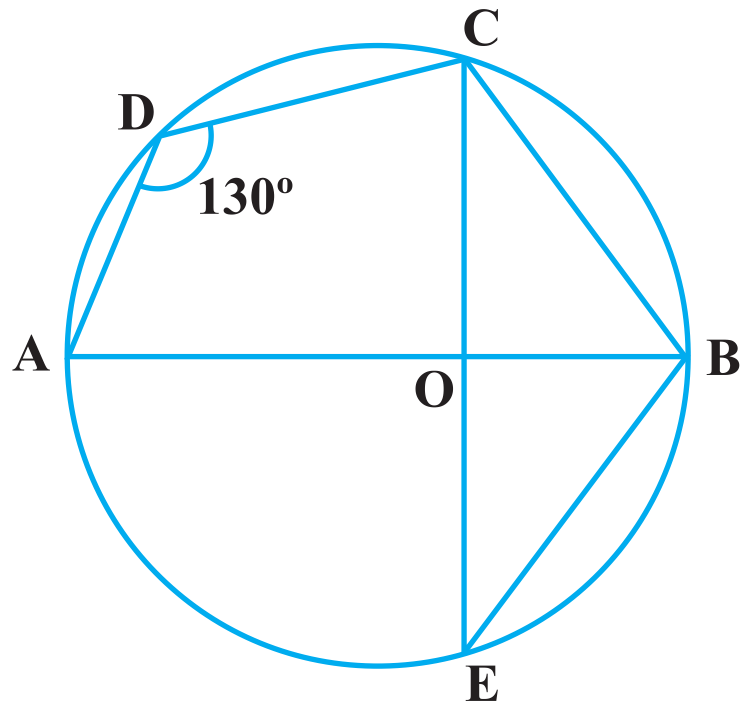
Draw a quadrilateral ABCD inscribed in a circle having centre O. Given, $\angle\text{ADC}=130^\circ$
Since, ABCD is a quadrilateral. inscribed in a circle, therefore ABCD becomes a cyclic quadrilateral.
$\because$ Since, the sum of opposite angle of a cyclic quadrilateral is 180°.
$\therefore\angle\text{ADC}+\angle\text{ABC}=180^\circ$
$\Rightarrow130^\circ+\angle\text{ABC}=180^\circ$
$\Rightarrow\angle\text{ABC}=50^\circ$
Since, AB is a diameter of a circle, then AB subtends an angle to the circle is right angle.
$\therefore\angle\text{ACB}=90^\circ$
In $\triangle\text{ABC},\ \ \angle\text{BAC}+\angle\text{ACB}+\angle\text{ABC}=180^\circ$ [by angle sum property of a triangle]
$\Rightarrow\angle\text{BAC}+90^\circ+50^\circ=180^\circ$
$\Rightarrow\angle\text{BAC}=180^\circ-(90^\circ+50^\circ)$
$=180^\circ-140^\circ=40^\circ$
View full question & answer
Question 24 Marks
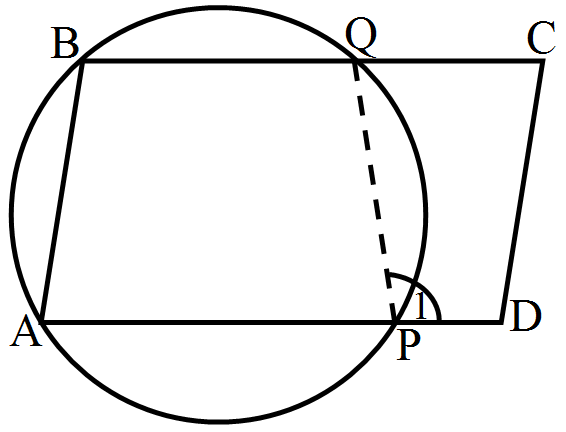
ABCD is a parallelogram. A circle through A, B is so drawn that it intersects AD at P and BC at Q. Prove that P, Q, C and D are concyclic.
Answer
ABCD is a parallelogram. A circle through A, B is so drawn that intersects AD at P and BC at Q. We have to prove that P, Q, C and D are concyclic. Join PQ.

Now, side AP of the cyclic quadrilateral APQB produced to D.
$\therefore\ \text{Ext. }\angle1=\text{int.opp. }\angle\text{B}$
$\because$ BA || CD and BC cuts them
$\therefore\angle\text{B}+\angle\text{C}=180^\circ$
[ $\because$ sum of int. $\angle\text{s}$ on the same side of the transversal is 180°]
or $\angle1+\angle\text{C}=180^\circ\ [\therefore\angle1=\angle\text{B}\ (\text{proved})]$
$\therefore$ PDCQ is cyclic quadrilateral.
Hence, the point P, Q, and are concyclic.
View full question & answer
Question 34 Marks
On a common hypotenuse AB, two right triangles ACB and ADB are situated on opposite sides. Prove that $\angle\text{BAC} = \angle\text{BDC.}$
Answer
In right triangle ACB and ADB, we have

$\angle\text{ACB}=90^\circ$ and $\angle\text{ADB}=90^\circ$
$\therefore\angle\text{ACB}+\angle\text{ADB}=90^\circ+90^\circ=180^\circ$
If the sum of any pair of opposite angle of quadrilateral is 180°, then the quadrilateral is cyclic. So, ADBC is a cyclic quadrilateral.
Join CD. Angle $\angle\text{BAC}$ and $\angle\text{BDC}$ are made by $\widehat{\text{BC}}$ in the same segment BDAC.
Hence, $\angle\text{BAC}=\angle\text{BDC}.$
[$\because$ Angles in the same segment of a circle are equal]
View full question & answer
Question 44 Marks
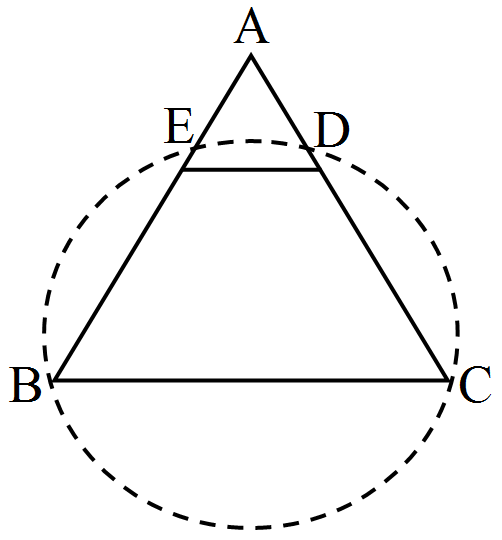
If a line is drawn parallel to the base of an isosceles triangle to intersect its equal sides, prove that the quadrilateral so formed is cyclic.
Answer
Given: $\triangle\text{ABC}$ is an isosceles triangle such that AB = AC and also DE || SC.
To prove: Quadrilateral BCDE is a cyclic quadrilateral.
Construction: Draw a circle passes through the points B, C, D and E.

Proof: In $\triangle\text{ABC},\ \ \text{AB}=\text{AC}$ [equal sides of an isosceles triangle]
$\Rightarrow\angle\text{ACB}=\angle\text{ABC}\ \ ...(\text{i})$
[angles opposite to the equal sides are equal]
Since, DE || BC
$\Rightarrow\angle\text{ADE}=\angle\text{ACB}$ [corresponding angles] ....(ii)
On adding both sides by $\angle\text{EDC}$ in Eq. (ii), we get,
$\angle\text{ADE}+\angle\text{EDC}=\angle\text{ACB}+\angle\text{EDC}$
$\Rightarrow180^\circ=\angle\text{ACB}+\angle\text{EDC}$ [$\angle\text{ADE}$ and $\angle\text{EDC}$ from linear pair aniom]
$\Rightarrow\angle\text{EDC}+\angle\text{ABC}=180^\circ$ [from Eq. (i)]
Hence, BCDE is cyclic quadrilateral, because sum opposite angles is 180°.
View full question & answer
Question 54 Marks
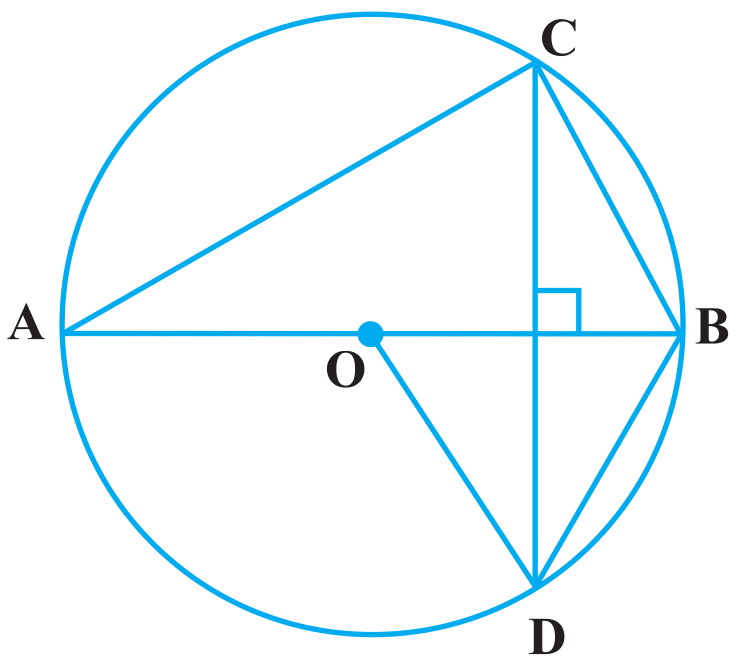
In Fig. O is the centre of the circle, BD = OD and $\text{CD}\bot\text{AB}.$ Find $\angle\text{CAB}.$
Answer
Given, in the figure $\text{BD}=\text{OD},\ \text{CD}\bot\text{AB}$

In $\triangle\text{OBD},\ \ \ \text{BD}=\text{OD}$ [given]
$\text{OD}=\text{OB}$ [both are the radius of circle]
$\therefore\text{OB}=\text{OD}=\text{BD}$
Thus, $\triangle\text{ODB}$ is an equilateral triangle.
$\therefore\angle\text{BOD}=\angle\text{OBD}=\angle\text{ODB}=60^\circ$
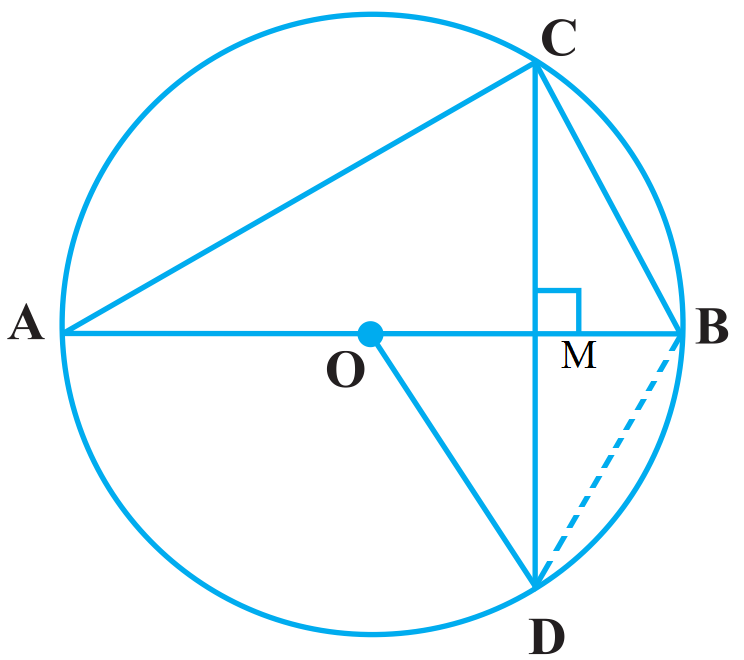
In $\triangle\text{MBC}$ and $\triangle\text{MBD},\ \ \text{MB}=\text{MB}$ [common side]
$\angle\text{CMB}=\angle\text{BMD}=90^\circ$
and CM = MD [in a circle, any perpendicular draw on a chord also bisects the chord]
$\therefore\triangle\text{MBC}=\triangle\text{MBD}$ [by SAS congruence rile]
$\therefore\angle\text{MBC}=\angle\text{MBD}$ [by CPCT]
$\Rightarrow\angle\text{MBC}=\angle\text{OBD}=60^\circ\ \ \ [\because\angle\text{OBD}=60^\circ]$
Since, AB is a diameter of the circle,
$\therefore\angle\text{ACB}=90^\circ$
In $\triangle\text{ACB},\ \ \ \angle\text{CAB}+\angle\text{CBA}+\angle\text{ACB}=180^\circ$ [by angle sum property of triangle]
$\Rightarrow\angle\text{CAB}+60^\circ+90^\circ=180^\circ$
$\Rightarrow\angle\text{CAB}=180^\circ-(60^\circ+90^\circ)=30^\circ$
View full question & answer
Question 64 Marks
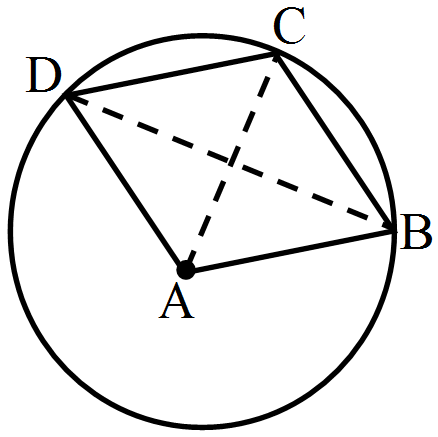
ABCD is such a quadrilateral that A is the centre of the circle passing through B, C and D. Prove that $\angle\text{CBD}+\angle\text{CDB}=\frac{1}{2}\angle\text{BAD}$
Answer
Given: In a circle, ABCD is a quadrilateral having centre A.

To prove: $\angle\text{CBD}+\angle\text{CDB}=\frac{1}{2}\angle\text{BAD}$
Construction: Join AC and BD.
Proof: Since arc DC subtends $\angle\text{DAC}$ at the centre and $\angle\text{CBD}$ at a point B in the remaining part of the circle.
$\therefore\angle\text{DAC}=2\angle\text{CBD}\ ...(\text{i})$
In a circle, the angle subtended by arc at the centre is twice the angle subtended by it at the remaining part of the circle.
Similarly, arc BC subtends $\angle\text{CAB}$ at the centre and $\angle\text{CDB}$ at a point D in the remaining part of the circle.
$\therefore\angle\text{CAB}=2\angle\text{CDB}\ ... (\text{ii})$
In a circle, the angle subtended by an arc at the centre is twice the angle subtended by it at the remaining part of the circle.
On adding Eqs. (i) and (ii), we get
$\angle\text{DAC}+\angle\text{CAB}=2\angle\text{CBD}+2\angle\text{CDB}$
$\Rightarrow\angle\text{BAD}=2(\angle\text{CBD}+\angle\text{CDB})$
$\Rightarrow\angle\text{CDB}+\angle\text{CBD}=\frac{1}{2}\angle\text{BAD}$
Hence, proved.
View full question & answer
Question 74 Marks
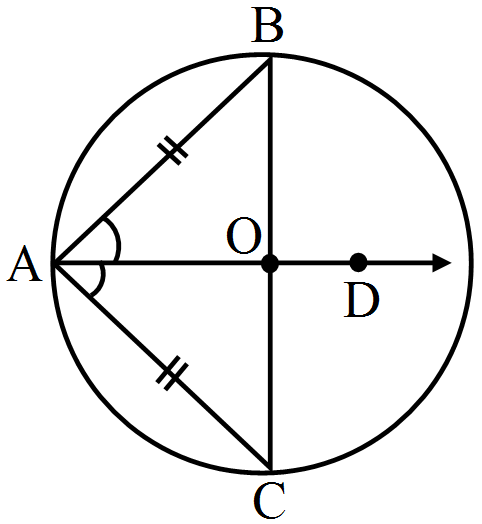
AB and AC are two equal chords of a circle. Prove that the bisector of the angle BAC passes through the centre of the circle.
Answer
Given: AS and AC are two equal chords whose centre is O.

To prove: Centre O lies on the bisector of $\angle\text{BAC}.$
Construction: Join SC, draw bisector AD of $\angle\text{BAC}.$
Proof In $\angle\text{SAM}$ and $\angle\text{CAM},$
AS = AC [given]
$\angle\text{BAM} = \angle\text{CAM}$ [given]
and AM = AM [common side]
$\therefore\triangle\text{BAM}=\triangle\text{CAM}$ [by SAS congruence rule]
$\Rightarrow\text{BM}=\text{CM}$ [by CPCT]
and $\angle\text{MBA}=\angle\text{CMA}$ [by CPCT]
So, BM = CM and $\angle\text{BMA}=\angle\text{CMA}=90^\circ$
So, AM is the perpendicular bisector of the chord BC.
Hence, bisector of $\angle\text{BAC}$ i.e., AM passes through the centre O.
View full question & answer
Question 84 Marks
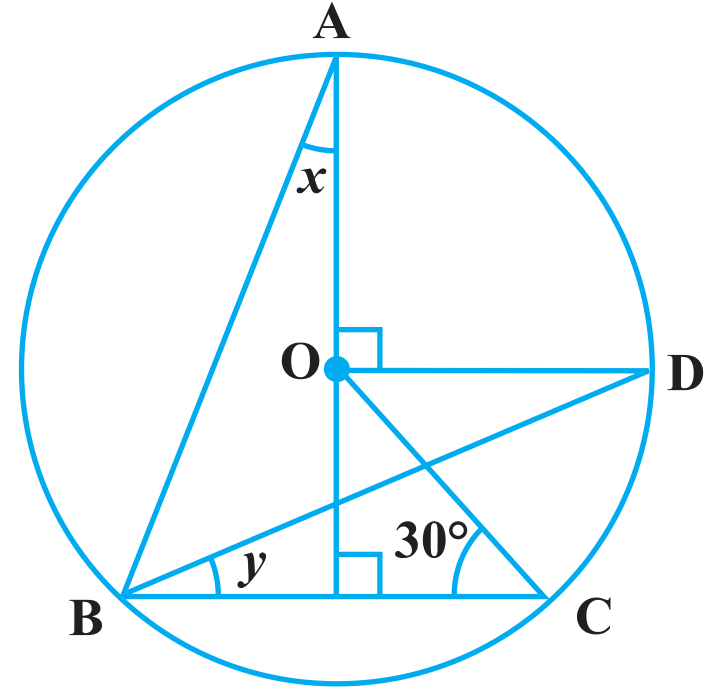
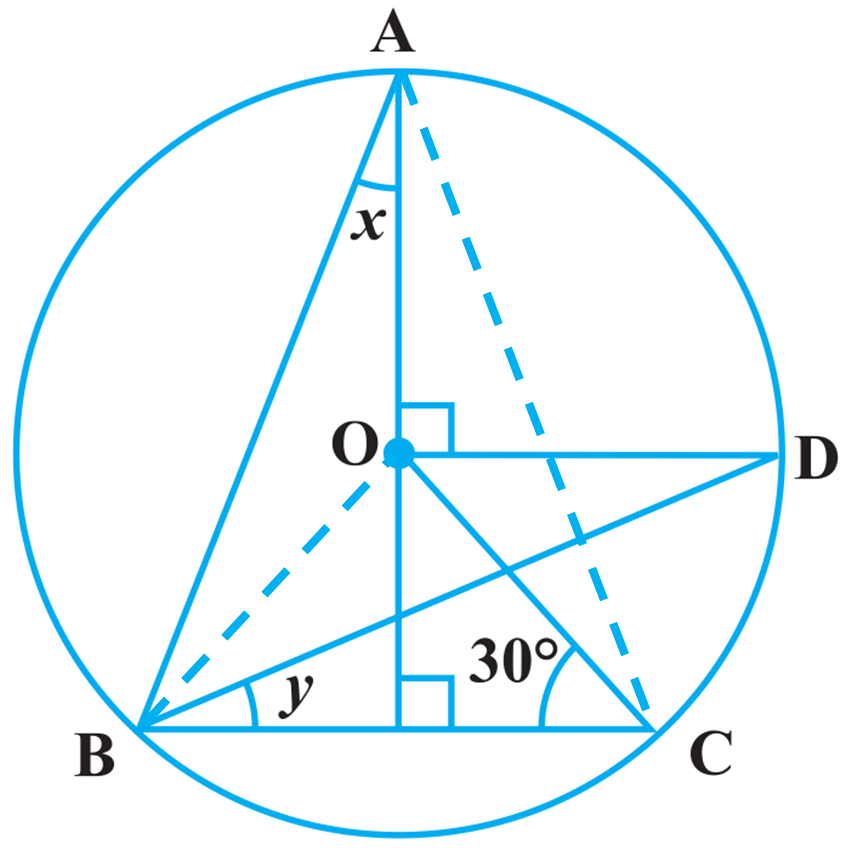
In Fig. O is the centre of the circle, $\angle\text{BCO}=30^\circ.$ Find x and y.
Answer
Given, Ois the centre of the circle and $\angle\text{BCO}=30^\circ.$ In the given figure join OB and AC.

In $\triangle\text{BOC},\ \ \ \text{CO}=\text{BO}$ [both are the radius of circle]
$\therefore\angle\text{OBC}=\angle\text{OCB}=30^\circ$ [angles opposite to equal sides are equal]
$\therefore\angle\text{BOC}=180^\circ-(\angle\text{OBC}+\angle\text{OCE})$ [by angle sum property of a triangle]
$=180^\circ-(30^\circ+30^\circ)=120^\circ$
$\angle\text{BOC}=2\angle\text{BAC}$
We know that, in a circle, the angle subtended by an arc at the centre is twice the angle subtended by it at the remaining part of the circle.
$\therefore\angle\text{BAC}=\frac{120^\circ}{2}=60^\circ$
Also, $\angle\text{BAE}=\angle\text{CAE}=30^\circ$ [AE is an angle bisector of angle A]
$\Rightarrow\angle\text{BAE}=\text{x}=30^\circ$
In $\triangle\text{ABE},\ \ \ \angle\text{BAE}+\angle\text{EBA}+\angle\text{AEB}=180^\circ$ [by angle sum property of triangle]
$\Rightarrow30^\circ+\angle\text{EBA}+90^\circ=180^\circ$
$\therefore\angle\text{EBA}=180^\circ-(90^\circ+30^\circ)=180^\circ-120^\circ=60^\circ$
Now, $\angle\text{EBA}=60^\circ$
$\Rightarrow\angle\text{ABD}+\text{y}=60^\circ$
$\Rightarrow\frac{1}{2}\times\angle\text{AOD}+\text{y}=60^\circ$
[in a circle, the angle subtended by an arc at the centre is twice the angle subtended by it at the remaining part of the circle]
$\Rightarrow\frac{90^\circ}{2}+\text{y}=60^\circ$ $[\because\angle\text{AOD}=90^\circ,\text{ given}]$
$\Rightarrow45^\circ+\text{y}=60^\circ$
$\Rightarrow\text{y}=60^\circ-45^\circ$
$\therefore\text{y}=15^\circ$
View full question & answer
Question 94 Marks
In Fig. $\angle\text{ADC}=130^\circ$ and chord BC = chord BE. Find $\angle\text{CBE}.$
Answer
In the given figure, we have $\angle\text{ADC}=130^\circ$ and chord BC = BE. We have to find $\angle\text{CBE}.$ Since ABCD is a cyclic quadrilateral and the opposite angles of a cyclic quadrilateral are supplementary.
$\therefore\angle\text{D}+\angle\text{ABC}=180^\circ$
$\Rightarrow130^\circ+\angle\text{ABC}=180^\circ$
$\Rightarrow\angle\text{ABC}=180^\circ-130^\circ=50^\circ$
$\Rightarrow\angle\text{OBC}=50^\circ....(1)$
In $\triangle\text{OBC}$ and $\triangle\text{OBE},$ we have
BC = BE [Given]
OC = OE [Radii of same circle]
OB = OB [Common side]
$\therefore\triangle\text{OBC}\cong\triangle\text{OBE}$ [By SSS cong. Rule]
$\angle\text{OBC}+\angle\text{OBE}=50^\circ$ $\big[$By C.P.C.T. and by (1) $\angle\text{OBC}=50^\circ\big]$
$\therefore\angle\text{OBC}+\angle\text{OBE}=50^\circ+50^\circ=100^\circ$
Hence, $\angle\text{CBE}=100^\circ$
View full question & answer
Question 104 Marks
A, B and C are three points on a circle. Prove that the perpendicular bisectors of AB, BC and CA are concurrent.
Answer
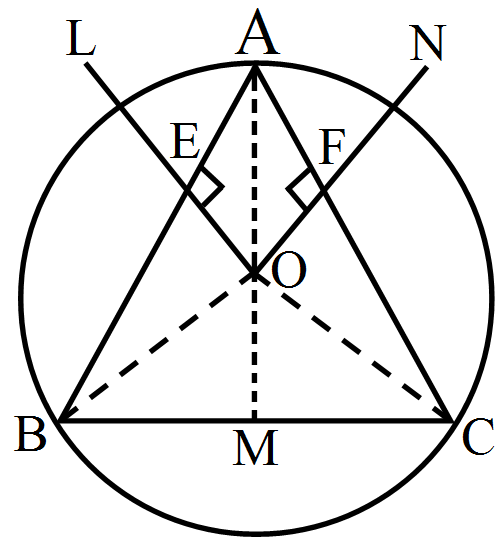
Given A circle passing through three points A, B and C.
Construction: Draw perpendicular bisectors of AB and AC and they meet at a point O. Join OA, OB and OC.
To prove: Perpendicular bisector of BC, also passes through O i.e., LO, ON and OM are concurrent.
Proof: In $\triangle\text{QEA}$ and $\triangle\text{OEB},$

AE = BE [OL is the perpendicular bisector of AB]
$\angle\text{AEO}=\angle\text{BEO}\ \ \ [\text{each } 90^\circ]$
and $\text{OE}=\text{OE}$ [common side]
$\therefore\triangle\text{OEA}\cong\text{OEB}$ [by SAS congruence rule]
$\therefore\text{OA}=\text{OB}$
Similarly $\triangle\text{OFA}=\triangle\text{OFC}$ [by SAS congruence rule]
$\therefore\text{OA}=\text{OC}$ [by CPCT]
$\therefore\text{OA}=\text{OB}=\text{OC}=\text{r}$ [say]
Now, we draw a perpendicular from O to the BC and join them.
In $\triangle\text{OMB}$ and $\triangle\text{OMC},$
$\text{OB}=\text{OC}$ [proved above]
$\text{OM}=\text{OM}$ [common side]
and $\angle\text{OMB}=\angle\text{OMC}$ [each 90°]
$\therefore\triangle\text{OMB}\equiv\triangle\text{OMC}$ [by RHS congruence rule]
$\Rightarrow\text{BM}=\text{MC}$ [by CPCT]
Hence, OM is the perpendicular bisector of BC.
Hence, OL, ON and OM are concurret.
View full question & answer
Question 114 Marks
Two equal chords AB and CD of a circle when produced intersect at a point P. Prove that PB = PD
Answer
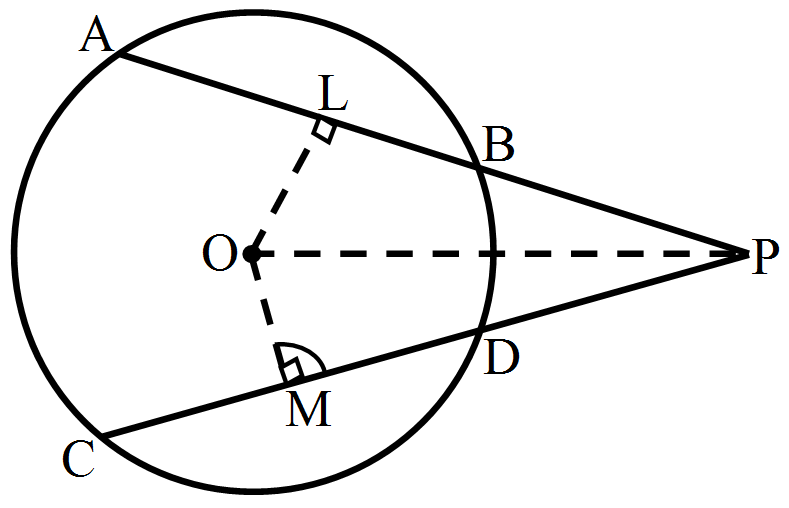
Given: Two equal chords AB and CD of a circle intersecting at a point P.

To prove: PB = PD
Construction: Join OP, draw $\text{OL}\bot\text{AB}$ and $\text{OM}\bot\text{CD}$
Proof: We have, AB = CD
$\Rightarrow\text{OL}=\text{OM}$ [equal chords are equidistant from the centre]
In $\triangle\text{OLP}$ and $\triangle\text{OMP}\ \ \text{OL}=\text{OM}$ [proved above]
$\angle\text{OLP}=\angle\text{OMP}$ [each 90°]
and OP = OP [common side]
$\therefore\triangle\text{OLP}=\triangle\text{OMP}$ [by RHS congruence rule]
$\Rightarrow\text{LP}=\text{MP}$ [by CPCT] ...(i)
Now, AB = CD
$\Rightarrow\frac{1}{2}(\text{AB})=\frac{1}{2}(\text{CD})$ [dividing both sides by 2]
$\Rightarrow\text{BL}=\text{DM}\ \ ...(\text{ii})$
[perpendicular drawn from centre to the circle bisects the chord i.e., AL = LB and CM = MD]
On subtracting Eq. (ii) from Eq. (ii) we get
LP - BL = MP - DM ⇒ PB = PD
Hence proved.
View full question & answer
Question 124 Marks
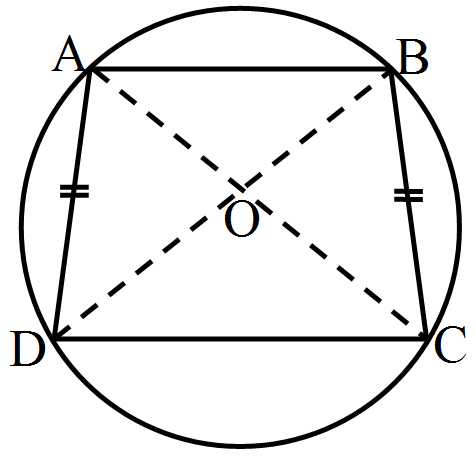
If non-parallel sides of a trapezium are equal, prove that it is cyclic.
Answer
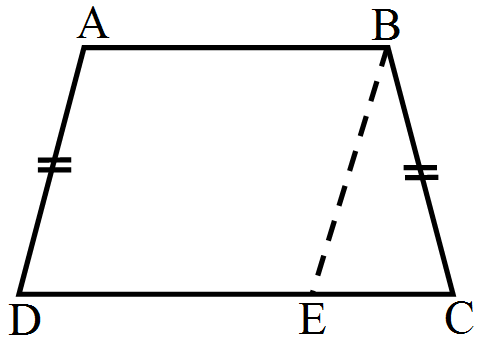
Given: ABCD is a trapezium whose non-parallel sides AD and BC are equal.

To prove: Trapezium ABCD is a cyclic
Join BE, where BE || AD.
Proof: Since, AB || DE and AD || BE
Since, the quadrilateral ABCD is a parallelogram,
$\therefore\angle\text{BAD}=\angle\text{BED}\ \ ...(\text{i})$ [opposite angles of a parallelogram are equal]
and AD = BE ...(ii) [opposite sides of a parallelogram are equal]
But, AD = BC [given] ...(iii)
From Eqs. (ii) and (iii), BC = BE
$\Rightarrow\angle\text{BEC}=\angle\text{BCE}\ \ ...\text{(iv)}$ [angle opposite to equal sides are equal]
Also, $\angle\text{BEC}+\angle\text{BED}=180^\circ$ [linear pair axiom]
$\therefore\angle\text{BCE}+\angle\text{BAD}=180^\circ$ [from Eqs. (i) and (iv)]
If sum of opposite angles of a quadrilateral is 180°, then quadrilateral is cyclic.
Hence, trapezium ABCD is a cyclic.
Hence proved.
View full question & answer
Question 134 Marks
If a pair of opposite sides of a cyclic quadrilateral are equal, prove that its diagonals are also equal.
Answer
Given: Let ABCD be a cyclic quadrilateral and AD = BC.

Join AC and BD.
To prove: AC = BD
Proof: In $\triangle\text{AOD}$ and $\triangle\text{BOC},$
$\triangle\text{OAD} = \angle\text{OBC}$ and $\angle\text{ODA} = \angle\text{OCB}$ [since, same segments subtends equal angle to the circle]
AB = BC [given]
$\triangle\text{AOD} = \triangle\text{BOC}$ [by ASA congruence rule]
Adding is DOC on both sides, we get,
$\triangle\text{AOD}+ \triangle\text{DOC} \cong \triangle\text{BOC} + \triangle\text{DOC}$
$\Rightarrow \triangle\text{ADC} \cong \triangle\text{BCD}$
AC = BD [by CPCT]
View full question & answer
Question 144 Marks
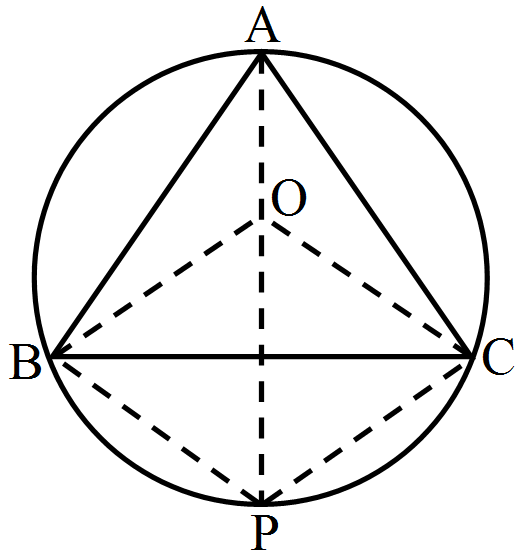
If ABC is an equilateral triangle inscribed in a circle and P be any point on the minor arc BC which does not coincide with B or C, prove that PA is angle bisector of $\angle\text{BPC}.$
Answer
Since equal choeds of a circle subtends equal angle at the centre, so we have chord AB = chord AC [Given]
So, $\angle\text{AOB}=\angle\text{AOC}\ \ ...(1)$
Since the angle subtended by an arc at the centre is double the angle subtended by it any point on the remaining part of the circle,

$\therefore\angle\text{APC}=\frac{1}{2}\angle\text{AOC}\ ...(2)$
and $\angle\text{APB}=\frac{1}{2}\angle\text{AOB}\ ...(3)$
$\therefore\angle\text{APC}=\angle\text{APB}$ [From (1), (2) and (3)]
Hence, PA is the bisector of $\angle\text{BPC}.$
View full question & answer
Question 154 Marks
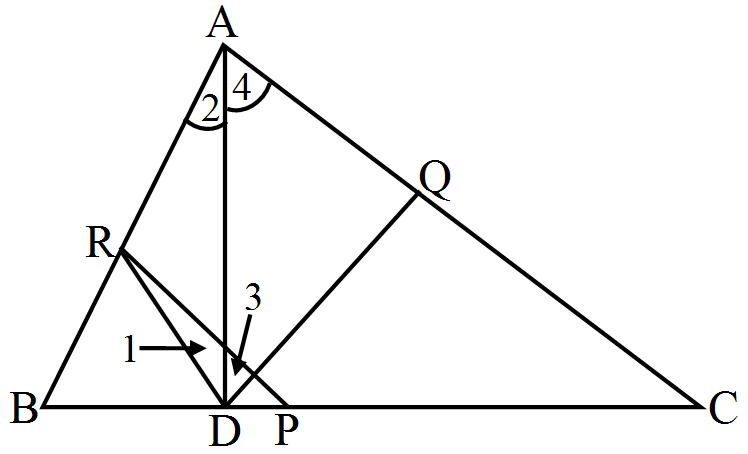
If P, Q and R are the mid-points of the sides BC, CA and AB of a triangle and AD is the perpendicular from A on BC, prove that P, Q, R and D are concyclic.
Answer
We have to prove that R, D, P and Q are concyclic.

Join RD, QD, PR and PQ.
$\because$ RP joints R and P, the mid-point of AB and BC.
$\therefore$ RP || AC [Mid-point theorem]
Similarly, PQ || AB.
$\therefore$ ARPQ is a || gm
$\angle\text{RAQ}=\angle\text{RPQ}$ [opposite angle of a || gm] .... (1)
$\because$ ABD is a rt. $\angle\text{D}\triangle$ and DR is a median,
$\therefore$ RA = DR and $\angle1=\angle2\ ....(2)$
Similarly $\angle3=\angle4\ ....(3)$
Adding (2) and (3), we get
$\angle1+\angle3=\angle2+\angle4$
$\Rightarrow\angle\text{RDQ}=\angle\text{RAQ}$
$\angle\text{RPQ}$ [Proved above]
Hence, R, D, P and Q are concyclic.
[$\because\angle\text{D}$ and $\angle\text{P}$ are subtended by RQ on the same side of it.]
View full question & answer
Question 164 Marks
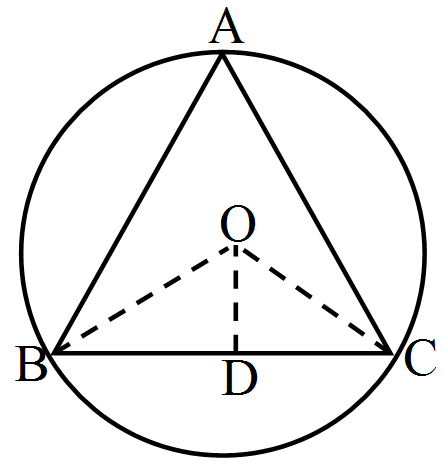
O is the circumcentre of the triangle ABC and D is the mid-point of the base BC. Prove that $\angle\text{BOD}=\angle\text{A}.$
Answer
Given: In a $\triangle\text{ABC}$ a circle is circumscribed having centre O.

Also, D is the mid-point of BC.
To prove: $\angle\text{BOD}=\angle\text{A}\ \ \text{or}\ \ \angle\text{BOD}=\angle\text{BAC}$
Construction: Join OB, OD and OC.
Proof: In $\triangle\text{BOD}$ and $\triangle\text{COD}$,
OB = OC [both are the radius of circle]
BD = DC [D is the mid-point of BC]
and OD = OD [common side]
$\therefore\triangle\text{BOD}\cong\triangle\text{COD}$ [by SSS congruence rule]
$\therefore\angle\text{BOD}=\angle\text{COD}$ [by CPCT] ....(i)
We know that, in a circle, the angle subtended by an arc at the centre is twice the angle subtended by it at the remaining part of the circle.
$\therefore2\angle\text{BAC}=\angle\text{BOC}$
$\Rightarrow\angle\text{BAC}=\frac{2}{2}\angle\text{BOD}$ $[\because\angle\text{BOC}=2\angle\text{BOD}]$ [from Eq. (i)]
$\Rightarrow\angle\text{BAC}=\angle\text{BOD}$
Hence proved.
View full question & answer
Question 174 Marks
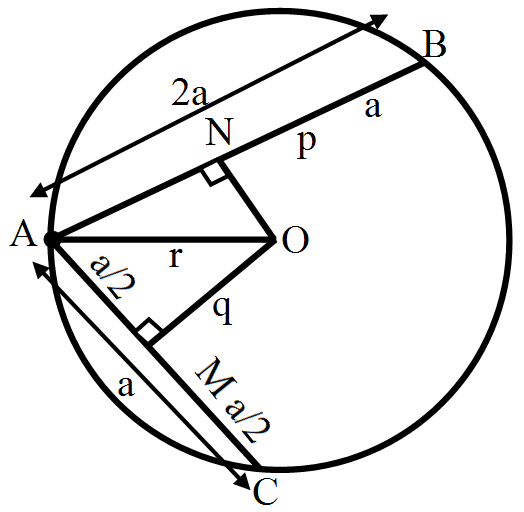
$AB$ and $AC$ are two chords of a circle of radius r such that $AB = 2AC$. If p and q are the distances of $AB$ and $AC$ from the centre, prove that $4q^2 = p^2 + 3r^2.$
Answer
Given: In a circlr of radius $r,$ there are two chords $AB$ and $AC$ such that $AB = 2AC,$ Also, the distance of $AB$ and $AC$ from the centre are $P$ and $q$, respectively.
To prove: $\text{4q}^2+\text{p}^2+3\text{r}^2,$
Proof: Let $AC = a,$ then $AB = 2a$

From centre $O,$ perpendicular is drawn to the chords $AC$ and $AB$ at $M$ and $N$, respectively.
$\therefore\text{AM}=\text{MC}=\frac{\text{a}}{2}$
$\text{AN}=\text{NB}=\text{a}$
In $\triangle\text{OAM},\ \ \text{AO}^2=\text{AM}^2+\text{MO}^2 [$by pythagoras theorem$]$
$\Rightarrow\text{AO}^2=\Big(\frac{\text{a}}{2}\Big)^2+\text{q}^2\ \ ...\text{(i)}$
In $\triangle\text{OAN},$ use pythagoras theorem,
$\text{AO}^2=(\text{AN})^2+(\text{NO})^2$
$\Rightarrow\text{AO}^2=(\text{a})^2+\text{p}^2\ \ \ ...(\text{ii})$
From Eqs. $(i)$ and $(ii),$
$\Big(\frac{\text{a}}{2}\Big)^2+\text{q}^2=\text{a}^2+\text{p}^2$
$\Rightarrow\frac{\text{a}^2}{4}+\text{q}^2=\text{a}^2+\text{p}^2$
$\Rightarrow\text{a}^2+4\text{q}^2=4\text{a}^2+4\text{p}^2 [$multiplying both sides by $4]$
$\Rightarrow4\text{q}^2=3\text{a}^2+4\text{p}^2$
$\Rightarrow4\text{q}^2=\text{p}^2+3(\text{a}^2+\text{p}^2)$
$\Rightarrow4\text{q}^2=\text{p}^2+3\text{r}^2$ $\big[$In right angled $\triangle\text{OAN},\ \text{r}^2=\text{a}^2+\text{p}^2\big]$
Hence proved.
View full question & answer
Question 184 Marks
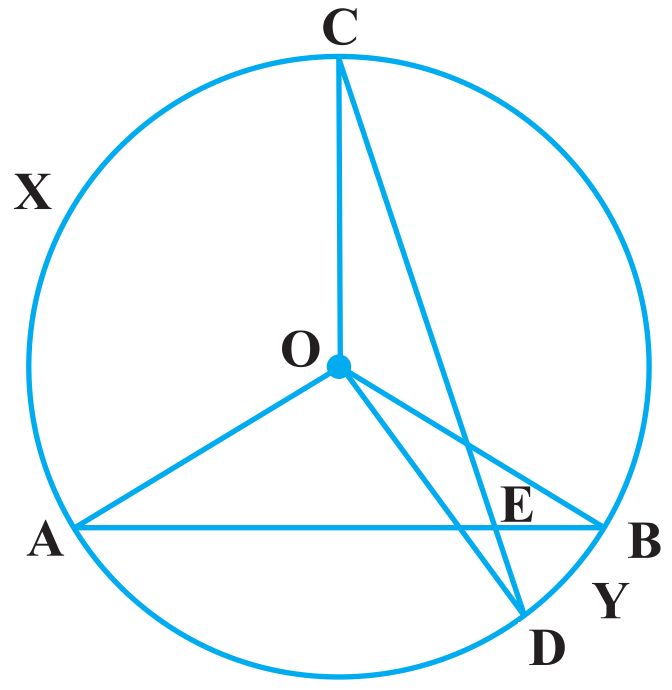
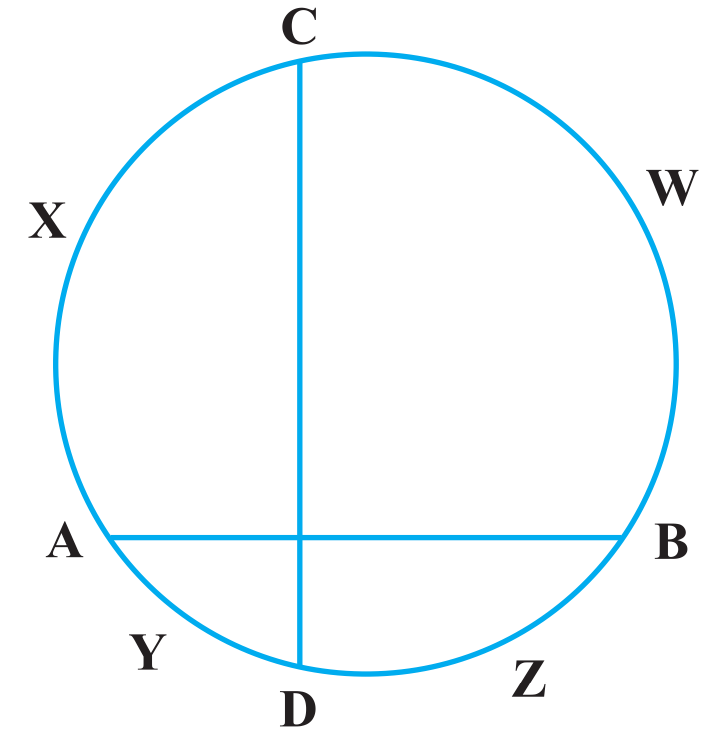
In Fig. AB and CD are two chords of a circle intersecting each other at point E. Prove that $\angle\text{AEC}=\frac{1}{2}$ (Angle subtended by arc CXA at centre + angle subtended by arc DYB at the centre).
Answer
Given: In a figure, two chords AB and CD intersecting each other at point E.
To prove: $\angle\text{AEC}=\frac{1}{2}$ [angle subtended by arc C × A at centre + angle subtended by arc DYB at the centre]

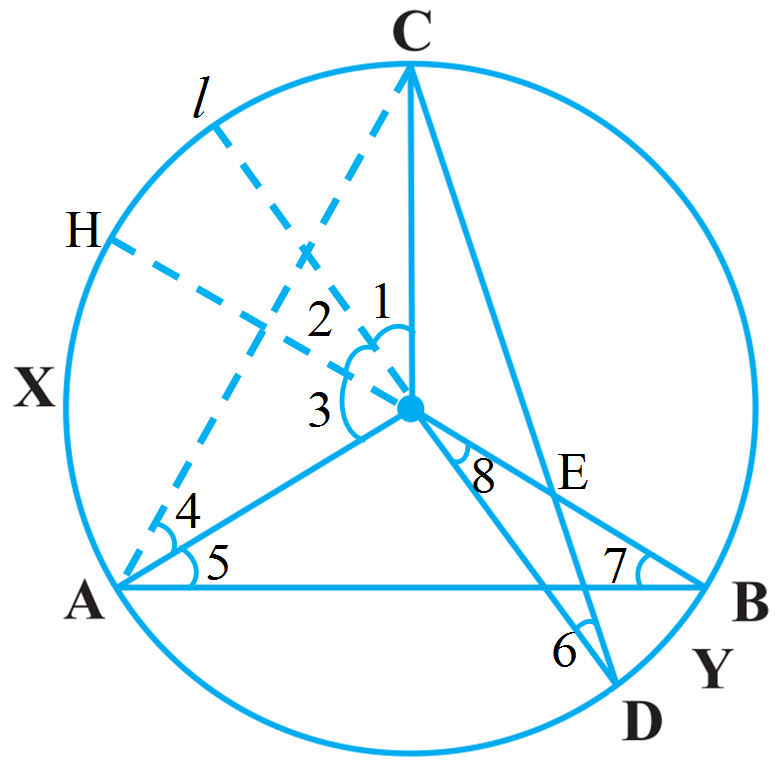
Construction: Extend the line DO and BO at the points l and H on the circle. Also, join AC.
Proof: We know that, in a circle, the angle subtended by an arc at the centre is twice the angle subtended by it at the remaining part of the circle.
$\therefore\angle1=2\angle6\ \ ...(\text{i})$
and $\angle3=2\angle7\ \ ...(\text{ii)}$
In $\triangle\text{AOC},\ \ \text{OC}=\text{OA}$ [both are the radius of circle]
$\angle\text{OCA}=\angle4$ [angles opposite to equal sides are equal]
Also, $\angle\text{AOC}+\angle\text{OCA}+\angle4=180^\circ$ [by angle sum property of triangle]
$\Rightarrow\angle\text{AOC}+\angle4+\angle4=180^\circ$
$\Rightarrow\angle\text{AOC}=180^\circ-2\angle4\ \ \ ...(\text{iii})$
Now, in $\triangle\text{AEC},\ \ \ \angle\text{AEC}+\angle\text{ECA}+\angle\text{CAE}=180^\circ$ [by angle property sum of a triangle]
$\Rightarrow\angle\text{AEC}=180^\circ-(\angle\text{ECA}+\angle\text{CAE})$
$\Rightarrow\angle\text{AEC}=180^\circ-[(\angle\text{ECO}+\angle\text{OCA})+\angle\text{CAO}+\angle\text{OAE}]$
$=180^\circ-(\angle6+\angle4+\angle4+\angle5)$ $\big[$In $\triangle\text{OCD},\angle6=\angle\text{ECO}$ angles opposite to equal sides are equal$\big]$
$=180^\circ-(2\angle4+\angle5+\angle6)$
$=180^\circ-(180^\circ-\angle\text{AOC}+\angle7+\angle6)$
[From Eq. (iii) and in $\triangle\text{AOB}.\angle5=\angle7,$ as (angles opposite to equal sides are equal)]
$=\angle\text{AOC}-\frac{\angle3}{2}-\frac{\angle1}{2}$ [from Eqs. (i) and (ii)]
$=\angle\text{AOC}-\frac{\angle1}{2}-\frac{\angle2}{2}-\frac{\angle3}{2}+\frac{\angle2}{2}$ [adding and subtracting $\frac{\angle2}{2}$]
$=\angle\text{AOC}-\frac{1}{2}(\angle1+\angle2+\angle3)+\frac{\angle8}{2}$ [$\because\angle2=\angle8$ (vertically opposite angles)]
$=\angle\text{AOC}=\frac{\angle\text{AOC}}{2}+\frac{\angle\text{DOB}}{2}$
$\Rightarrow\angle\text{AEC}=\frac{1}{2}(\angle\text{AOC}+\angle\text{DOB})$
$=\frac{1}{2}$ [angle subtended by arc CXA at the centre + angle subtended by arc DYB at the centre]
View full question & answer
Question 194 Marks
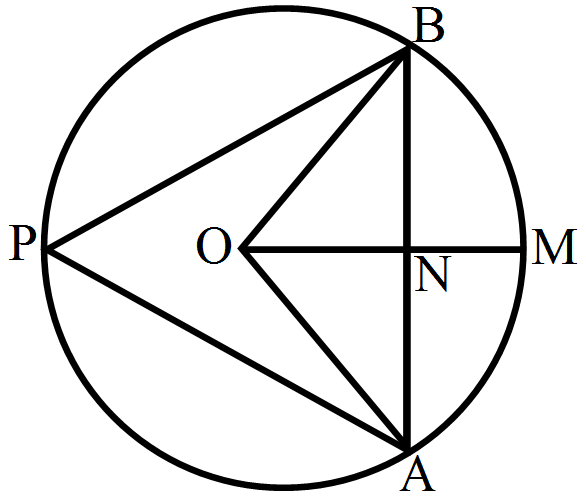
A circle has radius $\sqrt{2}\text{cm}.$ It is divided into two segments by a chord of length 2cm. Prove that the angle subtended by the chord at a point in major segment is 45°.
Answer
Draw a circle having centre O. Let AB = 2cm be a chord of a circle. A chord AB is divided by the line OM in two equal segments.

To prove, $\angle\text{APB}=45^\circ$
Here, AN = NB = 1cm
and $\text{OB}=\sqrt{2}\text{cm}$
In $\triangle\text{ONB},\ \ \text{OB}^2=\text{ON}^2+\text{NB}^2$ [use pythagoras theorem]
$\Rightarrow(\sqrt{2})^2=\text{NO}^2+(1)^2$
$\Rightarrow\text{ON}^2=2-1=1$
$\Rightarrow\text{ON}=1\text{cm}$ [taking positive square root, because distance is always positive]
Also, $\angle\text{ONB}=90^\circ$ [ON is the perpendicular bisector of the chord AB]
$\therefore\angle\text{NOB}=\angle\text{NBO}=45^\circ$
Similarly, $\angle\text{AON}=45^\circ$
Now, $\angle\text{AOB}=\angle\text{AON}+\angle\text{NOB}$
$=45^\circ+45^\circ=90^\circ$
We know that, chord subtends an angle to the circle is half the angle subtended by it to the centre.
$\therefore\angle\text{APB}=\frac{1}{2}\angle\text{AOB}$
$=\frac{90^\circ}{2}=45^\circ$
Hence, proved.
View full question & answer
Question 204 Marks
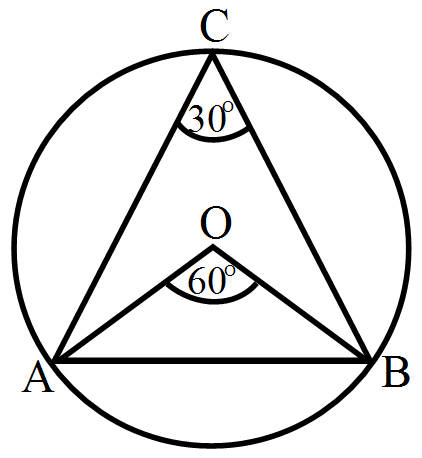
A chord of a circle is equal to its radius. Find the angle subtended by this chord at a point in major segment.
Answer
Since chord of a circle is equal radius, so we have AB = OA = OB.
Therefore, ABC is an equilateral triangle.

Since each angle of an equilateral triangle is 60°, so we have $\angle\text{AOB}=60^\circ$ Since angle subtended by an arc at the centre is double the angle subtended by it at any point on the remaining part of the circle, so we have
$\angle\text{AOB}=2\angle\text{ACB}$.
Hence, $\angle\text{ACB}=\frac{1}{2}\angle\text{AOB}=\frac{1}{2}\times60^\circ=30^\circ$
View full question & answer
Question 214 Marks
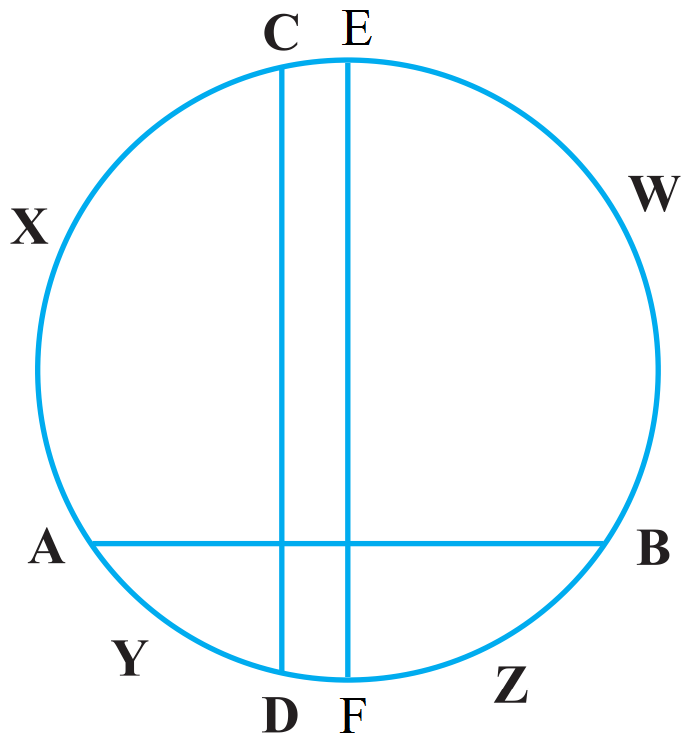
If two chords AB and CD of a circle AYDZBWCX intersect at right angles (see Fig.), prove that arc CXA + arc DZB = arc AYD + arc BWC = semi-circle.
Answer
Given: In a circle AYDZBWCX, two chords AB and CD intersect at right angles.
To prove: arc CXA + arc DZB = arc AYD + arc BWC = Semi-circle
Construction: Draw a diameter EF parallel to CD having centre M.
Proof: Since, CD || EF
arc EC = arc PD …(i)
arc ECXA = arc EWB [symmetrical about diameter of a circle] arc AF = arc BF …(ii)
We know that, arc ECXAYDF = semi-circle

arc EA + arc AF = semi-circle
⇒ arc EC + arc CXA + arc FB = semi-circle [from Eq. (ii)]
⇒ arc DF + arc CXA + arc FB = semi-circle [from Eq. (i)]
⇒ arc DF + arc FB + arc CXA = semi-circle
⇒ arc DZB + arc C × A = semi-circle
We know that, circle divides itself in two semi-circles, therefore the remaining portion of the circle is also equal to the semi-circle.
$\therefore$ arc AYD + arc BEC = semi-ciecle
Hence proved.
View full question & answer
Question 224 Marks
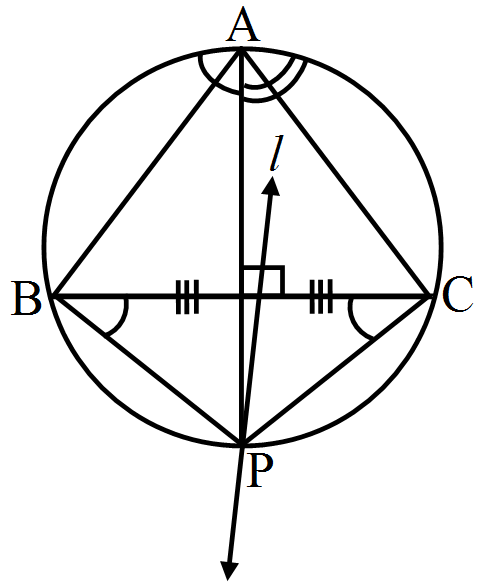
Prove that angle bisector of any angle of a triangle and perpendicular bisector of the opposite side if intersect, they will intersect on the circumcircle of the triangle.
Answer
Given: $\triangle\text{ABC}$ and l is perpendicular bisector of BC.

To prove: Angles bisector of $\angle\text{A}$ and perpendicular bisector of BC intersect on the circumcircle of $\triangle\text{ABC}.$
Proof: Let the angle bisector of $\angle\text{A}$ intersect circumcircle of $\triangle\text{ABC}$ at P. Join BP and CP.
$\Rightarrow\angle\text{BAP}=\angle\text{BCP}$ [Angles in the same segment are equal]
$\Rightarrow\angle\text{BAP}=\angle\text{BCP}=\frac{1}{2}\angle\text{A}\ ...(1)$ [AP is bisector of $\angle\text{A}$]
Similary, we have
$\angle\text{PAC}=\angle\text{PBC}=\frac{1}{2}\angle\text{A}\ \ ...(2)$
From equation (1) and (2), we have
$\angle\text{BCP}=\angle\text{PBC}$
$\Rightarrow\text{BP}=\text{CP}$
[$\because$ If the angles subtended by two chords of a circle at the centre are equal, the chords are equal]
⇒ P is on perpendicular bisector of BC.
Hence, angle bisector of $\angle\text{A}$ and perpendicular bisector of BC intersect on the circumcircle of $\triangle\text{ABC}.$
View full question & answer
Question 234 Marks
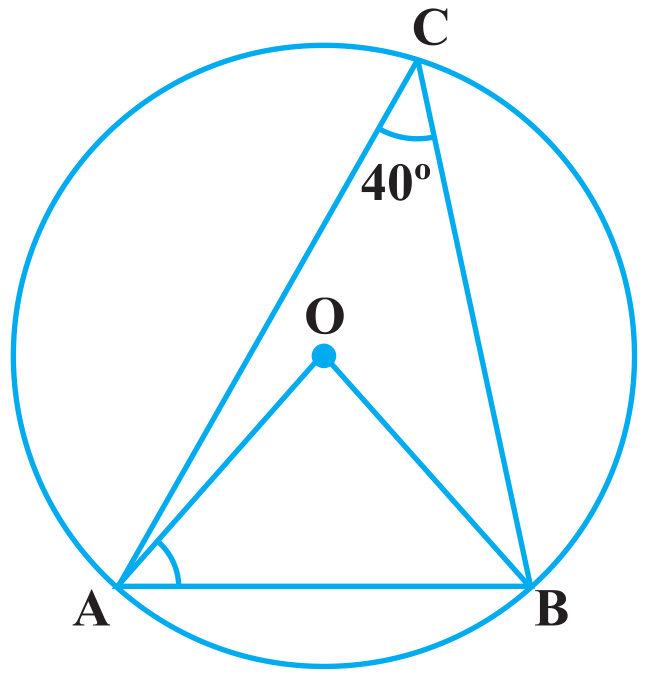
In Fig. $\angle\text{ACB}=40^\circ$. Find $\angle\text{OAB}.$
Answer
Given, $\angle\text{ACB}=40^\circ$
We know that, a segment subtends an angle to the circle is half the angle subtends to the centre.
$\therefore\angle\text{AOB}=2\angle\text{ACB}$
$\Rightarrow\angle\text{ACB}=\frac{\angle\text{AOB}}{2}$
$\Rightarrow40^\circ=\frac{1}{2}\angle\text{AOB}$
$\Rightarrow\angle\text{AOB}=80^\circ\ \ \ ...(\text{i})$
In $\triangle\text{AOB},\ \text{AO}=\text{BO}$ [both are the radius of a circle]
$\Rightarrow\angle\text{OBA}=\angle\text{OAB}\ \ ...(\text{ii})$ [angle opposite to the equal sides are equal]
We know that, the sum of all three angles in a triangle AOB is 180°.
$\therefore\angle\text{AOB}+\angle\text{OBA}+\angle\text{OAB}=180^\circ$
$\Rightarrow80^\circ+\angle\text{OAB}+\angle\text{OAB}=180^\circ$ [from Eqs. (i) and (ii)]
$\Rightarrow2\angle\text{OAB}=180^\circ-80^\circ$
$\Rightarrow2\angle\text{OAB}=100^\circ$
$\therefore\angle\text{OAB}=\frac{100^\circ}{2}=50^\circ$
View full question & answer
Question 244 Marks
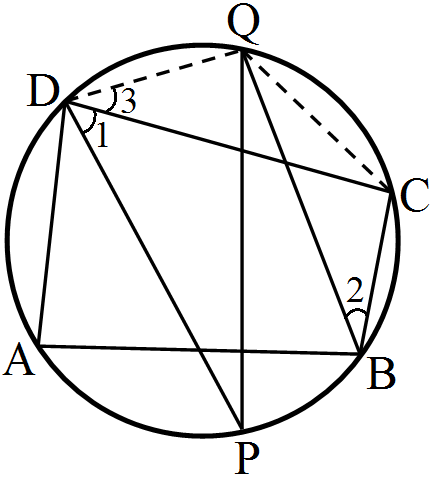
If bisectors of opposite angles of a cyclic quadrilateral ABCD intersect the circle, circumscribing it at the points P and Q, prove that PQ is a diameter of the circle.
Answer
Given: ABCD is a cyclic quadrilateral.
DP and QB are the bisectors of $\angle\text{D}$ and $\angle\text{B},$ respectively.
To prove: PQ is the diameter of a circle.
Construction: Join QD and QC.

Proof: Since, ABCD is a cyclic quadrilateral.
$\therefore\angle\text{CDA}+\angle\text{CBA}=180^\circ$ [sum of opposite angles of cylic quadrilateral is 180°]
On dividing both sides by 2, we get,
$\frac{1}{2}\angle\text{CDA}+\frac{1}{2}\angle\text{CBA}=\frac{1}{2}\times180^\circ=90^\circ$
$\Rightarrow\angle1+\angle2=90^\circ\ ...(\text{i})$ $\big[\angle1=\frac{1}{2}\angle\text{CDA and}\ \angle2=\frac{1}{2}\angle\text{CBA}\big]$
But, $\angle2=\angle3$ [angles in the same segment QC are equal] ...(ii)
$\angle1+\angle3=90^\circ$
From Eqe. (i) and (ii), $\angle\text{PDQ}=90^\circ$
Hence, PQ is a diameter of a circle, because diameter of the circle.
Subtends a right angle at the circumference.
View full question & answer
Question 254 Marks
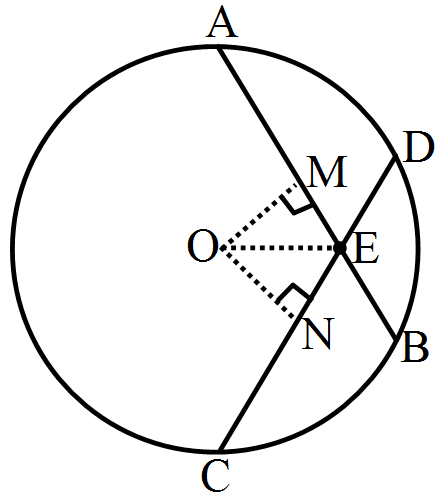
If two equal chords of a circle intersect, prove that the parts of one chord are separately equal to the parts of the other chord.
Answer
Given: Consider AB and CD are two equal chords of a circle, which meet at point E.
To prove: AE = CE and BE = DE
Construction: Draw $\text{OM}\bot\text{AB}$ and $\text{ON}\bot\text{CD}$ and join OE where O is the centre of circle.

Proof: In $\triangle\text{OME}$ and $\triangle\text{ONE}.$
OM = ON [equal chords are equidistant from the centre]
OE = OE [common side]
and $\angle\text{OME}=\angle\text{ONE}$ [each 90°]
$\therefore\triangle\text{OME}\cong\triangle\text{ONE}$ [by RHS congurence rule]
$\Rightarrow\text{EM}=\text{EN}$ [by CPCT] ...(i)
Now, $\text{AB} = \text{CD}$
On dividing both sides by 2, we get,
$\frac{\text{AB}}{2}=\frac{\text{CD}}{2}\Rightarrow\text{AM}=\text{CN}\ \ ...(\text{ii})$
[Since, perpendicular drawn from centre of circle to chord to chord bisects the chord i.e., AM = MB and CN = ND]
On adding Eqs. (i) and (ii), we get
$\text{EM} + \text{AM} = \text{EN} + \text{CN}$
$\Rightarrow\text{AE}=\text{CE}\ \ \ ...(\text{iii})$
Now, $\text{AB} = \text{CD}$
On subtracting both sides by AE, we get
$\text{AB} - \text{AE} = \text{CD} - \text{AE}$
$\Rightarrow\text{BE}=\text{CD}-\text{CE}$ [from Eq. (iii)]
$\Rightarrow\text{BE}=\text{DE}$
Hence, proved.
View full question & answer
Question 264 Marks
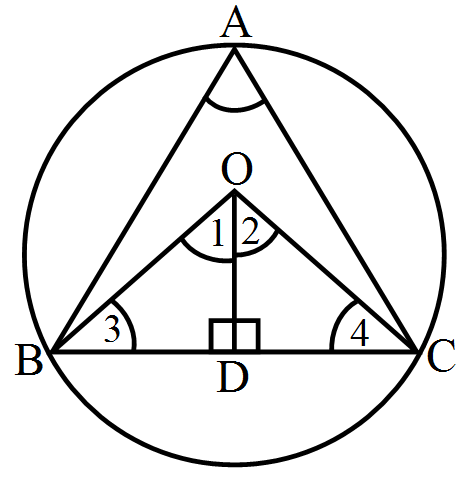
The circumcentre of the triangle ABC is O. Prove that $\angle\text{OBC} + \angle\text{BAC} = 90^\circ.$
Answer
ABC is a triangle and O is the circumcentre.

Draw $\text{OD}\bot\text{BC}.$ Join OB and OC.
In right $\triangle\text{OBD}$ and right $\triangle\text{OCD}$, we have
hyp. OB = hyp. OC [Raddi of the same circle]
OD = OD [Common side]
$\therefore\triangle\text{OBD}\cong\triangle\text{OCD}$ [By RHS cong. Rule]
$\therefore\angle1=\angle2$ and $\angle1=\angle4$ [By C.P.C.T.]
Now, $\angle\text{BOC}=2\angle1$ and $\angle\text{BOC}=2\angle\text{A}$
$\therefore2\angle1=2\angle\text{A}\Rightarrow\angle1=\angle\text{A}$
$\therefore\angle\text{A}=\angle2\ ....(1)\ \ \ [\because\angle1=\angle2]$
$\Rightarrow\angle\text{A}+\angle4=\angle2+\angle4$ [Adding $\angle4$ to both sides]
$\Rightarrow\angle\text{A}+\angle3=90^\circ\ \ [\because\angle2+\angle4=90^\circ\ \text{and}\ \angle4=\angle3]$
$\Rightarrow\angle\text{BOC}=\angle\text{A}=90^\circ$
Hence, proved.
View full question & answer
Question 274 Marks
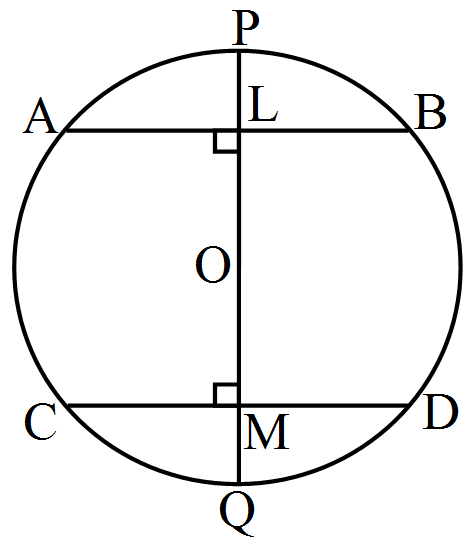
If a line segment joining mid-points of two chords of a circle passes through the centre of the circle, prove that the two chords are parallel.
Answer
Given: AB and CD are two chords of a circle whose centre of O. The mid-points of AB and CD are L and M respectively.

To prove: AB || CD
Proof: $\because$ L is the mid-point of chord AB $\therefore\text{OL}\bot\text{AB},\ \text{or}\ \angle\text{ALO}=90^\circ$
[$\because$ The line joining the centre of a circle to the mid-point of a chord is perpendicular to the chord]
Similarly, $\angle\text{CMO}=90^\circ$
$\therefore\angle\text{ALO}=\angle\text{CMO}$
But, these are corresponding angles.
So, AB || CD.
Hence, proved.
View full question & answer
Question 284 Marks
Two circles with centres O and O′ intersect at two points A and B. A line PQ is drawn parallel to OO′ through A(or B) intersecting the circles at P and Q. Prove that PQ = 2OO′.
Answer
Two ciecles with centre O and O' intersect at two points A and B. A line PQ is drawn parallel to OO' through A (or B) intersecting the circles at P and Q.
Draw $\text{OC}\bot\text{PA}$ and $\text{O'D}\bot\text{AQ}.$
We have to prove that PQ = 2OO'.
Since perpendicular from the centre to a chord bisect the chord, so
PA = 2CA ....(1)
and AQ = 2AD ...(2)
Adding (1) and (2), we get
PA + AQ = 2CA + 2AD
⇒ PQ = 2(CA + AD) = 2CD
Hence, PQ = 2OO' [$\because$ CD and OO' are opposite sides of a rectangle]
View full question & answer
4 Marks Questions - MATHS STD 9 Questions - Vidyadip