Question types

Coordinate Geometry question types

271 questions across 8 question groups — pick any mix to generate a MATHS paper with step-by-step answer keys.

271
Questions
8
Question groups
5
Question types
Sample Questions

Coordinate Geometry questions

One sample from each question group in this chapter. Select any group above to see the full set with answer keys.
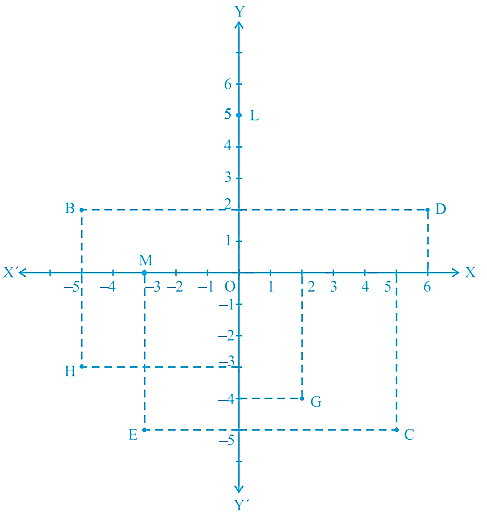
Q 1M.C.Q1 Mark
Write the correct answer in the following:
The point at which the two coordinate axes meet is called the:
View full solution
Q 3M.C.Q1 Mark
The point which lies on the y-axis at a distance of 5 units in the negative direction of the y-axis is:
View full solution
Directions: In the following questions, the Assertions (A) and Reason(s) (R) have been put forward. Read both the statements carefully and choose the correct alternative from the following:
Assertion: The point (x, 0), x < 0 lies on ox’
Reason: (0, 14),$ \big(0,\frac{-28}{3}\big)$ are the points on the y - axis whose distance from the line 3x + 4y = 1 is 8 unit.
  1. Both Assertion and Reason are correct and Reason is the correct explanation for Assertion.
  2. Both Assertion and Reason are correct and Reason is not the correct explanation for Assertion.
  3. Assertion is true but the reason is false.
  4. Both assertion and reason are false.
View full solution
Directions: In the following questions, the Assertions (A) and Reason(s) (R) have been put forward. Read both the statements carefully and choose the correct alternative from the following:
Assertion: -6 is the slope of the line perpendicular to the line passing through the points (-5, 1) and (-2, 0).
Reason: x + 3y = -18  is the equation of a line having slope $\frac{-1}{3}$ and y - intercept equal to 6.
  1. Both Assertion and Reason are correct and Reason is the correct explanation for Assertion.
  2. Both Assertion and Reason are correct and Reason is not the correct explanation for Assertion.
  3. Assertion is true but the reason is false.
  4. Both assertion and reason are false.
View full solution
Directions: In the following questions, the Assertions (A) and Reason(s) (R) have been put forward. Read both the statements carefully and choose the correct alternative from the following:
Assertion: The distance of the point $ (\alpha, \beta)$ from the origin is $\sqrt{(\alpha^2+\beta^2)}.$
Reason: The area of the triangle whose vertices are A (1, 2), B (-2, 3) and C (-3, -4) is 11.
  1. Both Assertion and Reason are correct and Reason is the correct explanation for Assertion.
  2. Both Assertion and Reason are correct and Reason is not the correct explanation for Assertion.
  3. Assertion is true but the reason is false.
  4. Both assertion and reason are false.
View full solution
Directions: In the following questions, the Assertions (A) and Reason(s) (R) have been put forward. Read both the statements carefully and choose the correct alternative from the following:
Assertion: The area of the triangle formed by the points A (-1.5, 3), B (6, -2) and C (-3, 4) is 0.
Reason: Area of $\triangle\text{ABC}=12$ [-1.5(-2 - 4) + 6(4 - 3) + (-3)(3 + 2)] = 12 [9 + 6 - 15] = 0. It is a straight line.
  1. Both Assertion and Reason are correct and Reason is the correct explanation for Assertion.
  2. Both Assertion and Reason are correct and Reason is not the correct explanation for Assertion.
  3. Assertion is true but the reason is false.
  4. Both assertion and reason are false.
View full solution
Directions: In the following questions, the Assertions (A) and Reason(s) (R) have been put forward. Read both the statements carefully and choose the correct alternative from the following:
Assertion: The points A(9, 0), B(9, 6), C(-9, 6) and D(-9, 0) are the vertices of a Rectangle.
Reason: AB = CD and BC = AD hence given points A, B, C and D are the vertices of a rectangle.
  1. Both Assertion and Reason are correct and Reason is the correct explanation for Assertion.
  2. Both Assertion and Reason are correct and Reason is not the correct explanation for Assertion.
  3. Assertion is true but the reason is false.
  4. Both assertion and reason are false.
View full solution
Write whether the following statements are True or False? Justify your answer.
A point lies on y-axis at a distance of 2 units from the x-axis. Its coordinates are (2, 0).
View full solution
Write whether the following statements are True or False? Justify your answer.
The coordinates of a point whose ordinate is $-\frac{1}{2}$ and and abscissa is 1 are $-\frac{1}{2},\ 1$
View full solution
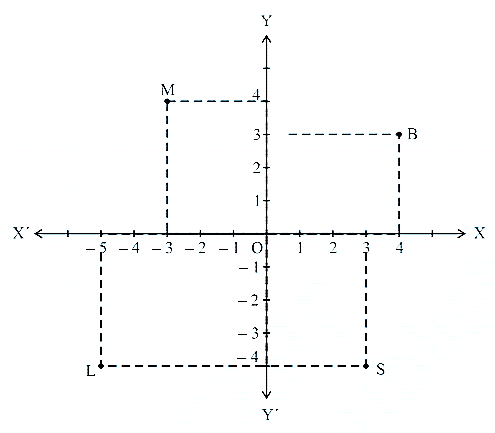
Plot the ordered pairs (x, y) of numbers as points in the Cartesian plane. Use the scale 1cm = 1 unit on the axes
x -3 0 -1 4 2
y 7 -3.5 -3 4 -3
View full solution
Q 283 Marks Question3 Marks
(Street Plan): A city has two main roads which cross each other at the centre of the city. These two roads are along the North-South direction and East-West direction. All the other streets of the city run parallel to these roads and are 200 m apart. There are 5 streets in each direction. Using 1cm = 200 m, draw a model of the city on your notebook. Represent the roads/streets by single lines. There are many cross- streets in your model. A particular cross-street is made by two streets, one running in the North-South direction and another in the East-West direction. Cross street is referred to in this manner: If the 2nd street running in the North-South direction and 5th in the East-West direction meet at some crossing, then we will call this cross-street (2, 5). Using this convention, find: how many cross - streets can be referred to as (3, 4).
View full solution
Q 293 Marks Question3 Marks
(Street Plan): A city has two main roads which cross each other at the centre of the city. These two roads are along the North-South direction and East-West direction. All the other streets of the city run parallel to these roads and are 200 m apart. There are 5 streets in each direction. Using 1cm = 200 m, draw a model of the city on your notebook. Represent the roads/streets by single lines. There are many cross- streets in your model. A particular cross-street is made by two streets, one running in the North-South direction and another in the East-West direction. Cross street is referred to in this manner: If the 2nd street running in the North-South direction and 5th in the East-West direction meet at some crossing, then we will call this cross-street (2, 5). Using this convention, find: how many cross - streets can be referred to as (4, 3).
View full solution
View full solution
View full solution
Read the Source/ Text given below and answer these questions:

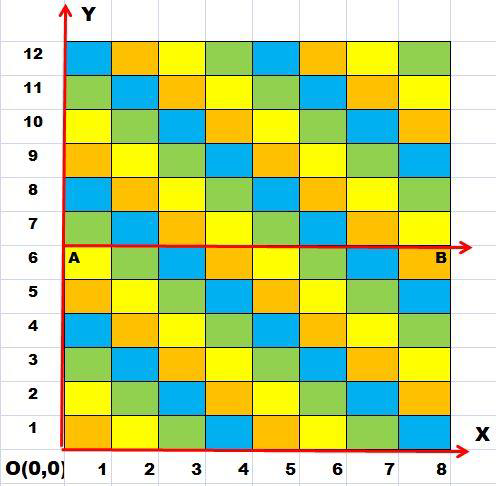
Roshan decorated one of his bathroom wall with tiles as shown in the picture. He was having tiles of four colours orange, yellow, green and blue. He fitted the tiles in $8$ columns and $12$ rows. The size of one tile was $1$foot $\times 1$ foot and the area of each tile is $1$ foot$^2$. He arranged the tile in such a way that colour of tiles in each row and column were in the pattern: Orange $\rightarrow$ Yellow $\rightarrow$ green $\rightarrow$ Blue $\rightarrow$ Orange $\rightarrow .....$ and so on. Now answer the following questions:
  1. Which colour tile was fitted at the point with coordinates $(5, 3)$?
  1. Orange.
  2. Yellow.
  3. Green.
  4. Blue.
  1. Which colour tile was fitted at the point with coordinates $(7, 7)$?
  1. Orange.
  2. Yellow.
  3. Green.
  4. Blue.
  1. Which colour tile was fitted at the point with coordinate $(2, 5)$?
  1. Orange.
  2. Yellow.
  3. Green.
  4. Blue.
  1. What is the area of the tiles fitted in the rectangular part $\text{OABX}$?
  1. $50$ foot$^2$
  2. $24$ foot$^2$
  3. $12$ foot$^2$
  4. $48$ foot$^2$
  1. What is the ordinate of top row tiles?
  1. $8$
  2. $12$
  3. $16$
  4. $6$
View full solution
View full solution
View full solution

Generate a Coordinate Geometry paper free

Pick question groups from the list above, set marks and difficulty, and export a branded PDF with step-by-step answer keys. First 3 chapters free — no signup.
Download App