Questions

M.C.Q

🎯

Test yourself on this topic

24 questions · timed · auto-graded

Question 11 Mark
Write the correct answer in the following:
Point (-3, 5) lies in the:
  1. First quadrant.
  2. Second quadrant.
  3. Third quadrant.
  4. Fourth quadrant.
Answer
  1. Second quadrant.
Solution:
In the point (-3, 5) abscissa is negative and ordinate is positive. So, it lies in the second quadrant.
View full question & answer
Question 21 Mark
Write the correct answer in the following:
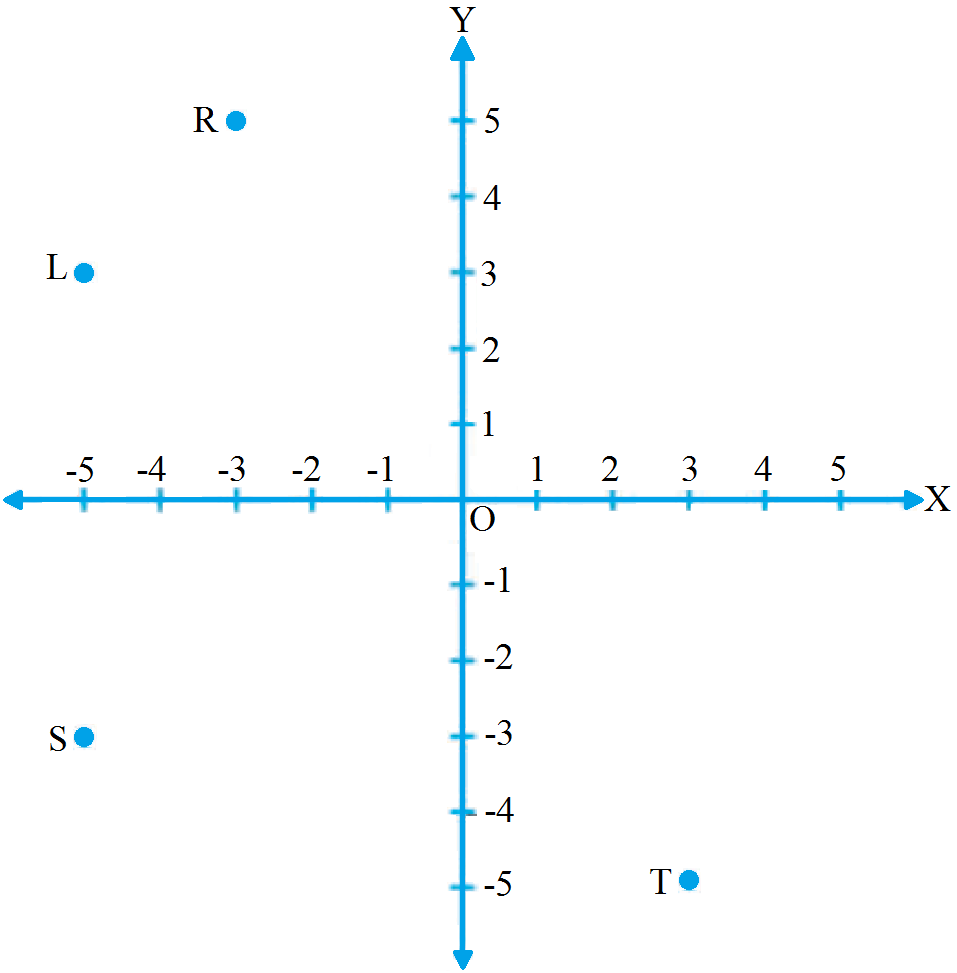
In the point identified by the coordinates (-5, 3) is:
  1. T
  2. R
  3. L
  4. S
Answer
  1. T
Solution:
Clearly, point T lies in the fourth quadrant. The distance of T from y-axis is 3 unit and from x-axis is -5 units. So, the points identified by the coordinate (-5, 3) is T.
View full question & answer
Question 31 Mark
Write the correct answer in the following:
Points (1, -1), (2, -2), (4, -5) and (-3, -4):
  1. lie in II quadrant.
  2. lie in III quadrant.
  3. lie in IV quadrant.
  4. Do not lie in the same quadrant.
Answer
  1. Do not lie in the same quadrant.
Solution:
In points (1, -1), (2, -2) and (4, -5) x-coordinate is positive and y-coordinate is negative, So, they all lie in IV quadrant. In point (-3, -4) x-coordinate is negative and y-coordinate is negative. So, it lies in III quadrant. So, given points do not lie in the same quadrant.
View full question & answer
Question 41 Mark
Write the correct answer in the following:
The point which lies on y-axis at a distance of 5 units in the negative direction of y-axis is:
  1. (0, 5)
  2. (5, 0)
  3. (0, -5)
  4. (-5, 0)
Answer
  1. (0, -5)
Solution:
Given the point lies on Y-axis this shows that this x-coordinate is zero. Also it is at a distance of 5 units in negative direction of Y-axis, so its y–coordinate is negative. Hence, the required point is (0, -5).
View full question & answer
Question 51 Mark
Write the correct answer in the following:
Point (-10, 0) lies:
  1. On the negative direction of the x-axis.
  2. On the negative direction of the y-axis.
  3. In the third quadrant.
  4. In the fourth quadrant.
Answer
  1. On the negative direction of the x-axis.
Solution:
In point (-10, 0) y-coordinate is zero, so it lies on X-axis and its x-coordinate is negative, so the point (-10, 0) lies on the X-axis in the negative direction.
View full question & answer
Question 61 Mark
Write the correct answer in the following:
A point both of whose coordinates are negative will lie in:
  1. I quadrant.
  2. II quadrant.
  3. III quadrant.
  4. IV quadrant.
Answer
  1. III quadrant.
Solution:
A point both of whose coordinates are negative will lie in III quadrant because, in III quadrant x-coordinate and y-coordinate both are negative.
View full question & answer
Question 71 Mark
Write the correct answer in the following:
If P(-1, 1), Q(3, -4), R(1, -1), S(-2, -3) and T(-4, 4) are plotted on the graph paper, then the point(s) in the fourth quadrant are:
  1. P and T
  2. Q and R
  3. Only S
  4. P and R
Answer
  1. Q and R
Solution:
We know that quadrant IV consists of the all points (x, y) for which x is positive and y negative. So, the points in the fourth quadrants are Q(3, -4) and R(1, -1).
View full question & answer
Question 81 Mark
Write the correct answer in the following:
Abscissa of a point is positive in:
  1. I and II quadrants.
  2. I and IV quadrants.
  3. I quadrant only.
  4. II quadrant only.
Answer
  1. I and IV quadrants.
Solution:
Abscissa of a point is positive in I and IV quadrants.
View full question & answer
Question 91 Mark
Write the correct answer in the following:
Signs of the abscissa and ordinate of a point in the second quadrant are respectively:
  1. +, +
  2. -, -
  3. -, +
  4. +, -
Answer
  1. -, +
Solution:
Signs of the abscissa and ordinate of a point in the second in the second quadrant a-, +
View full question & answer
Question 101 Mark
Write the correct answer in the following:
Which of the points P(0, 3), Q(1, 0), R(0, -1), S(-5, 0), T(1, 2) do not lie on the x-axis?
  1. P and R only.
  2. Q and S only.
  3. P, R and T.
  4. Q, S and T.
Answer
  1. P, R and T.
Solution:
We know that, if a point is of the form (x, 0) i.e., its y-coordinate is zero, then it will lie on X-axis otherwise not. Here, y-coordinates of points P(0, 3), R(0, -1) and T(1, 2) are not zero, so these points do not lie on the X-axis.
View full question & answer
Question 111 Mark
Write the correct answer in the following:
Ordinate of all points on the x-axis is:
  1. 0
  2. 1
  3. -1
  4. Any number.
Answer
  1. 0
Solution:
Ordinate of all the points on the x-axis is 0.Because ordinate (or y-coordinate) of a point is perpendicular distance of this point from the x-axis measured along the y–axis.
View full question & answer
Question 121 Mark
Write the correct answer in the following:
If P(5, 1), Q(8, 0), R(0, 4), S(0, 5) and O(0, 0) are plotted on the graph paper, then the point(s) on the x-axis are:
  1. P and R
  2. R and S
  3. Only Q
  4. Q and O
Answer
  1. Q and O
Solution:
We now that, a point lies on X-axis, if its y-coordinate is zero.
So, the points on the axis are Q(8, 0) and O(0, 0).
View full question & answer
Question 131 Mark
Write the correct answer in the following:
Point (0, -7) lies:
  1. On the x-axis.
  2. In the second quadrant.
  3. On the y-axis.
  4. In the fourth quadrant.
Answer
  1. In the fourth quadrant.
Solution:
In Point (0, -7) co-ordinate of x axis is zero so it lies on y axis.
View full question & answer
Question 141 Mark
Write the correct answer in the following:
The points (-5, 2) and (2, -5) lie in the:
  1. Same quadrant.
  2. II and III quadrants, respectively.
  3. II and IV quadrants, respectively.
  4. IV and II quadrants, respectively.
Answer
  1. II and IV quadrants, respectively.
Solution:
In point (-5, 2), x-coordinate is negative and y-coordinate is positive, so it lies in II quadrant and in point (2, -5), x- coordinate is positive and y-coordinate is negative, so it lies in IV quadrant.
View full question & answer
Question 151 Mark
Write the correct answer in the following:
If the perpendicular distance of a point P from the x-axis is 5 units and the foot of the perpendicular lies on the negative direction of x-axis, then the point P has:
  1. x coordinate = -5
  2. y coordinate = 5 only
  3. y coordinate = –5 only
  4. y coordinate = 5 or -5
Answer
  1. y coordinate = 5 or -5
Solution:
We do know that perpendicular distance of a point from the X-axis Y-coordinate of that point. Here foot of perpendicular lies on the negative direction of X-axis, so perpendicular distance can be measure in II quadrant or III quadrant. Hence, the point P has y coordinate = 5 or -5
View full question & answer
Question 161 Mark
Write the correct answer in the following:
Abscissa of all the points on the x-axis is:
  1. 0
  2. 1
  3. 2
  4. Any number.
Answer
  1. Any number.
Solution:
Abscissa of all the points on the X-axis is any number because X-axis is a number line which contains many real numbers on it.
View full question & answer
Question 171 Mark
Write the correct answer in the following:
The perpendicular distance of the point P(3, 4) from the y-axis is:
  1. 3
  2. 4
  3. 5
  4. 7
Answer
  1. 3
Solution:
The perpendicular distance of the point P(3, 4) from the y-axis is abscissa (x-coordinate) of the point (3, 4), which is 3.
View full question & answer
MCQ 181 Mark
Write the correct answer in the following:
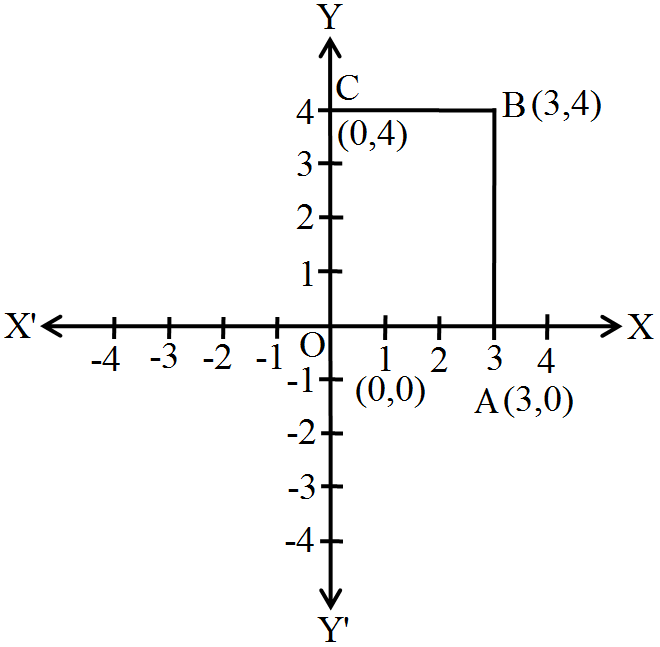
On plotting the points $O(0, 0), A(3, 0), B(3, 4), C(0, 4)$ and joining $\text{OA, AB, BC}$ and $CO$ which of the following figure is obtained?
  • A
    Square.
  • Rectangle.
  • C
    Trapezium.
  • D
    Rhombus.
Answer
Correct option: B.
Rectangle.
Here, point $O(0, 0)$ is the origin. $A(3, 0)$ lies on positive direction of $X-$axis, $B(3, 4)$ lies in $1^{st}$ quadrant and $C(0, 4)$ lines on positive direction of $Y-$axis. On joining $\text{OA AB, BC}$ and $CO$ the figure obtained is a rectangle.
View full question & answer
Question 191 Mark
Write the correct answer in the following:
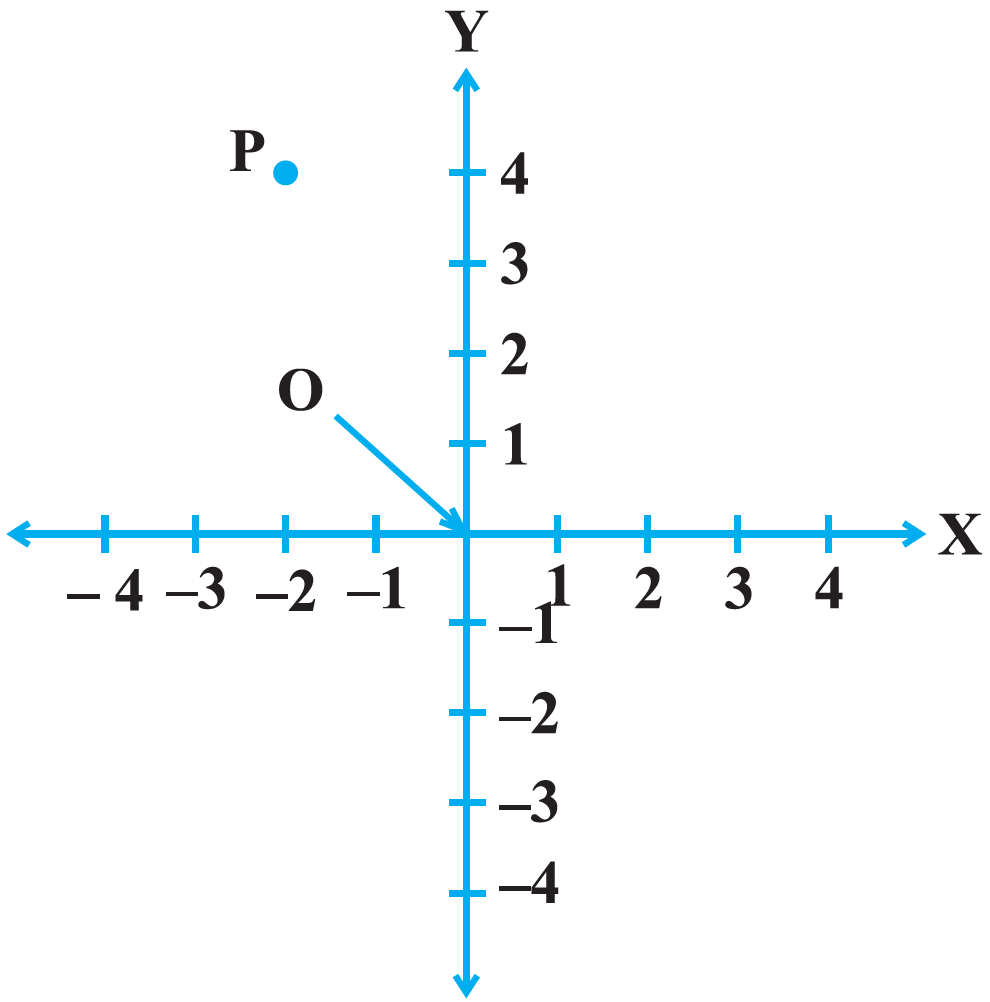
In coordinates of P are:
  1. (-4, 2)
  2. (-2, 4)
  3. (4, -2)
  4. (2, -4)
Answer
  1. (-2, 4)
Solution:
Here, given point P lies in II quadrant, so its abscissa will be negative and ordinate will be positive. Also its perpendicular distance from X-axis is 4 y-coordinate of P is 4 and its perpendicular distance from Y-axis is 2. So, x–coordinate is -2. Hence, coordinate of P are (-2, 4).
View full question & answer
Question 201 Mark
Write the correct answer in the following:
If the coordinates of the two points are P(-2, 3) and Q(-3, 5), then (abscissa of P) – (abscissa of Q) is:
  1. -5
  2. 1
  3. -1
  4. -2
Answer
  1. 1
Solution:
We have, points P(-2, 3) and Q(-3, 5)
Here, abscissa of P i.e., x-coordinate of P is -2 and abscissa of Q i.e., x-coordinate of Q is -3.
So, (Abscissa of P) - (Abscissa of Q)
= -2 - (-3) = -2 + 3 = 1
View full question & answer
Question 211 Mark
Write the correct answer in the following:
The point whose ordinate is 4 and which lies on y-axis is:
  1. (4, 0)
  2. (0, 4)
  3. (1, 4)
  4. (4, 2)
Answer
  1. (0, 4)
Solution:
Given ordinate of the point is 4 arid the point lies on Y-axis, so its abscissa is zero. Hence, the required point is (0, 4).
View full question & answer
Question 221 Mark
Write the correct answer in the following:
The point at which the two coordinate axes meet is called the:
  1. Abscissa.
  2. Ordinate.
  3. Origin.
  4. Quadrant.
Answer
  1. Origin.
Solution:
The points at which the two coordinate axes meet is called the origin.
View full question & answer
Question 231 Mark
Write the correct answer in the following:
If y coordinate of a point is zero, then this point always lies:
  1. In I quadrant.
  2. In II quadrant
  3. On x-axis.
  4. On y-axis.
Answer
  1. On x-axis.
Solution:
We know that if y-coordinate of a point, i.e., ordinate is zero, then this point always lies on x-axis.
View full question & answer
Question 241 Mark
Write the correct answer in the following:
The points whose abscissa and ordinate have different signs will lie in:
  1. I and II quadrants.
  2. II and III quadrants.
  3. I and III quadrants.
  4. II and IV quadrants.
Answer
  1. II and IV quadrants.
Solution:
The points whose abscissa and ordinate have different sings will be of the from (-x, y) or (x, -y) and these points will lie in II and IV quadrants.
View full question & answer